
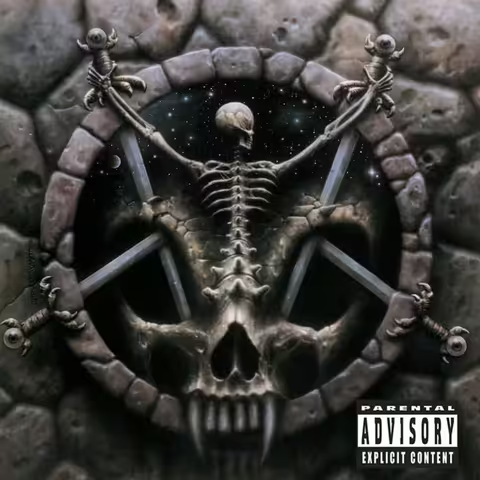
By the autumn of 1994 every loud band in California was being asked the same question, often by the same A and R executives: what are you going to do about Nirvana? Pearl Jam had spent the year on the cover of Time, Soundgarden had a Grammy on the shelf, and the major-label rosters were being quietly thinned of anyone who could not be explained to a teenager in a cardigan. Slayer's answer to the grunge question, delivered on 27 September 1994, was an album that made no concessions whatsoever. Divine Intervention ran for thirty-six minutes and thirty-three seconds, contained ten songs about serial killers, cult leaders, Nazi officers and the failures of the American courts, and debuted at number 8 on the Billboard 200, the highest US chart position the band had ever achieved.
It was also the album on which Slayer became a different band. Dave Lombardo, the founding drummer whose double-kick technique had defined every previous record, was gone. In his place sat Paul Bostaph, a twenty-nine-year-old from the Bay Area who had spent his apprenticeship in Forbidden. Behind the desk sat Toby Wright, a Rick Rubin protege fresh off engineering Alice in Chains. On the sleeve was a painting by an unknown San Diego illustrator named Wes Benscoter, and inside the booklet a photograph of a young fan calmly slicing the Slayer logo into his own forearms with a surgical scalpel. The record arrived with the look and the personnel of a band that had decided, almost defiantly, to keep being itself.
Album Facts
| Field | Detail |
|---|---|
| Artist | Slayer |
| Album | Divine Intervention |
| Release date | 27 September 1994 |
| Label | American Recordings |
| Producers | Slayer (production), Toby Wright (co-production, engineering, mixing), Rick Rubin (executive) |
| Studios | Ocean Way (Los Angeles), Sound City (Van Nuys), Record Plant (additional) |
| Genre | Thrash metal |
| Track count | 10 |
| Total runtime | 36:33 |
| Billboard 200 peak | 8 |
| UK Albums Chart peak | 15 (number 1 on the UK Rock and Metal Albums Chart) |
| Other notable peaks | Finland 4, Sweden 10, Switzerland 15, Germany 18, France 19, New Zealand 20, Austria 22, Japan 23, Canada 27, Australia 27, Scotland 28, Netherlands 31 |
| Certifications | RIAA Gold (US), Music Canada Gold |
| Estimated sales | Over 496,000 US copies by 2009; 93,000 first-week |
| Key singles and tracks | "Dittohead", "Divine Intervention", "Serenity in Murder", "Killing Fields" |
The State of Slayer in 1992
The Decade of Aggression tour that closed the year 1991 was, for Slayer, a sustained victory lap and a quiet crisis at the same time. Seasons in the Abyss had been the band's biggest record to date. The accompanying live double album, named for the tour itself, captured a group at the absolute height of its powers. And yet by the time the touring party flew home from Europe, Dave Lombardo had decided he could not keep doing it.
Lombardo's departure has been written about often enough since to have become its own small genre of metal magazine feature. The short version is that the drummer wanted to bring his pregnant wife on the road, the band and the management said no, and Lombardo concluded that the economics of being a Slayer member with a young family no longer worked. He played his last show with the band in 1992. Tom Araya, Jeff Hanneman and Kerry King were suddenly in the position of being one of the most influential drum-led bands in heavy music without a drummer.
The break could not have come at a stranger moment commercially. Nirvana's Nevermind had displaced Michael Jackson at the top of the Billboard 200 in January 1992. By the time Slayer began auditioning replacements, the whole alternative apparatus that had circled around metal in the late 1980s, MTV's Headbangers Ball, the Sunset Strip clubs, the European glossies, was being rebuilt around flannel shirts and detuned guitars. Several of the band's thrash peers were either splitting up, going on hiatus or making conspicuous attempts to soften the edges of their sound. Slayer, the band whose entire reputation rested on never doing that, were now also a band without a rhythm engine.
Finding Paul Bostaph
The shortlist of drummers capable of playing Slayer material at tempo is short by definition. King and Hanneman had been writing for triplets and blast figures since 1983, and the role required not just stamina but a particular kind of micro-timing on the double-kick. The man they eventually chose, Paul Bostaph, had served his apprenticeship in the Bay Area thrash band Forbidden, where he had played on the 1990 album Twisted into Form and built a reputation among fellow drummers as one of the most technically literate kit players on the scene.
Bostaph auditioned at the start of 1992 and was offered the job almost immediately. He spent the next two years playing live with Slayer, learning the back catalogue and slowly working his way into the writing room. By the time the band convened to begin pre-production for what would become Divine Intervention, Bostaph had been wearing the seat long enough to have opinions about how the songs should feel, and the band were happy to let him bring them. He is credited as a lyricist on the title track alongside Araya, Hanneman and King, an unusual collaborative credit that suggests how integrated he had become.
The Bostaph era would last, in two separate stretches, more than two decades. He left in 2001 with an elbow injury, returned in 2013 after the death of Hanneman, and remained behind the kit through to the band's final tour. Divine Intervention is where it begins.
Writing Divine Intervention
For the first time in their career, Slayer gave themselves a long runway. The band took most of 1993 off the road and used the space to write material at home rather than in the studio. In a 1995 interview with Scott Iwasaki of the Deseret News, Tom Araya described the approach as a deliberate change of habit.
"We decided to take more time to bring this one together. We actually went into the studio with more written material than the past. We completed three out of seven songs outside the studio. We all sort of felt it was important to do it slowly. After the last tour, we had the intention to take the break."
Tom Araya, Deseret News, 1995
The writing split that emerged on the record is recognisably Slayer. Kerry King supplied the bulk of the lyrics for the openly political material, including "Dittohead", "Fictional Reality", "Circle of Beliefs" and "Mind Control". Hanneman, the band's resident reader of military history, returned to the Second World War for "SS-3". Araya wrote the songs that drew on his long-standing fascination with serial killers, of which "213" became the most discussed and the most uncomfortable.
By the time the band walked into Ocean Way in March 1994, eleven songs were on the table. One would be dropped to leave the ten that make up the album. The exact identity of the cut song has never been confirmed in print, though the Araya quote about the label conversation, reproduced further down, suggests it was very much on the band's mind that there was always one more song in the bag than the album needed.
Inside Ocean Way and Sound City
The album was tracked in two of the most storied rooms in Los Angeles. Ocean Way, on Sunset Boulevard, was the room in which Pet Sounds had been cut three decades earlier and in which everyone from Sinatra to Michael Jackson had worked. Sound City, in Van Nuys, was the room where Fleetwood Mac had recorded Rumours, where Nevermind had been tracked in 1991, and where Tom Petty had made Damn the Torpedoes. The booking choices say something quietly important about how American Recordings positioned the band. Slayer were no longer being filed away in a metal-specialist facility. They were being recorded in the same rooms as the mainstream rock business they were now expected to compete with.
Sessions ran from March to June 1994. "Super" Dave Brock was the assistant engineer at Ocean Way; Jeff Sheehan handled the Sound City room; Brian Pollack picked up additional duties at the Record Plant, where a small amount of supplementary tracking was done. Jim Scott and Jim Champagne are credited as additional engineers across the project.
The label itself had quietly changed identity between Slayer records. Rick Rubin's imprint, originally Def American, had been renamed American Recordings in 1993, an event Rubin marked by hiring a Buddhist priest to perform a funeral for the word "Def". Divine Intervention was the first studio album Slayer made for the rebranded label.
Toby Wright and the Sound of the Record
The day-to-day producer in the room was Toby Wright, a Rubin associate who had spent the early 1990s engineering for Alice in Chains and would later produce MTV Unplugged in New York for Nirvana. Wright is credited on Divine Intervention as co-producer, engineer and mixer. The actual production credit on the sleeve reads simply "Slayer", with Rubin given an executive production line, which was effectively how Rubin worked with the band by this point: setting the budget, signing off on the masters, dropping in for the important decisions and otherwise leaving the band to it.
The resulting sound is denser, drier and a little more compressed than Seasons in the Abyss. The double-kick on Bostaph's pedals is closer to the front of the mix; King's tone is fatter; Hanneman's leads have a colder, more glassy edge. Whether that is a gain or a loss has been a matter of opinion in the band itself. Kerry King has on more than one occasion said that the band should have paid more attention to the mix. Araya has gone further, suggesting that if any Slayer album deserves a remaster it is this one. The album sits in the catalogue as a record fans love and the band themselves have always been slightly suspicious of.
The Songs
Ten tracks, thirty-six minutes, no obvious commercial concession. The tracklist below preserves the punctuation as it appears on the sleeve, including the unusual full stops in track two.
| # | Title | Writers (lyrics / music) | Length | Notes |
|---|---|---|---|---|
| 1 | "Killing Fields" | Araya / King | 3:57 | Opening track and a fixture of the live set for the next decade |
| 2 | "Sex. Murder. Art." | Araya / King | 1:50 | Shortest song on the album; punctuation preserved from the sleeve |
| 3 | "Fictional Reality" | King / King | 3:38 | King solo writing credit |
| 4 | "Dittohead" | King / King | 2:31 | Only single with a commissioned music video |
| 5 | "Divine Intervention" | Araya, Bostaph, Hanneman, King / Hanneman, King | 5:33 | Title track; only song with a Bostaph lyric credit |
| 6 | "Circle of Beliefs" | King / King | 4:30 | Singled out by AllMusic |
| 7 | "SS-3" | Hanneman / Hanneman, King | 4:07 | Reinhard Heydrich; cited in the 1998 German ban |
| 8 | "Serenity in Murder" | Araya / Hanneman, King | 2:36 | Title track of the 1995 follow-up EP |
| 9 | "213" | Araya / Hanneman | 4:52 | Jeffrey Dahmer; Araya described it as a "love song" |
| 10 | "Mind Control" | Araya, King / Hanneman, King | 3:04 | Closes the record |
"Killing Fields" sets out the manifesto: a hammered open-string riff, Bostaph's first audible double-kick gallop on a Slayer studio recording, and a lyric that takes the genocide imagery the band had been deploying since Reign in Blood and routes it through the post-Cold-War language of the 1990s. "Sex. Murder. Art." is the album's hardcore moment, a hundred and ten seconds of compressed aggression that owes as much to the Bad Brains as it does to the band's own back catalogue. AllMusic's Alex Henderson, in his contemporary review, picked out the opener alongside "Serenity in Murder" and "Circle of Beliefs" as evidence of the record's seriousness of intent.
"Slayer wisely refused to sound like anyone but Slayer. Tom Araya and co. responded to the new environment simply by striving to be the heaviest metal band they possibly could."
Alex Henderson, AllMusic
The slower mid-album tracks are where the new line-up announces itself most clearly. Bostaph plays with a different sense of room from Lombardo, slightly looser on the cymbals and slightly tighter on the kick pattern, and the writing accommodates him. "Fictional Reality" lays out long mid-tempo riff blocks; "Circle of Beliefs" pushes a doomy half-time refrain. The band sound, by their own demanding standards, deliberate.
Dittohead and the American Courtroom
"Dittohead" is the song Slayer chose to back with a commissioned music video and the song that drew the most cultural fire on release. King's lyric is an attack on the American legal system for what he saw as the licence it gave to violent offenders. The title is a borrowing from the listener base of the conservative radio host Rush Limbaugh, whose fans called themselves Dittoheads, and the song carries a generally Limbaugh-adjacent contempt for what King calls bleeding-heart sentencing.
Neil Strauss, reviewing the album for the New York Times on 20 February 1995, noted that the lyric tries to denounce the leniency of the courts but ends up, paradoxically, advocating the very permissiveness it claims to attack. It is a fair reading of a song whose narrator spends most of three minutes describing the freedoms a serial killer would enjoy under the existing system. The contradiction did not appear to bother the band, but the resulting song became the album's most lyrically contested moment.
The video itself is one of the more sparing pieces of metal promo from the period. It cuts between the band performing on a black stage and inserts of crime footage and courtroom imagery. MTV's Headbangers Ball had been cancelled earlier in 1995 and the network had little appetite for the clip, but it ran on the European Beavis and Butt-Head equivalents and earned the band a small amount of crossover exposure that would otherwise have gone past them entirely.
"213" and the Jeffrey Dahmer Question
If "Dittohead" was the album's loudest political moment, "213" was its most uncomfortable lyric. Tom Araya had been reading about Jeffrey Dahmer since the 1991 arrest, and his fascination with the case found its way onto the record as a song written, unsettlingly, from inside Dahmer's apartment. The title is the number of the flat Dahmer had occupied at the Oxford Apartments on North 25th Street in Milwaukee, where most of the killings took place. Araya wrote the lyric; Hanneman, alone among the three songwriters on the album, wrote the music.
Speaking to Neil Strauss for the New York Times profile that ran a few months after release, Araya described the song in terms that have followed him around ever since.
"For this one, I just kind of got inspired by watching TV. That gave me a whole lot of ideas. The whole idea about the dude with Slayer in his arms was brought about because reality is scarier than anything you can make up."
Tom Araya, New York Times, 1995
Araya elsewhere called "213" a love song, a description that has been quoted and re-quoted with varying levels of irony. What the song actually is, musically, is one of the longest pieces on the album at four minutes and fifty-two seconds, structured around a slow ascending Hanneman riff that gives Bostaph the space to play the most jazz-inflected fills of his Slayer career. The lyric is harder to defend on close inspection, but the music is among the album's most patient and atmospheric.
"SS-3" and the German Ban
Hanneman's contribution to the album's controversies arrived in track seven. "SS-3" takes its title from the radio call sign of Reinhard Heydrich, the senior SS official responsible for the operational planning of the Holocaust, who was assassinated by Czechoslovak operatives in Prague on 27 May 1942 and died of his injuries on 4 June. Hanneman, a long-time student of Second World War history whose interest had already produced "Angel of Death" and "Behind the Crooked Cross", treated the subject as another chapter in a continuing examination of the period rather than as a one-off provocation.
The German authorities did not see it that way. In 1998, four years after release, Divine Intervention was added to the list of media restricted from public display and youth sale in Germany under the Bundespruefstelle fuer jugendgefaehrdende Medien framework. The decision did not amount to a complete ban, but it removed the album from the shelves of high-street record shops and made it effectively impossible to advertise. The presence of "SS-3" was cited explicitly in the listing.
Hanneman, who never granted interviews about his SS-related material at length, maintained throughout his career that historical interest was not endorsement. The same argument had been deployed for "Angel of Death" eight years earlier, with similarly mixed results in court.
The Title Track
The title track sits at the centre of the album in both running order and intent. At five minutes and thirty-three seconds it is the longest song on the record, and it is the only one to carry a Paul Bostaph writing credit, putting him in the lyric column alongside Araya, Hanneman and King. The music is by Hanneman and King.
The arrangement moves through three distinct passages. It opens on a sparse Hanneman riff over Bostaph's ride bell, builds into a mid-tempo verse with Araya's voice processed lower in the mix than usual, and breaks into a final third that races to the closing chorus. The lyric, a group composition, reads as a meditation on the violence the band had spent the entire album examining from different angles, drawn back to a single act of intercession that never quite comes.
The runout groove on the original vinyl pressing carries the second appearance in the band's discography of the backronym that gave the band its name: Satan Laughs As You Eternally Rot. The first had been etched into the runout of the 1983 debut Show No Mercy. Its return on the title track of the 1994 album was the kind of small joke the band reserved for their most devoted listeners.
Wes Benscoter and the Scalpel Arm
The visual identity of Divine Intervention was assembled by a small group of collaborators, several of whom would become long-term Slayer contributors. The cover painting was by Wes Benscoter, a San Diego illustrator working at the time mostly on book covers and underground metal sleeves. Benscoter's brief was to reimagine the early Slayer eagle-and-pentagram graphic that the band had been calling the Slayergram since the start of the decade. He delivered a version in which the eagle's wings were spread across a deep red field with the pentagram set into its chest, a design that would later become the template for his work on Undisputed Attitude in 1996 and Live Intrusion in 1995.
The band portraits were shot by Annalisa. Additional band photography came from Neil Zlozower, the Los Angeles rock photographer whose work had appeared on covers from Van Halen to Motley Crue. Art direction and design were handled by Dick Walter.
The image that became the album's defining piece of marketing, however, was a single photograph by Stephen Stickler, printed inside the booklet on the reverse of the tray card. It shows a young fan, bare-chested, sitting calmly at a table and using a surgical scalpel to carve the four-letter Slayer logo into his own forearms. Both arms are bloodied. The fan is looking down at his work with an expression of concentration rather than pain. Mike Bone, then head of marketing at American Recordings, confirmed in subsequent interviews that the scene was also captured on video and that the label considered using the footage in promotion before settling on the still photograph alone.
The packaging that contained these images was unusually elaborate for a thrash record. The first US pressing came in a clear jewel case wrapped in a die-cut cardboard O-card, with a sixteen-page foldout poster booklet that opened out to a full-sized version of the Benscoter painting. Few major-label rock records of the period invested that much in physical presentation. Slayer's audience, the label had concluded, was the kind that bought objects rather than disposable plastic, and the packaging was priced and built accordingly.
Release and the Grunge Question
The album was released on 27 September 1994 in the United States. It was Slayer's first new studio material in almost four years, and the gap had done nothing to dampen demand. Kevin Kirk, the proprietor of the Heavy Metal Shop in Salt Lake City, told Blabbermouth on 23 November 2005 that he had ordered a thousand copies on faith and sold every one within weeks of release. Comparable accounts came from specialist retailers across the country.
The label conference that preceded the release became, for Araya, a defining moment in the band's relationship with American Recordings.
"When we did Divine Intervention, this was the last conference we ever had with a record label where they sat us down and sold us the idea of how they wanted to do Divine, and how they were going to do this with the cover, and all these different ideas for the album. Then one guy looked at us and said, 'But we need a hit song.' And we said, 'But you've got eleven songs, and if you can't find a hit in one of them then you're shit out of luck because that's what we're giving you.' So we're like saying to them, 'Right, you write the fucking hit song and we'll record it.' That shut the guy up and that was the last time we had any kind of meetings like that."
Tom Araya
The wider cultural reception was complicated by the same factors that had created the meeting in the first place. The mainstream rock press, which had decisively pivoted to Seattle in 1992, was now obliged to cover a thrash album that had broken into the top ten without compromise. Reviewers reached for the same comparisons they had been reaching for since 1986. The album was variously described as a return to form, a thrash holdout against grunge, and a statement of principle from a band who had refused to update their identity for the new market.
Reviews and Charts
The chart performance was unambiguous. Divine Intervention entered the US Billboard 200 at number 8, the highest position Slayer had ever achieved, on first-week sales of 93,000. It reached number 15 on the main UK Albums Chart and topped the UK Rock and Metal Albums Chart at number 1. Finland peaked at 4, Sweden at 10, Switzerland at 15, Germany at 18, France at 19, New Zealand at 20, Austria at 22, Japan at 23, Canada and Australia at 27, Scotland at 28 and the Netherlands at 31. US sales passed 496,000 by 2009. The album was certified Gold by the RIAA in the United States and by Music Canada north of the border.
The critical reception was strong without being unanimous.
- Kerrang! awarded a full five stars in issue 514, dated 1 October 1994, in a review by Paul Rees.
- Rolling Stone gave four stars out of five in a 9 February 1995 review by Robert Palmer.
- AllMusic settled on three out of five, with Alex Henderson singling out "Killing Fields", "Serenity in Murder" and "Circle of Beliefs" and praising Bostaph as a positive, energising influence.
- Rock Hard gave 8.5 out of 10 in issue 89, reviewed by Gotz Kuhnemund.
- Metal Forces awarded 7 out of 10 on the day of release, reviewed by Neil Arnold.
- Entertainment Weekly graded the album a B on 30 September 1994 in a review by Tom Sinclair.
- Spin Alternative Record Guide came in lower with 6 out of 10 in its 1995 edition, reviewed by Greg Sandow.
- Martin Popoff's Collector's Guide to Heavy Metal, in its 2007 edition, gave the album 8 out of 10.
The pattern across the reviews is consistent. Specialist metal publications treated the record as essential. The wider rock press was respectful but qualified, often hedging the praise with comments about whether thrash itself remained a viable form in the alternative era. The chart number suggested that the question was being answered by the audience without recourse to the press at all.
Touring Divine Intervention
The Divine Intervention world tour ran from late 1994 through 1995 across North America, Europe, Japan and Australia. The European leg in particular passed through cities that had been formative for the band in the late 1980s, and the setlists balanced the new record against the back catalogue with unusual generosity to the new material. "Killing Fields", "Dittohead", "Divine Intervention", "Serenity in Murder" and "213" all entered regular rotation; several would stay there for the next decade.
One product of the tour was the home video release Live Intrusion, recorded at the Mesa Amphitheatre in Mesa, Arizona on 12 March 1995 and released on VHS the following year. The film is a useful document of how the band integrated the new material live in the first months of the touring cycle, and it preserves Bostaph's first major filmed performances with the band. The cover, again by Wes Benscoter, made explicit the visual continuity between the album and the touring identity.
The 1995 EP Serenity in Murder rounded out the immediate touring-era releases. It packaged the studio recording of the title song with live versions of "Angel of Death", "Mandatory Suicide" and "War Ensemble", running to a total of sixteen minutes and twenty-six seconds. It served as a stopgap before the band's next studio move, the divisive punk-covers album Undisputed Attitude, which appeared in 1996.
Personnel and Credits
| Role | Player | Notes |
|---|---|---|
| Slayer | ||
| Vocals, bass | Tom Araya | Lyric writer on "Killing Fields", "Sex. Murder. Art.", "Serenity in Murder", "213" and "Mind Control" |
| Guitars | Jeff Hanneman | Sole music writer on "213"; sole writer of "SS-3" |
| Guitars | Kerry King | Sole writer of "Fictional Reality", "Dittohead", "Circle of Beliefs" |
| Drums | Paul Bostaph | First Slayer studio album; previously of Forbidden |
| Production and engineering | ||
| Executive producer | Rick Rubin | Founder of American Recordings |
| Co-producer, engineer, mixer | Toby Wright | Also engineered for Alice in Chains in the early 1990s |
| Additional engineering | Jim Scott, Jim Champagne | |
| Assistant engineer (Ocean Way) | "Super" Dave Brock | |
| Assistant engineer (Sound City) | Jeff Sheehan | |
| Assistant engineer (Record Plant) | Brian Pollack | |
| Mastering | Stephen Marcussen | Marcussen Mastering, Los Angeles |
| Artwork and packaging | ||
| Cover illustration | Wes Benscoter | Reimagined the Slayergram; later painted Undisputed Attitude and Live Intrusion |
| Band portraits | Annalisa | |
| Additional band photography | Neil Zlozower | |
| Inner-tray scalpel photograph | Stephen Stickler | Scene was also filmed for promotional use |
| Art direction and design | Dick Walter | |
Legacy and Aftermath
In the years after Divine Intervention, the path the band took was not a straight line. The 1996 follow-up Undisputed Attitude was a covers album of West Coast hardcore songs, an interesting record that pleased almost no one in the moment. Diabolus in Musica in 1998 experimented, awkwardly, with the seven-string textures of the nu-metal scene. God Hates Us All in 2001 rebuilt much of the energy of Divine Intervention and is the album most often cited by fans as the comparable artistic peak of the second Slayer era. Christ Illusion in 2006, World Painted Blood in 2009 and Repentless in 2015 closed the studio discography.
Read from the other end of the catalogue, Divine Intervention looks like a hinge. It was the last Slayer album recorded under the long shadow of Reign in Blood and Seasons in the Abyss, and the first recorded by the line-up that would carry the band through to the death of Jeff Hanneman in May 2013. It was also the last album the band made with the late-twentieth-century major-label apparatus broadly intact: the next record would be released after Napster.
The band's own assessments have softened with time. Both Araya and King have continued to point at the mix as the album's weak point, but neither has disowned the songs. Bostaph in interviews has consistently described the album as the moment he understood what Slayer was for, in the sense of what the role of the drummer in this particular band required of him. The Live Intrusion footage from 1995 captures a band in the process of working that out in public.
Songs from the album have been covered in tribute compilations and live by a generation of younger metal bands that grew up with Bostaph's playing on this record as a touchstone for thrash drumming. Sample-and-influence trails are harder to draw because thrash material rarely surfaces in sampling culture, but the album sits in most credible accounts of the 1990s as a key piece of evidence that thrash had not died with grunge, only narrowed its audience.
Things You Might Not Know
| Fact | Detail |
|---|---|
| The label's funeral for "Def" | Def American was renamed American Recordings in 1993, with Rick Rubin reportedly hiring a Buddhist priest to perform a funeral for the dropped word. |
| Eleven songs on the table | Tom Araya's recollection of the label meeting refers to eleven songs being offered; the final cut has ten, with no public confirmation of which song was dropped. |
| The runout groove joke | Satan Laughs As You Eternally Rot, the backronym that gave the band its name, is etched into the runout of original vinyl pressings of this album, its second appearance after the 1983 Show No Mercy. |
| Bostaph's lyric credit | "Divine Intervention" is the only Paul Bostaph lyric credit in the entire Slayer studio discography; he sits alongside Araya, Hanneman and King on the title track. |
| The Rumours room | Sound City in Van Nuys, where part of the album was tracked, is the same room used for Fleetwood Mac's Rumours and Nirvana's Nevermind. |
| The scalpel was real | The fan in the inner-tray photograph is genuinely carving the Slayer logo into his forearms; American Recordings confirmed that the scene was filmed as well as photographed. |
| 1,000 copies in weeks | Kevin Kirk's Heavy Metal Shop in Salt Lake City ordered a thousand copies on release and sold them all within a few weeks, a number unusual for a single specialist retailer. |
| The Heydrich call sign | The title "SS-3" refers to the SS radio call sign assigned to Reinhard Heydrich, whose 1942 assassination in Prague has been the subject of several feature films. |
| Apartment 213 | The number 213 refers to Jeffrey Dahmer's flat at the Oxford Apartments on North 25th Street in Milwaukee; the building was demolished in 1992, two years before the song was recorded. |
| Banned in Germany in 1998 | The album was added to the German youth-protection restriction list in 1998, four years after release, with "SS-3" cited as a contributing reason. |
| UK Rock and Metal number 1 | The album peaked at number 15 on the main UK Albums Chart but topped the UK Rock and Metal Albums Chart, a result the band acknowledged but did not tour heavily on. |
| King's mix regret | Kerry King has said in interviews that the band should have paid more attention to the mix, and Tom Araya has named Divine Intervention as the one Slayer album he would consider remastering. |
How to Listen Now
The album has stayed in print, in various physical formats, more or less continuously since 1994. The original American Recordings CD with the O-card and foldout booklet remains the prize for collectors and turns up at moderate prices on the second-hand market. A standard jewel-case CD reissue circulated through the late 1990s and 2000s. Vinyl pressings have appeared in coloured-vinyl variants from American Recordings and various reissue labels. Digital streaming versions on the major platforms use the original Stephen Marcussen master, unremastered, which is part of the explanation for the band's lingering frustration with the mix.
For first-time listeners, the obvious route in is the trio of "Killing Fields", "Dittohead" and "Divine Intervention", which between them lay out the album's range of tempo, lyrical preoccupation and songwriting voices. From there the cul-de-sacs are "213", the album's most patient piece, and "SS-3", the most musically conventional. The Riffology podcast covered Divine Intervention as part of its survey of mid-1990s thrash; the episode is available on every major podcast platform, and the conversation digs further into the Bostaph transition and the long shadow the record cast over the band's later work.

Comments