
Nickelback paid a drum technician $5,000 for suggesting a moment when they should stop playing. The pause in "How You Remind Me", just before its climactic vocal line, became the defining detail of Silver Side Up: a tiny arrangement decision inside an enormous commercial breakthrough. Chad Kroeger later told Classic Rock the story of that payment, although recollections differ over the technician's identity. The useful lesson survives the disputed name. This was not simply a lucky chorus arriving fully formed. Other people helped turn a promising song into a record that listeners could recognise, anticipate and join.
Released on 11 September 2001, Nickelback's third album is also much darker than its reputation as a radio staple suggests. Family separation, domestic abuse and damaged relationships sit beside the breakthrough hit. There is a rescued song from the band's debut, a guest appearance by Ian Thornley and a closing track that takes its time. Behind those ten songs lies the transition from an industrious Canadian touring band to international headliners, with all the financial pressure, critical resistance and sudden opportunity that change involved.
Album Facts
| Field | Detail |
|---|---|
| Artist | Nickelback |
| Album | Silver Side Up |
| Release Date | 11 September 2001 |
| Label | Roadrunner; EMI in Canada |
| Producer(s) | Rick Parashar and Nickelback |
| Studio(s) | Greenhouse, Burnaby; mixed at Armoury, Vancouver |
| Genre / Subgenre | Post-grunge; hard rock |
| Track Count | 10, standard edition |
| Total Runtime | 39:08, AllMusic catalogue timing |
| Billboard 200 Peak | 2 |
| UK Albums Chart Peak | 1, for two weeks |
| Other Notable Chart Peaks | Canada 1; Austria 1; Ireland 1; Germany 4; Australia 5 |
| Certifications | US 6x platinum; Canada 8x platinum; UK 3x platinum |
| Estimated Sales | Almost 10 million worldwide, The Canadian Encyclopedia's 2015 estimate |
| Key Singles | How You Remind Me; Too Bad; Never Again |
Cultural Context
Radio explains the world this record entered more clearly than the internet jokes that followed it. Staind's Break the Cycle was already selling heavily; System of a Down's Toxicity had just topped the American album chart. Nickelback arrived amid a crowded market for heavy guitars and immediately legible emotion. Their release-week competition included several very different answers to what a rock record could be:
- P.O.D.'s Satellite, carrying rap-rock into a broad crossover market.
- Slayer's God Hates Us All, at the more abrasive end of the spectrum.
- Bob Dylan's Love and Theft, another major release that week.
The attacks of 11 September overwhelmed the normal business of release day. Kroeger recalled watching the news on the tour bus in Pennsylvania before somebody remembered their album had just come out. That chronology matters: "How You Remind Me" had reached radio in July, and its writing concerned a relationship, not the attacks. Some listeners subsequently attached their own experiences of that period to it. Calling it a response to September 11 would reverse cause and effect.
Nickelback Before Silver Side Up
Hanna, Alberta, supplied the starting point; Vancouver supplied a larger working environment. Chad and Mike Kroeger, Ryan Peake and the Kroegers' cousin Brandon came through a cover-band apprenticeship before pursuing their own songs. The early releases were the Hesher EP and Curb, both from 1996. Brandon departed, and after another drummer change Ryan Vikedal joined the lineup that would record the breakthrough.
The State first appeared independently in 1998, then reached a much wider audience through the EMI and Roadrunner arrangements. Its international rollout explains why accounts variously attach 1998, 1999 or 2000 to the record. "Leader of Men" helped establish the band's rock-radio credentials. Roadrunner's Ron Burman had seen an enthusiastic Vancouver crowd responding to material the wider industry barely knew. The label was investing in an existing operation, not assembling one.
"Because they'd sunk so much money into us for our previous album, they were just like, this has to work, or we're gonna be fucked."
Ryan Peake, Classic Rock/Louder, 2025
By July 2001, Billboard reported 302,000 American sales for The State. Nickelback had also won the 2001 JUNO for Best New Group. Those were substantial footholds, but neither guaranteed the next step. The important change going into Silver Side Up was that the band could make a new album with label backing instead of having to finance the whole recording first and find distribution afterwards.
Pre-production and Demos
Several songs had already been tested before the breakthrough campaign. "Hollywood" and "Hangnail" were familiar to early live audiences, while "Just For" reached back further still. This was not ten pieces composed in a sudden burst after the record deal. It combined older material with a late arrival that changed the balance of the album.
Songfacts places the band's first work on "How You Remind Me" about a week before recording. Its account of a rapid group arrangement is worth separating from the writing of the song itself. Asked about the famous ten-minute origin story in 2021, Kroeger gave a longer, though still remarkably short, estimate:
"Other than that, it was done in the basement. Somewhere between 45 minutes and an hour, I had the whole thing fleshed out: lyrics, melody, chords, the whole nine yards."
Chad Kroeger, Billboard, 2021
That basement was in Vancouver. Kroeger had argued with his girlfriend and sang the developing song loudly through a PA, hoping she would hear its point. Her response, in the Classic Rock account, was that she liked the song. Private irritation had produced something considerably more useful than a successful argument.
Peake subsequently suggested changing the order of the chords in the outro. The arrangement therefore had more than one stage: an initial lyric and melody, group rehearsal, then decisions about the ending and the climactic pause. The published recollections do not establish a complete dated demo inventory or an alternative working title for the album.
Recording Silver Side Up With Nickelback
Greenhouse Studios in Burnaby was familiar territory from The State. Discographies place the sessions within April-June 2001; Kroeger later described the album-making deadline as five weeks. Those are different kinds of information, a calendar window and a remembered working allowance, not grounds for inventing an exact daily session schedule.
Rick Parashar brought experience that included Pearl Jam's Ten. Nickelback shared the production credit, while Joey Moi worked on engineering and digital editing. Mixing moved to Randy Staub at Armoury Studios in Vancouver, with George Marino mastering at Sterling Sound in New York. Recording, mixing and mastering locations should not be flattened into a claim that the band tracked the album in three cities.
The most revealing production detail concerns what they kept. Speaking to Mix in 2003, Peake said of "How You Remind Me": "We just put a few more things on top of it, but most of tracks were from the demo on that one". His recollection challenges the idea that professional production necessarily meant replacing every useful early performance. In this instance, developing the arrangement and retaining the material that already worked were compatible decisions.
The stop before the final chorus also shows why rehearsal-room contributions matter. Classic Rock names technician Andrew Mawhinney; in Billboard's 2021 interview, Kroeger tentatively remembered someone called Morgan. Both accounts credit a drum technician with the suggestion. The identification remains inconsistent, so assigning it confidently to one person would make a tidier story than the evidence permits.
"I couldn't wait to get at the helm and start producing our own records, and never having to say, 'Okay, good enough, we're running out of time.'"
Chad Kroeger, Billboard, 2021
That complaint explains the value of preparing arrangements before paid studio time began. It does not establish a reported recording budget, and no reliable figure accompanies the recollection. Nor should a detailed equipment list from the next album be borrowed to fill the gap. Mix's account of specific amplifier combinations, microphone chains and the barn studio describes The Long Road.
For this record, the published digital-editing and Pro Tools credits demonstrate computer work in the production chain. They do not, by themselves, identify the original recording medium or tape stock. The firmer story is musical: a rehearsed band, a producer with relevant experience, a retained demo foundation and a deadline that made decisions consequential.
Personnel and Credits
Published album credits and booklet transcriptions identify a larger team than the four faces usually associated with the record. Ryan Vikedal is the drummer here; Daniel Adair joined Nickelback in 2005. The conspicuous guest is Big Wreck's Ian Thornley, whose contribution belongs to the closing track rather than the crossover single.
| Role | Player | Notes |
|---|---|---|
| Core band | ||
| Vocals, guitars | Chad Kroeger | Lead vocals; lyrics |
| Guitars, vocals | Ryan Peake | Backing vocals; arrangements |
| Bass | Mike Kroeger | Core lineup |
| Drums, percussion | Ryan Vikedal | Album drummer |
| Guest and session musicians (credited) | ||
| Slide guitar | Ian Thornley | "Good Times Gone" |
| Production and engineering | ||
| Production | Rick Parashar; Nickelback | Co-producers |
| Engineering | Joey Moi | Also digital editing |
| Digital editing | Geoff Ott | Also credited with engineering assistance |
| Mixing | Randy Staub | Armoury Studios, Vancouver |
| Mastering | George Marino | Sterling Sound, New York |
| Engineering assistance | Pat "Sajak" Sharman | Recording support |
| Mixing assistance | Alex Aligizakis | Pro Tools operation |
| Engineering assistance | Kristina Ardron; Kevin Fairbairn | Additional assistants |
| Production coordination | Kevin "Chief" Zaruk | Booklet credit |
| Artwork | ||
| Design and illustration | Amoebacorp | Album design |
| Photography | Daniel Moss | Album photography credit |
Thornley's appearance gives the credits a link to another Canadian guitar band without turning the album into a guest showcase. His slide part is a specific addition to the quartet, not the centre of the album's identity.
The Songs
The standard ten-song running order is the album's essential shape. Lyrics are credited to Chad Kroeger and music to Nickelback; individual timings vary slightly across listings and editions. The three singles occupy the first four positions, but the second half carries older live material and the record's most expansive ending.
| # | Title | Writer(s) | Length | Single? | Notes |
|---|---|---|---|---|---|
| 1 | Never Again | Chad Kroeger; Nickelback | 4:20 | Yes | Domestic abuse viewed through a child's eyes |
| 2 | How You Remind Me | Chad Kroeger; Nickelback | 3:43 | Yes | Late addition; breakthrough crossover hit |
| 3 | Woke Up This Morning | Chad Kroeger; Nickelback | 3:50 | No | Opened the Live at Home concert |
| 4 | Too Bad | Chad Kroeger; Nickelback | 3:52 | Yes | Family separation; second campaign single |
| 5 | Just For | Chad Kroeger; Nickelback | 4:03 | No | Re-recording of Curb's "Just Four" |
| 6 | Hollywood | Chad Kroeger; Nickelback | 3:04 | No | Performed live before release |
| 7 | Money Bought | Chad Kroeger; Nickelback | 3:24 | No | Album track outside the singles campaign |
| 8 | Where Do I Hide | Chad Kroeger; Nickelback | 3:38 | No | Included in Live at Home |
| 9 | Hangnail | Chad Kroeger; Nickelback | 3:54 | No | Another song tested live before release |
| 10 | Good Times Gone | Chad Kroeger; Nickelback | 5:18 | No | Ian Thornley's guest slide guitar |
Never Again
Opening with a child's account of domestic abuse is an important statement of intent. "Never Again" does not invite the listener into a comfortable world and then introduce trouble later. The perspective is already inside the household, with a child's limited power to change what is happening. AllMusic's Liana Jonas singled out its immediate force. It is easy to understand why Mike Kroeger favoured this as the first single: it presented the band's heavier side without qualification. The eventual release strategy changed the public introduction, not the album's opening argument.
How You Remind Me
The hit works because its narrator is implicated in the failure he describes. The other person is not simply a villain; the argument exposes flaws he already recognises in himself. Jonas's review focused on that emotional dissection, while Tom Breihan's later Stereogum assessment stressed the arrangement's build and release. Those are complementary explanations for the crossover. Familiar hard-rock machinery carries a situation that needs no specialist knowledge to understand. The chorus gives listeners a release, but the song never quite supplies the reassurance of an uncomplicated love ballad.
Too Bad
Here the family history is personal, although that does not make the lyric a complete account of everyone involved. Chad connected the song to growing up without his father. Mike's later interview with American Songwriter complicated the simple abandonment narrative by describing restrictions on contact as well:
"That's his take on the emotionally disappointing part of our upbringing when Chad's dad just wasn't around, and he wasn't really permitted to be around."
Mike Kroeger, American Songwriter, 2024
The distinction gives the song more weight. Its anger belongs to somebody looking back on childhood, carrying hurt into an adult understanding that cannot make those missing years available again.
Just For
This is a return to "Just Four" from Curb, not a newly discovered demo. Its inclusion connects the major-label breakthrough to the independently released debut. Nickelback were not discarding their earlier catalogue wholesale: they were deciding which material deserved another opportunity. For anyone approaching the band backwards from the hit, the two recordings provide a particularly useful comparison, because the underlying song predates the commercial transformation. The altered spelling is also an easy way to distinguish the releases without treating them as unrelated compositions.
Good Times Gone
The closer stretches beyond five minutes and brings Thornley's slide guitar into the picture. Jonas described a gradual accumulation of instruments and intensity, followed by a retreat into quieter guitar. That gives the album an ending rather than merely another potential single. It also leaves room for a different scale of performance after the compact run of preceding tracks. The guest credit is not decorative trivia: it helps explain why this song deserves attention when the three familiar radio selections have stopped dominating the conversation.
B-sides, Outtakes and Lost Songs
The singles are the practical starting point for material beyond the standard album. "Learn the Hard Way" accompanied the UK "How You Remind Me" CD and appeared on several "Too Bad" configurations. It also turns up in expanded album listings and among international bonus material associated with The Long Road. Its repeated reuse makes it more useful to collectors than a generic promise of unheard songs in a vault.
European "Too Bad" editions offered "Yanking Out My...", also known as "Yanking Out My Heart". Other territories drew on earlier recordings: the Australian "How You Remind Me" CD included "Little Friend", while the American release used acoustic "Leader of Men". These are different purchases, not interchangeable containers for the same extras.
There are also alternate presentations of the hit, including an acoustic version and the European "Gold mix". "Never Again" releases favoured concert material, with some configurations adding live "Breathe" and "Old Enough". None of that automatically establishes when an extra was recorded or why it missed the album. The available release evidence is stronger than the evidence for a complete, dated list of rejected session songs.
Album Artwork and Packaging
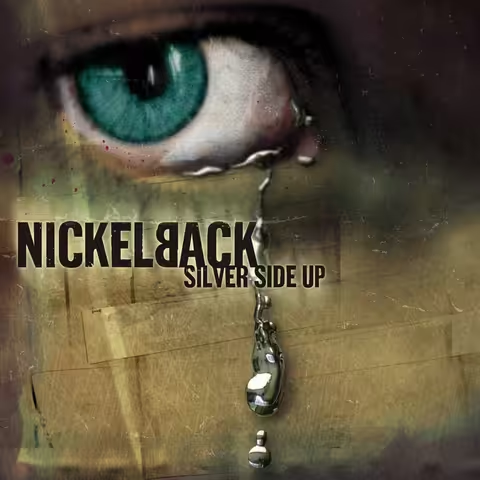
A turquoise eye occupies the upper part of the sleeve, with a reflective, silver-coloured tear descending over a scratched gold-green surface. The large black Nickelback name cuts across the middle-left, while the smaller album title sits beneath it. The image is distressed and close-up, not a conventional portrait introducing the four musicians.
Amoebacorp receives the design and illustration credit; Daniel Moss is credited with photography. Those credits do not establish whose eye appears or which specific photographic element Moss supplied. Neither should the metallic tear be assigned an elaborate secret meaning without a designer's explanation. As an editorial reading, the combination of a human eye and an apparently hard, reflective tear suits the record's mixture of vulnerability and force.
The release circulated on CD and cassette, with vinyl editions also entering the catalogue. Later format changes do not necessarily imply different artwork concepts, new mixes or additional songs. The actual tracklist and edition details remain more useful than the format alone.
Release and Reception
Billboard reported an American opening week of 178,000 copies and a number-two debut, behind Jay-Z's The Blueprint. Britain developed more slowly. Official Charts records a Top 100 entry at number 80 in January 2002, followed by two weeks at number one in March. The eventual total of 84 Top 100 weeks describes a sustained seller, not just a release-week rush.
Critical approval was much less uniform. Rolling Stone's Matt Diehl wrote on 17 September 2001: "Nearly every song seems trapped in the amber of early-Nineties Seattle aesthetics, the sonic equivalent of too many unfortunate goatees." AllMusic's Jonas placed greater value on the personal storytelling and intensity. The disagreement was already there before Nickelback became a routine internet punchline: were familiar musical devices effective communication or insufficient invention?
- 2002 JUNOs: Best Rock Album, Best Group and Best Single for "How You Remind Me".
- Best Album nomination: Silver Side Up lost to Diana Krall's The Look of Love.
- 2003 Grammys: "How You Remind Me" nominated for Record of the Year, without winning.
Music Canada awarded eight-times platinum on 1 April 2004. The larger worldwide figure remains an estimate: The Canadian Encyclopedia put it at almost ten million in its entry updated in 2015. It should not be presented as a newly audited total. Equally, the frequently repeated story of a scrapped "Never Again" video does not establish that MTV banned the album or the band.
Singles and Music Videos
Three main singles sustained the campaign, and all topped Billboard's Mainstream Rock chart. Release dates need territory labels: an American radio add and a British retail release could be months apart. "Too Bad", in particular, began its US campaign in November 2001, not simply "sometime in 2002".
| Single | US Radio / UK Retail | US Hot 100 | UK | Selected Extras |
|---|---|---|---|---|
| How You Remind Me | 17 July 2001 / 25 February 2002 | 1 | 4 | Acoustic version; "Learn the Hard Way" |
| Too Bad | 27 November 2001 / 26 August 2002 | 42 | 9 | Live "Never Again" and "Leader of Men" |
| Never Again | 8 July 2002 / 25 November 2002 | Did not chart | 30 | Live "One Last Run" and "Worthy to Say" |
Greg and Colin Strause directed "How You Remind Me"; Billboard's advance coverage announced a Vancouver shoot. Nigel Dick directed "Too Bad", with Vance Burberry as director of photography and Declan Whitebloom editing. Its family narrative extends the song into a miniature drama. The released "Never Again" clip instead uses Live at Home performance footage. Exact filming budgets and dates are not established by the available production listings.
Touring and Live
The launch was built around touring, not a sudden withdrawal into celebrity. Billboard's July 2001 announcement scheduled a 3 Doors Down run beginning on 31 August at the Minnesota State Fair in St Paul. Default were among the acts accompanying the later campaign. Across 2001 and 2002, the scale of the operation changed dramatically, but an enlarged audience did not instantly translate into spare cash.
"And any touring we were doing, we were probably just breaking even because you gotta pay for the bus, you gotta pay for the employees."
Chad Kroeger, Sticks and Stones podcast, quoted by Loudwire, 2021
Kroeger was recalling the early breakthrough period, not claiming the record never earned money. The distinction keeps an illuminating business anecdote from becoming a false story about permanent non-payment.
The clearest live document is the 25 January 2002 show at Edmonton's Skyreach Centre, filmed for Live at Home. Seven songs from the new album sat beside earlier material. Jerry Cantrell joined for Alice in Chains' "It Ain't Like That", and the encore included Big Wreck's "Mistake". The repertoire showed the group's connections as well as its new commercial status. It was not a front-to-back performance of Silver Side Up.
A separate SiriusXM studio performance offers another setting for the enduring single, rather than footage from that Edmonton concert:
In TV, Film and Media
"How You Remind Me" became useful screen shorthand because audiences knew it so thoroughly. Its later appearances include different kinds of reuse, not one undifferentiated list of soundtrack licences:
- The Guitar Hero series made it a playable song.
- A 2018 Saturday Night Live sketch turned it into an unlikely deathbed singalong.
- The Once Upon a Deadpool trailer had Ryan Reynolds and Fred Savage singing it.
One frequent association needs separating out: Chad Kroeger and Josey Scott's "Hero", from the 2002 Spider-Man soundtrack, is not one of this album's ten tracks. Its success overlapped the campaign, which helps explain the confusion.
Covers, Samples and Tributes
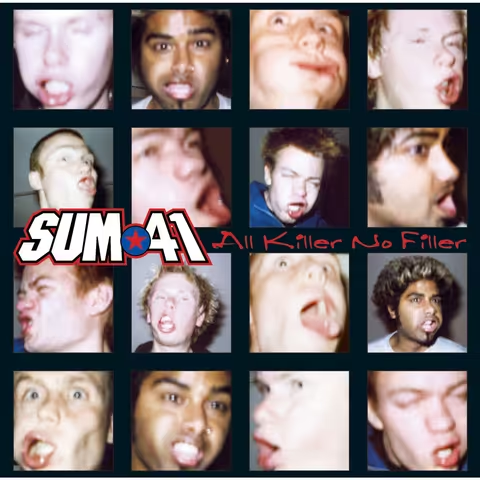
Sum 41 performed "How You Remind Me" on MTV's New Year's broadcast as 2001 became 2002. Their All Killer No Filler would also compete against Silver Side Up for the 2002 Best Rock Album JUNO. Avril Lavigne later recorded her own version for the 2012 Japanese animated film One Piece Film: Z. These are substantial examples of the song travelling beyond its original band, and the latter found a completely different film audience.
Its afterlife also includes an authorised advertising reinvention. In 2026, Megan Thee Stallion and Nickelback collaborated on "Pickle's Back", reworking the hit for a Cheetos campaign. The route from a basement relationship argument to a snack advertisement is hardly a conventional measure of artistic influence, but it is evidence of extraordinary recognition. These later covers and rewrites should not be mistaken for samples used to construct the original album. No such claim follows from their existence.
Reissues, Remasters and Anniversaries
A Rhino vinyl reissue appeared in July 2017, catalogue number 008122 7935078. It retained the standard ten-song programme rather than adding a disc of demos. At the album's twenty-fifth anniversary in September 2026, Nickelback's official shop also listed the familiar CD and vinyl editions. A current listing is evidence of availability, not proof of a newly commissioned remaster.
No expanded anniversary box, Atmos mix or complete session archive was verified in the consulted release material. Collectors seeking additional performances have a documented option in Live at Home, released on 29 October 2002, with backstage material and a making-of feature for the "Too Bad" video.
The acoustic versions, single edits and territory-specific extras remain another useful companion archive. They document how the album was presented and promoted, even where they cannot answer every question about its studio development.
Legacy and Influence
Silver Side Up changed what Nickelback could afford to do next. During The Long Road, released in 2003, Kroeger bought Greenhouse's A-room equipment and moved production into a renovated barn. Mix documented that transition at the time. The frustration with limited studio time had become a practical investment in control, not merely a complaint repeated in interviews.
All the Right Reasons followed in 2005 and became an even bigger commercial chapter. That later success can make this album look like a rehearsal for the Nickelback most people remember. It is better understood as the hinge: established live material, a tighter production framework and a single that suddenly reached listeners far outside rock radio.
Reassessment has also become less predictable than a simple battle between fans and critics. Breihan awarded "How You Remind Me" 8/10 in his 2022 Stereogum column, praising the song while acknowledging the band's battered reputation. That is a verdict on the single, not a retrospective score for all ten tracks.
"You hear it on the radio all the time, you hear it in TV shows, you just know the song. You know the words, without ever having really learned the words."
Megan Thee Stallion, Billboard, 2026
Her description is more specific than declaring an entire generation of bands indebted to this album without their testimony. Recognition became almost involuntary. Yet the record around the hit remains worth recovering: less a parade of celebratory rock-star poses than a compact collection preoccupied with what people carry out of troubled relationships and homes.
Things You Might Not Know
| Fact | Detail |
|---|---|
| The misheard word | In Billboard's 2021 interview, Chad Kroeger explained that the repeated ending word in "How You Remind Me" is "yet", not "yeah". |
| The earlier sales baseline | Billboard reported that The State had sold just 6,500 copies in its first American week, illustrating the distance travelled before the breakthrough. |
| A separate JUNO | Randy Staub won the 2002 Best Recording Engineer JUNO for "How You Remind Me" and "Too Bad", separately from the band's three awards. |
| The later chart return | Official Charts records another ten-week UK Top 100 run for Silver Side Up between March and May 2008. |
| A mixtape detour | 50 Cent used "How You Remind Me" in a Ja Rule spoof on his 2002 mixtape No Mercy, No Fear. |
| Choose a band member | The Live at Home DVD included multi-angle features, allowing viewers to follow individual musicians rather than only the main concert edit. |
| The fourth live selection | The 2002 EP Three #1's + The First One Live paired performances of the three campaign singles with earlier breakthrough "Leader of Men". |
| A hit across two years | "How You Remind Me" first topped the Hot 100 in December 2001 but finished as Billboard's number-one single for 2002. |
| Not a critics' ranking | Silver Side Up placed 47th on Billboard's decade-end album chart for the 2000s, a measure of chart performance rather than critical consensus. |
| The house came first | Kroeger told Billboard he had bought the Vancouver house associated with the song using his first publishing cheque, before the worldwide breakthrough. |
The Riffology Podcast
The Riffology podcast is available on all major platforms for more conversations about the records behind the reputations. Silver Side Up rewards that approach: start with the famous chorus, then stay for the older songs, the uneasy family stories and the people whose names rarely make the headline.

Comments