
Alex Band says RCA signed him at 15, made him wait four years before letting him make a record, then took another year to put it out. When Camino Palmero finally arrived on 10 July 2001, The Calling's debut had got its green light from a piece of luck: a Disney film-music boss heard a demo of "Wherever You Will Go" and wanted the band to play it on screen in Coyote Ugly.
By Band's account the album took three weeks to record, after years of writing more than 100 songs and working with dozens of producers. Critics were mostly unimpressed. Radio took almost a year to come round, until Band had drained his own bank account to keep the single alive. Then it climbed to number 5 on the Billboard Hot 100 and spent 23 weeks at number one on the Adult Top 40. This is the story of the record, and of the song that, in one label man's phrase, ate the band.
Album Facts
| Field | Detail |
|---|---|
| Artist | The Calling |
| Album | Camino Palmero |
| Release Date | 10 July 2001 |
| Label | RCA Records |
| Producer(s) | Marc Tanner; Ron Fair, executive producer |
| Studio(s) | Cherokee Studios, Hollywood; The Green Room, Van Nuys; mixed at Image Recording, Hollywood and Enterprise Studios, Burbank |
| Genre / Subgenre | Post-grunge, pop rock |
| Track Count | 11 (12 on some 2002 editions) |
| Total Runtime | 46:06 |
| Billboard 200 Peak | 36 |
| UK Albums Chart Peak | 12 (34 weeks on chart) |
| Other Notable Chart Peaks | 8 Germany; 9 Austria; 9 New Zealand; 10 France; 10 Norway; 11 Sweden; 23 Australia; 35 Canada |
| Certifications | Platinum (RIAA, BPI, ABPD Brazil); Gold (Canada, New Zealand) |
| Estimated Sales | Reports range from over 2.5 million to over 5 million worldwide |
| Key Singles | Wherever You Will Go; Adrienne; Could It Be Any Harder |
| Riffology Vault | Release dates, pressings and cover art |
The World Camino Palmero Walked Into
RCA's attention was on pop. Billboard's retrospective says The Calling struggled to get label heads to notice them amid the pop explosion the label was enjoying with Christina Aguilera and P!nk. Rock was getting harder-edged, with nu-metal and garage rock on the rise, and Rolling Stone Australia later wrote that The Calling "veered in the opposite direction".
The album landed on the same day as Dream Street's debut, in a year when Linkin Park's Hybrid Theory was among the best-selling albums in the world.
From Generation Gap to The Calling
Aaron Kamin was a premed student at UCLA when he began dating Alex Band's sister. He plays six instruments, and when he saw guitars lying around the Band family home in the San Fernando Valley, the two bonded over music. Kamin started spending more time writing with Band than with his girlfriend, and the "ultimatum" came: her or music with her brother. He chose the music, and dropped out of college.
Their first band was Generation Gap, named for the age gap between its young songwriters and the much older players who answered their ad. They made demos and shopped them to Band's next-door neighbour, an RCA executive. RCA signed them, and at the label's urging the duo dropped the name and the older players.
What followed was limbo. "We got signed about five years ago but they made us wait four years to make a record," Band told CBBC Newsround in 2002. For five years the pair wrote and recorded more than 100 songs and worked with dozens of producers, Associated Press reported that spring.
"All we could do was play the same few clubs in LA... all we could do was write songs and the record only took three weeks after we finally got in to do it."
Alex Band, CBBC Newsround, 2002
Asked by CBBC Newsround about British music he loved, Band named David Bowie, The Beatles, Led Zeppelin, Radiohead, Coldplay and Peter Gabriel. He told musicOMH: "We were in limbo for five years and it was sheer perseverance that got us through."
Band has said the original contract named them Next Door. Both men have since described The Calling as a two-man outfit at heart, with the rest of the lineup hired as session and touring musicians.
A Funeral, a Disney Executive and a "Monster" of a Song
"Wherever You Will Go" was written years before the record deal came, according to Billboard. Kamin has said it began at a funeral: his grandmother's best friend had died, leaving a husband of 50 years or more, and "I was at the funeral and afterwards I just started thinking of what it would be like to be him." Band gave CBBC Newsround the short version in 2002: the concept was losing a relative and wanting to go with them.
The song was overlooked until Kathy Nelson, then president of film music at the Walt Disney Motion Picture Group, heard it.
"Kathy apparently said, 'That song is a f–king monster. I need it in this movie I'm working on.'"
Aaron Kamin, Billboard, 2021
Nelson wanted the band in the movie playing the song, and they appear in Coyote Ugly as a bar act. Band says the placement changed everything: "Once Coyote Ugly wanted it, the label was like, 'Oh, this is a hit.'" He called it the catalyst that woke Ron Fair at RCA to the idea of making a record. A year after those years in the studio, AP reported, RCA finally gave them a shot at an album and brought in Marc Tanner to put it together.
Three Weeks in the Studio: Making Camino Palmero
Marc Tanner, who according to Songfacts had co-written and produced hits for the band Nelson, produced the album with Ron Fair as executive producer. The sessions were short: Band repeated the three-week figure to musicOMH.
Most of the album was cut at Cherokee Studios in Hollywood, where tracks 1, 3, 4, 6, 7, 9, 10 and 11 were recorded. "Nothing's Changed", "Final Answer" and "Things Don't Always Turn Out That Way" were done at The Green Room in Van Nuys. David Thoener and Marc Greene engineered, with Tiago Becker and Valente Torrez assisting. Mixing was split between Image Recording in Hollywood (tracks 1 to 6, 8 and 9) and Enterprise Studios in Burbank (tracks 7, 10 and 11), with Chris Lord-Alge and Thoener credited as mixers. Doug Sax, Robert Hadley and Stephen Marcussen mastered it.
Kamin is credited with guitar, mandolin, sitar, percussion and loops, with Spectrasonics loops credited alongside. The band on the road was not quite the band on the record: bassist Billy Mohler and drummer Nate Wood were brought in late in the sessions, AP reported, and Matt Laug and Bob Glaub are credited on drums and bass. Tanner told Associated Press in 2002 that "Alex is the voice, and Aaron is the sound."
Personnel and Credits
| Role | Player | Notes |
|---|---|---|
| The Calling | ||
| Lead vocals | Alex Band | Co-wrote every track |
| Guitar, mandolin, sitar, percussion, loops | Aaron Kamin | Co-wrote every track |
| Additional guitar | Sean Woolstenhulme | Left in June 2002 |
| Bass | Billy Mohler | Brought in late; credited on 2002 CD |
| Drums, percussion | Nate Wood | Brought in late; credited on 2002 CD |
| Guest and session musicians | ||
| Drums, percussion | Matt Laug | Guest credit |
| Bass | Bob Glaub | Guest credit |
| Keyboards | Paul Mirkovich | Additional keys |
| Synthesizer, synth strings | Ron Fair | Also executive producer |
| Tabla, percussion | Satnam Ramgotra | |
| Production and engineering | ||
| Producer | Marc Tanner | Credited producer |
| Executive producer, A&R | Ron Fair | A&R shared with Brian Malouf |
| Recording | David Thoener, Marc Greene | Assistants Tiago Becker, Valente Torrez |
| Mixing | Chris Lord-Alge, David Thoener | Assistants Matt Silva, Roger Lopez |
| Mastering | Doug Sax, Robert Hadley, Stephen Marcussen | The Mastering Lab, Marcussen Mastering |
| Artwork | ||
| Art direction, design | Frank Harkins | |
| Cover photograph | Kurt Iswarienko | |
| Package photography | Olaf Heine | |
The band's membership was a matter for lawyers by 2003. Kamin and Band say Mohler and Wood were hired hands. Mohler and Wood allege they were promised royalties.
The Songs on Camino Palmero
| # | Title | Writer(s) | Length | Single? | Notes |
|---|---|---|---|---|---|
| 1 | Unstoppable | Band, Kamin | 3:59 | Recorded at Cherokee | |
| 2 | Nothing's Changed | Band, Kamin | 4:44 | Cut at The Green Room; maxi-CD B-side | |
| 3 | Wherever You Will Go | Band, Kamin | 3:28 | Yes | Lead single, 22 May 2001 |
| 4 | Could It Be Any Harder | Band, Kamin | 4:41 | Yes | Third single, Adult Top 40 number 35 |
| 5 | Final Answer | Band, Kamin | 4:34 | Cut at The Green Room; singled out by Entertainment Weekly | |
| 6 | Adrienne | Band, Kamin | 4:30 | Yes | Second single; B-side of the US 7-inch |
| 7 | We're Forgiven | Band, Kamin | 4:31 | Mixed at Enterprise Studios, Burbank | |
| 8 | Things Don't Always Turn Out That Way | Band, Kamin | 4:11 | Cut at The Green Room, Van Nuys | |
| 9 | Just That Good | Band, Kamin | 3:54 | Mixed at Image Recording | |
| 10 | Thank You | Band, Kamin | 2:58 | Shortest track; mixed in Burbank | |
| 11 | Stigmatized | Band, Kamin, Eric Bazilian | 4:31 | Only track with an outside co-writer |
"Wherever You Will Go" is the record in miniature: a big-hearted, strummy ballad about love and mortality, its slow-build romanticism driven home by a gruff vocal, with a chorus suited to weddings and anniversaries, according to Rolling Stone Australia. Its official video is below.
"Adrienne" is the record's other calling card. Band has said Adrienne is not a real person but a type many people have met: someone unworthy of your affection who spends your money. Entertainment Weekly picked on "Final Answer": David Browne wrote that The Calling were "so stiflingly earnest" that their love song "Final Answer" was "dead serious". "Stigmatized", the only song with an outside co-writer in Eric Bazilian, was in the set at Boston's Paradise Rock Club on the first headline tour.
B-sides, Bonus Tracks and Alternate Versions
- "Lost" was the B-side on the UK, European and Australian "Wherever You Will Go" singles and on the Australian "Adrienne" single, and became the Japanese edition's bonus track.
- "The One" was the other B-side on "Adrienne".
- An acoustic "Wherever You Will Go" ran 3:24 on the UK CD and cassette singles.
- A live "Wherever You Will Go" (3:18) was a previously unreleased bonus on the 2002 European CD and appears on the UK and Australian editions.
- iTunes added "For You" (3:41), and a further bonus, "When It All Falls Down" (3:36), is also listed.
The Camino Palmero Cover
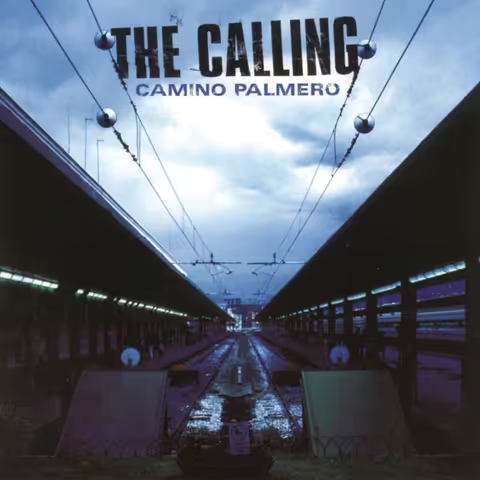
The sleeve is a photograph looking straight down the gap between two railway platforms, composed so the canopies and strip lights on either side run towards a single vanishing point. Wet rails gleam down the middle, overhead wires are strung with four round globes, and a heavy blue-grey sky closes the top of the frame. The whole picture is tinted blue and purple, with THE CALLING in distressed black capitals and CAMINO PALMERO in smaller blue letters beneath. The band do not appear on it.
The scene shows platforms 5 and 6 of Santa Maria Novella station in Florence, Italy. Frank Harkins is credited with art direction and design, Kurt Iswarienko with the cover photograph and Olaf Heine with the package photography.
Release and Reception
The reviews were mostly cold. Entertainment Weekly gave it a C in March 2002. Hot Press's Hannah Hamilton called it a "pathetic excuse for a record that goes nowhere, says nothing". Melodic was kinder, with Johan Wippsson writing that the band had "all the chances to be the next Lifehouse". Plugged In praised its messages of forgiveness while objecting to how several songs treat women.
Listeners disagreed. The record entered the UK chart on 15 June 2002 at 88, hit its peak of number 12 on 20 July and stayed on the chart for 34 weeks, finishing the year at number 84. In the US it peaked at number 36 on the Billboard 200 and finished 2002 at number 118. It reached the top ten in Austria, France, Germany, New Zealand and Norway. The RIAA certified it gold by March 2002, and platinum on 6 December 2024. It is also platinum in the UK and Brazil (more than 125,000 copies) and gold in Canada and New Zealand. CBS News put worldwide sales at over 2.5 million in 2004; a 2017 interview write-up says more than 5 million.
Awards followed. The Calling won the 2002 MTV Europe Music Award for Best New Act, beating Shakira, Avril Lavigne and The Strokes, plus Smash Hits Best Rock Act and an NRJ Music Award. Billboard's 2009 decade-end charts named "Wherever You Will Go" the number one Adult Pop song of the decade.
Singles and Music Videos
| Single | Released | Peaks | B-sides |
|---|---|---|---|
| Wherever You Will Go | 22 May 2001 (US radio) | US Hot 100 5; UK 3; number 1 in Italy and New Zealand | Lost; Nothing's Changed; acoustic version |
| Adrienne | 15 April 2002 | UK 18; US Hot 100 Bubbling Under 16 | The One; Lost |
| Could It Be Any Harder | 19 August 2002 | US Adult Top 40 35 | Not found |
The lead single was a slow burn. It reached the Hot 100 top ten on 26 January 2002 and peaked at number 5 on 16 March, spending 11 weeks in the top ten and finishing 2002 as Billboard's fifth-biggest single, behind Nickelback, Ashanti and Nelly. The Calling reached number one on the Adult Pop airplay chart that December and stayed there 23 consecutive weeks, a run only Santana and Rob Thomas's "Smooth" had beaten, and which Taylor Swift's "Cruel Summer" later matched.
The rollout was staggered. In the US the single went to mainstream rock, active rock and alternative radio on 22 May 2001, to hot adult contemporary on 27 August and to contemporary hit radio on 25 September. Band recalled that in America the release "coincided directly with September 11th". Australia followed on 11 March 2002, New Zealand on 18 March, Europe on 17 June and the UK on 24 June.
"It just wouldn't break the top 10, and I literally drained my bank account to push it a little longer, and then it did break."
Alex Band, The Indy Review, 2026
Two videos exist for the song, the first set in Mexico. The better-known one, directed by Gregory Dark, has the band performing in the concrete channel of the Los Angeles River while a teenage soap opera plays out in the foreground, and it did well on MTV's Total Request Live. Band said TRL was awesome but "made us kind of look like a boy band". The "Adrienne" video, directed by Nigel Dick according to Songfacts, was filmed at an abandoned military base in Los Angeles. Band wanted a domino effect, with people singing the lyrics and falling down at the end.
Touring and Live
The first headlining tour kicked off in February 2002. By March the band had appeared on NBC's Late Night and Total Request Live, and Associated Press found them at a soundcheck at the Roxy in Los Angeles, where the bouncer asked the two members of the band for their wristbands.
On Monday 11 March the tour reached the Paradise Rock Club in Boston, a sold-out show with about fifty underage girls behind the velvet rope. The set included "Wherever You Will Go", "Nothing's Changed" and "Stigmatized", and ended with "Adrienne". Kamin recalls lip-syncing on a children's TV show in Denmark, and the band later toured from Brazil to Thailand. "Outside of America, we were 10 times more successful," Band says, and both men remember Beatlemania-style chaos in Brazil and the UK.
In TV, Film and Media
"Wherever You Will Go" became a sync staple. The band plays it in Coyote Ugly, though it was not on the soundtrack. Beyond that it closed the Smallville episode "Metamorphosis", was played over Colin's scene with the Wisconsin girls in Love Actually and ended the series finale of Saving Grace. CBS used the song and video to promote The Guardian in 2001, and it turned up in an NHL Stanley Cup playoffs commercial and in Star Trek: Enterprise promos. In J.K. Rowling's Lethal White, it is the song for Robin and Matthew's wedding dance.
The Lawsuit and the Song That Ate the Band
The success pulled the band apart. Woolstenhulme left in June 2002 to join his brother Rick's band Lifehouse, and Mohler and Wood left that October. In 2003 the pair sued Band, Kamin and their management, alleging fraud and mismanagement. Kamin calls the suit "totally without merit" and says it was settled very quickly.
"[Label execs] didn't care if we lasted forever. They just wanted to see how hard they could squeeze us while we had a hit on the radio."
Aaron Kamin, Billboard, 2021
"Some label guy called it 'the song that ate the band,'" Kamin says. The follow-up arrived in 2004, with Clive Davis as executive producer and a new single, "Our Lives".
Covers and Tributes
Charlene Soraia covered "Wherever You Will Go" for a 2011 Twinings tea advert. Her version entered the UK singles chart at number 20 and climbed to number 3, and was certified platinum in Britain. It also sent the original back into the UK chart at number 16.
Reissues and Anniversaries
The 2002 European CD added a live "Wherever You Will Go" as track 12, and a Japanese BMG reissue followed in May 2005. A vinyl LP arrived on 2 December 2022, when Music On Vinyl pressed a 180 gram edition with a four-page lyric booklet, limited to 1,500 numbered copies on translucent blue vinyl. A standard reissue followed on 17 July 2026. In 2021 Band said he planned to perform the whole of Camino Palmero in a live stream on 10 July, the album's 20th anniversary.
Legacy of Camino Palmero
The second album, Two, appeared in June 2004. "Our Lives" was used at the 2004 Summer Olympics and the 78th Academy Awards, but the album peaked at number 54 on the Billboard 200, below its predecessor. The band split in 2005. Band had by then sung on Santana's "Why Don't You and I", another Adult Top 40 number one, and went solo. He and Kamin have since fallen out and sued each other over the band's name.
Time has been kinder to the song than the critics were. Rolling Stone Australia ranked it number 24 on its 2025 list of the best one-hit wonders of the 2000s. On 25 September 2026 came Before the World Turns to Dust, the first Calling record in 22 years, which Band says he had to fund himself. "I sold 10 million records and I only just recouped a couple years ago," he told The Indy Review.
Things You Might Not Know
| Fact | Detail |
|---|---|
| Horror-set childhood | Band grew up on the sets of his father's horror films and told CBBC Newsround he always had very small parts, "one or two lines". |
| Gold to platinum | RIAA certified the album gold by March 2002 but did not award platinum until 6 December 2024, more than 22 years later. |
| A billion streams | Songfacts says "Wherever You Will Go" has passed a billion streams on Spotify. |
| The street spelling | CBBC Newsround's 2002 transcript of Kamin's interview renders the street name as "Carmino Parmello". |
| Sold to someone else | The Calling's "Chasing the Sun" was first sold to another band for the 2001 film Summer Catch, and the duo later regained the rights and re-recorded it. |
| Soundtrack work | Between albums the pair also wrote songs for the films Kate and Leopold, Daredevil and Sweet Home Alabama, according to Associated Press. |
| Family took notice | Kamin joked that even his family did not really get his success until the band were on TV. |
| MADtv parody | MADtv parodied the song, with cast members playing The Calling, Scott Stapp, Eddie Vedder and Ray Charles. |
Hear More on the Riffology Podcast
Camino Palmero took years to get made and three weeks to record. For more stories like this one, from the sessions to the singles to the rows, the Riffology podcast is available on all the major podcast platforms.

Comments