Sum 41 posted their demo tape to every major label they could find an address for, and every one of them said no. What eventually started a bidding war was the same music with a video attached: a ten-minute VHS montage of four teenagers from Ajax, Ontario soaking pedestrians with Super Soakers, egging houses and staging idiot shot-for-shot remakes of action films, cut together with live footage and mailed out in late 1999 as a homemade press kit. Within a week, according to Rolling Stone's reporting at the time, the labels were fighting over them.

The album that came out of that deal, All Killer No Filler, was released on 8 May 2001 and did something none of the four had planned for. It sold more than 1.6 million copies in the United States alone, put a Canadian band with a song about being useless at the top of the American alternative chart, and left its own author with a two-decade case of impostor syndrome that he has never fully shaken. Deryck Whibley has spent twenty-five years telling interviewers that he does not think it is very good. Almost nobody agrees with him.

Album Facts

FieldDetail
ArtistSum 41
AlbumAll Killer No Filler
Release Date8 May 2001
LabelIsland Records (US and international), Aquarius Records (Canada)
ProducerJerry Finn
StudiosMetalworks Studios, Mississauga, Ontario; Cello Studios, Los Angeles
GenrePop punk, skate punk, with rap-rock and NWOBHM detours
Track Count13 (14 on the UK edition)
Total Runtime32:14 (35:32 with the UK bonus track)
Billboard 200 Peak13 (4 August 2001), 49 weeks on chart
UK Albums Chart Peak7
Other Notable PeaksCanada 9, New Zealand 16, Austria 19, Ireland 22, France 25, Germany 29, Australia 33
CertificationsUS platinum (RIAA, 2001), Canada 3x platinum (2004), UK 2x platinum (2021), Japan gold (2002), Australia gold (2003)
Estimated SalesAt least 1,690,000 in the US by October 2002 per Billboard
Key Singles"Fat Lip", "In Too Deep", "Motivation"
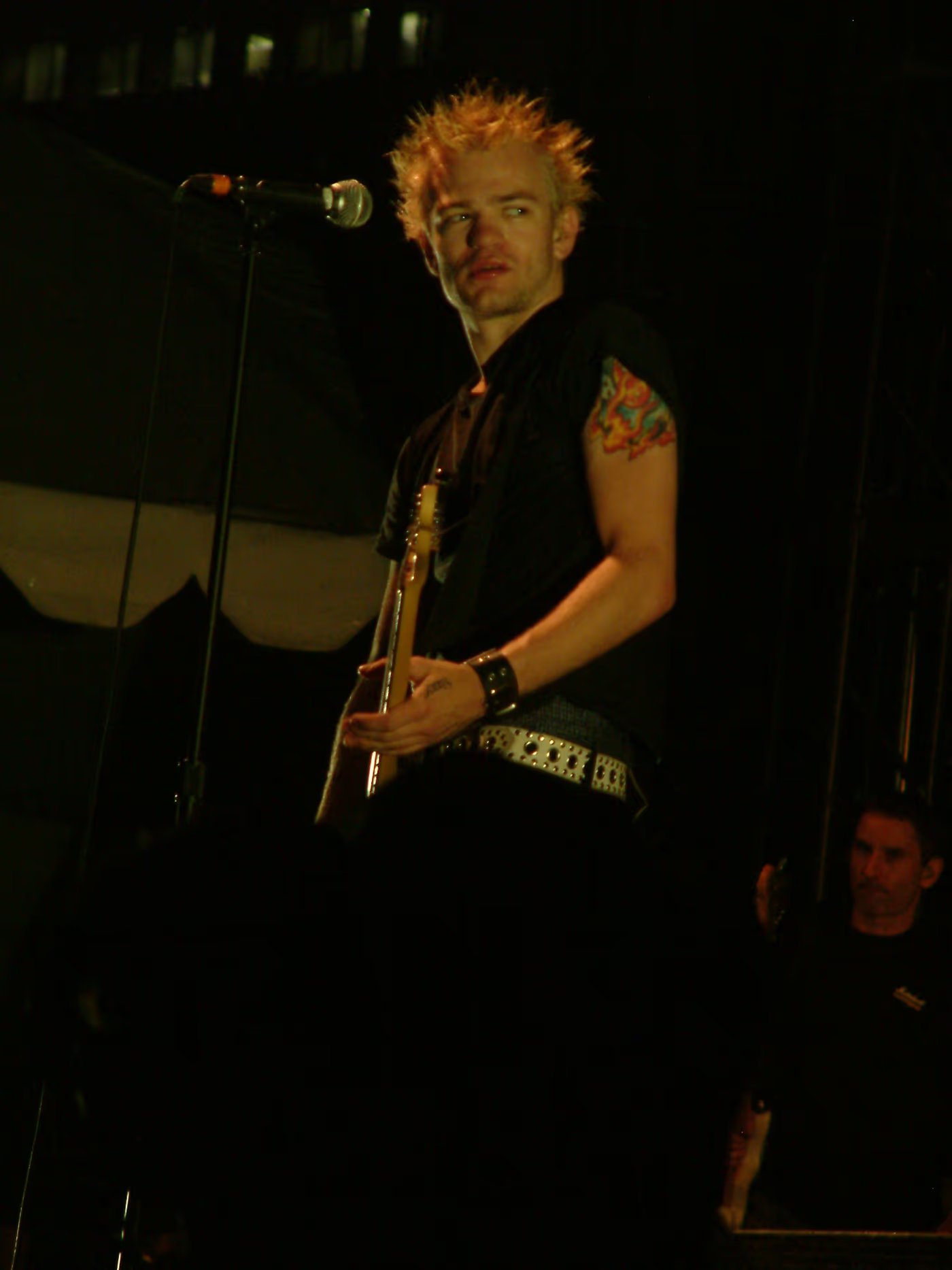
Deryck Whibley of Sum 41 on stage in 2003, with bleached spiky hair, a black sleeveless T-shirt, a flame tattoo on his upper arm and a studded belt, holding a guitar next to a microphone stand.
Deryck Whibley at Ottawa Bluesfest in July 2003, two years into the touring cycle that All Killer No Filler set in motion. Photo by Scott Penner, CC BY-SA 2.0, via Wikimedia Commons.

What 2001 Sounded Like

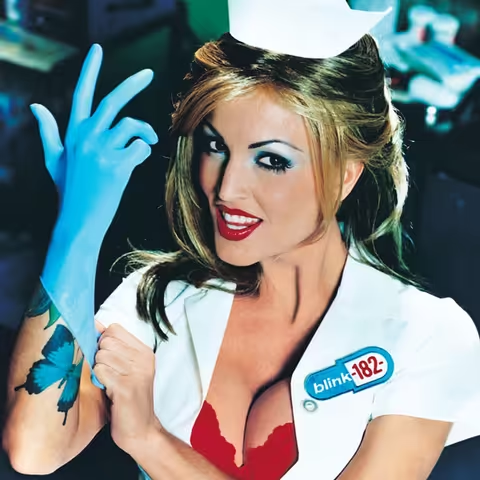
Punk had already been through its mainstream reckoning by the time Sum 41 arrived. Green Day's Dookie broke the seal in 1994, The Offspring's Smash went nuclear the same year, and by 1999 Blink-182's Enema of the State had turned the whole thing into a stadium proposition with a nurse on the sleeve. What made 2001 different was that the market had stopped treating this music as an anomaly and started treating it as an asset class. Labels wanted the next one. Radio formats had been built around it. MTV had a daily countdown show where teenagers voted, which meant a band with a funny video and a chorus could beat a global pop act on the strength of nothing but phone calls.

The competition that year was not other punk bands. It was everything. In the twelve months around All Killer No Filler, the American charts belonged to nu-metal at its commercial peak, teen pop in its final flush, and hip-hop moving from dominance to total dominance. A punk record had to sound like it belonged in that company or it got buried. Jerry Finn's production is the sound of somebody who understood that problem completely.

  • Linkin Park's Hybrid Theory was still selling in enormous quantities from the previous October.
  • Staind, Drowning Pool and Puddle of Mudd owned American rock radio.
  • Blink-182 released Take Off Your Pants and Jacket on 12 June 2001, five weeks after Sum 41.
  • Alien Ant Farm, Jimmy Eat World and Weezer's green album all landed in the same window.
  • MTV was about to turn twenty, and would mark it with a birthday show that changed Sum 41's life.

There is one more piece of context that matters, and it is Canadian. Sum 41 were signed to Aquarius at home and Island abroad, and the domestic market did not fall for them first. Steve Jocz put it plainly to Maclean's: "It's strange to be a Canadian band and be bigger in the States. But our kind of music isn't as popular in Canada as it is in the U.S., and there are a lot more people there." By the end of 2001 the album was among the top thirty best-selling records of the year in Canada anyway, and the third-biggest seller by a Canadian artist. The country caught up.

From Kaspir to Sum 41

Whibley started playing in bands as a kid in Ajax, a commuter town east of Toronto. Before Sum 41 there was Kaspir, formed in 1994, and before that a run of short-lived projects going back to a rap trio he joined at eleven. The band that mattered took shape in the summer of 1996 with drummer Steve Jocz, and the name came from arithmetic rather than inspiration: they counted the days from the start of the school summer holidays to the date of the Warped Tour they wanted to attend, and it came to forty-one. They debuted the new name at a battle of the bands on 28 September 1996.

The lineup churned. Jon Marshall sang until he left, at which point Whibley took over the microphone on the advice of a man who would become the most consequential and most complicated figure in the band's story. Dave Baksh, who had been in an alternative-metal band called 747, came in on lead guitar. Bassist Richard Roy quit after a van accident in 1997, Mark Spicoluk filled in, and Jason McCaslin took the job for good in 1999.

The advice came from Greig Nori, frontman of the Canadian band Treble Charger. Whibley, sixteen at the time, talked his way backstage at a Treble Charger show in Toronto and persuaded Nori to come and watch Sum 41 play. Nori did, liked what he saw, and took on management duties before eventually producing them. He described the arrangement to Rolling Stone in terms that read very differently now than they did in 2001.

"It's like the movies. You find a protege, he becomes your equal, and then he passes you."

Greig Nori, Rolling Stone, 2001

The first release was Half Hour of Power, a mini-album some sources call an EP and others call a debut LP, produced by Nori and Whibley at Metalworks and issued on 13 June 2000 through Island's Big Rig imprint in the US and Aquarius in Canada. It scraped number 176 on the Billboard 200 and number 143 in the UK, went gold in Canada and silver in Britain, and gave the band four songs they would raid for the album proper: "Summer", "Makes No Difference", "Machine Gun" and "What We're All About".

Pre-production, Demos and a Prank Tape

The most important thing to understand about how Sum 41 got signed is that the conventional route failed completely. Whibley has been consistent about this for twenty-five years.

"We sent our music out first and it got turned down by everybody."

Deryck Whibley, Billboard, April 2021

What worked was the video, and it was not made with a record deal in mind. The band had been filming themselves for their own entertainment for years, and the footage was exactly what four bored teenagers with a camcorder in the late nineties would produce.

"We would film ourselves doing stupid stuff, like drive-by water gunning people, egging houses, and cut it with some film of our shows. I put this thing together, just for our friends, and our manager saw it and said, 'This is great. Let's put a three-minute video together with your music, we'll send this out to record companies, and this is your demo.' And then, it was a matter of weeks. Every label in the U.S. was trying to sign us, and it turned into a big bidding war. But it was the same music, that was the funniest part. That music was already turned down by everybody."

Deryck Whibley, Billboard, 2021

Gavin Edwards, writing in Rolling Stone, described the tape as "remakes of action movies and footage of the members driving around, drenching pedestrians with Super Soakers", edited into a ten-minute montage in late 1999 and posted to a batch of major labels. His summary of what followed is four words long: "within a week, there was a full-fledged bidding war". Island won it, Sum 41 signed in 1999, and the celebration was funded by a label president in a mood. Lyor Cohen, then running Island Def Jam, told them, in Steve Jocz's retelling, to go out and cause as much damage as they liked because the company would pay for it. Cohen's own assessment of the band, given to Rolling Stone, is one of the great backhanded compliments in A and R history: "The Beastie Boys were much tamer. Sum 41 are a multiple of them."

The songwriting happened in far less glamorous circumstances. Whibley was living at his mother's house in Ajax, and the only place he could work without waking anyone was the family car, parked on the driveway, in a Canadian winter, with the engine off.

"I'm still living at my parents' house, and my parents go to bed at, like, eight o'clock. So I used to sit in the car with an acoustic guitar and tape recorder. But it was freezing, because it's Canada, and I can't turn the car on, because you can't waste their gas. It was really difficult."

Deryck Whibley, Billboard, 2021

By the time sessions loomed, Whibley had a stack of songs already finished, and had deliberately held them back. He has recalled having "Rhythms", "Nothing on My Back", "Motivation", "In Too Deep" and "Handle This" all ready, and the band knowing those were the stronger ones. Half Hour of Power, he has said, was essentially their live set, put out fast because the label wanted something in shops immediately. The good material was being saved for the real album. His stated reference points were not what the marketing would suggest: Rancid, Pennywise, Elvis Costello and The Beatles, plus the record that started all of it for him.

"I was about 14 when Dookie came out. I remember seeing the video for 'Basket Case' for the first time. It had so much energy and it was so different. I'd never seen anything like it before. From then I was an instant fan."

Deryck Whibley, NME, 2014

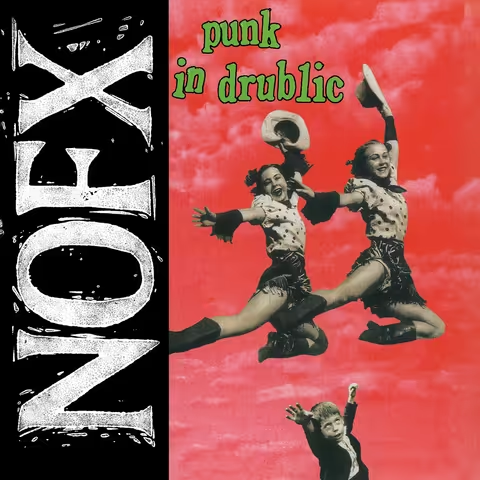
One other album gets named repeatedly as a structural influence on the record: NOFX's Punk in Drublic, the 1994 Epitaph release that showed a generation of skate-punk bands how to bolt genuine melody onto very fast playing without sounding soft. You can hear its fingerprints in the way the guitar harmonies on All Killer No Filler are arranged, and in the willingness to let a joke sit inside a serious hook.

Creating All Killer No Filler

Island did not hand the record back to Greig Nori. For the album that would have to sell, they went to Jerry Finn, who by 2000 was the most reliable set of ears in American punk. Finn had engineered and mixed Green Day's Dookie in 1994, produced Rancid, and then produced Blink-182's Enema of the State in 1999, the record that proved a punk band could be mixed for pop radio without losing the aggression. He is the reason All Killer No Filler sounds like it does: the guitars are enormous but clean, the drums crack rather than thud, and every vocal is placed at the very front.

Sessions took place at Metalworks Studios in Mississauga, Ontario, the facility built by Triumph's Gil Moore where the band had already made Half Hour of Power, and at Cello Studios in Los Angeles. Sources differ on the exact window. The album's own credits point to June 2000 through January 2001; other accounts have the bulk of it happening across the winter of 2000 and finishing in March 2001. What is not in dispute is that the band arrived nowhere near as good as they thought they were.

"He did a lot for us musicianship-wise. We were horrible musicians. And we didn't know we were horrible. We actually thought we were pretty good, because we were so bad and so young that you don't even know you're not good. And he kept telling us to do it over, it's not good enough. And we're like, 'What is this guy talking about? It sounds great!' But he kept pushing us and you would start to see it take shape and hear how better it was."

Deryck Whibley, Billboard, 2021

Dave Baksh has been even more candid about what Finn's coaching actually felt like from the receiving end, and considers not re-hiring him the band's single biggest career mistake.

"He sat me down and told me I was a garbage guitar player and I needed to get better. He taught me the art of treating every section, whether it be four bars, twelve bars, whatever, as a composition in itself, and you deliver that performance in whatever pocket that is."

Dave Baksh, The Rodeo Magazine, 2024

The improvement across the sessions is audible if you play Half Hour of Power and All Killer No Filler back to back. The re-recorded "Summer" is the clearest evidence: same song, same arrangement, transformed performance. Tom Lord-Alge, a mixer whose credits run from Steve Winwood to Marilyn Manson, handled the mix. Joe McGrath and Sean O'Dwyer engineered. Brian Gardner mastered it. Whibley has since said that the way he produces Sum 41 records himself is essentially Finn's method, built on and extended but rooted entirely in what he learned in those rooms.

McGrath gets the credit for the title. The story that has followed the record since 2001 is that he made an offhand remark during the sessions that this album was all killer, no filler, and the band liked the sound of it enough to put it on the sleeve. It is the kind of thing an engineer says to keep a room's spirits up at two in the morning. It ended up as the name of the biggest-selling record any of them would ever make, and, in one of the small ironies of the whole story, as a stick for critics to beat them with.

Nori did not vanish from the sessions, though he was not the producer and is not credited as one. He sang backing vocals on "Motivation", "In Too Deep" and "Handle This", and played additional guitar on "Handle This" and "Pain for Pleasure". His name also sits on the writing credits of three of the album's biggest songs, which is where a fair amount of later friction originated.

Personnel and Credits

RolePlayerNotes
Core band
Lead vocals, rhythm guitarDeryck "Bizzy D" WhibleyAlso plays drums on "Pain for Pleasure"
Lead guitar, backing vocalsDave "Brownsound" BakshRaps on "Fat Lip" and "What We're All About"; co-lead vocals on "Pain for Pleasure"
BassJason "Cone" McCaslinJoined the band in 1999, credited co-writer on "Pain for Pleasure"
DrumsSteve "Stevo32" JoczRaps on "Fat Lip"; lead vocals on "Pain for Pleasure"; spoken word on "Introduction to Destruction"
Guest and session musicians
Backing vocals, guitarGreig NoriBacking vocals on "Motivation", "In Too Deep" and "Handle This"; extra guitar on "Handle This" and "Pain for Pleasure"
Guitar soloKerry KingSlayer guitarist, on "What We're All About" (bonus and reissue editions, not the original 13-track album)
DrumsTommy LeeMotley Crue drummer, on the live "What We're All About" used as a B-side
Production and engineering
ProducerJerry FinnCame in off Blink-182's Enema of the State; engineered Green Day's Dookie
MixingTom Lord-Alge
EngineersJoe McGrath, Sean O'DwyerMcGrath is credited with the offhand remark that became the album title
MasteringBrian Gardner
Artwork
Inner inlay photoChris Wahl
Outer inlay and group photo designJonathan MannionBest known for hip-hop sleeves including Jay-Z's Reasonable Doubt
Album designKim Kinakin

Two things in that table are worth pausing on. The first is that the record's most-loved joke, "Pain for Pleasure", is played by a band that has completely rearranged itself: the drummer is out front singing, the singer is behind the kit, and the lead guitarist is harmonising. That is not a studio trick, it is how they performed it live, in costume.

The second is Jonathan Mannion. In 2001 Mannion was one of the most in-demand photographers and art directors in hip-hop, the man behind sleeves for Jay-Z, DMX and Eminem. Island putting him on the outer artwork of a Canadian pop-punk debut tells you exactly how the label saw this band: not as a niche punk signing, but as a mainstream youth-culture proposition that needed to look like it belonged next to the biggest records in the shop.

The Songs

#TitleWriter(s)LengthSingle?Notes
1Introduction to DestructionJocz0:38NoSleeve credits Jocz with spoken word; Whibley has said the announcer voice was their Island Def Jam A and R man. Later lent its name to the band's 2001 DVD
2Nothing on My BackWhibley, Jocz3:01NoWritten before the sessions began
3Never Wake UpWhibley0:50NoInterlude
4Fat LipWhibley, Jocz, Baksh, Nori2:58Yes, April 2001Roughly eighteen months in the writing; false ending at 1:38
5RhythmsWhibley2:59NoOne of the five songs finished before the studio
6MotivationWhibley (Nori credited on the song's publishing)2:50Yes, January 2002Nori sings backing vocals
7In Too DeepWhibley (Nori credited on the song's publishing)3:27Yes, September 2001Riff written at 18 while waiting for Baksh to pick him up
8SummerWhibley2:49NoRe-recorded from Half Hour of Power
9Handle ThisWhibley, Baksh3:37UK release onlyRiff written on the spot in front of other people, which Whibley never does
10Crazy Amanda BunkfaceWhibley2:16NoB-side on both the "In Too Deep" and "Motivation" singles
11All She's GotWhibley, Baksh2:22NoLive version appeared on multiple single formats
12Heart AttackWhibley2:49NoDeep cut, rarely played live
13Pain for PleasureWhibley, Jocz, Baksh, McCaslin1:43NoIron Maiden homage; Baksh wrote the riff, Jocz sings, Whibley drums
14Makes No DifferenceWhibley, Nori3:11UK bonus trackOriginally on Half Hour of Power

Note the discrepancy in the writing credits. The album sleeve credits everything to Whibley unless otherwise noted, but the registered writing credits for the three biggest songs on the record, "Fat Lip", "In Too Deep" and "Motivation", all include Greig Nori. Those credits were worth a great deal of money, and they matter to the story that unfolds later.

Fat Lip

It is the song that broke them and it very nearly did not exist. The album was around seventy per cent finished and the label had already mapped out the campaign: "In Too Deep" first, "Motivation" second, "Handle This" third. "Fat Lip" was the last thing Whibley wrote for the record, and by his own account it was not even supposed to be a song.

He has described the writing as a slow assembly rather than a burst. He wrote the riff on its own, wrote the chorus roughly six months later, wrote a verse separately, and only realised at some point that "they're all around the same tempo, they're all the same key". The whole thing took around eighteen months to write and another six to record, and it kept not working. What finally fixed it was not a part or a sound. It was the scansion of the raps.

"It used to go, 'Stormin' through the party like my name was El Nino / Hangin' out drinkin' in the back of an El Camino.' Once I realised what was wrong with it, it became 'Stormin' through the party like my name was El Nino / When I'm hangin' out drinkin'.' When you have that little thing to pull you into the next line is what made it all flow. Every line had to have that. When you listen to it, every line there's a pickup word that takes you into the next line. They overlap each other. And that's what made it all of a sudden a special song to me."

Deryck Whibley, Stereogum, 2021

The El Nino line itself came from a Chris Farley sketch on Saturday Night Live, and was the only lyric that existed for a long time. The rap verses, delivered by Baksh and Jocz as well as Whibley, came out of a childhood spent on LL Cool J, Beastie Boys and Run-DMC. There was even a tutor: in the early days the band were coached by MC Shan, an actual old-school New York rapper, in a studio in Scarborough, Ontario, an arrangement Whibley remembers mostly for how frustrated Shan became trying to teach rhythm to four suburban Canadian teenagers. MTV's Brian Hiatt called the result "pop-punk-meets-hip-hop", which is accurate but undersells how strange it sounded on rock radio in 2001.

Whibley was embarrassed by the demo and half the band thought it was stupid. One person heard it and disagreed immediately.

"I played it for Jerry Finn, and he was like, 'That's your first single. That's gonna be a hit.'"

Deryck Whibley, Stereogum, 2021

There is one more production decision worth flagging: the false ending at 1:38. The record company objected, on the grounds that dead air on radio is a cardinal sin. The band kept it. It is now one of the most recognisable two seconds in the genre.

In Too Deep

The album's best-written song has an origin story nobody would guess. Whibley has said he originally wrote it for the Canadian rapper Snow, recorded a version with him that never came out, passed it to another band who also never released it, and only got it back by default. What survives of that reggae-inflected first draft is nothing at all.

The riff arrived because Dave Baksh was, as usual, late.

"He was supposed to pick me up when I was still living in my mum's house before we were signed. We all lived with our parents back then, because we were only just 18. He was late as usual, while I was sitting by the door waiting and waiting and waiting. But I had a guitar there. So I just kind of picked it up while I checked out the window, looking around for him. And then the riff came. Within maybe three or four minutes the majority of the song was written."

Deryck Whibley, Kerrang!, 2019

Then they nearly left it off. The band got bored of it as newer songs arrived, and it took other people insisting it was a hit to keep it on the record. Whibley's relationship with it has stayed complicated ever since; the band did not play it live for around nine years, and he has admitted to finding it "so basic" and being faintly embarrassed by it, despite it being their biggest song in Britain.

Dave Baksh's guitar solo is the moment the album quietly declares its ambitions. It is a finger-tapped run, a technique that pop-punk bands in 2001 simply did not use. Baksh is typically self-deprecating about it: "For some reason, I guess pop punk, they weren't used to finger tapping, so I got this reputation as, 'Oh, this dude is so metal and he's such a great guitar player,' and I really wasn't." It is still the clearest signal on the record that these were metal kids playing punk rather than punk kids who had learned three chords.

Motivation and Handle This

"Motivation" is a song about not being able to find any, which the band understood was the most relatable subject available to a seventeen-year-old. Musically it is the most straightforwardly Californian thing on the album, all upstrokes and stacked harmony, with Nori on the backing vocals.

"Handle This" is the outlier: a slower, almost tender track that sits at number nine and completely resets the album's temperature. It began life sounding nothing like Sum 41 at all. Whibley has compared the original arrangement to Third Eye Blind's "How's It Going to Be", and says they recorded it that way before deciding it made no sense on the record. The fix arrived by accident.

"One day, I was like, 'Let's try to heavy this thing up a bit,' and I picked up a guitar. I don't write in front of people, ever. But now and then, if you're put on the spot, sometimes you come up with something really cool. And I came up with that intro instantly."

Deryck Whibley, Billboard, 2021

Pain for Pleasure

The closer is a 103-second New Wave of British Heavy Metal parody, an unabashed Iron Maiden pastiche complete with galloping bass, twin-guitar harmony and a shrieked vocal. The record was finished when it appeared. Whibley's account is that Baksh started messing about with a Maiden-style riff, Jocz began singing over it, and ten minutes later the whole song existed. Wikipedia's version, sourced to a 2015 book, adds the detail that Jocz wrote it on the toilet. Either way it was recorded as a joke and then kept because it was too good to bin. Jocz sings lead, Baksh sings co-lead, and Whibley moves to the drums.

Rolling Stone's Gavin Edwards happened to be at Metalworks when Baksh cut his part and reported the scene: the guitarist pulling his shorts up high on his waist in the vocal booth, the better to produce a castrato tone for the final absurd line, "Satan is his name", with Whibley almost falling out of his chair laughing. Live, the band performed the song in costume and in character, insisting to interviewers that Pain for Pleasure were a separate group who hated Sum 41. That commitment to the bit is what stopped it being a throwaway and made it a set-list fixture for twenty-four years.

It is also the single most important sentence in the album's cultural argument. Adria Young, writing a retrospective for Vice, nailed why it mattered.

"By mainstreaming an anti-mainstream subculture, Sum 41's All Killer, No Filler made Iron Maiden t-shirts cool again and helped usher in a new era of teenage crap."

Adria Young, Vice, 8 May 2014

The deep cuts

"Nothing on My Back" opens the record proper and is arguably the most purely NOFX-shaped thing here, a fast, melodic, harmonically busy two minutes that would not have sounded out of place on Punk in Drublic. "Rhythms" is the most underrated song on the album, a proper Costello-ish pop construction hiding inside a punk arrangement. "Heart Attack" and "All She's Got" are the two that fell out of the live set fastest, though "All She's Got" survived long enough to appear as a live B-side on three different single formats. "Crazy Amanda Bunkface" exists mostly for its title, which is exactly the kind of thing that made teenagers love this band and made critics grind their teeth.

B-sides, Outtakes and Lost Songs

Because All Killer No Filler arrived in the last years of the physical-single era, the B-sides are a genuine second album's worth of material, and most of it is either Half Hour of Power tracks or live recordings from the 2001 touring cycle.

  • "Makes No Difference" appeared as a B-side across several "Fat Lip" formats and as the UK album's bonus track.
  • "What I Believe", "Machine Gun" and "T.H.T. (Tables Have Turned)" were pulled from Half Hour of Power onto various single formats.
  • Live versions of "Fat Lip", "All She's Got", "Crazy Amanda Bunkface", "Machine Gun" and "Makes No Difference" were spread across the CD singles.
  • UK and European DVD singles carried "Pain for Pleasure" as an extra.
  • Island issued a promotional seven-track sampler, The 7 Series, containing "Nothing on My Back", "Fat Lip", "Rhythms", "Motivation", "In Too Deep", "Handle This" and "Pain for Pleasure".

The most significant orphan is "What We're All About". It was written by Whibley, Jocz and Baksh, first appeared on Half Hour of Power, and was then re-recorded with a guest guitar solo from Slayer's Kerry King for the Spider-Man soundtrack in 2002. That version was released as a single in its own right, charting at 32 in the UK, and eventually surfaced on the Japanese tenth-anniversary edition of the album. A live take with Motley Crue's Tommy Lee behind the kit turned up as a B-side on both the "In Too Deep" and "Motivation" singles. It is the one song from this era that is simultaneously everywhere and on no proper album, which is why it consistently confuses people.

Artwork and Packaging

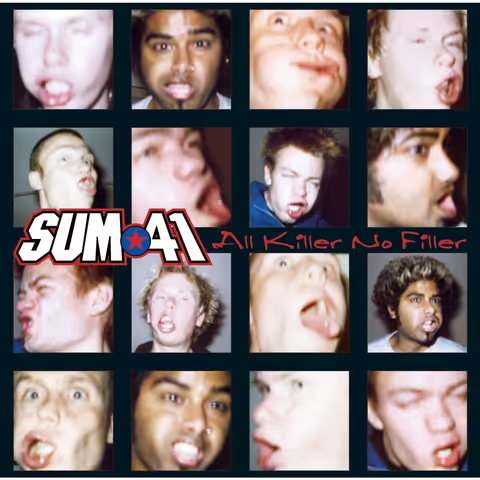
The sleeve is sixteen flash-lit snapshots arranged in a four-by-four grid on a near-black, deep navy field. Each frame is a close-up of a band member pulling a face: tongues out, eyes crossed, cheeks squashed, a nose pushed up into a pig snout, one head thrown back mid-gurn. The photography is deliberately cheap-looking, the sort of thing a point-and-shoot with the flash on produces in a bedroom or the back of a van, and the frames are printed with visible white borders like a contact sheet of holiday snaps. Across the middle, the Sum 41 logo sits in blocky white capitals with a heavy red outline, with a blue disc and a red star standing in for the space between the words. To its right, "All Killer No Filler" is scrawled in loose red handwriting.

It is a very good piece of design pretending to be no design at all. There is no moody band portrait, no concept, no attempt at gravity. It looks like the visual equivalent of the prank video that got them signed, which was almost certainly the point, and it is credited to a genuinely serious team: Chris Wahl on the inner inlay photo, hip-hop art director Jonathan Mannion on the outer inlay and interior group photo design, and Kim Kinakin on the overall album design.

There is one territorial variant worth knowing about. The UK edition swapped the near-black grid for blue, and added "Makes No Difference" as a fourteenth track. If you have a British first pressing, the sleeve is a different colour from every American copy on the shelf.

Release and Reception

All Killer No Filler was announced on 8 March 2001 and released two months later to the day. The commercial performance was immediate and enormous. It entered and climbed to number 13 on the Billboard 200 on 4 August 2001, and then simply refused to leave, logging 49 weeks on the chart. It hit number 7 in the UK, 9 in Canada and 16 in New Zealand. The RIAA certified it platinum in the summer of 2001, within weeks of release, and by October 2002 Billboard was reporting US sales of at least 1,690,000.

TerritoryPeak
US Billboard 20013
UK Albums Chart7
Canada9
Belgium (Flanders)11
New Zealand16
Austria19
Ireland22
France25
Germany29
Australia33
Switzerland39
Netherlands69

The critics were a different story. The album's reception in 2001 ranged from warm to actively hostile, and the split fell along a predictable line: writers who thought the jokes were the point liked it, writers who thought the jokes were a symptom did not. Arion Berger's three-star review for Rolling Stone on 5 June 2001 landed almost exactly in the middle, calling it "ADD rock for the vaguely unsatisfied" while conceding that "Sum 41 are sharp musicians and have the songcraft thing down (or at least one version of it), and their inability to stay away from old-school satanic metal is endearing".

Entertainment Weekly's Tom Sinclair was less generous, giving it a C+ on 15 June and concluding that "getting over more on speed and spirit than hooks and substance, Sum 41 ultimately don't add up to much". Terry Bezer at Drowned in Sound went to 4 out of 10 on 17 July, praising "Fat Lip" as an "impressive hybrid of all things trendy" and "In Too Deep" as a summer anthem before deciding that "it's not a bad album but too many bands are doing the same thing a million times better". Kerrang!, reviewing on 28 July, gave it four stars out of five. Robert Christgau filed it as an honourable mention. The Rolling Stone Album Guide would later upgrade it to four stars.

The re-evaluation started roughly a decade later and has not stopped. AllMusic's Jason Birchmeier wrote that "it would be a mistake to view Sum 41 as just another second-rate band cashing in on the early-'00s punk-pop boom, even if it did recruit Jerry Finn to produce All Killer No Filler". Rock Sound placed it at 46 in its 101 Modern Classics list and at 11 in its 51 Most Essential Pop Punk Albums. PopMatters marked the twentieth anniversary by calling it "a near-flawless album masquerading as a joke", which is probably the single best six-word summary of the record anyone has written.

Awards were a mixed return. Sum 41 had already lost Best New Group at the 2001 Junos to Nickelback. At the Juno Awards on 13 April 2002 at Mile One Stadium in St. John's, Newfoundland, they picked up three nominations and converted none of them: Group of the Year went to Nickelback again, Album of the Year to Diana Krall's The Look of Love, and Best Rock Album to Nickelback's Silver Side Up. That is about as 2002 a hat-trick of defeats as it is possible to suffer. They finally took Group of the Year at the 2003 Junos, on the back of everything this album had built.

Elsewhere they did better. Kerrang! gave them Best International Newcomer at its 2002 awards. "Fat Lip" was nominated for Best New Artist in a Video at the MTV Video Music Awards on 6 September 2001, losing to Alicia Keys' "Fallin'". At home, Sum 41 took both MuchLOUD Best Rock Video and People's Choice Favourite Canadian Group at the 2001 MuchMusic Video Awards, though for "Makes No Difference" rather than anything on this record, and returned in 2002 to win Favourite Canadian Group again, that time credited to "In Too Deep".

Singles and Music Videos

SingleReleasedChart peaksB-sides / extrasVideo
Fat Lip22 April 2001US Alternative 1, US Hot 100 66, UK 8, Canada 33, Ireland 16, Germany 42"Makes No Difference", "What I Believe", "Machine Gun", "T.H.T.", live "Crazy Amanda Bunkface"; DVD single added "Pain for Pleasure"Dir. Marc Klasfeld, filmed 6 to 7 March 2001 in Pomona, California
In Too Deep4 September 2001US Alternative 10, UK 13, UK Rock 1, Canada 20, Australia 29, Ireland 12, France 36Live "Fat Lip", live "All She's Got", live "It's What We're All About" with Tommy LeeDir. Marc Klasfeld, Industry Hills Aquatic Club and Sun Valley, California
Motivation5 January 2002US Alternative 24, UK 21, UK Rock 3, Scotland 18, Ireland 40"Crazy Amanda Bunkface", "Pain for Pleasure", live "Machine Gun", live "All She's Got", live "What We're All About"Dir. Super America; Steve Jocz's attic bedroom in Ajax, or a set built to look like it
Handle This2002, promotional onlyDid not chart anywhereEuropean 3-track CD: "Handle This", live "Motivation", live "Makes No Difference"No video was ever made

Marc Klasfeld directed the first two videos and both are essential to understanding why the band broke so hard on television. The "Fat Lip" clip was shot over two days in Pomona, California in March 2001 and has, by design, no concept at all.

"There was no concept to that video. Klasfeld came from a documentary background and we came up with this idea of having no idea. It's sort of like the Seinfeld thing, a show about nothing: we'll invite all these fans to come down and we'll just film them doing stuff. And it came out great. It was like a mini documentary of suburban punk rock kids outside of L.A."

Deryck Whibley, Billboard, 2021

Real fans, not extras, and a lot of the props in shot were things kids had brought along themselves. The two-day shoot left the band so wrecked that they spent the following night's Los Angeles gig covered in Bengay, and Whibley remembers the dressing room reeking of it afterwards. Good Charlotte's Benji and Joel Madden saw a cut and told them, correctly, that it was the last day anyone would not know who they were.

It worked. "Fat Lip" went to number one on MTV's Total Request Live repeatedly through August 2001, at one point displacing NSYNC, and topped the MuchMusic Countdown at home. The clip also features a moment that confuses first-time viewers: an a cappella, beatboxed run at "What We're All About" performed in a liquor store, a song that is not on the American album at all. The "Pain for Pleasure" costume skit tacked onto the end was shot during the same production, essentially on a lunch break.

The "In Too Deep" video is the better piece of film-making and the one people remember. It is a straight parody of the diving-competition finale of the 1986 Rodney Dangerfield comedy Back to School, right down to being shot at the Industry Hills Aquatic Club in City of Industry, California, the same pool used in the film. The band compete against a squad of muscular jocks in red Speedos while performing in a drained pool; Baksh surfaces out of the water to play his solo, a shot lifted from Guns N' Roses' "Estranged"; and Jocz closes it out with a triple-bounce dive modelled on Dangerfield's Triple Lindy. Additional pool footage was captured at Cadillac Jack's and the Pink Motel in Sun Valley. As with "Fat Lip", the crowd were real: the first several hundred fans to answer an open call on the band's website. It went to number one on the MuchMusic Countdown.

Two people turned down cameos. The band asked Rodney Dangerfield himself to appear, and got back the flat reply that he did not do music videos. They then asked NOFX's Fat Mike, whom they were sharing the 2001 Warped Tour with, to play the diving coach. He said no as well, and according to Whibley has been complaining about the decision ever since.

"We asked Fat Mike to be the coach. He said no. It's funny because we joke about it, still. He still brings it up to me, to this day, like, 'I should have done the video!'"

Deryck Whibley, Billboard, 2021

"Motivation" is the cheapest and most charming of the three: the band playing in a cluttered attic bedroom piled with rubbish. Sources disagree on whether it was shot in Steve Jocz's actual attic in Ajax, which is the standard account, or on a Los Angeles set dressed to look exactly like it, which is what some contemporary reporting suggests. Either way, after the aquatic set-piece of the previous single, going back to a suburban loft was a statement of a kind.

Sum 41 on the Road, 2001 to 2002

The band played something in the region of 300 shows in 2001. They opened for the Mighty Mighty Bosstones, The Offspring, Blink-182 and Social Distortion, played Vans Warped Tour dates, and appeared at Edgefest II in Canada in August. They took the first half of the 2001 Honda Civic Tour supporting Blink-182, alongside The Ataris and Bodyjar. In October they moved up to headlining a North American run with Unwritten Law and Gob in support, and by December were touring internationally under the fairly terrible banner of the Tour of the Rising Sum. They performed on Saturday Night Live on 6 October 2001, the episode hosted by Seann William Scott. In April 2002 they took H2O and Autopilot Off out on the American east coast and into Canada, then toured with Goldfinger.

None of that is the show that mattered. On 1 August 2001, MTV threw its twentieth-birthday special, MTV20: Live and Almost Legal, at the Hammerstein Ballroom in New York, and put Sum 41 on early in the night at a point when "Fat Lip" was climbing but not yet a hit. What they played was a medley: "Fat Lip", into Beastie Boys' "No Sleep Till Brooklyn", into Motley Crue's "Shout at the Devil" with Tommy Lee joining them on drums, into Judas Priest's "You've Got Another Thing Comin'" with Rob Halford walking out to sing it. For four metal kids from Ajax who had spent their teens wearing Maiden shirts, it was not a booking, it was a fever dream.

They had asked others first. Slash turned them down with the line that he did not even play Guns N' Roses songs with Guns N' Roses, and the Beastie Boys passed. Lee said yes immediately; Halford, to their astonishment, also said yes.

"We didn't really have much of a rehearsal ahead of it. I remember I came offstage thinking it wasn't so good and that we were fucking up the whole time, but then we got back to the green room after and everyone from our label and management and MTV were just freaking out about how good it was. Rob Halford called us 'the next great heavy metal band' on live TV. It took weeks for us to process what happened. That was the turning point for the band."

Deryck Whibley, Kerrang!, 2024

Whibley has been blunter still elsewhere, telling Billboard that "from that moment on, our lives were never the same". The band went straight back out on tour and found a different audience waiting for them. Other bands on the circuit told them what was coming; they did not believe it. Tom DeLonge of Blink-182, watching them from the wings in Toronto around the same period, offered Rolling Stone the neatest summary of their appeal available: "It's great to see punk rock with personality."

In TV, Film and Media

The album's songs went into heavy sync rotation almost immediately and never really came out. "Fat Lip" appeared on the American Pie 2 soundtrack in 2001, which put it in front of exactly the audience Island wanted. "In Too Deep" has had the longer commercial afterlife of the two, showing up in the closing sequence of American Pie 2, in a montage in Cheaper by the Dozen in 2003, in the trailer for Guess Who in 2005, in the Malcolm in the Middle episode "Reese Drives" scoring a slow-speed police chase, in the third season of the animated Harley Quinn in 2022, and in a Taco Bell advertising campaign in 2025 built explicitly around Y2K nostalgia.

"Summer", the track carried over from Half Hour of Power and re-cut with Jerry Finn, is the second song on Music From And Inspired By Tony Hawk's Pro Skater 3 in 2001, which for a certain generation counted for more than any radio play. It is a common mix-up: "Fat Lip" has never appeared on a Tony Hawk soundtrack. "Fat Lip" did turn up in ESPN X Games Skateboarding in 2001 and NHL 2002, alongside "Makes No Difference".

The album's real second life, though, has been in rhythm games, which kept these songs in front of teenagers who were not born when they came out.

  • Guitar Hero (2005) included "Fat Lip", though as a re-recorded cover rather than the master.
  • A Sum 41 track pack for Guitar Hero 5 arrived on 10 August 2010 with "Fat Lip", "In Too Deep" and "Still Waiting".
  • Guitar Hero Live shipped with "In Too Deep"; "Fat Lip" followed in a Pop Punk Perfection premium show in November 2015.
  • Rock Band added "Fat Lip" as downloadable content on 31 January 2012 and "In Too Deep" on 16 February 2017. Both have since been delisted.
  • Rocksmith 2014 released a five-song Sum 41 pack in June 2014 including both singles.

Controversy and Complications

There was no censorship scandal here, no banned video and no lawsuit over the record itself. The controversy attached to All Killer No Filler was the ordinary kind, the argument about authenticity that always follows a punk band into the charts. Punk purists dismissed them as a manufactured product; the rap verses on "Fat Lip" drew fire from both directions, too silly for the rap-rock crowd and too rap-rock for the punks; and Whibley's own discomfort with the album's success is the most eloquent testimony that the criticism landed.

"When it got as successful as it did, I had an immediate embarrassment. Almost like you become ashamed of your own success. I feel like it snuck through and everyone's going to find out soon that it's not that good. Like I sort of cheated my way, somehow."

Deryck Whibley, Vice, 8 May 2026

The serious complication arrived much later. In his memoir Walking Disaster: My Life Through Heaven and Hell, published on 8 October 2024, Whibley alleged that Greig Nori had begun a sexual relationship with him when he was a teenager, pressured him to continue it, and isolated him from his family. Whibley has also alleged that Nori pushed to be added as a co-writer on Sum 41 songs to lend the band industry credibility, and Nori does hold registered writing credits on "Fat Lip", "In Too Deep" and "Motivation".

Nori denies the allegations. In a statement issued through his lawyer he called the accusation of a non-consensual relationship "a lie", said there had been "a consensual sexual relationship" that he did not initiate, and that "ultimately the relationship simply faded out. Consensually. Our business relationship continued." Whibley has publicly said he stands behind every word of the book. Both men filed defamation claims in the Ontario Superior Court of Justice in early 2025; Nori is seeking six million dollars, Whibley three million, and Nori's action also names the publisher. None of the allegations on either side has been tested in court, and news organisations covering the memoir have noted they were unable to independently verify its detailed claims.

It is not this article's job to adjudicate any of that. What can be said factually is that Nori's name is on this album as backing vocalist, additional guitarist and co-writer on its three biggest songs, and that Whibley himself has placed the relationship squarely across this period of his life. Asked why he included it in the book at all, he said leaving it out would have made the whole thing a lie, because "that relationship was so intertwined with our first four records and, really, everything I did from 1996 to 2005".

Covers, Samples and Tributes

"In Too Deep" is the album's standard, and its most consistent interpreter has been Avril Lavigne, who was married to Whibley from 2006 to 2010 and has performed it live across two decades. She played it on her 2008 Japanese tour, and brought Whibley out to sing it with her at the MGM Grand Garden Arena in Las Vegas on 1 June 2024 during the Greatest Hits Tour, dropping "Smile" from the set to make room. Whibley has also guested on it with Good Charlotte at Aftershock Festival on 2 October 2025, and with the Jonas Brothers and drummer Frank Zummo in Seattle in September 2025, which is a fair indication of how far into the general pop bloodstream the song has travelled.

Bowling for Soup released a studio cover of "In Too Deep" on 21 April 2026, part of a run of pop-punk covers. Jaret Reddick framed it as a debt being settled: "We met Sum 41 in 2000 when our bands toured with Catch 22. We instantly hit it off. It is an honor to be able to add them to this collection of pop-punk covers we are doing." Bully covered "Fat Lip" for The A.V. Club's Undercover series in August 2016, drafting in a guest to handle the raps. As It Is, the British band, made a "Fat Lip" cover their very first project together. Setlist.fm has logged 61 different acts playing "Fat Lip" live, among them All Time Low, Mayday Parade and Skrillex.

In the other direction, the album's own borrowings are worn openly rather than sampled. "Pain for Pleasure" is a straight-faced tribute to Iron Maiden. The "Fat Lip" verses are an affectionate lift of Beastie Boys and Run-DMC cadence rather than any actual sample. The record does not contain a cleared sample, which for a 2001 album with rap verses on the lead single is itself slightly unusual.

Reissues, Remasters and Anniversaries

The album has been repackaged repeatedly, and the schedule tells its own story about how its reputation grew.

EditionYearWhat was added
UK original2001Blue grid sleeve instead of near-black, plus "Makes No Difference" as a bonus track
Japanese 10th Anniversary6 April 2011SHM-CD with 12 bonus tracks including the Kerry King version of "What We're All About", six live recordings and a bonus DVD of homemade EPK footage
Vinyl reissues2016 onwardsStandard black, then a run of colour variants including coke-bottle clear, coke-bottle green, transparent yellow swirl and blue
Does This Look All Killer No Filler tour2022Not a release, but a full anniversary cycle: both first albums played in full, Simple Plan supporting every date, closing at London's Alexandra Palace on 21 October 2022
25th Anniversary24 July 2026Limited silver double vinyl and CD, alternate cover, five previously unreleased live tracks: "Fat Lip", "All She's Got", "What We're All About", "Machine Gun" and "Crazy Amanda Bunkface"

The Japanese tenth-anniversary set is the one collectors chase, largely because its bonus DVD includes the original homemade EPK, which is to say the actual descendant of the prank tape that got them signed. The 25th anniversary edition landed on 24 July 2026, just over a week ago at the time of writing, and is the first release to give the album a proper archival treatment in its home markets: all thirteen original tracks remastered for 2026, plus the five live recordings. There was no twentieth-anniversary reissue at all, which makes this the first proper look back the record has been given outside Japan. Whibley marked the announcement by pointing out how unlikely the whole thing looked at the time.

"When 'Fat Lip' came out, I remember the music scene was very heavy. It wasn't like 'Fat Lip' was a shoo-in, like, 'This is going to be a smash hit.' It was more, 'This is really going to be difficult.'"

Deryck Whibley, uDiscover Music, June 2026

The Legacy of All Killer No Filler

What happened next was a career that went in a direction almost nobody predicted from this record. Does This Look Infected? arrived on 26 November 2002 and was noticeably heavier and less jokey. Chuck, in 2004, was named after Charles "Chuck" Pelletier, the United Nations peacekeeper who evacuated the band and around forty other civilians from a hotel in the Democratic Republic of the Congo after fighting broke out while they were filming a documentary for War Child Canada. Pelletier was later awarded the Medal of Bravery, and the footage became the 2005 film Rocked: Sum 41 in Congo. It is difficult to think of another band whose second and third albums moved that far from their first in tone.

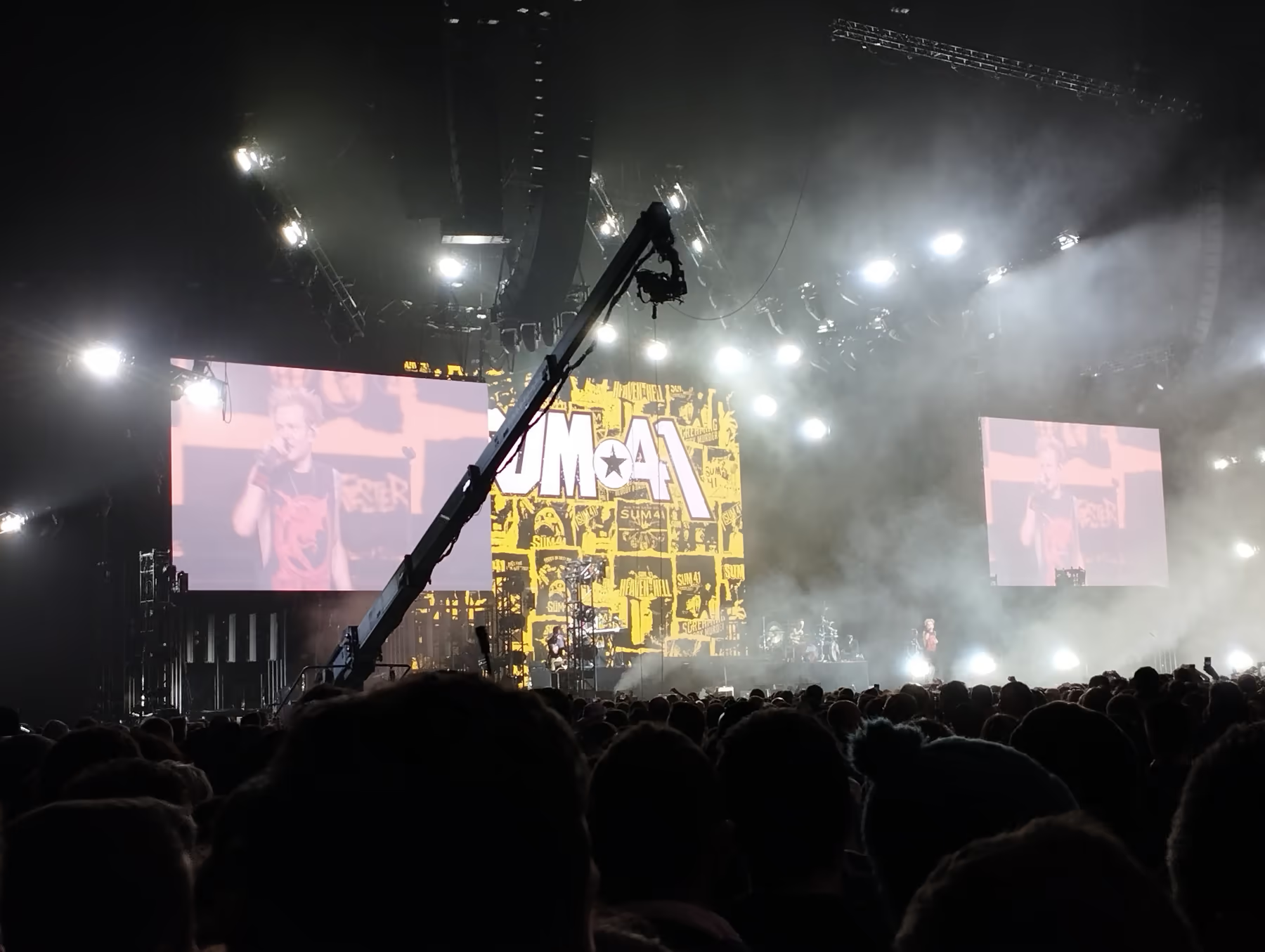
Sum 41 playing an arena show in 2024, with a large yellow stage backdrop carrying the band's logo, two video screens showing the singer, and a packed crowd silhouetted in the foreground.
Sum 41 at Paris La Defense Arena on 23 November 2024, on the farewell Tour of the Setting Sum. Photo by ManoSolo13241324, CC0, via Wikimedia Commons.

The band's arc after that was long and frequently hard. Dave Baksh left on 10 May 2006 and returned on 14 August 2015. Steve Jocz announced his departure on 18 April 2013. On 16 May 2014 Whibley revealed he had suffered liver and kidney failure caused by excessive drinking, and had to relearn how to walk and how to play. He recovered, the band carried on, and on 8 May 2023, twenty-two years to the day after the album's release, Sum 41 announced they would break up after a final album and tour. Heaven :x: Hell came out on 29 March 2024. The farewell run, the Tour of the Setting Sum, took in 117 shows from Seoul in February 2024 to Toronto in January 2025, with the Australian leg cancelled after Whibley was hospitalised with pneumonia. The last concert was on 30 January 2025 at the Scotiabank Arena in Toronto, a 29-song set that closed a career of almost thirty years, announced with the line that they were going to end it where it all began.

They played once more after that. On 30 March 2025, at the Junos in Vancouver, Joel and Benji Madden of Good Charlotte inducted Sum 41 into the Canadian Music Hall of Fame, and the band performed a medley of "Landmines", "Fat Lip", "Still Waiting" and "In Too Deep". The Maddens were the same two people who, twenty-four years earlier in a Los Angeles hotel, had watched a rough cut of the "Fat Lip" video and told four Canadians it was the last day anyone would not know who they were. The very last notes Sum 41 played in public included the song from this album.

Through all of it, All Killer No Filler remained the record. Between 1996 and 2016 it ranked among the twenty best-selling albums by a Canadian band in Canada. The list of bands who have gone on record citing Sum 41 as a formative influence is long and spread across two decades of guitar music: 5 Seconds of Summer, PVRIS, Neck Deep, Waterparks, Trash Boat, Roam, Seaway, Dune Rats, The Vamps, Bully and, from an entirely different genre, Marshmello. Lynn Gunn of PVRIS has given Kerrang! a whole interview on the subject of Sum 41 setting her on her musical path.

Not everyone came round. Noel Gallagher, asked about them years later, offered the definitive dissenting verdict: "After I heard Sum 41, I thought, I'm actually alive to hear the shittiest band of all time." It is worth putting next to the retrospective lists, because both are true to somebody. Kerrang! placed the album at 14 in its 51 greatest pop-punk albums of all time in 2017, and at 12 in a 2021 reassessment of the best albums of 2001. Rock Sound had it at 46 in 101 Modern Classics and 11 in its 51 Most Essential Pop Punk Albums.

The person least convinced remains its author. Twenty-five years on, Whibley still hedges. He told Billboard he had "always felt it wasn't that great, if I'm being honest", and that "for the longest time, I thought it wasn't a very good record". Asked in 2026 which song holds up, though, he did not hesitate: "'Fat Lip.' It was a favourite when I wrote it. It's still one of my favourites." A record made by four people who thought they were better musicians than they were, produced by a man who knew exactly how much better they could get, and titled after a joke an engineer made in the small hours. It sold nearly two million copies in America and it has outlived every argument anyone had about it.

Things You Might Not Know

FactDetail
The maths behind the nameThe band counted the days from the start of their school summer holidays to the date of the Warped Tour they wanted to see. It came to forty-one, and they debuted the name at a battle of the bands on 28 September 1996.
The title was an engineer's asideEngineer Joe McGrath is credited with remarking during the sessions that the record was all killer, no filler. The band liked it enough to put it on the sleeve.
The demo was rejected everywhereEvery major label turned down the music. What triggered a bidding war was a ten-minute VHS of the band pranking strangers with Super Soakers and staging a fake pizza-shop robbery.
Fat Lip was the second choice"In Too Deep" was originally slated as the lead single. The band pushed for "Fat Lip" because they loved it, and it went to number one on Billboard Alternative Airplay.
The label hated the false endingThe two-second gap at 1:38 in "Fat Lip" was objected to by the record company on the grounds that dead air kills radio play. The band kept it in.
Eighteen months of assemblyWhibley wrote the "Fat Lip" riff first, added the chorus six months later, wrote a verse separately, and only later realised all three parts were in the same key and tempo.
In Too Deep started as reggaeAccording to Steve Jocz, the song began as a reggae idea intended for Greig Nori's band Treble Charger, with a guest slot earmarked for the rapper Snow.
Ten minutes on the toilet"Pain for Pleasure" came together in about ten minutes, with Baksh supplying the Iron Maiden riff and Jocz writing over it. One book account has Jocz composing it on the lavatory. He sings lead; Whibley plays the drums.
An actual rapper taught themBefore the album, the band were coached in rapping by MC Shan, the veteran New York MC, at a studio in Scarborough, Ontario. Whibley recalls him being visibly frustrated by his suburban Canadian pupils.
Two cameo refusalsRodney Dangerfield declined to appear in the "In Too Deep" video parodying his own film, saying he did not do music videos. NOFX's Fat Mike turned down the diving-coach role and has been regretting it out loud to Whibley ever since.
The label president's blessingIsland Def Jam boss Lyor Cohen told the newly signed band to go out and cause as much damage as they liked and the company would pay for it. He later compared them favourably, in destructive terms, to the Beastie Boys.
El Nino came from SNLThe opening rap line about storming through a party was lifted from a Chris Farley sketch on Saturday Night Live, and for a long stretch it was the only lyric in the song that existed.
Written in a parked carWhibley wrote much of the record sitting in his parents' car on the driveway with an acoustic guitar and a tape recorder, in a Canadian winter, engine off because he was not allowed to waste their petrol.
A hip-hop art directorJonathan Mannion, the photographer behind Jay-Z's Reasonable Doubt and a slew of major rap sleeves, designed the outer inlay and interior group photo.
The blue British sleeveUK copies replaced the near-black photo grid with a blue one and added "Makes No Difference" as a fourteenth track, making the British first pressing visually distinct from every American copy.
Dave Baksh tapsThe lead guitar solo on "In Too Deep" is finger-tapped, a metal technique almost unheard of in mainstream pop-punk in 2001.
Slayer on a Sum 41 trackKerry King played the guitar solo on the re-recorded "What We're All About", which went to the Spider-Man soundtrack in 2002 and later onto the Japanese anniversary edition.
Skating into the charts"Summer", carried over from Half Hour of Power and re-cut for this album, landed on the Tony Hawk's Pro Skater 3 soundtrack in 2001.
Two Juno losses in one nightAt the 2002 Junos the album lost Best Album to Diana Krall's The Look of Love and Best Rock Album to Nickelback's Silver Side Up.
Certified before most people heard itThe RIAA certified the album platinum in the summer of 2001, only weeks after release, on the way to 1,690,000 US copies by October 2002.

Hear More on the Riffology Podcast

If this record was the soundtrack to your teenage bedroom, or if you have spent twenty-five years arguing with someone who insists it is disposable, the Riffology podcast digs into records like this one every episode: the sessions, the stories, the B-sides nobody remembers and the arguments that never quite got settled. You will find it on Apple Podcasts, Spotify, Amazon Music, Pocket Casts and every other major platform. Come and tell us whether Deryck Whibley is right about his own album. He is not.