To make Master of Puppets as tight as possible, producer Flemming Rasmussen had Metallica tune down slightly and play along to slowed tape, then sped the reels back up so the machine-gun riffs landed with perfect precision. Metallica wrote the album in about eight weeks during the summer of 1985, recorded it through the night in Copenhagen, and released it with no music video and no radio-friendly single.
It still became the first thrash album certified platinum in America, and in 2015 the first metal recording chosen for the Library of Congress's National Recording Registry. It was also the last record Cliff Burton made. Six months after it came out, the bassist was killed when the band's tour bus left the road in Sweden.
Album Facts
| Field | Detail |
|---|---|
| Artist | Metallica |
| Album | Master of Puppets |
| Release Date | 3 March 1986 (some sources give 24 February) |
| Label | Elektra; Music for Nations |
| Producer(s) | Metallica, Flemming Rasmussen |
| Studio(s) | Sweet Silence Studios, Copenhagen; mixed at Amigo Studios, Los Angeles |
| Genre / Subgenre | Thrash metal |
| Track Count | 8 |
| Total Runtime | 54:52 |
| Billboard 200 Peak | 29 (72 weeks on chart) |
| UK Albums Chart Peak | 41 |
| Other Notable Chart Peaks | Germany 4, Poland 3, Finland 5, Austria 10 (peaks to 2024) |
| Certifications | US 8x Platinum; Canada 6x Platinum; UK Platinum |
| Estimated Sales | 7,980,000 US (Nielsen SoundScan, 1991 to 2023) |
| Key Singles | Master of Puppets (France, July 1986) |
Cultural Context
Spring 1986 belonged to pop. Wham!, Whitney Houston, Sade and Dream Academy were all over the Billboard charts, and the metal on MTV was mostly camera-friendly glam. Metallica went the other way, deliberately avoiding the slick production and synthesisers of the hard rock and glam albums around them.
Underground, thrash was about to break. 1986 is now seen as the genre's pinnacle year:
- Slayer released Reign in Blood.
- Megadeth released Peace Sells... but Who's Buying?
- Anthrax followed with Among the Living in 1987.
- By the end of 1987 those three and Metallica were being called the Big Four.
Metallica's Story Before Master of Puppets
Five years in, Metallica had already laid the foundations of thrash with 1983's Kill 'Em All and stretched it with the more sophisticated songwriting of Ride the Lightning in 1984. That record caught the ear of Elektra Records' Michael Alago, who signed the band to an eight-album deal in the autumn of 1984, and Elektra reissued Ride the Lightning that November. The band parted with manager Jon Zazula and moved to Cliff Burnstein and Peter Mensch at Q Prime.
Rasmussen was already part of the family. Metallica had found him through his work on Rainbow's Difficult to Cure, whose guitar sound Kirk Hammett loved, and a strong dollar meant they could buy twice as much studio time in Europe. Rasmussen admitted he had never even heard of them before Lars Ulrich called. The band were also unhappy with the acoustics of the American studios they had considered, so for the third album they went back to Ulrich's native Denmark.
In the summer of 1985 they played the Monsters of Rock festival at Castle Donington, a middle-of-the-bill slot below ZZ Top that Rolling Stone called their biggest gig to date. The members' average age was 23.
Pre-production and Demos
Hetfield and Ulrich, who shared a house in El Cerrito, did most of the writing in their garage, working from cassettes of Burton and Hammett's ideas. The album was already called Master of Puppets before it was finished. The pair described each song starting as "guitar riffs, assembled and reassembled until they start to sound like a song". Then came a title and a topic, and Hetfield wrote lyrics to fit.
"Battery" was the first song written, followed by "Disposable Heroes". A rough summer demo, allegedly recorded the day after Live Aid, already had both of those, an instrumental "Master of Puppets", and a song called "Only Thing" that combined what became "Welcome Home (Sanitarium)" and "Orion". The two were split apart before the sessions, which meant "Orion" was not fully written when the band arrived in Denmark. "The Thing That Should Not Be" was the only other unfinished song. An early "Disposable Heroes" also carried an extra fast riff that ended up in "Damage, Inc."
"There's a spark or spontaneity or impulsiveness that happens when you're in your twenties. We wrote Master of Puppets in probably eight weeks over that summer."
Lars Ulrich, Rolling Stone, 2016
They prepared in other ways too. Ulrich took drum lessons and Hammett worked with Joe Satriani on recording more efficiently. Ulrich hoped Rush's Geddy Lee would produce, but the schedules never lined up, so Rasmussen got the job again. This was also the first Metallica album with no writing contributions from Dave Mustaine.
Creating Master of Puppets in Copenhagen
Recording at Sweet Silence ran from early September to 27 December 1985, nearly four months with only a two-day break at Christmas. It took longer than Ride the Lightning because the band had grown more perfectionist. Rasmussen's notes show them loosening up first on covers meant as possible B-sides: the Misfits' "Green Hell" and Diamond Head's "The Prince". Ulrich said in 1986 that the covers taught him to play the album songs "a lot more aggressively".
For a band already nicknamed Alcoholica, the sessions were disciplined. They had dinner at Rasmussen's house, started work at 7pm and finished between 4am and 6am, just in time for the hotel's free breakfast buffet. They stayed sober on recording days, and Rasmussen insists nobody partied in the studio.
Everything went to analogue 24-track on Ampex 456 tape through Rasmussen's 1976 Trident A Range desk and a UREI 1176, with two 24-track machines synchronised. The mantra was "no reverb!", so Rasmussen recorded plenty of room ambience instead. The guitar sound was built by stacking takes.
"The rhythm at no point was less than four guitars, and at some points it's eight guitars. We'd do James' sound on his guitar with his amp, and he would double that performance on Kirk's guitar."
Flemming Rasmussen, Mix, 2018
Burton hated headphones, so Rasmussen put him in the vocal booth with a pair of JBL 4333 speakers blasting the track while he jumped around as if he were onstage. Burton was a brilliant player with slight timing issues, which is where the slowed-tape trick came in. On the title track it brought the tuning back up to concert pitch, and Ulrich has since said the album version is "too tight".
Some of the key gear, as documented:
- Hetfield: Jackson King V through a Mesa/Boogie Mark IIC+ used as a preamp.
- Hammett: a 1974 Gibson Flying V, a Jackson Randy Rhoads and a Fernandes Strat copy.
- Burton: an Aria bass through Mesa/Boogie heads and cabinets.
- Ulrich: Tama drums, recorded in a 45-by-60-foot warehouse at the back of the studio.
- Snare: a Ludwig Black Beauty borrowed from Def Leppard's Rick Allen, overnighted to Copenhagen.
- Vocals: a Shure SM7B, with Hetfield's lead double-tracked.
Waiting for Ulrich to finish drums, Hammett and Burton went stir-crazy, walking round Copenhagen half-drunk and once finding a freezing, waveless beach. A game of liar's dice with Mercyful Fate ended in a drunken wrestling match that spilled into the street.
The mix was not finished in Denmark. In January 1986 the multitracks went to Michael Wagener at Amigo Studios in Los Angeles, who transferred the analogue reels to digital tape and mixed the album in two weeks. "They wanted it fairly dry, in your face, and everything loud," Wagener told Mix.
Personnel and Credits
| Role | Player | Notes |
|---|---|---|
| Core band | ||
| Vocals, rhythm guitar | James Hetfield | Also acoustic guitars on Battery; first solo on the title track; second solo on Orion; all lyrics |
| Lead guitar | Kirk Hammett | |
| Bass, backing vocals | Cliff Burton | Final album |
| Drums, percussion | Lars Ulrich | |
| Production and engineering | ||
| Producers | Metallica, Flemming Rasmussen | Rasmussen also engineered |
| Assistant engineer | Andy Wroblewski | |
| Mixing | Michael Wagener | Amigo Studios, Los Angeles |
| Assistant mixing engineer | Mark Wilzcak | |
| Mastering | George Marino | Also the 1995 remaster |
| 2017 remastering | Howie Weinberg, Gentry Studer | |
| Artwork | ||
| Cover concept | Metallica, Peter Mensch | |
| Cover illustration | Don Brautigam | |
| Inner sleeve photos | Ross Halfin | |
| Back cover photos | Rich Likong, Ross Halfin, Rob Ellis | |
The credits are just the four of them, but the parts were shared out with care. Hetfield takes the melodic first solo over the clean middle of the title track before Hammett's more virtuosic one. On "Orion", Burton originally wanted to play every solo on bass and reluctantly gave some up; the finished track has two from Burton, one from Hetfield and three from Hammett. Rolling Stone credits Burton with co-writing close to half the album.
The Songs
| # | Title | Writer(s) | Length | Single? | Notes |
|---|---|---|---|---|---|
| 1 | Battery | Hetfield, Ulrich | 5:13 | No | First song written; riff improvised in London |
| 2 | Master of Puppets | Hetfield, Ulrich, Burton, Hammett | 8:36 | Yes (France) | Burton's favourite Metallica song |
| 3 | The Thing That Should Not Be | Hetfield, Ulrich, Hammett | 6:37 | No | Lovecraft-inspired; unfinished when sessions began |
| 4 | Welcome Home (Sanitarium) | Hetfield, Ulrich, Hammett | 6:28 | B-side | Inspired by One Flew Over the Cuckoo's Nest |
| 5 | Disposable Heroes | Hetfield, Ulrich, Hammett | 8:17 | No | First album song played live, September 1985 |
| 6 | Leper Messiah | Hetfield, Ulrich | 5:40 | No | Attacks televangelism; title from Bowie's Ziggy Stardust |
| 7 | Orion | Hetfield, Ulrich, Burton | 8:28 | No | Instrumental; Burton wrote the middle section |
| 8 | Damage, Inc. | Hetfield, Ulrich, Burton, Hammett | 5:33 | No | Opens with reversed bass chords based on Bach |
The running order mirrors Ride the Lightning: a fast opener with an acoustic intro, a long title track, and a fourth track with ballad qualities.
Battery
"Battery" opens on acoustic guitars Rolling Stone described as Ennio Morricone-inspired before the band crashes in. Hetfield came up with the riff while relaxing in London. The title reads as "assault and battery", but the lyric also nods to the San Francisco thrash scene and the Old Waldorf at 444 Battery Street, the most prominent club Metallica played.
Master of Puppets
Eight and a half minutes of downpicked chromatic riffing, with the opening riffs at around 212 beats per minute, a clean middle section and a fade-out of sinister laughter. Burton and Hammett slipped in a riff quoting David Bowie's "Andy Warhol" as a homage. The lyric is about addiction.
"I just went to this party in S.F. and there was a bunch of sick freaks shooting up, and it made me sick. It's not about any drug in general but people being controlled by drugs and not the other way around."
James Hetfield, 1986, quoted in Rolling Stone, 2016
The Thing That Should Not Be and Welcome Home (Sanitarium)
"The Thing That Should Not Be" is H.P. Lovecraft set to down-tuned, Black Sabbath-style guitars, with references to The Shadow over Innsmouth and Cthulhu, and a main riff meant to sound like a beast dragging itself into the sea. "Welcome Home (Sanitarium)", from Ken Kesey's One Flew Over the Cuckoo's Nest, swaps between 4/4 and 6/4 time. Rasmussen said Hetfield had been "more of a shouting kind of vocalist" on Ride the Lightning, and that the improvement on this record was "massive".
Disposable Heroes and Leper Messiah
"Disposable Heroes" is an anti-war song with sections at 220 beats per minute, and Hammett modelled the guitar passage at the end of each verse on war-film music. Ulrich rates its lyrics among his favourites that Hetfield has written. "Leper Messiah" goes after televangelists, moving from 136 beats per minute to a gallop at 184 and climaxing in a scream of "Lie!"
Orion and Damage, Inc.
"Orion" opens with Burton's bass processed to sound like an orchestra, and was named after the constellation because of its "spacey sounding" bridge. Rasmussen said Burton arrived with "more or less all of the ideas himself" and perfected them in the studio.
"For me, 'Orion' was Cliff Burton's swan song. It was a great piece of music, and he'd written the whole middle section."
Kirk Hammett, Rolling Stone, 2016
The closer, "Damage, Inc.", starts with reversed bass chords based on Bach's "Come, Sweet Death" and then drops into a pedal-point riff in E that Hammett says was influenced by Deep Purple.
Outtakes and Lost Songs
The first songs Metallica recorded in Copenhagen never made the album. Those warm-up covers came back later with Jason Newsted on bass: "Green Hell" was combined with the Misfits' "Last Caress" on 1987's The $5.98 E.P.: Garage Days Re-Revisited, and "The Prince" became the B-side of "One". Rough mixes and September 1985 drum-room jams of "The Prince" and "The Money Will Roll Right In" finally surfaced on the 2017 box set.
Album Artwork and Packaging
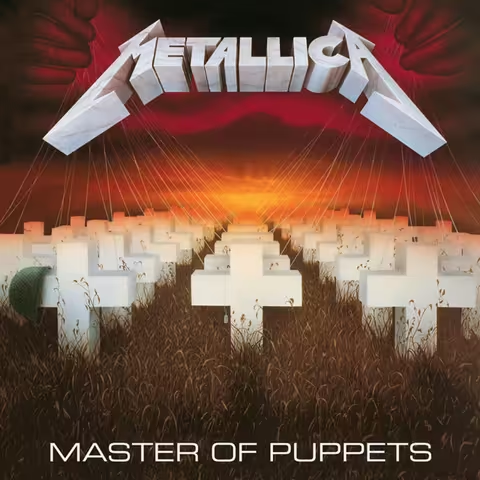
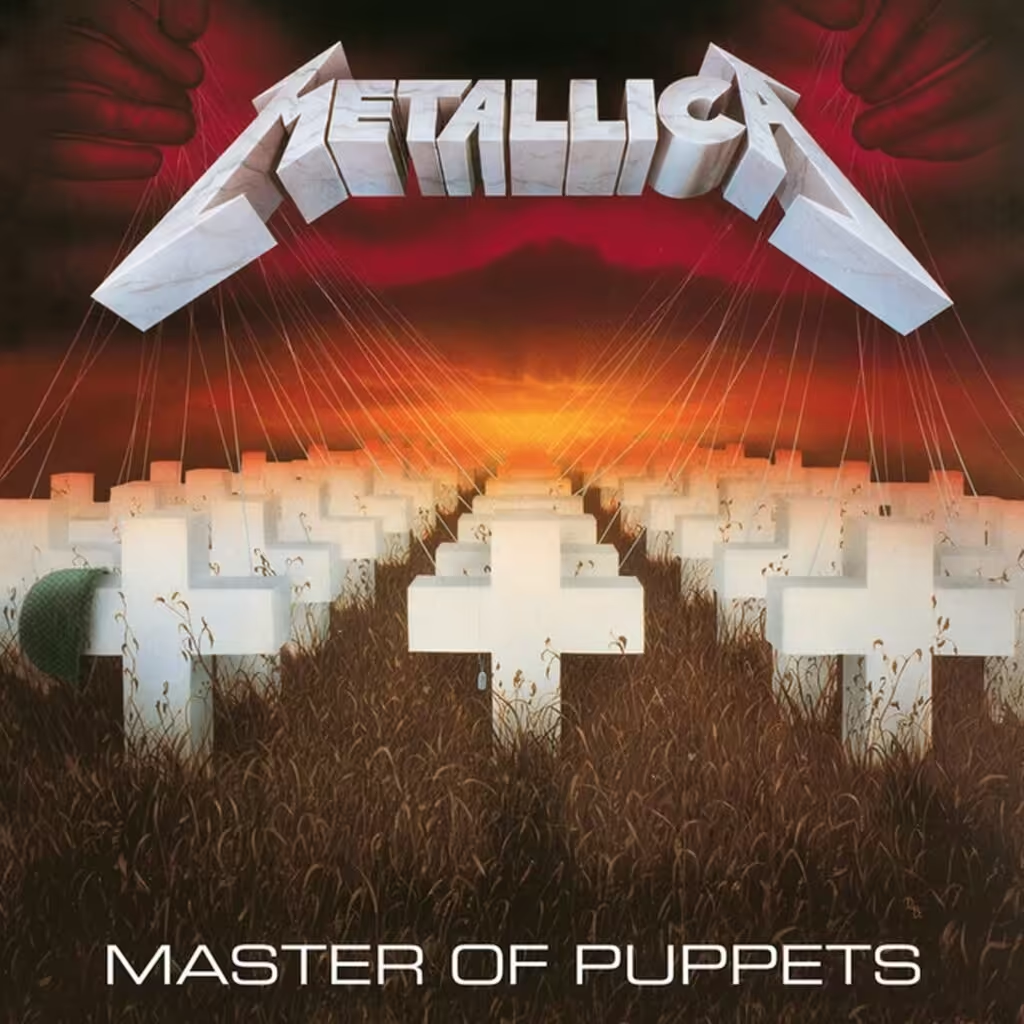
The cover was conceived by Metallica and Peter Mensch and painted by Don Brautigam. Two red hands reach down from the top corners, pulling strings tied to the white Metallica logo and to row after row of white crosses in a field of long brown grass. The sky behind is blood red, burning orange on the horizon. A green helmet hangs on one cross at the left and dog tags dangle from the centre cross, details that point most directly at "Disposable Heroes". Ulrich said the image summed up the album's subject: people being manipulated without realising it.
Ross Halfin shot the inner-sleeve photographs. The band also took a swipe at the PMRC with a fake parental advisory notice warning that "The only track you probably won't want to play is 'Damage, Inc.' due to multiple use of the infamous 'F' word."
Release and Reception
Master of Puppets came out on 3 March 1986, though some sources give 24 February. It entered the Billboard 200 at No. 128 on 29 March, climbed to No. 29 and stayed on the chart for 72 weeks, against 50 for Ride the Lightning. Billboard reported 300,000 sales in its first three weeks, and it passed half a million in its first year with almost no radio play. In the UK it reached No. 41, the band's highest chart placing there at the time.
Rolling Stone's Tim Holmes called it "the sound of global paranoia" and wrote that "If they ever award a titanium album, it should go to Master of Puppets." Kerrang! said it "finally put Metallica into the big leagues where they belong". Not everyone agreed. Spin's Judge I-Rankin was disappointed, and Robert Christgau gave it a B-minus. Later critics were kinder: AllMusic's Steve Huey called it the band's best album, and PopMatters heard "a metal version of Phil Spector's Wall of Sound".
| Market | Award | When |
|---|---|---|
| US (RIAA) | Gold | November 1986, the band's first |
| US (RIAA) | Platinum | July 1988, a first for thrash |
| US (RIAA) | 6x Platinum | 2003 |
| US (RIAA) | 8x Platinum | May 2025 |
| UK (BPI) | Silver, then Gold | January and December 1987 |
| UK (BPI) | Platinum | 2016, three decades after release |
Singles and Music Videos
Metallica made no video for the album and released nothing ahead of it, choosing to tour instead. The only single was the title track, issued in France on 2 July 1986 as a 7-inch with the song cut to 3:27 and a 4:06 version of "Welcome Home (Sanitarium)" on the flip.
Touring and Live
The Damage, Inc. Tour ran from 27 March 1986 to 13 February 1987. From March to August Metallica opened for Ozzy Osbourne in American arenas, their first arena tour, playing 45-minute sets. Osbourne took their soundcheck jams on Black Sabbath riffs as mockery, though Ulrich said the band were honoured to be there. Between 23 May and 7 June they also headlined a run of US dates with Armored Saint.
In July Hetfield broke his arm skateboarding, and guitar tech John Marshall of Metal Church played rhythm guitar from 27 July to 25 September. Hetfield played rhythm again at Solnahallen in Stockholm on 26 September. It was Burton's last show.
At around 6.30 the next morning, on the way to Copenhagen, the bus left the road near Ljungby. Burton was thrown through a window and the bus fell on him. He was 24. The driver blamed ice and was charged with manslaughter but not convicted. Hetfield walked the road looking for the ice, and police found none either. "Orion" was played at Burton's funeral. Jason Newsted of Flotsam and Jetsam was hired on 28 October and played his first show on 8 November. In February 1987 Metallica played Katowice, the first of the Big Four to play behind the Iron Curtain.
The title track, first played on New Year's Eve 1985 in San Francisco, is now the band's most-played song. In 2006 they played the whole album on the Escape from the Studio '06 tour, which also gave "Orion" its first full live performance. Ulrich called the anniversary run "the first time we allowed ourselves to look in the rear-view mirror and feel good about what we had done in our past."
In TV, Film and Media
- Stranger Things: Eddie Munson plays the title track in the Upside Down in the season four finale, first shown on 1 July 2022.
- The song entered the Billboard Hot 100 for the first time, peaking at No. 35.
- In the UK it reached No. 22, their first Top 40 single since 2008.
- Films: Old School (2003) and the opening credits of Zombieland: Double Tap.
- Games: "Battery" is in Rock Band 2, Guitar Hero: Metallica and Fortnite Festival.
Controversy and Borrowing Claims
Dave Mustaine claimed a co-write on "Leper Messiah", saying it grew out of an old song called "The Hills Ran Red". Metallica denied it, while accepting that one section used his ideas. Mustaine also says Ulrich wrote the title track's opening riff while Mustaine was still in the band. The Sunday Times, meanwhile, said Metallica had "borrowed" the riff of "Welcome Home (Sanitarium)" from Bleak House's 1980 track "Rainbow Warrior".
Covers, Samples and Tributes
- Dream Theater covered the whole album on tour in 2002, later issued as an official bootleg.
- Kerrang!'s April 2006 tribute, Master of Puppets: Remastered, featured Machine Head, Bullet for My Valentine, Chimaira, Mastodon, Mendeed and Trivium.
- Apocalyptica covered "Welcome Home (Sanitarium)".
- DJ Shadow sampled the "Orion" bass intro on "The Number Song" from Endtroducing.....
- Rivers Cuomo has called Weezer's "Undone - The Sweater Song" "almost a complete rip-off" of "Welcome Home (Sanitarium)".
Reissues, Remasters and Anniversaries
George Marino, who mastered the original, remastered it in 1995. A digital reissue added live versions of "Battery" and "The Thing That Should Not Be" from the Seattle Coliseum in August 1989. The big one arrived on 10 November 2017, a remastered box set with 10 CDs, three vinyl records, two DVDs and a cassette. Inside are the remastered album, a 1986 show at Chicago's Aragon Ballroom, 50 tracks of rough mixes, riff tapes and demos, four CDs of soundboard recordings including Newsted's audition, interviews, and a fan cassette of the final Stockholm show. Pitchfork gave it 10/10. A three-CD edition was also released.
The Legacy of Master of Puppets
In writer Christopher Knowles's words, the album "ripped Metallica away from the underground and put them atop the metal mountain". Histories now tend to treat Ride the Lightning, Master of Puppets and ...And Justice for All as a trilogy. Burton's influence carried into that next record: many of its songs were written while he was alive, and his unused riffs went into "To Live Is to Die". When Rick Rubin was preparing Death Magnetic, he asked the band to think about what they had been listening to while making Master of Puppets.
The accolades have piled up:
- The first metal recording in the National Recording Registry, from the 2015 selections announced in March 2016.
- Rolling Stone's 500 Greatest Albums: No. 167 in 2003 and 2012, No. 97 in 2020.
- No. 2 on Rolling Stone's 2017 greatest metal albums list, behind Paranoid.
- Included in Time's 100 best albums; named the best heavy metal album ever by IGN.
- Robert Trujillo's favourite album, with "Disposable Heroes" one of his favourite Metallica songs.
"Master Of Puppets is superb, maybe their masterpiece. I've turned down so many bands over the years who thought they'd automatically get their own Master... just by working with me: not every band can be Metallica!"
Flemming Rasmussen, Louder, 2022
Things You Might Not Know
| Fact | Detail |
|---|---|
| Under the hour | At 54:52, it is still the most recent Metallica studio album to run under an hour. |
| Ulrich's snare habit | After borrowing Rick Allen's Black Beauty, Ulrich found one in a Danish shop at its 1976 price. Rasmussen says he now owns about 20. |
| Cliff's poker rules | Burton loved calling wild cards in studio poker games: deuces, one-eyed jacks and black kings, all for stakes worth about ten cents. |
| A book title | "Disposable Heroes" takes its title from the book Fahrenheit 451. |
| Hetfield's tattoo | After Burton's death, Hetfield had the notes from the bridge of "Orion" tattooed on his left arm. |
| The painting's price | Brautigam's original cover painting sold at Christie's in New York for $35,000 in November 2008. |
| A Trujillo on the track | Robert Trujillo's son Tye, then 17, added guitar tracks to the version of the title track used in Stranger Things. |
| Billion-stream epic | At 8:36, the title track became the second-longest song ever to pass a billion streams. |
| Crosses onstage | Filming Metallica: Through the Never at Vancouver's Rogers Arena, crosses rose from the stage during the title track, echoing the cover. |
| Rasmussen's missing copy | Rasmussen told Rolling Stone in 2016 he was not sure he still owned the CD, because his children kept stealing it. |
Listen to the Riffology Podcast
Want the full story told out loud? The Riffology podcast covers Master of Puppets, from El Cerrito and Copenhagen to the road outside Ljungby, and you can find it on all major podcast platforms.
Comments