
By the autumn of 1987 Slayer were at the absolute commercial and creative peak of American thrash metal, and absolutely uncertain about what to do next. Reign in Blood, released in October 1986, had compressed an entire genre into a twenty-nine minute statement so perfectly sealed that even the band could not see how to extend it. Producer Rick Rubin had pulled their sound out of the speed-metal underground into a cleaner mid-range that exposed every note Dave Lombardo, Jeff Hanneman and Kerry King played. The four-piece had spent twelve months pushing that record into the world: the Reign in Pain tour with Overkill, the Combat Tour II with Anthrax through summer 1987, and then UK and European dates that stretched into the autumn. By December 1987 they were back in Los Angeles, with no fully written songs and an awkward question to answer.
The question was not a creative one, exactly. It was a positional one. Reign in Blood had defined what a Slayer record was supposed to sound like in a way that no previous Slayer record had managed. Whatever followed would inevitably be measured against it. Hanneman would later say South of Heaven was the only Slayer album the band ever actually discussed before they wrote any music for it, because, in his words, they could not top Reign in Blood and they knew that whatever they recorded would be compared to it. The decision the four of them reached was a counter-intuitive one. They would slow down.
The broader context made the call harder still. By late 1987 the American thrash hierarchy had clarified into the loose grouping that the press would shortly start calling the Big Four. Metallica had released Master of Puppets in March 1986 and were sitting on a follow-up that would arrive in August 1988 as ...And Justice for All. Megadeth had put out Peace Sells... but Who's Buying? in September 1986 and were working on So Far, So Good... So What!. Anthrax, fresh off the road with Slayer themselves, were preparing State of Euphoria. Each of the other three would, in their own way, push harder, longer, faster or more political. Slayer, the band that had just released the most uncompromising of all those records, were the only one of the four to respond by deliberately stepping off the accelerator.
The decision to slow down
Slowing down was not a thing Slayer had ever done on a studio album before, and arguably not a thing they ever fully did again. The early records had been engaged in an arms race with their Bay Area and East Coast peers to be the fastest, ugliest and most extreme thing on a Metal Blade or Def Jam invoice. Reign in Blood had won that race so decisively that the only useful response was to step out of it. "We had to slow down," Hanneman said simply in interviews around the time, the most quoted single sentence of the album cycle. Kerry King framed the same decision in more strategic terms, calling it a move to keep people guessing. The official Slayer band biography put it cleanest of all: "in order to contrast the aggressive assault put forth on Reign in Blood, Slayer consciously slowed down the tempo of the album as a whole. They also added elements like undistorted guitars and toned-down vocal styles not heard on previous albums."
That last sentence is the more interesting one. Reducing tempo was the headline, but the band were also opening the arrangements. The wall-to-wall density of Reign in Blood had compressed songs into ninety-second sprints. Here, riffs that would have been blasted past at one hundred and ninety beats per minute were given room to walk. Clean guitars, dropped vocals and arrangement space, things Slayer had previously banned from their records on principle, were quietly waved through.
Hit City West and Chung King
From December 1987 into February 1988 the band split the album between two studios on opposite coasts. Most of the tracking happened at Hit City West in West Los Angeles, a room Rick Rubin and his engineers had been favouring for hard-rock and metal sessions, with its wide live room and a clean monitor path that suited the dryer Slayer sound Rubin had been pursuing since Reign in Blood. Additional work was done at Chung King Studios in lower Manhattan, then Def Jam's house facility, two years into its life and still primarily a hip-hop room. Chung King had been built around Run-DMC and LL Cool J sessions and was not necessarily where anyone expected a thrash-metal follow-up to be tracked, but it was Def Jam's room and Def Jam was paying.
The split between the two studios was practical rather than conceptual. Rubin's diary was already pulling him between coasts. Engineers were swapped in as availability dictated. Bill Freesh, Peter Kelsey and Steve Ett are all credited on recording alongside Andy Wallace, with overdubs and vocal sessions slotted in where rooms were free. The album's total studio time has never been publicly itemised, but the assembled record runs to thirty-six minutes and fifty-four seconds across ten tracks, nine originals and one Judas Priest cover.
Rick Rubin's hands-off command
Rubin produced South of Heaven, but the production credit on the sleeve is shared with the band themselves, and the arrangement reflects the reality of how the sessions went. By 1988 Rubin had already shaped his late-Eighties production stance: arrange ruthlessly in pre-production, then track the band largely live and add minimal overdubs, leaving the performances exposed and the air around them audible. He shaped the song framings, pushed the band on arrangement decisions and then let them play. The hands-off-but-controlling approach gave Slayer more authorship of the record than they had taken on Reign in Blood, where Rubin's role in stripping their sound had been the dominant story.
The audible result is that the songs on South of Heaven sound forensic. The PopMatters reviewer Adrien Begrand later observed that the mix "shoves Lombardo's drumming right up front", and the kit sound is one of the most exposed and least processed in the Slayer catalogue. Guitars are dryer than the late-Eighties metal norm. Vocals sit in the mid-range rather than being scooped out to make room for cymbals. Space, on a Slayer record, was a deliberate provocation, and Rubin and the band signed off on it together.
Andy Wallace and the mix
Andy Wallace mixed the record, his name credited alongside the recording team rather than the production team but his contribution arguably the most consequential of any non-band hand on the album. Wallace at this point was still building the rock-mix CV that, three years later, would produce Nevermind for Nirvana. Before he was the most in-demand mixer in alternative rock, he was the man Rubin trusted to make a Slayer record sit on a stereo. The mix he delivered keeps Lombardo's kit at the front of the picture, holds the guitars in a tight stereo pair with very little widening trickery, and resists the temptation to gate or compress the natural ring out of the snare. Tom Araya's bass, sometimes invisible on the previous Slayer records, is audible on most of South of Heaven as a separate instrument rather than as a guitar shadow.
Howie Weinberg mastered the album at Masterdisk in New York. It was the start of a working relationship that would run through every subsequent Slayer record up to God Hates Us All in 2001, and it produced one of the more conservative-sounding masters in the band's catalogue: dynamic, not crushed, with the cymbal transients still doing the work that latter-day mastering would flatten.
Guitars, amps and the dry sound
The guitar rigs on the record sit at a hinge point in both players' careers. Jeff Hanneman tracked most of his parts on his BC Rich Mockingbird, still his primary stage guitar in 1988, running into a Marshall JCM800 head with a Boss SD-1 pedal in front for a tube-stage push rather than a distortion of its own. Kerry King ran a similar Marshall stack, with the JCM800 alongside the head that, decades later, Marshall would build into his 2203KK signature; his own ESP signature guitars were still years off and his BC Rich Mockingbird era was approaching its end. Tom Araya played a Fender Precision and a BC Rich Eagle bass through an Ampeg SVT rig that, on this record more than any other, was actually allowed to be heard.
What is striking, listening back, is how little post-amp processing is present. Hanneman in particular leaned on natural tube saturation rather than the noise gates and stompbox chains that had already become the late-Eighties metal standard. The album sounds dryer and more naturally distorted than its peers; where Metallica had begun layering gated, scooped tones on Master of Puppets, Slayer on South of Heaven were going in the opposite direction, trusting the room and the amp and leaving the listener nowhere to hide.
The room and the amp are also doing more compositional work than is sometimes credited. The slower tempos exposed not only the players but the harmonic content. A chromatic riff that flickered past in a blur on Reign in Blood stretches out on South of Heaven as a sequence of audible chord changes. Hanneman's writing on the record uses more half-step movement and more sustained tritones than the previous album allowed; both choices read as deliberate exploitation of the new headroom. King's writing leans the other way, towards punkier riffs delivered with more weight, the seed of the groove direction the band would explore further on Seasons in the Abyss.
Lombardo up front and Araya singing
Dave Lombardo's drum kit on the record was a Tama setup with a forward-mounted rotary rack and a large bass drum, voiced for the forensic close-mic'd recording the Rubin and Wallace setup produced. The kit is forward in the mix and is recorded in a way that exposes the player as much as the part, the kind of presentation that flattering compression usually hides.
Araya's vocals push in two specific directions on South of Heaven, neither of which would recur to the same extent on a later Slayer record. The first is the sustained, almost-singing mid-range he uses on the title track, holding melodic notes for whole bars rather than barking syllables at thrash tempo. The second is the cleaner, almost crooned passages he delivers on the album closer "Spill the Blood", a register he had largely buried on the previous three Slayer albums. Kerry King later said in print that Araya had "added too much singing" on the record. Hanneman, in the same forum, defended the choice as essential to the album's overall shape. Both men were arguing about the same fact: South of Heaven is the only Slayer album where the vocalist is asked to sing.
"South of Heaven" the song
The opener and title track is the album's manifesto. It begins on a sinewy clean-guitar pattern by Hanneman that runs for over forty seconds before the band crashes in, and then settles into a mid-tempo, almost doom-metal groove that runs at roughly half the speed of anything on Reign in Blood. The lyric, written by Araya to Hanneman's music, casts Slayer's longstanding apocalyptic imagery in a slower, ceremonial mode: instead of being shouted past, the imagery is allowed to hang in the air. Kerry King takes the first guitar solo, Hanneman the second. Released as the first single from the album, the song became the band's first true live anthem and would open most Slayer concerts for the next three decades, an unusual opener for a band whose stock-in-trade had always been starting a show with the fastest thing in the set.
"Silent Scream" and "Live Undead"
"Silent Scream", the album's second track, is the major exception to the slow-down strategy and the album's clearest callback to Reign in Blood. It is built around a Lombardo double-kick figure that opens at brutal tempo, with King and Hanneman trading short bursts of solo across the verses. The lyric concerns abortion, and the song became one of the album's most-covered tracks on tribute records. Max Kolesne, the drummer for the Brazilian death-metal band Krisiun, later named hearing "Silent Scream" for the first time as a foundational moment, citing the fast double-bass figure running unchanged underneath the entire song.
"Live Undead", track three, is the album's most theatrical cut. The lyric is a first-person zombie monologue. The structure is an exercise in tempo changes with seven separately marked guitar solos sequenced across the song's three and a half minutes, with Hanneman taking solos one, four and seven and King taking two, three, five and six. It is a song built to be analysed by the kind of fan who pauses cassettes to copy out solo orders by hand, and many did.
"Behind the Crooked Cross" and Hanneman's war material
"Behind the Crooked Cross" is Hanneman's solo writing credit on lyrics and music, a song about a Nazi soldier's regret rather than any kind of endorsement. It is the kind of moral-grey-area war material Hanneman would write throughout his Slayer career and that his bandmates sometimes had to defend in the press on his behalf. The lineage runs from "Angel of Death" on the previous album to "SS-3" and "Eyes of the Insane" much later, and "Behind the Crooked Cross" is the most ambivalent of them: the narrator is a former believer looking back, not a participant being celebrated.
The song was rarely played live, because Hanneman said in interviews that he hated it. King has gone on record saying he wanted to play it, in his words, because it has a cool intro, but never managed to convince the rest of the band to put it in a setlist. The track is therefore one of the album's curious orphans: a perfectly serviceable Slayer song that the band themselves quietly buried.
"Mandatory Suicide"
Together with the title track, "Mandatory Suicide" is the album's other near-permanent live setlist fixture and arguably its most influential single piece of writing. Mid-tempo, built on a Lombardo tom-and-snare verse pattern that became one of the most-copied beats in late-Eighties metal, with King's spoken-word breakdown in the bridge ("And the blood will spill, the bodies will lie") and the long shouted chant of the title across the chorus. Released as the album's second single, it became the Slayer song most likely to introduce a new listener to the band's mid-tempo capabilities, a counter to the assumption from the previous record that Slayer existed only at top speed.
What is interesting about "Mandatory Suicide" in 2026 is that it is the song most often pointed to by younger metal bands as the moment thrash learned to groove. The verse pattern, transposed and slowed further, became the unspoken template for any number of mid-Nineties groove-metal records that followed. Slayer themselves remained largely indifferent to that influence in interviews, but the lineage is hard to argue with.
"Ghosts of War", "Read Between the Lies" and "Cleanse the Soul"
"Ghosts of War", a King and Hanneman collaboration, is the heaviest writing on the record. It carries a long heavy outro that King has said in interviews is his favourite section of the whole album. In the same interviews he has wondered aloud about an alternate timeline in which the band put the heavy ending at the end of "Chemical Warfare" from the previous record and just did the last half, an idea he could never get past the rest of the band.
"Read Between the Lies" is the album's attack on television evangelism, music by Hanneman, lyrics by Araya and King. It is built on a chromatic descending riff and on one of the album's more overt thrash arrangements, a chosen point of contrast to the slower material around it. "Cleanse the Soul" has the unusual distinction of being the Slayer recording King has been most publicly critical of. He has called it "one of the black marks in our history" and has described its opening riff as a "happy riff", a word he uses as a slur. He has conceded that the heavier section after the opening works for him, which is something.
"Dissident Aggressor" and the Grammy that went to Tull
"Dissident Aggressor" is the Judas Priest cover, originally on Priest's Sin After Sin in 1977, written by Glenn Tipton, Rob Halford and K. K. Downing. It is the first studio cover Slayer ever recorded. Hanneman has said it was chosen because of its war-themed lyric and because it was a personal favourite of both his and King's. The Slayer reading is dryer and angrier than the original, replacing Halford's operatic upper register with Araya's shouted mid-range and trading Priest's twin-lead choreography for a faster, more chromatic solo section.
Slayer's version was nominated for Best Metal Performance at the 31st Annual Grammy Awards in February 1989. It lost, in the same category that the famously absent Metallica had been favoured to win for ...And Justice for All, to Jethro Tull's Crest of a Knave. The Tull win became the defining punchline of the early Grammy metal category and led directly to the category being split the following year. The footnote that Slayer were also nominated, for a Judas Priest cover from a record largely about deliberately not being a thrash record, is one of the more interesting historical accidents of the late-Eighties metal canon.
"Spill the Blood" and the quiet ending
"Spill the Blood" is Hanneman's solo writing credit on the album closer, and is the most deliberate musical statement on the record. It opens on a clean acoustic guitar arpeggio over a tolling bell pattern, then escalates through Araya's cleanest singing on any Slayer record before snapping into a riff-led second half. The contrast with the opening of Reign in Blood, which began on the screams of "Angel of Death" and never let up, could not be more deliberate. Reign in Blood opened on extremity; South of Heaven closes on quiet. The framing is the whole point.
The track was never a live regular, in part because the arrangement is hard to reproduce on a thrash-metal touring rig, in part because Slayer's audience never quite wanted to sit through the quiet first half. As a recorded statement, however, it is the album's most underrated moment, and one of the cleanest pieces of writing Hanneman ever delivered on his own.
Larry Carroll's skull and Columbia's refusal
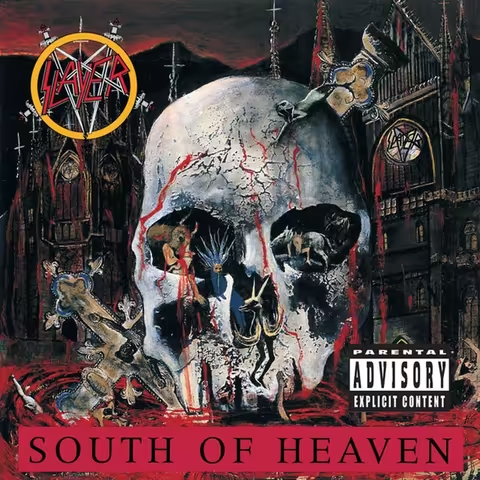
Larry Carroll's cover art continues the visual language he had established for the band on Reign in Blood. This time the central figure is the KNM-ER 1470 skull, an incomplete archaic-human skull of the extinct species Homo rudolfensis discovered in 1972 in Koobi Fora, Kenya, by the field worker Bernard Ngeneo working for Richard Leakey, and dated to approximately one point nine million years old. The skull is rendered in Carroll's now-trademark scratched-and-burned line work, surrounded by the upside-down crosses and inverted ecclesiastical iconography that had become the band's stock visual vocabulary. Howard Schwartzberg co-illustrated again. Douglas Day handled the overall sleeve design. Glen E. Friedman's promotional photograph from 1986, originally shot around the Reign in Blood release, became the back cover image, and one of the most reproduced shots of the four-man Slayer lineup.
The release itself ran into the same distribution wall that had bedevilled the previous record. Columbia Records, which then distributed Def Jam in the United States, had refused to release Reign in Blood over the "Angel of Death" lyric and refused to handle South of Heaven on similar grounds. Def Jam used a Geffen-through-Warner Bros workaround to get the record into US shops, one of only two Def Jam titles released that way. It was the last Slayer record to come out on Def Jam. When Rick Rubin shortly afterwards ended his partnership with Russell Simmons, the Slayer catalogue moved to Rubin's new Def American imprint, later just American Recordings, and would remain there for the rest of the band's recording career.
The choice of the KNM-ER 1470 skull is, in retrospect, more pointed than Carroll's previous Slayer work. Reign in Blood's sleeve had been a thicket of inverted religious imagery rendered in pure heavy-metal idiom. South of Heaven swaps that for a single, ancient, scientifically dated object: a fossil older than any of the religions the band were busy inverting. The visual argument runs in parallel to the musical one. Both are about taking a step back from the maximalism of the previous record and letting a single image, or a single mid-tempo riff, do the work that a wall of crosses or a wall of sixteenth notes had done before. Carroll's continued involvement, across Reign in Blood, South of Heaven and Seasons in the Abyss, gave the late-Eighties Slayer catalogue a unified visual identity matched by very few bands of the period.
Release, reviews, touring and legacy
South of Heaven was released on 5 July 1988 into a divided press. Some critics praised the band's willingness to try something other than Reign in Blood Part Two; others felt the slower tempos had cost Slayer the very thing that made them Slayer. Kim Neely's Rolling Stone review famously dismissed the record as "genuinely offensive satanic drivel". Kerrang gave it five stars. Metal Forces awarded it eight out of ten. Collector's Guide to Heavy Metal went all the way to ten out of ten. AllMusic, with retrospective benefit, gave it four stars. Robert Christgau, with characteristic spread of the difference, gave it a B minus. The chart numbers were respectable rather than spectacular: number 57 on the Billboard 200, number 25 in the UK, number 23 in Germany, number 11 in Finland, number 31 in the Netherlands, number 50 in Sweden, number 53 in Australia, number 89 in Canada, number 91 in Ireland.
The longer arc is more interesting. The RIAA certified the album Gold on 20 November 1992, Slayer's second US Gold album after Seasons in the Abyss. On 1 January 1993 the BPI awarded it Silver, the very first UK certification for any Slayer album. Music Canada later certified it Gold. Decibel magazine inducted it into its Hall of Fame in January 2013, the second and last classic Slayer album to be inducted before Jeff Hanneman's death on 2 May of that same year from alcohol-related cirrhosis. In 2017, Rolling Stone, the same magazine that had once called the record drivel, placed it at number 47 on its 100 Greatest Metal Albums of All Time. The journey from review to canon took twenty-nine years.
Touring around the album ran through 1988 and 1989. Most shows opened with the title track, the slow ceremonial entrance that became the band's permanent opener for decades afterwards. The shows leaned heavily on Reign in Blood material but added five or six South of Heaven cuts to most setlists. The Hell on Earth Tour in summer 1988 paired the band with Motorhead and Overkill. The Headbangers Ball Tour later that year added Voivod. European dates in early 1989 closed the cycle. For audiences whose previous Slayer encounter had been the relentless forward motion of Reign in Blood, the new material gave them their first opportunity to hear Slayer breathe between songs.
As legacy, South of Heaven is the pivot point between Slayer the cult thrash-metal phenomenon of the mid-Eighties and Slayer the platinum-shipping metal institution of the early Nineties. The album proved that the band could write a slower record without ceasing to be Slayer. It set the template for Seasons in the Abyss in 1990, which then went platinum on the back of "Seasons in the Abyss" and "War Ensemble" and confirmed Rubin as the band's permanent producer. The influence of the slower material has rippled outwards across the doom-thrash subgenre and across the wider category of slow-burn second-record strategies: both Sepultura's Chaos A.D. in 1993 and Pantera's Far Beyond Driven in 1994 carry recognisable marks of the South of Heaven approach. Slayer themselves have been reluctant, decades on, to play the album in full live; King in particular has been publicly unenthusiastic about full-album live performances of this record. The compromise has been that "South of Heaven" and "Mandatory Suicide" continue to anchor every Slayer setlist and now every Kerry King solo setlist, while the rest of the album lives where it has always lived best: on a stereo, played in sequence, allowed to breathe.
The record also reframes the Big Four argument that has structured so much late-Eighties metal discourse. Where Metallica's late-Eighties pivot took the form of length and intricacy, Megadeth's took the form of harmonic density and Anthrax's took the form of crossover-friendly tempo, Slayer's pivot was the unfashionable one. They got slower. They allowed Tom Araya to sing. They closed a record on an acoustic arpeggio. None of those moves played to any of the audience expectations the previous record had set, and all of them have proved more durable than the equivalent gambits made by the band's contemporaries. Almost forty years on, the cleanest single-sentence summary of why South of Heaven still works is the one Hanneman gave at the time. They had to slow down. They did. The album outlived the argument.
Personnel
- Slayer: Tom Araya (vocals, bass), Jeff Hanneman (guitars), Kerry King (guitars), Dave Lombardo (drums).
- Production: Rick Rubin (producer), Slayer (co-producers), Andy Wallace (mixing and recording), Bill Freesh (recording), Peter Kelsey (recording), Steve Ett (recording), Howie Weinberg (mastering at Masterdisk, New York).
- Artwork: Larry Carroll (illustration), Howard Schwartzberg (illustration), Douglas Day (design), Glen E. Friedman (back-cover photography).
Tracklist
| # | Title | Length |
|---|---|---|
| 1 | South of Heaven | 4:58 |
| 2 | Silent Scream | 3:07 |
| 3 | Live Undead | 3:50 |
| 4 | Behind the Crooked Cross | 3:15 |
| 5 | Mandatory Suicide | 4:05 |
| 6 | Ghosts of War | 3:53 |
| 7 | Read Between the Lies | 3:20 |
| 8 | Cleanse the Soul | 3:02 |
| 9 | Dissident Aggressor (Judas Priest cover) | 2:35 |
| 10 | Spill the Blood | 4:48 |
| Total runtime | 36:54 |
Things you might not know
| Fact | Detail |
|---|---|
| The last Def Jam Slayer record | South of Heaven was the final Slayer studio album released on Def Jam. When Rick Rubin and Russell Simmons split, the Slayer catalogue moved to Rubin's new Def American imprint, where it stayed for the rest of the band's career. |
| Columbia walked away | Columbia Records, which then distributed Def Jam in the United States, refused to handle South of Heaven, just as it had refused to handle Reign in Blood. Def Jam used a Geffen-through-Warner Bros distribution workaround instead, one of only two Def Jam titles released that way. |
| The cover is an archaic-human skull | Larry Carroll's cover illustration is built around the KNM-ER 1470 skull, an incomplete Homo rudolfensis cranium discovered in 1972 at Koobi Fora, Kenya, by Bernard Ngeneo working for Richard Leakey, and dated to approximately one point nine million years old. |
| Slayer's first studio cover | "Dissident Aggressor" is the first cover version Slayer ever committed to a studio recording. It was nominated for Best Metal Performance at the 31st Annual Grammy Awards in 1989, the year the category was infamously won by Jethro Tull. |
| King calls his playing "most lackluster" | Kerry King has publicly described his own performance on South of Heaven as his most lacklustre, attributing it to having just married and moved to Phoenix during the writing and tracking period. |
| King also publicly hates "Cleanse the Soul" | King has called the track "one of the black marks in our history" and described its opening riff as a "happy riff", a word he uses with audible distaste. |
| The only album the band discussed first | Jeff Hanneman has said South of Heaven was the only Slayer album the band ever actually talked about before writing music for it, because they knew they could not top Reign in Blood and needed to agree what to do instead. |
| The album ends on an acoustic guitar | "Spill the Blood" opens on a clean acoustic arpeggio over a tolling bell pattern, with Tom Araya delivering his cleanest sung passages on any Slayer record before the song snaps into its riff-led second half. |
| RIAA Gold 1992, BPI Silver 1993 | The RIAA certified the album Gold on 20 November 1992, four years after release. On 1 January 1993 the BPI awarded it Silver, the first ever UK certification for any Slayer album. |
| Decibel Hall of Fame, four months before Hanneman | Decibel magazine inducted the album into its Hall of Fame in January 2013. Jeff Hanneman died on 2 May of that same year, making South of Heaven the second and last classic Slayer album inducted while he was still alive. |
How to listen now
The 1988 Def Jam original on CD and LP remains the cleanest physical representation of the album as Rubin, Wallace and Weinberg signed it off; original pressings still trade in healthy numbers and the early-Nineties Def American reissues are essentially the same master under a new logo. Streaming services carry the album under American Recordings and Universal Music. The 2003 Soundtrack to the Apocalypse box set drew "South of Heaven" and "Mandatory Suicide" from the record. Decibel's January 2013 Hall of Fame coverage remains the most thorough oral history in print. The 2024 to 2026 wave of Slayer "farewell" tour reissues have put the record back into shop windows for a new audience, and "South of Heaven" and "Mandatory Suicide" continue to anchor both the Slayer reunion festival shows of 2024 onwards and Kerry King's solo touring band's setlists, which is to say that the album's two most-canonical songs are still being performed live by two different bands containing the same guitarist.

Comments