Why Seasons in the Abyss still matters
By the autumn of 1990, Slayer had spent the better part of a decade being shouted about, banned from venues, denounced from pulpits and crowned in the metal press as the most extreme band on a major-label budget. What they had not done was make an album that brought all of that together in one listenable package. Reign in Blood was a 28-minute assault; South of Heaven was its mid-tempo counterweight; Show No Mercy and Hell Awaits were the documents of a quartet still finding the shape of its own sound. Seasons in the Abyss, released on 9 October 1990, was the record that pulled those threads into a single argument and presented it at 42 minutes 27 seconds, the longest studio album Slayer would ever make.
It is also a record defined by what came after it. It was the last Slayer studio LP to feature drummer Dave Lombardo until Christ Illusion in 2006, the bridge between the original lineup and the Paul Bostaph era, and the album that pushed the band on to MTV in a way that Reign in Blood had refused to. For the four men who made it, Seasons in the Abyss was their closest brush with the mainstream that thrash metal had been promised in 1990, and the closing chapter of a decade in which they had, in critic Nathan Brackett's phrase, made "music to conquer nations by".
After South of Heaven: Slayer's commercial reality in 1989
South of Heaven had landed in July 1988 and divided the audience that Reign in Blood had built. Slowing the tempo had been a deliberate strategic choice by Rick Rubin and the band; the result was a record that Kerry King would spend decades defending in interviews and that Slayer's most diehard early fans treated as a slight retreat. Commercially, however, it worked. South of Heaven reached number 57 on the Billboard 200 and would in time be certified gold in the United States, doing for Slayer what Reign in Blood, gold itself by 1992, had taken longer to achieve.
By the time Slayer came off the road in 1989, the wider thrash scene had matured around them. Metallica had released ...And Justice for All the same summer as South of Heaven and would, with the eponymous Black Album, completely redraw what was possible for a thrash band on a major label. Megadeth's Rust in Peace was due in 1990. Anthrax's Persistence of Time was being prepared. Slayer's fifth album had to do more than just be heavier than the last one; it had to position the band inside a marketplace that was, for the first time, ready to treat them as something other than a fringe concern.
The answer, agreed in conversations between the band and producer Rick Rubin during late 1989 and early 1990, was to write a record that synthesised the two preceding albums. Reign in Blood had been pure speed; South of Heaven had been almost pure restraint. Seasons in the Abyss would put both in the same room and refuse to choose between them. The title track, a slow, brooding closing piece built around a desert-dry guitar figure, sat alongside War Ensemble, which opened the album at 200 beats per minute. The point was the contrast.
The Rick Rubin and Andy Wallace partnership
Rick Rubin had produced Reign in Blood and South of Heaven and was, by 1990, the most important figure in the band's creative orbit outside of the four members themselves. His role on Seasons in the Abyss was again as overseer rather than knob-twiddler. The detail work was handled by Andy Wallace, who took co-producer, engineer and mixing credits and would in less than a year's time mix Nevermind for Nirvana, recasting his own career and a great deal of American popular music in the process.
Wallace had cut his teeth at the Power Station in New York and had worked with Rubin on Reign in Blood and South of Heaven; his fingerprints are all over the precise, separated, slightly clinical sound that became the Slayer house style of the late eighties. On Seasons in the Abyss he is the architect of an unusually dynamic mix for a thrash record: cymbals sit clearly in the high end, the two guitars are panned hard and individually identifiable, and Tom Araya's bass guitar is genuinely audible in a way it would not always be on later Slayer LPs. Slayer themselves were credited as co-producers, an acknowledgement that Hanneman and King were involved in arrangement and tone decisions to a degree that would have surprised outside observers.
Mastering went to Howie Weinberg, then resident at Masterdisk in New York and within a few years of becoming the most in-demand mastering engineer in American alternative music. His master is the document that fans heard on first-pressing CDs and cassettes in October 1990 and is the version that, for many listeners, remains the canonical sound of the record.
Studio geography: Hit City West, Hollywood Sound, The Record Plant
Recording began in March 1990 and finished in June, spread across three Los Angeles facilities. Basic tracking started at Hit City West and continued at Hollywood Sound. Overdubs and mixing moved across town to The Record Plant, the Los Angeles institution that had been a fixture of West Coast recording since the early seventies.
The three-studio approach was largely a matter of booking logistics rather than artistic strategy, but it shaped the record in subtle ways. Different rooms have different drum sounds; the slightly varied ambience around Lombardo's kit across the album is one of the things that gives Seasons in the Abyss its sense of breadth. Slayer worked quickly, as they always had with Rubin and Wallace, with most basic tracks captured live in two or three takes before guitar overdubs and vocals were layered. By Slayer standards this was a relatively long session, certainly longer than the famously rushed Reign in Blood, and the increased studio time shows up in the level of detail in the guitar arrangements and in the unusual amount of vocal layering on tracks such as the title track and Dead Skin Mask.
- Hit City West (Los Angeles) - basic tracking, March 1990
- Hollywood Sound (Los Angeles) - additional tracking, April and May 1990
- The Record Plant (Los Angeles) - overdubs and mixing, completed June 1990
- Masterdisk (New York) - mastering by Howie Weinberg
Writing the record: Hanneman, King and Araya splitting duties
The songwriting division on Seasons in the Abyss is unusually transparent because Slayer credited it precisely on the sleeve. Of the ten tracks, six are based on music by Jeff Hanneman, two by Kerry King outright, and two are split between the two guitarists. The lyrics are divided between Hanneman, King and bassist Tom Araya, with Araya taking the bulk of the words on the slower, more narrative pieces and the guitarists splitting the faster, more aggressive material between themselves.
That split mirrors a real creative division inside the band. Hanneman, the quieter and more cerebral of the two guitarists, was the source of most of the band's war-and-history material, and his pieces on Seasons (War Ensemble, Blood Red, Hallowed Point) lean toward the political and the historical. King's contributions (Spirit in Black, Skeletons of Society, Temptation, parts of Born of Fire) lean toward the personal and the confrontational. Araya's lyrics, which dominate Dead Skin Mask and the title track, move Slayer further into the true-crime and existential territory that would define a great deal of their nineties output.
Writing for the album had begun in earnest in mid-1989, in a rehearsal room in suburban Los Angeles, with Hanneman and King bringing in tapes of riffs and Lombardo working out arrangements at the kit. Demos were cut on a four-track and passed to Rubin for feedback before formal pre-production began. By the time the band arrived at Hit City West in March 1990, the arrangements were close to final and the album was, in band parlance, ready to be captured rather than ready to be invented.
Dave Lombardo's drumming on Seasons (and the storm clouds gathering)
Dave Lombardo was 25 when he recorded Seasons in the Abyss, and his performance on the album is arguably the most varied of his Slayer career. War Ensemble is a single-foot kick exercise of relentless eighth notes; Skeletons of Society is a groove-led mid-tempo piece; the title track is structured around half-time feel with snare ghost notes that sit underneath the guitars rather than driving them. Lombardo had been pushed in the South of Heaven sessions to play with restraint; on Seasons he is asked to do both restraint and full-bore double-time, often within the same song.
What the record does not advertise is that this was the last LP Lombardo would make with Slayer for sixteen years. He had been frustrated for some time about touring money and the way payments were structured, and on the touring cycle that followed Seasons in the Abyss those frustrations boiled over. He left the band in May 1992 during pre-production for Divine Intervention. Paul Bostaph would replace him for the studio albums that followed; Lombardo did not record a Slayer studio LP again until Christ Illusion in 2006. Seasons in the Abyss is, in that sense, the closing chapter of the band's first creative era, and Lombardo's performance on it has acquired an additional weight in retrospect that nobody in the room in 1990 could have anticipated.
War Ensemble: the opener as statement of intent
If Reign in Blood had opened with Angel of Death and South of Heaven with its slow-burning title track, Seasons in the Abyss split the difference. War Ensemble is a Hanneman composition with lyrics co-written with Araya, and it announces the record at almost five minutes of sustained controlled aggression. The opening riff is a chromatic descending figure played in unison by both guitarists over Lombardo's blast-beat introduction; the verse drops to a chugged half-time before the chorus launches back into the opening tempo.
The lyric is one of Slayer's most quoted: "The final swing is not a drill / It's how many people I can kill". J.D. Considine wrote in The Baltimore Sun in February 1991 that the United States Army had been using Slayer songs, War Ensemble among them, to psych troops during Operation Desert Shield in the Saudi desert, an irony that the band, in interviews, seemed uncertain whether to embrace or disown. Hanneman had been working on the lyric since before the first Gulf War began; the timing of release, two months after the Iraqi invasion of Kuwait and three months before Operation Desert Storm, was coincidence rather than design.
Musically, War Ensemble is the song on the record that comes closest to Reign in Blood. It is also the most demanding piece on Lombardo's kit. Live, it would become a fixture of Slayer setlists from 1990 until the band's 2019 retirement and remains one of the most-cited examples of late-period thrash construction.
Blood Red, Spirit in Black and Slayer's political turn
Blood Red is the shortest piece on Seasons in the Abyss at two minutes 47 seconds, and the most directly political. Araya's lyric concerns the Chinese government's suppression of the Tiananmen Square protests on 4 June 1989, less than a year before the album was tracked, and is one of the few moments in Slayer's catalogue where the band addresses a single specific contemporary news event. Musically, it is a brisk Hanneman composition with a serrated main riff and one of Araya's most clipped, restrained vocal performances.
Spirit in Black follows, a King piece (both music and lyrics) that closes the album's first side on the original LP. It is the album track that does most to bridge the speed-driven and groove-driven halves of Slayer's vocabulary, opening with a doomy mid-tempo riff before accelerating into a faster middle section. Spirit in Black was issued as the album's second single in 1990, though it did not receive a music video and saw only limited radio play in territories where rock-radio formats would accept a Slayer track at all.
Read alongside Hallowed Point (a Hanneman/Araya/King collaboration about gun violence) and the title track's broader meditation on apocalypse, these songs document a band consciously stepping away from the demonic and supernatural imagery that had dominated the early records and toward the real-world horror that would define their nineties work. Slayer had always sung about death; on Seasons in the Abyss they began to sing, more often than not, about who was doing the killing and why.
Dead Skin Mask: Ed Gein and Slayer's true-crime imagination
Dead Skin Mask is the album's emotional and structural centrepiece. The lyric, written by Tom Araya, is a first-person narrative about Ed Gein, the Wisconsin murderer and graverobber whose 1957 arrest had already provided the partial inspiration for Psycho, The Texas Chain Saw Massacre and The Silence of the Lambs. Gein, who died in 1984, had fashioned clothing and household items from human remains taken from local graves and from the bodies of two women he had killed.
The song moves at a deliberate mid-tempo for its full five minutes 20 seconds, opening with a guitar harmonic that recurs throughout as a kind of leitmotif. The middle section drops to an almost-spoken Araya vocal over sparse guitar, and the song closes on the sound of a child's voice asking to be let out. That voice was contributed by Matt Polish, credited in the album's personnel notes. It is one of the most-discussed moments on any Slayer record.
Dead Skin Mask was not released as a single but became a fan favourite on the touring cycle that followed and, in time, a Slayer setlist mainstay. It also confirmed a pattern that would define a great deal of the band's nineties output, with songs about real murderers (213 on Divine Intervention concerned Jeffrey Dahmer, for instance) recurring through the catalogue.
The Temptation accident: the unintentional double-tracked vocal
One of the more frequently retold studio stories from the Seasons in the Abyss sessions concerns Temptation, a King composition that sits eighth on the running order. King wanted to track his own vocal interpretation of the song against Araya's, intending to use it as a guide or possibly as a layered backing. During playback, both vocal tracks were accidentally left up in the monitor mix. The unintended doubling, with Araya and King singing simultaneously and slightly out of phase, was so striking that the band decided to keep it.
The result is the only Slayer studio recording to feature both Araya and King as co-lead vocalists on the same passage, and it gives Temptation an unsettled, slightly off-axis character that the track would not have had with a clean single vocal. King has retold the story in multiple interviews over the years, generally crediting the accident to a happy mistake rather than to deliberate experimentation, and the song's peculiar feel is the reason it sits where it does on the record, late in the running order where its strangeness can be absorbed without disrupting the album's momentum.
The title track: writing, recording and the Giza Plateau video shoot
Seasons in the Abyss closes the album at six minutes 34 seconds, the longest piece on the record. The music is by Jeff Hanneman, the lyric by Tom Araya. The structure moves from a clean-toned opening figure into a half-time main groove and then through two distinct heavier sections before returning to the opening figure to close. It is, in many respects, the closest thing Slayer ever recorded to a ballad, although the band would object strongly to the term.
The song was issued as the album's lead single in 1990 and was paired with what was, remarkably, the band's first proper music video. The shoot took place at the Giza Plateau in Egypt, with Slayer performing in front of the Pyramids and the Sphinx; the choice of location was driven partly by the song's lyrical imagery and partly by a desire to make a visual statement that no other thrash band of the era could match. The resulting video earned the Concrete Foundations Award for Best Video at the 1991 Foundations Forum (the prize was tied that year with Jane's Addiction's "Been Caught Stealing") and gave Slayer its first sustained presence on MTV via the Headbangers Ball programme.
The combination of the video and the album's broader chart success meant that Seasons in the Abyss and War Ensemble received the heaviest MTV airplay of any Slayer material to date, despite continued resistance from mainstream rock radio. For a band that had built its career almost entirely on word of mouth, tape trading and fanzine coverage, the shift was significant.
Sleeve, sound, Larry Carroll and Howie Weinberg's master
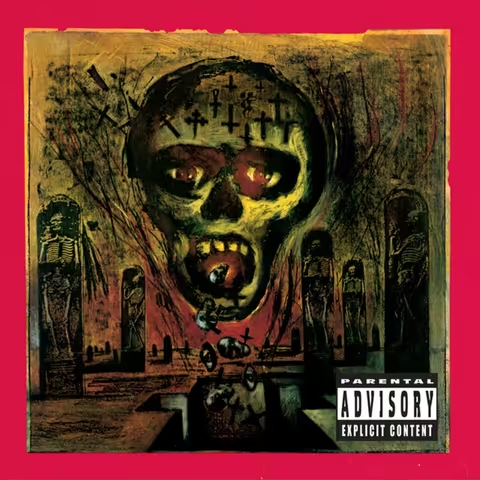
The cover painting is by Larry Carroll, the American artist who had also produced the sleeves for Reign in Blood and South of Heaven and who would go on to provide the artwork for Christ Illusion in 2006. Carroll's Seasons in the Abyss painting depicts a fractured, half-submerged human face against a dark, vaguely architectural background; the imagery is consistent with the surrealist tradition that Carroll worked within and avoids the cartoonish hellscapes that other thrash bands of the era favoured. Graphic design was by Robert Fisher. Photography was credited to Sunny Bak and Marty Temme.
Howie Weinberg's master is notable for its dynamic range. Compared with the later masters of Slayer's nineties albums, Seasons in the Abyss is not pushed especially hard at the top end and retains enough headroom for the quieter passages of the title track and Dead Skin Mask to genuinely contrast with the louder material. The 1994 American Recordings reissue used the same Weinberg master; subsequent CD reissues and digital releases have largely preserved it. Vinyl pressings have varied in quality and a number of audiophile half-speed cuts have circulated in the second-hand market.
Release, chart and critical reception
Seasons in the Abyss was released on 9 October 1990 through Def American Records, the Geffen-distributed label that Rick Rubin had founded after his split from Russell Simmons at Def Jam. Initial commercial performance was strong by Slayer standards. The album entered the US Billboard 200 at number 40, the band's highest charting position to date and one that would stand until the Sony / American Recordings issue of God Hates Us All in 2001. In the United Kingdom it reached number 18 on the Albums Chart, the band's highest UK position at the time. Charting positions across Europe and Australasia were similarly strong, with Finland (#12), Ireland (#10), Germany (#19) and Austria (#29) all delivering top-thirty placings.
| Chart (1990 to 1991) | Peak |
|---|---|
| US Billboard 200 | 40 |
| UK Albums Chart | 18 |
| UK Rock and Metal Albums | 16 |
| Germany | 19 |
| Austria | 29 |
| Finland | 12 |
| Ireland | 10 |
| Australia | 58 |
| Greece (re-entry) | 48 |
Certifications followed quickly. The album was certified gold by the Recording Industry Association of America (US) and by Music Canada. By 2017, US Nielsen SoundScan sales had passed 813,000 copies, a figure that does not include the substantial pre-SoundScan sales the album accumulated during its first eighteen months on shelf.
Critical reception was the warmest of any Slayer album to that point. Rock Hard gave Seasons in the Abyss a perfect 10 out of 10. Select awarded five stars. Entertainment Weekly gave it a B+. AllMusic's Steve Huey, writing in the late nineties, awarded four and a half stars out of five and described it as Slayer's "most accessible album", a description that nettled fans but captured the record's structural balance. The Collector's Guide to Heavy Metal scored it nine out of ten. The Rolling Stone Album Guide gave it three and a half. Spin's Alternative Record Guide rated it seven out of ten. Sputnikmusic, in a later retrospective, scored it four out of five.
"Slayer's most accessible album, and arguably their best."
Steve Huey, AllMusic
Clash of the Titans 1991, Headbangers Ball and Slayer at peak visibility
Touring for Seasons in the Abyss was the most ambitious of Slayer's career to that point. The European leg of the Clash of the Titans tour, in autumn 1990, paired Slayer with Megadeth, Suicidal Tendencies and Testament. The American leg, in the summer of 1991, kept Slayer and Megadeth and added Anthrax and a young Alice in Chains in the opening slot. It was the first time the four most commercially successful American thrash bands had toured together at scale, and the Alice in Chains slot proved prescient: by the time the tour wrapped, Facelift had been on shelves for nearly a year and the band that supported Slayer in 1991 would headline arenas of its own within twelve months.
Concurrent with the touring, MTV's Headbangers Ball gave the title track and War Ensemble videos heavy late-night rotation. The programme, hosted by Riki Rachtman, was the single most important televisual outlet for thrash and hard rock in the late eighties and early nineties, and Slayer's sustained presence on it during 1990 and 1991 represented the closest the band would come to mainstream visibility until the streaming era. Live performances were documented on Decade of Aggression, the double live album released in October 1991.
- Clash of the Titans (Europe), September to November 1990, with Megadeth, Suicidal Tendencies and Testament
- Headlining US dates, late 1990 and early 1991
- Clash of the Titans (US), summer 1991, with Megadeth, Anthrax and Alice in Chains
- Decade of Aggression live album, October 1991, documenting the touring cycle
Legacy: Rolling Stone, Loudwire, the Lombardo split, Christ Illusion reunion
The standing of Seasons in the Abyss has only grown in the decades since release. Rolling Stone placed it at number 31 on its 2017 list of the 100 Greatest Metal Albums of All Time. Loudwire, in a 2016 ranking of Slayer's catalogue, placed it second behind Reign in Blood. Children of Bodom bassist Henkka T. Blacksmith has called it "the best metal album ever". Matt Drake of Evile, writing about the band's influence on his own work, described it as Slayer's "perfect mix".
The album also occupies a unique position in Slayer's internal history. It is the last studio document of the band's original lineup until Christ Illusion sixteen years later, and the touring cycle that followed it produced the cracks that would lead to Dave Lombardo's May 1992 departure during pre-production for Divine Intervention. Paul Bostaph took over the drum stool and would make three studio albums (Divine Intervention, Diabolus in Musica and God Hates Us All) before Lombardo's return for Christ Illusion in 2006. When the original lineup reunited in the studio, the album they made was produced by Josh Abraham rather than Rubin and recorded in a single block at the Pass studio in Hollywood; the world Seasons in the Abyss had been made in was twenty years gone.
Cultural footnotes followed. S.O.D. (Stormtroopers of Death) released a parody tribute single titled Seasoning the Obese. In 2021 a prog-metal supergroup billed as Sleigher, featuring members of Haken, Cradle of Filth, Venom Inc., Protest the Hero and Dream Theater's Jordan Rudess, released a Christmas-themed parody titled Seasons Greetings in the Abyss. Songs from the album have been covered, sampled and quoted by an array of bands across thrash, death metal and metalcore for thirty-five years. War Ensemble and the title track remained in Slayer's setlist until the band's final show at the Forum in Los Angeles on 30 November 2019.
Personnel and credits
| Role | Credit |
|---|---|
| Slayer | |
| Bass, lead vocals | Tom Araya |
| Guitar | Kerry King (also lead vocal on parts of Temptation) |
| Guitar | Jeff Hanneman |
| Drums | Dave Lombardo |
| Additional musicians | |
| Child voice on Dead Skin Mask | Matt Polish |
| Production | |
| Producer | Rick Rubin |
| Co-producer, engineer, mixing | Andy Wallace |
| Co-producers | Slayer |
| Mastering | Howie Weinberg |
| Artwork and design | |
| Cover painting | Larry Carroll |
| Graphic design | Robert Fisher |
| Photography | Sunny Bak, Marty Temme |
Tracklist
| # | Title | Lyrics | Length |
|---|---|---|---|
| 1 | War Ensemble | Hanneman, Araya | 4:51 |
| 2 | Blood Red | Araya | 2:47 |
| 3 | Spirit in Black | King | 4:07 |
| 4 | Expendable Youth | Araya (music King) | 4:09 |
| 5 | Dead Skin Mask | Araya | 5:20 |
| 6 | Hallowed Point | Hanneman, Araya (music Hanneman, King) | 3:23 |
| 7 | Skeletons of Society | King (music King) | 4:40 |
| 8 | Temptation | King (music King) | 3:25 |
| 9 | Born of Fire | King (music Hanneman, King) | 3:07 |
| 10 | Seasons in the Abyss | Araya | 6:34 |
All music by Jeff Hanneman except where indicated.
Things you might not know
| Fact | Detail |
|---|---|
| Slayer's first proper video | The Seasons in the Abyss promo, filmed at the Giza Plateau in Egypt, was the first time the band had committed to a full conceptual music video shoot. |
| The Temptation accident | Kerry King's reference vocal and Tom Araya's lead were both left up in the monitor mix during playback; the band liked the unintended doubling and kept it on the finished record. |
| Andy Wallace, one year out from Nevermind | The engineer who mixed Seasons in the Abyss in June 1990 would mix Nirvana's Nevermind in May 1991, less than a year later. |
| Slayer's longest studio album | At 42 minutes 27 seconds, Seasons is the longest LP in the Slayer catalogue. |
| Concrete Foundations Award | The Seasons in the Abyss video won Best Video at the 1991 Foundations Forum, tied with Jane's Addiction's Been Caught Stealing. |
| The Gulf War footnote | J.D. Considine reported in The Baltimore Sun in February 1991 that the US Army was using Slayer songs, including War Ensemble, to psych troops during Operation Desert Shield. |
| Sales beyond gold | By 2017 US Nielsen SoundScan tallies for Seasons in the Abyss had passed 813,000 copies. |
| S.O.D. parody single | Stormtroopers of Death released a parody titled Seasoning the Obese in tribute to the album. |
| Sleigher Christmas cover | In 2021 a prog supergroup billed as Sleigher, featuring members of Haken, Cradle of Filth, Venom Inc., Protest the Hero and Dream Theater's Jordan Rudess, released Seasons Greetings in the Abyss. |
| Last Lombardo studio LP for sixteen years | Dave Lombardo would not appear on another Slayer studio album until Christ Illusion in 2006. |
| Larry Carroll's third Slayer sleeve | Carroll had already painted Reign in Blood and South of Heaven; Seasons in the Abyss was his third consecutive Slayer cover. |
| Henkka T. Blacksmith's verdict | The Children of Bodom bassist has described Seasons in the Abyss as the best metal album ever made. |
How to listen now
Seasons in the Abyss is available on every major streaming service in its original 1990 form via the American Recordings catalogue (now distributed by Sony Music). Vinyl has remained almost continuously in print since the original Def American pressing and has been reissued in multiple colour variants over the years, with the most widely circulated current edition being the standard black-vinyl American Recordings repress. CD copies of the 1994 American Recordings reissue, with the slightly altered spine art that distinguishes them from the Def American first pressing, are common in the second-hand market. Decade of Aggression, released in October 1991, captures the touring cycle and is the best place to hear the Seasons material in the form Slayer played it live at the height of the album's touring run. For listeners coming to Slayer fresh, Seasons in the Abyss is the album most often recommended as a starting point, precisely because of the structural balance that made fans of the more extreme material accuse it, gently, of being too accessible.
Comments