In August 1998 Korn were a Bakersfield five-piece with two well-regarded albums and a stubborn underground following. By the end of September they were the biggest rock band in America. Follow the Leader, their third album, entered the US Billboard 200 at number one with roughly 268,000 copies sold in its opening week, topped the charts in Australia, Canada and New Zealand, and went on to be certified 5x Platinum by the RIAA. It also did something stranger than that: it dragged an entire sub-genre out of the basement clubs and put it on Total Request Live.
The record arrived in a year when alternative rock was wobbling between Britpop hangover, post-grunge fatigue and the first stirrings of a swaggering, downtuned, hip-hop adjacent metal that nobody had quite agreed how to name. Within twelve months that scene had a name (nu metal), a flagship festival (Family Values), a uniform (Adidas, baggy shorts, microphone stands wrapped in barbed wire) and a poster band. All of those things flowed from Follow the Leader.
Behind the scenes, the album was anything but tidy. Korn fired their original producer half way through, re-recorded every vocal, paid a friend of Todd McFarlane to sketch the cover concept, ran a live-streaming web channel from the studio before YouTube existed, and finished the year founding their own touring festival just so they could take Limp Bizkit, Ice Cube, Orgy, Incubus and Rammstein out on the road with them. The story of how it came together is the story of a band finally getting permission to be as ambitious as their riffs had been all along.
Korn in early 1998: leaving Ross Robinson
By the time Korn began thinking about a third album in the winter of 1997, they had already changed the shape of American heavy music twice. The self-titled 1994 debut introduced the trademark Korn sound: detuned seven-string guitars from Brian "Head" Welch and James "Munky" Shaffer, slap-and-claw bass from Reginald "Fieldy" Arvizu, David Silveria's hip-hop inflected drumming, and Jonathan Davis whispering, scatting and screaming his way through a back catalogue of childhood trauma. Life Is Peachy in 1996 took the same template to the US Top 5 with no radio support to speak of.
Both albums had been produced by Ross Robinson, the Indigo Ranch shaman who would soon become the unofficial midwife of nu metal for Sepultura, Slipknot, Limp Bizkit, At the Drive-In and several others. Robinson's signature method, getting Davis into an almost trance-like emotional state in front of the microphone, had given Korn's first two records their unbearable intimacy. It had also, by the band's own later account, left them slightly exhausted.
For album three, Korn wanted a cleaner, bigger sound without losing the bruised quality Robinson had drawn out of them. They also wanted a working environment that did not feel like therapy. Steve Thompson, half of the Thompson and Barbiero production team behind Guns N Roses, Tesla and Soundgarden, was hired to produce. Toby Wright, who had engineered Alice in Chains' self-titled 1995 album and produced Corrosion of Conformity, was brought in as engineer. Robinson, in a graceful sideways move, stayed on as Davis's vocal coach.
The location chosen was NRG Recording Studios on Hatteras Street in North Hollywood, a complex that had recently played host to records by Limp Bizkit, Soulfly and Filter and which would later host nearly everyone on the Family Values bill. The band booked in for March 1998 with no firm finish date and a budget that, by the standards of Korn's first two records, was enormous.
Korn TV and the build-up
Before a single note was recorded, Korn did something that no major label rock band had done before. In March 1998 they launched their own live-streaming video channel directly from the studio.
The show was called After-School Special, it ran every Thursday evening from 7:30 to 8:30pm Eastern time, and it was broadcast over the band's website using RealMedia, the dominant streaming codec of the late dial-up era. Bandwidth meant the picture was the size of a postage stamp and the audio fell apart whenever someone in the booth shouted, but the experiment was a genuine first. Long before social media closed the gap between performer and audience, Korn were sitting on couches in their own studio, talking to the camera and inviting friends to drop in.
The guest list was a roll call of the not-yet-mainstream alternative scene: Sugar Ray, Limp Bizkit, Deftones, Steve Vai, 311 and The Pharcyde all turned up. For fans who had spent the previous four years tracking Korn down on import-only EPs and 7-inch flexis, watching members of their favourite band horse around with Fred Durst in real time was unprecedented intimacy. It also seeded the relationships that would feed both the album's guest list and the Family Values Tour.
Recording at NRG: chaos in the booth
The actual making of Follow the Leader ran from March to May 1998 and, by every account that has surfaced since, was a nonstop party.
Davis has been the most candid about it. In a 2023 Loudersound feature by the writer Morat, he described the NRG sessions as an extended bacchanal: people drifting in and out of control rooms at all hours, cocaine on every flat surface, women in various states of undress visible through the glass while he was trying to lay down lead vocals. He recalls cutting the vocal for the opening track It's On! with one couple openly having sex on the studio floor in his sightline and another receiving oral sex behind him. The vocal stayed.
The most retold story is the eight-ball negotiation. Davis has said in multiple interviews, including with Scuzz and Blabbermouth, that he refused to begin tracking vocals on the first day until Toby Wright agreed to procure him an eight-ball of cocaine, an eighth of an ounce. Wright, by then under pressure to start banking takes, complied. Davis has been clear in his sober years that this was not a sustainable working method and that he was, by then, in the depths of an addiction that would only be resolved by hitting bottom on the touring cycle that followed.
For all the chaos around the microphone, in front of it sat Ross Robinson. The band had kept their previous producer on as vocal coach precisely because they trusted his ability to push Davis into the rawer corners of a performance. Wright has since recounted that Robinson's methods were as extreme as ever: when he felt Davis was holding back, Robinson would punch him repeatedly in the back inside the vocal booth to provoke a more visceral take. Davis has confirmed the story and never described it as anything other than collaborative.
The result, captured in songs like Freak on a Leash, Dead Bodies Everywhere and Pretty, is some of the most ferocious vocal work of Davis's career. The screams are louder than anything he had attempted before. The whispers are closer to the mic. The scatted, glossolalic mid-section of Freak on a Leash remains his signature single moment and was, by his own description, almost entirely improvised in the booth with Robinson pushing him from the other side of the glass.
Firing Steve Thompson
Some time in April 1998, with the album perhaps two-thirds tracked, Korn fired their producer.
The split was reported in a June 1998 issue of Kerrang!, edited at the time by Malcolm Dome. Davis was the band member willing to go on the record. Asked why Steve Thompson was no longer involved, he answered with the diplomatic but firm phrasing the band have stuck with ever since. They had not been seeing eye to eye, they bumped heads a lot, Thompson was an awesome producer but everyone felt the project would go better if he left. Nobody has filled in the missing detail in the intervening twenty-eight years, and Thompson himself has never publicly contradicted the band's version.
The fallout was significant. Davis has confirmed in subsequent interviews that every vocal recorded under Thompson had to be discarded and re-tracked from scratch under Toby Wright, partly because of stylistic disagreements about take selection and partly because the band wanted a clean break. The decision pushed the schedule back by weeks. The album was finally mixed in June 1998 by Brendan O'Brien, the Atlanta-based producer fresh off his run of Pearl Jam, Stone Temple Pilots and Rage Against the Machine records. Mastering was handled by Stephen Marcussen at Marcussen Mastering in Hollywood. The credited engineer of record is John Ewing Jr. Programming came from Tommy D. Daugherty, with additional drums and programming by Justin Z. Walden and digital editing by Don C. Tyler.
By the time the masters were cut, Toby Wright was the producer of record alongside the band themselves. Thompson's name does not appear on the sleeve.
The guests: Ice Cube, Fred Durst, Slimkid3, Cheech Marin
One of the consequences of taking a longer, more relaxed approach to a third album was that Korn had time to bring people in. The guest list on Follow the Leader is the most varied of any Korn record before or since.
Ice Cube turned up to rap on Children of the Korn, the album's clearest declaration that the band considered themselves as much the descendants of N.W.A. as of Black Sabbath. The cross-genre handshake was important commercially as well as artistically: at a time when white suburban metal audiences and Black urban hip-hop audiences were treated as marketing silos, putting Cube on a Korn record and Korn on a Cube record was a quietly subversive move.
Fred Durst showed up for All in the Family, which played as an extended rap battle in which Davis and Durst traded insults about each other's appearance, hygiene, dress sense and musical taste. Limp Bizkit's 1997 debut had come out to limited fanfare and the Bizkit camp owed Korn a substantial debt for the early support. The mock beef on All in the Family sealed the alliance and trailed the Family Values Tour, where Limp Bizkit would be the most prominent support act.
Tre Hardson, performing under his Pharcyde alias Slimkid3, dropped a verse on Cameltosis, a track whose musical bed is one of the funkiest things on the record and whose title remains the album's most adolescent joke. Cheech Marin sang lead on the hidden Cheech and Chong cover Earache My Eye, written by Tommy Chong, Gaye Delorme and Marin himself for the Cheech and Chong catalogue. The cover, with Fieldy on lead vocals and the band switching positions to play it live, became a setlist staple for years.
Personnel and credits
| Role | Personnel |
|---|---|
| Lead vocals, bagpipes | Jonathan Davis |
| Guitar | Brian "Head" Welch |
| Guitar, talk box on Freak on a Leash and Dead Bodies Everywhere | James "Munky" Shaffer |
| Bass; lead vocals on Earache My Eye | Reginald "Fieldy" Arvizu |
| Drums | David Silveria |
| Guest vocals on Children of the Korn | Ice Cube |
| Guest vocals on All in the Family | Fred Durst |
| Guest vocals on Cameltosis | Tre Hardson (Slimkid3 of The Pharcyde) |
| Lead vocals on Earache My Eye | Cheech Marin |
| Producers | Steve Thompson (dismissed mid-album), Toby Wright, Korn |
| Vocal coach | Ross Robinson |
| Engineer | John Ewing Jr. |
| Programming | Tommy D. Daugherty |
| Additional drums and programming | Justin Z. Walden |
| Digital editing | Don C. Tyler |
| Mixing | Brendan O'Brien |
| Mastering | Stephen Marcussen |
| Cover art | Todd McFarlane and Greg Capullo (pencils), Brian Haberlin (colour) |
| Sleeve design | Brent Ashe |
| Photography | Joseph Cultice |
| Record labels | Immortal Records, Epic Records |
Track listing
| # | Title | Length | Note |
|---|---|---|---|
| 1 | It's On! | 4:28 | Opens the album proper after the 12 silent tracks on the physical pressing |
| 2 | Freak on a Leash | 4:15 | Bagpipe-prefaced lead radio single, McFarlane-directed video |
| 3 | Got the Life | 3:45 | First charting single, retired from MTV's TRL |
| 4 | Dead Bodies Everywhere | 4:44 | Talk box from Munky in the chorus |
| 5 | Children of the Korn | 3:52 | Feat. Ice Cube |
| 6 | B.B.K. | 3:56 | Single in some territories |
| 7 | Pretty | 4:12 | Lyric drawn from Davis's time as a coroner's assistant in Bakersfield |
| 8 | All in the Family | 4:48 | Feat. Fred Durst, rap battle |
| 9 | Reclaim My Place | 4:32 | |
| 10 | Justin | 4:17 | Tribute to a young fan with intestinal cancer whose final wish was to meet the band |
| 11 | Seed | 5:54 | |
| 12 | Cameltosis | 4:38 | Feat. Slimkid3 of The Pharcyde |
| 13 | My Gift to You | 7:16 | Album closer; on the physical pressing this track runs to 15:40 with two minutes of silence and a short interlude before the hidden Earache My Eye |
| 14 | Earache My Eye | 4:50 | Hidden Cheech and Chong cover, feat. Cheech Marin |
All songs are credited to Korn except Earache My Eye, which is credited to Tommy Chong, Gaye Delorme and Richard Marin. The original physical CD lists 25 tracks: positions 1 to 12 are each five seconds of silence, the songs above run from positions 13 to 25, and Earache My Eye begins approximately 10 minutes 50 seconds into the closing track. The total running time of the physical edition is 70 minutes 8 seconds. Subsequent digital releases collapse the silent prefix and surface the hidden track as a separate cue, giving the 14-track listing reproduced above and a running time of 69 minutes 48 seconds.
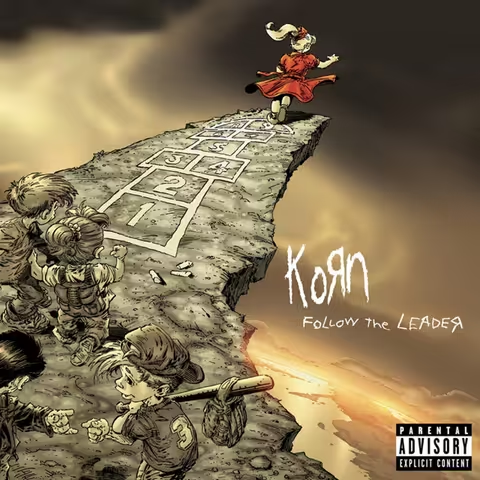
The cover renders the title with the second R of LEADER reversed so that the word appears to look back at itself, a piece of typographic mischief that has tripped up cataloguers, music streaming services and screen readers for a quarter of a century.
The songs, track by track
It's On! opens the record with a dropped, downtuned riff that announces immediately that this is a bigger-sounding Korn than the one heard on the first two records. The lyric is a straight-up declaration of musical war, Davis taunting unnamed rivals over a chassis that Silveria drives with hi-hat splashes lifted directly from West Coast hip-hop. It is the song Davis was tracking when, by his account, the studio scene around him reached its most ridiculous extreme.
Freak on a Leash is the album's defining moment. The song opens with Davis playing the bagpipes, an instrument he had taken up as a teenager in his Bakersfield school marching band and which has since become an unlikely calling card. The verse rides a sparse Welch and Shaffer riff before the chorus arrives in a wall of overdriven seven-string. The middle section, in which Davis abandons words entirely and produces a sequence of yelped, growled, sung syllables that have been transcribed online as everything from "boom-na-da-mmm-da-mmm" to less printable interpretations, was a one-take improvisation in the booth with Ross Robinson on the other side of the glass. It became the single most imitated vocal performance in late-90s heavy music and remains the cornerstone of every Korn live show.
Got the Life is the song that introduced Korn to commercial radio. Built on a stuttered Silveria drum loop and a Fieldy bass figure that is functionally a hip-hop break, it is the closest the band ever got to writing a pop single without compromising. The video, directed by McG and shot at the Park Plaza Hotel in Los Angeles, became one of the most played clips on MTV through the autumn of 1998 and was, alongside the eventual Freak on a Leash clip, among the first videos to be formally retired from Total Request Live for hitting the show's chart ceiling. Eminem makes a brief uncredited cameo as a wedding guest, two months before The Slim Shady LP arrived and rewrote the rules of mainstream rap.
Dead Bodies Everywhere is one of two songs on the album where Munky reaches for the talk box, the same Heil device made famous by Peter Frampton and Joe Walsh. In Korn's hands it becomes a distorted, glottal mock-voice trading lines with Davis, a piece of Frampton-via-Sabbath ventriloquism that was widely imitated in nu metal's next wave.
Children of the Korn hands the second verse to Ice Cube, who treats the appearance as straight business: a tightly-wound sixteen bars about authority, refusal and survival that maps cleanly onto Davis's own lyrical preoccupations. It is the song that retroactively justified the rap-rock label that the music press had been hanging on the band for two years.
B.B.K., an acronym whose meaning Davis has variously suggested stands for "Big Bald Korn" and other less polite expansions, is the most straightforwardly hardcore song on the album, an aggressive cycle of riffs and stop-time breaks that crops up on most Korn setlists to this day.
Pretty is one of the darkest things Korn ever recorded. Davis, who worked as a coroner's assistant in Bakersfield before the band, has said the lyric was inspired by an autopsy of a young victim of sexual violence whose case had stayed with him. The performance is barely a song so much as a controlled scream against a slowly building riff. It is the moment on the record that most clearly links Follow the Leader back to the brutality of the first two albums.
All in the Family arrives as comic relief. The rap battle between Davis and Fred Durst is intentionally ridiculous, the two singers taking swings at each other's wardrobes and rumoured personal habits over a swung, almost vaudevillian groove. Producer Toby Wright has said the recording was completed quickly with both singers in the room together, freestyling against pre-prepared cues.
Reclaim My Place and Seed are the deepest cuts on the album, both written almost entirely in the studio and both carrying the kind of dense, layered guitar arrangement that Wright had been hired in part to capture.
Justin is the album's emotional centre. Justin Pierce was a young fan with intestinal cancer whose Make-A-Wish style request, in 1997, was to meet Korn. The band did not write the song on commission. They wrote it after the fact, in tribute, when his condition worsened. The 12 silent tracks at the start of the physical pressing are dedicated to Justin and amount, taken together, to a minute of intentional silence at the top of the record. Davis's own superstition about ending an album on track 13 reinforced the structural decision.
Cameltosis lets Tre Hardson loose over the funkiest backing on the album, a chopped Fieldy figure that would not be out of place on a Pharcyde record of the same period.
My Gift to You closes the album proper at just over seven minutes, a slow, suffocating account of love and possession that Davis has described as the most personal song on the record. On the physical CD it is extended to fifteen minutes forty with a long silence and a fragmentary interlude before the hidden Earache My Eye, where Fieldy steps to the front microphone, Davis moves to the drum stool, Silveria switches to bass and the band tear through Cheech and Chong's routine with the affection of fans who had been quoting it at each other in the van for years.
Cover artwork by Todd McFarlane, Greg Capullo and Brian Haberlin
The cover of Follow the Leader is the work of three of the biggest names in late-1990s American comics. Todd McFarlane, the Image Comics co-founder behind Spawn, took the lead. Greg Capullo, his frequent collaborator and later the definitive Batman penciller of the New 52 era, did the figure work. Brian Haberlin coloured the result. The sleeve was art-directed by Brent Ashe, and the inner photography of the band was shot by Joseph Cultice.
The concept came from Fieldy. The bassist sketched the basic idea, a small child hopscotching along chalked-up paving stones towards the edge of a cliff while a stylised mass of other children trail behind, and asked a friend to render the rough. That preliminary sketch was the version eventually walked across to McFarlane's studio. The bridge from a Bakersfield bedroom doodle to a McFarlane illustrated sleeve was an unlikely one and it only happened because of two pre-existing relationships. First, McFarlane had publicly described Korn as "the Doors of the 90s" in interviews, an endorsement the band had not forgotten. Second, Korn had contributed a song to McFarlane's Spawn film soundtrack album in 1997, establishing a working relationship that could be tapped for a favour the following year.
The result is the third consecutive Korn album cover to feature children placed in a disturbing context. The 1994 debut had a small girl shrinking from a faceless figure with a swing. Life Is Peachy had a child being menaced in a toilet stall. Follow the Leader kept the throughline but recast it in McFarlane's heightened, theatrical visual language. Davis, asked about the recurring motif in 1998, gave an answer that has been quoted regularly since. Children are always scariest when they are happy, he said. They are the most beautiful thing in the world, but when you see them placed the way the band placed them in their artwork it just becomes, in his words, kind of weird.
Release and the Korn Kampaign
Follow the Leader was released on Tuesday 18 August 1998 through Immortal Records and Epic Records, the band's parent labels since the start. The night before, on 17 August, Korn played an in-store appearance at the Sunset Boulevard branch of Tower Records in Los Angeles as the launch of the so-called Korn Kampaign.
The Kampaign was a coordinated promotional tour built around the visual language of an American political campaign: red, white and blue motifs, motorcade-style fan meetings, and stops at record stores rather than venues. Where a traditional album cycle leaned on radio and MTV, Korn deliberately put fans first, running events through the second half of August and into early September designed for ticketless attendance.
The label tooled up to match. Concrete Marketing, working through their Concrete Corner programme, gave away 100,000 shrink-wrapped sampler CDs alongside copies of Follow the Leader at participating independent retailers. The samplers bundled Korn with a stable of label-mates and tour-mates including Kid Rock, Orgy, Powerman 5000 and Limp Bizkit, plus an unreleased Korn track as the closing draw. The campaign's on-camera pitchman was Jim Rose of the Jim Rose Circus, whose sideshow act had toured Lollapalooza earlier in the decade.
It worked. The album entered the Billboard 200 at number one with roughly 268,000 copies sold in its first week, the band's first chart topper. It did the same in Australia, Canada and New Zealand. In the UK it peaked at number five on the main albums chart and number one on the dedicated Rock and Metal chart. Across mainland Europe it landed inside the top ten in France, the Netherlands, Norway, Austria, Estonia and Hungary, and inside the top fifteen everywhere except a few outliers.
Family Values Tour 1998
The most consequential thing Korn did in the autumn of 1998 was not a single, a video or an interview. It was founding a touring festival.
The Family Values Tour ran from 22 September to 31 October 1998 and was Korn's own production from the ground up. The name came from Fieldy, who later explained that the band had so many friends in other groups who felt like family that putting them all on one tour seemed the natural way to repay the support. The bill, in addition to Korn themselves, comprised Limp Bizkit, Ice Cube, Orgy, Incubus and Rammstein, with Rammstein in particular making their first significant US tour appearance.
Production was substantial. The stage centrepiece was a steel cage at the rear of the platform, known as the Korn Kage, in which radio contest winners watched the show from inside the band's line of sight. The Kage was Fieldy's idea, and a logistical headache for venue staff who had to vet, brief and rotate the winners through forty consecutive shows. Tickets were capped at around thirty dollars a head, low for a multi-band package even by 1998 standards, and the tour averaged 9,000 in attendance per show and grossed roughly 6.5 million dollars in total, around 240,000 dollars per night.
The tour did not cross the Atlantic. Korn skipped Europe entirely on this cycle, deferring continental touring to the following year. That choice has been retrospectively read as a missed opportunity for the support acts, several of whom would have benefited from European exposure in 1998 rather than 1999, but it kept Korn themselves in front of US arena crowds during the album's peak commercial window.
1999: Big Day Out, Rock Is Dead, the kilts and the VMAs
In January 1999 Korn travelled to Australia for the Big Day Out festival circuit, taking the album to the territory in which it had already gone 3x Platinum. From 26 February through to mid-April 1999, they were back in North America headlining the Rock Is Dead Tour, with Rob Zombie as direct support and Videodrone opening. The tour name was a deliberate parallel to a Marilyn Manson tour of the same name running concurrently, a piece of cross-camp friction that filled column inches without ever escalating into anything serious.
It was during Rock Is Dead that Jonathan Davis began wearing kilts onstage as a regular part of the costume, in homage to his Scottish heritage and as a practical solution to the trousers-versus-stage-temperature problem at the centre of any extended tour. The kilt rapidly became part of the Korn iconography, joining the bagpipes and the H. R. Giger microphone stand that the artist had built for Davis after seeing the band live.
The tour also introduced the live version of Earache My Eye, with the band swapping instruments. Munky and Head changed sides of the stage, Davis sat behind Silveria's kit, Silveria moved to Fieldy's bass and Fieldy stepped up to the lead microphone. Fans who had not heard the hidden track buried inside My Gift to You on the album learned about it for the first time from these stage swaps.
In September 1999, with the singles cycle in full bloom, the Freak on a Leash video swept the MTV Video Music Awards. The clip, directed by Todd McFarlane in a hybrid of live action band footage and McFarlane's own animated treatment of the album cover, was nominated for nine VMAs and won two: Best Rock Video and Best Editing. Four months later, in February 2000, the same video took the Grammy for Best Short Form Music Video, the first Grammy of Korn's career.
Critical reception
Reviews at the time were largely, although not unanimously, positive. AllMusic's Stephen Thomas Erlewine gave the album four and a half stars out of five and called it, in a phrase that has dogged the band ever since, "an effective follow-up to their first two alt-metal landmarks". The Encyclopedia of Popular Music matched the rating with a straight four out of five. Rolling Stone's David Fricke landed at four stars and produced perhaps the most quoted line of any contemporary review.
"Korn have an ideal record for those long, black days when all you can do is say, what the fuck, what the fuck, what the fuck, at bloody murder volume."
David Fricke, Rolling Stone, 1998
Spin awarded the album seven out of ten in an October 1998 review titled "Harvest of Sorrow" by RJ Smith. USA Today's Edna Gundersen went three and a half out of five. The Guardian, in a notice by Caroline Sullivan, gave three out of five. Entertainment Weekly's Jim Farber wound in at B-minus and described the album as "a big load of dumb fun" that was, in his words, "incredibly perverse, going to almost laughable lengths to mess with metal cliche". Yahoo! Music's Janiss Garza called the band "intensely tortured and savage as ever".
The dissents came from the usual quarters. Pitchfork, in a Brent DiCrescenzo review that became briefly notorious for its dismissiveness, settled at 6.9 out of 10. Robert Christgau, in his Consumer Guide column, gave the album a flat C and noted, with the rhetorical sting that was his stock in trade, that although Korn deny they are metal, they "demonstrate that the essence of metal is self-obliterating volume and self-aggrandising display". Jon Pareles in the New York Times called the album "choppy" and described Davis as "wrestling with self-hatred, violent impulses, parental execration, and a confused sexual identity".
"An effective follow-up to their first two alt-metal landmarks."
Stephen Thomas Erlewine, AllMusic
Retrospective reassessment has been considerably kinder. Loudwire placed the album at number one in its list of the ten best hard rock albums of 1998 and at number one on its longer best hard rock album of each year since 1970 project for the same year. The same outlet placed it ninth on its list of the fifty greatest nu metal albums of all time, with a January 2026 reassessment by Rae Lemeshow-Barooshian nudging it up to eighth. Loudersound placed it fifth on its own fifty best nu metal list. NME included it in their 100 greatest heavy metal albums, at number 36. Rolling Stone included it in their 100 best albums of 1998 list at number 40. Rock Sound made it their album of the year for 1998. The Digitaldreamdoor 100 greatest albums of 1998 placed it at number seven, and the Discover Music best 67 albums of 1998 list put it at twentieth. Most consequentially for the band's long-term standing, the album is one of the entries in the reference book 1001 Albums You Must Hear Before You Die.
Commercial performance
Domestically, Follow the Leader entered the US Billboard 200 at number one in early September 1998 with roughly 268,000 copies sold in its first week of release. It was certified Gold and Platinum by the RIAA within months and reached 5x Platinum status on 15 March 2002. It remains one of the band's best-selling albums in the United States.
Internationally the picture was nearly as strong. ARIA in Australia certified the album 3x Platinum. Music Canada matched that with 3x Platinum. The RMNZ in New Zealand certified it Platinum, as did AMPROFON in Mexico. The BPI in the United Kingdom certified it Gold, as did the SNEP in France and the ABPD in Brazil. NVPI in the Netherlands also reached Gold. The album reached number one in Australia, Canada and New Zealand, number four in Finland, number five in the UK Albums Chart, France and Norway, number six on the Eurochart, and number seven in Austria, the Netherlands, Estonia and Hungary. It went top fifteen in Italy, Germany, Belgium and Scotland and topped out at number 24 in Sweden and 27 on the Japanese Oricon chart.
Singles activity was concentrated around two tracks. Got the Life, released on 24 July 1998 and re-promoted in November of the same year, reached number 15 on the Billboard Mainstream Rock Songs chart and certified Gold in Australia. Freak on a Leash, released as the album's second proper single on 25 February 1999, reached number six on the Alternative Songs chart and number six on the Bubbling Under Hot 100, and also went Gold in Australia. All in the Family had been issued first, on 18 July 1998, as a teaser. Children of the Korn and B.B.K. were issued as further singles in some territories. The biggest single award of the cycle was the Grammy for Best Short Form Music Video for Freak on a Leash, presented in February 2000.
Legacy
Follow the Leader is the album that took nu metal mainstream. Within two years of its release every major label in the United States had a nu metal signing on its books, MTV had built whole programming blocks around the genre, and the production techniques pioneered on the record (seven-string detuned guitars, hip-hop inflected drumming, slap bass run through guitar amps, rap features) had become a template repeated to exhaustion on records by bands ranging from Powerman 5000 and Coal Chamber to Papa Roach and Linkin Park.
The Family Values Tour franchise outlasted any of those imitators. It returned in 1999 under Limp Bizkit's direction, again in 2001 with Korn back at the top of the bill, and intermittently through the 2000s. It established the multi-band package-tour model that Ozzfest had pioneered but which Family Values arguably perfected for a younger, hip-hop-adjacent audience.
The Korn TV experiment looks, with hindsight, like an obvious precursor to the streaming-first promotional cycle of the 2010s and 2020s. RealMedia is long defunct and the original broadcasts are not preserved anywhere accessible, but the principle that a major rock band can sit in their own studio, run a camera and connect directly with an audience without a label or a broadcaster as intermediary, was tested on After-School Special a decade before YouTube made it normal.
The McFarlane connection has aged into something more enduring than the comics partnership of the moment. McFarlane's animated treatment of the album cover, used as a visual bed for the Freak on a Leash video, sits in the MTV archive as one of the most accomplished hybrid live-action and animation music videos of the decade. It has been studied in animation schools and revisited in retrospectives every time an anniversary of the album rolls around.
For Korn themselves, Follow the Leader remains the album that made everything that followed possible. The band have since released a further dozen studio records, weathered the departure and return of Head Welch, the departure of Silveria, the brief addition of Slipknot drummer Joey Jordison and the long-term incumbency of Ray Luzier behind the kit. They have outlived nu metal as a commercial force by more than two decades. None of it happens without the August 1998 number one.
Things you might not know
| Fact | Detail |
|---|---|
| The reversed R | The cover title is stylised as FOLLOW the LEADER with the second R reversed so the letter appears to look back at the word. It is one of the most consistently mistyped album titles in catalogue databases. |
| The minute of silence | The 12 silent tracks that open the physical CD total a full minute and are dedicated to Justin, a young fan with intestinal cancer whose last wish was to meet the band. |
| Davis's superstition | Padding the start with silence also served to push the album away from ending on track 13, a number Davis considered unlucky for a closer. |
| Eight-ball entrance fee | Davis has said he refused to start tracking vocals on day one of the NRG sessions until Toby Wright agreed to procure him an eighth of an ounce of cocaine. |
| Punched into a take | Ross Robinson, kept on as vocal coach, would punch Davis repeatedly in the back inside the vocal booth to provoke a more visceral performance. |
| An entire vocal pass binned | Every vocal recorded under original producer Steve Thompson was discarded and re-tracked from scratch after his mid-album dismissal. |
| Eminem in a Korn video | Eminem appears as a wedding guest in the Got the Life video, shot at the Park Plaza Hotel in Los Angeles, two months before The Slim Shady LP arrived. |
| Fieldy designed the cover | The original concept sketch for the McFarlane sleeve was drawn by a friend of the band from a rough produced by Fieldy. |
| Doors of the 90s | Korn approached McFarlane after hearing he had described them in interviews as the Doors of the 90s. |
| Spawn connection | Korn had already contributed a song to McFarlane's 1997 Spawn film soundtrack, which oiled the wheels for the cover commission. |
| RealMedia broadcasting | Korn TV's After-School Special, launched in March 1998, was the first live-streaming video department run from a major rock band's own website. |
| Korn Kage | Fieldy also came up with the Family Values Tour's steel cage at the back of the stage, in which radio contest winners watched each show from inside the band's line of sight. |
| Tower Records launch | The Korn Kampaign promotional tour began with an in-store appearance at Tower Records on Sunset Boulevard in Los Angeles on 17 August 1998, the day before the album's release. |
| One hundred thousand free samplers | Concrete Marketing shrink-wrapped 100,000 free sampler CDs to copies of the album at participating retailers, bundling Kid Rock, Orgy, Powerman 5000 and Limp Bizkit alongside an unreleased Korn track. |
| Earache My Eye position swap | When Korn played the hidden Cheech and Chong cover live, the band rotated instruments: Davis on drums, Silveria on bass, Fieldy on lead vocals and the two guitarists swapping sides of the stage. |
If you are enjoying this kind of long-form album archaeology, the Riffology podcast covers a different record every week in the same depth. The show is available on Apple Podcasts, Spotify, Amazon Music, Pocket Casts and every other podcast platform worth using.
Comments