
Dirt is the rare commercial-peak record by a band visibly coming apart at the seams. Alice in Chains tracked it across the spring and summer of 1992 with a producer who refused on principle to be his singer's friend, finished it while at least three of the four members were drinking or using heavily, and shipped it into the same release week as Pearl Jam's continuing chart dominance and the cultural shrapnel of Nirvana's Nevermind. By the time the supporting tour reached Brazil, the original bassist had been fired in a hotel room; by the time the band reached Lollapalooza 1993, Layne Staley was barely able to finish a set.
What landed in record shops on 29 September 1992 was a five-times platinum monument to that decline. Jerry Cantrell built the songs out of Black Sabbath-shaped riffs and slow rolling country harmonies; Staley sang them as confessions and warnings; Dave Jerden recorded them through a stack of Bogner preamps in Burbank with a clarity that has only made them more unsettling with age. Thirty years on, the album returned to the Billboard top ten on the back of a half-speed remaster. This is the story of how it was made, who made it, and what it cost.
Album Facts
| Field | Detail |
|---|---|
| Artist | Alice in Chains |
| Album | Dirt |
| Release Date | 29 September 1992 |
| Label | Columbia Records |
| Producers | Dave Jerden and Alice in Chains; Rick Parashar produced Would? |
| Studios | Eldorado Recording, Burbank; London Bridge, Seattle; One on One, Los Angeles |
| Genre / Subgenre | Grunge, alternative metal, heavy metal, hard rock |
| Track Count | 13 |
| Total Runtime | 57:37 |
| Billboard 200 Peak | 6 in 1992; re-entered at 9 in October 2022 |
| UK Albums Chart Peak | 42 on first release; 36 on the 2022 reissue, number 1 on the UK Rock and Metal chart |
| Other Notable Chart Peaks | 13 Australia, 25 Canada, 11 Finland, 11 Sweden, 15 Norway, 17 Netherlands |
| Certifications | 5x Platinum US, Platinum Australia, Platinum Canada, Platinum New Zealand, Gold UK |
| Estimated Sales | 5 million in the US per RIAA certification; 3.36 million scanned US copies as of 2008 |
| Key Singles | Would?, Them Bones, Angry Chair, Rooster, Down in a Hole |
Cultural Context
September 1992 was the moment grunge stopped being a regional Seattle story and became a generational one. Nirvana's Nevermind had reached number one nine months earlier and still sat in the Billboard top forty when Dirt arrived. Pearl Jam's Ten was on its second commercial wave. Soundgarden were finalising Badmotorfinger's promotional push. Stone Temple Pilots had released Core a week before Dirt landed. Even the soundtrack to Cameron Crowe's Singles, with Alice in Chains' own Would? as a centrepiece, was charting in the top ten.
Outside the music press the year had been a furnace. The acquittal of the four LAPD officers filmed beating Rodney King set Los Angeles on fire on the very afternoon the band were due to begin tracking. The Bosnian war was widening. George H. W. Bush was a few weeks from losing the presidency to Bill Clinton. In the cinema, Reservoir Dogs and Unforgiven were redrawing what American film looked like, while MTV had quietly stopped being a video station and become a cultural utility. Alice in Chains were positioned at the seam between two scenes that did not normally talk to each other: the grunge audience that had grown around Sub Pop and the metal audience that bought Metallica and Megadeth records. Dirt would speak to both, partly by accident and partly because Cantrell wrote riffs heavy enough to satisfy a thrash fan and Staley sang melodies pretty enough to win over the Pearl Jam crowd.
The Band's Story Up to This Point
The lineup that recorded Dirt had been together as Alice in Chains since 1987, when Cantrell met Staley in a Seattle rehearsal space and the singer agreed to leave his glam outfit Alice N' Chains for something darker. Drummer Sean Kinney, a hard-hitting Bonham disciple, and bassist Mike Starr, a regular on the Seattle club circuit, completed the four-piece. Their 1990 debut Facelift took eighteen months to break, eventually pushed past platinum by the slow-burning single Man in the Box and a relentless tour schedule supporting Van Halen, Iggy Pop and Megadeth.
By early 1992 they were one of Columbia's bankable rock acts. The acoustic-leaning EP Sap, recorded in two days with Rick Parashar at London Bridge in late 1991 and released in February 1992, had quietly become a fan favourite and proven the band could do more than crunch. They had also already cut Would? for the Singles soundtrack at London Bridge, again with Parashar at the desk. The song's success on rock radio that summer gave Columbia confidence to back a fuller second album, and Alice in Chains decamped to Burbank in April 1992 with a stack of new Cantrell demos and a working title, The Machine, that would not survive the sessions.
They arrived as a band already showing strain. Staley had checked out of rehab not long before tracking began and was using heroin again within weeks. Kinney and Starr were both drinking heavily. Cantrell, the only one with anything resembling stability, was carrying most of the writing load and increasingly the band's logistical weight too. The mood walking into Eldorado was somewhere between sibling closeness and warring exhaustion.
Pre-production and Demos
Most of Dirt was written on the road during Facelift touring through 1991. Cantrell had been carrying around riff cassettes for years and now had time on tour buses and in hotel rooms to assemble them into songs. Them Bones, Dam That River, Rain When I Die, Down in a Hole and Rooster all existed in some demo form by the start of 1992. Staley contributed lyrics during long stretches of soundcheck downtime, often retreating to a notebook while the rest of the band ran through Facelift material.
A 1991 demo tape, later released piecemeal on the 1999 Music Bank box set, captured songs that fed both Sap and Dirt. Two pieces from that tape, Fear the Voices and Lying Season, were considered for the album and dropped; Fear the Voices eventually became a 1999 radio single. Cantrell would later say the band was still finding its sound on that tape and the songs felt half-formed compared to what survived.
Hate to Feel and Angry Chair were written entirely by Staley, who played the rhythm guitar on both. Cantrell has repeatedly cited that solo writing leap with pride, framing it as the moment Staley stopped being only the band's voice and started being a co-author of its identity. The pair worked through arrangements in pre-production at Eldorado in the days before the LA riots erupted. The original sequencing had Down in a Hole as track four, between Rain When I Die and Sickman; Columbia overrode that and pushed it to track twelve for the original American CD pressing, a decision later reversed for the current and most reissue editions.
Creating the Album
Tracking began at Eldorado Recording in Burbank on the day of the Rodney King verdict. The band were watching television in the control room when the not-guilty result came through. Within hours Los Angeles was alight. Cantrell was in a convenience store buying beer when a man came in and started looting it; he got back into his car and into traffic chaotic enough that he watched people being pulled from vehicles and beaten in front of him. Producer Dave Jerden, engineer Bryan Carlstrom and the rest of the band quickly agreed that nobody was making a record in this. They piled into vehicles with Slayer's Tom Araya, who happened to be in town, and drove east to the Joshua Tree desert. They stayed for four or five days until the curfews ended and the smoke cleared, then went back to Eldorado and pressed record.
Jerden had produced Facelift and was the band's first and only choice for Dirt. He had a long alternative pedigree by 1992, including Jane's Addiction's Nothing's Shocking and Ritual de lo Habitual and engineering work with the Rolling Stones, and a year after Dirt he would record Anthrax's Sound of White Noise in the same room. His approach was conservative in the best sense: capture great performances cleanly, keep the band live in a room as much as possible, then build guitar tones in overdub that no live amp could deliver in isolation.
That signature Dirt guitar tone, the slow swampy thickness that lives between blues and doom, came from blending three signal paths. Jerden put a Bogner Fish preamp on the low end, a Bogner Ecstasy on the mids and a Rockman Headphone amp on the highs, then balanced the three to taste track by track. Cantrell's main guitar was his G&L Rampage, an aggressive single-pickup Leo Fender design built for hard rock. The acoustic textures on Down in a Hole and the breath in the verses of Rooster came from Guild acoustics. Mike Starr's bass was tracked direct and through Ampeg, with Jerden keeping the low end relatively dry so the guitars could sit thick on top.
Bryan Carlstrom, Annette Cisneros and a young Ulrich Wild handled the engineering across the three rooms. Eldorado in Burbank carried the bulk of basic tracking. Some overdubs and additional work were done at London Bridge in Seattle, the room Sap had been cut in. One on One in Los Angeles was used for further overdubs and mix preparation. Steve Hall and Eddy Schreyer mastered.
The day-to-day in Burbank was difficult. Staley had relapsed and was, in Jerden's words, using during sessions. The producer pushed back, repeatedly suggesting that the singer get clean. Years later Jerden recalled the consequence with a shrug. "Apparently he got all mad at me during the Dirt sessions," he told Rolling Stone. "And what's my job as a producer? To produce a record. I'm not getting paid to be Layne's friend." Staley would, briefly, go cold turkey on his own during the sessions, reading Dean Koontz's horror novel The Bad Place to distract himself. The respite did not last. Sean Kinney and Mike Starr were drinking through the same period. Cantrell was the spine that held the project together.
"We deal with our daily demons through music. All of the poison that builds up during the day we cleanse when we play."
Jerry Cantrell, RIP magazine, 1993
For all the chaos, the band were efficient when they were in the room. Sessions ran from April through July 1992, an unhurried but disciplined pace by major-label standards. The arrangements were largely settled going in; the time in the studio went into texture, harmony stacks and Cantrell's lead guitar tones. Layne Staley's vocals, when they came, frequently went down in one or two takes, the producer letting tape roll through the singer's frayed-edge performances. Backing vocal harmonies between Staley and Cantrell are the album's signature: two voices wound around each other, the lower one always pulling the higher one further into the gloom.
Personnel and Credits
| Role | Player | Notes |
|---|---|---|
| Core band | ||
| Lead and backing vocals | Layne Staley | Also rhythm guitar on Hate to Feel and Angry Chair |
| Guitars, backing vocals | Jerry Cantrell | Co-lead vocals on Down in a Hole and Would? |
| Bass | Mike Starr | Last Alice in Chains album; fired during the supporting tour in January 1993 |
| Drums | Sean Kinney | Co-supervised the cover photo shoot at Rocky Schenck's Hollywood studio |
| Guest musicians | ||
| Vocals on Iron Gland | Tom Araya | Slayer frontman; recorded after travelling with the band to Joshua Tree |
| Production and engineering | ||
| Production and mixing | Dave Jerden | Produced every track except Would?; previously did Facelift |
| Production on Would? | Rick Parashar | Tracked at London Bridge for the Singles soundtrack ahead of the album sessions |
| Engineering | Bryan Carlstrom | Long-time Jerden collaborator |
| Engineering and mixing | Annette Cisneros | |
| Engineering | Ulrich Wild | Later a producer for Deftones and Static-X |
| Mastering | Steve Hall and Eddy Schreyer | |
| Artwork | ||
| Photography | Rocky Schenck | Cover shot at his Hollywood studio on 14 June 1992 |
| Art direction and visual effects | Mary Maurer | |
| Cover design | Doug Erb | |
| Logo | David Coleman | |
| Sun logo and icons | Layne Staley | The singer contributed several of the small graphic motifs |
| Cover model | Mariah O'Brien | Cast by Schenck; fans assumed for years she was Staley's girlfriend Demri Parrott |
The Personnel list rewards a slow read. Three first-name engineers, two unrelated mastering credits, a Slayer guest spot and a guitar credit for Staley on the only two songs he wrote solo: it is a credits sheet that quietly documents a band stretching itself in every direction.
The Songs
| # | Title | Writer(s) | Length | Single? | Notes |
|---|---|---|---|---|---|
| 1 | Them Bones | Cantrell | 2:30 | Yes | About mortality and the inevitability of death |
| 2 | Dam That River | Cantrell | 3:09 | Written after Sean Kinney broke a coffee table over Cantrell's head | |
| 3 | Rain When I Die | Cantrell, Staley, Kinney, Starr | 6:01 | Lyrics by Cantrell and Staley about their respective girlfriends | |
| 4 | Down in a Hole | Cantrell | 5:38 | Yes | Cantrell's love song to his then partner Courtney Clarke |
| 5 | Sickman | Cantrell, Staley | 5:29 | Staley asked Cantrell for the sickest, heaviest riff he could write | |
| 6 | Rooster | Cantrell | 6:15 | Yes | Cantrell's tribute to his Vietnam-veteran father Jerry Cantrell Sr. |
| 7 | Junkhead | Cantrell, Staley | 5:09 | Opens the conceptual descent through Side Two | |
| 8 | Dirt | Cantrell, Staley | 5:16 | Written to a person Staley said had buried him | |
| 9 | God Smack | Cantrell, Staley | 3:56 | Frank lyric about heroin and the chase | |
| 10 | Iron Gland (Intro/Dream Sequence) | Cantrell | 0:43 | Tom Araya on vocals; built from a Cantrell riff the band hated | |
| 11 | Hate to Feel | Staley | 5:15 | Staley solo writing credit, plays rhythm guitar | |
| 12 | Angry Chair | Staley | 4:48 | Yes | Staley solo writing credit, plays rhythm guitar |
| 13 | Would? | Cantrell | 3:28 | Yes | Tribute to Andrew Wood of Mother Love Bone; produced by Rick Parashar at London Bridge |
Them Bones opens the record with a 7/8 thrash riff, a Cantrell vocal scream that bleeds into Staley's first lyric, and a thesis. "I believe them bones are me," Cantrell sings, and the album's two-and-a-half minute first impression is mortality presented as fact and then turned into a sarcastic grin. He has described the song as a phobic person's attempt to talk himself out of fear of dying.
Dam That River has perhaps the most direct origin story on the album. Kinney, drunk, broke a coffee table over Cantrell's head during an argument; Cantrell wrote the song the next morning. The riff bulldozes for three minutes; the lyric is a near-literal account of being unable to stop a friend from doing something stupid.
Rain When I Die stretches to six minutes of slow climb, the only Dirt track with a four-way writing credit including Kinney and Starr. Cantrell and Staley split the lyric, each writing to a girlfriend. It is the album's first big extended showcase for the Cantrell-Staley vocal blend.
Down in a Hole is the closest thing on the record to a country song dressed in distortion. Cantrell wrote it for his then long-term partner Courtney Clarke, and described it in 1999 as one of his three favourite songs he had ever written. In the Music Bank box set notes he called it the reality of his life and a song that, in a weird way, foretold where he and Clarke would end up: a touring musician's life, he wrote, is not conducive to much success with long-term relationships. On the original American CD pressing Columbia bumped the song to track twelve, fearing a slow ballad mid-album; current editions restore it to Cantrell's intended fourth slot.
Sickman is Cantrell answering a request from Staley, who asked the guitarist for the sickest, heaviest, most messed-up thing he could write. Rooster is the album's most famous song after Would?, a slow-burning tribute to Cantrell's father Jerry Cantrell Sr., a Vietnam veteran nicknamed Rooster as a child for his prominent cowlick. The two were estranged for years; Cantrell has called the song the start of the healing process between them.
"Rooster is the start of the healing process between my Dad and I from all that damage that Vietnam caused."
Jerry Cantrell, Music Bank liner notes, 1999
Junkhead, Dirt, God Smack, Hate to Feel and Angry Chair form the conceptual run that Staley described to RIP magazine in 1993 as the record's narrative spine. "It starts out with a really young naive attitude with Junkhead," he explained, "like drugs are great, sex is great, rock'n'roll, yeah. Then, as it progresses, there's a little bit of growing up and a little bit of a realisation of what it's about, and that ain't what it's about. It's really easy to die. It's really hard to live." Staley later said publicly he regretted that some fans took those songs as an endorsement of heroin rather than a warning.
Iron Gland is the album's strangest credit. Cantrell had a riff that he kept playing in the studio, the others hated it, and he wrote a forty-three-second mock-anthem around it as a wind-up, complete with Tom Araya bellowing over the top in a deliberate echo of Black Sabbath's Iron Man. He then promised to never play the riff again.
Hate to Feel and Angry Chair are the only two Dirt songs written solely by Staley, and he plays the rhythm guitar on both. Cantrell has consistently and generously framed them as the album's most important creative milestone, the moment Staley demonstrated he could write a full Alice in Chains song on his own.
Would? closes the record. Cantrell wrote it as a tribute to his friend Andrew Wood of Mother Love Bone, who had died of a heroin overdose in March 1990 and whose death had already produced the Temple of the Dog memorial album. Released as a single in June 1992, well ahead of Dirt, the song was placed at the front of Cameron Crowe's Singles soundtrack and became Alice in Chains' biggest crossover moment. The version on Dirt is the same recording made with Rick Parashar at London Bridge.
Album Artwork and Packaging
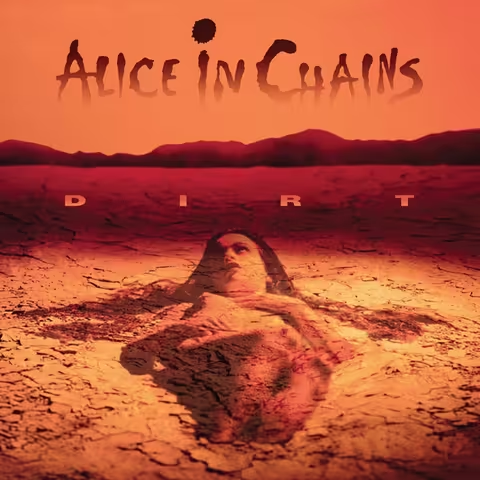
The cover is one of the most recognisable images of the grunge era: a nude woman, possibly dead, half-buried in a cracked desert floor. The photograph was taken by Rocky Schenck at his Hollywood studio on 14 June 1992, with Sean Kinney supervising for the band. The set was built on a soundstage and the dirt was real. Schenck cast model and actress Mariah O'Brien for the shoot after submitting a single photograph for the band's approval. For years fans assumed the model was Staley's then-girlfriend Demri Lara Parrott; Schenck only set the record straight in a 2011 Revolver feature.
The shoot ran around eight hours. After it ended, O'Brien went to the bathroom and left her wig embedded in the dirt. Schenck took a few extra photographs of the empty set with the abandoned wig; those images were used years later in the artwork for the 1999 Music Bank box set. Mary Maurer art-directed, Doug Erb designed the sleeve, and David Coleman drew the logo. Staley himself contributed the small sun motif and several other icons that recur through the booklet.
Asked about the image, Staley framed it as revenge. "The song Dirt was written to a certain person who basically buried my ass," he told the Canadian magazine M.E.A.T. in December 1992, "so the woman on the album cover is kinda the portrayal of that person being sucked down into the dirt, instead of me. The picture is the spitting image of her, and that wasn't even planned. I was pretty angry about it when I first saw it. She's not happy about it either. It was real eerie."
Release and Reception
Dirt was released on 29 September 1992 and entered the Billboard 200 at high speed. It peaked at number six and stayed on the chart for 102 consecutive weeks, finally dropping out at number 196 in late September 1994. It charted across continental Europe, peaking at 11 in Finland and Sweden, 15 in Norway, 17 in the Netherlands and 13 in Australia. In the UK the album reached 42 first time round.
Contemporary reviews were strong and, in places, ecstatic. Kerrang! gave it five out of five, Don Kaye calling it "an unflinching, brutally truthful and, yes, fiercely rocking testimonial to human endurance". Entertainment Weekly gave it an A. The Chicago Tribune awarded four stars. Q was lukewarm at two stars, NME notoriously hostile at two out of ten. Retrospective reviews have been kinder almost without exception. AllMusic's Steve Huey called it Alice in Chains' major artistic statement and the closest they ever came to a flat-out masterpiece, and Pitchfork's 2022 reissue review scored it 8.7.
"Dirt is Alice in Chains' major artistic statement and the closest they ever came to recording a flat-out masterpiece. It's a primal, sickening howl from the depths of Layne Staley's heroin addiction, and one of the most harrowing concept albums ever recorded."
Steve Huey, AllMusic, retrospective review
At the 1993 Grammys the album was nominated for Best Hard Rock Performance, losing to Eric Clapton's Unplugged. The Would? video, directed by Joseph Reidy on the Singles film set, took Best Video from a Film at the 1993 MTV Video Music Awards. Rolling Stone has since placed Dirt at number 26 on its 100 Greatest Metal Albums of All Time list, number 6 on its 50 Greatest Grunge Albums, and Guitar World ranked it the number one guitar album of 1992 ahead of Bad Religion's Generator and The Offspring's Ignition.
Singles and Music Videos
Columbia worked the album for almost two years, releasing five singles between the summer of 1992 and the autumn of 1993, each with an accompanying video that received heavy MTV play.
| Single | Released | US Mainstream Rock Peak | Video Director | Notes |
|---|---|---|---|---|
| Would? | June 1992 | 19 | Joseph Reidy | Released ahead of Dirt as part of the Singles soundtrack |
| Them Bones | September 1992 | 21 | Rocky Schenck | Album lead single proper |
| Angry Chair | November 1992 | 22 | Rocky Schenck | Staley solo writing credit |
| Rooster | March 1993 | 7 | Mark Pellington | Video features interviews with Jerry Cantrell Sr. |
| Down in a Hole | October 1993 | 13 | Nigel Dick | Filmed in the desert in black and white |
The Rooster video is the most ambitious of the five. Pellington intercut performance footage with sequences featuring Cantrell Sr. on camera, talking about Vietnam in a way he had never previously done with his son. Staley wore a pheasant feather in his hair; the video was rotated heavily on MTV and is widely credited with breaking the song to the rock-radio mainstream. Down in a Hole, shot a year later in black and white in the California desert, captured the band visibly thinner and quieter than they had been twelve months earlier.
Touring and Live
The band supported Dirt with a punishing eighteen-month touring cycle and survived less of it intact than they had hoped. The first major leg was opening for Ozzy Osbourne on the No More Tours run through late 1992 and early 1993. Days before the tour began, Staley broke his foot in an all-terrain-vehicle accident and played the entire opening leg on crutches at the front of the stage. The Hollywood Rock festival run in Brazil followed in January 1993; immediately after the band's appearance in Rio de Janeiro on 22 January, Mike Starr was fired. He was replaced within weeks by Mike Inez, formerly of Ozzy Osbourne's band, who would remain Alice in Chains' bassist on and off for the next three decades.
- Ozzy Osbourne support, North America, late 1992 to early 1993
- Hollywood Rock festival, Brazil, January 1993
- UK and European headline shows, February to April 1993
- Lollapalooza '93 main stage, June to August 1993, with Primus, Tool, Rage Against the Machine and Babes in Toyland
Lollapalooza was the high water mark and the end of the road. Alice in Chains co-headlined the main stage across the summer of 1993 and were, by most accounts, magnificent on the nights they made it to the stage at all. By the autumn Staley's health was bad enough that a planned Metallica support run was cancelled. The band would never again complete a full tour with Staley as frontman. He died of an overdose on 5 April 2002, eight years to the day after Kurt Cobain.
In TV, Film and Media
Would? remains the song most synonymous with Dirt's afterlife in film and television, partly because it was already a soundtrack piece in 1992 thanks to Singles. Rooster has been the bigger sync earner over the long arc, soundtracking sequences in Supernatural, This Is 40 and Terminator Salvation, among many others.
- Would? on the Singles original motion picture soundtrack, 1992
- Rooster in Supernatural, 2005
- Rooster in Terminator Salvation, 2009
- Rooster in This Is 40, 2012
- Multiple Dirt tracks across countless wrestling, sports and video-game placements through the 2000s and 2010s
Legacy and Influence
Dirt is the album most often cited as the bridge between grunge and the alternative metal of the late 1990s. Its slow-tempo riffs and harmonised twin vocals became a template that Deftones, Tool, Godsmack, Staind and Mastodon would each refract differently. The band's wider catalogue, especially the 1994 acoustic-leaning EP Jar of Flies and the 1995 self-titled album recorded with Mike Inez, deepened the sound without ever quite matching Dirt's commercial reach.
Staley's withdrawal from public life through the back half of the 1990s effectively ended Alice in Chains as a touring entity. The band's MTV Unplugged in April 1996 was their last full performance with the original singer. After his death in 2002 the surviving members regrouped, eventually returning with William DuVall sharing lead vocals on 2009's Black Gives Way to Blue, 2013's The Devil Put Dinosaurs Here and 2018's Rainier Fog. Mike Starr, by then long out of the band, died of an overdose in 2011.
Dirt itself has only grown in stature. Rolling Stone ranked it number six on its 50 Greatest Grunge Albums in 2019 and number 26 on its 100 Greatest Metal Albums of All Time. American Songwriter in 2025 listed it among four grunge albums it argued were better than Nevermind. It remains the band's commercial high-water mark, the album most listeners encounter first, and the one most often cited as Cantrell's most complete piece of writing.
Reissues, Remasters and Anniversaries
Dirt has been reissued and remastered repeatedly. The 1999 Music Bank box set put alternate mixes, the early demos of Fear the Voices and Lying Season, and extensive liner notes back in circulation. A 180-gram vinyl reissue followed in November 2009. Sony's 30th anniversary edition, mastered and pressed on yellow opaque double vinyl, was released on 23 September 2022 and pushed the album back into the Billboard 200 top ten at number nine, thirty years after its original peak at number six. The remaster was also released in Dolby Atmos and on Apple Digital Master high-resolution streaming.
Notable bootlegs and archival items in circulation include the 1991 demo tape that fed Sap and Dirt, multiple Lollapalooza '93 audience recordings, and a Hollywood Rock 1993 broadcast tape that is the last widely circulated full live document of Mike Starr playing with the band.
Things You Might Not Know
| Fact | Detail |
|---|---|
| The working title | Dirt was developed under the working title The Machine before the band settled on its eventual one-word name. |
| Day one of tracking | The first day of recording at Eldorado in Burbank fell on the day of the Rodney King verdict in April 1992, and the LA riots followed within hours. Sessions paused for four or five days while the band sheltered in Joshua Tree. |
| The Slayer connection | Tom Araya travelled to Joshua Tree with the band during the riots and stayed close enough to the project to be invited back into the studio to bellow over the forty-three-second Iron Gland interlude. |
| Jerden's honesty | Dave Jerden told Rolling Stone years later that Staley was angry with him during sessions because Jerden kept telling the singer to get clean. His defence: "I'm not getting paid to be Layne's friend." |
| Cantrell's three-amp trick | The album's signature guitar tone was three amps in parallel: a Bogner Fish preamp on the low end, a Bogner Ecstasy on the mid range, and a Rockman Headphone amp on the high end. |
| The cover mystery | For years fans assumed the woman half-buried on the cover was Staley's girlfriend Demri Parrott. Photographer Rocky Schenck only confirmed the model was actress Mariah O'Brien in a 2011 Revolver interview. |
| The track-order fight | Cantrell's intended sequence had Down in a Hole at track four; Columbia bumped it to track twelve on the original American CD pressing, fearing a slow ballad in the album's first quarter. Current editions restore Cantrell's order. |
| The coffee table | Dam That River was written the morning after drummer Sean Kinney broke a coffee table over Cantrell's head during a drunken argument. |
| Staley the songwriter | Hate to Feel and Angry Chair are the only two Alice in Chains songs Layne Staley wrote entirely on his own, and he plays the rhythm guitar on both. |
| Would? was already old | Would? was tracked at London Bridge with Rick Parashar months before the Dirt sessions began, for the Singles film soundtrack. The version on Dirt is the same recording. |
Podcast
The Riffology podcast dives into Dirt in episode RIFF017, picking apart the recording, the singles run, the LA riots interruption and the long-tail influence on alternative metal in the years after. The show is available on every major podcast platform and embedded above this article.
Comments