Joe Duplantier spent roughly six months and the bulk of an album budget on wood, screws and glue, building a recording studio with his own hands in a unit in Ridgewood, Queens. Gojira started tracking their sixth album there on 6 April 2015. About ten days later the sessions stopped dead: he and his brother Mario learned that their mother in France was gravely ill, and they flew home. Patricia Rosa Duplantier died of cancer on 5 July 2015.
The record they went back and finished is called Magma. It is 43 minutes and 51 seconds long across ten songs, roughly 23 minutes shorter than From Mars to Sirius, and it is the most restrained, most melodic and least technical thing Gojira have ever released. It also made them the first French band to top the Billboard Hard Rock Albums chart, won them two Grammy nominations, and was named album of the decade by at least one metal publication. This is how it was written, what the brothers were carrying while they made it, and why a band famous for eight-minute epics deliberately built a record you can hear in one sitting.
Album Facts
| Field | Detail |
|---|---|
| Artist | Gojira |
| Album | Magma |
| Release date | 17 June 2016 |
| Label | Roadrunner Records |
| Producer | Joe Duplantier |
| Studio | Silver Cord Studio, Ridgewood, Queens, New York |
| Genre | Progressive metal, groove metal, post-metal |
| Tracks | 10 |
| Runtime | 43:51 |
| Billboard 200 peak | 24 (17,000 first-week units) |
| UK Albums peak | 24 |
| Other peaks | 1 US Hard Rock Albums, 1 UK Rock & Metal, 4 Switzerland, 5 Finland, 9 Austria, 9 Norway, 10 France |
| Certifications | Gold in France (SNEP), 28 December 2023 |
| Estimated sales | 400,000 worldwide in the first eight months |
| Key singles | Stranded, Silvera, Low Lands |
What Metal Sounded Like in 2016
2016 was a year in which heavy music kept trying to work out how big it was allowed to be. The Best Rock Album category that Magma ended up in at the following February's Grammys tells the story on its own: Gojira were up against Blink-182's California, Panic! At The Disco's Death Of A Bachelor, Weezer's self-titled white album and Cage The Elephant's Tell Me I'm Pretty. In the Best Metal Performance field the competition was more familiar territory.
- Megadeth, "Dystopia", which took the award
- Baroness, "Shock Me"
- Korn, "Rotting In Vain"
- Periphery, "The Price Is Wrong"
Gojira arrived in that company as outsiders twice over: a French band in an overwhelmingly Anglo-American field, and a band whose reputation rested on long, dense, ecologically minded death metal rather than anything a radio programmer would recognise.
How Gojira Got Here
Gojira formed in the small Atlantic coast town of Ondres in 1996, built around the Duplantier brothers, Joe on guitar and vocals and Mario on drums, with guitarist Christian Andreu. They spent five years called Godzilla before being legally compelled to change the name in 2001, taking Gojira, the Japanese original. Bassist Jean-Michel Labadie completed the lineup that has never changed since.
The ascent was slow and entirely self-made. The Link arrived in 2003 with 2,500 copies distributed independently. From Mars to Sirius followed in 2005 on the French independent Listenable Records, recorded in a barn the band rebuilt themselves, and reached only number 44 in France, though it eventually became the record most people mean when they say they discovered Gojira. The Way of All Flesh in 2008 crept to 138 on the Billboard 200 on 4,200 first-week copies. Signing to Roadrunner Records in November 2011 changed the scale: L'Enfant Sauvage in 2012 reached number 34 in the US on 11,000 first-week sales, 104 places higher than its predecessor.
Then Joe moved to New York. By August 2012 he had been living there about a year, and the band's centre of gravity shifted across the Atlantic with him. That relocation is the hinge on which Magma turns, because it created both the studio the album was made in and the distance from home that made the family emergency of 2015 so much harder to absorb.
Pre-production and the Plan for a Short Record
The brief for Magma existed two years before anyone pressed record. Speaking to Guitar World in June 2014, Joe Duplantier laid out an unusually specific plan: the band had more than twenty song ideas on the table, "we could release three records or something", and yet what he wanted was "a short, very dynamic kind of album" of fewer than thirteen tracks. He also flagged a stylistic swerve, promising "some PANTERA-ish kind of riffs, which is kind of new for us", and riffs that were "a little punchier sometimes". Most tellingly of all, he claimed the producer's chair before a studio existed to sit in: "I wanna produce it. I have to do it myself somehow."
The other half of the plan was ruthlessness. Gojira had historically developed and rescued material; this time they threw it out. Joe described a process of dumping songs and dumping riffs, "which we never did before", and a cycle of enthusiasm followed by cold reassessment.
"One day we're super-happy with a new thing we did, and then we both listen to it at home, and we come back and say, 'Out.' After two or three weeks, we realise, 'Oh my God! This is so depressive. We need to get rid of that song.'"
Joe Duplantier, Guitar Mania, 2016
Mario approached his own instrument the same way, deliberately simplifying a style built on polyrhythmic complexity. "Now I try to stay simple as a drummer and this is my way of being a better musician," he told Loudwire in May 2016. Labadie, for his part, wanted more compositional breathing room for the bass. The stated goal, in Joe's words, was music that was more mature and less visceral.
Building Silver Cord, and Making Magma
Construction of Silver Cord Studio began in November 2014 in Ridgewood, Queens, with Mario moving to New York shortly after to help. The economics were the initial justification. "Instead of spending all that money on sessions, why not use it for gear and build my own studio with some nails, wood and glue?!" Joe told MusicRadar's Amit Sharma in August 2016. He later did the sums and reckoned the build cost roughly what booking a commercial studio would have.
"I wondered if I was going mad. I spent all the money on wood and screws, and six months later, there was a studio right in front of me."
Joe Duplantier, MusicRadar, 2016
What emerged was a live room of more than 300 square feet, a locker of over seventy microphones, DigiDesign, Focusrite and DDA consoles, and Pro Tools. The room was finished in early April 2015 and the band began tracking on the sixth. Ten days later it all stopped. The brothers flew to France to be with their mother.
Patricia Rosa Duplantier died on 5 July 2015. It was during her hospitalisation that the album acquired its name, and the reasoning is worth reading in full because it is the whole record in four sentences.
"We were feeling a mix between memories of the past and a fear of the future, with all the emotions burning inside. Magma is this expression of something boiling inside: we cannot touch it, but eventually it will erupt."
Mario Duplantier, Metal Hammer
Joe has been unusually candid about the period, describing it as spiritual and mental torture not to know whether to hope for recovery or for an end, and saying they had to learn not to hope but simply to live in the moment. Mario announced on 28 August 2015 that recording had resumed and was almost complete. The sessions that followed were, by both brothers' accounts, frequently overwhelming. "Mario was recording drums, and I was playing guitar with him," Joe told Blabbermouth, "both of us would start crying."
Technically, the record is defined by subtraction. Joe recorded through EVH 5150 III heads with a single Shure SM57 in front of the cabinet and nothing else: "It's not processed, it's a very pure sound." Choruses were built from just two guitar tracks, his Charvel prototype with an EMG 81 in the bridge, plus a Telecaster underneath for brightness. A DigiTech Whammy became, remarkably, the first pedal the band had ever used on a record, having previously generated their noises by hand with pick scrapes.
- Charvel prototype, later the Pro-Mod San Dimas Style 2 HH signature model
- Fender Telecaster layered under choruses for top end
- EVH 5150 III 100-watt heads, single SM57, unprocessed
- DigiTech Whammy, the band's first ever pedal
- Joe Duplantier on flute, filmed during the sessions
Mixing was completed by 20 February 2016, with Johann Meyer engineering and mixing alongside Joe. Ted Jensen mastered.
Personnel and Credits
| Role | Player | Notes |
|---|---|---|
| Core band | ||
| Vocals, guitar, flute | Joe Duplantier | All lyrics; also produced, mixed and arranged |
| Drums | Mario Duplantier | Co-wrote all music with Joe |
| Guitar | Christian Andreu | Founder member, in the band since 1996 |
| Bass | Jean-Michel Labadie | Pushed for more space in the arrangements |
| Production and engineering | ||
| Producer | Joe Duplantier | Self-produced, as promised in 2014 |
| Mixing, engineering | Johann Meyer | Completed February 2016 |
| Mastering | Ted Jensen | Sterling Sound veteran |
| Additional engineering | Will Putney | |
| Additional engineering | Alexis Berthelot | |
| Additional engineering | Jamie Uertz | |
| Additional engineering | Taylor Bingley | |
| Artwork | ||
| Cover artwork | Hibiki Miyazaki | American artist |
| Design | The Visual Strategist | Sleeve layout and typography |
| Band photography | Gabrielle Duplantier | Shares the brothers' surname |
The striking thing about that list is how short it is. There are no guest vocalists, no string sections, no hired session players, no outside producer. On a record made by a band at the point of a major commercial breakthrough, signed to a major label subsidiary, the only names beyond the four members are engineers, a mastering engineer and the people who made the sleeve. Everything you hear was played by the same four men who have been in Gojira since 1998.
The Songs on Magma
| # | Title | Writer(s) | Length | Single? | Notes |
|---|---|---|---|---|---|
| 1 | The Shooting Star | J. Duplantier / M. Duplantier | 5:42 | Video | Opens with clean vocals, not a growl |
| 2 | Silvera | J. Duplantier / M. Duplantier | 3:32 | Yes | Grammy nominated for Best Metal Performance |
| 3 | The Cell | J. Duplantier / M. Duplantier | 3:17 | Video | Shortest full song; video came nine months later |
| 4 | Stranded | J. Duplantier / M. Duplantier | 4:29 | Yes | Lead single; introduced the DigiTech Whammy |
| 5 | Yellow Stone | J. Duplantier / M. Duplantier | 1:19 | Instrumental; sets up the title track | |
| 6 | Magma | J. Duplantier / M. Duplantier | 6:42 | Longest track; poison, letting go, flight | |
| 7 | Pray | J. Duplantier / M. Duplantier | 5:13 | Slow, sludge-weighted centrepiece | |
| 8 | Only Pain | J. Duplantier / M. Duplantier | 3:59 | The album's hardest, fastest moment | |
| 9 | Low Lands | J. Duplantier / M. Duplantier | 6:03 | Yes | Video directed by Alain Duplantier |
| 10 | Liberation | J. Duplantier / M. Duplantier | 3:35 | Instrumental closer; acoustic, almost pastoral |
All lyrics are Joe's; all music is credited to Mario and Joe. The most immediate signal that something has changed comes eight seconds into The Shooting Star, where the vocal that arrives is a clean, low, almost incantatory line rather than the strafing bark Gojira built their name on. Its lyric, asking whoever has gone to send a sign from the other side, sets the album's terms straight away: this is a record addressed to someone who is no longer there.
Silvera is the pivot. At three and a half minutes it is the most compact thing the band had written, hung on one insistent riff and a chorus built around the line about changing yourself in order to change the world. Metal Hammer's Dom Lawson noted that the sentiment "would seem overly earnest and a little mawkish delivered by anyone else, but the Frenchmen's sincerity has long been a major selling point". It became the Grammy-nominated track and, almost a decade on, remains the song most likely to introduce a non-believer to the band.
Stranded was the world's first taste of the record and the most disorientating choice they could have made, a lurching, mid-tempo groove with the Whammy pedal smearing the guitar into something closer to a siren than a riff. Yellow Stone, at 79 seconds, is the shortest thing in the catalogue and functions as a fuse for the title track. Magma itself is the longest song here at 6:42 and the closest the album comes to the band's old scale, a slow accumulation about poison spreading through body and mind, and about letting go and flying.
The back half is where the grief sits heaviest. Pray and Only Pain work as a pair of opposites, the first slow and sludge-weighted, the second the fastest and most aggressive track on the album. Low Lands is the deep cut worth rediscovering: six minutes of drift about escaping worldly plagues, with imagery of a giant monster that no longer poses a threat, which for a band who took their name from Godzilla is not an accident. Liberation ends the record with an acoustic instrumental that is closer to folk than metal, and is the single clearest statement of the album's argument that mourning and release are the same motion.
What Did Not Make Magma
Here is the most unusual fact about Magma's release: there are no B-sides, no bonus tracks and no extended edition. Every physical and digital configuration issued in 2016, across CD, vinyl and digital in the US, Europe, Canada, Australia and Brazil, carries the same ten songs. For a major-label metal album in the mid-2010s, when territory-exclusive bonus cuts were near-universal, that is a deliberate act of discipline entirely in keeping with the "we want a short album" brief.
That does not mean there was nothing left over. Joe's 2014 account had the band sitting on more than twenty song ideas, enough in his estimation for three records, and the writing process he described was one of continuous elimination rather than refinement. Songs were discarded weeks after being celebrated. Riffs were binned wholesale. None of that material has ever surfaced officially, and no credible source has documented what any of it sounded like. What did appear on the special editions was not audio at all but a bonus DVD, a twelve-part live set drawn from the band's back catalogue including Ocean Planet, The Heaviest Matter of the Universe, Backbone and Flying Whales from From Mars to Sirius, L'Enfant Sauvage, Vacuity, Oroborus, The Gift of Guilt and a Mario Duplantier drum solo.
The Artwork
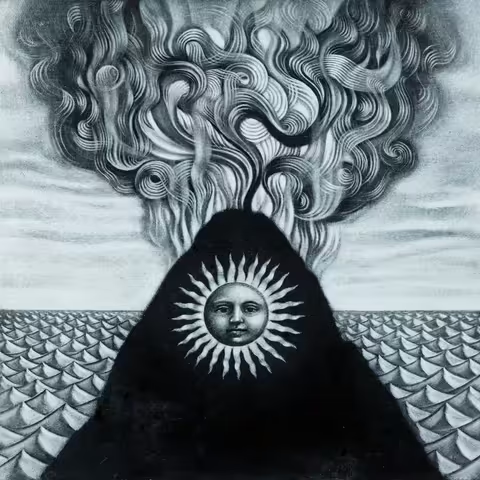
The sleeve, by American artist Hibiki Miyazaki with design by The Visual Strategist, is the rare metal cover that tells you exactly what the record is before you play it. It is monochrome, drawn in a fine engraving or etching style with a faint blue-grey wash, and it has no lettering on the image at all.
A solid black triangle, unmistakably a volcano, rises from a flat horizon out of a stylised sea rendered as rows of repeating scalloped waves, the kind you find on antique maps and woodcuts. From its peak a single thin thread of smoke climbs and then blooms into an enormous mass of curling, coiling smoke that fills the whole upper half of the frame. Set into the black slope of the mountain, roughly where a heart would be, is a pale sun disc with a calm human face and alternating straight and wavy rays, the classic alchemical or heraldic sun.
The reading is not subtle and does not need to be. Something serene is buried inside something enormous, black and about to erupt. Gabrielle Duplantier, who shares the brothers' surname, took the band photography for the package, one more sign of how closely held this record was.
Release and Reception
Magma was released on 17 June 2016 and did numbers Gojira had never come close to. It debuted at 24 on the Billboard 200 on 17,000 first-week units and went to number one on the Top Hard Rock Albums chart, making Gojira the first French band ever to top it. In the UK it also hit 24, and number one on the Rock and Metal chart. It reached the top ten in Switzerland, Finland, Austria, Norway and France, and the top forty in twelve European countries. Within eight months it had sold 400,000 copies worldwide. France finally certified it gold on 28 December 2023.
Critically it was close to a clean sweep, landing at 79 on Metacritic. The Guardian gave it five stars, PopMatters nine out of ten, Spin eight out of ten, Pitchfork 7.6 and Rolling Stone three and a half.
"This is not the death metal of From Mars to Sirius, nor does it pretend to be. The Duplantiers had to make this album for themselves. We are the fortunate witnesses."
Jon Hadusek, Consequence, 2016
The dissent, such as it was, came from within the fanbase rather than the press, and it centred on exactly what the reviews praised: the cleaner vocals, the shorter songs, the retreat from technicality. MetalSucks ran its review under the headline "Gojira's Magma: A Magnificent Mixed Bag", and Metal Hammer would later place Gojira in a feature about metal bands who went soft and were better off for it. There was no scandal, no censorship and no lawsuit attached to this record; the only argument it started was about whether accessibility counts as a betrayal.
Year-end lists settled that argument decisively. Metal Hammer made it their album of 2016, WhatCulture put it top of their hard rock and metal list, Loudwire placed it fourth and Rolling Stone eighth in their metal rundowns, and Consequence ranked it 33rd across all genres. Kirk Hammett called it "an incredible piece of art" and the best album he had heard in a long time. In October 2019 MetalSucks named it the number one metal album of the entire 2010s.
Singles and Music Videos
| Single | Date | Video director | Notes |
|---|---|---|---|
| Stranded | 22 April 2016 | Vincent Caldoni | Album artwork and tracklist revealed the same day |
| Silvera | 20 May 2016 | Drew Cox | Grammy nominated performance |
| Low Lands | 8 July 2016 | Alain Duplantier | Video premiered three weeks after the album |
| The Shooting Star | 2016 | Markus Hofko | Video only, not a commercial single |
| The Cell | 23 February 2017 | Drew Cox | Video only; thermal imaging footage |
The campaign was unusually visual for a band who had once made a video entirely out of still photographs. "Stranded" landed first, on 22 April 2016, and Rolling Stone described it as disturbing. Drew Cox directed twice, and his "The Cell" video is the most striking of the set, shooting the band through thermal imaging so the footage renders in the same stark black and white as the sleeve, cut with surveillance clips and digitally mapped outlines.
The keeper, though, is "Low Lands", directed by Alain Duplantier and released on 8 July 2016. Between his direction, Gabrielle Duplantier's photography and two brothers writing every note, the credits on this album read like a family document, which given what it is about feels less like nepotism than like the point.
The Magma World Tour
Gojira toured this record for roughly three and a half years, working to a rotation of six-week runs followed by a month off. It began in Europe and on the summer festival circuit in June 2016, including a Hellfest appearance the week of release.
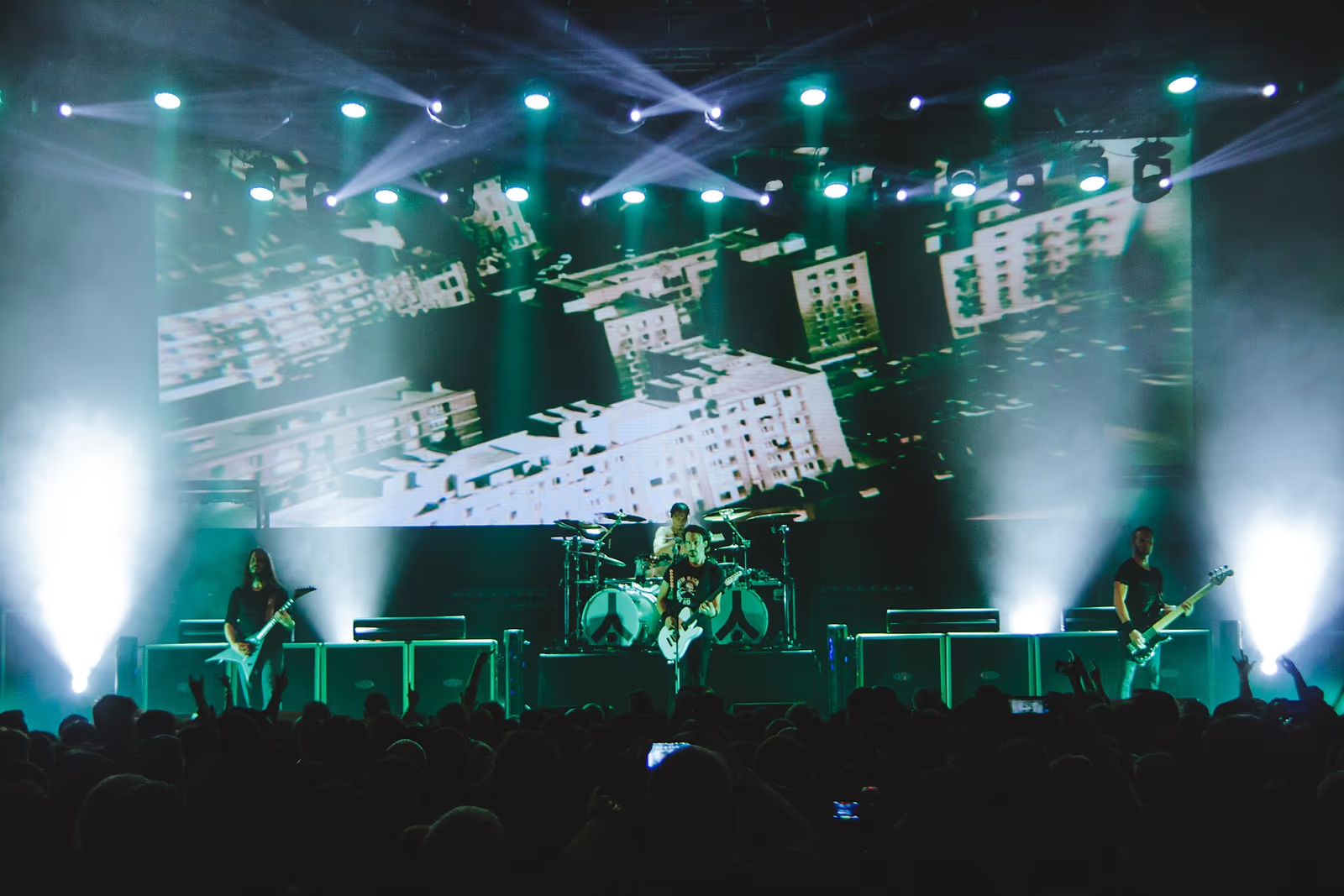
In July 2016 they played a deliberately tiny warm-up at Saint Vitus Bar in Brooklyn, a few streets from the studio the album was built in, before a 27-date North American headline run through to October with Tesseract supporting. November and December took them into UK and European arenas alongside Alter Bridge, Volbeat and Like A Storm. January 2017 brought a French tour with nine consecutive sold-out shows, capped by two sold-out nights at the Olympia in Paris on 1 and 2 April. In the summer of 2017 they supported Metallica's WorldWired stadium tour of the US with Avenged Sevenfold and Volbeat, and by 2018 they were headlining Tuska, Brutal Assault and Bloodstock, and playing the largest crowd of their career at Pol'and'Rock in Kostrzyn nad Odrą, Poland.
Magma in TV, Film and Media
This is one area where the honest answer is that there is not much to report. No significant film, television, advertising or video game placement of a Magma track is documented by any credible source, which is unusual for an album this commercially successful and says something about how sync-resistant Gojira's music is. The band's true mainstream media moment arrived eight years later, on 26 July 2024, when they performed at the Paris Olympics opening ceremony at the Conciergerie, the first hard rock or metal act ever to play one. The song was not from this album, but the platform existed because of it.
Covers, Samples and Tributes
Similarly, no notable cover version, sample or tribute record drawn from Magma has been documented. Its influence has travelled by endorsement rather than reinterpretation. Kirk Hammett's public praise in November 2016 mattered, and James Hetfield has separately named From Mars to Sirius as the album that made him a fan, which is presumably part of why Metallica took Gojira out on a stadium tour the following summer. Where Magma shows up in other people's records is in the licence it gave: you could cut a song to three and a half minutes, sing rather than scream, and lose nothing.
Reissues and the Tenth Anniversary
The original 2016 campaign covered CD, digital and 12-inch vinyl, with special editions in Europe pairing both formats with the live DVD. In 2020 the album was bundled with L'Enfant Sauvage as a two-album package. Nothing else appeared for a decade.
That changed for the tenth anniversary. A reissue campaign is scheduled for 13 November 2026 through Atlantic Records, in a spread of variants:
- Lava-coloured vinyl, limited to 500 copies, exclusive to Revolver
- Black and red A-side/B-side vinyl
- Black and red galaxy vinyl
- A deluxe edition on marbled silver vinyl
The deluxe package is the one that matters for anyone who cares how this album was made: it comes with a 52-page book of behind-the-scenes photographs plus drawings and paintings by Mario and Joe Duplantier. Given how private the band were about the circumstances of the sessions at the time, a book of the brothers' own artwork from that period is a significant piece of archival release.
The Legacy of Magma
The Grammy nominations came on 12 February 2017, at the 59th ceremony at the Staples Center in Los Angeles. Gojira lost both: Best Rock Album to Cage The Elephant's Tell Me I'm Pretty, and Best Metal Performance to Megadeth's "Dystopia". They would not win one until 2025, when "Mea Culpa (Ah! Ça ira!)" took Best Metal Performance at the 67th Grammys, the band's first victory after a nomination in 2022 for "Amazonia".
What Magma did was change the ceiling. Fortitude in 2021 debuted at 12 on the Billboard 200 with 27,372 album-equivalent units, topped Top Rock Albums, Hard Rock Albums, Top Album Sales and the UK Rock and Metal chart, and was the best-selling album of its release week in the United States. None of that happens without the record that came before it.
"We made this album with sadness and pain, but it's a pure expression of feelings in the moment: we are mourning, but at the same time there is joy."
Joe Duplantier, Metal Hammer
Ten years on, the assessment MetalSucks reached in 2019 has held up better than most decade-list verdicts. Magma is the album where a technically formidable band worked out that restraint hits harder than complexity, and it remains the door most new listeners walk through on their way back to From Mars to Sirius and the rest.
Things You Might Not Know
| Fact | Detail |
|---|---|
| The first pedal, ever | The DigiTech Whammy on Stranded was the first effects pedal Gojira had ever used on a record; their signature noises had always been made by hand with pick scrapes. |
| One microphone | Every guitar tone on Magma was captured with a single Shure SM57 in front of an EVH 5150 III cabinet, with no processing on the way in. |
| Joe plays flute | Joe Duplantier is credited with flute as well as vocals and guitar, and was filmed recording the part during the sessions. |
| The band's own bricks | Joe built Silver Cord Studio himself over about six months and later calculated it cost roughly the same as booking a commercial studio would have. |
| A French first | Topping the Billboard Top Hard Rock Albums chart made Gojira the first French band ever to do so. |
| No bonus tracks anywhere | Every 2016 edition worldwide carries the same ten songs. There are no territory-exclusive extras, no B-sides and no bonus cuts. |
| Three albums' worth binned | Joe reckoned in 2014 they had more than twenty song ideas and could have released three records; they cut it to ten tracks instead. |
| Named in a hospital | The title was chosen while the brothers' mother was in hospital, before she died, as a description of emotions boiling under the surface. |
| A family credit list | Alain Duplantier directed the Low Lands video and Gabrielle Duplantier shot the band photography, alongside the two brothers who wrote every note. |
| Nine years to gold at home | France did not certify Magma gold until 28 December 2023, more than seven years after a release that had sold 400,000 copies worldwide inside eight months. |
Hear More on the Riffology Podcast
Gojira's Magma gets the full treatment on the Riffology podcast, where the hosts dig into the sessions, the songs and the story behind one of the most quietly devastating metal records of its decade. You can find the episode, and the rest of the back catalogue, on all the major podcast platforms.


Comments