Introduction
MTV Unplugged in New York is the only Nirvana album recorded in a single uninterrupted take, the only Nirvana album whose stage set Kurt Cobain personally designed to look like a funeral, and the only Nirvana album released after his death. The fourteen-song acoustic performance was taped on 18 November 1993 at Sony Music Studios in Hell's Kitchen, Manhattan, with stargazer lilies, black candles and a crystal chandelier arranged around the band on Cobain's specific instruction. Alex Coletti, the show's producer, took the lily-and-candle brief and asked whether the singer meant something like a funeral. Cobain said yes. Coletti would tell that story for the rest of his career.
The performance broadcast on 16 December 1993. Four months and twenty days later, on 5 April 1994, Cobain shot himself in Seattle. Seven months after that, on 1 November 1994, DGC Records released the unmodified audio of the November 1993 taping as a fourteen-track album. It debuted at number one on the Billboard 200 with 310,500 first-week US copies, the highest opening-week sales of Nirvana's career, surpassing both Nevermind and In Utero. It went on to eight-times Platinum in the United States, won the band's only Grammy, and has become the canonical recording in a celebrity-acoustic television franchise that had previously been defined by Eric Clapton playing his own greatest hits. None of which is what Cobain had in mind. He thought, when the cameras stopped rolling on the night, that the performance had been a disaster.
Album Facts
| Field | Detail |
|---|---|
| Artist | Nirvana |
| Album | MTV Unplugged in New York |
| Recording Date | 18 November 1993 (single afternoon, single take) |
| Release Date | 1 November 1994 |
| Label | DGC Records |
| Producer(s) | Scott Litt (album); Alex Coletti (TV taping) |
| Studio(s) | Sony Music Studios, Hell's Kitchen, Manhattan, New York (recording); SST Rehearsal Facility, Weehawken, New Jersey (two days of rehearsals); Bad Animals Studio, Seattle (post-production overseen by Litt) |
| Director | Beth McCarthy-Miller |
| Genre | Acoustic rock, alternative rock, folk rock, grunge |
| Track Count | 14 |
| Total Runtime | 53 minutes 40 seconds (66 minutes in unedited form) |
| Billboard 200 Peak | #1 (debut, November 1994) |
| UK Albums Chart Peak | #1 |
| Other Notable Chart Peaks | Number one in Australia, Austria, Belgium, Canada, France, Ireland, the Netherlands, New Zealand, Norway, Sweden and Switzerland |
| Certifications | RIAA: 8× Platinum; BPI: 2× Platinum |
| Estimated Sales | Over five million US copies sold within months of release; widely cited at over ten million worldwide |
| Key Singles | "About a Girl" (1994); "The Man Who Sold the World" and "Where Did You Sleep Last Night" received heavy radio play without formal single release |
Cultural Context
Late 1993 was, for American alternative rock, a moment of awkward and very profitable adolescence. The Seattle-defined wave that Nevermind had broken open in late 1991 was now mainstream-American-radio's default rock setting, with a thriving second tier and a third tier of major-label signings that had become quietly enormous. The records sitting in the upper reaches of the Billboard 200 alongside In Utero in November 1993 give a fair picture of the competitive landscape Nirvana were operating inside:
- Pearl Jam, Vs., released 19 October 1993, the new opening-week US sales record at 950,000 copies.
- The Smashing Pumpkins, Siamese Dream, the late-summer slow-burn record that was still in the chart's top forty.
- Smashing Pumpkins' contemporaries and rivals Stone Temple Pilots, whose Core was over a year old and still moving units.
- Soundgarden, between albums but with Superunknown three months away.
- Alice in Chains, whose Jar of Flies EP would arrive in January 1994 and become the first EP in history to debut at number one on the Billboard 200.
MTV's Unplugged franchise had been running since 1989 and by late 1993 was probably the network's most coveted artist showcase. Eric Clapton's January 1992 taping, released as an album in August of that year, had sold over twelve million US copies by mid-1993 and won six Grammys. Mariah Carey, 10,000 Maniacs, Paul McCartney, Rod Stewart and Neil Young had all made career-defining or career-resetting Unplugged albums by 1993. The format was understood, by every band's label, as a guaranteed commercial event. What it had become, in practice, was a way to repackage hit singles as acoustic ballads.
Cobain had watched the format. He and the band had sat through plenty of episodes by the time MTV came knocking, and they had read it the way they read most things the music industry handed them, which was suspiciously. Dave Grohl has been clear in subsequent interviews that the band found most Unplugged tapings disappointing precisely because the artists treated them as miniature stadium shows. The decision to accept the invitation only came once Cobain had decided, in conversations during the Meat Puppets-supported leg of the In Utero tour, that he had a way to do it that was not a miniature stadium show. The setlist, the staging, the guest choices, the cellist, the cover-heavy programming and the funereal art-direction were all built around a single guiding principle: this is going to be the opposite of an acoustic greatest-hits record.
The Band's Story Up to This Point
By November 1993 Nirvana were two studio albums deep into a major-label career that had been more commercially explosive and personally destabilising than any of the band had imagined possible. Nevermind, released on 24 September 1991, had displaced Michael Jackson's Dangerous from the top of the Billboard 200 in January 1992 and turned the trio (Kurt Cobain, Krist Novoselic and Dave Grohl, who had joined in 1990) into the unwilling spokespeople of an alternative-rock breakthrough they had not asked to lead.
In Utero, released two months before the Unplugged taping, was Cobain's deliberate corrective to that breakthrough. Recorded with Steve Albini at Pachyderm Studio in Cannon Falls, Minnesota in February 1993, mixed in part by Scott Litt after Albini's masters were judged commercially unworkable, it was the band's loudest, most uncomfortable and most lyrically corrosive record. It debuted at number one on the Billboard 200, and it shipped half the first-week numbers of Nevermind. Cobain understood this as a victory.
The In Utero tour had begun in October. Two essential touring additions had been made: Pat Smear of the Germs on second guitar, and the Seattle cellist Lori Goldston on selected songs. Both would carry directly into the Unplugged taping. The tour itself was volatile. Cobain's heroin addiction was on-again, off-again. His stomach pain, the chronic gastrointestinal condition that haunted him throughout his adult life, was untreated. Shows were either transcendent or collapsing. By the time the band travelled to New York for two days of Unplugged rehearsals on 16 and 17 November, the inner circle had reached a state of constant low-grade anxiety about whether the next show would happen.
Pre-production and Setlist Battles
The setlist Cobain delivered to MTV in advance of rehearsals was, from the network's commercial perspective, an act of provocation. Of the eight original Nirvana songs, only "Come as You Are" was a top-tier hit single. "Smells Like Teen Spirit" was not on the list. Neither was "Lithium". Neither was "In Bloom". Neither was "Heart-Shaped Box". The remaining originals (one from Bleach, three further from Nevermind, two more from In Utero) were either album tracks or songs that had peaked on the modern-rock chart and never crossed over.
The provocation got worse. Six of the fourteen songs were covers. Three of them were by the Meat Puppets, an Arizona band signed to SST whose second album, Meat Puppets II, had sold modestly in 1984 and was almost completely unknown to MTV's daytime audience. The plan was to bring brothers Curt and Cris Kirkwood out on stage to play on those three songs together with Nirvana. The MTV production team responded by lobbying hard for higher-profile guests. Eddie Vedder. Tori Amos. Anyone the audience would recognise from a CD-rack at Sam Goody. Cobain refused on every front. As a member of the production team would later put it:
"They had no idea who the Meat Puppets were. They wanted to know why we couldn't have Eddie Vedder, or Tori Amos, or Pearl Jam. Kurt said no."
MTV Unplugged production staff member, retrospective interview
Two days of rehearsal at the SST Rehearsal Facility in Weehawken, New Jersey, were tense. The mechanics of translating songs born in feedback into acoustic arrangements were not trivial. Grohl, whose drumming had been built around the volume and physicality of a rock kit, struggled to scale down. Director Beth McCarthy-Miller's description has become canonical:
"Dave Grohl was like Animal from The Muppet Show. He could not play softly."
Beth McCarthy-Miller, director, MTV Unplugged in New York
Grohl's eventual solution was to play the bulk of the set with brushes and bundled wooden dowels rather than drumsticks. Novoselic dug out the accordion he had played as a child (his first instrument) for "Jesus Doesn't Want Me for a Sunbeam"; the moment he picked it up in rehearsal, Cobain immediately saw how it could work. Guitar tech Earnie Bailey was given the brief of taking the cheap Buck Owens-model red-white-and-blue acoustic guitar that Novoselic owned and modifying it to the point that, as Bailey put it, it sounded like a guitar rather than a child's toy. Smear played it for most of the set. A planned cover of the Velvet Underground's "Here She Comes Now" was rehearsed but never made it to the taping; Meat Puppets guitar tech Troy Meiss has said it was the best of the band's rehearsals.
Creating the Recording
The 17 November rehearsal day ended badly. Cobain was in withdrawal and refused to play. Crew members at Sony Music Studios reported that nobody on the production was certain, by the end of the evening, that the 18 November taping would actually happen. There was no contingency. The audience invitations had gone out. The lilies had been ordered.
Cobain arrived at the studio on the afternoon of 18 November wearing jeans, Converse trainers, an olive-green Manhattan-brand mohair cardigan and a t-shirt advertising the all-female San Francisco punk band Frightwig (the choice was characteristic: he used the largest platform of his career to advertise an obscure band he admired). One label representative noted later that he had not washed his hair in over a week. Coletti had supplied a stool to sit on, which Cobain rejected; the singer went and found an office swivel chair from somewhere else in the Sony building and sat on that instead. The three-hour soundcheck was difficult.
The two production decisions that defined how the recording sounds were both Cobain's. The first was that despite the "unplugged" premise, he wanted to run his acoustic guitar through his Fender Twin Reverb amplifier and through the same pedalboard he used live. Coletti's solution was practical and clandestine: a wooden box was built to surround the amplifier so that, from the audience's and the cameras' point of view, it looked like a stage monitor. The amplification is most audible on "The Man Who Sold the World", where the acoustic guitar carries an unmistakably driven, almost electric quality. The second was Cobain's choice of guitar.
The instrument was a 1959 Martin D-18E, an acoustic-electric experiment of which only 302 were built. Cobain had bought it from Voltage Guitar in Los Angeles earlier in the autumn of 1993 for approximately US$5,000. He had it modified with a Bartolini soundhole pickup and had the nut recut so he could play it left-handed. Courtney Love has said, in subsequent interviews, that it was the last guitar he ever played. The Martin's slightly nasal acoustic-electric tone is recognisable across the entire performance.
The recording itself ran fourteen songs straight through with only minimal between-song banter, an essentially single-take performance that was a first in the Unplugged franchise. Cobain has been described, by everyone on the production, as having lifted from anxious to almost cheerful from the moment the cameras started rolling. Grohl summarised what changed:
"Then we sat down and the cameras started rolling and something clicked."
Dave Grohl, on the moment the Unplugged taping began
Scott Litt sat in the control room. Litt had produced six R.E.M. studio albums by November 1993 and had recently remixed "Heart-Shaped Box" and "All Apologies" from In Utero at the label's request after Steve Albini's mixes were judged commercially unworkable. He recorded the Unplugged performance live to digital multitrack with what would, almost a year later, become essentially zero overdubs; the album mix Litt eventually delivered was the live recording with minor cleanup.
Personnel and Credits
| Role | Player | Notes |
|---|---|---|
| Core band | ||
| Vocals, acoustic guitar | Kurt Cobain | 1959 Martin D-18E throughout, run through a hidden Fender Twin Reverb amplifier |
| Drums, backing vocals, bass on track 3 | Dave Grohl | Played most of the set with brushes and bundled wooden dowels rather than sticks; bass on "Pennyroyal Tea" so Novoselic could pick up accordion |
| Bass, accordion, guitar | Krist Novoselic | Accordion on "Jesus Doesn't Want Me for a Sunbeam"; guitar on the three Meat Puppets covers so Cris Kirkwood could play bass |
| Additional musicians | ||
| Rhythm and lead guitar | Pat Smear | Former Germs guitarist; touring member since 1993; played a heavily modified Buck Owens model acoustic belonging to Novoselic, reworked by tech Earnie Bailey |
| Cello | Lori Goldston | Seattle cellist who had been touring with Nirvana on the In Utero tour; Cobain mistakenly introduced her as "Lori Goldstein" on camera and the slip was kept in |
| Guitar on "Plateau", "Oh Me", "Lake of Fire" | Curt Kirkwood | Meat Puppets |
| Bass and backing vocals on "Plateau", "Oh Me", "Lake of Fire" | Cris Kirkwood | Meat Puppets |
| Production and engineering | ||
| Album producer, mixer | Scott Litt | R.E.M. producer; had remixed two In Utero singles earlier in 1993 |
| Show producer | Alex Coletti | MTV Unplugged in-house producer |
| Director | Beth McCarthy-Miller | MTV staff director; later Saturday Night Live |
| Audio engineer | Bob Ludwig | Mastering at Gateway Mastering, Portland, Maine |
| Guitar technology | Earnie Bailey | Modified the Buck Owens acoustic to playable specification |
| Artwork | ||
| Cover photography | Frank Micelotta | The hunched-over-the-Martin photograph that has become canonical |
| Art direction | Robert Fisher | DGC in-house art director; later worked on the Beck and Foo Fighters catalogues |
The Songs
| # | Title | Writer(s) / source | Length | Notes |
|---|---|---|---|---|
| 1 | About a Girl | Cobain (from Bleach, 1989) | 3:37 | Released as the album's sole official single in 1994 |
| 2 | Come as You Are | Cobain (from Nevermind, 1991) | 4:13 | The only top-tier hit single in the set |
| 3 | Jesus Doesn't Want Me for a Sunbeam | Eugene Kelly / Frances McKee (Vaselines cover) | 4:37 | Novoselic on accordion; Grohl on bass |
| 4 | The Man Who Sold the World | David Bowie cover | 4:20 | The track on which the hidden Fender Twin amplification is most obvious |
| 5 | Pennyroyal Tea | Cobain (from In Utero, 1993) | 3:40 | Performed entirely solo by Cobain, just voice and guitar |
| 6 | Dumb | Cobain (from In Utero, 1993) | 2:52 | Goldston's cello most prominent here |
| 7 | Polly | Cobain (from Nevermind, 1991) | 3:16 | Already an acoustic song on the studio original; here more uncomfortable still |
| 8 | On a Plain | Cobain (from Nevermind, 1991) | 3:44 | Cut from original TV broadcast; restored to album |
| 9 | Something in the Way | Cobain (from Nevermind, 1991) | 4:01 | Cut from original TV broadcast; restored to album |
| 10 | Plateau | Curt Kirkwood (Meat Puppets cover) | 3:39 | Kirkwood brothers join the band on stage |
| 11 | Oh Me | Curt Kirkwood (Meat Puppets cover) | 3:25 | Kirkwood brothers |
| 12 | Lake of Fire | Curt Kirkwood (Meat Puppets cover) | 2:55 | Kirkwood brothers; Cobain singing in a deliberately uncomfortable key |
| 13 | All Apologies | Cobain (from In Utero, 1993) | 4:23 | Not yet released as an In Utero single at time of taping |
| 14 | Where Did You Sleep Last Night | Traditional, Lead Belly arrangement | 5:08 | Cobain's introduction credited it to his "favourite performer", Lead Belly |
Of the originals, the most quietly devastating is "Pennyroyal Tea", which Cobain performed entirely solo: voice and Martin only, with Grohl and Novoselic visible in the wings but silent. The In Utero song was about an abortifacient tea historically used by women to induce miscarriage, set inside a lyric about chronic sickness and self-loathing; performed solo in a room of strangers it is essentially unbearable. "All Apologies", which had not yet been released as a single from In Utero at the time of the taping, became substantially better-known in this version, Goldston's cello giving the chorus a near-liturgical weight.
The covers function as a guided tour of Cobain's record collection. The Vaselines' "Jesus Doesn't Want Me for a Sunbeam" rebuilds a tiny Glasgow indie-pop song into a chamber piece, with Novoselic's accordion carrying the harmonic load. David Bowie's "The Man Who Sold the World" was, for a sizeable share of the millions who bought the album in late 1994, the first time they had heard the song; Bowie reportedly noted with amusement that a generation of fans afterwards assumed it was a Nirvana original. The three Meat Puppets covers ("Plateau", "Oh Me", "Lake of Fire") are the most country-influenced minutes in Nirvana's recorded catalogue, with the Kirkwood brothers on stage and Cobain singing in deliberately uncomfortable keys, straining his voice for emotional effect.
The closing performance of "Where Did You Sleep Last Night", a traditional Appalachian murder ballad known most widely from Lead Belly's 1944 recording, is the moment the whole album is built around. Cobain introduced it by saying it was written by his favourite performer, then jokingly told the audience he had asked David Geffen to buy Lead Belly's guitar for him and been turned down; Novoselic suggested a donation basket. Then they played it. The performance builds from a measured opening verse to a final scream-sung verse on which Cobain's voice cracks open. Neil Young, who would later be linked to Cobain through the lyric Cobain quoted in his suicide note, described the vocal afterwards as "unearthly, like a werewolf, unbelievable". The camera caught Cobain's eyes glazing over in the final bars. The audience sat silent. Coletti asked for an encore. Cobain refused, telling him:
"I can't top that last song. I'm not playing anything else."
Kurt Cobain to Alex Coletti, 18 November 1993
Coletti pleaded with him for around five minutes. Cobain held. The cameras stopped rolling. MTV executive Amy Finnerty, who knew Cobain well, took him aside afterwards and tried to explain what the audience's stunned silence had actually meant: "Kurt, they think you are Jesus Christ". He read it as failure regardless.
B-sides, Outtakes and Lost Songs
The performance was conceived as a single artefact rather than a sessions-and-B-sides exercise, so the conventional B-side ecosystem barely exists here. Two songs from the taping itself were cut from the 16 December 1993 television broadcast for time: "On a Plain" and "Something in the Way". Both were restored to the album. A studio cover of "Where Did You Sleep Last Night" had reportedly been intended as a B-side for the planned "Pennyroyal Tea" commercial single from In Utero, but the single was withdrawn in the immediate aftermath of Cobain's death and never properly issued.
The most consequential lost song is the Velvet Underground cover, "Here She Comes Now", which the band rehearsed at length in Weehawken but never taped at Sony. Troy Meiss, Meat Puppets guitar tech, has said in subsequent interviews that he considered it the best song the band played across the two days that did not make the final set. No professional recording of that rehearsal version is known to exist publicly. Five further rehearsal takes, of "Come as You Are", "Polly", "Plateau", "Pennyroyal Tea" and "The Man Who Sold the World", were recorded in some form and eventually released as bonus material on the 2007 DVD.
Album Artwork and Packaging
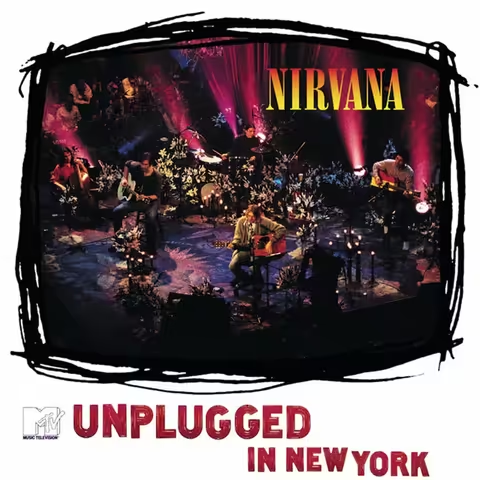
The cover photograph, taken during the performance by Frank Micelotta, is one of the most reproduced images in rock photography. Cobain is hunched over the Martin, eyes shut, the cardigan sliding off one shoulder, the lilies and candles just out of frame. Robert Fisher, DGC's in-house art director, handled the layout and the typographical decisions: a sparse white-on-black title block, the credits and tracklist set in a small serif on the back, no liner essay. The packaging was deliberately undecorated. There was no posthumous note. There was no producer's foreword. The album was allowed to do its own work.
The original 1994 CD pressing came with a twelve-page booklet that included production credits, the audience-shot of the room with the funeral lilies, and a brief photo essay of stills from the taping. The 2007 DVD release expanded the package considerably: the full unedited performance including "On a Plain" and "Something in the Way", five full-band rehearsal tracks, and a 1999 MTV documentary, Bare Witness: Nirvana Unplugged.
Release and Reception
The MTV Unplugged in New York episode first aired on 16 December 1993, in a 45-minute edit. The album was released on 1 November 1994 (almost seven months after Cobain's death) by DGC Records in the US and by Geffen internationally. It debuted at number one on the Billboard 200 with 310,500 first-week US copies, the largest opening week of Nirvana's career, and went to number one in at least twelve other countries including the UK, Australia, France and Germany. By March 1995 it had sold 6.8 million US copies, outstripping In Utero. The RIAA certified it eight-times Platinum.
"About a Girl" was issued as the only formal commercial single, though "The Man Who Sold the World", "Where Did You Sleep Last Night" and "Lake of Fire" all received heavy US radio rotation. The album won the Grammy Award for Best Alternative Music Performance at the 38th ceremony in February 1996; it remains Nirvana's only competitive Grammy win. Rolling Stone called the record "stirring and occasionally brilliant"; the journalist Charles M. Young, in a much-cited retrospective piece, called it Nirvana's "second masterpiece" and argued that Cobain could have rewritten contemporary folk music with the same authority he had brought to rock.
AllMusic's retrospective summary captured the consensus that hardened across the late 1990s and 2000s:
"Fearlessly confessional, MTV Unplugged in New York finds Kurt Cobain on the verge of discovering a new sound and style. It captures the band in an entirely new light, and it suggests they could have explored an entirely new direction."
AllMusic, retrospective review
Rolling Stone has subsequently included it on multiple iterations of its Greatest Albums of All Time list. It is routinely ranked the best Unplugged album in the franchise's history, and one of the small handful of live albums (alongside The Last Waltz, Live at Leeds and At Folsom Prison) that is treated as a peer to the artist's studio catalogue rather than a souvenir of it.
Singles and Television
The album's promotional cycle was unusual because the entire performance had already aired on national television almost a year before the album release. The video for "About a Girl" used the existing MTV Unplugged footage and was placed into heavy network rotation on release. The "Where Did You Sleep Last Night" performance was treated similarly: never released as a formal commercial single, but pushed onto US rock radio and into MTV programming alongside the album. The video footage of "The Man Who Sold the World" became, retroactively, the most-watched piece of the original taping; David Bowie himself spoke warmly of it on several subsequent occasions.
The 1993 episode itself was rebroadcast continuously on MTV in the weeks immediately following Cobain's death in April 1994 and again at every album-anniversary milestone after that. It remains, by some measures, the most-rebroadcast Unplugged episode in the show's history.
Touring and Live
The taping itself was the only formal show. Nirvana's In Utero tour continued in Europe through February 1994 and was cut short on 1 March in Munich, after which Cobain travelled to Rome, where he overdosed on 4 March in a near-fatal incident. The American leg of the tour had been planned through into the summer of 1994. After Cobain's death on 5 April, no further Nirvana performances took place. Pat Smear went on to join the Foo Fighters in 1995. Lori Goldston has continued working as a touring and session cellist. The Kirkwood brothers have toured the Meat Puppets sporadically across the subsequent thirty years.
Notable live afterlives of the Unplugged performance include:
- The November 1999 documentary Bare Witness: Nirvana Unplugged, broadcast by MTV with new interviews from Grohl, Novoselic, Goldston and the Kirkwoods, eventually included on the 2007 DVD.
- The 2007 DVD release of the unedited performance, mixed by Litt, mastered to the standard of a modern home-video release.
- The 2015 Brett Morgen documentary Kurt Cobain: Montage of Heck, which used Unplugged footage as connective tissue across its biographical timeline.
- The 2024 Apple Music Live archival release, the first lossless-streaming version of the audio.
- The 2025 Kurt Cobain Unplugged exhibition at London's Royal College of Music, around the donation of the Martin D-18E by Peter Freedman.
The performance has been covered, restaged and tributed by a long list of artists across the subsequent three decades. Patti Smith's 2007 album Twelve contained a version of "Smells Like Teen Spirit" that explicitly acknowledged the Unplugged template as its model. Post Malone's 2018 Bud Light Dive Bar Tour Nirvana tribute set was largely a re-staging of Unplugged. The Foo Fighters have intermittently played "Jesus Doesn't Want Me for a Sunbeam" live in similar arrangement.
In TV, Film and Media
Beyond the original MTV broadcast and the 2007 DVD, the Unplugged performance has been used in dozens of films and television documentaries. The most significant placements include Gus Van Sant's 2005 Kurt-Cobain-inspired feature Last Days, which used the original Sony Studios audio of "Where Did You Sleep Last Night" over its closing credits; Brett Morgen's authorised 2015 documentary Montage of Heck, which built three of its set-piece sequences around Unplugged footage; and AMC's 2019 series The Terror: Infamy, which used "All Apologies" in its closing montage. The performance is also a fixture in HBO's various "best of the 1990s" and "MTV at forty" retrospective documentaries.
Reissues, Remasters and Anniversaries
The original 1994 CD has been reissued multiple times in essentially identical form. The 2007 DVD release was the first substantial expansion of the catalogue: it added the two cut songs, the five rehearsal tracks, and the 1999 MTV documentary. A vinyl reissue followed in 2013. The 2014 twentieth-anniversary cycle did not, unusually, produce a super-deluxe box set; the Nirvana catalogue's previous tentpole anniversary releases (the 2011 Nevermind 20th, the 2013 In Utero 20th) had set a precedent of extensive bonus discs that the Unplugged twentieth declined to follow. Universal's catalogue division has, as of 2026, not yet issued a Dolby Atmos remix or a half-speed-mastered vinyl edition.
The 2024 thirtieth-anniversary cycle brought a lossless streaming upgrade across Apple Music and Spotify, and the catalogue was added to Dolby's spatial-audio Atmos roster in pilot form on Apple Music for a small selection of tracks. A full thirtieth-anniversary super-deluxe physical box has been rumoured for late 2026 but is unconfirmed as of writing.
Legacy and Influence
The album's commercial legacy is straightforward. It has sold over five million US copies and is generally cited around or above ten million worldwide. Its influence on subsequent acoustic-television tapings is harder to quantify but obvious in form: every Nirvana-conscious band that took an Unplugged or BBC Acoustic or Tiny Desk slot in the subsequent thirty years (Pearl Jam, Alice in Chains, Stone Temple Pilots, Foo Fighters, Arctic Monkeys, Vampire Weekend, Lana Del Rey) has had the option of either following the Cobain template (set list as curatorial statement, careful staging, covers as autobiography) or rejecting it. Most have followed it. Eric Clapton's hit-rerun acoustic model has not been the dominant influence on the franchise in the post-1994 period.
The cultural afterlife of the physical objects from the night is its own minor industry. The olive-green Manhattan-brand mohair cardigan, with its cigarette burns, missing button and stains, sold at auction in October 2019 for US$334,000. It has never been washed. The 1959 Martin D-18E, after a contested ten-year journey through Frances Bean Cobain's possession and her divorce from Isaiah Silva (who took the guitar as part of the financial settlement), sold at Julien's Auctions on 20 June 2020 for US$6.01 million to Peter Freedman of RØDE Microphones, making it the most expensive guitar ever sold at auction. Freedman toured it through 2021 to 2024 in support of music-education charities and permanently donated it to the Royal College of Music in London in 2025; it now sits on permanent display there.
The album's influence inside the surviving band has been substantial too. Dave Grohl has spoken in interviews about the Unplugged taping as the moment he understood his own ceiling as a drummer, and the experience of playing the set with brushes and dowels fed directly into the deliberately small-feeling drum kit he assembled for the first Foo Fighters album in 1995. Pat Smear's involvement in the Foo Fighters (which he joined that same year) is a direct line from his Unplugged role. Krist Novoselic's subsequent retreat from full-time touring and pivot into accordion-led folk-rock projects (notably his 2017 album Eyelid Kid) explicitly cites the Sunbeam moment as its founding point.
Things You Might Not Know
| Fact | Detail |
|---|---|
| The funeral set was Cobain's idea | The stargazer lilies, black candles and crystal chandelier were specified by the singer; producer Alex Coletti asked, "You mean like a funeral?" and Cobain confirmed. |
| One take, fourteen songs | The entire performance was recorded in a single uninterrupted take, a first for MTV Unplugged, where most tapings ran multiple restarts. |
| No "Teen Spirit" | "Smells Like Teen Spirit", "Lithium", "In Bloom" and "Heart-Shaped Box" were all deliberately excluded. "Come as You Are" was the only top-tier hit single performed. |
| The hidden Fender Twin | Despite the "unplugged" premise, Cobain ran his Martin through a Fender Twin Reverb amplifier and his usual pedalboard; Coletti had a wooden enclosure built to disguise the amp as a stage monitor. |
| The day-before refusal | Cobain refused to play during the 17 November rehearsal day and was visibly unwell from withdrawal. The production team did not know, until the afternoon of the 18th, whether the taping would happen. |
| The stolen office chair | Cobain disliked the stool MTV supplied and walked off to find a swivel office chair from somewhere else in the Sony building, which he then sat on for the entire performance. |
| The Frightwig t-shirt | The shirt visible under Cobain's cardigan advertised the all-female San Francisco punk band Frightwig, characteristic of his lifelong habit of using major platforms to promote obscure bands. |
| The unwashed cardigan | The olive-green Manhattan-brand mohair cardigan, complete with cigarette burns, missing button and stains, sold at auction in October 2019 for US$334,000. It has never been washed. |
| The most expensive guitar ever auctioned | The 1959 Martin D-18E sold for US$6.01 million on 20 June 2020 to RØDE Microphones founder Peter Freedman, who permanently donated it to the Royal College of Music in London in 2025. |
| A 302-unit-only Martin | The Martin D-18E was an unusual acoustic-electric experiment of which only 302 were ever built; Cobain bought his from Voltage Guitar in Los Angeles in autumn 1993 for around US$5,000 and had the nut recut for left-hand play. |
| Grohl was the Muppet | Director Beth McCarthy-Miller compared Grohl's struggle to play quietly to "Animal from The Muppet Show". His eventual solution was brushes and bundled wooden dowels. |
| Novoselic's first instrument | The accordion Novoselic played on "Jesus Doesn't Want Me for a Sunbeam" was his first childhood instrument, retrieved specifically for the taping after Cobain saw him pick it up in rehearsal. |
| Pat Smear's toy guitar | Smear played a cheap red-white-and-blue Buck Owens model acoustic belonging to Novoselic, modified extensively by tech Earnie Bailey so that, as Bailey put it, it sounded like a guitar rather than a child's toy. |
| "Lori Goldstein" | Cobain mistakenly introduced cellist Lori Goldston as "Lori Goldstein" on camera. The slip was left in the broadcast and the album. |
| Velvet Underground was rehearsed | The band rehearsed a cover of "Here She Comes Now" at Weehawken; Meat Puppets guitar tech Troy Meiss has called it the best of the rehearsals that did not make the final set. |
| Cobain refused the encore | After "Where Did You Sleep Last Night", Cobain told Coletti, "I can't top that last song". Coletti pleaded for around five minutes before backing off. |
| He thought he had failed | Cobain misread the audience's stunned silence as disapproval. MTV's Amy Finnerty later told him, "Kurt, they think you are Jesus Christ"; he was unpersuaded. |
| Courtney Love stayed away | Coletti has said that Love and the couple's eighteen-month-old daughter Frances Bean were not in the studio audience; he believed Cobain was "a little too nervous" to have them there. |
| Verse Chorus Verse was abandoned | DGC initially planned a posthumous double live album titled Verse Chorus Verse compiling career-spanning performances including Unplugged; Novoselic and Grohl found compiling it too emotionally difficult and the project was scrapped one week after announcement. |
| Their only Grammy | The Grammy for Best Alternative Music Performance in February 1996 remains Nirvana's only competitive Grammy win in any category. |
| The highest first-week of their career | The 310,500 US first-week sales in November 1994 exceeded both Nevermind's and In Utero's opening weeks, making this posthumous live album the band's biggest debut. |
| The 2007 DVD added the cut songs | "On a Plain" and "Something in the Way" were both cut from the original 16 December 1993 broadcast for time and restored to the 1994 album; the 2007 DVD presented the full unedited performance plus five rehearsal tracks and a 1999 MTV documentary. |
The Riffology Podcast
The Riffology podcast covers MTV Unplugged in New York in depth: the funeral-set art direction, the political battles over the Meat Puppets, the hidden Fender Twin, the cardigan and the Martin, and the way a single November afternoon in Hell's Kitchen became Nirvana's last finished record. The episode is available on Apple Podcasts, Spotify, Amazon Music and every other major platform.
Comments