Backstreet Symphony by Thunder: The Making of a British Hard Rock Classic
Thunder’s debut album, Backstreet Symphony, arrived in 1990 and changed the shape of British hard rock. The album combined bluesy swagger, powerful hooks, and a streetwise energy that set Thunder apart from their peers. Released at a time when grunge and American rock were on the rise, this record offered a distinctly British answer—one rooted in tradition, yet bursting with modern confidence.
In this article, I’ll take you on a detailed journey through the story of Backstreet Symphony. We’ll explore its creation, the recording process, the album’s commercial impact, and its enduring legacy. You’ll find in-depth analysis of each track, stories from the studio, and a look at how Thunder’s debut still matters more than thirty years on. There’s also a look at the band’s extensive touring, their influences, and the cultural context of 1990. If you want to understand why Backstreet Symphony stands tall in rock history, you’re in the right place.
To begin, here’s a table of key facts about the album:
| Attribute | Details |
|---|---|
| Album title | Backstreet Symphony |
| Release date | 5 March 1990 (UK); 9 April 1990 (US) |
| Genre | Hard rock |
| Total runtime | 51:32 (standard edition) |
| Number of tracks | 11 (standard); bonus tracks on reissues |
| Record label | EMI (UK); Capitol, Geffen (US); Toshiba EMI (Japan) |
| Recording studio | Great Linford Manor Studios, Milton Keynes, England |
| Producer(s) | Andy Taylor (ex-Duran Duran, The Power Station) – Mixed by Mike Fraser |
Upon its release, Backstreet Symphony made an immediate impact. It peaked at number 21 on the UK Albums Chart and reached 114 on the US Billboard 200. The album was certified Gold in the UK by the BPI for sales over 100,000 units. Singles such as “Love Walked In” and “Dirty Love” broke into the UK Top 40, with “Love Walked In” reaching as high as number 21. Thunder’s arrival was described by Classic Rock’s Dave Ling as “one of the all-time great hard rock debuts.”
Band members have spoken with pride about this period. Drummer Gary “Harry” James once called it “the booziest time of my career,” while Andy Taylor said the sessions were “uplifting” and “special.” The combination of raw energy and sharp songwriting led Kerrang! to rank it number 7 in their Albums of the Year for 1990. In 2008, Kerrang! readers voted it the 84th best British rock album of all time. Clearly, Backstreet Symphony is not just a product of its era—it’s a record that continues to inspire and entertain rock fans worldwide.
The Genesis of “Backstreet Symphony”
To understand Backstreet Symphony, you have to step back to late 1980s Britain. The hard rock scene was shifting, with American bands dominating the charts and a new wave of British acts looking to reclaim their place. Thunder formed in 1989 out of the ashes of Terraplane, a group that never quite broke through despite releasing two albums on Epic Records. Danny Bowes (vocals), Luke Morley (guitar), and Gary “Harry” James (drums) regrouped with Ben Matthews (guitar, keyboards) and Mark “Snake” Luckhurst (bass) to form Thunder. Their aim was clear: write big, anthemic songs with British character and deliver them with heart and humour.
Thunder’s early demos caught the ear of Andy Taylor, best known for his work with Duran Duran and The Power Station. Taylor saw their potential and produced their demo, which quickly landed them a deal with EMI. The chemistry between Taylor and the band would prove crucial—Taylor brought not only production expertise but also a sense of confidence and ambition. Luke Morley, Thunder’s chief songwriter, became the creative engine, while Bowes’ vocals and James’ drumming gave the band its signature sound.
The band’s line-up for the album was as follows:
| Member | Instrument(s) / Role(s) |
|---|---|
| Danny Bowes | Lead vocals |
| Luke Morley | Guitar, backing vocals, cover concept, primary songwriter |
| Ben Matthews | Guitar, piano, organ, engineering assistance |
| Mark “Snake” Luckhurst | Bass |
| Gary “Harry” James | Drums, percussion |
Financially, the album was backed by EMI, who saw Thunder as a major new signing. While exact figures are not public, the support from a major label meant the band could record at Great Linford Manor Studios and bring in Andy Taylor as producer. There were no reported financial disasters, but the band faced the usual pressures to deliver a debut that would stand out in a crowded market.
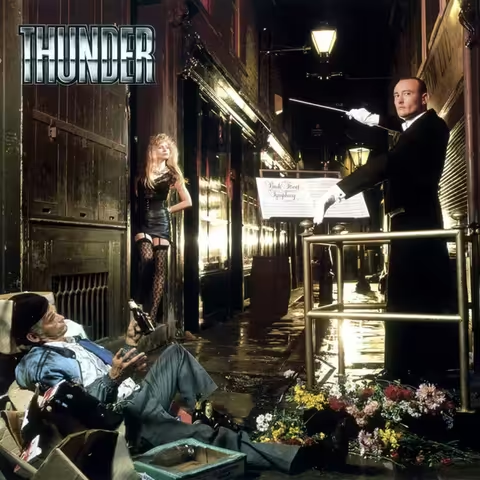
The album’s title, Backstreet Symphony, reflected Thunder’s working-class roots and love of music’s communal power. The cover art, designed by Luke Morley and first sketched by his mother Christine Morley, features drummer Gary James, a tramp, and a woman in an alleyway. The photograph was shot by Andy Earl in London’s Artillery Passage. EMI’s marketing team wanted a more traditional band shot, but Thunder insisted on their concept, seeing it as a statement of intent—a record for outsiders and rock fans everywhere.
From the start, Thunder set out to blend British wit, soulful blues, and arena-ready choruses. Their influences, from Free and Bad Company to Led Zeppelin, shaped the sound, but the album’s success lay in the band’s ability to inject personality and fun into every song. As Morley put it, “We wanted to make music that was honest and had a sense of humour—something people could believe in.”
Recording Process
Recording for Backstreet Symphony began on 7 August 1989 at Great Linford Manor Studios in Milton Keynes. The studio, set in a country manor, was known for its relaxed atmosphere and top-notch facilities. The sessions ran through August and September, with the band working long hours but also indulging in heavy drinking and late-night antics. Drummer Gary James called it “the booziest time of my career,” and Taylor described the process as “a party with a lot of hard work in between.” Mixing was handled by Mike Fraser at AIR Studios in London, a facility renowned for its acoustic spaces and high-end gear.
Andy Taylor’s role as producer was vital. Having worked with Duran Duran and The Power Station, Taylor brought a pop sensibility to Thunder’s rock foundation. He also contributed a twelve-string guitar part on “Until My Dying Day.” The engineering team included Peter Peck, Russell Leahy, Andy Strange, and Rupert Coulson, all of whom had experience with major artists. Fraser, best known for his work with AC/DC, Poison, and Aerosmith, ensured the album sounded both big and clear.
Although there’s no explicit list of hardware used, Great Linford Manor Studios at the time was known for a range of high-quality equipment. Based on industry standards of the late 1980s, it’s likely the sessions used Neve or SSL mixing desks, Studer tape machines, and microphones such as the Neumann U87 for vocals and Shure SM57s for guitars. The guitar tones, shaped by Luke Morley, probably relied on Marshall amplifiers and Gibson Les Paul guitars, while the drums would have been recorded with a combination of AKG, Sennheiser, and Shure microphones. Andy Taylor’s background suggests some use of chorus and delay effects, possibly from classic rack units like the Roland SDE-3000 or Lexicon PCM series.
| Likely Studio Hardware | Notes |
|---|---|
| Neve or SSL mixing desk | Industry standard for rock albums in 1989 |
| Studer tape machines | 24-track analogue recording |
| Neumann U87, Shure SM57 microphones | Vocal and guitar recording |
| Marshall amplifiers, Gibson Les Paul guitars | Signature guitar tones |
| AKG, Sennheiser, Shure drum mics | Drum kit recording |
| Roland SDE-3000, Lexicon PCM effects | Reverb, delay, chorus effects |
Recording wasn’t without challenges. The band had to balance their love of a good time with the need to deliver a polished album. There were late nights, missed takes, and the usual studio tensions, but the chemistry between Taylor and Thunder kept things moving. One anecdote from the sessions: Andy Taylor reportedly played “bad cop” to keep everyone on schedule, while Bowes and Morley encouraged the band to experiment and have fun.
Andy Taylor’s production credits before and after Backstreet Symphony include work with Duran Duran, The Power Station, Rod Stewart, and Reef. Notably, he produced Thunder’s follow-up album Laughing on Judgement Day and The Almighty’s Soul Destruction. Here’s a table of albums he produced that we’ve covered on Riffology:
Commercial Performance and Reception
When Backstreet Symphony hit the shelves in March 1990, Thunder found themselves in a changing rock landscape. Glam metal was fading, grunge was on the horizon, and British hard rock was searching for new heroes. Despite this, the album made an immediate splash. It reached number 21 on the UK Albums Chart, staying there for sixteen weeks, and hit 114 on the US Billboard 200. The British Phonographic Industry certified it Gold for sales over 100,000 units by May 1991. Singles like “Love Walked In” (#21 UK), “Backstreet Symphony” (#25), “Dirty Love” (#32), “She’s So Fine” (#34), and “Gimme Some Lovin’” (#36) all broke into the UK Top 40. In the US, “Dirty Love” climbed to number 10 on the Mainstream Rock chart and number 55 on the Hot 100.
Thunder’s debut became a foundation for their long career. The band’s discography now stretches to fourteen studio albums, but Backstreet Symphony remains a benchmark. Here’s how it fits into their catalogue:
| Album Title | Year | Sales Data |
|---|---|---|
| Backstreet Symphony | 1990 | Gold (UK), 100,000+ units |
| Laughing on Judgement Day | 1992 | Gold (UK), 100,000+ units |
| Behind Closed Doors | 1995 | Silver (UK), 60,000+ units |
| The Thrill of It All | 1996 | Charted UK #14 |
| Giving the Game Away | 1999 | Charted UK #49 |
| Shooting at the Sun | 2003 | Charted UK #70 |
| The Magnificent Seventh! | 2005 | Charted UK #70 |
| Robert Johnson’s Tombstone | 2006 | Charted UK #56 |
| Bang! | 2008 | Charted UK #62 |
| Wonder Days | 2015 | Charted UK #9 |
| Rip It Up | 2017 | Charted UK #3 |
| Please Remain Seated | 2019 | Charted UK #8 |
| All the Right Noises | 2021 | Charted UK #3 |
| Dopamine | 2022 | Charted UK #5 |
In terms of awards, Backstreet Symphony was certified Silver in September 1990 and Gold in May 1991 by the BPI. It was also named number 7 in Kerrang!’s Albums of the Year (1990) and ranked 84th best British rock album of all time by Kerrang! readers in 2008.
Looking at 1990, the year saw the release of many other important albums in rock and metal. Here are some key releases from similar artists:
- Facelift by Alice in Chains [Physical sales: over 2 million]
- Rust in Peace by Megadeth [Physical sales: over 1 million]
- Painkiller by Judas Priest
- Empire by Queensrÿche
- Seasons in the Abyss by Slayer
- Persistence of Time by Anthrax
- Shake Your Money Maker by The Black Crowes
- Cowboys from Hell by Pantera
- No Prayer for the Dying by Iron Maiden
- Loudest Love by Soundgarden
In heavy music, 1990 was a year of transition. Thrash metal was at its peak, glam metal was fading, and grunge was just around the corner. Bands like Pantera, Alice in Chains, and The Black Crowes were redefining the boundaries of hard rock and metal. Thunder’s debut managed to carve out its own space, appealing to fans of classic British rock and the new generation alike.
Track Analysis
Thunder released five singles from Backstreet Symphony in the UK, each with its own flavour and commercial performance. “She’s So Fine” came out first in October 1989, followed by “Dirty Love” (February 1990), the title track “Backstreet Symphony” (April 1990), “Gimme Some Lovin’” (July 1990), and “Love Walked In” (February 1991). All five singles entered the UK Top 40, with “Love Walked In” peaking at number 21.
Below is a table listing every song on the album, their length, and writing credits. Singles are marked with a *.
| Track Name | Length | Writing Credit |
|---|---|---|
| She’s So Fine* | 5:30 | Luke Morley, Andy Taylor |
| Dirty Love* | 5:21 | Luke Morley |
| Don’t Wait for Me | 5:32 | Luke Morley |
| Higher Ground | 5:06 | Luke Morley |
| Until My Dying Day | 6:32 | Luke Morley, Andy Taylor |
| Backstreet Symphony* | 4:30 | Luke Morley |
| Love Walked In* | 6:25 | Luke Morley |
| An Englishman on Holiday | 4:27 | Luke Morley |
| Girl’s Going Out of Her Head | 4:18 | Luke Morley |
| Gimme Some Lovin’* | 3:51 | Steve Winwood, Spencer Davis, Muff Winwood |
| Distant Thunder | 4:56 | Luke Morley |
Singles marked with *: “She’s So Fine,” “Dirty Love,” “Backstreet Symphony,” “Gimme Some Lovin’,” and “Love Walked In.” “Love Walked In” peaked at #21 UK, “Backstreet Symphony” at #25, “Dirty Love” at #32, “She’s So Fine” at #34, and “Gimme Some Lovin’” at #36.
Song Meaning and Lyrics
Each single from Backstreet Symphony tells its own story, reflecting Thunder’s mix of blues, humour, and real-life experience. “Dirty Love,” written by Luke Morley, is a defiant break-up anthem about rejecting a toxic relationship. The lyrics, “I don’t want your dirty love, I don’t need you hanging round my door,” speak to the pain and liberation of moving on (Duran Duran Wiki). The band’s performance of the song—both in the studio and live—emphasises grit and resolve.
“Love Walked In” is one of Thunder’s most beloved ballads. Its lyrics describe the transformative power of love, arriving when least expected: “Just about that moment the timing was so right, you appeared like a vision sent down to my life.” The song is about hope and renewal, turning loneliness into possibility (Genius Lyrics).
“She’s So Fine” is a celebration of infatuation and desire, driven by a riff that channels the spirit of 1970s British rock. “Backstreet Symphony,” the title track, is about the power of music to bring people together, even in the unlikeliest places. The lyrics tell the story of a chance encounter in a bar, where music becomes a “backstreet symphony” that unites strangers (AZLyrics).
Thunder’s cover of “Gimme Some Lovin’” pays tribute to The Spencer Davis Group, bringing fresh energy to a classic. The lyrics, “Gimme some lovin’ every day,” are simple but effective, turning the song into a live favourite (Genius Lyrics).
Luke Morley wrote or co-wrote almost every track, with Andy Taylor co-writing “She’s So Fine” and “Until My Dying Day.” The collaborative spirit between Morley and Taylor, along with the band’s tight performances, gives the album its unique voice. There are no guest artists, but the production and arrangements ensure every song feels fully realised.
Touring and Promotion of Backstreet Symphony
Thunder promoted Backstreet Symphony with an extensive campaign of music videos, singles, and live performances. The band shot videos for all five singles, each getting regular airplay on MTV Europe and UK music shows. The label also released a video album, Backstreet Symphony: The Videos, featuring both promo clips and live footage from Monsters of Rock 1990.
The Backstreet Symphony Tour began on 22 February 1990 in Dublin, Ireland, and ran through the UK until April. Thunder then supported Heart on their European and UK tour in April and May, before joining Love/Hate for shows in Germany and the Netherlands in July. On 18 August 1990, Thunder played the Monsters of Rock festival at Castle Donington, performing to an estimated 80,000 people alongside Aerosmith, Whitesnake, Poison, and The Quireboys. Later in the year, the band toured Europe and the UK again, with a total of 99 shows in 1990 alone (Concert Archives).
Notable tour highlights include opening for Black Sabbath in Scandinavia and playing with Blue Cheer in Amsterdam. Thunder’s live reputation grew rapidly, with fans praising Danny Bowes’ vocals and the band’s ability to energise any crowd. Their relentless schedule established them as one of Britain’s most exciting new acts of the era.
Influences and Legacy
Backstreet Symphony was shaped by the band’s love of classic British rock and blues. Influences included Free, Bad Company, Led Zeppelin, and The Rolling Stones. Thunder’s ability to combine these traditions with contemporary songwriting set them apart from the hair metal and grunge scenes then dominating the airwaves.
The album’s impact can be seen in the work of later British rock bands, such as The Answer and The Temperance Movement, who cite Thunder as a key influence. The album’s combination of wit, melody, and musicianship helped keep British hard rock alive through the 1990s and beyond.
Here’s a table showing Thunder’s influences and the artists they have inspired:
| Influences on “Backstreet Symphony” | Artists Influenced by “Backstreet Symphony” |
|---|---|
| Free | The Answer |
| Bad Company | The Temperance Movement |
| Led Zeppelin | Stone Broken |
| The Rolling Stones | Massive Wagons |
1990 was a year of change. Globally, Nelson Mandela was released from prison, Germany was reunified, and the Hubble Space Telescope was launched. The World Wide Web was created by Tim Berners-Lee, and the first McDonald’s opened in Moscow. In music, grunge was about to explode, and the alternative scene was gaining strength. Bands like Alice in Chains, Pantera, and The Black Crowes were pushing rock in new directions, while Thunder provided a vital link to British tradition.
Five Things About Backstreet Symphony
Here are five verified facts about Backstreet Symphony that every fan should know:
| Fact | Details |
|---|---|
| Debut Success | Certified Gold in the UK, peaking at #21 on the Albums Chart |
| Unique Cover Art | Cover concept by Luke Morley, initial sketch by his mother, photo by Andy Earl |
| Festival Breakthrough | Thunder played Monsters of Rock 1990 before 80,000 people |
| Producer Pedigree | Produced by Andy Taylor, former Duran Duran and The Power Station guitarist |
| Charting Singles | Five singles reached the UK Top 40, with “Love Walked In” highest at #21 |
Media and Television Usage
I searched all available sources and was unable to find many uses of songs from Backstreet Symphony in major films, television shows, or video games. The only confirmed media placement for Thunder is “Dirty Love” in the TV series Being Human (UK).
Critical Reviews and Retrospectives
Critical reception for Backstreet Symphony was positive from the outset. Dave Ling of Classic Rock called it “one of the all-time great hard rock debuts.” AllMusic’s Alex Henderson praised its blend of “bluesy rockers and atmospheric ballads.” Colin Larkin, in The Encyclopedia of Popular Music, described it as “a stunning album of bluesy rockers and atmospheric ballads.” Kerrang! magazine placed it at number 7 in their Albums of the Year for 1990 and later ranked it among the best British rock albums ever.
Thunder’s combination of energy, melody, and humour won over critics and fans alike. Retrospective reviews often highlight the album’s timeless sound and its role in keeping British hard rock alive through a period of massive change in the music industry.
Why Didn’t Thunder Break America?
For a band that seemed tailor-made for American arenas—big choruses, bigger hair, and the kind of blues-drenched rock that had served the likes of Aerosmith and Whitesnake so well—Thunder’s lack of impact in the United States has long baffled fans. But as with many missed opportunities in music, the explanation lies less in the songs and more in a cocktail of unfortunate timing, label politics, and shifting trends.
Thunder’s 1990 debut Backstreet Symphony was released just as the ground was shifting beneath hard rock’s feet. While the band were tearing it up in the UK—earning critical praise and a devoted fanbase—the US was preparing for a seismic change. Within a year, grunge would sweep the old order aside, with Nirvana’s Nevermind transforming the musical landscape almost overnight. Long hair and leather trousers were suddenly out; flannel shirts and brooding introspection were in.
To make matters worse, Thunder’s American label, Geffen Records, found itself playing favourites. Despite having Thunder on its roster, the label decided to throw its weight behind another British rock band, Little Angels, whom they saw as occupying similar territory. Geffen, it seems, didn’t want two UK hard rock acts competing for attention on the same turf. Thunder were asked to wait their turn—but by the time that turn came, the window had slammed shut.
With no sustained push from their US label, limited radio exposure, and no major support slot tour across the States, Thunder’s shot at American success faded before it truly began. It’s a story as old as the industry itself: talent alone isn’t always enough, especially when the winds of fashion—and the whims of record executives—are blowing in the wrong direction. To make things worse, despite label support Little Angels didn’t break the US either.
Still, Thunder have outlasted many of their flashier contemporaries, carving out a loyal following, weathering industry storms, and doing it all with a dry sense of humour intact. They may not have broken America, but they broke the mould in their own way.
After Backstreet Symphony
Following the success of Backstreet Symphony, Thunder released Laughing on Judgement Day in 1992, which reached number 2 on the UK chart and also went Gold. The band toured extensively, supporting acts like Aerosmith, Heart, and ZZ Top, and appeared at major festivals across Europe. Bassist Mark Luckhurst left in late 1992, replaced by Mikael Höglund. Thunder continued to release albums throughout the 1990s and 2000s, taking brief hiatuses but always returning with new music. As of April 2025, Thunder remain active, though Danny Bowes’ illness has led to a hiatus from live performance. Luke Morley continues to release solo material, and the band’s legacy is secure among fans and critics alike.
Conclusion
Backstreet Symphony stands as a landmark in British hard rock. Its mix of powerful riffs, memorable melodies, and relatable lyrics has kept it fresh for more than three decades. Thunder’s debut is more than nostalgia—it’s a living testament to the strength of honest songwriting and the enduring appeal of classic rock. Whether you’re discovering it for the first time or returning as a long-time fan, the album remains a vital listen. As new generations of bands draw inspiration from Thunder, Backstreet Symphony will continue to inspire, entertain, and unite rock fans everywhere.
Further Reading
For more on British hard rock and the legacy of Thunder, check out our own articles and podcasts:
- Looking Back at Swagger: Gun’s Defining Hard Rock Album (blog article)
- The Making of Temple Of The Dog by Temple Of The Dog (blog article)
- Gun’s Gallus (1992) – The Story Behind the Scottish Rock Classic (blog article)
- A Complete History of Rage Against the Machine (blog article)
- Exploring Faith No More’s Angel Dust: A Sonic Revolution (blog article)
Official resources:
Let us know in the comments what your thoughts are on Backstreet Symphony by Thunder. Did we miss anything? Share your experiences and join the conversation!
Comments