
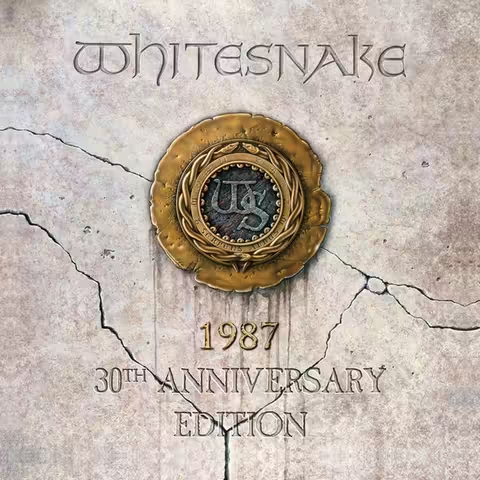
By January 1985 David Coverdale was within weeks of folding Whitesnake. The band had just closed the long, fractious Slide It In tour with two enormous Rock in Rio shows in Brazil, and on the final night drummer Cozy Powell had walked. Coverdale, hoarse, bankrupt and tired of the touring circuit, flew back to England considering whether to retire the name altogether. He instead found himself in a series of telephone calls with Geffen Records in Los Angeles, who had picked up the North American rights to Whitesnake's catalogue while EMI continued to hold Europe, and who had a very specific opinion about what should happen next. They wanted Coverdale to keep the young English guitarist John Sykes, recently poached from Thin Lizzy, and to make a record for the United States.
What followed was a fourteen month recording process spread across five studios in three countries, a near-fatal collapse of Coverdale's voice, the implosion of the band that wrote the record, and a switch of producers at the eleventh hour. The album that emerged on 16 March 1987 has since been certified 8x Platinum in the United States alone, sold around 25 million copies worldwide and provided the late Eighties with two of its most heavily televised singles. It also cost almost everyone who made it their job.
The end of Slide It In
The Slide It In lineup that closed 1984 was not the unit that had recorded the album of the same name. By Rock in Rio guitarist Mel Galley had been forced out by a stage injury, John Sykes had been drafted in from Thin Lizzy's recently halted operation, and the keyboard, bass and drum chairs had been rotated more than once. The Brazilian dates were rapturously received but did nothing to settle the personalities involved. Cozy Powell, whose own diary already pointed towards Emerson, Lake and Powell, used the post-tour break to confirm his departure. Bassist Neil Murray, the longest-serving non-Coverdale member of the group, expected to be next.
Coverdale was newly resident in the United States, going through a difficult divorce, in poor financial shape after years of European-scale touring on a European-scale budget, and increasingly aware that the British hard rock scene he had emerged from at the back end of Deep Purple in 1976 was being outsold by a generation of American radio bands he had no real connection to. Geffen, in the form of label chief David Geffen and the influential A&R man John Kalodner, had a clear pitch. Sign properly to the label for the United States and Canada, write an album for American FM radio, keep Sykes as the foil to Coverdale's voice and accept the marketing apparatus that came with it. EMI in London, who had released the existing catalogue, kept the rest of the world.
Le Rayol and a cassette from Ritchie Blackmore
In the spring of 1985 Coverdale, Sykes and Murray relocated to Le Rayol on the French Riviera and set up a writing room in a rented villa. The three of them worked through a stack of cassette ideas Coverdale had brought with him, several of which were years old. The most important turned out to be a half-formed riff and chant Coverdale had taped during his short collaboration with Ritchie Blackmore in the mid-Seventies, before Whitesnake had begun. Sykes seized on it and the two of them rebuilt the piece in the south of France over the course of a fortnight. It became "Still of the Night".
The same writing trip produced "Bad Boys", "Straight for the Heart", "Children of the Night" and "Give Me All Your Love". Coverdale also pulled out an unreleased Whitesnake demo originally written for Tina Turner, who had passed on it, and reworked the melody and lyric with Sykes. That song became "Still of the Night"'s eventual chart partner, "Is This Love". Murray contributed bass arrangements and live takes from the villa sessions and was promised a full studio call once the songs were ready. Sykes, fifteen years younger than Coverdale and recently freed from the Thin Lizzy axis, treated the trip as the start of his own act as much as Coverdale's, an impression he would not lose for the rest of the project.
To Vancouver and a constellation of studios
With songs in hand and a deal signed, Coverdale's first decision was the drum chair. Aynsley Dunbar, the Liverpool-born veteran who had played with Jeff Beck, Frank Zappa, Journey and Jefferson Starship, was recruited in Los Angeles in the summer of 1985 on the strength of an afternoon's audition. Don Airey was brought in to handle keyboard overdubs, with Bill Cuomo added in California for further pad and texture work. In September 1985 the four-piece reconvened at Little Mountain Sound Studios in Vancouver to record basic tracks with producer Mike Stone, the British engineer best known at that point for his work with Queen, Journey and Asia.
Little Mountain was the spine of the project but it was far from the only room used. Sessions also moved through Phase One in Toronto, Compass Point in Nassau, Cherokee Studios in Hollywood, One on One in North Hollywood and Keith Olsen's own Goodnight L.A. studio in Los Angeles. Across the fourteen month gestation, every part of the record was at some stage broken down into its constituent components and reassembled in a different building. The Studer A800 multitrack tape from Little Mountain travelled north, south and east more times than the band did. Sykes in particular was meticulous to the point of obsession, regularly recutting solos for the same song in a different room with a different mic chain to see which version sat best in the mix.
The Sykes guitar sound and Bob Rock
The lead guitar tone on the finished album, all dense midrange harmonics, stacked rhythm tracks and overdubbed solos that read as single takes, is one of the most cloned sounds in late-Eighties hard rock. The man Sykes leaned on to achieve it was Bob Rock. At the time Rock was the in-house engineer at Little Mountain Sound and a long-time studio friend of Coverdale's. He was simultaneously finishing Bon Jovi's Slippery When Wet down the corridor with producer Bruce Fairbairn, and a few months after the Whitesnake basics were laid he would begin work on Aerosmith's Permanent Vacation in the same room. Inside half a decade he would produce Metallica's self-titled Black Album.
Rock and Sykes worked through endless permutations of Marshall heads, Mesa Boogie cabs, Gibson Les Paul Customs and the dual-coil Sykes signature pickups he was developing with EMG. The signature trick was a heavily layered rhythm bed, six to eight stacked Marshall takes of each part, tuned slightly differently and panned hard, with leads cut clean on top so they read as singing voices rather than as widdle. Mike Stone, who was nominally producing, gave Sykes the room. The arrangement, more than any other single decision, is what allowed Sykes to argue afterwards that the album was his record.
Coverdale's collapse
In the spring of 1986, with basic tracks done and most of the guitar work either finished or nearly so, Coverdale stopped being able to sing. A specialist diagnosed a severe sinus infection that had been working away for months and prescribed immediate surgery. The procedure was successful in clearing the infection but left Coverdale with no confidence that his upper range would come back, and a six month rehabilitation programme that involved no singing at all. The band's most expensive asset, his voice, was now an open question. The album was already deep over budget.
Coverdale spent the summer of 1986 in California, in Munich visiting his daughter from his first marriage, and in London. He was, he later admitted, severely depressed. The accumulated debt from two years off the road and the steadily growing recording bill was reported in interviews at the time at around three million dollars. Geffen kept paying for the studio but, in April 1986, took the unusual step of stopping wages for every member of the band except Sykes. Murray and Dunbar were politely told to find other work for the rest of the year. The official line was that this was a budgetary measure. The unofficial line was that Coverdale was already reconsidering the lineup.
Wages stop and producers change
The working relationship between Coverdale and Mike Stone, never warm, broke down over the summer of 1986. Stone was retained nominally as producer of the instrumental tracks but Coverdale began discussions with the journeyman American producer Ron Nevison, fresh from Heart's self-titled commercial breakthrough, about taking over the vocal sessions. Nevison was briefly attached, then in August 1986 Coverdale switched again, this time to Keith Olsen. Olsen, an alumnus of Fleetwood Mac, Pat Benatar and Foreigner sessions, had the room (Goodnight L.A.), the gear and the bedside manner to coax Coverdale's voice back.
The story Olsen later told about the first session is almost too neat. Coverdale was nervous, six months out from surgery, and not in voice. Olsen put up "Still of the Night" and asked him to sing it cold. As Coverdale told it years later, "I almost vomited, sang the song twice with my fingers crossed, and that's what's on the record." Whether literally accurate or not, both men agreed in subsequent interviews that the very first vocal Coverdale committed to tape after his surgery was the lead on the album's most demanding song, and that the take stayed.
Vandenberg's solo and the firing of John Sykes
While Coverdale was recovering and starting vocal sessions with Olsen in California, Sykes and Murray returned to London with Mike Stone in October and November 1986 to complete instrumental overdubs at a brisk pace. Tapes flew back to Los Angeles in December for Olsen to finalise mixes at Goodnight L.A. It was during this final stretch that John Kalodner and David Geffen pressed Coverdale to re-record "Here I Go Again", originally a UK single from 1982's Saints & Sinners, in a glossier, MTV-friendly arrangement. Coverdale, perhaps sensing the commercial logic, agreed. Sykes, who had not written the song and disliked the idea of polishing what he considered a previous-era track, declined to play the new lead.
Coverdale's solution was Dutch guitarist Adrian Vandenberg, leader of his own band Vandenberg and someone Coverdale had already been quietly courting for the touring lineup. Vandenberg flew into Los Angeles, cut the solo for "Here I Go Again '87" in a single afternoon at Goodnight L.A., and was thanked. When Sykes returned from London and discovered that another guitarist had played lead on what would become the album's biggest single, he confronted Coverdale in the studio. The argument was decisive. Coverdale, by his own account in later interviews, had concluded by the autumn of 1986 that the band that had made the record was not the band he wanted standing next to him on the videos and the road campaign that Geffen had already begun planning.
Coverdale dismisses the entire band
In the first weeks of 1987, with mastering already booked and the album scheduled for a March release, Coverdale dismissed John Sykes, Neil Murray and Aynsley Dunbar. The official reasons he gave at the time and afterwards were "personal differences", broken trust, and his own state of mind on returning from Munich. Murray and Dunbar were given relatively quiet exits. Sykes, who had been writing partner on every new song on the record and who had spent most of 1986 carrying the guitar overdubs while Coverdale was off the clock, was not. The relationship between the two men became publicly and durably bitter, and remained so for the rest of Sykes' life.
The financial picture was also brutal. Coverdale had nothing left in the bank, the album had cost a reported one to two million dollars to make, and he privately put his total accumulated debt at around three million dollars. None of the four players on the record's sleeve would tour the album as a band. Sykes used what royalties did eventually come through to form Blue Murder with Carmine Appice and Tony Franklin in 1988. Murray returned to session work in London and would later rejoin Whitesnake himself. Dunbar drifted back into the West Coast session scene. Coverdale built an entirely new group for the videos.
The Video Kids
The lineup Coverdale assembled in early 1987 for the album campaign was, by his own admission, designed first for television. Adrian Vandenberg took the role Sykes would have played. Ex-Dio and Sweet Savage guitarist Vivian Campbell, then twenty-four, took the second guitar slot. Ex-Quiet Riot and Ozzy Osbourne bassist Rudy Sarzo replaced Neil Murray. Veteran rock drummer Tommy Aldridge, ex-Black Oak Arkansas and Ozzy Osbourne, took Dunbar's stool. Four working musicians, three of them American-resident, all of them with hair, looks and stadium credibility, and none of whom had played a note on the album they were about to promote.
The Video Kids, as fans almost immediately christened them, made their first appearance in the Marty Callner-directed clip for "Still of the Night" in March 1987 and were instantly familiar from MTV rotation through to the autumn of 1988. Vivian Campbell would leave acrimoniously after the touring cycle and resurface in Def Leppard in 1992. Vandenberg, Sarzo and Aldridge stayed on for the follow-up album Slip of the Tongue in 1989, where a wrist injury would eventually force Vandenberg himself to hand over lead guitar duty to Steve Vai.
Hugh Syme's amulet and three titles
The sleeve image, a gold Celtic-runic amulet set on a black field, was designed by Canadian graphic artist Hugh Syme at Coverdale's request. Syme, a frequent collaborator with Rush and later Megadeth, embedded several layered symbols in the disc, with elements that Coverdale has variously described as representing the Sun, the Moon, fertility, and a pair of interlocking snakes. The single-image, no-band-photo approach was deliberate. Coverdale, having sacked the four men who had made the record, did not want a group portrait on the front. The amulet became the band's de facto logo for the rest of the decade.
The album also carried three different titles in different territories, which has caused fans and discographers headaches ever since. In the United States, where it was put out by Geffen, it was simply Whitesnake, the band's first North American self-titled release. In Europe, where it was put out by EMI, it was called 1987 because EMI had already used Whitesnake as the title of a 1978 EP. In Japan, where CBS/Sony pressed it, it was titled Serpens Albus, Latin for "white snake", which Coverdale liked enough that he occasionally referred to the project by that name in interviews. The three editions did not share a tracklist.
Release: three sleeves, three tracklists
Geffen issued the album in the United States on 16 March 1987, although Coverdale himself and several contemporary press releases have cited 23 March or 7 April; the discrepancy is partly a question of in-store date versus the catalogue release date Geffen filed. EMI followed in Europe on 30 March 1987 as 1987, with two additional tracks ("Looking for Love" and "You're Gonna Break My Heart Again") and a reshuffled running order that pushed "Crying in the Rain '87" later in the sequence. CBS/Sony released the Japanese pressing on 22 April 1987 as Serpens Albus, using the nine-track American sequence.
The European edition runs to 53:10, almost eleven minutes longer than the American 42:25. The reason for the cut was partly the technical ceiling of an LP side and partly John Kalodner's preference for "Children of the Night" as the closing slow-burn, and his strong dislike of the bluesier "Looking for Love" in that role. Coverdale has repeatedly described "Looking for Love" as one of the best songs he wrote with Sykes and has expressed regret that American buyers did not get it on first pressing. CD and cassette copies eventually unified around the European tracklist for most of the late-Nineties reissues, but the 1987-era vinyl pressings did not.
The songs
The American running order opens with "Crying in the Rain '87", a fully re-recorded version of a track from 1982's Saints & Sinners that Geffen demanded as a counterpart to the also-rebuilt "Here I Go Again". The new version more than doubles the original's runtime to 5:38, anchored by an extended Sykes solo that takes the song from acoustic ballad to full-band stomp. "Bad Boys" follows, a tight, brisk piece of glam rock written at Le Rayol with a chorus designed for arena participation, and the song the band would use to open most live shows on the 1987-88 tour.
The lead single "Still of the Night" is the album's statement of intent and a deliberate piece of Led Zeppelin homage that Coverdale has acknowledged on the record. The Marty Callner-directed video was originally meant to feature a pre-fame model named Claudia Schiffer, but a scheduling clash the day before the shoot meant Coverdale's then-partner Tawny Kitaen stepped in instead. The clip became the most-requested video on MTV at the time of release and set the template for the campaign. "Here I Go Again '87" is the most commercially loaded track on the record: a glossier re-recording of Coverdale and Bernie Marsden's 1982 song, with Vandenberg's solo, John Kalodner's insistence, and the Tawny Kitaen "doing the splits on a pair of Jaguar bonnets" video. It reached number one on the Hot 100 on 10 October 1987.
"Give Me All Your Love" follows in the American running order, a propulsive AOR cut later reworked as the "Give Me All Your Love '88" single with a Vivian Campbell solo and additional bass and drums from the touring lineup. "Is This Love", originally written for Tina Turner during the Le Rayol sessions, became the album's biggest ballad and the song most often cited by Coverdale as the most natural Coverdale-Sykes co-write on the record. It peaked at Hot 100 number two on 19 December 1987. "Children of the Night" closes the American edition, a mid-tempo gothic-tinged piece that Kalodner championed over the bluesier alternatives.
"Straight for the Heart" and "Don't Turn Away" round out the US sequence with shorter, more straightforwardly radio-shaped songs. The European edition adds "Looking for Love", at 6:33 the longest song on either version of the record, and "You're Gonna Break My Heart Again", a four-minute Sykes-led cut that European critics tended to single out as the toughest moment on the album. Several of the European-only tracks would only appear in the United States on later reissues and the eventual 30th anniversary box.
The chart story
Whitesnake debuted on the Billboard 200 at number 72 on 18 April 1987, the week of release, on the back of "Still of the Night" airplay alone. It was in the top 10 by 9 May, the top 5 by 30 May, and peaked at number 2 in early June, where it would spend ten non-consecutive weeks between June 1987 and January 1988. The number one slot was held by three different albums during that run, in turn: U2's The Joshua Tree, Whitney Houston's Whitney, and most often Michael Jackson's Bad. Cash Box, the rival of Billboard at the time, did rank the album at number one for three weeks. It charted for 76 weeks in total, longer in the US top 5 than any other release of 1987.
Outside the United States the album reached number 8 in the United Kingdom, number 5 in Canada, number 2 in New Zealand, and number 3 in Finland. RIAA certifications climbed in lockstep with the singles. The record went 4x Platinum on 2 December 1987, 5x Platinum on 7 January 1988, 6x Platinum on 24 July 1992 and finally 8x Platinum on 10 February 1995. ARIA certified it Platinum in Australia, BPI Platinum in the UK, Music Canada 5x Platinum and the Bundesverband Musikindustrie Gold in Germany. By 2025 lifetime sales were estimated at around 25 million copies worldwide, a figure that places it inside the commercial top tier of all Eighties hard rock releases.
The three Top-20 American singles drove the campaign. "Still of the Night" reached number 79 on the Hot 100 but number 18 on the Mainstream Rock chart and number 16 in the UK, where it was the band's first top 20 single in three years. "Here I Go Again" went to number 1. "Is This Love" went to number 2. As a knock-on effect, sales of the band's previous studio album Slide It In, which had originally been certified Gold in 1984, climbed back through the catalogue charts and reached 2x Platinum by the end of 1988.
The international picture was more uneven than the headline territory numbers suggest. The album sold strongly in West Germany, the Netherlands, Sweden and Australia, all markets where the band already had a base from the Slide It In tour, but underperformed in France, Italy and Japan relative to the Geffen forecast. Geffen's response was an aggressive second wave of video edits and remixes through 1988, including the Vivian Campbell-led "Give Me All Your Love '88 Mix" and an extended "Is This Love" twelve-inch, which kept the campaign visible on MTV almost a year after the original release. Kalodner has since described the elongated promotional cycle as the template he would reuse on Aerosmith's Permanent Vacation and Pump campaigns.
Reviews, awards and the tour
Critical reception split along familiar lines. The British rock press was broadly positive: Mick Wall would later call it "one of the best rock albums of its era", Classic Rock and Record Collector both eventually settled on five-star retrospective ratings, and German Rock Hard gave it 9 out of 10. The American press was more sceptical of the commercial polish. Robert Christgau filed a D+ ("the attraction of this veteran pop-metal has got to be total predictability"), and JD Considine in Rolling Stone wrote a guarded review that praised it as a "guilty pleasure" while calling it "such a convincing simulacrum" of Led Zeppelin, the Scorpions and Foreigner that there was almost nothing of Whitesnake left inside it. AllMusic later gave it 4.5 out of 5; the Los Angeles Times gave it 4 out of 5; MusicHound rated it the full 5. Martin Popoff awarded it 8 out of 10 in his Collector's Guide. Rolling Stone itself eventually ranked the album at number 12 on its 50 Greatest Hair Metal Albums of All Time list in 2019.
Award nominations were limited but visible. The 1988 Brit Awards nominated Whitesnake for Best British Group, and the 1988 American Music Awards nominated the record for Favorite Pop/Rock Album. Neither category was won. The tour, with the Video Kids lineup, was where the financial recovery actually happened. The band opened on the second stage of the Texxas Jam at the Cotton Bowl on 20 June 1987 in front of around 80,000 people, took an opening slot on Motley Crue's Girls, Girls, Girls Tour through the autumn of 1987 with consistently strong box-office returns, and headlined arenas in their own right through 1988. The campaign closed on 15 August 1988 at the Memorial Coliseum in Portland, Oregon.
Legacy and the death of John Sykes
The album's video-led, MTV-aware marketing template, built around Tawny Kitaen, Marty Callner, John Kalodner's A&R and Geffen's broadcast spend, became the playbook that drove much of late-Eighties American hard rock commerce. The pattern is visible in the campaigns for Aerosmith's Permanent Vacation later in 1987, Def Leppard's Hysteria, Bon Jovi's New Jersey in 1988 and through to Skid Row's debut in 1989. Inside Whitesnake, the immediate aftermath was less tidy. The Video Kids lineup recorded Slip of the Tongue in 1989 with mixed reception, Coverdale and Jimmy Page recorded a joint album in 1993, and Coverdale would not put another studio Whitesnake album out under the band name until Restless Heart in 1997.
John Sykes, dismissed in 1987 and bitter about the album's marketing as a Coverdale solo project in band's clothing, formed Blue Murder with Carmine Appice and Tony Franklin in 1988. He recorded sporadically through the Nineties and Two Thousands and gave very few interviews. He died on 20 January 2025, aged 65. His death prompted a wave of critical reassessment of the 1987 record as substantially his work as guitarist, co-writer and arranger, and a reframing of the historic Coverdale-Sykes argument that has shifted the consensus closer to Sykes' position than it had been during his lifetime. Coverdale's own public tribute, published the week after Sykes' death, acknowledged the guitarist's "indelible" contribution to the record in unusually direct terms.
The record has continued to perform commercially decade on decade. "Here I Go Again" returned to mainstream visibility through its use in the 2000 film Old School and a string of subsequent television syncs, and "Is This Love" has become a standard at American wedding receptions in a way that would have surprised Coverdale and Sykes in 1986. Sales of the album spiked again following Sykes' death, putting Whitesnake briefly back into the top ten on the Billboard Hard Rock catalogue chart in February 2025. Almost forty years on, the fourteen month, four producer, three studio, three title, two band project has settled into the late-Eighties canon on its own terms.
Personnel
- David Coverdale - lead vocals
- John Sykes - guitars, backing vocals
- Neil Murray - bass guitar
- Aynsley Dunbar - drums
Additional musicians:
- Don Airey - keyboards
- Bill Cuomo - keyboards
- Adrian Vandenberg - lead guitar solo on "Here I Go Again '87"
- Dann Huff - additional guitar on "Here I Go Again" Radio Mix
- Mark Andes - bass on "Here I Go Again" Radio Mix
- Denny Carmassi - drums on "Here I Go Again" Radio Mix
- Vivian Campbell - lead guitar solo on "Give Me All Your Love '88 Mix"
- Tommy Funderburk - backing vocals
Production and engineering:
- Mike Stone - producer (instrumental tracks)
- Keith Olsen - producer (vocals), mixing at Goodnight L.A.
- Bob Rock - engineering assistance, Little Mountain Sound
- Greg Fulginiti - mastering at Artisan Sound Recorders
- Stephen Marcussen - Direct Metal Mastering
- Hugh Syme - art direction and amulet design
Touring "Video Kids" lineup, 1987 to 1988:
- David Coverdale - lead vocals
- Adrian Vandenberg - guitars
- Vivian Campbell - guitars
- Rudy Sarzo - bass
- Tommy Aldridge - drums
Tracklist
| # | Title | Length |
|---|---|---|
| 1 | Crying in the Rain '87 | 5:37 |
| 2 | Bad Boys | 4:09 |
| 3 | Still of the Night | 6:38 |
| 4 | Here I Go Again '87 | 4:34 |
| 5 | Give Me All Your Love | 3:30 |
| 6 | Is This Love | 4:43 |
| 7 | Children of the Night | 4:24 |
| 8 | Straight for the Heart | 3:39 |
| 9 | Don't Turn Away | 5:11 |
The European edition, titled 1987 and released through EMI on 30 March 1987, added "Looking for Love" (6:33) and "You're Gonna Break My Heart Again" (4:11), and used a different running order. The Japanese edition, titled Serpens Albus and released through CBS/Sony on 22 April 1987, used the nine-track North American sequence.
Things you might not know
| Fact | Detail |
|---|---|
| Two labels, two territories | Geffen held North America and EMI held Europe, which is the structural reason the same record went out as Whitesnake and 1987 in the same fortnight. |
| Coverdale's voice nearly went | A sinus operation in spring 1986 was followed by six months of compulsory vocal rest, and the first vocal he sang after surgery was the lead on "Still of the Night". |
| Bob Rock was the engineer | The future producer of Aerosmith, Bon Jovi and Metallica was the in-house engineer at Little Mountain Sound and built the layered Sykes guitar sound with him. |
| Vandenberg's only solo on the record | The Here I Go Again '87 lead is Dutch guitarist Adrian Vandenberg, cut in a single afternoon at Goodnight L.A. after Sykes refused to play it. |
| Three titles | The record is Whitesnake in the US, 1987 in Europe (because EMI had used the band name as a 1978 EP title) and Serpens Albus in Japan. |
| Tawny Kitaen was the late replacement | The Still of the Night video was scheduled to feature a pre-fame Claudia Schiffer, and Kitaen stepped in the day before the shoot. |
| Coverdale fired the band before release | John Sykes, Neil Murray and Aynsley Dunbar were all dismissed in early 1987, weeks before the album they had spent fourteen months making went on sale. |
| The amulet was Hugh Syme | The Canadian Rush sleeve designer built the gold Celtic-runic amulet at Coverdale's request, with layered symbols for the Sun, Moon, fertility and interlocking snakes. |
| Around 25 million copies sold | Lifetime worldwide sales by 2025 are estimated at roughly 25 million, with 8x Platinum certification from the RIAA dating to 10 February 1995. |
| The 1987-88 tour opened in front of 80,000 | The Video Kids lineup's first major show was the Texxas Jam at the Cotton Bowl on 20 June 1987. |
How to listen now
The album is widely available on every major streaming platform under all three of its historical titles, with most services defaulting to the eleven-track European 1987 edition. The 2018 remaster cleans up the high end and brings Sykes' guitar layers forward in the mix. Vinyl copies of both the original Geffen and EMI pressings remain plentiful on the secondhand market. The definitive collector's edition is the 30th anniversary super deluxe box released by Rhino and Parlophone on 6 October 2017, which compiles the full original tracklist newly remastered alongside Snakeskin Boots live audio, demos and rehearsals, alternative remixes, and a 1987-Tour Video Bootleg DVD. With John Sykes' death in January 2025 prompting a critical reappraisal of the record as substantially his work as guitarist, co-writer and arranger, the 2017 super deluxe is the most rewarding single point of entry to the music his Whitesnake actually made.
Comments