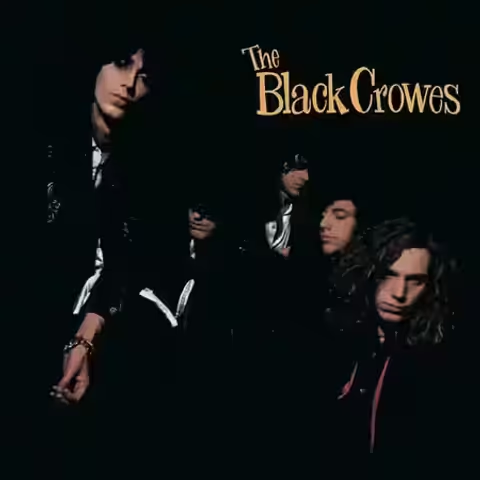
George Drakoulias caught five Atlanta kids called Mr. Crowe's Garden at a half-empty New York club in 1988, signed them to Rick Rubin's six-month-old Def American label, handed Rich Robinson a stack of Faces and Humble Pie LPs and an open-G tuning, and within a year had them in Soundscape Studios in Atlanta cutting a debut album that almost nobody at the label thought the marketplace would tolerate. The brothers fronting the band had already turned down a deal from R.E.M.'s manager Jefferson Holt the previous year. Rich Robinson was nineteen. Chris Robinson was twenty-two. Neither of them had yet written most of the songs that would make their record one of the strangest commercial successes of the early 1990s.
The marketplace was, of course, wrong. Released on 13 February 1990, Shake Your Money Maker peaked at number four on the Billboard 200, threw off five charting singles, was certified five-times Platinum in the United States, and ended the year as readers of Rolling Stone magazine voted The Black Crowes Best New American Band. It did all of this in a year when American rock was supposedly dominated by hair metal on one flank and the first stirrings of the Seattle scene on the other. The Crowes' debut belonged to neither camp. It belonged to 1972.
| Field | Detail |
|---|---|
| Artist | The Black Crowes |
| Album | Shake Your Money Maker |
| Release Date | 13 February 1990 |
| Label | Def American Recordings |
| Producer | George Drakoulias (Rick Rubin, executive producer) |
| Studios | Soundscape (Atlanta); Chapel, Paramount and Grandmaster (Los Angeles) |
| Genre | Blues rock, Southern rock, hard rock, roots rock |
| Track Count | 10 (plus hidden track on CD) |
| Total Runtime | 44:50 |
| Billboard 200 Peak | 4 |
| UK Albums Chart Peak | 36 |
| Other Notable Peaks | Canada 4, New Zealand 4, Germany 30, Australia 43 |
| Certifications | 5x Platinum (US), Platinum (NZ), Gold (Canada), Silver (UK) |
| Estimated Sales | Over 5 million in the US alone |
| Key Singles | Jealous Again, Hard to Handle, Twice As Hard, She Talks to Angels, Seeing Things |
A 1972 record made in 1990
To understand why Shake Your Money Maker landed with such force in February 1990, it helps to remember what the American rock charts looked like the week it arrived. The Billboard 200 was led by Paula Abdul's Forever Your Girl, Janet Jackson's Rhythm Nation 1814 and Phil Collins' ...But Seriously. The biggest rock records in the racks were Aerosmith's Pump, Motley Crue's Dr. Feelgood and Bon Jovi's New Jersey. Pop-metal still bestrode MTV. Soundgarden had a major-label deal but no breakthrough. Pearl Jam did not yet exist. Nirvana's Bleach had been out for seven months and had sold roughly forty thousand copies on Sub Pop.
Into that context arrived a record that opened with a fuzzy, mid-tempo Stones lift, ran on Hammond organ and slide guitar, and sounded for all the world as if it had been recorded in 1972 and left in a basement for eighteen years. Most of the band were barely out of their teens. Rich Robinson, the guitarist, had not yet turned twenty by the time the sessions ended. The closest contemporary reference points were not other young bands at all, they were the records the Crowes' parents had played around the house in suburban Atlanta: Sticky Fingers, Exile on Main Street, the Faces' A Nod Is As Good As a Wink, Smokin' by Humble Pie. Drakoulias had handed those records back to Rich during pre-production and told him to listen as a guitar player rather than a fan.
It worked because the songs underneath the Stones-isms were strong, and because the band, after roughly six years of small-club nights as Mr. Crowe's Garden, played as a unit. There is no programming on the record, very few overdubs that draw attention to themselves, and almost no studio sleight of hand. The album sold over five million copies in the United States by simply being a competent, swaggering rock band caught on tape with a producer who knew better than to get in the way.
From Mr. Crowe's Garden to a Def American deal
The brothers Robinson, Chris on vocals and Rich on guitar, formed Mr. Crowe's Garden in Atlanta in 1984 while still attending Walton High School in suburban Cobb County. The name came from Leonard Leslie Brooke's children's book Johnny Crow's Garden. Their first professional demo was cut for A&M Records in 1987 in Carrboro, North Carolina, with Drivin N Cryin's Jeff Sullivan briefly drumming and Steve Gorman, the man who would go on to occupy the drum stool for the duration of the band's first run, joining shortly afterwards. R.E.M.'s manager Jefferson Holt offered the band a deal on his Dog Gone label that same year. They turned it down.
By 1988 the lineup had stabilised as a five-piece, with Johnny Colt on bass and Jeff Cease on second guitar. Drakoulias caught one of their New York shows the same year and persuaded Rick Rubin's nascent Def American imprint to sign them. He immediately started reshaping their listening habits. As Rich Robinson would later concede, the band that recorded Shake Your Money Maker was a long way from the band that hit the road in support of it.
"I had just graduated from high school a year before. Not a ton of life experience and not a great band. Chris and I had a penchant for writing songs, but neither of us were stellar players. I started playing guitar when I was 15. I started late, so I only had four years experience. We weren't a seasoned band, but we wrote these songs and made a record. We did roughly 360 shows in 18 months, and we literally learned to be a band on the road. And we flourished."
Rich Robinson, Uncut, 2021
Drakoulias's first move with the rechristened Crowes was musical, not cosmetic. He turned Rich on to Faces and Humble Pie, encouraged him to retune his guitar to open-G in the manner of Keith Richards on Sticky Fingers, and started running covers of "Memphis Queen" and "Tumbling Dice" at rehearsals. The band's name went through "The Heartless Crowes" and "The Stone Mountain Crowes" before the brothers settled on the simpler version. By the time they walked into Soundscape in the summer of 1989, the songs were already road-tested, the influences were on the table, and the producer had a clear idea of what he wanted on tape.
Demos, working titles and a teenager's riff
Several of the songs that ended up on Shake Your Money Maker were not new. "Could I've Been So Blind" and "She Talks to Angels" had both existed in the Mr. Crowe's Garden book for years before the Def American deal. The riff to "She Talks to Angels", in particular, had been written by Rich Robinson at the age of seventeen, on an acoustic guitar in his bedroom in Marietta, Georgia, in standard tuning that drops the high E to D, before he had any meaningful body of work behind him as a player.
The demos cut for A&M in Carrboro have circulated among collectors for years and would eventually be officially released on the 30th Anniversary Edition box set in 2021. Two of those demos, "She Talks to Angels" and "Front Porch Sermon", appear on disc two of that set with their original arrangements largely intact. Hearing them next to the finished album is instructive. The bones of the songs were already there in 1987. What Drakoulias added in 1989 was tempo, attitude, the right amplifier choice, and the discipline to leave space for the rhythm section.
Other songs were written specifically for the record. "Jealous Again" was assembled in the rehearsal room as the band tried to find their own version of "Tumbling Dice" off the Stones' Exile on Main Street. Chris Robinson was direct about the debt, and equally direct about how it became a song of their own.
"We stepped into a new place on 'Jealous Again.' We were going for a 'Tumbling Dice' thing. I remember writing the intro, putting the song together with Chris, and bringing it to rehearsal, where everyone got it. The first time we played it live was opening for Drivin' N Cryin' in Nashville."
Rich Robinson, Guitar Player, 2021
The decision to record Otis Redding's "Hard to Handle" came late and was driven, by most accounts, by Drakoulias rather than the band. The Crowes had played the song at Atlanta club gigs as Mr. Crowe's Garden, but had not earmarked it for the album. Drakoulias pushed for it on the grounds that they needed a single radio could grasp instantly, and that a Stax cover gave the record a thread back to the Southern soul vocabulary the Robinson brothers had grown up with. It would become the breakthrough single and remains the song that introduced most of the record-buying public to the band.
Recording at Soundscape and the move to Los Angeles
Sessions began at Soundscape Studios in Atlanta in the summer of 1989 and shifted to Los Angeles for overdubs and mixing, with work split across the Chapel, Paramount and Grandmaster rooms. Drakoulias was the producer of record, with Brendan O'Brien, then on his way to becoming one of the defining American rock producers of the decade, engineering and playing on several tracks. Lee Manning is credited as mixing engineer; Greg Fulginiti handled the original mastering. David Bianco was brought in to remix "Twice As Hard" for the single edit.
The band tracked live in the room more or less as a five-piece, with Chris Robinson doing scratch vocals from a booth and replacing them later. Rich played a 1958 Les Paul Junior, a Gibson ES-335 and, on selected tracks, a Zemaitis, into a rotation of Fender Super Reverb and Marshall amplifiers. The signature sound of the record, the slightly under-driven, midrange-rich rhythm guitar that anchors "Twice As Hard" and "Sister Luck", came from those Junior-into-Super-Reverb pairings rather than anything more elaborate.
The most consequential creative decision of the sessions was the addition of Chuck Leavell, the former Allman Brothers and (then current) Rolling Stones touring keyboardist, on piano and Hammond organ. Leavell's playing is everywhere on the record, from the intro to "Twice As Hard" through the gospel-edged piano figure on "Sister Luck" to the smoky organ pads under "She Talks to Angels". Officially he was a guest, but the band's subsequent decision to hire a full-time keyboard player (Eddie Harsch joined in 1991) was a direct response to how much of the album's identity rested on Leavell's contributions.
Brendan O'Brien is also rather more than the engineer the credits suggest. He plays the guitar solo on "Hard to Handle", overdubbed during the LA sessions, and is credited in the liner notes with "a potpourri of instruments" across the album. In 1989 O'Brien was an unknown name; within five years he would be producing Pearl Jam's Vs. and Stone Temple Pilots' Purple. The Crowes hired him before he was famous, and the album benefits from a young engineer keen to prove himself rather than an established hand running through a checklist.
Laura Creamer of the late-1960s sunshine-pop trio Honey Ltd. supplied background vocals on a handful of tracks, adding the soul-revue stack that lifts the chorus of "Hard to Handle" and the coda of "Stare It Cold". Pete Angelus, who would direct two of the album's videos, was the band's personal manager.
The recording budget was modest by 1989 major-label standards, in keeping with Def American's lean operation. The label was barely two years old; Rick Rubin had founded it in 1988 after splitting from Russell Simmons at Def Jam, and he ran it as a producer-led outfit with low overheads. Shake Your Money Maker was the album that paid for the office. Rubin's executive-producer credit on the sleeve was added late, and only because the record was already on its way to becoming a hit; it has been a sore point with the band ever since.
Personnel and credits
| Role | Player | Notes |
|---|---|---|
| Core band | ||
| Lead vocals | Chris Robinson | Co-songwriter on every original |
| Guitar | Rich Robinson | Open-G rhythm; co-songwriter |
| Guitar | Jeff Cease | Only Black Crowes album he appears on; replaced by Marc Ford in 1991 |
| Bass | Johnny Colt | Member 1989 to 1997 |
| Drums | Steve Gorman | Joined Mr. Crowe's Garden in 1987 |
| Guest and session | ||
| Piano, Hammond organ | Chuck Leavell | Allman Brothers and Rolling Stones touring keyboardist |
| Background vocals | Laura Creamer | Of 1960s trio Honey Ltd. |
| Guitar solo on "Hard to Handle", additional instruments | Brendan O'Brien | Also engineer; later produced Pearl Jam, Stone Temple Pilots |
| Production and engineering | ||
| Producer | George Drakoulias | Discovered the band in 1988 |
| Executive producer | Rick Rubin | Credit added on the sleeve only after the record became a hit |
| Engineer, mixing | Brendan O'Brien | With Lee Manning |
| Mixing engineer | Lee Manning | |
| Remixing on "Twice As Hard" | Dave Bianco | For the single edit |
| Mastering | Greg Fulginiti | Original 1990 master; Leon Zervos remastered for the 30th Anniversary Edition |
| Assistant engineers | Tag George, Lee Manning | |
| Artwork and management | ||
| Artwork, art direction, design | Alan Forbes | Iconic American rock-poster artist |
| Cover photography | Ruth Leitman | |
| Photography | Michael Lavine | Later worked on Nirvana's In Utero sleeve |
| Personal manager | Pete Angelus | Also directed two of the album's music videos |
The most pointed absence from the credits, in retrospect, is Marc Ford. The guitarist who would replace Jeff Cease in 1991 and effectively define the Crowes' sound on The Southern Harmony and Musical Companion and Amorica is nowhere on this album. Cease's playing is solid throughout, but he was never integrated into the band's working life on the road, and by the time the touring cycle for the debut wrapped up he was gone.
The songs
| # | Title | Writer(s) | Length | Single? | Notes |
|---|---|---|---|---|---|
| 1 | Twice As Hard | C. Robinson, R. Robinson | 4:09 | Yes (Dec 1990) | Open-G rhythm; remixed for single by Dave Bianco |
| 2 | Jealous Again | C. Robinson, R. Robinson | 4:35 | Yes (Jan 1990) | First single; modelled on the Stones' "Tumbling Dice" |
| 3 | Sister Luck | C. Robinson, R. Robinson | 5:13 | No | Chuck Leavell on piano; first major showcase for Chris Robinson's vocal |
| 4 | Could I've Been So Blind | C. Robinson, R. Robinson | 3:44 | No | A Mr. Crowe's Garden holdover |
| 5 | Seeing Things | C. Robinson, R. Robinson | 5:18 | Yes (Oct 1991) | Slow blues ballad; the album's emotional centre |
| 6 | Hard to Handle | Allen Jones, Al Bell, Otis Redding | 3:08 | Yes (Aug 1990) | The breakthrough single; #1 Mainstream Rock; Brendan O'Brien plays the solo |
| 7 | Thick n' Thin | C. Robinson, R. Robinson | 2:43 | No | The shortest track; closest the album gets to Faces-style boogie |
| 8 | She Talks to Angels | C. Robinson, R. Robinson | 5:29 | Yes (Mar 1991) | #1 Mainstream Rock; riff written by Rich at 17 |
| 9 | Struttin' Blues | C. Robinson, R. Robinson | 4:09 | No | |
| 10 | Stare It Cold | C. Robinson, R. Robinson | 5:13 | No | Album closer; Laura Creamer's BVs hit hardest here |
| 11 | Live Too Fast Blues / Mercy, Sweet Moan | Jones, Bell, Redding | 1:08 | No | Hidden track on CD; not on streaming versions |
The two songs that did most of the album's commercial work are also its two extremes. "Hard to Handle" is a brisk, horn-shaped Stax cover that arrived just as American rock radio was looking for a pulse outside hair metal. "She Talks to Angels" is a hushed, open-tuned acoustic ballad whose lyrics about a young heroin user in the Atlanta club scene gave the album its only piece of real moral weight.
Chris Robinson has been candid that the lyric was largely invention. He had grown up in suburban Atlanta and watched the city's club kids from a distance; the woman in the song is a composite, and he himself had not at that point lived any of the story he was singing.
"'She Talks to Angels' is a funny song in that so many people resonate with it. The dark details like drugs and things like that would be a part of growing up and being in this world, but when I wrote that song I had no idea, I hadn't done any of those things. I hadn't lived that, everything was in my imagination."
Chris Robinson, Songfacts interview
Among the deeper cuts, "Sister Luck" is the song that points most clearly to where The Black Crowes would go on The Southern Harmony and Musical Companion. Chuck Leavell's piano carries the verses, Chris's vocal is more a soul performance than a rock one, and Rich's guitar is held back to colour rather than drive. "Seeing Things" sits in similar territory, a slow gospel blues that allows Chris Robinson the space to inhabit a vocal rather than just deliver it. It is the song most often cited by other singers as evidence that Chris was, in 1990, a much more complete vocalist than the band's pin-up image suggested.
"Twice As Hard", the album's opener and final single, has been read in two different directions. The Robinsons have always discussed it as a song about how leaving a relationship gets harder the second time you try. Some long-time fans, and at least one prominent commenter on the song's lyric, have always heard it as a song about kicking an addiction. The lyric supports both readings; the band has politely declined to settle the matter.
B-sides, outtakes and the 30th-anniversary haul
The 30th Anniversary Edition box set, released on 26 February 2021, all but rewrote the public record on what was lying around in the Soundscape and Los Angeles tape libraries. The set was announced on 8 January 2021 with a previously unheard track, "Charming Mess", as the lead-off teaser. The full disc-two bonus collection paired six unreleased originals from the 1989 sessions with covers cut at the time but never finished, plus alternate mixes and the two surviving Mr. Crowe's Garden demos.
- "Charming Mess", an outtake from the original sessions that sat unfinished for thirty-one years.
- "30 Days in the Hole", the band's cover of the Steve Marriott-penned Humble Pie standard. Drakoulias had pushed for it during the sessions but it was deemed too on-the-nose at the time.
- "Don't Wake Me" and "Waitin' Guilty", two further sessions originals that were left off the running order.
- A cover of John Lennon's "Jealous Guy", cut in 1989 and unreleased until 2021.
- "Hard to Handle" (With Horns Remix), an alternate mix that restores a horn arrangement Drakoulias eventually pulled from the album version.
- Acoustic versions of "Jealous Again" and "She Talks to Angels", recorded for promo use during the original campaign.
- The Mr. Crowe's Garden demos of "She Talks to Angels" and "Front Porch Sermon", dating to the 1987 A&M sessions in Carrboro.
Disc three of the box is the now-canonical live document of the album: a fifteen-track set recorded at Center Stage in Atlanta on 23 December 1990, with the band already comfortable in their own skin and Chris Robinson fully into his stage persona. It is the closest the official discography gets to a Crowes show from the original tour.
The Alan Forbes sleeve
The sleeve was designed by Alan Forbes, who would go on to be one of the most distinctive American rock-poster artists of the 1990s and 2000s. Forbes was at the start of his career when the band hired him, and the cover bears the hallmarks of his early work: a high-contrast period-pastiche illustration in the tradition of Rick Griffin and the San Francisco poster art of the late 1960s, with the band's name set in custom hand-drawn type.
Cover photography is credited to Ruth Leitman; band photography elsewhere in the booklet is by Michael Lavine, who would within a few years shoot some of the most recognisable American rock portraits of the decade, including the cover of Nirvana's In Utero. The album was also stylised on some pressings as The Black Crowes Present: $hake Your Money Maker, with the dollar sign in place of the S, a nod to the album's pun-as-double-meaning title (itself a reference to the Elmore James blues classic of the same name, which the band would frequently cover live but which never appeared on the record).
Release and reception
Initial press in February 1990 was favourable but cautious. Critics could hear what the record was doing, but a great many of them were unsure whether the world wanted another Stones-shaped band at the dawn of a new decade. The Mark Coleman review in Rolling Stone, published in May 1990, struck the tone the magazine would carry for the next twelve months: the album was good, the band was promising, and the question was whether they could write a second one.
"Shake Your Money Maker is the kind of streamlined, supertight groove album that bar-band dreams are made of."
Mark Coleman, Rolling Stone, May 1990
The harshest contemporary verdict came from NME, which gave the album four out of ten and dismissed the band as carbon-copy revivalists. Mark Putterford's review accused them of having "studied their sonic textbooks a little too closely". Q, Mojo, Melody Maker and Record Collector all eventually settled at four stars out of five. Mick Wall, in Kerrang!, gave it a perfect five and called it "shaken, not stirred".
By early 1991 the public verdict had been delivered. The album spent more than a year on the Billboard 200, peaking at number four; "Hard to Handle" hit number one on the Mainstream Rock Tracks chart in late 1990, and "She Talks to Angels" did the same the following spring. Rolling Stone readers and critics named the band Best New American Band at the close of 1990, and the band landed the cover of issue 605 in May 1991. Dave Marsh, reviewing for Entertainment Weekly, summed up the mood with characteristic dryness.
"The Black Crowes are to the early Rolling Stones what Christian Slater is to the young Jack Nicholson: a self-conscious imitation, but fine enough in its own right. Bluesmen these Crowes will never be, but their sheer energy earns 'em the right to trash it up."
Dave Marsh, Entertainment Weekly, January 1991
Retrospectively, AllMusic's Steve Huey isolated the two qualities that have kept the album in print for thirty-five years: Rich Robinson's guitar playing and what he called Chris Robinson's "appropriate vocal swagger". The album was nominated for Best New Artist at the 1991 Grammy Awards (it lost to Mariah Carey) and has been certified five-times Platinum by the RIAA.
Singles, B-sides and music videos
| Single | Released | Mainstream Rock Peak (US) | Hot 100 Peak (US) | UK Singles Peak | B-side | Video Director |
|---|---|---|---|---|---|---|
| Jealous Again | January 1990 | 5 | 75 | Live versions of "Jealous Again" and "Words You Throw Away" | Pete Angelus | |
| Hard to Handle | August 1990 | 1 | 26 | 45 | "Could I've Been So Blind" | David Naylor |
| Twice As Hard | December 1990 | 11 | 47 | "Sister Luck" (live) | Pete Angelus | |
| She Talks to Angels | March 1991 | 1 | 30 | "She Talks to Angels" (acoustic) | David Naylor | |
| Seeing Things | October 1991 | 22 | "Seeing Things" (live) |
Pete Angelus, the band's manager, directed the videos for "Jealous Again" and "Twice As Hard" with a deliberately stripped-back, almost low-budget aesthetic that played as a deliberate rebuke to the lavishly art-directed glam-metal videos that dominated MTV's Headbanger's Ball at the time. The "Jealous Again" clip is essentially a performance video set in an empty soundstage, with the band in flowing thrift-shop shirts and Chris Robinson's increasingly Mick Jagger-like microphone work front and centre. It got heavy MTV rotation through 1990.
The "Hard to Handle" video, directed by David Naylor, is the one that broke the band beyond rock radio. It pairs road footage and live shots with a brisk, near-comic edit, and slotted comfortably onto MTV's daytime rotation alongside Janet Jackson and Madonna clips. The "She Talks to Angels" video, also Naylor's, swapped that energy for a moody, sepia-toned ballad clip and was the band's first sustained crossover into adult-contemporary radio and VH1.
Touring, the ZZ Top firing and Monsters of Rock
The touring cycle for Shake Your Money Maker ran for the best part of two years and ultimately did more to make the band's reputation than the record itself. The Crowes opened for Robert Plant in early 1990, played their first London show at The Marquee that summer, and progressed through a long support slot with Heart and Aerosmith before landing the prize gig of the campaign: an opening slot on the ZZ Top tour, sponsored by Miller Beer, in early 1991.
That tour did not end well. From the stage at successive Miller-sponsored shows, Chris Robinson loudly mocked the idea of beer-company sponsorship of rock and roll, and after several formal warnings the band were fired in March 1991. The fallout was extensively covered in Rolling Stone, where the magazine ran the band on the cover under the headline "What's So Bad About The Black Crowes?". Far from damaging the band, the firing turned them into a cause; ticket sales for their own headlining tour, launched in May, jumped immediately.
That summer they joined the European Monsters of Rock tour as a support act on a bill headlined by Metallica and AC/DC, with Motley Crue and Queensrysche also on the bill. The Crowes were the odd band out stylistically, a roots-rock five-piece on a thrash and pop-metal package, but the audiences took them. Photographs of Chris Robinson, lank-haired and shirtless, working a stadium crowd with a tambourine in one hand and a bottle of bourbon in the other, became one of the defining images of the band's first peak.
The headline dates from the eighteen-month touring cycle tell their own story.
- Spring 1990: opening slot on Robert Plant's Manic Nirvana tour, the band's first major-shed dates.
- Summer 1990: first London headline show at The Marquee, sold out in advance of "Hard to Handle" reaching UK radio.
- Autumn 1990: extended support runs with Heart and Aerosmith across North American arenas.
- February to March 1991: opening slot on the ZZ Top tour, fired in March after Chris Robinson's anti-sponsorship rants from the stage.
- May 1991: first US headlining tour, ticket sales boosted by the Rolling Stone cover story on the firing.
- Summer 1991: European Monsters of Rock leg supporting Metallica and AC/DC, with Motley Crue and Queensrysche on the bill.
- Autumn 1991: Jeff Cease fired and replaced by Marc Ford for the closing American dates.
By the end of the cycle, the band had played roughly 360 shows in eighteen months. Chuck Leavell's role was taken on full-time by Eddie Harsch from the High as the Moon tour onwards, the Crowes' acknowledgement that the keyboard parts on the debut album were no longer optional live.
In TV, film and media
"Hard to Handle" became the album's most prolific sync, turning up in Rules of Engagement, Black Dog, True Blood and innumerable American sports broadcasts. It is, alongside Joe Cocker's "Feelin' Alright" and Cheap Trick's "I Want You to Want Me", one of those rock songs whose place at the top of every NFL highlight reel and Coors Light advert is so entrenched that younger listeners can be forgiven for thinking it predates the Otis Redding original. "She Talks to Angels" has surfaced in The Sopranos and in several end-credits sequences over the years.
Beyond formal placements, the Crowes' covers of the album's material in concert have populated countless live broadcasts. The band's full-album performance of Shake Your Money Maker on the 30th Anniversary tour in 2021 was filmed for a forthcoming live album, Shake Your Money Maker Live, released in March 2023.
Controversy and the Rick Rubin credit
The album generated little outright controversy. There was no parental advisory sticker, no banned video, and the harshest moment of the campaign was the ZZ Top firing, which the band quickly turned to their advantage. The one persistent grievance, raised at intervals by Rich Robinson and Drakoulias since the early 2010s, has been Rick Rubin's executive-producer credit. According to Rich, in interviews collected by Far Out Magazine and others, Rubin had no creative input during the sessions and the credit was added to the sleeve only when reissue runs began after the album went platinum. It is a small footnote against the scale of the record's success, but it explains why mentions of Rubin in connection with this album tend to be carefully qualified.
Covers, samples and influence
The album itself contains one cover, the Otis Redding number, but the songs on it have been covered widely. Hootie and the Blowfish's Darius Rucker has cited "She Talks to Angels" repeatedly as a direct influence on "Let Her Cry"; he eventually performed the song with the surviving Crowes at the 2023 CMT Music Awards. Country acts from Blackberry Smoke to The Cadillac Three to Kings of Leon have pointed back to Shake Your Money Maker as the record that proved a young band could play roots rock without ironic distance and find a major-label audience for it. The White Stripes pointed to it less directly, but Jack White's interview-stated love of Drakoulias-produced records is on the record.
The album's Stones-derived guitar vocabulary has been quietly absorbed into several decades of subsequent American rock. Open-G tuning, the Faces-styled rolling rhythm-section feel, the Hammond-and-piano underbed: these were rare features in 1990 and are commonplace today, in part because Shake Your Money Maker demonstrated that they sold.
Reissues, remasters and anniversaries
The album was reissued domestically in 1998 with two bonus tracks ("Don't Wake Me" and an acoustic "She Talks to Angels"). A further remaster was undertaken for the 30th Anniversary Edition, released on 26 February 2021. Leon Zervos handled the new mastering. The deluxe box gathered the remastered album, an unreleased-tracks disc, an acoustic-and-demos disc, and the 1990 Center Stage live recording across three CDs and four LPs, plus a 7-inch reproduction of the original "Jealous Again" UK promo single. A standard remastered single-CD edition was also issued. The set hit number 13 on the UK Albums Chart and number 11 on the Scottish Albums Chart.
A live document of the rescheduled 30th-anniversary tour, Shake Your Money Maker Live, was released on 17 March 2023 as a double CD and double vinyl. It captures the album played in full plus a second set of catalogue selections, recorded with the reunion-era backing band that supported Chris and Rich Robinson on the tour.
Legacy and influence
By any honest reckoning, Shake Your Money Maker is the best-selling Black Crowes album by a wide margin and the only one to break decisively beyond the band's core rock-radio audience. Its successor, The Southern Harmony and Musical Companion, debuted at number one on the Billboard 200 in 1992 but ultimately sold less than half as many copies. Subsequent records (Amorica, Three Snakes and One Charm, By Your Side, Lions) had their devoted audiences but never approached this album's commercial profile. The 2024 comeback record, Happiness Bastards, earned a Grammy nomination but moved figures more in line with a contemporary heritage release than a multi-platinum debut.
What the album sits inside, more than a band's commercial peak, is a counter-narrative of early-1990s American rock. The standard story of 1990 to 1992 runs from Pretty Hate Machine to Nevermind to Dirt; Shake Your Money Maker shows how thoroughly that story has flattened the actual marketplace. In the same months that grunge was breaking, a Stones-derived blues-rock debut from Atlanta was holding court on rock radio, taking the Grammy nomination for Best New Artist, and outselling several of the records the standard story credits with reshaping the era. The band were nominated for the Rock and Roll Hall of Fame in both 2025 and 2026; the case for induction rests almost entirely on this record and its immediate sequel.
The album also marked the moment when the producer ecosystem around Drakoulias, Brendan O'Brien and Pete Angelus consolidated. Drakoulias would go on to produce Hollywood Town Hall for The Jayhawks and Give Out But Don't Give Up for Primal Scream. O'Brien would produce Pearl Jam, Stone Temple Pilots, Train and Bruce Springsteen. The Crowes' debut was, in retrospect, the first major commercial proof point for a sound and a working method that would dominate American rock production for the rest of the decade.
Things you might not know about Shake Your Money Maker
| Fact | Detail |
|---|---|
| The teenage riff | The riff to "She Talks to Angels" was written by Rich Robinson on an acoustic guitar in his bedroom when he was 17, before the band had recorded a demo. |
| The first turned-down deal | R.E.M.'s manager Jefferson Holt offered Mr. Crowe's Garden a contract on his Dog Gone label in 1987. The brothers said no, almost two years before George Drakoulias found them. |
| The album title is a cover that isn't on the album | The title is borrowed from Elmore James's 1961 blues classic. The band have played the song live many times since 1990 but never put it on the record itself. |
| The dollar-sign sleeve | Some pressings stylise the title as "$hake Your Money Maker", a knowing pun that survives on certain CD and vinyl variants. |
| The Brendan O'Brien guitar solo | The lead guitar solo on "Hard to Handle" is played by Brendan O'Brien, the album's engineer, not Rich Robinson or Jeff Cease. |
| The Best New American Band vote | Rolling Stone readers and critics voted The Black Crowes Best New American Band at the end of 1990, beating out a field that included Jane's Addiction's pre-breakup peers and several other better-funded major-label debuts. |
| The Jeff Cease anomaly | This is the only Black Crowes studio album that features Jeff Cease on second guitar. He was fired during the 1991 European tour and replaced by Marc Ford. |
| Chuck Leavell, near-member | Chuck Leavell's piano and organ were so central to the record that the band immediately hired a full-time keyboardist, Eddie Harsch, the following year, simply to be able to reproduce the sound live. |
| The fired-from-ZZ-Top cover story | The May 1991 Rolling Stone cover story on the band ran under the headline "What's So Bad About The Black Crowes?", a direct response to their firing from the Miller-sponsored ZZ Top tour two months earlier. |
| The Grammy that wasn't | The album was nominated for Best New Artist at the 1991 Grammy Awards. The winner that night was Mariah Carey. |
| The thirty-one-year-old outtake | "Charming Mess", finally released as a teaser for the 30th Anniversary Edition in January 2021, had sat unfinished on a 1989 session reel for thirty-one years. |
| The Rick Rubin credit was added late | According to multiple band members and Drakoulias himself, Rubin's executive-producer credit was added to the sleeve only after the album had become a hit, not at the time of recording. |
Listen to the Riffology Podcast
If this kind of deep-dive into the records that defined a generation is your sort of thing, the Riffology podcast goes further still, picking apart the songs, the sessions and the stories behind albums like Shake Your Money Maker with the same level of detail. New episodes land regularly on Apple Podcasts, Spotify, Pocket Casts and every other major platform. Follow the show, subscribe, and let us know which album you would like to see featured next.
Comments