Paranoid was supposed to be called War Pigs, and the song that gave it its eventual title was knocked out in twenty-five minutes because the band were short on running time. Three days of studio work in June 1970, a producer who deferred to four Birmingham musicians who had already played most of these songs to death in a Zurich beat club, and a decision by Vertigo Records to rename the record around its accidental hit. The result is the album that, more than any other, defined what heavy metal would sound like for the next half-century.
Black Sabbath had only released their debut in February of the same year. By the time they walked into Regent Sound on 16 June 1970, that record was a UK Top 10 hit and they were already a band in a hurry, with a label that wanted a follow-up while the iron was hot. They got it, and they got something else: a record that topped the UK Albums Chart, broke them in America, and gave Tony Iommi, Geezer Butler, Ozzy Osbourne and Bill Ward a permanent place in the foundation myths of metal.
This is the story of how Paranoid was made, why it nearly carried a different name, and why a song the band wrote almost as a joke became the one that put them on Top of the Pops.
| Field | Detail |
|---|---|
| Artist | Black Sabbath |
| Album | Paranoid |
| Release date | 18 September 1970 (UK), 7 January 1971 (US) |
| Label | Vertigo (UK), Warner Bros. (US) |
| Producer | Rodger Bain |
| Engineers | Tom Allom, Brian Humphries |
| Studios | Regent Sound and Island Studios, London |
| Recording dates | 16 to 18 June 1970 |
| Genre | Heavy metal, hard rock, early doom |
| Track count | 8 |
| Total runtime | 41:51 |
| UK Albums Chart peak | No. 1 |
| US Billboard 200 peak | No. 12 |
| Other notable peaks | No. 1 Netherlands, No. 2 Denmark, No. 2 Germany, No. 4 Australia |
| Certifications | 4x Platinum (RIAA), Platinum (BPI 2008), Platinum (Canada), Gold (Germany) |
| Estimated sales | Over 4 million in the US alone |
| Singles | Paranoid (August 1970), Iron Man (October 1971, US) |
From the debut to the follow-up
Black Sabbath's self-titled debut had landed in February 1970 to almost universal critical disgust and almost equally universal commercial success. It reached No. 8 in the UK and crept up the US charts with no help from radio, building on a fanbase the band had been quietly cultivating in working men's clubs and beat venues across Birmingham, Switzerland and Hamburg. Vertigo wanted a follow-up immediately. The band, already road-hardened by years of seven-set nights at the Hirschen Club in Zurich, had plenty of material to draw on.
Most of the songs that became Paranoid had been kicking around the live set for months. War Pigs evolved out of a jam during their old number Warning. Hand of Doom came from playing US air bases in Europe and watching young soldiers strung out on smack returning from Vietnam. Fairies Wear Boots was Ozzy's response to a run-in with a gang of skinheads in Birmingham. The Zurich residency in late 1969, where the band played 45-minute sets, often stretching a single song to fill an entire slot, taught them how to extend, jam and rebuild a riff in real time. By June 1970 those riffs were sharpened to a knife edge.
"Tony Iommi turned out to be one of the greatest heavy rock riff-makers of all time. Whenever we went into the studio we'd challenge him to beat his last riff, and he'd come up with something like Iron Man and blow everyone away."
Ozzy Osbourne, I Am Ozzy, 2010
Producer Rodger Bain returned from the debut. So did engineer Tom Allom, later better known for his decade producing Judas Priest. The team understood the band, the band trusted the team, and the budget reflected an industry that had not yet decided whether Sabbath were a fluke. There was no time for indulgence and no money for a second take. What you hear on Paranoid is, very largely, four people playing live in a room.
Three days at Regent Sound and Island Studios
The recording sessions ran from 16 to 18 June 1970, split between Regent Sound Studios on Tottenham Court Road and Island Studios in Basing Street, Notting Hill. Regent had been the budget-end Tin Pan Alley demo room where the Rolling Stones cut much of their early catalogue. Island, by contrast, was a Richard Branson-era state-of-the-art facility built into a converted church hall, where Led Zeppelin would record IV the following year. The contrast tells you a lot about Sabbath's place in the industry: still a Vertigo subsidiary act, but with enough buzz from the debut to access the better room when it mattered.
Bain's approach was to capture the band the way they sounded onstage and then layer just enough studio detail to make the record feel composed rather than bootlegged. Iommi's guitars went through a Laney Supergroup head, the same setup he used live, with Iommi's now-trademark detuned-string-action and home-made plastic fingertip thimbles, the result of an industrial accident at a Birmingham sheet-metal factory in his teens that had cost him the tips of two fingers. The fingertip prosthetics meant he could not feel string tension, which is partly why his vibrato sounds the way it does.
"We didn't have enough songs for the album, and Tony Iommi just played the guitar lick and that was it. It took twenty, twenty-five minutes from top to bottom."
Bill Ward, quoted in Steven Rosen, The Story of Black Sabbath, 1996
Geezer Butler, by his own admission, had to talk himself into recording Paranoid at all. He thought the riff was too close to Led Zeppelin's Communication Breakdown, and Zeppelin were one of his favourite bands. He wrote the lyric in around five minutes while the band were on a tea break, scribbling lines about depression and dope-induced anxiety on whatever was to hand. The song was tracked in roughly two hours.
For Planet Caravan, the album's quietest moment, the team did get experimental. Ozzy sang through a Leslie speaker (the rotating cabinet usually used for Hammond organ), with Bain running an oscillator on the vocal chain. Tom Allom played piano, Iommi switched from guitar to flute, and Bill Ward played congas instead of his kit. Iommi's solo borrows directly from Django Reinhardt's jazz vocabulary, a reminder that Sabbath were a wider-listening band than their reputation suggests.
Paranoid the song: the twenty-five-minute accident
The band finished tracking what they thought was the album, listened back, and realised it ran a few minutes short of an LP side. Iommi started doodling on a riff he had been turning over in soundcheck, Butler scrambled lyrics about paranoia and depression, Ozzy sang it down in one or two takes, and the engineering team rolled tape. The whole thing was bashed out in well under an hour.
The label heard the playback, decided it was the most commercial thing the band had ever done, and pushed it out as a single in August 1970, more than a month before the album. It hit No. 4 on the UK Singles Chart, the band were summoned to Top of the Pops the day Hendrix died, and Paranoid the song single-handedly rewrote Paranoid the album's commercial trajectory. Vertigo, panicked into believing the album also needed renaming around its breakout, instructed the band to drop War Pigs as the title.
"It was on an acetate. I remember playing it and turning the sound way up and shaking the whole building. I said, I think that's the breakthrough album. I don't understand it, but Paranoid sounds like a great title for an album and a great title for a single."
Joe Smith, Warner Bros. executive vice-president 1970-72, in the Classic Albums documentary, 2010
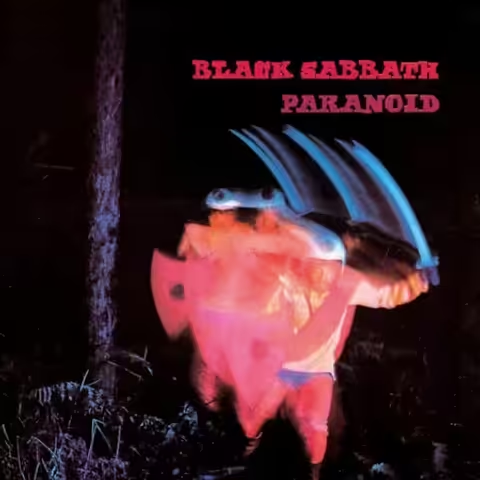
By that point the cover art had already been shot in Black Park in Buckinghamshire by photographer Keith Macmillan (credited as Keef). The model is Macmillan's assistant Roger Brown, dressed in pink and yellow, holding a sword and a shield, photographed three times in superimposition through a pink colour wash. It is, unmistakably, a war pig. Nobody at the label felt strongly enough to reshoot. Ozzy's later quip in I Am Ozzy that "what the fuck does a bloke dressed as a pig with a sword in his hand got to do with being paranoid, I don't know, but they decided to change the album title without changing the artwork" remains the definitive verdict.
Track by track
Eight tracks, 41 minutes 51 seconds, every song credited to Iommi, Butler, Ward and Osbourne. The North American pressing folded War Pigs into a hidden-medley title (War Pigs / Luke's Wall) and likewise for Fairies Wear Boots (Jack the Stripper / Fairies Wear Boots), reflecting onstage segues the band had used in 1969-70.
| # | Title | Length | Notes |
|---|---|---|---|
| Side one | |||
| 1 | War Pigs | 7:57 | Originally titled Walpurgis. Anti-war lyric written by Butler over an extended jam from the band's number Warning. |
| 2 | Paranoid | 2:48 | The single. Written and recorded in roughly two hours as filler. UK No. 4. |
| 3 | Planet Caravan | 4:32 | Ozzy through a Leslie speaker with oscillator, Iommi on flute, Allom on piano, Ward on congas. |
| 4 | Iron Man | 5:56 | Originally Iron Bloke. Riff prompted Ozzy's "sounds like a big iron bloke walking around" remark; Butler wrote the time-traveller-turned-to-steel narrative. |
| Side two | |||
| 5 | Electric Funeral | 4:53 | Apocalyptic nuclear-warfare imagery. Iommi uses a wah pedal as a fixed tone-shaper rather than a sweep. |
| 6 | Hand of Doom | 7:08 | About US servicemen returning from Vietnam strung out on heroin, after the band played American army bases in Europe. |
| 7 | Rat Salad | 2:30 | Drum-solo instrumental. Originated as Ward's stretching device on long European sets. |
| 8 | Fairies Wear Boots | 6:15 | Lyric written by Ozzy after a violent run-in with skinheads. Closes with one of Iommi's loosest, jazz-inflected solos. |
War Pigs is, in a literal sense, the album. It opens with Ward's air-raid-siren tom rolls, drops into the riff that Butler later said sounded "like Black Sabbath at their angriest", and never resolves comfortably. Butler's lyric was originally a Walpurgisnacht piece about politicians as the real Satanists, sending working-class kids to die in wars they themselves would never fight. Vertigo refused the title, the band swapped it for War Pigs, and the lyric stayed almost unchanged. The line "generals gathered in their masses, just like witches at black masses" is the original Walpurgis ghost still showing through.
Iron Man is the album's other gravitational object. The riff is one of the most-played in rock guitar pedagogy, and the lyric, written by Butler around Ozzy's reaction to the riff, is a science-fiction parable about a time-traveller who sees the apocalypse and is turned to steel by a magnetic field, then ignored when he returns to warn humanity. It became the band's highest-charting US single, despite never reaching the Top 40 there.
Planet Caravan is the curveball. Two minutes in, after the percussion and bass settle into a bossa-nova lilt and Ozzy's treated vocal floats over the top, it becomes obvious that this is not a band that only does one thing. Iommi's solo nods to Django; the lyric, by Butler, is a romance song about drifting through space with a lover, a deliberate antidote, in his words, to "the usual love crap". The band almost dropped it from the album for being too far off-brand. Pantera's 1994 cover, on Far Beyond Driven, sat closer to the original than most listeners expected.
Electric Funeral and Hand of Doom together form the album's political heart. Funeral imagines the aftermath of a nuclear strike; Doom is a documentary in song about Vietnam-era heroin addiction. Butler later told the documentary maker Matthew Longfellow that he wrote Hand of Doom because nobody else was telling that story:
"There was nothing on the news about this. There was no programmes telling you that the US troops in Vietnam, to get through that horrible war, were like fixing up. It just stuck in my head, and when we got to Hand of Doom, that's what I wrote it about."
Geezer Butler, in Classic Albums: Paranoid, 2010
Rat Salad is the album's only instrumental, a short showcase for Ward whose origin story is genuinely useful to know: in early-career Europe, Sabbath had to stretch sets to seven 45-minute slots a night, and Ward filled the time with extended drum solos. Rat Salad is what got squeezed down into vinyl-friendly form. Fairies Wear Boots, the closer, marries one of Iommi's loosest, swing-feel riffs to a Butler lyric written around an Ozzy story of being attacked by skinheads. It ends the record on something close to a smile.
Personnel and credits
| Role | Player | Notes |
|---|---|---|
| Black Sabbath | ||
| Vocals | Ozzy Osbourne | Lead throughout. Treated vocal on Planet Caravan via Leslie speaker. |
| Guitars, flute | Tony Iommi | Flute on Planet Caravan. Used Laney Supergroup amplifier and Gibson SG (Monkey). |
| Bass guitar | Geezer Butler | Wrote the majority of the lyrics. Played a Fender Precision through a Laney head. |
| Drums, congas | Bill Ward | Drums on every track except Planet Caravan, where he plays congas. |
| Production and engineering | ||
| Producer | Rodger Bain | Also produced Black Sabbath (1970) and Master of Reality (1971). |
| Engineer, piano | Tom Allom | Played piano on Planet Caravan. Later produced Judas Priest's classic-era catalogue. |
| Engineer | Brian Humphries | Better known for his later work with Pink Floyd. |
| Artwork | ||
| Photography, design | Keith Macmillan (Keef) | Shot in Black Park, Buckinghamshire. Cover concept dated from the abandoned War Pigs title. |
| Sleeve model | Roger Brown | Macmillan's assistant. Wore the helmet, brandished the sword, and ran around a forest in pink. |
| Graphic design credit | Marcus Keef | Marcus Keef is Macmillan; the credits used the same person under two names. |
Notable absences: there are no string sections, no choirs, no guest soloists. Paranoid is one of the great album-as-band-portraits in rock. Even Allom's piano contribution, on Planet Caravan, is so subdued that most listeners do not register it as a separate instrument until they read the credits.
Cover art and the title that would not be
The cover that Keith Macmillan shot in Black Park, with assistant Roger Brown in pink helmet, yellow tights and red shield brandishing a sword in a dark wood, was designed for an album to be called War Pigs. Vertigo's late decision to rename the album around the success of the Paranoid single left them with sleeve artwork that did not match the title, photographs that had no time to be reshot, and a UK gatefold whose interior carried the band's first ever appearance on their own album sleeve, also shot by Macmillan, on a grassy hill in monochrome.
The label's official line was that the title change was about marketing the hit. Ozzy's autobiography frames it that way too. But Joe Smith of Warner Bros., in the Classic Albums documentary, was blunter:
"We were in the midst of the war ourselves in this country, and what their reasoning was, not that important to me. I knew we weren't going to call it War Pigs."
Joe Smith, Warner Bros. EVP, in Classic Albums: Paranoid, 2010
Two reasons, in short, for one decision. The single had blown up, and a hawkish American distributor was not going to put War Pigs in the front window of a record store in 1970. The band lost the title; the cover stayed; the contradiction has been a running joke for fifty-five years.
Release and reception
Paranoid was issued in the UK on 18 September 1970 and went straight to No. 1, displacing Simon and Garfunkel's Bridge Over Troubled Water. It is the only Black Sabbath album to top the UK Albums Chart with the original Ozzy-era line-up. The US release was held back until 7 January 1971 because the debut was still selling there. When Paranoid did appear in the US, it climbed to No. 12 on the Billboard 200 with, in the band's own retelling, almost no FM radio support.
Critical reaction at the time was sharply divided. Disc, in September 1970, gave the album four stars and called the music "tight, loud, simple and exciting". The American press were less convinced. Lester Bangs in Rolling Stone famously wrote off the band as "just like Cream, but worse". Robert Christgau gave the album a C- in his Rock Albums of the Seventies guide, dismissing it as horror-themed camp.
The audience disagreed. They turned up at gigs in numbers the venues could not handle. They bought the single. They bought the album. By the end of 1971 Paranoid had been certified gold in the UK and platinum in Canada. By 2014, with SoundScan-era tracking only counting from 1991, it had moved 1.6 million copies in the US since the start of digital tallying alone. RIAA certification now stands at 4x Platinum.
What changed the critical weather was time. By 2017, Rolling Stone's reassessment had named Paranoid the greatest heavy metal album of all time. Pitchfork retroactively scored it 9.5/10. Guitar World ranked it No. 6 on its Greatest 50 Guitar Albums of All Time. The same record that Christgau dismissed as camp now sits at No. 139 on Rolling Stone's 500 Greatest Albums.
"Paranoid defined the sound and style of heavy metal more than any other record in rock history."
Steve Huey, AllMusic, retrospective review
Singles, charts and certifications
Two singles were lifted from the album. Paranoid was released in August 1970, before the album, and reached No. 4 in the UK, the band's only Top 10 single during their original run. Iron Man followed in October 1971 in the United States, peaking outside the Billboard Hot 100's top forty but becoming Sabbath's highest-charting US single of the era and a permanent rock-radio staple from that point on.
| Territory | Chart | Peak |
|---|---|---|
| United Kingdom | Official Albums Chart | 1 |
| Netherlands | Album Top 100 | 1 |
| Denmark | Tracklisten | 2 |
| Germany | Offizielle Top 100 | 2 |
| Australia | Kent Music Report | 4 |
| Finland | Official Finnish Charts | 4 |
| Norway | VG-lista | 5 |
| Italy | Musica e Dischi | 5 |
| United States | Billboard 200 | 12 |
| Canada | RPM Top Albums | 20 |
Certifications since: 4x Platinum in the United States (RIAA), Platinum in the UK on the 2008 reissue (BPI), Platinum in Canada (Music Canada), Platinum in Italy (FIMI), Gold in Germany (BVMI), Gold in Denmark (IFPI Danmark), and Gold in Australia (ARIA). For an album that the British music press initially dismissed and American radio actively avoided, that is a long-tail performance very few records of its era can match.
Touring 1970 to 1971
The Paranoid touring cycle was relentless. The band played the UK and Europe through autumn 1970, made their first US tour in October 1970, and were back in America for a longer leg through 1971 alongside Yes, Cactus and Mountain at various points. Onstage they had already moved past the album: setlists from late 1970 show extended versions of War Pigs and Iron Man, often segued (the Luke's Wall and Jack the Stripper subtitles on the US sleeve are direct memorialisations of these live transitions), with Rat Salad blown out into a fifteen-minute Ward solo.
- October 1970: first US tour, supporting and headlining medium-sized halls.
- December 1970: Top of the Pops appearance for Paranoid the single, recorded the day Hendrix died, and a moment Iommi later described as the band realising the wider world had finally noticed.
- March 1971: Paranoid hits No. 12 on the Billboard 200 in the US, with virtually no FM radio play.
- July 1971: Sabbath replace the New Yardbirds-era Yes-style improvisation in their set with a tighter, riff-led structure that becomes the template for every metal show that followed.
"That single attracted screaming kids. We saw people dancing when we played it, and we decided that we shouldn't do singles for a long while after that, to stay true to the fans who'd liked us before we'd become popular."
Tony Iommi, liner notes to Reunion, 1998
That decision, to step back from the singles market after Paranoid had given them their pop moment, is one of the reasons the band became the founding parents of metal rather than a one-hit Top of the Pops curio. They went back to the album as their unit of work, and the next three records (Master of Reality, Vol. 4 and Sabbath Bloody Sabbath) are arguably the run that, with Paranoid, builds the genre.
Legacy and influence
Almost every heavy band of the past five decades has cited Paranoid somewhere in their origin story. Metallica's James Hetfield has repeatedly named it as the album that made him pick up a guitar. Slipknot, Soundgarden, Nirvana and Foo Fighters have all played material from it live. Pantera covered Planet Caravan. Cathedral, Sleep, Electric Wizard and the entire 1990s doom metal revival treat War Pigs and Iron Man the way punk treats Anarchy in the UK. Iommi's down-tuned, blues-derived approach to the riff (made out of necessity by his missing fingertips) is the technical seed of everything from Tool to Mastodon.
"Paranoid was a totally complete album. It wasn't forced, and the chemistry between the four of us was so fluid. It was the most organic record that Sabbath, in any era, ever made."
Geezer Butler, Metal Edge interview, 2023
The accolades in print form a long list:
- Rolling Stone: ranked the greatest metal album of all time in 2017; No. 139 on the 500 Greatest Albums (2020 list).
- Guitar World: No. 6 on the Greatest 50 Guitar Albums of All Time (2009).
- Pitchfork: 9.5/10 on a retrospective review.
- Kerrang!: ranked No. 39 on its 100 Greatest Heavy Metal Albums of All Time list (1989).
- Q magazine: included on its Best Gothic Albums of All Time list (1999).
- Colin Larkin's Top 50 Heavy Metal Albums (1994): ranked No. 3.
- Selected for the Classic Albums documentary series in 2010, the recognised mark of a culturally important record.
The album also has its dark side, in the most literal sense. In 1974 a young nurse, Hilary Pollard, was found dead in her flat in Rawcliffe, North Yorkshire, with the Paranoid LP on the turntable. The inquest considered, then dismissed, the album's role in her death. Iommi, in his autobiography, talks about the case with unusual care; the band have never tried to use it as part of their mythology.
Reissues and the 2016 super deluxe
Paranoid has been reissued more times than almost any other British rock album of its era. The most significant editions:
| Year | Edition | What it added |
|---|---|---|
| 1996 | Castle Communications CD | First CD reissue with the live Wicked World as bonus, later moved to Past Lives. |
| 2009 | Sanctuary Deluxe Edition (2CD + DVD) | Disc one: 2009 remaster. Disc two: the 1974 quadraphonic mix folded down to stereo. Disc three: alternate takes and instrumental mixes from Regent Sound. DVD with the 1974 quad mix. |
| 2010 | Universal Music SHM-SACD (Japan) | Audiophile high-resolution edition. |
| 2016 | Rhino / Warner Bros. Super Deluxe (4CD) | 2012 digital remaster, quadraphonic mix folded to stereo, plus two previously unreleased 1970 concerts (Montreux and Brussels) released on official label for the first time. |
| 2020 | Sanctuary / Warner 5LP boxed set | The 2016 contents on vinyl. |
The Montreux 1970 and Brussels 1970 shows on the 2016 set had circulated as bootlegs for decades. They are the closest thing to hearing what the band sounded like onstage during the actual recording window, including alternate lyrics on War Pigs that show clear traces of the original Walpurgis text Butler had to abandon under label pressure.
Things you might not know
| Fact | Detail |
|---|---|
| The original title | The album was meant to be called War Pigs. Vertigo and Warner Bros. switched it to Paranoid after the title track became a hit single, but the cover art was already shot and never changed. |
| Walpurgis before that | War Pigs was itself originally called Walpurgis, a song Butler conceived as a Satanic-Christmas inversion in which the real Satanists are warmongers and bankers. The label rejected the title as too Satanic. |
| Iron Bloke | Iron Man's working title was Iron Bloke, after Ozzy's reaction to Iommi first playing the riff: that it sounded "like a big iron bloke walking around". |
| Twenty-five minutes | The song Paranoid was written and arranged in around twenty to twenty-five minutes, with Butler writing the lyric in roughly five. |
| Butler thought it was a Zeppelin rip-off | Geezer Butler initially refused to record Paranoid, convinced it sounded too much like Communication Breakdown by Led Zeppelin, his favourite band of the moment. |
| The Leslie cabinet vocal | Ozzy's vocal on Planet Caravan was sung through a Leslie speaker, normally used on Hammond organ, with Rodger Bain adding an oscillator. Iommi played flute and Allom played piano. |
| Tony Iommi's missing fingertips | An industrial accident in his teens at a Birmingham sheet-metal factory cost Iommi the tips of two fingers on his fretting hand. He played the entire album wearing home-made plastic thimbles. |
| The cover model is the photographer's assistant | The pink-and-yellow swordsman on the sleeve is Roger Brown, Keith Macmillan's photographic assistant, posed in Black Park in Buckinghamshire. |
| Recorded in standard tuning | Despite the album's reputation as the foundational doom record, every song on Paranoid is recorded in standard E tuning. The down-tuning experiments came later, on Master of Reality. |
| Joe Smith heard a hit at first listen | Warner Bros. executive Joe Smith, hearing the Paranoid acetate, pushed the volume up so far it shook the building, and decided on the spot to rename the album around the song. |
| UK No. 1 for the only time | Paranoid is the only Black Sabbath album to top the UK Albums Chart with the original Ozzy-era line-up. The band did not return to UK No. 1 until 13, in 2013, forty-three years later. |
| Hand of Doom is anti-drugs, not pro-drugs | Butler has spent decades correcting the misreading. The song was written about US Vietnam veterans returning addicted to heroin, after the band saw it first-hand on tour at American army bases in Europe. |
| The 1974 inquest | A 1974 inquest into the death of nurse Hilary Pollard, found at home with Paranoid on her turntable, briefly considered the album's lyrical content as a factor before dismissing it. |
Listen to the Riffology Podcast
Paranoid sits at the centre of the Riffology podcast's run through Black Sabbath's classic-era catalogue, from the 1970 debut through Sabbath Bloody Sabbath, Sabotage and beyond. The full conversation about how three days at Regent Sound in June 1970 produced the album that more or less invented heavy metal is on the feed wherever you listen, including Apple Podcasts, Spotify, Amazon Music and Pocket Casts. Subscribe, leave a rating, and tell us which Sabbath record we should cover next.
Comments