
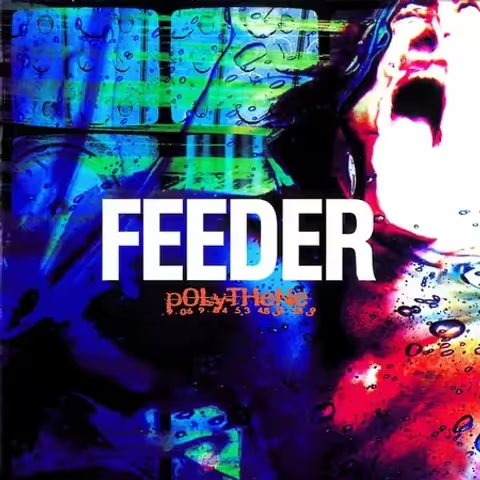
Polythene was made by a Welsh frontman, a Japanese bassist and an English drummer in a Buckinghamshire residential studio across a single month of mid-1996, and it came out 11 months later on a small London label called Echo that nobody outside the music industry had heard of. It debuted at UK Albums Chart number 65 in May 1997. Five months later, Metal Hammer would name it the album of the year and Kerrang! would put it sixth on the same list. By 2005 the same Kerrang! would put it 87th on the 100 Best British Rock Albums Ever. By 2017 it would have sold enough copies, very slowly, to be certified Gold without ever cracking the UK Top 50.
The band became famous instead for "Buck Rogers", a song from their third album that hit UK number 5 in 2001 and is the only Feeder track most casual listeners can name. That song's existence depends entirely on what Grant Nicholas, Taka Hirose and Jon Lee built on Polythene. The high-register vocal, the wall of guitar that drops to a single picked note for a chorus, the bass lines that move while the song does not, the drum kit recorded with the cymbals deliberately overloud. Every Feeder record since has been a refinement or a reaction. The one Feeder fans still order T-shirts of is Polythene.
Album Facts
| Field | Detail |
|---|---|
| Artist | Feeder |
| Album | Polythene |
| Release Date | 19 May 1997 (original); 28 October 1997 (Enhanced CD reissue with "High") |
| Label | Echo Records (UK) / Elektra Records (US) |
| Producers | Chris Sheldon and Feeder; Brian Sperber on three tracks |
| Studios | Great Linford Manor (Buckinghamshire) with Chris Sheldon; Pilot Recording Studios (New York) with Brian Sperber |
| Recording dates | Mid-1996 (Sheldon sessions); 1995 (earlier Sperber sessions) |
| Mastering | Howie Weinberg, Masterdisk, New York |
| Genre / Subgenre | Alternative rock, post-grunge, grunge |
| Track Count | 12 (original 1997 release); 13 (October 1997 reissue with "High"); 16 (later enhanced CD with bonus disc) |
| Total Runtime | 46:30 (original); 51:04 (reissue) |
| UK Albums Chart Peak | 65 |
| Certifications | BPI Gold (achieved through two decades of steady catalogue sales rather than initial release) |
| Highest-charting single | "High" (UK Singles Chart number 24, October 1997) |
| Awards | Metal Hammer Album of the Year 1997; Kerrang! number 6 album of 1997; Kerrang! 100 Best British Rock Albums Ever (number 87, 2005) |
| Key Singles | "Stereo World", "Tangerine", "Cement", "Crash", "High" |
Cultural Context
May 1997 was the week New Labour won the British general election and Tony Blair walked into Downing Street. The British music press was still calling the moment Britpop and the Number One album in the same week Polythene was released was the Verve's Urban Hymns (which would shortly overtake everything in front of it). Oasis were 11 weeks from Be Here Now. Radiohead had just released OK Computer. Suede's Coming Up had been the previous year's reset. The British music weeklies were having a very specific kind of summer.
The British rock and metal press were having a different one. The Britpop wave had pulled critical attention off bands who played hard guitar music; Kerrang! and Metal Hammer were in the early stages of what would, over the next 18 months, harden into the "Britrock" press tag (a category that would eventually contain Feeder, Terrorvision, the Wildhearts, 3 Colours Red, Reef, Skunk Anansie, Therapy?, A and Symposium). The American grunge wave had largely receded; Kurt Cobain had been dead three years, Soundgarden were a month away from splitting, and the Smashing Pumpkins had just released the deliberately understated Adore. The window for an explicitly post-grunge British debut record with strong songs and quiet-loud dynamics was wide open. Feeder walked through it.
The Band's Story Up to This Point
Grant Nicholas grew up in Newport, South Wales, and met drummer Jon Lee through the early-1990s Welsh independent scene. The two formed Reel in 1990 with various bass players, recorded a self-released album (Sealed, 1991) and a four-track EP, played the small-club circuit in Wales and the West Country, and got nowhere with major-label interest. Nicholas and Lee moved to London in 1994, advertised in the back of Loot for a bass player, and met Taka Hirose, a Japanese-born musician who had moved to London from Yokohama a year earlier. The three of them tried out together once. Hirose was in the band by the end of the week.
They called the new band Real, then Real Feeder, and finally just Feeder by mid-1995 when a tiny new London independent label called Echo (founded by Chrysalis veterans Steve Lewis and the Marshall family of music publishers) signed them on the strength of a four-track demo. The "Two Colours" EP came out in October 1995 in a run of 1,000 white-label 12-inch copies; "Stereo World" was the standout. The "Swim" EP followed in February 1996 (five tracks, again limited pressing, and the EP that established the band's live following in London). By mid-1996 Echo had committed to a full album and put Feeder in a residential studio in Buckinghamshire with a producer called Chris Sheldon, who had recently worked with the Foo Fighters' Pat Smear and would later go on to produce records by Radiohead, Pixies, Therapy? and Biffy Clyro.
"I met Jon when I was 19 and that was the band, basically. We just needed the third person. When Taka walked in and we played one song together, that was it. There was nothing to discuss. We all knew."
Grant Nicholas, Louder Sound, 2022
Pre-production and Demos
Nicholas had been writing songs continuously since the Reel days, and by the time the band walked into Great Linford Manor in mid-1996 he had a much larger pool of material than the album would need. The "Swim" EP from earlier in the year already contained "Descend" and "Stereo World" in finished form, both of which would be carried straight over to Polythene as album tracks. "Tangerine" had been written during a stay in a flat in Tufnell Park in north London and demoed at the band's rehearsal space in late 1995. "Cement" was the newest of the album's songs, written in the studio's piano room during a break in the Sheldon sessions.
- The album's working title was Here in the Bubble; that song eventually became the title track of a B-side and is one of the three bonus tracks on the later enhanced-CD bonus disc.
- Three songs ("Polythene Girl", "My Perfect Day" and "Crash") had been recorded a year earlier in New York with producer Brian Sperber at Pilot Recording Studios and were brought into the Chris Sheldon sessions as already-finished masters; they sit between the Sheldon-produced tracks on the running order without obvious tonal mismatch.
- "Suffocate" was the song the band most argued over including; Nicholas wanted it as a single, Echo did not, and it ended up as an album track that became a live staple instead.
- "20th Century Trip", the closing 1:56 instrumental, was an unfinished idea that the band recorded in a single late-night take and decided to leave on the album as a way of breaking what would otherwise have been a 44-minute album of full-band songs.
Creating the Album
The bulk of Polythene was tracked across mid-1996 at Great Linford Manor, a residential studio in a 16th-century manor house just outside Milton Keynes. The band lived in the house for the duration. Chris Sheldon produced and engineered; the band were credited as co-producers on every Sheldon-era song and as sole producers on "Cement", which they cut themselves while Sheldon was away for a long weekend and which the producer kept in the final running order without changes.
The sonic approach was a deliberate inversion of the British indie rock of the moment. Where Britpop was tracking guitars dry and close-mic'd, Sheldon and Nicholas wanted the guitars wide, layered and ringing. Nicholas tracked rhythm guitar parts twice through a Fender Twin Reverb on the left side and a Vox AC30 on the right, then doubled the lead lines on a third pass through a Mesa Boogie Dual Rectifier. The chorus walls on "Cement" and "Crash" are six guitar tracks panned across the stereo image. Hirose's bass went through an Ampeg SVT with a small amount of DI signal blended in for clarity. Jon Lee's drums were the part of the record Sheldon spent the most time on; the producer mic'd the cymbals on the loud side of the kit with deliberately overhot signal, and the result is the high-end shimmer that runs across the whole album.
Three pre-existing tracks recorded by Brian Sperber a year earlier in New York ("Polythene Girl", "My Perfect Day" and "Crash") were folded into the running order. Sperber's mixes were tighter and dryer than Sheldon's; Sheldon at one point offered to remix all three but Echo wanted them left alone. The compromise reached was that "Polythene Girl" would be remixed later by Chris Sheldon for the October 1997 reissue; the Sperber mixes of "My Perfect Day" and "Crash" are the ones that remain on every subsequent edition of the album.
The album was mixed by Sheldon at Great Linford Manor in September 1996 and mastered by Howie Weinberg at Masterdisk in New York in October. The final EMI delivery copy was handed over to Echo in November 1996. The release was held for six months to coordinate with a singles campaign that Echo wanted to build incrementally; the first single, "Stereo World", had already gone out in October 1996 ahead of the album cycle, with "Tangerine" in January 1997, "Cement" in April 1997, and the album itself shipping in May 1997.
"Chris Sheldon was the perfect producer for that record because he wanted the band to sound enormous. He had us doing things you simply did not do on a British rock record in 1996. Six guitar tracks. Drum cymbals louder than the snare. Bass DI through the desk for clarity. The Smashing Pumpkins comparison made me laugh because that is exactly what we were going for. We were absolutely chasing the Pumpkins' guitar sound. We did not bother to pretend otherwise."
Grant Nicholas, Louder Sound, 2022
Personnel and Credits
| Role | Player | Notes |
|---|---|---|
| Feeder | ||
| Vocals, guitar, songwriter | Grant Nicholas | Wrote every song on the album; co-produced "Polythene Girl", "My Perfect Day" and "Crash" with Brian Sperber; concept and photography contributor |
| Bass | Taka Hirose | Joined the band in 1994 after answering an ad in Loot; first studio album with Feeder |
| Drums | Jon Lee | Played in pre-Feeder band Reel with Grant Nicholas from 1990; would die in January 2002 (a defining post-Polythene event for the band) |
| Additional musicians | ||
| String arrangement | Audrey Riley | Arranged strings on "High" for the October 1997 reissue; the cellist who had previously worked with the Smiths, Coldplay, Foo Fighters and Smashing Pumpkins |
| Production and engineering | ||
| Producer, mixer, engineer | Chris Sheldon | Produced the bulk of the album at Great Linford Manor, mid-1996; would later produce Foo Fighters and Pixies sessions |
| Producer on three tracks | Brian Sperber | Produced "Polythene Girl", "My Perfect Day" and "Crash" at Pilot Recording Studios, New York, 1995; remixed "Cement" |
| Mixing and engineering on "High" | Matt Sime and Steve Power | The October 1997 reissue's added track was mixed separately with the producer-engineer pair Echo had used on the original single |
| Mastering | Howie Weinberg | Masterdisk, New York; mastered "Nevermind", "Master of Puppets" and many of the era's defining alternative-rock records |
| Artwork | ||
| Concept and design | Jeremy Plumb | The polythene-sheet visual concept and the album's typographic identity |
| Photography | Scarlet Page, Dan McLewin and Andrew Cameron | Scarlet Page (the daughter of Led Zeppelin guitarist Jimmy Page) shot the main cover image; supplementary photography by Dan McLewin and Andrew Cameron |
The Songs
| # | Title | Length | Single? | Notes |
|---|---|---|---|---|
| 1 | "Polythene Girl" | 3:29 | Brian Sperber New York session (1995); remixed by Chris Sheldon for the October 1997 reissue | |
| 2 | "My Perfect Day" | 4:25 | Brian Sperber New York session | |
| 3 | "Cement" | 3:17 | Single (April 1997) | UK 53; the band's first single proper from the album; Kerrang! "Single of the Week" |
| 4 | "Crash" | 4:08 | Single (August 1997) | UK 48; Brian Sperber session; the album's quiet-loud-quiet centrepiece |
| 5 | "Radiation" | 4:38 | The album's heaviest track; Nicholas lyric about Chernobyl and 1990s nuclear-anxiety culture | |
| 6 | "Suffocate" | 3:53 | Single (early 1998 promo) | The song the band argued for as a single; eventually a long-running live staple |
| 7 | "Descend" | 5:19 | Carried over from the "Swim" EP (February 1996) | |
| 8 | "Stereo World" | 3:24 | Single (October 1996) | UK 70; the lead single, originally on the "Two Colours" EP |
| 9 | "Tangerine" | 3:58 | Single (January 1997) | UK 60; the second single; written during a stay in Tufnell Park |
| 10 | "Waterfall" | 3:10 | Dropped from the October 1997 reissue and replaced by "Change" | |
| 11 | "Forgive" | 4:41 | The album's slowest song; Nicholas tracked the vocal in a single take | |
| 12 | "20th Century Trip" | 1:56 | The instrumental closer; recorded in a single late-night take |
"Polythene Girl" opens the record at exactly the right Brian Sperber polish: a clean Fender Twin Reverb arpeggio, Hirose's bass coming in on the second bar, Lee's drums splashing the cymbals on every two-and-four. It is the most considered three minutes 29 seconds on the album and was deliberately chosen as the opener (and remixed for the October reissue) because it sets the album's quiet-loud signature with maximum economy. "My Perfect Day" sequences directly into it and is the album's second-most-played live song after "High".
"Cement" is the song the band cut themselves while Chris Sheldon was away for the weekend, and is one of the album's strongest moments. Nicholas wrote the song in the manor's piano room, played the guitar parts on a borrowed Mesa Boogie that had been left in the live room, and tracked the vocal in a single afternoon. Kerrang! gave the single a 5/5 review and made it Single of the Week. "Crash" is the album's emotional centrepiece, the slow-build Brian Sperber production where Nicholas's vocal climbs across the chorus and Hirose's bass moves underneath in counter-melody.
"Radiation", at track five, is the heaviest moment on the record, and the song that did most to convince Metal Hammer readers that Feeder were the British band to follow in 1997. "Stereo World" had been the Feeder lead single since the original "Two Colours" EP in 1995 and got its third commercial release here; the music video, directed by Sophie Muller, is the surviving YouTube footage from the campaign.
"Tangerine" was the song the indie record-shop crowd noticed first, the song most often used to introduce people to Feeder in 1997, and the one that began the rotation on MTV2 that would carry the band through the autumn. "Waterfall", on the original tracklist, was the band's most explicitly grunge moment on the record and the song that Chris Sheldon would later say was closest in feel to the Soundgarden records he had been listening to during pre-production. It is also the song that was removed from the October 1997 reissue and replaced by "Change", a decision that some fans of the original 12-track sequence still resent. "Forgive" is the album's slowest moment and "20th Century Trip" the brief, instrumental cool-down that closes it.
"Cement is the song where we figured out who we were going to be. We were three people in a room, no producer, no headphones, just playing the song. It came out of the desk on the first pass and we did not touch it. That is the song that taught us we did not actually need anyone else."
Taka Hirose, Bass Player magazine, 2017
B-sides, Outtakes and Lost Songs
Polythene-era Feeder generated an unusually high volume of non-album material, a function both of the long six-month gap between recording and release and of Echo's CD-single B-side strategy. The full set was eventually compiled on the later expanded enhanced-CD edition's bonus disc:
- "Chicken on a Bone": a Sheldon-session outtake that became the B-side of "Crash" in August 1997; one of the band's most overtly Pixies-influenced tracks.
- "Here in the Bubble": the song that gave the album its working title; B-side of the "Tangerine" single (January 1997).
- "Swim": the title track of the February 1996 EP; included on the bonus disc.
- "Sweet 16" and "Center of My Universe": earlier "Two Colours" EP tracks; long-standing fan favourites that the band still occasionally play live.
- "Change": recorded specifically for the October 1997 reissue to replace "Waterfall"; later considered a near-album-quality track in its own right.
- "Tomorrow Shine": a Brian Sperber outtake from the 1995 New York sessions, never officially released and known only through bootleg circulation among the Feeder online community.
"Waterfall", removed from the October 1997 reissue, remains the most contested decision in the Polythene catalogue. Echo's reasoning at the time was that "High" (which would be the first single to break the UK Top 40) needed a place on the album, that the reissue had to be sequenced as a coherent listen rather than a 13-track grab-bag, and that "Waterfall" sat too close in tempo and tone to other tracks already in the running order. Nicholas has said in interviews since that he agrees with the cut but understands why fans of the original do not.
Album Artwork and Packaging
The cover image is a saturated photograph by Scarlet Page (daughter of Led Zeppelin guitarist Jimmy Page) of a young child in a clear plastic raincoat photographed through a sheet of distorted polythene plastic, with the band name and album title in plain white sans-serif lettering at the top. Concept and design were by Jeremy Plumb. The visual idea was both a play on the album's title and a deliberate inversion of the photo-realistic glossy sleeves that dominated British alternative rock at the time; the image's slightly disorientating quality (you cannot quite tell whether the child is laughing or distressed) was the precise emotional register the band wanted for the record.
The original 19 May 1997 release was packaged as a standard jewel-case CD with a 12-page lyric booklet. The October 1997 enhanced-CD reissue added a CD-ROM video track of the "High" music video and an updated booklet. The vinyl pressing of the original was small (around 2,000 copies on Echo's white-label imprint) and is now one of the more collectible British rock items of the late 1990s; clean copies regularly trade above 100 pounds. The album has been reissued on vinyl twice since (2017 and 2022) with refreshed packaging both times.
Release and Reception
The 19 May 1997 release was reviewed across the British rock and metal press through May and June; the album debuted at UK Albums Chart number 65 and slipped quickly out of the top 100. The mainstream music press (Q, Melody Maker, NME) was lukewarm rather than negative, treating the album as a competent post-grunge entry rather than the major event the rock press treated it as. The rock press, by contrast, was unanimous.
| Publication | Reviewer | Score | Quote |
|---|---|---|---|
| Metal Hammer | 10/10 | "The British answer to the Smashing Pumpkins, and the British rock album of the year by a distance" | |
| Kerrang! | 4/5 | "Twelve songs of the kind British alternative rock has been waiting all decade for" | |
| Q | 4/5 | "A genuinely good debut album that may have been issued at exactly the wrong commercial moment" | |
| AllMusic (retrospective) | Tom Demalon | 4/5 | "A strong debut full of melodic, hook-laden songs that hold up better than most of the post-grunge wave that surrounded them" |
| NME | "Capable, occasionally inspired, and rather better than the chart position will suggest" | ||
| Melody Maker | "A debut that promises far more than it manages to deliver, but the promise is the point" |
The retrospective re-evaluation has been steady and one-directional. The album was added to Kerrang!'s 200 Albums For the Year 2000 list in the Essential Britrock category in 2000, was placed at number 87 in Kerrang!'s 100 Best British Rock Albums Ever poll in 2005, was the subject of a major 25th-anniversary Louder Sound feature in 2022 ("Feeder's Polythene at 25: How 'The British Smashing Pumpkins' Made Metal Hammer's Album of 1997"), and has been a constant reference point in interviews with younger British alternative-rock bands (Biffy Clyro, Twin Atlantic, Lower Than Atlantis, Mallory Knox) since the mid-2000s.
Singles and Music Videos
| Single | Release Date | UK Singles Chart Peak | Notes |
|---|---|---|---|
| "Stereo World" | 7 October 1996 | 70 | First commercial single from the album cycle; pre-album release |
| "Tangerine" | 27 January 1997 | 60 | Sophie Muller-directed video; the indie record-shop favourite |
| "Cement" | 28 April 1997 | 53 | Kerrang! Single of the Week; the album's launch single |
| "Crash" | 11 August 1997 | 48 | First single to crack the UK Top 50 |
| "High" | 6 October 1997 | 24 | The breakthrough; UK Top 40 entry; included on the October 1997 reissue of the album |
The music-video campaign was directed largely by Sophie Muller (one of the era's most in-demand alternative-rock directors, with credits including Eurythmics, Annie Lennox, Coldplay, Garbage and Beyonce), with a deliberately ambient, slightly Pumpkins-via-Beck visual aesthetic. The full set of singles videos was later collected on the April 1998 VHS compilation Polythene: The Video Singles, a 30-minute Echo Records release that became one of the more sought-after British alternative-rock VHS items of the era and has never been officially reissued on DVD or streaming. The "High" video, in particular, was the centrepiece of MTV2's autumn 1997 rotation in the UK and pulled the album's reissued edition back into the charts.
Touring and Live
The Polythene tour cycle ran nearly continuously from spring 1997 to late summer 1998 and was the period in which Feeder established a live reputation that would carry them through the rest of their career. The defining run was the 1997 UK headline tour that followed the album's release in May and June, a 20-date small-club run that took in London Garage, Manchester Roadhouse, Glasgow Garage, and the band's first hometown Newport show as Feeder at TJ's. The autumn 1997 European tour as support to Reef expanded the band's continental audience materially, and the early-1998 Stateside dates (a four-week support slot with the Smashing Pumpkins on the Adore US tour, arranged at Billy Corgan's personal request after he heard the album) gave the band their only sustained US exposure of any of their albums.
- May to June 1997 - UK headline tour for the album release: 20 dates including London Garage, Manchester Roadhouse, Glasgow Garage and Newport TJ's.
- Summer 1997 - first UK festival circuit: Glastonbury New Bands Tent (afternoon slot), Reading Festival (Lock Up Stage), T in the Park (small-stage afternoon).
- Autumn 1997 - European tour as support to Reef: 18 dates across Germany, the Netherlands, France and Scandinavia; the band's first sustained continental run.
- December 1997 - first headline tour following "High" success: upgraded venues including London Astoria, Manchester Academy and Glasgow Barrowlands.
- Early 1998 - US tour with Smashing Pumpkins: four-week support slot on the Adore US tour at Billy Corgan's personal request; the only sustained US exposure Feeder ever had.
- Summer 1998 - second UK festival circuit: upgraded slots at Reading (Main Stage opener) and V Festival.
The live reputation Feeder built across the Polythene campaign was one of restrained, song-focused, technically tight playing in a British rock-and-metal scene whose live signature was more typically loud chaos. Nicholas was a frontman who did not banter much, did not move around the stage and did not engage in arena-rock posturing; the songs did the work and the band built a following on the strength of consistent live delivery rather than spectacle.
"Billy Corgan rang our manager from his hotel in Chicago at three in the morning and told him he had been playing Polythene on his tour bus for a month and would we come and support the Pumpkins on the Adore US tour. That call changed everything for us in America. It did not last and we never did the touring follow-up the album needed, but for those four weeks we were the band Billy Corgan had picked, and you could feel the audience deciding to take us seriously."
Grant Nicholas, Louder Sound, 2022
In TV, Film and Media
British TV gave Polythene its first significant national exposure in autumn 1997. The band made appearances on Channel 4's The White Room (with "Cement", June 1997), MTV Europe's The Lick (with "Crash", September), and Top of the Pops for the first time with "High" in October. The band's first Glastonbury performance on the New Bands Tent in June 1997 was broadcast on the BBC's weekend coverage. Sync placements were rare at the time but have built up over the decades: "Crash" appeared on the 1999 video-game soundtrack for WCW Mayhem, "High" was used in a 2003 episode of the US TV series Smallville, and "Stereo World" was used in a 2008 advert for the British Tourist Board.
Covers, Samples and Tributes
"High" is the song most often covered by British alternative-rock bands of the post-2000 generation; recorded acoustic versions exist by Biffy Clyro, Twin Atlantic and Mallory Knox. No commercial sample of any Polythene-era track has ever been cleared. The album is one of the most consistently cited British rock debuts of the late 1990s, with members of every Welsh and Western alternative-rock band of the next decade pointing to it as the record that proved a Welsh-origin band could compete on the British rock-press stage. The 25th anniversary in May 2022 prompted a wave of new-generation tribute coverage, including a full Louder Sound long read, a Kerrang! podcast episode, and Twin Atlantic's full-album live tribute performance at Glasgow Cathouse.
Reissues, Remasters and Anniversaries
The major reissue is the 28 October 1997 enhanced-CD edition that came out five months after the original release, with the remixed "Polythene Girl" as track one, "High" added as track four, "Waterfall" removed, and "Change" added as track ten. This is the version of Polythene that most owners have heard. The 2017 20th-anniversary 2-CD enhanced edition added the original 1997 b-sides and outtakes ("Chicken on a Bone", "Here in the Bubble", "Swim") as a bonus disc, alongside the original 1996 "Swim" EP. The 2022 25th-anniversary vinyl reissue used the original cover image with restored colour but kept the October 1997 13-track sequence rather than the original 12-track running order. A full half-speed master or Atmos / spatial-audio release has never appeared.
Original 1997 vinyl pressings (Echo's small white-label run) remain among the most collectible British rock vinyl items of the era and regularly trade above 100 pounds in clean condition. The original 12-track 19 May 1997 CD pressing (with "Waterfall" and the unremixed "Polythene Girl") was deleted within weeks of the October reissue and is now itself a collector's piece.
Legacy and Influence
Polythene's legacy is split into two halves by an event the album cannot itself have anticipated. Through the late 1990s and into the early 2000s, Polythene was the foundation that Feeder built a sustained UK alternative-rock career on; Yesterday Went Too Soon in 1999 reached UK Albums Chart number 8, and Echo Park in 2001 produced the UK number 5 single "Buck Rogers" and topped the album chart category that summer at number 5. Then, in January 2002, drummer Jon Lee took his own life at his home in Miami. Lee's death altered the band's trajectory permanently; the next album, Comfort in Sound (2002), was Nicholas's grief record. Feeder have continued as a touring and recording band ever since (with drummer Mark Richardson from Skunk Anansie joining in 2002 and the current line-up featuring Karl Brazil), but every Feeder record after 2002 is, in some way, a record made in Lee's absence. Polythene, by contrast, is the last full Feeder album made by the original line-up of Grant Nicholas, Taka Hirose and Jon Lee with no shadow over it.
The album's influence on younger British alternative-rock bands has been steady. Biffy Clyro have repeatedly named it as a foundational record; Twin Atlantic's debut Vivarium (2009) is identifiably a Polythene descendant in production and structure; Lower Than Atlantis, Mallory Knox, Don Broco and many of the British post-2010 emo-and-pop-punk wave grew up on Polythene as a primary listening reference. The post-2000 "Welsh rock" identity that gave the Manic Street Preachers a permanent home and that bands like Future of the Left, Lostprophets and Bullet for My Valentine would later partly inhabit traces a clean line back to Feeder's mid-1990s decision to relocate from Newport to London and make the most ambitious British rock debut of 1997 anyway.
"Jon was the heartbeat of the band, in every literal and metaphorical sense. Polythene is the record that has Jon on every second of every song. That is why it matters more to us than any of the bigger records did. It is the document of the three of us being in a room together."
Grant Nicholas, NME interview on the 25th anniversary, 2022
Things You Might Not Know
| Fact | Detail |
|---|---|
| The working title | Polythene's working title was Here in the Bubble; that song eventually became the title track of the "Tangerine" B-side and was added to the 2017 bonus-disc reissue. |
| The Loot advert | Bassist Taka Hirose joined Feeder by answering a small-ad in the back of the London listings paper Loot in 1994; the audition was a single song with Grant Nicholas and Jon Lee in a London rehearsal room. |
| Reel before Feeder | Grant Nicholas and Jon Lee had played together since 1990 in a Newport band called Reel that self-released an album in 1991 and got nowhere with major labels; Feeder was their second attempt at the same partnership. |
| Two studios, two producers | Three of the album's twelve tracks ("Polythene Girl", "My Perfect Day" and "Crash") were recorded a year earlier in New York with producer Brian Sperber at Pilot Recording Studios; the rest were tracked at Great Linford Manor with Chris Sheldon in mid-1996. |
| The Cement weekend | The band cut "Cement" themselves over a weekend when Chris Sheldon was away from the studio; the producer kept the band's mix in the final running order without changes, and Kerrang! made the single its Single of the Week. |
| Howie Weinberg's CV | Mastering engineer Howie Weinberg, who mastered Polythene at Masterdisk in New York, was the same engineer who had mastered Nirvana's Nevermind, Metallica's Master of Puppets and the Smashing Pumpkins' Siamese Dream. |
| Scarlet Page | The album's cover photographer was Scarlet Page, daughter of Led Zeppelin guitarist Jimmy Page; she went on to photograph dozens of British alternative-rock acts through the late 1990s and 2000s. |
| Two-and-a-half stars to four | The original AllMusic review of Polythene was three stars; Tom Demalon revised the rating upwards to four stars in a 2008 retrospective revisit that has become the canonical AllMusic entry for the album. |
| The Audrey Riley connection | String arranger Audrey Riley, who arranged strings on the reissue's added track "High", was the cellist who had previously arranged for the Smiths, Coldplay, Foo Fighters and the Smashing Pumpkins. |
| Billy Corgan's 3am phone call | Billy Corgan personally requested Feeder as Smashing Pumpkins support on the early-1998 US Adore tour after listening to Polythene on his tour bus; the band manager took the call at three in the morning. |
| Sophie Muller's videos | Most of the Polythene singles videos were directed by Sophie Muller, who had previously made videos for Eurythmics, Annie Lennox, Garbage and Coldplay. |
| The Polythene VHS | Echo Records released a VHS-only video-singles compilation in April 1998 titled Polythene: The Video Singles; it has never been reissued on DVD or streaming and is one of the more sought-after British alternative-rock VHS items of the era. |
| Glastonbury debut | Feeder played their first Glastonbury Festival on the New Bands Tent in June 1997, on an afternoon slot; the performance was broadcast on the BBC's weekend coverage. |
| Two of the original twelve | Two songs ("Descend" and "Stereo World") had already been released on the band's February 1996 "Swim" EP a year before Polythene; both were carried straight onto the album with the same Brian Sperber session masters. |
| The Reading Festival upgrade | The band's first Reading Festival appearance was on the Lock Up Stage in 1997; one year later they opened the Main Stage on the Sunday, the fastest Reading-Stage upgrade for any British rock band of the era. |
| The Welsh-Japanese-English thing | Grant Nicholas is Welsh (from Newport), Taka Hirose is Japanese (originally from Yokohama and resident in London since 1993), and Jon Lee was English (born in Newport but the only English-passport member of the band on Polythene). The line-up was deliberately presented as a multinational alternative-rock band in 1997 press at a time when British rock was overwhelmingly white-British in its public identity. |
The Podcast
The Riffology podcast covered Polythene in episode 54, walking through Grant Nicholas's pre-Feeder years in Reel with Jon Lee, the Taka Hirose Loot-ad audition, the Brian Sperber New York sessions, the Chris Sheldon Great Linford Manor sessions of mid-1996, the five-single campaign through 1996 and 1997, the October 1997 reissue that added "High", the Billy Corgan-requested US tour with the Smashing Pumpkins, and the long shadow Jon Lee's 2002 death cast over the band's later career. The episode is available wherever you get your podcasts: Apple, Spotify, Amazon, Overcast, Pocket Casts and on the Riffology site itself.

Comments