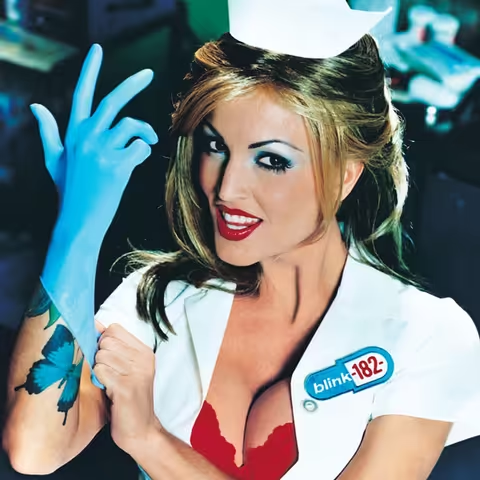
Janine Lindemulder, the smiling adult-film actress snapping on a blue surgical glove on the cover of Blink-182's Enema of the State, originally wore a red cross on her nurse's cap. The American Red Cross objected. The symbol, its lawyers pointed out, is protected under the Geneva Conventions, and three skate-punks from San Diego were in no way a medical organisation, so the cross had to come off. That a band best known at the time for getting naked on stage ended up in a polite legal standoff with a Nobel Peace Prize-winning humanitarian body over a porn star in a nurse outfit is, in miniature, the entire story of this record: juvenile filth and accidental hooks, polished until they became one of the defining mainstream rock albums of the decade.
Released on 1 June 1999 by MCA Records, Enema of the State was Blink-182's third album and the first to feature drummer Travis Barker, who had replaced Scott Raynor barely a year earlier. Recorded in three months with producer Jerry Finn, it spun off three singles, "What's My Age Again?", "All the Small Things" and "Adam's Song", sold an estimated 15 million copies worldwide, and dragged pop-punk out of the skate-shop and onto Total Request Live. The band styled their name in lowercase as blink-182, the way it appears on the sleeve, and over thirty-five minutes they wrote the template that Sum 41, Simple Plan, Fall Out Boy and a thousand mall-punk bands would spend the next decade copying. This is how it happened.
Album Facts
| Field | Detail |
|---|---|
| Artist | Blink-182 (styled blink-182) |
| Album | Enema of the State |
| Release Date | 1 June 1999 |
| Label | MCA Records |
| Producer | Jerry Finn |
| Studios | Mad Hatter, The Bomb Factory and Conway (Los Angeles); Signature Sound, Big Fish and Studio West (San Diego area); mixed at South Beach Studios, Miami |
| Genre / Subgenre | Pop-punk, punk rock, skate punk |
| Track Count | 12 |
| Total Runtime | 35:17 |
| Billboard 200 Peak | No. 9 |
| UK Albums Chart Peak | No. 15 |
| Other Notable Chart Peaks | No. 2 New Zealand, No. 4 Australia, No. 5 Italy, No. 6 Austria, No. 7 Canada |
| Certifications | 5x Platinum (US, RIAA); Platinum (UK); 4x Platinum (Canada); 3x Platinum (Australia) |
| Estimated Sales | Around 15 million worldwide |
| Key Singles | "What's My Age Again?", "All the Small Things", "Adam's Song" |
What 1999 Sounded Like
To understand why Enema of the State hit the way it did, you have to remember what was on the radio in the summer of 1999. The American singles chart belonged to teen pop and processed R&B. Britney Spears had arrived in January with "...Baby One More Time", the Backstreet Boys' Millennium shifted over a million copies in a single week that May, and the Latin-pop crossover of Ricky Martin's "Livin' la Vida Loca" was inescapable. The harder end of the rock dial, meanwhile, had curdled into nu-metal, the rap-rock posturing of Limp Bizkit's Significant Other and Kid Rock's Devil Without a Cause. Both of those would soundtrack the chaos of Woodstock '99 later that same July.
Into that gap, three guys in board shorts who told dick jokes between songs looked, on paper, like a novelty. Punk had already been through one mainstream cycle earlier in the decade. Green Day's Dookie and The Offspring's Smash had both gone multi-platinum in 1994, proving there was a teenage audience for fast, melodic, three-chord guitar music that the major labels had been happy to sign. By 1999 that wave was assumed to have crested. Blink-182's own previous record, 1997's Dude Ranch, had gone gold on the strength of the single "Dammit" without ever threatening the top of the chart. The conventional wisdom said pop-punk was a club-sized concern.
The records Blink-182 were quietly competing with, and within months outselling, tell the story:
- Backstreet Boys, Millennium (May 1999), the album everyone expected to define the year
- Limp Bizkit, Significant Other (June 1999), released within weeks of Enema
- Red Hot Chili Peppers, Californication (June 1999)
- Ricky Martin's self-titled English-language debut (May 1999)
- The soundtrack to American Pie, the teen comedy that name-checked the era and gave Blink a cameo
Blink-182 Before Enema
Blink-182 had formed in the San Diego suburb of Poway in 1992 as a trio of Tom DeLonge on guitar, Mark Hoppus on bass and Scott Raynor on drums, originally just called Blink until an Irish electronic act of the same name forced the addition of the numbers. They built a following the hard way, through relentless touring, self-released cassettes and a 1995 debut, Cheshire Cat. Dude Ranch in 1997 was the step up, recorded for the indie Cargo Music but distributed through a deal with MCA, and "Dammit (Growing Up)" became a genuine modern-rock radio hit. The major label saw the upside and exercised its option.
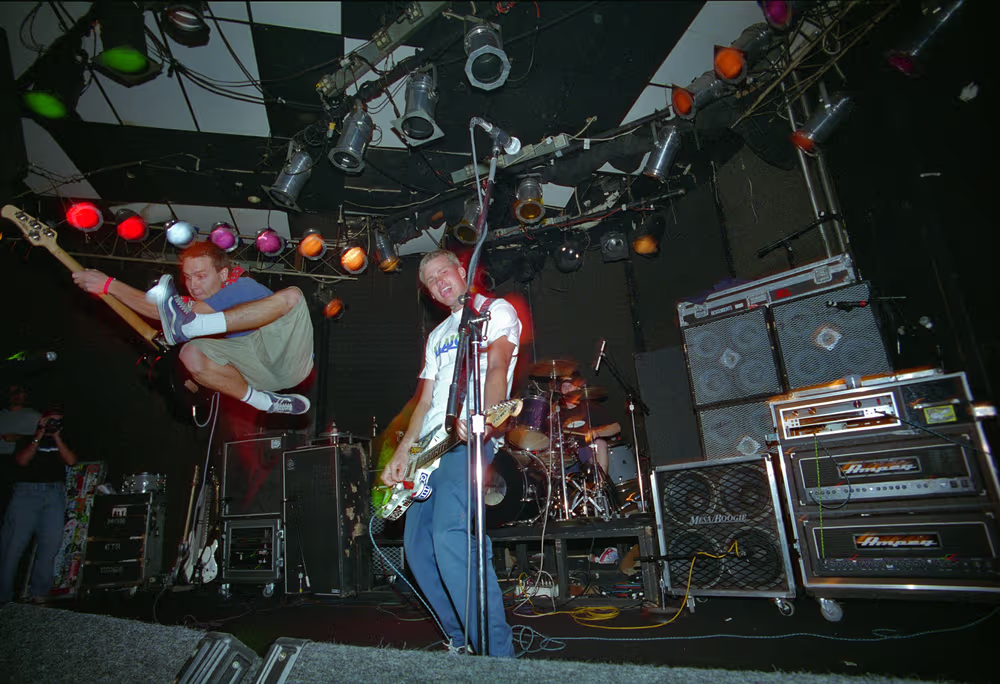
The fault line ran through the drum stool. Raynor was struggling with personal problems and drinking, and during the SnoCore tour in early 1998 things came to a head. Accounts differ on the exact sequence, but Raynor was given an ultimatum and left the band in February 1998. With tour dates already booked, Hoppus and DeLonge needed a drummer immediately. They borrowed Travis Barker, who was playing in the opening ska-punk act The Aquabats. The legend, repeated by Barker himself, is that he learned the band's entire twenty-song set from a cassette in around forty-five minutes before his first show and played it without a mistake. The temporary fix became permanent, and the difference was night and day. Barker was a faster, harder, more precise drummer than Blink had ever had, a player who could swing and machine-gun in the same bar.
"We should have looked for a new drummer right then, because it was obvious what band he belonged in."
Adam Deibert of The Aquabats, on watching Barker play with Blink-182
So the band that walked into the studio at the start of 1999 was, for the first time, the classic line-up: Hoppus, DeLonge, Barker. They had a hit single behind them, a major label's marketing budget in front of them, and something to prove about whether the joke band could actually make a great record.
Writing the Songs and the Working Titles
Hoppus and DeLonge wrote almost everything together, and the songs that became Enema of the State came out of the same well they always drew from: girls, boredom, suburbia, growing up and refusing to. "What's My Age Again?" started life under the title "Peter Pan Complex", a reference MCA worried nobody would get, and the label changed it over the band's objections. Its opening guitar figure came from Hoppus trying to play Green Day's "J.A.R." on guitar, fluffing the part, and deciding he liked the mistake better than the original. "All the Small Things" was DeLonge's deliberate tribute to the Ramones, built around a run of "na na na" hooks; early demos were literally labelled the "Ramones-style song". The verse about roses left on the stairs was real, a gesture from DeLonge's girlfriend (and later wife) Jennifer Jenkins after he came home late from recording.
Not everything was a love song or a gag. "Adam's Song" was largely Hoppus's, written about the specific loneliness of being on tour and away from everyone you know, and shaped by a letter from a teenager he had read in a magazine. It is a slower, heavier, more interior piece than anything else on the record, structured like a suicide note that turns, in its final verse, toward hope. Travis Barker would later write that the title itself came from a sketch on the comedy series Mr. Show, about a fictional band whose song encourages a fan to kill himself, the band turning that dark joke inside out into something sincere.
The album nearly carried a very different name. Among the working titles floated during the sessions were Vasectomy, Vasecto-you, Does That Look Infected? and, right up until close to the end, Turn Your Head and Cough. That last one matters, because it is the reason there is a surgical glove on the cover at all. DeLonge has described the band's ambition for the songs in characteristically blunt terms.
"We wanted to make a record that sounded like nursery rhymes on steroids."
Tom DeLonge, on the songwriting goal for Enema of the State
Recording with Jerry Finn
The single most important decision the band made was hiring Jerry Finn to produce. Finn had engineered and mixed Green Day's Dookie, the record that more or less invented the commercial pop-punk sound Blink were chasing, and had gone on to work with Rancid, Pennywise, Morrissey and Madness. He understood exactly how to make fast, simple, melodic punk sound enormous on the radio without sanding off its edges. He became, in effect, a fourth member during the sessions, and his fingerprints, the doubled vocals, the gigantic clean-then-distorted guitars, the impossibly tight low end, are all over the finished album.
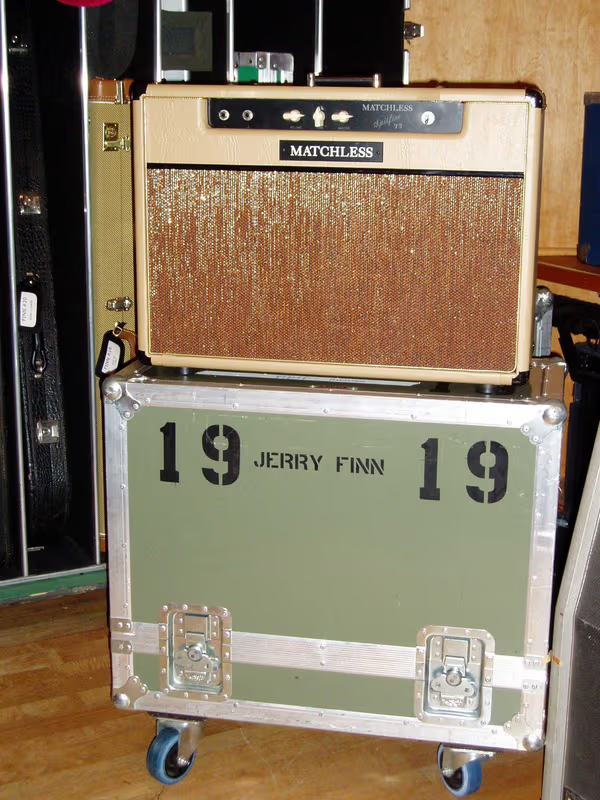
Recording ran from January to March 1999, spread across a string of California studios rather than one home base. The bulk of the drums were cut at Mad Hatter, the Los Angeles room owned by jazz pianist Chick Corea, and the speed at which Barker worked became part of the album's mythology: he reportedly laid down the majority of his drum tracks in around eight hours, playing live without headphones and, unlike on later Blink albums, without a click track. The whole thing was recorded to analogue tape rather than Pro Tools, which is a large part of why it still sounds like a band in a room rather than a grid.
The studios and gear that shaped the record:
- Mad Hatter, The Bomb Factory and Conway in Los Angeles; Signature Sound, Big Fish and Studio West around San Diego
- Tom DeLonge's Fender Stratocaster pushed through a Mesa/Boogie Triple Rectifier for that scooped, buzzsaw tone
- Mark Hoppus on Fender Precision and Jazz basses plus a Music Man StingRay
- Travis Barker cycling through roughly a dozen rented snare drums from Orange County Drum and Percussion
- Vocals captured on a Blue Bottle tube condenser microphone, recommended by Finn
- Roger Joseph Manning Jr. adding subtle keyboards over the top
The sessions were, by all accounts, fun. Finn kept the mood light, and the band have repeatedly credited him with making the slog of tracking and overdubbing bearable.
"Recording can get pretty monotonous, but at least we could laugh with Jerry."
Mark Hoppus, on working with Jerry Finn
Mixing went to Tom Lord-Alge at South Beach Studios in Miami, with a single instruction from the band, to make it sound as aggressive as possible. Finn himself mixed two tracks, "The Party Song" and "Wendy Clear". Brian Gardner mastered it at Bernie Grundman Mastering in Hollywood. The result was a record that was glossy and punchy in a way Blink had never managed before, and which Finn always suspected would connect far beyond their existing fanbase. He was also irritated, in retrospect, at where the band kept getting filed.
"It's kind of funny that they've been lumped in with Kid Rock and Limp Bizkit, who play up that kind of pimp lifestyle, because Blink is so not that."
Jerry Finn, producer
Personnel and Credits
| Role | Player | Notes |
|---|---|---|
| Core band | ||
| Bass, vocals | Mark Hoppus | Lead and backing vocals; co-writer on every track |
| Guitars, vocals | Tom DeLonge | Lead and backing vocals; co-writer on every track |
| Drums | Travis Barker | His first Blink-182 studio album |
| Guest and session musicians | ||
| Keyboards | Roger Joseph Manning Jr. | Former Jellyfish member; added keyboard textures |
| Production and engineering | ||
| Producer | Jerry Finn | Also mixed "The Party Song" and "Wendy Clear" |
| Recording engineer | Sean O'Dwyer | |
| Assistant engineers | Darrel Harvey, John Nelson, Robert Read | |
| Mixing | Tom Lord-Alge | Mixed the majority of the album at South Beach Studios, Miami |
| Mastering | Brian Gardner | Bernie Grundman Mastering, Hollywood |
| Drum technician | Mike Fasano | |
| Artwork | ||
| Photography | David Goldman | Cover shoot, 12 March 1999 |
| Art direction and design | Tim Stedman | |
| Design | Keith Tamashiro | |
| Cover model | Janine Lindemulder | Adult-film actress, photographed in nurse uniform |
The credit that surprises people is Roger Joseph Manning Jr., a veteran of the cult power-pop band Jellyfish, quietly layering keyboards under a record that prided itself on three-chord simplicity. By his own account he was given a free hand, and the work was a pleasure precisely because nobody treated the band like a punchline.
"They welcomed all my ideas, and they were super supportive, and that's why it was so much fun working with them."
Roger Joseph Manning Jr., keyboardist
The Songs
| # | Title | Writer(s) | Length | Single? | Notes |
|---|---|---|---|---|---|
| 1 | Dumpweed | Hoppus / DeLonge | 2:23 | Opening track; turbulent-relationship lyric over an anthemic riff | |
| 2 | Don't Leave Me | Hoppus / DeLonge | 2:23 | Breakup song; features a reversed, delayed guitar effect | |
| 3 | Aliens Exist | Hoppus / DeLonge | 3:13 | DeLonge's UFO fascination; references Majestic 12 | |
| 4 | Going Away to College | Hoppus / DeLonge | 2:59 | Young love and separation anxiety | |
| 5 | What's My Age Again? | Hoppus / DeLonge | 2:28 | Yes | Originally titled "Peter Pan Complex" |
| 6 | Dysentery Gary | Hoppus / DeLonge | 2:45 | Rejection and jealousy | |
| 7 | Adam's Song | Hoppus / DeLonge | 4:09 | Yes | Slow, introspective; alludes to Nirvana's "Come as You Are" |
| 8 | All the Small Things | Hoppus / DeLonge | 2:48 | Yes | Ramones tribute; the band's biggest hit |
| 9 | The Party Song | Hoppus / DeLonge | 2:19 | Inspired by a pretentious San Diego house party | |
| 10 | Mutt | Hoppus / DeLonge / Raynor | 3:23 | Predates Barker; an earlier version was cut for the 1998 film The Show | |
| 11 | Wendy Clear | Hoppus / DeLonge | 2:50 | Title references Hoppus's boat | |
| 12 | Anthem | Hoppus / DeLonge | 3:37 | Closing track about suburban entrapment |
The sequencing is ruthless. "Dumpweed" detonates the record in twenty seconds, and the first half barely lets up, "Aliens Exist" indulging DeLonge's lifelong conviction that the government is hiding something, "What's My Age Again?" landing as the clearest distillation of the band's entire worldview: an adult refusing to grow up and deciding, by the chorus, that it is fine not to. The single's note about "nobody likes you when you're twenty-three" became a generational shorthand, and the song carries the album's central paradox, songs about immaturity, written and arranged with real craft.
Then, deep in the running order, "Adam's Song" stops the party dead. It is the moment the record earns the right to be taken seriously, four minutes of genuine ache, with a mid-song piano break (those Roger Manning keyboards) and a lyric that stares directly at depression before pulling back from the edge. Mark Hoppus has spoken about it more than any other song he has written, and his framing of it has shifted over the years from a description of despair to something closer to gratitude for having survived.
"It's almost a celebration of hardships gone through and friends lost."
Mark Hoppus, on Adam's Song, NPR, 2018
Then, jarringly, "All the Small Things" arrives like sunshine, the song that turned Blink-182 from a successful band into an inescapable one. DeLonge has been candid that he wrote it knowing the label needed a radio song, but the band only realised what they had once they heard it back.
"Once we recorded this song and heard it, it gave us the chills. We just looked at each other and knew we had this little piece of magic."
Tom DeLonge, 2005
The deep cuts reward attention too. "Mutt" is the album's oldest song, carrying a writing credit for Scott Raynor because an earlier version had been recorded with him for the 1998 indie film The Show; it would later turn up on the American Pie soundtrack. "Wendy Clear" is named after Hoppus's boat, written during a tour with MxPx about an unexpected crush. And "Anthem" closes the record where it lives, in the suburbs, raging gently against the curfew, inspired by a high-school house party that the police shut down.
B-sides, Outtakes and Lost Songs
For an album this lean, not a lot ended up on the cutting-room floor, but two songs from the era are worth knowing about. "Man Overboard" was fully recorded during or around the sessions but never finished, reportedly because the lyrics were never nailed down to the band's satisfaction. They returned to it and completed it for the live album that followed, where it appears as the sole new studio track. There was also an unfinished instrumental knocking around, often referred to as "Life's So Boring", which never reached a releasable state.
What this means in practice is that Enema of the State is one of those rare blockbuster albums with almost no shadow discography of B-sides and alternate takes, in part because the band wrote economically and in part because the analogue, fast-tracking approach did not generate piles of digital outtakes. The demos that do circulate among collectors are mostly earlier, rougher passes at the album versions rather than abandoned songs.
The Nurse, the Glove and the Red Cross
The cover is one of the most recognisable rock images of its era, and it is worth describing exactly what is on it. A grinning woman, the adult-film actress Janine Lindemulder, fills the frame in a white nurse's coat, snapping a blue surgical glove onto her raised left hand. She wears heavy blue eyeshadow and bright red lipstick, has blue butterfly tattoos running up her left forearm, and a red bra is just visible under the open coat. The band's lowercase logo sits on a pill-shaped white badge on her chest. Behind her, a teal-green clinical room dissolves into blur. The whole thing is a sleazy, knowing parody of a medical pin-up, shot by David Goldman on 12 March 1999, with art direction by Tim Stedman and Keith Tamashiro.
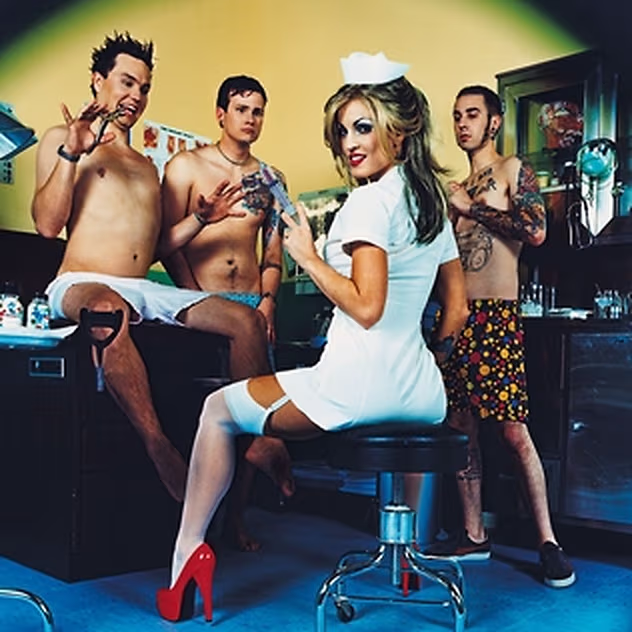
The blue glove is not an accident. Goldman has explained that he came up with it precisely because the album was, until almost the last minute, going to be called Turn Your Head and Cough, and a snapping rubber glove was the obvious visual gag. The detail that has become folklore, though, is the red cross. On the very first pressing, Lindemulder's cap carried a bold red cross and the band's name used a capital B. A second version kept the cross but switched to the preferred lowercase b. Then the American Red Cross intervened, pointing out that the red-cross emblem is legally protected under the Geneva Conventions as a marker of medical and humanitarian neutrality, and that a pop-punk band did not qualify. The cross was removed, leaving the plain white cap seen on the version most fans own, the one reproduced at the top of this page. In some territories the artwork was censored further, with clothing painted over the band on the back cover and Lindemulder's cleavage covered.
Release and Reception
Enema of the State entered the Billboard 200 at number 9, selling around 109,000 copies in its first week, a strong but not earth-shattering debut. What happened next was the slow burn. Driven by relentless airplay and MTV rotation, the album simply refused to leave the chart, going platinum in the United States by October 1999, triple platinum by January 2000 and five-times platinum by February 2001. It reached the top ten across much of the world, number 2 in New Zealand, number 4 in Australia, number 5 in Italy, and eventually sold an estimated 15 million copies globally.
Critics in 1999 were warmer than the band's clown reputation might have led you to expect. The New York Times made it an Album of the Week. Reviewers who came to mock often left admitting the songs were better than they had any right to be.
- AllMusic's Stephen Thomas Erlewine called it "a fun record that's better than the average neo-punk release".
- Rolling Stone's Neva Chonin found it "harmless, but still gnarly enough to foment the kind of anti-everything rebellion" teenagers crave.
- Billboard's Paul Verna praised it as "short, to the point, and bristling with attitude".
- Kerrang! reckoned there was "enough energy, attitude and cracking songs here to ensure that Blink will be remembered for more than just onstage nudity".
It was not universal. NME's Stevie Chick was scathing, dismissing the record as "wholly toothless and soulless" and the band as "an imitation of a comedy act", a fair summary of the snobbery Blink spent years pushing against. Retrospect has been kinder than almost anyone in 1999 would have predicted, and the album now sits near the top of every serious pop-punk canon.
Singles and Music Videos
| Single | Released | US Hot 100 | US Modern Rock | UK | Video director |
|---|---|---|---|---|---|
| What's My Age Again? | 13 April 1999 | No. 2 | No. 17 | Marcos Siega | |
| All the Small Things | 28 September 1999 | No. 6 | No. 1 | No. 2 | Marcos Siega |
| Adam's Song | 14 March 2000 | No. 2 (Alternative) | Liz Friedlander |
The videos did at least as much work as the songs. "What's My Age Again?" put the band's reputation front and centre: directed by Marcos Siega, it shows Hoppus, DeLonge and Barker running naked through Los Angeles, with Lindemulder appearing again as a nod to the cover. The trick, as Hoppus has cheerfully admitted, was that the streaking was mostly an illusion. "The scene with the butt shots, when we were running down the street, were actually the only real nude scenes," he said. "We wore skin-coloured Speedos for most of the scenes, and when we were running, I realised how unattractive male genitals are."
"All the Small Things" was the masterstroke. Siega built the video as a frame-by-frame parody of the boy-band and teen-pop clichés saturating MTV at the time, sending up the Backstreet Boys, NSYNC, 98 Degrees, Britney Spears and Christina Aguilera, complete with a beach, a slow-motion wind machine and synchronised choreography the band could barely perform. It was shot on 5 and 6 August 1999 at Van Nuys Airport and Santa Monica State Beach. It became a Total Request Live fixture and won Best Group Video at the 2000 MTV Video Music Awards. The irony, as Siega himself later noted, is that mocking the pop world is exactly what dragged Blink into it.
"In some ways, I think that video put Blink at that sort of pop level with those other bands. We were making fun of them, but it kind of became the thing it was making fun of."
Marcos Siega, video director
"Adam's Song", directed by Liz Friedlander, was the sober counterweight, a straight performance-and-narrative piece befitting the song's subject. Its release in March 2000 would shortly be overtaken by a real-world tragedy, dealt with in the next section.
Touring and Live
Blink-182 took Enema of the State on the road almost immediately and never really stopped. The Loserkids Tour, running from late October to late November 1999 across the United States and Canada, was their first proper arena outing, a remarkable jump for a band that had been playing clubs eighteen months earlier. The following year's Mark, Tom and Travis Show tour leaned into the band's self-aware humour, staging shows like a drive-in movie complete with a retro billboard and projected films, and the trio added festival slots including Reading and Leeds in August 2000.
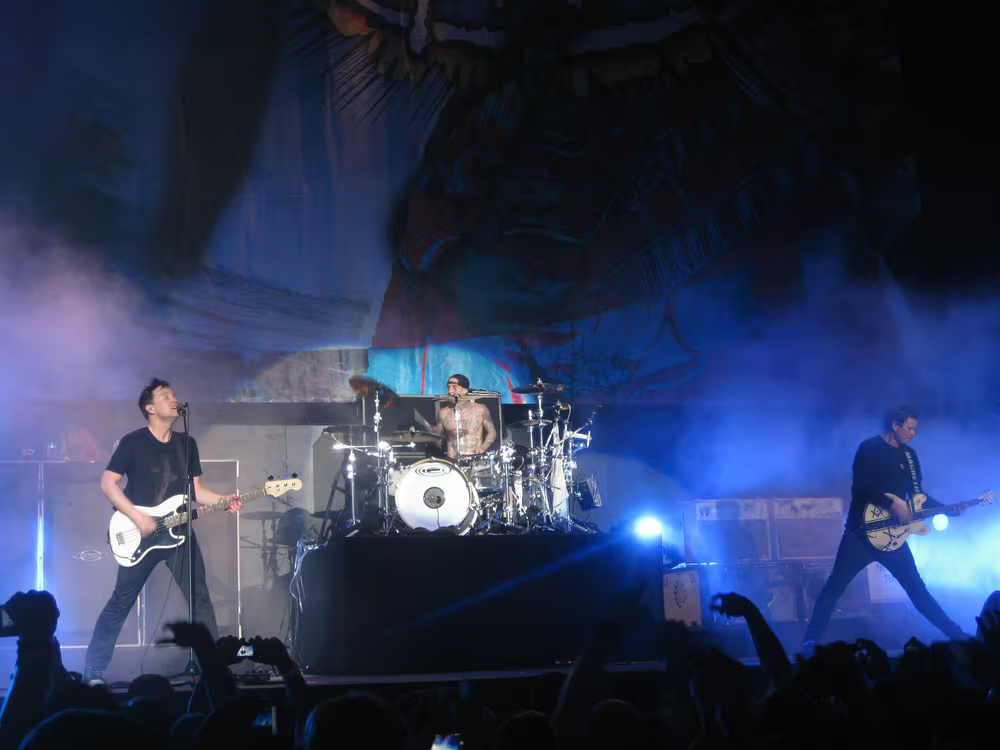
The live document of this period is The Mark, Tom, and Travis Show (The Enema Strikes Back!), released in November 2000 and recorded across two Californian shows on 4 and 5 November 1999, at the Bill Graham Civic Auditorium in San Francisco and the Universal Amphitheatre near Los Angeles. It captures the between-song filth in full, and includes the finally-finished "Man Overboard" as its one studio track. The touring cycle was not without incident; at one point Barker broke a finger, and Damon DeLapaz of support band Fenix TX stepped in to cover drums so shows could go ahead.
Two decades later, the album was important enough to anchor a 2019 anniversary tour on which the band, with Matt Skiba covering DeLonge's parts, played Enema of the State in full, a level of reverence usually reserved for records nobody once thought of as disposable.
In TV, Film and Media
The album is permanently entangled with one film in particular. American Pie, released in July 1999, used "Mutt" on its soundtrack and gave the band a brief on-screen cameo as the act playing on a webcam during the film's most notorious scene. The cameo lasts under half a minute, and the film's credits managed to misattribute the band twice, crediting "Mutt" to a misspelled "Travis Barkor" in one place and to former drummer Scott Raynor in another. The two cultural artefacts, the album and the movie, defined the same late-1990s suburban teenage moment so completely that they have been bound together ever since.
Beyond that, the singles have had a long afterlife in advertising, sports arenas, television and film, with "All the Small Things" in particular becoming one of those songs, alongside "Mr. Brightside", that an entire generation will still sing at full volume in any bar that plays it.
Controversy and the Adam's Song Tragedy
The lightest controversies were the obvious ones: the parental-advisory filth, the nudity, the Red Cross legal tangle over the cover. The heaviest was something the band never wanted any part of. In May 2000, a seventeen-year-old named Greg Barnes, a Columbine High School student who had survived the previous year's massacre and lost a close friend in it, took his own life with "Adam's Song" reportedly playing on repeat. Hoppus, who had written the song as an explicitly anti-suicide message, was devastated. He later described the moment he found out.
"I was actually out shopping, and management called me up and told me the story of what happened, and I was like, 'But that's an anti-suicide song.'"
Mark Hoppus, MTV News, 2001
The episode has stayed with Hoppus, and it complicated the band's reputation in a way that, for all the dick jokes, ultimately deepened it. "Adam's Song" remains one of the most-cited pieces of evidence that Blink-182 were always more than a comedy act, and the band have continued to talk about mental health in connection with it for the rest of their career.
Covers, Samples and Tributes
The album's songs, "All the Small Things" especially, have been covered endlessly, from acoustic singer-songwriter readings to full lullaby renditions aimed at parents who grew up on the record and now play it to their kids. Tribute compilations devoted to the album exist, and the songs have been interpolated and reworked in countless live medleys. Years later the band themselves revisited the material in unexpected ways, including a mash-up audio release pairing "What's My Age Again?" with a Lil Wayne track. The broader tribute, though, is structural rather than musical: the sheer number of bands who built careers on the chassis this album designed.
Reissues and Anniversaries
Unlike many records of its stature, Enema of the State has not been buried under a mountain of super-deluxe box sets, partly a function of how little unreleased material exists. It has been kept in print on vinyl across numerous coloured-wax variants, including limited clear, red-and-white split and other pressings tied to its milestone anniversaries. The most significant commemoration was the 2019 twentieth-anniversary tour, on which the album was performed start to finish, rather than a lavish archival reissue. For a record made quickly and cheaply on tape, with barely a scrap left over, the live full-album performance has arguably been the truest form of celebration.
Legacy and Influence
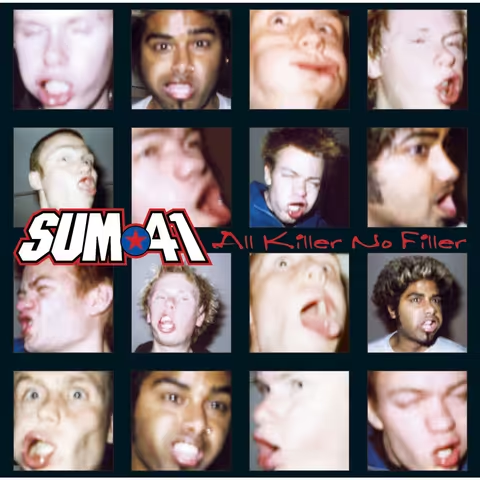
It is hard to overstate how completely Enema of the State reset the commercial ceiling for pop-punk. Within a couple of years the airwaves and the MTV countdown filled with bands working directly from its blueprint, Sum 41, Simple Plan, New Found Glory, Yellowcard, and a little later the emo-pop wave of Fall Out Boy and Panic! at the Disco. Critics have compared its generational impact to Nevermind, not in sound but in function: the record that told a million teenagers that this was a band they could start themselves.
"Many indie bands evolved not from Velvet Underground or Sonic Youth, but Smash, Dookie, or Enema of the State, records that served as beginner's manuals."
Ian Cohen, Pitchfork, 2014
The accolades piled up in retrospect. Rolling Stone placed it at number 2 on its 50 Greatest Pop-Punk Albums, Kerrang! and Rock Sound both crowned it the genre's best ever, and Loudwire ranked it number 2 on its own pop-punk list. The cover, that grinning nurse, has appeared on multiple "greatest album covers of all time" rundowns. For the band, it was the launch pad for an even bigger album, 2001's Take Off Your Pants and Jacket, which debuted at number one, and for a career that has run, with detours and reunions, into the present.
Hoppus, looking back, has located the band's essence in this specific record rather than any of the more ambitious ones that followed.
"It's the heart of Blink-182's musical sensibilities, its simplicity, its purity, its singularity of purpose between the three of us."
Mark Hoppus, 2013
There is a sadness threaded through the legacy too. Jerry Finn, the producer who did as much as anyone to make this sound possible, went on to helm three more Blink records before he died in 2008 at just thirty-nine, following a brain haemorrhage. The cleanest, biggest, most enduring version of pop-punk that ever reached a stadium owes an enormous and under-acknowledged debt to him.
Things You Might Not Know
| Fact | Detail |
|---|---|
| The Geneva Conventions cover | The American Red Cross forced the band to remove the red cross from the nurse's cap, because the emblem is legally protected and a pop-punk band is not a recognised medical or humanitarian body. |
| The glove explained | The blue surgical glove exists because the album was nearly titled Turn Your Head and Cough; photographer David Goldman built the gag around that working title. |
| Eight-hour drums | Travis Barker reportedly tracked the bulk of his drum parts in around eight hours at Mad Hatter, playing live with no headphones and no click track. |
| Chick Corea's studio | Mad Hatter, where those drums were cut, is owned by the jazz-fusion pianist Chick Corea, an unlikely birthplace for a pop-punk landmark. |
| Forty-five-minute audition | Barker is said to have learned Blink's entire twenty-song set in roughly 45 minutes before his first gig with the band in 1998. |
| A renamed single | "What's My Age Again?" was originally called "Peter Pan Complex" until MCA decided the reference was too obscure and changed it over the band's objections. |
| A happy accident | The intro to "What's My Age Again?" came from Hoppus misplaying Green Day's "J.A.R." on guitar and preferring his mistake to the original. |
| Jellyfish on a punk record | The keyboards were played by Roger Joseph Manning Jr. of the cult power-pop band Jellyfish, a surprising hand on a record built around three chords. |
| The oldest song | "Mutt" carries a writing credit for former drummer Scott Raynor and existed in an earlier form recorded for the 1998 film The Show. |
| Speedos, not skin | The naked running in the "What's My Age Again?" video was mostly skin-coloured Speedos; only the rear shots were genuinely nude. |
| Credited twice, wrongly | The American Pie credits misattributed "Mutt" both to a misspelled "Travis Barkor" and to ex-drummer Scott Raynor. |
| Mr. Show origins | According to Barker's memoir, the title "Adam's Song" came from a sketch on the comedy series Mr. Show about a band whose song urges a fan to kill himself, flipped into something sincere. |
| Analogue, not Pro Tools | Unlike the band's later albums, Enema of the State was recorded to analogue tape, which is a big part of why it still sounds like a live band. |
The Riffology Podcast
Pull Enema of the State apart and you find the same paradox in every groove: a band that wanted, more than anything, to make you laugh, who accidentally made one of the most important rock records of their generation while doing it. Thirty-five minutes, three singles, one nurse and a brand-new drummer who could play anything, and an entire genre changed shape behind them. The Riffology podcast digs into records exactly like this one, the albums that mattered more than anyone expected, and you can find every episode wherever you get your podcasts. Subscribe, turn it up, and try not to think too hard about how unattractive male genitals are.
Comments