
The double-platinum debut and the trap of being known as "the Bon Jovi guys"
When Skid Row walked into pre-production for their second album in the autumn of 1990, they did so as one of the most commercially successful hard rock debuts Atlantic Records had on its roster. Their self-titled 1989 first album had been pushed to double platinum status in the United States on the back of two enormous singles, "18 and Life" and "I Remember You". The pair of ballads had soundtracked the back half of 1989 on MTV and rock radio, and had pulled Sebastian Bach, Dave Sabo, Scotti Hill, Rachel Bolan and Rob Affuso out of the New Jersey club circuit and onto arena stages around the world.
The trouble, as Sabo and Bolan saw it, was the asterisk that accompanied every press write-up. Dave "The Snake" Sabo had grown up around the corner from Jon Bon Jovi in Sayreville, New Jersey, and had briefly been a member of the pre-fame Bon Jovi line-up before Richie Sambora arrived. When Skid Row needed a manager and a leg-up onto a major label, it had been Bon Jovi who effectively cleared the runway, taking the younger band out as support on the New Jersey Syndicate Tour from 1989 into 1990 and helping broker the Atlantic deal. By the time the dust settled on the debut album campaign, the music press had locked onto the Bon Jovi connection as a defining frame. Skid Row were "the Bon Jovi proteges", or worse, the "Bon Jovi associates", language that pinned them into the safe, sing-along, pop-metal half of the late 1980s rock spectrum.
Inside the band, that was the wrong half. Bolan was a punk obsessive whose record collection ran through the Ramones, the Sex Pistols and Judas Priest as readily as it did Aerosmith. Bach had been raised on Kiss and the New Wave of British Heavy Metal. The songs they had been writing in dressing rooms and tour buses across 1990 were not ballads or summer-radio singles; they were faster, angrier and considerably louder. The second album, they decided early, was going to be the one that put the Bon Jovi comparisons in a coffin and nailed the lid shut. The working title was crude, blunt and openly hostile to the music industry treadmill that had produced it. They were going to call the record Slave to the Grind.
The New Jersey writing sessions and Michael Wagener's return
Most of the writing happened in a low-ceilinged rehearsal room in central New Jersey across the latter half of 1990, with Sabo and Bolan working as the principal writing axis exactly as they had on the debut. The pair would arrive with riffs and skeleton arrangements, the rhythm section would knock them into shape and Bach would take cassette tapes home to write top lines and lyrics. The notable difference second time around was the speed. Songs such as the title track, "Riot Act" and "Get the Fuck Out" came together as short, blunt, deliberately aggressive pieces with little interest in radio formatting. Even the slower material, "In a Darkened Room" in particular, was darker in subject matter than anything on the first album.
When the time came to choose a producer, the decision was straightforward. Michael Wagener, the German engineer-turned-producer who had cut his teeth alongside Accept in the 1970s and gone on to engineer or produce records for Dokken, Metallica, Ozzy Osbourne, Extreme and Alice Cooper, had produced Skid Row's debut and had emerged from those sessions on warm terms with the band. Crucially, Wagener was a heavy metal lifer whose instincts ran toward bigger guitars, drier drums and less polish than the Bruce Fairbairn or Bob Rock school that defined Bon Jovi-era pop metal. He was the producer most likely to translate Bolan's punk impulses and Bach's full-throated upper register onto tape without sanding them down.
Wagener committed to the project across late 1990 and early 1991, and the band began demoing the material with him as part of pre-production. Those demos turned out to matter more than anyone expected. The plan, as on most rock records of the era, was that the demos would be reference points for the studio masters. Reality was less obliging, as the title track would shortly demonstrate.
The two studios: New River in Fort Lauderdale and Scream in Studio City
The bulk of Slave to the Grind was tracked at New River Studios in Fort Lauderdale, Florida, a residential complex on the New River that had become a popular destination for hard rock acts looking to keep their bands away from the temptations of Los Angeles. Iron Maiden had worked there, as had Bon Jovi. The setup suited Skid Row. Affuso could build out a large drum sound in the main room, the two guitarists had space to track separate rigs without bleed and the band could lock themselves away from press and label politics for weeks at a stretch.
Additional work, including portions of the mixing and overdubs, took place at Scream Studios in Studio City in the San Fernando Valley, a room Wagener used frequently in this period. Riley J. Connell and Craig Doubet handled engineering and assistant engineering duties across the two locations. George Marino, the long-serving Sterling Sound mastering engineer in New York, was brought in to cut the masters. Bob Defrin handled art direction, working closely with Bach on the album packaging.
Wagener's approach was to record the band live where possible. Rhythm guitars were doubled rather than quadrupled to keep the low mid-range open for Bolan's bass, which sits noticeably higher in the Slave to the Grind mix than it had on the debut. Affuso's kick and snare were tracked dry, with reverb added at mixdown rather than printed to tape. Bach tracked his lead vocals quickly, often nailing keepers in one or two passes; his upper register, which had matured noticeably in the two years since the debut, gave Wagener material to work with on tracks such as "Quicksand Jesus" and "In a Darkened Room" that the first album simply did not contain.
The title track demo that became the master
The single strangest production story on the album concerns its title track. "Slave to the Grind" had been written by Sabo, Bolan and Bach in New Jersey as a short, fast, almost speed-metal piece, with a Sabo riff that hammered in unison with Bolan's bassline and a Bach vocal that ran high and tight against the top of his range. As part of pre-production, the band cut a demo with Wagener to capture the arrangement.
The demo, by all accounts, was electric. When the band tried to re-cut the song properly during the album sessions, they could not match it. Multiple takes were attempted in Fort Lauderdale and reportedly at Scream as well; each one was technically tidier than the demo and considerably less alive. Eventually, Wagener and the band made the call to bin the studio masters and use the original demo as the album version. It is the take that sits in the sequence at track two on every pressing of Slave to the Grind that has ever been issued.
Wagener has recalled the session in interviews, saying the title track was recorded and mixed in roughly an hour during pre-production and that the band placed it on the album as it was, without remixing.
Michael Wagener, Blabbermouth.net, 2015
Bach confirmed the story in a February 2017 conversation on Yahoo Music's Backspin series, noting that the rough vocal he had laid down expecting to redo later had been the take that ended up on the master, and that he had never improved on it in the studio. For a record that the band were openly trying to engineer as a statement of seriousness, the centrepiece track was, in effect, a happy accident captured in a demo session.
The David Bierk cover painting and the Caravaggio reference
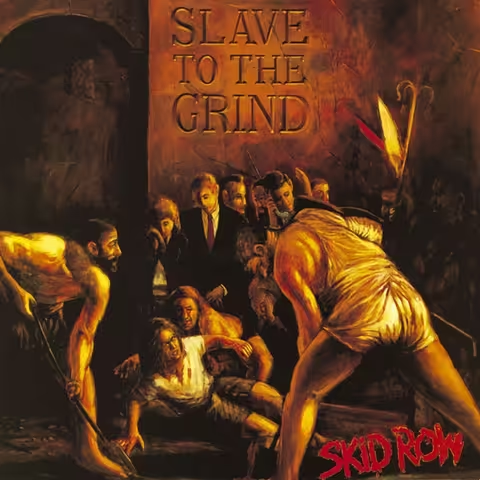
The sleeve of Slave to the Grind is one of the more unusual pieces of art attached to a 1991 hard rock album, and it is unusual partly because it is not really an album cover at all. It is a section of a long horizontal mural that wraps from the front of the original CD jewel case across the spine, around the back and into the interior booklet. The painter was David Bierk, a Canadian artist who had spent the 1970s and 1980s building a substantial fine-art reputation working in a representational style heavily indebted to the European old masters. Bierk was also Sebastian Bach's father.
Bach had grown up watching his father paint and had been pushing for an album sleeve that would feel more like a piece of gallery work than a rock-and-roll product. Bierk's response was a composition openly modelled on Caravaggio's 1608 oil painting "Burial of St. Lucy", which hangs in the church of Santa Lucia alla Badia in Syracuse, Sicily. Bierk borrowed the painting's vertical composition of huddled mourners, its dark earth-tone palette and its sense of crowded, lower-ground perspective, and reworked the scene as a medieval-era street populated by figures whose clothing and posture belong to the 1600s but whose hands carry televisions, telephones and other modern technology. The visual argument is straightforward: humanity has changed surface and ornament across the centuries, but the underlying condition of being a slave to the grind has not. Hidden in the crowd, for those who go looking, is a likeness of John F. Kennedy.
The full mural appears in its entirety only across the gatefold of the original vinyl issue and the inside spread of the CD booklet. The version most fans came to know is the cropped square that appears on the front of the CD, with the band name and album title rendered in a serif gold typeface that would have looked at home on an academic art monograph rather than a heavy metal record. The decision to lead with that image rather than a band photograph was deliberate. Skid Row did not appear on the front of their own record sleeve.
Monkey Business: the lead single and the album's opening statement
"Monkey Business" opens the record at track one and was released as the lead single on 3 June 1991, eight days ahead of the album. The song is a swaggering, mid-paced rock track built on a Sabo riff that rolls between a syncopated verse figure and a punchier chorus. Bolan's lyric trades the love-song scaffolding of "I Remember You" for a noir-ish urban narrative about a back-alley figure called the King; Bach delivers it with a snarl. Crucially, the song is heavier than anything Skid Row had released as a single from the debut, and that was the point. By choosing "Monkey Business" rather than one of the album's ballads as the opening salvo, the band and Atlantic were sending a deliberate signal that this campaign was not going to be a rerun of "18 and Life".
The accompanying video was directed in moody black and white with a noir framing that matched the song's lyrical concept, and went into heavy MTV rotation across the summer of 1991. "Monkey Business" reached the upper reaches of the Billboard Album Rock Tracks chart and provided the radio platform on which the album debut would land a week later. As an opening track on the album itself, it works as a thesis statement: heavier guitars, less obvious hook, more attitude.
The title track and the speed metal pivot
If "Monkey Business" was the signal, "Slave to the Grind" itself, sequenced at track two, was the proof. The song begins with Affuso's snare counting in on a near-blast tempo, Sabo and Hill firing a unison riff that sits closer to Megadeth than to Bon Jovi, and Bach attacking the lyric in a register that openly courts comparison with Rob Halford. The chorus locks into a single rhythmic figure repeated with mounting intensity. The whole thing is over in three minutes and thirty-one seconds and feels like an ambush.
It is in this track that the speed-metal pivot of the album is most visible. Skid Row had not become a thrash band overnight; the rest of the record is rooted in mid-paced hard rock. But the title track established a ceiling for the band's heaviness that they would keep working at for the rest of their career, and that contemporaries from Mötley Crüe to Warrant simply did not aim for. The video for the song was filmed live in a warehouse setting with hand-held cameras to match the song's energy. Atlantic, anxious about how the new direction would play on MTV, requested at one point during production that the band feature a bikini-clad model alongside them in the clip. The band refused on the basis that the song was about drudgery and exploitation, not female sexuality. The video shipped without one.
Quicksand Jesus, Psycho Love and the lyrical reach
The second album is, in part, the record on which Skid Row tried to prove that they could write about something other than girls and the road. The clearest example is "Quicksand Jesus", a Sabo and Bolan composition placed fourth on side one and built on a slow, descending chord progression that gives Bach room to deliver one of his most controlled vocal performances on the record. The lyric is a meditation on faith, doubt and the temptation to keep believing in something you know is failing; the title is a metaphor for organised religion as ground that gives way the moment you stand on it. Atlantic clearly recognised the song's importance, releasing it as a Japan-only single in May 1992 with its own music video. Among fans, it remains one of the most highly regarded deep cuts on the album.
"Psycho Love", written solely by Bolan, sits in the middle of side one and pushes the lyrical envelope in a different direction, dealing with obsessive, predatory attraction in language that is significantly more uncomfortable than anything on the debut. Musically, the song is built around a sliding Bolan bass figure that drives the verses, with Hill and Sabo trading clean and crunching guitar parts in the chorus. A 3D video for the song was filmed and featured later on the Road Kill home video release, complete with a pair of 3D glasses tucked into the packaging. Together, "Quicksand Jesus" and "Psycho Love" demonstrated a lyrical reach that the band were not given full credit for at the time.
Get the Fuck Out and the clean-edition compromise
Track six is "Get the Fuck Out", a two-minute and forty-two-second blast of Sabo and Bolan punk-metal that takes its title and chorus from a profane kiss-off to a one-night stand. It is intentionally crude, intentionally short, and represents the album's clearest debt to Bolan's punk record collection. In 1991, it was also commercially radioactive. A growing number of American retailers, led by Walmart, refused to stock albums that carried the Recording Industry Association of America's parental advisory sticker.
Atlantic's response, with the band's reluctant agreement, was to issue a second pressing of the album under what became known as the "clean version". The track listing was identical except for track six, where "Get the Fuck Out" was replaced by a new song titled "Beggar's Day", credited to Sabo, Bolan and Bach and running four minutes and five seconds. "Beggar's Day" was not a sanitised remake; it was a different song entirely, a moodier mid-tempo track that fit the running order in length but bore no relationship to the song it replaced. The clean pressing carried no parental advisory sticker and was the only version Walmart and several large American chains would stock. Both pressings continued to sell in parallel for the lifetime of the campaign.
Wasted Time and In a Darkened Room: the ballads that anchor side two
For all the talk of heaviness, two of the most enduring songs on Slave to the Grind are slow ones. "Wasted Time", the album closer at track twelve, is a five-minute and fifty-second elegy written by Sabo, Bolan and Bach for a friend lost to heroin addiction. The arrangement opens with a clean Sabo guitar figure and an Affuso brushed backbeat, builds through a controlled Bach vocal in the verses to a heavier chorus, and resolves into a long, mournful guitar solo. It is the most ambitious piece of long-form ballad writing the band ever attempted and was released as the album's third single on 11 November 1991, with a black-and-white video that became one of the band's most-played MTV clips through the winter of 1991 and into 1992.
"In a Darkened Room", placed at track nine, is the album's other slow centrepiece. Also written by Sabo, Bolan and Bach, the song deals obliquely with childhood abuse and trauma; the lyric is one of the most uncomfortable Skid Row ever recorded and Bach's delivery is correspondingly restrained. It was released as the fourth single in November 1991. Trivia collectors note that the original album's inner sleeve printed the song's running time as 4:57, a misprint; the actual song clocks in at 3:57. Together with "Wasted Time", "In a Darkened Room" gave the campaign two slow singles to balance the heavier material on the rock-radio side and ensured that the album held an MTV presence through the winter long after the title track had cycled off.
The deep cuts: The Threat, Livin' on a Chain Gang, Creepshow, Riot Act and Mudkicker
The album's five remaining tracks are the deep cuts that round out the running order and demonstrate the consistency of the songwriting. "The Threat", at track three, is a Sabo and Bolan stomper that doubles down on the album's social-frustration theme. "Livin' on a Chain Gang", a Sabo and Bolan track at position seven, plays with chain-gang imagery as a metaphor for working life and rolls on a swaggering main riff that became a live-set favourite. "Creepshow", credited to Bolan, Hill and Affuso and placed at track eight, is one of only two songs on the album not co-written by Sabo and is built around a darker, almost Pantera-adjacent verse riff with Bach pushing into a harder upper register over the choruses.
"Riot Act" at track ten is the shortest piece on the record at two minutes and forty-two seconds, an unapologetic punk-metal blast that drops virtually all hard rock convention in favour of speed and venom. It is the song that contemporary reviewers most often cited as evidence of the band's punk and thrash influences breaking through. "Mudkicker" at track eleven, co-written by Bolan, Hill and Bach, is a strutting, swampy mid-tempo rocker that gives Hill room to extend in the solo section and acts as a deliberately bluesier counterweight before "Wasted Time" closes the record. Together, these five tracks are the connective tissue that turns the album from a singles-plus-filler proposition into a coherent twelve-track sequence.
Release week: the first heavy metal record to debut at number one in the SoundScan era
Slave to the Grind shipped to American retail on 11 June 1991 and entered the Billboard 200 the following week at number one with first-week sales of 134,000 copies. The figure mattered less than the structural fact behind it. May 1991 had been the moment that Billboard switched its album chart over to Nielsen SoundScan, the point-of-sale tracking system that for the first time counted actual scanned sales rather than rough estimates phoned in by retail managers. SoundScan had immediately rewritten the chart's relationship with hard rock and country, both of which were systematically undercounted under the old system. Skid Row's debut at the top of the new chart was the first heavy metal album to enter the Billboard 200 at number one under the SoundScan methodology, and only the third album in chart history at that point to debut at number one full stop, after Elton John's Captain Fantastic and the Brown Dirt Cowboy in 1975 and Michael Jackson's Bad in 1987.
The chart performance internationally tracked the United States result. The album reached number five in the United Kingdom on the Albums Chart, number three in Australia on the ARIA chart, number five on Canada's RPM chart, number three in Finland and on Japan's Oricon chart, number eight in New Zealand, number nine in Sweden, number twelve in Germany and Norway, number fifteen in Switzerland and number sixteen in Austria, with a peak of number thirty-two in Hungary later in the campaign. Certifications followed in due course. The Recording Industry Association of America certified the album two times Platinum in 1998 for shipments of two million copies in the United States. Music Canada certified it Platinum. The RIAJ in Japan and the ARIA in Australia both certified Gold. The British Phonographic Industry certified Silver.
The Use Your Illusion tour, Pantera and Soundgarden in support
Skid Row's touring cycle for Slave to the Grind began the day the record went on sale and ran into the following year. The opening leg was the most high-profile booking the band would ever take. They were named as the opening act on the North American leg of Guns N' Roses' Use Your Illusion Tour, riding alongside Axl Rose and company through the summer and autumn of 1991 as the tour cycled through arenas and stadiums in support of Use Your Illusion I and Use Your Illusion II. The exposure was massive. Crowds of fifteen and twenty thousand a night, on a bill where Skid Row were the only support, gave the band an arena-headliner reach that they could not have approached on their own.
In early 1992 they took the campaign over to their own headline production, the Slave to the Grind Tour, which played theatres and arenas across North America and Europe. The choice of support acts for that tour spelled out the company Skid Row now considered themselves to keep. Pantera, who had just released Vulgar Display of Power and were beginning the run that would make them the most important groove-metal band of the decade, were on the bill. So were Soundgarden, then a year away from Superunknown. For a band still routinely described in the late 1980s as a Bon Jovi-affiliated glam-metal act, sharing a stage every night with Pantera and Soundgarden in 1992 was an unambiguous statement about which side of rock's coming reorganisation Skid Row intended to sit on.
Press, controversy and the Atlantic relationship
Critical reception in 1991 split largely along the lines anyone might have predicted. Steve Huey at AllMusic eventually settled at four and a half stars out of five, describing the record as more aggressive than its predecessor and as one of the better mainstream hard rock and heavy metal albums of its moment. Brenda Herrmann in the Chicago Tribune gave it three and a half out of five, praising the Sabo and Bolan writing partnership and the band's sense of humour. Janiss Garza in Entertainment Weekly went to A-minus, singling out the ballads' lyrical depth and the fury of "Riot Act" and the title track. Ray Zell awarded four out of five in Kerrang!. Daina Darzin in Spin praised the album's integrity and passion and compared it favourably with early Mötley Crüe and Judas Priest. Martin Popoff, writing later in The Collector's Guide to Heavy Metal Vol 3, gave it nine out of ten and called it a surprising and welcome jolt to the system.
Not everyone agreed. David Fricke at Rolling Stone settled at three out of five, complimenting Wagener's production and the band's interplay but arguing that the lyrics had not matured to match the playing. Robert Christgau, true to form, marked the record as a "dud". The harshest review of all came from Mary Anne Hobbs in NME, who handed the band one out of ten and dismissed them as "Skid Markers". The disparity between Hobbs's score and Popoff's was as wide as critical reaction to a single album got that year.
The relationship with Atlantic was rather more delicate than the chart numbers suggested. The label had been openly nervous about the heavier direction during pre-production, the bikini-model argument during the title-track video shoot was only the most visible symptom of that nervousness, and the requirement for a separately pressed clean edition spoke to the commercial realities the label was managing. To the band's credit, they pushed back hard enough on each of those fronts that the record they released was substantively the record they had wanted to make. The number one debut and the platinum certifications gave them, briefly, the leverage to ensure the next round of arguments would be conducted from a stronger position.
The legacy: Sebastian Bach's exit, the reissue cycle and the album's place in 1991 rock
The two albums that followed Slave to the Grind, the punk-covers EP B-Side Ourselves in 1992 and the full-length Subhuman Race in 1995, would extend the heavier direction further still. By 1996, however, the relationship between Bach and the rest of the band had broken down beyond repair. He was dismissed from the group at the end of that touring cycle and never returned, and Skid Row's second life with subsequent vocalists has run on a much smaller commercial scale ever since. That break makes Slave to the Grind, in retrospect, the high-water mark of the original line-up's recorded output. The arc from the 1989 debut to the 1995 third album is the arc of a band that was tightening, hardening and getting better, and Slave to the Grind sits at the peak of that arc.
The album has remained continuously in print through Atlantic and then Rhino reissues. A 30th Anniversary edition was issued for the 2021 milestone, expanding the original twelve-track sequence with bonus material drawn from the period: a studio cover of the Sex Pistols' "Holidays in the Sun" credited to all four songwriters, a live "Get the Fuck Out" recorded at Wembley Stadium during the Guns N' Roses support run in 1991, and a live "Delivering the Goods" Judas Priest cover recorded in Arizona in 1992. The clean-edition substitute "Beggar's Day" continues to surface on compilations, and "Quicksand Jesus" has periodically been added to anthology pressings.
Held against the wider rock landscape of 1991, Slave to the Grind occupies a particular niche. It arrived in June, ahead of the September release of Nirvana's Nevermind, the August release of Metallica's Black Album and the August release of Pearl Jam's Ten, and a few months ahead of the autumn arrival of Use Your Illusion I and Use Your Illusion II. By the end of that calendar year, the centre of gravity in mainstream rock had visibly shifted; the bands that would define the next half-decade were either established or arriving. Skid Row's record sits in that landscape as one of the very last hair-metal-era debuts to hit number one before the floor moved, and as a record that, by leaning hard into its heavier instincts, gave its makers a longer afterlife in the post-1991 rock economy than most of their late-1980s peers. The record that was supposed to bury the Bon Jovi associations did so. It did rather more than that besides.
Personnel
| Musician | Role |
|---|---|
| Sebastian Bach | Lead vocals |
| Dave "The Snake" Sabo | Guitars, backing vocals |
| Scotti Hill | Guitars, backing vocals |
| Rachel Bolan | Bass, backing vocals |
| Rob Affuso | Drums, percussion |
| Michael Wagener | Producer, mixing engineer |
| Riley J. Connell | Engineer |
| Craig Doubet | Assistant engineer |
| George Marino | Mastering engineer, Sterling Sound, New York |
| Bob Defrin | Art direction |
| David Bierk | Cover painting |
Tracklist
| # | Title | Writer(s) | Length |
|---|---|---|---|
| 1 | Monkey Business | Sabo, Bolan | 4:20 |
| 2 | Slave to the Grind | Sabo, Bolan, Bach | 3:31 |
| 3 | The Threat | Sabo, Bolan | 3:52 |
| 4 | Quicksand Jesus | Sabo, Bolan | 5:26 |
| 5 | Psycho Love | Bolan | 3:58 |
| 6 | Get the Fuck Out | Sabo, Bolan | 2:42 |
| 7 | Livin' on a Chain Gang | Sabo, Bolan | 4:00 |
| 8 | Creepshow | Bolan, Hill, Affuso | 3:59 |
| 9 | In a Darkened Room | Sabo, Bolan, Bach | 3:57 |
| 10 | Riot Act | Sabo, Bolan | 2:42 |
| 11 | Mudkicker | Bolan, Hill, Bach | 3:56 |
| 12 | Wasted Time | Sabo, Bolan, Bach | 5:50 |
Things you might not know
| Fact | Detail |
|---|---|
| The title track is a demo | The album version of "Slave to the Grind" is the pre-production demo. The band tried to re-cut it during the main sessions and could not match the original take, so Wagener and the band placed the demo on the master. |
| An hour to tape | Wagener has said in interviews that the title track was recorded and mixed in roughly an hour and added to the album without being remixed. |
| Caravaggio on the cover | David Bierk's painting for the front sleeve takes its composition from Caravaggio's 1608 oil "Burial of St. Lucy" in Syracuse, Sicily, reworked as a medieval street scene populated by figures using modern technology. |
| JFK in the crowd | A likeness of John F. Kennedy is hidden among the figures in Bierk's painting for fans willing to look closely at the full mural across the gatefold. |
| Bach's father painted the sleeve | David Bierk was a Canadian fine artist with a substantial gallery reputation. He was also Sebastian Bach's father. |
| The bikini fight | Atlantic asked the band to feature a bikini-clad model in the title-track video. The band refused on the basis that the song was about drudgery, not female sexuality. |
| Two album versions exist | A clean pressing replaces "Get the Fuck Out" with a different song titled "Beggar's Day", credited to Sabo, Bolan and Bach. It was created so that retailers refusing parental-advisory product could still stock the record. |
| Third ever number-one debut | At its release, Slave to the Grind was only the third album in Billboard 200 history to debut at number one, after Elton John's Captain Fantastic and the Brown Dirt Cowboy in 1975 and Michael Jackson's Bad in 1987. |
| A liner-note typo | The original inner sleeve prints the running time of "In a Darkened Room" as 4:57. The song actually runs 3:57; the printed figure has been carried into later reissues by mistake. |
| Sabo's pre-fame Bon Jovi stint | Dave Sabo was briefly a member of the pre-fame Bon Jovi line-up in New Jersey, before Richie Sambora arrived. He and Jon Bon Jovi remained close friends, which is how Skid Row landed the support slot on the New Jersey Syndicate Tour. |
| Pantera and Soundgarden as support | For the 1992 headline Slave to the Grind Tour, Skid Row took both Pantera and Soundgarden out as support acts, a bill that telegraphed which direction the band's loyalties pointed by the year of Vulgar Display of Power. |
How to listen now
The standard twelve-track Slave to the Grind is available on every major streaming service, including Spotify and Apple Music, in its original 1991 running order with "Get the Fuck Out" intact at track six. The clean-edition "Beggar's Day" surfaces on a handful of digital compilations and on selected reissue pressings, and is worth seeking out as a curio.
For collectors, the 30th Anniversary deluxe edition issued through the original Atlantic and BMG infrastructure in 2021 is the most comprehensive package, adding the studio Sex Pistols cover and the period-correct Guns N' Roses tour live tracks to the original sequence. The original 1991 Atlantic vinyl pressing remains the best home for the David Bierk mural, which is reproduced at meaningful size across the gatefold and inner sleeve rather than thumbnailed onto a CD booklet. It turns up regularly on the second-hand market and is the format in which the album was intended to be viewed.

Comments