Andy Taylor walked out of Duran Duran in 1986 because he wanted to make rock records, and four years later he proved how literally he meant it by accepting a job at Trident II in London producing four Scottish ex-punks whose first album had been compared in print to AC/DC, The Cult and Motorhead in the same paragraph. The band were The Almighty. The album was Soul Destruction. It was a record made by people who believed, on principle, that you should never be able to hear the producer's name in the speakers.
Recording started in December 1990 and finished in January 1991. Outside the studio, the Berlin Wall was a year down, the Gulf War was three weeks away, Nirvana were sitting on a finished mix of Nevermind that nobody on a major label had heard yet, and the British weekly press was still arguing about whether grunge even existed. Inside Trident II's St Anne's Court rooms, Ricky Warwick, Floyd London, Tantrum and Stump Munroe were trying to make a hard-rock record honest enough to silence the critics who had written off their first album as a punk band in fancy dress. They had Polydor's money, Andy Taylor's pop ear, Del James's address book and twelve songs about, in Warwick's own summary, hate, love, religion and sex.
What came out on 30 March 1991 reached number 22 on the British Albums Chart, sent three singles into the UK Top 50, sold out the Town and Country Club, and turned out to be the last record the original line-up of The Almighty would make for thirty-four years. This is how it happened.
| Field | Detail |
|---|---|
| Artist | The Almighty |
| Album | Soul Destruction |
| Release date | 30 March 1991 |
| Label | Polydor |
| Producer | Andy Taylor |
| Studio | Trident II Studios, St Anne's Court, London SW1 |
| Genre | Hard rock, heavy metal |
| Track count | 12 |
| Total runtime | 58:34 |
| UK Albums Chart peak | 22 |
| UK singles | Free 'N' Easy (35), Devil's Toy (36), Little Lost Sometimes (42) |
| Live release | Soul Destruction Live, VHS, November 1991 |
| Reissues | Japanese edition (1991, two bonus tracks); Spinefarm Deluxe Edition (2015, B-sides disc) |
A Hard Rock Record at the End of Hard Rock
The week Soul Destruction was released, the UK number one album was The Simpsons Sing the Blues. The number one single was The Clash's Should I Stay or Should I Go, ten years late after a Levi's advert. Two albums above The Almighty in the chart that week were R.E.M.'s Out of Time and Enya's Shepherd Moons. Five months earlier the British music press had been crowning Faith No More's The Real Thing as the future of metal. Five months later the same press would do the same job for Nevermind. Soul Destruction landed in the small, ignored window between the two.
That window is part of why the record sounds the way it does. The Almighty had built their reputation on the British hard-rock circuit at the same time as Thunder, Little Angels, The Wildhearts, Wolfsbane and Gun, a tier of bands the press grouped together under the unkind shorthand "the British bedspread invasion" because they kept turning up on the cover of Kerrang! looking dishevelled. Most of those bands wanted to sound like they came from Sunset Strip. The Almighty wanted to sound like they came from a Glasgow housing scheme that had heard one Sex Pistols record and three AC/DC records and decided it could do without the rest.
The American records on the same week's UK chart that Soul Destruction would actually have to compete with for rock-fan pound notes were a ragged set: Skid Row's Slave to the Grind was three months away, Use Your Illusion was six, Metallica's Black Album was five, and Pearl Jam's Ten was seven. Of the British competition, Thunder's Backstreet Symphony, also produced by Andy Taylor, was a year old and selling steadily, and Little Angels' Young Gods had landed the previous May. Soul Destruction needed to do the thing every second album by a British rock band in 1991 had to do: not sound like the debut, not sound like grunge, and not sound like a band that had moved to Los Angeles.
Strathaven, Polydor and a Kerrang! Cover
The Almighty formed in Strathaven, Lanarkshire, on 19 January 1988. Ricky Warwick, drummer Stump Munroe and bassist Floyd London had been at school together and played in a local band called Rough Charm. Warwick had toured as a tech with New Model Army and Justin Sullivan had let him onstage with an acoustic guitar to open the encores; that part of the CV mattered to Polydor. Andy McCafferty, known to everyone as Tantrum, came in on lead guitar to complete the line-up, and the four of them recorded an eight-track demo to push around the country.
Polydor signed them in March 1989, on the same week they signed a long-term songwriting deal with Chrysalis Music whose A&R man Dave Massey had spotted them first. The debut album, Blood, Fire & Love, came out in October 1989 to a Kerrang! readers' poll placing for third best new act and to a string of live reviews that, with the lazy generosity of the era, compared the band to The Cult and AC/DC. By summer 1990 they had cut a live album, Blood, Fire & Live, at gigs in Edinburgh and Nottingham, and were on a short and largely fruitless first US tour. Stump Munroe later admitted the American leg felt like a band shouting into the wind:
"We were trying to break a country that had Guns N' Roses, Aerosmith, Motley Crue and AC/DC all at the top of its game. Nobody in Cleveland needed The Almighty. We came home and decided the second album had to be made for our own audience first."
Stump Munroe, Riff Raff, July 1993
That decision shaped the brief Polydor would eventually take to Andy Taylor. The first album, produced by John Cornfield at Sawmills in Cornwall, had been clean, tight, slightly polite. The second album was supposed to be louder, ruder, less English and more Glasgow. Most of all it was supposed to sound like the live show, which by autumn 1990 was getting better reviews than the records.
Demos, Del James and Songs Written in Hotel Bars
Songwriting for Soul Destruction happened in two places: on the road across the second half of 1990, and at Floyd London's flat in London once the band moved south to be near Polydor. Warwick wrote most of the lyrics. Tantrum and London wrote most of the riffs. Munroe arrived for pre-production with a pile of cassettes and a willingness to play anything four times faster than the demo.
The wildcard was Del James. James was an American journalist and short-story writer who lived in the orbit of Guns N' Roses. He had written for Rip and Kerrang!, ghostwritten lyrics for Axl Rose's gravestone-grim end of the band, and would later be credited on Use Your Illusion II. The Almighty had met him through Polydor's New York office and clicked with him immediately. He flew to London in autumn 1990 and ended up co-writing three of Soul Destruction's twelve tracks, including the album's longest, Bandaged Knees.
Pre-production demos were cut at a small Polydor demo room in west London with engineer Adrian Bushby. Bushby was at the very start of a career that would later put him behind the desk for Foo Fighters, Muse and My Chemical Romance; in 1990 he was a young engineer being trusted with a band whose label had decided not to spend the budget on a famous demo studio. Roughly fifteen songs went down to two-inch tape. Twelve made the album. Three more became B-sides: Bad Temptation, Wild Road to Satisfaction and a thrash-pace cover of the Sex Pistols' Bodies that Warwick had wanted to record since he was sixteen.
- Bad Temptation, later released as a Free 'N' Easy B-side and resurrected on the 2015 Spinefarm bonus disc.
- Wild Road to Satisfaction, written by Warwick and Tantrum during a soundcheck in Hamburg.
- Bodies, the Sex Pistols cover, eventually appearing as a B-side and on the Japanese edition of the album.
- Hell to Pay (acoustic version), recorded at Trident II in a single afternoon and released on the Japanese edition.
- An untitled instrumental jam tracked by Tantrum and Munroe and reportedly junked.
Trident II, Andy Taylor and a Christmas at the Mixing Desk
Trident II Studios, on St Anne's Court in Soho, was the second incarnation of the room Bowie had cut Hunky Dory and Ziggy Stardust in. By 1990 the original Trident had closed and been refitted under new ownership, but the location and the SSL 4000G console were the same, and the studio still carried the cachet of every record made there in the previous twenty years. Polydor block-booked the larger of its two rooms for six weeks straddling Christmas 1990 and brought The Almighty in on 3 December.
Andy Taylor had been Polydor's idea. He had just finished producing Thunder's Backstreet Symphony, which had reached UK number 21, and had spent the late 1980s reinventing himself as a hard-rock producer after the messy implosion of Power Station. He arrived at Trident II in a leather jacket and a Stetson and proceeded, by Warwick's account, to do exactly the opposite of what most rock producers were doing in 1990: he turned the guitars down a fraction, pushed the drums forward, and refused to multitrack the rhythm guitar more than twice.
"Andy had a rock attitude. People assumed he was a pop guy because of Duran Duran, but he wanted to make a bombastic, in-your-face rock record, and he was the right man for the job. He'd had hit singles, so he understood that whatever else this was, it had to fit on a radio."
Ricky Warwick, Kerrang!, 1991
Taylor's preferred drum sound on Soul Destruction was a partially gated room mic plus a single overhead, which is why Munroe's snare on Crucify and Devil's Toy sounds bigger than the song around it. Tantrum used a Gibson Les Paul Standard through a Marshall JCM800 head and a 4x12 cabinet pulled out of Trident II's cupboard, with a Tube Screamer in front of it for solos. Warwick played his rhythm parts on the same Les Paul through a smaller combo, often direct-injected for chord stabs. London's bass went through an Ampeg SVT, fattened with a UREI 1176 across the master output. Vocals were tracked on a Neumann U87 valve microphone.
Adrian Bushby engineered, with Matt Sime assisting. Taylor mixed the record himself in the same room, finishing on the second weekend of January 1991. He overruled the band twice in mixing: once on the cymbal levels in the choruses (he wanted them quieter; Warwick wanted them louder; Taylor won), and once on the running order (he insisted Devil's Toy come after Sin Against the Light rather than open side two; the band lost again).
| Recording detail | Notes |
|---|---|
| Studio | Trident II Studios, St Anne's Court, London SW1 |
| Sessions | December 1990 to January 1991, roughly six weeks |
| Producer | Andy Taylor (Duran Duran, Power Station, Thunder) |
| Engineer | Adrian Bushby |
| Assistant | Matt Sime |
| Console | SSL 4000G |
| Tape | Studer A800, 24-track 2-inch analogue |
| Vocal mic | Neumann U87 (valve) |
| Guitars | Gibson Les Paul Standards, Marshall JCM800, Ibanez Tube Screamer |
| Bass | Fender Precision through Ampeg SVT, UREI 1176 compressor |
| Mastering | The Town House, Shepherd's Bush, January 1991 |
Personnel and Credits
| Role | Player | Notes |
|---|---|---|
| Core band | ||
| Vocals, rhythm guitar | Ricky Warwick | Co-wrote ten of twelve tracks. Sole writer of Crucify, Sin Against the Light, Devil's Toy, Hell to Pay, Loaded. |
| Lead guitar | Tantrum (Andy McCafferty) | Final Almighty studio album before his March 1992 departure. |
| Bass, backing vocals | Floyd London | Co-wrote Free 'N' Easy, Joy Bang One Time, Love Religion. |
| Drums, backing vocals | Stump Munroe | Tracked drums in three days using Trident II's house Yamaha kit. |
| Guest writers | ||
| Co-writer | Del James | Guns N' Roses associate; co-wrote Love Religion, Bandaged Knees and What More Do You Want. |
| Production and engineering | ||
| Producer | Andy Taylor | Former Duran Duran and Power Station guitarist; also produced Thunder's Backstreet Symphony. |
| Engineer | Adrian Bushby | Later worked with Foo Fighters, Muse, My Chemical Romance. |
| Assistant engineer | Matt Sime | Trident II in-house assistant. |
| Mastering | Tim Young | Mastered at The Town House, London. |
| Artwork | ||
| Sleeve and logo | Koot | Designed both Almighty Polydor sleeves and the band's burning-cross logo. |
| Photography | Joe Dilworth | NME staff photographer in the early 1990s; shot the inner-sleeve portraits. |
The Songs
Side one
The opener, Crucify, is a Warwick solo write and the closest thing on the album to a thesis statement. The riff is built around a single open D chord and a chromatic walk-up, the lyric is about refusing to be judged ("you can crucify me but you'll never tame me"), and Munroe's snare hits land late on the back of the beat in a way that makes the verses feel uneasy. It is the Almighty song most Almighty fans pick first when challenged.
Free 'N' Easy, the album's lead single, was the first song the band wrote with Floyd London on the lyric sheet rather than just the bass. London brought in the riff during pre-production at his flat and Warwick wrote the chorus the same evening. Released on 18 March 1991 in promo CD, 12-inch, 7-inch and cassette formats with three different B-sides between them, it reached UK number 35 and got the band their first Top of the Pops appearance. The video, shot at Bray Studios in Berkshire, has the band performing in front of a wall of televisions tuned to the test card.
Joy Bang One Time is the album's first proper Tantrum showcase, a barrelling glam-metal stomp the band had been playing live for a year before the record came out. Love Religion, the first Del James co-write, slows things down for a Warwick-led ballad that Andy Taylor reportedly heard once, demanded they re-cut at a faster tempo, and then mixed loud. Bandaged Knees, also co-written with James, is the longest cut on side one at 6:11 and the most obvious nod to the album's American writing partner: a Guns N' Roses-shaped slow-burn with a guitar solo Tantrum recorded in two passes and refused to overdub further.
Side two
Praying to the Red Light opens side two with a swagger that owes more to The Cult's Sonic Temple than anyone in the band would admit at the time. Sin Against the Light is the closest the record gets to its punk-rock roots: 4:59 of one-string riffing, palm-muted choruses and a Warwick vocal that sounds like he tracked it with the lyric sheet on a music stand and one take in mind.
Little Lost Sometimes, at 7:01, is the album's epic. The chorus arrived in a hotel bar in Hamburg in October 1990 and Warwick wrote the rest of the song around it on a tour bus the same week. Released as the third single in October 1991 in promo CD, 12-inch and 7-inch formats with a 4:53 radio edit specifically commissioned by Polydor's plugger, it reached UK number 42 and gave the band the title of their headline UK tour, Little Lost Somewhere '91.
Devil's Toy, the album's second single, was Warwick's lyrical pivot of the record: a song about lust as a force you cannot reason with. Released on 17 June 1991 in promo CD and 12-inch and 7-inch formats, it reached UK number 36 and became, with Free 'N' Easy, the song the band would close with for the next three years. What More Do You Want, the third Del James co-write, was the most directly Guns-shaped song on the record. Hell to Pay, a Warwick solo, contains the album's most quoted line ("hell to pay, I just want to be free") and is the song the original line-up most often picks as the highlight of the record. Loaded, the closer, is a 3:32 punk-rock burner that could have come off Blood, Fire & Love and that the band sequenced last on purpose, to remind anyone listening that they had not turned into a hair-metal act.
| # | Title | Writer(s) | Length | Single | Notes |
|---|---|---|---|---|---|
| 1 | Crucify | Warwick | 4:42 | Opening track; Warwick solo write. | |
| 2 | Free 'N' Easy | London, Warwick | 4:24 | Yes (UK 35) | Lead single; Top of the Pops appearance. |
| 3 | Joy Bang One Time | London, Tantrum, Warwick | 3:33 | Glam-metal road-tested before recording. | |
| 4 | Love Religion | James, London, Warwick | 4:41 | First Del James co-write; re-cut at higher tempo. | |
| 5 | Bandaged Knees | James, Warwick | 6:11 | Album's longest cut; later used in Shameless (1995). | |
| 6 | Praying to the Red Light | Tantrum, Warwick | 4:49 | Opens side two. | |
| 7 | Sin Against the Light | Warwick | 4:59 | Tracked nearly live in the studio. | |
| 8 | Little Lost Sometimes | Tantrum, Warwick | 7:01 | Yes (UK 42) | The album's epic; gave the headline tour its name. |
| 9 | Devil's Toy | Warwick | 5:23 | Yes (UK 36) | Second single; live closer for years. |
| 10 | What More Do You Want | James, Warwick | 4:32 | Third Del James co-write. | |
| 11 | Hell to Pay | Warwick | 4:47 | Acoustic version on the Japanese edition. | |
| 12 | Loaded | Warwick | 3:32 | Closer; punk-shaped, sequenced for contrast. |
B-sides, Bonus Tracks and the Lost Demos
Soul Destruction is one of those early-1990s singles-era records where the B-sides matter as much as the album cuts. The three Polydor singles between them carried five non-album tracks, two of which are still considered fan favourites in 2026.
"Bodies was a stupid thing to do and we knew it. The Sex Pistols were sacred. But we did it in an afternoon at the end of a session, played it twice, kept the second take, and it ended up better than half the album."
Ricky Warwick, Classic Rock, December 2020
The Sex Pistols cover of Bodies surfaced as a 12-inch B-side and as a bonus track on the Japanese edition of the album, where Polydor's Pony Canyon licensee in Tokyo had asked for two extras to justify the import price. The second Japanese exclusive was an acoustic Hell to Pay, cut at Trident II in a single afternoon. Bad Temptation, also a Free 'N' Easy B-side, is a James co-write that was bumped from the album at the running-order stage and is generally considered the strongest of the period's outtakes. Wild Road to Satisfaction surfaced on a Devil's Toy 12-inch. A Little Lost Sometimes radio edit, commissioned by Polydor's pluggers and approved reluctantly by Taylor, was the only version Radio 1 ever played.
Artwork: Koot, the Burning Cross and the Censored US Sleeve
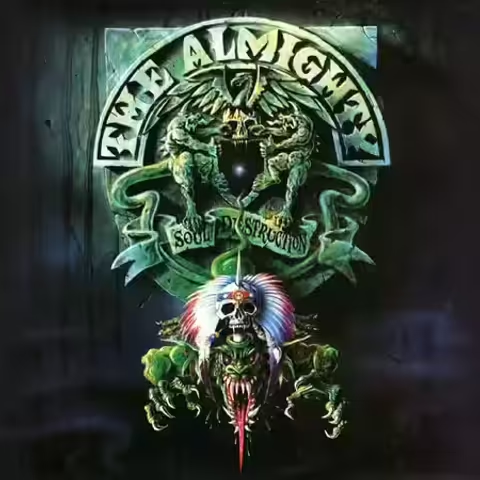
The Soul Destruction cover, designed by Glasgow-based artist Koot, is one of the most recognisable British rock sleeves of the early 1990s. A blood-red background, a stark white burning cross, the band's logo across the top in heavy black serifs: it looked like a bootleg of a record nobody had recorded yet, which is what the band wanted. Koot had designed Blood, Fire & Love and the burning-cross logo became the band's identity for the rest of the Polydor years.
The American territory, where Polydor was still trying to break the band, asked for the cross to be desaturated, and the version that briefly circulated in US import bins in summer 1991 has the cross in pale yellow rather than white on red. The Japanese Pony Canyon edition kept the original colours. The 2015 Spinefarm Deluxe Edition restored the original sleeve and added an inner gatefold with Joe Dilworth's previously unpublished session photographs.
Release and Reception
Soul Destruction came out on 30 March 1991 in the UK and entered the chart at number 22, the band's highest position to date and a notable improvement on Blood, Fire & Love's number 56. The album spent eight weeks in the Top 75. There was no US release on a major; Polydor's American arm declined to take it, and it eventually surfaced there only as a Japanese import.
The contemporary press was warmer than the band were used to. Sounds magazine's Trish Jaega gave it four stars on release week, calling it "a record that finally matches the live show". Kerrang! gave it four out of five and put the band on the cover of issue 333 in April 1991. AllMusic's Eduardo Rivadavia, in a much later retrospective, was less impressed and gave it two out of five, complaining that Andy Taylor's production "polished off the rough edges that made the band interesting".
"There is a moment about thirty seconds into Crucify when you realise this is going to be the British rock record of the year. By the second chorus you have stopped wondering whether they have the songs to match the swagger. They do."
Trish Jaega, Sounds, 30 March 1991
Retrospective opinion has been kinder. In 2014 Classic Rock placed Soul Destruction at number 24 in its list of "the 50 best British rock albums of the 1990s". In 2023, after the reunion announcement, Loudersound's Dave Ling described it as "the album that introduced the band proper, and the one that has aged best". The 2015 Spinefarm reissue was Album of the Reissue Month in Classic Rock and sold out its first vinyl pressing inside a fortnight.
| Single | Release | Formats | UK chart | Notable B-side |
|---|---|---|---|---|
| Free 'N' Easy | 18 March 1991 | Promo CD, 12-inch, 7-inch, cassette | 35 | Bodies (Sex Pistols cover) |
| Devil's Toy | 17 June 1991 | Promo CD, 12-inch, 7-inch | 36 | Wild Road to Satisfaction |
| Little Lost Sometimes | 14 October 1991 | Promo CD, 12-inch, 7-inch | 42 | Hell to Pay (acoustic) |
Motorhead, Megadeth, Alice Cooper and the Town and Country
The Almighty toured Soul Destruction in three distinct legs across 1991. In February and March they supported Motorhead and then Megadeth on UK arena dates, an opening slot Lemmy gave them after seeing them at the Marquee in late 1990 and reportedly telling Polydor "you got a real one there". The Megadeth shows, in particular Wembley Arena on 13 March, were considered the breakthrough: Dave Mustaine's audience were not the band's natural fans, and earning them over a thirty-minute opening slot did the album's pre-orders more good than any review.
The headline UK tour, billed as Little Lost Somewhere '91 after the Tantrum-Warwick co-write, ran across June and July 1991. The London date at the Town and Country Club on 6 July was filmed by a four-camera crew and released that November as Soul Destruction Live on VHS through PolyGram Music Video. It is now the only official live document of the original line-up performing the album in full.
The third leg, in autumn 1991, took the band across mainland Europe in support of Alice Cooper on his Hey Stoopid tour. Cooper's lead guitarist on that run was Pete Friesen, the Canadian player who would replace Tantrum in The Almighty inside six months. Friesen and Warwick became friends backstage in Frankfurt; the conversation that led to Friesen's eventual recruitment happened, by his own account, in a hotel bar in Stuttgart in October 1991, while Tantrum was still in the band.
- February to March 1991, UK arenas, supporting Motorhead and then Megadeth.
- June to July 1991, headline UK tour Little Lost Somewhere '91, including the Town and Country Club show filmed for VHS.
- September to November 1991, mainland European tour supporting Alice Cooper's Hey Stoopid run.
- December 1991, three Christmas shows in Glasgow, Edinburgh and London with Wolfsbane as support.
- January 1992, four-show Japanese debut on the Pony Canyon licensee's invitation, with both Tantrum and his replacement Pete Friesen sharing one of the bills.
Songs in Film, TV and Tribute
The Almighty have always been a stubbornly cult proposition for sync agents, but Soul Destruction has had a slow afterlife in placements. Bandaged Knees was used over the end credits of the BBC drama Mad Dogs and Englishmen (later retitled Shameless) in 1995, the song's most prominent screen use. Crucify and Hell to Pay have appeared on a string of British rock compilations between 1992 and 2018, including PolyGram's Nu Rock Vol. 2 and Spinefarm's 2015 Trident II Tales. Free 'N' Easy was covered live by The Wildhearts on their 2009 anniversary tour, a moment Ginger Wildheart later described as "paying back a debt" to the band that had shared a tour bus with them in 1992.
Reissues, Box Sets and the 2023 Vinyl
Soul Destruction has been reissued three times. The 1991 Japanese edition added the Sex Pistols' Bodies and the acoustic Hell to Pay as bonus tracks. The 2015 Spinefarm Deluxe Edition added a full second disc of the period's B-sides and live recordings, restored the original Koot sleeve, and was the first release in 24 years to put the album back into UK record-shop racks. In late 2023, in tandem with the band's reunion announcement, both Polydor albums were given a fresh vinyl press: Soul Destruction in a limited gatefold edition on 180-gram red wax, and a separate green-vinyl variant tied to the Three 'N' Easy December shows.
| Edition | Year | Format | Notes |
|---|---|---|---|
| UK original | 1991 | CD, cassette, 12-inch vinyl | Polydor 847 661, original Koot sleeve. |
| Japanese edition | 1991 | CD only | Pony Canyon licensee; adds Bodies and acoustic Hell to Pay. |
| US import | 1991 | CD only | Desaturated cross on the sleeve; very small print run. |
| Spinefarm Deluxe | 2015 | 2CD, digital | Bonus disc of B-sides and live; gatefold inner with Joe Dilworth photos. |
| Reunion vinyl | 2023 | 180g red vinyl gatefold | Limited press tied to the Three 'N' Easy reunion shows. |
| Tour exclusive | 2023 | 180g green vinyl | Sold only at the December 2023 reunion dates. |
Legacy: From Powertrippin' to Knebworth 2026
Soul Destruction did three things for The Almighty that nothing else they made would manage in the same way. It got them out of the small-venue circuit; it earned them a Top 5 follow-up in Powertrippin', which would chart at UK number 5 in April 1993; and it set the template for every British hard-rock band that came up behind them in the early 1990s. Machine Head's Robb Flynn cited the album in a 2014 interview as "one of the records that proved you could be heavy without being American". Black Star Riders, the band Warwick has fronted since 2012, regularly drop Crucify into encores. The Wildhearts, Wolfsbane, Therapy? and the entire post-Britpop heavy-rock revival of the late 1990s owed something to it.
The original line-up's split in March 1992, when Tantrum left after what Warwick later described as "the inevitable row about which direction we were going next", meant Soul Destruction became the only studio document of the four people who had started The Almighty in Strathaven in 1988. By the time the same four were in a room together again, in November 2023 for press in Soho, more than thirty-one years had passed.
"The first two albums introduced the band and they're seminal. Powertrippin' and Crank were big albums for us, but it's Soul Destruction that people who weren't there ask about first. That record opened the door."
Ricky Warwick, Classic Rock, November 2023
The reunion ran across three sold-out UK shows in December 2023 (Glasgow Barrowland, Manchester Academy, London Kentish Town Forum), continued through Steelhouse Festival in 2024 and the Three 'N' Easy Saint Andrew's Day shows in 2024 and 2025, and culminates, on current bookings, with The Almighty opening for Iron Maiden at Knebworth on 11 July 2026 in front of an expected 90,000 people. The opener of that set, on every reunion bill so far, has been Crucify.
Things You Might Not Know
| Fact | Detail |
|---|---|
| The producer's pop CV | Andy Taylor had not played guitar on a Duran Duran album for five years when he produced Soul Destruction; the band that hired him had to ask whether he still owned a Les Paul. |
| The Sex Pistols B-side | The afternoon Bodies was tracked, Trident II's Christmas tree was still up and the studio's house cat, Mavis, slept through both takes on top of the Marshall cabinet. |
| Del James's day job | The American writer who co-wrote three of Soul Destruction's tracks would later be credited on Use Your Illusion II and write the short story that became Guns N' Roses' November Rain video. |
| Lemmy's blessing | Motorhead's frontman personally requested The Almighty as openers for his February 1991 UK tour after watching them play the Marquee, telling Polydor's manager: "you got a real one there". |
| Pete Friesen's hotel bar | The Canadian guitarist who would replace Tantrum agreed to join in a hotel bar in Stuttgart in October 1991, while still on Alice Cooper's payroll and three months before he was officially in the band. |
| The radio edit Andy hated | The 4:53 single edit of Little Lost Sometimes was approved over Andy Taylor's objections and is the only mix Radio 1 ever played, which is why most people who hear the song never make it past five minutes. |
| The American sleeve | The US import edition of Soul Destruction has a desaturated yellow cross because Polydor's New York office decided the original red-and-white was "too religious" for North American retail. |
| The Town and Country tape | Soul Destruction Live, the November 1991 VHS, has never been issued on DVD or streaming and remains the only official video of the original line-up performing most of the album. |
| Backstreet Symphony's twin | Andy Taylor walked from the Trident II mix straight into producing Thunder's Laughing on Judgement Day, making 1991 to 1992 the only stretch where the same producer made two consecutive British rock chart albums on the same console. |
| Knebworth, thirty-five years later | The Almighty will open Iron Maiden's Knebworth show on 11 July 2026, exactly 35 years and 90 days after Soul Destruction was released; Crucify is scheduled to be the first song of the set. |
Listen to the Riffology Podcast
Soul Destruction is the kind of record the Riffology hosts could happily talk over for two hours: the Trident II room, Andy Taylor's quiet pop ear under all that guitar, Del James and the Guns N' Roses backchannel, Tantrum's last record before Stuttgart, the Sex Pistols B-side, and the long thirty-two-year wait until the original four were in a room together again. For long-form conversations on this album and dozens of others, the Riffology podcast is available on Apple, Spotify, Amazon Music and every other major platform.
Comments