Six Hundred Bucks and a Debut
Jack Endino's invoice for Nirvana's debut album ran to $606.17. He billed the band for roughly thirty hours of studio time at Reciprocal Recording in Seattle, spread across five sittings between Christmas Eve 1988 and 24 January 1989, and a friend of the band named Jason Everman wrote the cheque. Everman would be photographed on the sleeve, credited as second guitarist, and play not a single note on the finished record. Bleach, released by Sub Pop on 15 June 1989, is the cheapest, scrappiest, most committed sounding album in Nirvana's catalogue, and the one most directly stamped with the economics of the Pacific Northwest underground that produced it.
This is a record that almost did not come out. Sub Pop had only commissioned an EP, then ran out of money once the tracks were in the can, then asked Bruce Pavitt to reshuffle the running order at the last minute. By the time the LP reached shelves the band had already played most of the songs live for the better part of a year. What followed in 1991, when [Nevermind](/posts/the-making-of-nevermind-by-nirvana/) dragged Bleach back onto charts it had never troubled the first time around, would turn this cheap, deliberately ugly Seattle debut into Sub Pop's best-selling release. The story of how it got made is the story of grunge before grunge was a marketing word.
Album Facts
| Field | Detail |
|---|---|
| Artist | Nirvana |
| Album | Bleach |
| Release Date | 15 June 1989 (US, Sub Pop SP34) |
| Label | Sub Pop (US); Tupelo Recording Company (UK, 1989); Waterfront Records (Australia, 1989); Geffen Records (international reissue, April 1992) |
| Producer | Jack Endino |
| Studio | Reciprocal Recording, Seattle, Washington |
| Recording Dates | 23 January 1988, 30 June 1988, 24 December 1988, 29 to 31 December 1988, 14 and 24 January 1989 |
| Genre | Grunge, sludge metal, alternative rock, punk rock, hard rock, indie rock |
| Track Count | 11 (1989 vinyl); 12 (UK 1989 vinyl with Big Cheese in place of Love Buzz); 13 (1992 CD and most reissues, adding Big Cheese and Downer) |
| Total Runtime | 37:21 (original vinyl); 42:45 (1992 reissue) |
| Billboard 200 Peak | 89 (1992 reissue) |
| UK Albums Chart Peak | 33 (1992 reissue); number 3 on the NME Indie Albums chart in 1989 |
| Other Notable Chart Peaks | Australia 34, Germany 24, Austria 26, Finland 22, New Zealand 30, Japan 46 (all 1992); US Top Pop Catalog Albums number 1, May 1994 |
| Certifications | RIAA Platinum (United States); BPI Platinum (United Kingdom, 300,000 shipments); ARIA Platinum (Australia); SNEP 2 times Gold (France); FIMI Gold (Italy); ZPAV Gold (Poland); Music Canada Gold |
| Estimated Sales | More than 1.9 million in the United States; Sub Pop best-selling album release |
| Key Singles | Love Buzz (Sub Pop Singles Club, November 1988); Blew EP (Tupelo, November 1989) |
Aberdeen, Olympia and the Road to Sub Pop
By late 1988 Nirvana was a band only in the loose Pacific Northwest sense of the word. Kurt Cobain had left Aberdeen for Olympia, where he was living with his girlfriend, the photographer Tracy Marander. Krist Novoselic was based in Tacoma. Their drummer was Chad Channing, a small, soft-spoken Bainbridge Island player they had recruited in the spring after a procession of short-term occupants behind the kit. Aaron Burckhard, Dale Crover and Dave Foster had all sat in long enough to play a session or a clutch of shows, then drifted out. Channing was the first drummer who looked like he might stay.
The band practised in a borrowed barn on Novoselic's mother's property and rehearsed their set, half of it derived from a battered demo tape called Fecal Matter that Cobain had recorded with Crover three years earlier. The songs were heavy, slow, openly indebted to [Black Sabbath](/posts/black-sabbath-a-complete-history/) and the Melvins, with the occasional pop hook smuggled in as if by accident. Nobody in Aberdeen cared. The point was Seattle, an hour and a half up the I5, where a young label called Sub Pop was beginning to look like the only people in the United States interested in this kind of noise.
Sub Pop, Pavitt and the Singles Club
Sub Pop in 1988 was Bruce Pavitt and Jonathan Poneman working out of a small office in the Terminal Sales Building in downtown Seattle. Pavitt had spent the early eighties writing a fanzine of the same name and selling cassette compilations through the mail. Poneman, a former radio DJ, brought capital and a salesman's sensibility. Their working theory was that the Pacific Northwest had a distinct sound, that the sound would be photographed in grainy black and white by Charles Peterson, and that if they put out enough seven inch singles by enough Seattle bands they could build a regional myth from the ground up.
The Sub Pop Singles Club was the mechanism. Subscribers paid in advance for a year of monthly seven inch singles, hand-numbered, in limited runs of around a thousand, by Sub Pop bands. The club gave the label predictable cash flow and the subscribers got bragging rights. Nirvana, picked up after Cobain mailed in a demo Endino had cut for them in January 1988, were chosen as the inaugural single. The catalogue number was SP23. The pressing was a thousand copies on black vinyl, the sleeve numbered in red ink.
Love Buzz: The Debut Single
Love Buzz, released in November 1988, was the calling card. The choice of song was deliberately perverse. Cobain had picked it from his sister's record collection: a piece of 1969 Dutch psychedelia by Shocking Blue, the band best known in the United States for the bubblegum chart hit Venus. The Nirvana version stripped out the sitar of the original, replaced it with a sludgy bass riff played by Novoselic, and pasted on a ten-second collage of children's records that Cobain spliced together in his bedroom. The B-side was Big Cheese, a Cobain original written about Poneman.
The single sold out almost immediately, by the standards of the time. More importantly it caught the ear of college radio in the United States and of the British music weeklies, who at the end of 1988 were starved for a new American underground story and willing to take dictation from anybody in Seattle who would talk to them. Sub Pop's gamble was paying off, and Pavitt and Poneman now asked Nirvana for an EP to follow.
Reciprocal Recording and Jack Endino
Reciprocal Recording was a small eight-track studio at 4230 Leary Way NW in the Ballard neighbourhood of Seattle, built into a triangular wedge of a building that had once been a Greek bakery. Chris Hanzsek and Tina Casale had opened it in 1986 with cheap rates and a deliberate punk-friendly attitude. By 1987 Hanzsek had handed day-to-day operations to Jack Endino, a former merchant marine engineer who had bought into the studio with the idea of making records for the kind of bands he himself was in.
Endino played guitar in Skin Yard. He produced almost every band Pavitt and Poneman put on Sub Pop in those years: Mudhoney, Soundgarden, Tad, Green River. His method was modest. He liked old microphones, a Tascam M-30 console and a half inch Otari eight-track machine, and he priced his time at the low end of working-band-budget rather than at music-industry rates. The story of grunge in 1988 and 1989 is largely the story of what came out of his eight-track machine.
The January 1988 Session with Dale Crover
Three of the songs on Bleach predate the album proper. On 23 January 1988, Cobain and Novoselic drove to Reciprocal with Dale Crover, the drummer in the Melvins and a friend of Cobain's from Aberdeen, to cut a ten-song demo. Endino was at the desk. The session lasted five hours. The demo, never officially released at the time, would later circulate among collectors as the Dale Demo, and it was the tape that Cobain sent to Sub Pop later that spring.
When the band came to record the full album with Channing in December, they attempted to re-cut three of the songs from the January 1988 session with the new drummer. They tried Floyd the Barber, Paper Cuts and Downer with Channing on the kit, did not like the results, and went back to Endino's original Crover takes. Endino remixed them in the new sessions to sit alongside the Channing material. The result is the only Nirvana studio album with two different drummers, a fact still inadequately reflected in the original sleeve notes, which credit Channing simply as drums.
December 1988: Channing Behind the Kit
The main Bleach sessions started on Christmas Eve, 24 December 1988, with a five-hour block. The band returned on 29, 30 and 31 December, then again on 14 and 24 January 1989. Channing, an inventive but light-handed drummer, played a Tama kit and tuned his snare deliberately high. The contrast with Crover's heavier, more linear style is audible if you know what to listen for, particularly on Negative Creep and Scoff, which Channing pushes with a steady eighth-note urgency that Crover would not have brought.
Cobain used a Univox Hi-Flier copy of a Mosrite for most of the rhythm tracks, plugged into a small valve combo borrowed from the studio, and overdubbed leads on a left-handed Fender Mustang. Novoselic played a Gibson Ripper bass through a borrowed Peavey rig. There were no click tracks, no isolation rooms worth the name, and very little overdubbing beyond doubled vocals and occasional second guitar parts. The whole record was finished in roughly thirty hours of recorded time, plus Endino's mixing, with About a Girl reportedly tracked in a single afternoon.
Six Hundred and Six Dollars and Seventeen Cents
When the sessions were done Endino handed the band a bill for $606.17. The figure has since become the most-quoted number in Sub Pop history. It is documented in Michael Azerrad's Come as You Are: The Story of Nirvana, where Azerrad reports it as the cost of thirty hours of recording at the studio's working-band rate. Adjusted for inflation it is somewhere around $1,500 in modern money. By way of comparison, the major-label budget for Nevermind, recorded two and a half years later in Los Angeles with Butch Vig, was reportedly about $65,000, and most observers consider that to have been cheap.
The 606 figure is one of those numbers that has acquired a folkloric quality. It is repeated in liner notes, in documentaries and in the merchandise of the 2009 reissue, where Sub Pop printed the receipt on a tee shirt. The truth it points to is real. Bleach was made for less than a band today might spend on a single day of rehearsal-room hire, and almost every decision Endino made was conditioned by the constraint.
Jason Everman Pays the Bill
Nirvana did not have $606.17 in the bank. Sub Pop had not advanced any money. The man who paid was Jason Everman, a former Soundgarden roadie and a friend of Channing who had been knocking around the Seattle scene looking for a band to play in. Everman had been impressed by the Crover demo, had money saved from a stint commercial fishing in Alaska, and offered to bankroll the recording in exchange, more or less, for being allowed to join the band.
What he got was a sleeve credit and a place on the cover photograph. He never played on any of the eleven master tracks. Bassist Krist Novoselic, asked years later why Everman was credited as a second guitarist when he had not contributed a note, gave a famously laconic answer to Azerrad: "We just wanted to make him feel at home in the band." Everman briefly toured with Nirvana through the summer of 1989 in support of the album, then was dropped from the lineup. He went on to play in Soundgarden, then in Mind Funk, then to enlist in the United States Army Rangers and serve in Iraq and Afghanistan. The Bleach sleeve remains the document of his complicated, mostly silent contribution.
The Tracklist
The original 1989 American vinyl ran to eleven tracks and 37:21. The UK Tupelo edition replaced Love Buzz with Big Cheese for licensing reasons. The 1992 Geffen reissue added both Big Cheese and Downer to make the canonical thirteen-track CD that most listeners now know.
| # | Title | Writer(s) | Drummer | Length | Single? | Notes |
|---|---|---|---|---|---|---|
| 1 | Blew | Cobain | Channing | 2:55 | UK EP, Nov 1989 | Detuned to drop-D-and-a-step, played on a borrowed bass left in studio C-standard tuning |
| 2 | Floyd the Barber | Cobain | Crover | 2:18 | Carried over from the January 1988 demo session | |
| 3 | About a Girl | Cobain | Channing (and tambourine) | 2:48 | Written for Tracy Marander; the album pop anomaly | |
| 4 | School | Cobain | Channing | 2:42 | Four lines of lyric; a swipe at the Sub Pop scene | |
| 5 | Love Buzz | Robbie van Leeuwen | Channing | 3:35 | US 7-inch, Nov 1988 | Shocking Blue cover; replaced by Big Cheese on UK pressings |
| 6 | Paper Cuts | Cobain | Crover | 4:06 | Carried over from the January 1988 demo | |
| 7 | Negative Creep | Cobain | Channing | 2:56 | Cobain on Cobain, in his own words | |
| 8 | Scoff | Cobain | Channing | 4:10 | Described by Christopher Sandford as a parting salvo at his parents | |
| 9 | Swap Meet | Cobain | Channing | 3:03 | Cobain on rural Aberdeen couples | |
| 10 | Mr. Moustache | Cobain | Channing | 3:24 | Addressed to Nirvana macho male fans | |
| 11 | Sifting | Cobain | Channing | 5:24 | Closes the original vinyl edition | |
| 12 | Big Cheese | Cobain, Novoselic | Channing | 3:42 | B-side of Love Buzz; about Jonathan Poneman; added on the 1992 CD | |
| 13 | Downer | Cobain | Crover | 1:44 | From January 1988; on the 1990 CD and 1992 cassette and CD; absent from the 1990 cassette |
About a Girl: The Pop Song Hiding in the Sludge
The third track is the moment Bleach gives away the future. About a Girl is two and a half minutes of Beatles-shaped chord changes, a clean arpeggiated intro, a verse-chorus structure with a proper bridge, and a tambourine. Cobain wrote it in the bedroom he shared with Tracy Marander in Olympia, reportedly after spending an afternoon listening to Meet the Beatles. The lyric is a small, plaintive address to her about money, work and the daily friction of cohabitation.
It does not sound like anything else on the record. The producer Jack Endino, asked about it in a 2009 interview with Rolling Stone, said simply that he loved it from the first take and could not understand why everybody else on the Sub Pop scene seemed alarmed. The biographer Chuck Crisafulli, in his 2006 book Nirvana: The Stories Behind Every Song, called it a song that "perfectly captures the rage, hurt, and residual tenderness of a fractured, failing romance and pack[s] it all into verses and choruses that are unstoppably catchy." Five years later it would be the song Nirvana opened their MTV Unplugged set with, after Cobain warned the producers it would alienate fans who had only come for the hits.
Love Buzz: Borrowing from Shocking Blue
Love Buzz, the other obvious outlier, is a cover. Robbie van Leeuwen wrote it for the Dutch band Shocking Blue in 1969 and his version, all sitars and Mariska Veres's smoky vocal, is one of the great hidden corners of European psychedelia. Nirvana stripped the song to its bones. Novoselic plays a fuzzed-up bass line on what amounts to an eight-note ostinato, Channing keeps a steady tom-heavy four, and Cobain sings it straight, lowering the key and finding a worried edge that the original never quite reached. The childrens-record collage that prefaces the Sub Pop single edit was removed for the album version.
The cover sat at the heart of the band's live set for years. In the Sub Pop catalogue notes for the original Singles Club seven inch, the label described the A-side as "heavy pop sludge", a phrase that turned out to be load-bearing. The Shocking Blue connection also became, briefly, the subject of a minor publishing tangle when Love Buzz began earning royalties after Nevermind; van Leeuwen has gone on record more than once saying he was perfectly happy with the arrangement and the cheques.
Blew, Negative Creep and the Sludge Template
The opening track sets the bar for the rest of the record. Blew begins with a riff in drop D, but the bass Novoselic happened to pick up that day was already tuned a whole step low, so the figure plays a tone lower than expected and the whole song sits in a queasy register that nobody on the album was strictly aiming for. The accident defines the song. Endino kept the take, encouraged the band to play to it, and Blew became the first proper statement of what Bleach was going to sound like.
Negative Creep, two tracks later, is the most concentrated dose of the sludge template. Cobain screams a self-portrait over a riff that does not modulate, Channing pounds, and the whole thing collapses into a wall of guitar feedback after three minutes. Sifting, which closes the original vinyl, takes the formula to five and a half minutes with a long instrumental coda. Together these three songs and the Crover holdovers make the case for the Bleach the Sub Pop scene actually wanted: heavy, repetitive, lyrically unhappy, recorded loud enough to overdrive Endino's modest signal chain.
Lyrics, Aberdeen and the Drive to the Studio
Most of the words on Bleach were written the night before or the morning of the relevant session. Cobain told Spin in October 1993 that he had not given "a flying fuck what the lyrics were about" on the album, and claimed eighty per cent of them were finished the evening before recording, with the rest improvised in the car on the way to Reciprocal. The Azerrad book confirms the picture. Cobain would sit in the back seat with a notebook on the drive up from Aberdeen, scribbling, then walk into the booth and sing whatever was on the page.
He told the British journalist John Robb, in one of the band's first proper interviews, in Sounds magazine in 1989: "When I write a song the lyrics are the least important thing. I can go through two or three different subjects in a song and the title can mean absolutely nothing at all. Most of the lyrics on the Bleach album are about my life in Aberdeen." Despite the disavowal, Azerrad and others have noted that Mr. Moustache (a pop at jock culture), School (a swipe at the Sub Pop scene), Scoff (his parents) and Negative Creep (himself) all read more autobiographically than Cobain admitted at the time.
Big Cheese, Downer and the Format Variants
The format history of Bleach is the most tangled in the Nirvana catalogue, which is saying something. The 1989 American vinyl LP, Sub Pop SP34, ran to eleven tracks. The 1989 American cassette and CD added Downer, the Crover-drummed thrash piece left over from the 1988 sessions. In the UK Tupelo released the album on its own catalogue number, TUPLP6, but for licensing reasons replaced Love Buzz with Big Cheese, the Cobain and Novoselic co-write that had originally been the B-side of the Sub Pop seven inch. The Australian release on Waterfront Records added further coloured-vinyl variants over 1990 and 1991.
When Geffen took the album over for the international 1992 reissue they consolidated the format into a single thirteen-track CD running 42:45, with Big Cheese and Downer both included, packaged in a cardboard foldout case with a bonus booklet of Charles Peterson photographs from 1987 to 1990. Most contemporary reissues, including the 2009 deluxe, follow that running order. The original eleven-track vinyl is now a collector item.
Pavitt's Resequence and the Bleach Your Works Title
Two decisions reshaped the album in the months between the end of recording in January 1989 and its eventual June release. The first was a phone call from Bruce Pavitt asking the band to resequence the running order he had already approved. Endino has described being told, in the middle of mastering preparation, that the whole tape would need to be re-edited to a new sequence Pavitt felt would flow better on side one and side two of the LP. The second was the title. Cobain had been calling the album Too Many Humans, which Pavitt was not keen on. The replacement title, Bleach, came from a public-health poster Cobain found taped up at a needle exchange in San Francisco during a road trip with Novoselic. The poster, part of a wider 1980s harm-reduction campaign, urged intravenous drug users to clean their needles with household bleach to reduce HIV transmission. "Bleach Your Works" was the slogan. Cobain liked the abruptness of the single word.
The resequence and the new title were settled by spring 1989. Then Sub Pop ran out of money to manufacture the record, and the release was pushed back several months while Pavitt and Poneman scrambled for pressing funds. The eventual 15 June 1989 release date was, in effect, the first date they could afford to put out a finished tape that had been ready since February.
Tracy Marander and the Reko Muse Cover Shot
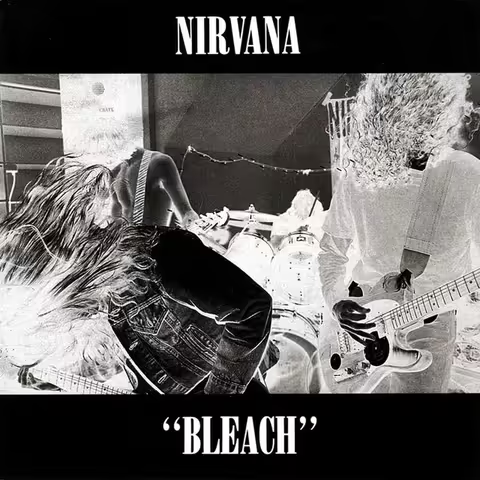
The cover photograph was taken by Tracy Marander, Cobain's then-girlfriend, at a Nirvana show at the Reko Muse art gallery in Olympia, Washington. Marander shot the band on stage in available light. Lisa Orth designed the sleeve. The single most striking visual decision, the colour-reversed, near-photo-negative treatment of the band photograph, made the front cover look like an X-ray of itself and put the album in immediate visual conversation with the Sub Pop house style being developed in parallel by Charles Peterson.
Everman is in the photograph, on the left of the frame. He is also pictured on the back. Photographer credit on the original sleeve went jointly to Marander and Peterson, who provided additional band shots used in the layout. When Sub Pop re-released the album in 2009 for its twentieth anniversary they removed Everman from the credit block, but he remains in the cover photograph, and the original sleeve has not been retouched.
Personnel and Credits
| Role | Player | Notes |
|---|---|---|
| Core band | ||
| Vocals, guitar | Kurt Cobain | Credited on the original sleeve as Kurdt Kobain |
| Bass | Krist Novoselic | Credited as Chris Novoselic |
| Drums, tambourine | Chad Channing | Tambourine on About a Girl |
| Guitar (credited only) | Jason Everman | Pictured on cover and credited as second guitarist, but does not perform on the album |
| Additional musicians | ||
| Drums | Dale Crover | Melvins drummer; plays on Floyd the Barber, Paper Cuts and Downer, carried over from the January 1988 demo session |
| Production and engineering | ||
| Producer, engineer, mixer | Jack Endino | Tracked the album at Reciprocal Recording in Seattle for $606.17 |
| Mastering, 2009 deluxe | George Marino | Sterling Sound, New York; remastered from the original analogue tapes in March 2009 |
| Artwork | ||
| Photography | Tracy Marander | Front cover photograph taken at Reko Muse gallery, Olympia, Washington |
| Photography | Charles Peterson | Additional band photographs in sleeve and 1992 reissue booklet |
| Sleeve design | Lisa Orth | Designed the colour-reversed front cover layout |
| Sleeve execution | Jane Higgins | Production artwork |
| Label | ||
| A and R | Bruce Pavitt and Jonathan Poneman | Sub Pop co-founders; commissioned the album as an EP, requested the final resequence |
June 1989: The Release and Its Territories
Bleach came out in the United States on 15 June 1989 with Sub Pop catalogue number SP34, in three formats: an LP, a cassette and a CD. The first vinyl pressing was on white vinyl, hand-numbered, in a run reportedly of around a thousand copies. Collectors today value those first pressings well into four figures. Subsequent Sub Pop pressings appeared on black, then on a succession of coloured-vinyl variants over the following two years as the label tried to keep the record in print.
The international picture was complicated. Tupelo Recording Company in the UK released the album the same summer with catalogue number TUPLP6 and, as noted, swapped Love Buzz for Big Cheese on the running order to keep Tupelo out of any Shocking Blue publishing tangle. Waterfront Records in Australia put it out across 1989 and 1990 in a series of coloured covers and coloured-vinyl editions, some of which now command higher prices than the Sub Pop original. Wider European distribution was patchy until Geffen picked the album up in 1992.
- Sub Pop SP34, US, June 1989, white vinyl first pressing, hand-numbered, around 1,000 copies.
- Tupelo TUPLP6, UK, summer 1989, twelve tracks with Big Cheese substituted for Love Buzz.
- Waterfront Records, Australia, 1989 to 1991, multiple coloured-vinyl editions on tour-themed sleeves.
- Geffen Records 24433, international, April 1992, the canonical thirteen-track CD reissue.
- Sub Pop 70834, US, November 2009, twentieth anniversary deluxe with George Marino remaster and a 1990 live disc.
The 1989 Press: NME, Melody Maker, Sounds
Bleach was not a commercial success on release. It did not chart in the United States and limped to a respectable number 3 on the NME Indie Albums chart in the UK, while peaking at number 8 on the equivalent MRIB indie listing. What it did get was the British music press. The weeklies had been primed by the Love Buzz single and by the steady drip of Sub Pop releases through the spring, and Bleach hit at exactly the moment the UK pop press needed a new American underground story to chew on.
Edwin Pouncey, writing in NME in July 1989, gave it eight out of ten and reached for the obvious comparison: "This is the biggest, baddest sound that Sub Pop have so far managed to unearth. So primitive that they manage to make label mates Mudhoney sound like Genesis." In Melody Maker the following month, the critic Push declared Nirvana "the only Sub Pop act to date whose songs consistently equal the standard set by their mates Mudhoney." In Sounds, John Robb interviewed Cobain at length and helped fix the image of Nirvana as the most articulate band on the Sub Pop roster, even as Cobain spent most of the interview undermining the idea that the words on his record meant anything in particular.
"This is the biggest, baddest sound that Sub Pop have so far managed to unearth. So primitive that they manage to make label mates Mudhoney sound like Genesis. Nirvana turn up the volume and spit and claw their way to the top of the musical garbage heap."
Edwin Pouncey, NME, July 1989
American press was slower to catch up. The college press picked up the album over the autumn, with CMJ peaking it at number 22 on its radio chart and number 37 on its progressive retail chart by October. Thurston Moore of Sonic Youth, by then a Sub Pop scene-spotter of note, became an early Bleach evangelist; during the mastering of Sonic Youth's own Goo the following year he reportedly told the engineers he wanted Goo to sound like Bleach.
Bleach on Tour: America and Europe
Nirvana toured the album as a four-piece, with Everman as second guitarist. A long American leg through the summer of 1989 took them across the country in a battered Dodge Sportsman van. Sub Pop sent the band out as headliners on a budget so small that most nights the four players, plus their soundman, plus all the gear, slept in the van. By all later accounts the dates were brutal and the friction with Everman, who had a more conventional metal-band sensibility than the rest of the group, grew week by week.
The European tour in the autumn was where the press picture firmed up. Nirvana opened for and at times co-headlined with Tad, the other Sub Pop band on the road that season, beginning at the Riverside venue in Newcastle upon Tyne on 23 October 1989. The pair played a now-mythologised set at the London Astoria on 3 December 1989 that has been re-released several times on bootleg and once officially. Christopher Sandford, in his Cobain biography, captured the moment the British music press built a mythology around Cobain's stage wardrobe: "when the style pundits noted Cobain's 'patent lumberjack shirts and ugly fifties geometric-patterned jerseys', seeing an example of 'low-couture chic' they missed the point that flannel shirts and sweaters were everyday dress in the marine climate of the Northwest."
Everman Out, Channing Out
By the end of the American tour the band had decided Everman would not be invited to continue. Nobody actually told him. Nirvana cancelled the final few dates of the Bleach tour, drove back to Washington, and stopped returning his calls. Everman, asked later, said he had decided to leave the band himself. Both accounts may be true. He turned up shortly afterwards in Soundgarden, played bass on their 1989 Loud Love EP, and then began the long professional pivot that would eventually take him into the United States Army Rangers in the late 1990s.
Channing lasted longer but not by much. The combination of Cobain's increasingly fixed view of what a Nirvana drummer should sound like, the long miles in the van, and Channing's lighter touch caught up with him during the 1990 sessions for the album that became Nevermind. He played on the early Smart Studios demos in April 1990 with Butch Vig, was dismissed shortly afterwards, and was replaced first briefly by Mudhoney's Dan Peters and then permanently by Dave Grohl from Washington DC hardcore band Scream. Bleach is the only completed Nirvana studio album Channing played on.
After Nevermind: Sudden Platinum in 1992
By the time Nevermind topped the Billboard 200 in January 1992, Bleach had sold roughly 40,000 copies in North America. That figure, modest in major-label terms, had nonetheless made it Sub Pop's best-selling release. Geffen, who now controlled Nirvana's recordings outside Sub Pop's existing rights, struck a deal with the indie to handle international distribution of a remastered version of the debut. The Geffen reissue, with catalogue number 24433, appeared in April 1992 in a cardboard foldout sleeve with the bonus photo booklet.
The reissue chart trajectory was the opposite of the original. Bleach climbed to number 89 on the Billboard 200, number 33 on the UK Albums Chart, number 34 on the Australian albums chart, number 22 on the Finnish chart, number 24 in Germany, number 26 in Austria, and into the lower reaches of charts across Europe. Sales accelerated again after Cobain's death in April 1994, when Bleach entered the Top Pop Catalog Albums chart at number 1. The RIAA certified the album Platinum, the BPI also Platinum on 300,000 UK shipments, and the ARIA Platinum in Australia. France issued a 2 times Gold certification from SNEP, with Gold awards following in Italy, Poland and Canada.
The 2009 Deluxe and the Pine Street Tape
For the twentieth anniversary Sub Pop went back to the analogue tapes. George Marino at Sterling Sound remastered the album from the original two-track masters in March 2009. The deluxe package, released on 3 November 2009 with catalogue number SP70834, paired the remastered album with a previously uncirculated soundboard recording of Nirvana's 9 February 1990 show at the Pine Street Theatre in Portland, Oregon. The Pine Street tape captures the band as a three-piece, Everman by then long gone, with Channing on drums in his last weeks of the gig, working through Bleach material alongside early versions of songs that would later appear on Nevermind.
The 2009 reissue is also where Everman's credit was finally tidied up. He is no longer listed as a band member on the deluxe sleeve, but he remains in the cover photograph and is given a special thanks in the booklet. Endino contributed liner notes for the package, as did Sub Pop, and Rolling Stone ran a piece by Tom Breihan in August 2009 in which Endino and Channing spoke about the sessions on the record for the first time at any length.
Legacy: Sub Pop's Best Seller
Bleach is Sub Pop's best-selling album release, and probably always will be. The label has put out a great deal of important music since, but no other Sub Pop record has matched the cumulative arc of Bleach, which is now well past 1.9 million United States sales according to the figures Sub Pop cited to Billboard in 2016. Most of those copies were sold after Nevermind, but the album cost was the same $606.17 regardless of how many copies eventually came back through the cash register, which gives Bleach what may be the most favourable studio-cost-to-sales ratio of any rock album of the era.
For Nirvana it remains the album most distinctly of a time and a place. The pop instincts that would dominate Nevermind are present only in About a Girl. The willingness to fold a Beatles structure into a noise record is the bridge between the two. Most of the rest of Bleach is the sound of a young band trying very hard to do what their record label expected of them, and quietly succeeding. As the journalist Anthony Carew put it in 2010, Bleach defined "the entire decade of the 90s" and, while Nirvana's later albums were "more widely acclaimed, caused a bigger cultural impact, and were generally more accomplished", "the band's essence was at its most essential on their debut."
"Familiar now with Cobain's extraordinary gift, we can hear it loud and clear on the 1989 debut album, Bleach. Cobain's gigantic, goofy, bass-playing buddy Krist Novoselic added drollery to the band's chaotic irreverence."
Robert Christgau, The New Yorker, August 2001
Rolling Stone placed Bleach at number 13 on its 2019 list of the 50 Greatest Grunge Albums. The album sits on Pitchfork's list of debut grunge records, was included on Loudwire's best debut hard rock albums list at number 12 in 2013, and on Radio X's 2025 list of the 25 best indie debut albums of the 1980s. The first Sub Pop tee-shirt slogan, "Loser", may have been printed first; Bleach is the record that actually proved Pavitt and Poneman's argument that something was happening in the Pacific Northwest worth paying attention to.
Things You Might Not Know
| Fact | Detail |
|---|---|
| The working title | Cobain originally wanted to call the record Too Many Humans before swapping in the title he picked off a needle-exchange poster in San Francisco. |
| The 606 receipt | Endino billed Nirvana $606.17 for roughly thirty hours of recording, a figure that has since become the most quoted number in Sub Pop history and was eventually printed on a tee-shirt for the 2009 reissue. |
| The non-playing guitarist | Jason Everman is pictured on the cover and credited as a second guitarist but does not appear on a single note of the eleven master tracks; he paid the studio bill and was repaid in sleeve credit. |
| Two drummers | Dale Crover of the Melvins plays on Floyd the Barber, Paper Cuts and Downer, all carried over from a January 1988 demo session; Chad Channing plays everything else. |
| The Beatles confession | Cobain admitted that About a Girl was written after an afternoon spent listening to Meet the Beatles, in his then-girlfriend Tracy Marander's apartment in Olympia. |
| The accidental tuning | The opening riff of Blew sits a whole step lower than the band intended because Novoselic picked up a bass that had already been tuned down a tone for a different song. |
| The eighty per cent number | Cobain told Spin in 1993 that around eighty per cent of the Bleach lyrics were written the night before recording, with some finished in the back of the car on the drive to Reciprocal. |
| The UK Big Cheese swap | Tupelo's 1989 UK pressing replaced Love Buzz with Big Cheese for licensing reasons, making the British original of Bleach a different running order from the American one. |
| The Australian rainbow | Waterfront Records in Australia put Bleach out over 1989 to 1991 in a sequence of coloured-vinyl variants that now sell for more than the Sub Pop first pressing. |
| Bruce Pavitt's resequence | Pavitt asked the band to resequence the entire album after the masters were already cut, holding up the release for several months while Sub Pop also scrambled to find pressing money. |
| The Pine Street tape | The 2009 deluxe edition added a previously uncirculated 9 February 1990 live recording from the Pine Street Theatre in Portland, the only officially released full-show document of Channing's final touring weeks with the band. |
| Thurston Moore wanted Goo to sound like Bleach | During the mixing of Sonic Youth's 1990 album Goo, Thurston Moore reportedly told the engineers he wanted the record to sound like Bleach, an unusually specific reference point for an established band citing a debut from a younger one. |
Listen to Riffology
If you have read this far you are exactly the kind of listener the Riffology podcast was made for. Every week the hosts dig into a single record in this kind of depth, talking about the people, the rooms, the bills paid and the songs that nearly did not make it. You can find Riffology on Apple Podcasts, Spotify, Amazon Music, Pocket Casts, Overcast and every other major platform, with new episodes landing weekly. If Bleach turned you into the kind of person who reads liner notes in the dark, you are home.
Comments