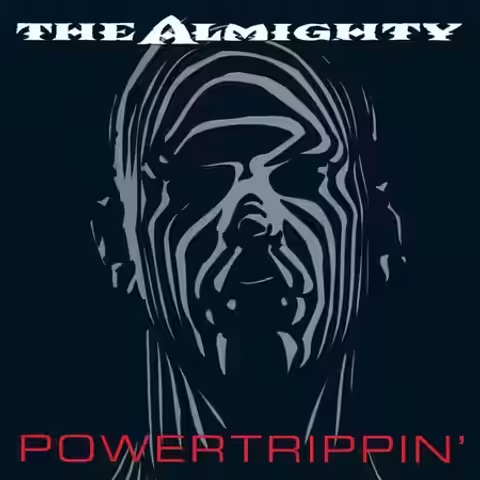
The album cover is a black-and-white photograph of an American test pilot in a 1954 pressure suit, his eyes hidden behind a darkened visor, his oxygen hose dangling like an umbilical cord. The image is Ralph Morse's Jet Age Man, lifted from the December 1954 cover of Life magazine, and on first glance it has nothing whatsoever to do with a Scottish hard rock band from Strathaven. Look at it for ten seconds and the connection becomes obvious. Powertrippin' is an album about people running on chemicals they cannot control, propelled by ambitions they cannot quite reach, sealed inside helmets nobody else can hear them screaming through. Ralph Morse, a war photographer who shot for Life for thirty years, could not have known he was making the perfect cover for a 1993 grunge-adjacent British rock record. The Almighty knew exactly what they were doing when they bought the rights.
Released by Polydor on 5 April 1993, Powertrippin' took the band into the UK Top 5 for the first and only time in their career. It was made by a lineup that had only existed for twelve months, in a residential studio surrounded by Surrey farmland, with a producer best known for engineering Judas Priest's Painkiller. It pulled them away from the spit-and-leather hard rock of their first two records and dropped them squarely into the conversation alongside Alice in Chains, Soundgarden and the louder end of British rock. And it nearly killed them, finishing the year with a cancelled European tour, a parted manager, an abandoned label and a band changing direction yet again. This is the full story.
Album Facts
| Field | Detail |
|---|---|
| Artist | The Almighty |
| Album | Powertrippin' |
| Release Date | 5 April 1993 (UK) |
| Label | Polydor (Victor Entertainment in Japan) |
| Producer | Mark Dodson |
| Studios | Ridge Farm Studios, Capel, Surrey (recording); Sawmills Studios, Golant, Cornwall (demos); Sterling Sound, New York (mastering) |
| Genre / Subgenre | Hard rock, heavy metal, grunge-influenced British rock |
| Track Count | 12 (single disc); plus 7-track Donington 1992 live bonus disc on later editions |
| Total Runtime | 58:27 |
| UK Albums Chart Peak | Number 5 (5 April 1993) |
| Other Notable Chart Peaks | Did not chart in the United States; Japanese release through Victor Entertainment |
| Certifications | None recorded; sales sat below the BPI Silver threshold of 60,000 |
| Estimated Sales | Reports vary; widely credited with around 100,000 UK sales across all formats including reissues |
| Key Singles | "Addiction" (UK No. 38), "Over the Edge" (UK No. 38), "Out of Season" (UK No. 41) |
Cultural Context: 1993 in British Rock
To understand what Powertrippin' is, you have to understand what was happening to British hard rock in the early 1990s. By the spring of 1993 the music press in the United Kingdom was effectively at war with itself. Kerrang! and Raw were still selling thousands of copies a week on the strength of grunge cover stories, while NME and Melody Maker were beginning their long pivot toward the bands that would become Britpop. The first Suede album was released on 29 March 1993, a week before Powertrippin'. Blur were finishing Modern Life Is Rubbish. Radiohead's Pablo Honey had just come out. Across the Atlantic, Pearl Jam's Vs. was still six months away but Ten was finally selling at scale, Nirvana were finishing In Utero with Steve Albini in Cannon Falls, Minnesota, and Alice in Chains were a fortnight from issuing the Jar of Flies sessions.
For a Scottish hard rock band signed to a major label in 1989, the ground was visibly tilting. The biker-rock-meets-metal pose that had carried Skid Row, The Cult and even Guns N' Roses was suddenly described in print as "old-fashioned" or, worse, "Spandex". Bands who had spent the 1980s in leather and spider-thin denim were quietly buying flannel shirts. Some, like Skid Row on Slave to the Grind and Anthrax on Sound of White Noise, met the moment with heavier, darker records. Others were dropped. The Almighty walked into Sawmills Studios at the end of 1992 knowing they had to do the first thing or risk the second.
- Suede's debut album was released a week before Powertrippin', on 29 March 1993, signalling the beginning of Britpop's media takeover.
- Iron Maiden were preparing to release A Real Live One in March 1993; The Almighty would join them as main support across Europe weeks later.
- Donington's Monsters of Rock festival was cancelled in 1993; the bands due to play it shifted to Milton Keynes Bowl, where The Almighty supported AC/DC.
- Therapy?, Skunk Anansie, Wildhearts and Manic Street Preachers were all approaching breakthrough records in the same eighteen-month window.
The Band's Story Up to This Point
The Almighty formed in the Lanarkshire town of Strathaven on 19 January 1988. Singer Ricky Warwick, drummer Stump Monroe and bassist Floyd London had played together since school in a band called Rough Charm; the line-up was completed when guitarist Andy "Tantrum" McCafferty joined them, despite all four members coming from punk rather than metal backgrounds. The contradiction would shape everything they did. They wrote like a punk band that had decided to play heavy rock, which made them harder than the glam-metal contingent and rougher than the post-punk one.
Polydor signed them in March 1989 on the strength of an eight-track demo and an enormous press buzz built almost entirely on live shows. The debut Blood, Fire & Love arrived in October 1989 to positive notices and a third-place finish in the Kerrang! readers' poll for Best New Act. A live album, Blood, Fire & Live, followed a year later. The second studio record, Soul Destruction, was released in March 1991 with Duran Duran's Andy Taylor producing, and reached UK Number 22.
By the end of 1991 the band were tour-hardened. They had supported Motörhead, Megadeth and Alice Cooper, headlined their own venues, and watched a London show at the Town and Country Club get filmed for a VHS release. They had also begun to feel constrained. The riffs Tantrum brought to the table were honest mid-tempo hard rock; the sound the rhythm section had developed on the road was darker and more elastic. In March 1992 the rift broke open. Tantrum left, citing the same "internal differences" the band would publicly acknowledge for years afterwards. He was a founding member, the writer of large parts of the first two albums, and Warwick's main creative foil. His departure could have ended the group.
"It was painful, but creatively the band needed to move on. We were getting heavier, we were getting darker, and we needed someone who could push us in that direction. We didn't have a lot of time to grieve about it."
Ricky Warwick, Classic Rock interview, 2020
The replacement came from an unexpected direction. Pete Friesen was a Canadian guitarist who had spent the previous three years in Alice Cooper's band, playing on the Hey Stoopid tour and contributing to its writing sessions. The Almighty had supported Cooper on his 1991 European leg, and Friesen and Warwick had got on. When Tantrum left, Friesen agreed to come over from North America and join. He brought a heavier, riff-orientated guitar style, a working knowledge of how American rock bands made big records, and a writer's instinct for arrangement. The Almighty that wrote Powertrippin' was, in the most literal sense, a different band from the one that wrote Soul Destruction.
Pre-production and the Friesen Effect
Friesen's arrival in spring 1992 fed almost immediately into the writing. A short Australian tour supporting The Screaming Jets was the new lineup's first work together; by the time they returned to the UK they had drafts of new songs. The summer brought the first major test. Donington Park's Monsters of Rock festival, the British rock institution, booked The Almighty as the opening act on 22 August 1992. They debuted "Addiction" in front of an audience of around 70,000, four months after Friesen's first day in the band. The performance, recorded for the BBC's Friday Rock Show, would later turn up as the bonus live disc on Japanese and special-edition pressings of Powertrippin'. It is the only commercially released document of the album's songs being played before they were properly recorded.
The writing process was unusually collaborative. Wikipedia's track-by-track credit list, taken from the album's liner notes, shows Warwick wrote all the lyrics; the music was Warwick and Friesen on every track except "Over the Edge" and "Jesus Loves You... But I Don't" (Warwick alone), "Out of Season" (a Warwick / London / Munroe rhythm-section co-write) and "Instinct" (Friesen and London). Two outside collaborators contributed. American songwriter Del James, a long-time friend of the Guns N' Roses camp who had co-written "The Garden" on Use Your Illusion I, took a writing credit on "Over the Edge" and "Instinct". Wolfsbane and Iron Maiden vocalist Blaze Bayley turned up later in sessions to provide additional backing vocals on "Jesus Loves You... But I Don't"; the two bands had been gigging on the British rock circuit together since the Wolfsbane / Almighty era of 1989.
Demos were cut in late 1992 at Sawmills Studios, the residential complex in Golant, Cornwall, that is reachable only by boat. The choice was deliberate. Sawmills had given The Stone Roses a year of Second Coming sessions and Catatonia a base for their early recordings; its tidal isolation made it perfect for a band whose internal politics had just been refigured. The Sawmills demos are believed to include a version of "Soul Destruction" recorded as a 1989 demo (later resurfaced as a B-side on the "Out of Season" single) along with early forms of much of the album.
Creating the Album
The choice of Mark Dodson as producer was the second key decision after hiring Friesen. Dodson had been a staff engineer at AIR Studios in London and had cut his teeth on records by The Cult and Iggy Pop. By the early 1990s he was building a reputation as a metal-rock producer with a forensic ear for low-end. He had engineered Judas Priest's Painkiller in 1990 with producer Chris Tsangarides, a record whose drum sound and rhythm guitar layering became a touchstone for the era. He had then produced Suicidal Tendencies' Lights... Camera... Revolution! the same year. Polydor and the band wanted that sound on a British rock album. Dodson said yes.
Sessions ran through the early months of 1993 at Ridge Farm Studios in Capel, Surrey. Ridge Farm had hosted Queen for parts of News of the World, Black Sabbath for Heaven and Hell, and Roxy Music for Avalon; by 1993 it was a thirty-year-old farmhouse complex with an SSL desk, a converted barn live room and the kind of weekend-cottage feel that suited residential rock recording. Ian Huffam took co-engineering and co-mixing credits with Dodson. Steve Bray, Dave Taylor and Phil Woods worked as assistant engineers. Greg Calbi handled mastering at Sterling Sound in New York; Calbi's credit list across his career runs from John Lennon's Walls and Bridges to Bruce Springsteen's Born to Run, and his work on Powertrippin' was one of the few American touches on a thoroughly British record.
The signature production decisions are easy to identify on playback. Stump Monroe's drums sit hard and dry in the front of the mix in the Painkiller manner, with very little reverb on snare or kick. Friesen's rhythm guitars are double-tracked tight; his lead lines are pushed up and panned wide. Warwick's vocals are recorded close, with the rasp left in. Two unusual textures recur. James Taylor, the Hammond organ player from the James Taylor Quartet (no relation to the American singer-songwriter), played piano on "Jesus Loves You... But I Don't" and Hammond on "Instinct", "Sick and Wired" and "Out of Season", thickening the mid-range. The Crazy Gang, a session backing-vocal group, were brought in for shoutalong choruses. The result is a record that sounds twice as big as Soul Destruction on the same playback equipment.
"Mark made us play harder. He'd ask for a take and you'd do it, and he'd say 'do another one, only this time mean it'. We weren't used to working that way. By the end of the record we were a lot more disciplined."
Stump Monroe, Riff Raff fanzine, July 1993
Sessions were not without friction. Reports from the time suggest the recording ran over schedule, with Friesen tracking and re-tracking guitar parts long after the others had finished their day. Polydor pushed for delivery in time for an April release; mastering was completed in New York within weeks of the final mixes leaving Surrey.
Personnel and Credits
| Role | Player | Notes |
|---|---|---|
| The Almighty | ||
| Lead vocals, rhythm guitar, acoustic and 12-string | Ricky Warwick | Wrote all lyrics on the album |
| Lead guitar | Pete Friesen | Canadian, ex-Alice Cooper. Joined April 1992 replacing Tantrum. Co-wrote most of the album with Warwick. |
| Bass, backing vocals | Floyd London | Founding member. Co-wrote "Out of Season" and "Instinct". |
| Drums, percussion, sand pipe | Stump Monroe | Founding member. Co-wrote "Out of Season". |
| Guest and session musicians | ||
| Additional backing vocals | Blaze Bayley | On "Jesus Loves You... But I Don't". Then in Wolfsbane; later Iron Maiden's vocalist 1994 to 1999. |
| Additional guitar | Mark Dodson | On "Takin' Hold". Producer-as-player credit. |
| Piano, Hammond organ | James Taylor | Piano on "Jesus Loves You..."; Hammond on "Instinct", "Sick and Wired", "Out of Season". From the James Taylor Quartet. |
| Backing vocals | The Crazy Gang | Session backing-vocal team used for shoutalong choruses. |
| Production and engineering | ||
| Producer, engineer, mixer | Mark Dodson | Engineer on Judas Priest's Painkiller; producer of Suicidal Tendencies' Lights, Camera, Revolution. |
| Engineering and mixing | Ian Huffam | Co-credit with Dodson |
| Assistant engineer | Steve Bray | |
| Assistant engineer | Dave Taylor | |
| Assistant engineer | Phil Woods | |
| Mastering | Greg Calbi | At Sterling Sound, New York. |
| Songwriting collaborators | ||
| Lyric co-write | Del James | On "Over the Edge" and "Instinct". American author and Guns N' Roses associate; co-wrote "The Garden" on Use Your Illusion I. |
| Artwork | ||
| Cover photograph | Ralph Morse | "Jet Age Man", originally shot for the cover of Life magazine, December 1954. |
The Songs
Here is the full tracklist before we dig into the standouts.
| # | Title | Writer(s) | Length | Single? | Notes |
|---|---|---|---|---|---|
| 1 | Addiction | Warwick / Friesen | 5:40 | Yes (UK 38) | Album opener, debuted live at Donington August 1992. |
| 2 | Possession | Warwick / Friesen | 4:27 | Driving second-track statement; pure Friesen-era riff. | |
| 3 | Over the Edge | Warwick / Del James | 4:36 | Yes (UK 38) | Second single; co-written with Guns N' Roses associate Del James. |
| 4 | Jesus Loves You... But I Don't | Warwick | 6:01 | Piano-led, slow build; Blaze Bayley backing vocals; James Taylor on piano. | |
| 5 | Sick and Wired | Warwick / Friesen | 4:48 | Hammond organ throughout. Live staple for years afterwards. | |
| 6 | Powertrippin' | Warwick / Friesen | 2:50 | Title track. Shortest song on the record. Pure punk DNA. | |
| 7 | Takin' Hold | Warwick / Friesen | 5:15 | Mark Dodson plays additional guitar; only producer-on-record credit. | |
| 8 | Out of Season | Warwick / London / Munroe | 5:35 | Yes (UK 41) | Third single. Only album cut without a Friesen writing credit. Hammond on the verses. |
| 9 | Lifeblood | Warwick / Friesen | 5:27 | Slow-burn ballad-tempo track; the album's most considered arrangement. | |
| 10 | Instinct | Warwick / James (lyrics); Friesen / London (music) | 5:16 | Heaviest track. Hammond organ. Second Del James co-write. | |
| 11 | Meathook | Warwick / Friesen | 4:40 | Late-album energy reset. Sticks close to the Soul Destruction template. | |
| 12 | Eye to Eye | Warwick / Friesen | 4:01 | Closing track. Acoustic and 12-string textures. The only song that openly looks back. |
Addiction
The album opens with the song that had announced its existence at Donington. "Addiction" is built around a Friesen riff that lurches in a half-bar behind the beat, a deliberately unsettled motif that gives the track its unease. Warwick's lyric is a flat, first-person account of compulsion, never specifying its object. The album's loudest production touch arrives at the chorus, where backing vocals from The Crazy Gang triple up the title word with the singer leaning in. It was issued as the lead single in March 1993 and reached UK Number 38, the highest chart position any of the album's singles would manage.
Jesus Loves You... But I Don't
The fourth track is the album's central oddity. It opens on James Taylor's piano, builds slowly through a verse Warwick sings almost speakingly, and then erupts into the loudest chorus on the record. Blaze Bayley's harmony vocal sits high in the chorus mix, an audible identification mark for any Wolfsbane or Iron Maiden fan listening closely. The lyric, despite the provocative title, is closer to a song about romantic disappointment than anti-religious provocation; Warwick has been clear in interviews that the title was chosen as a hook rather than as a thesis. Six minutes long and the second-longest cut on the album, it became the song most often cited by reviewers as evidence that the band had grown.
Powertrippin'
The title track is the shortest cut at 2:50, a deliberate reset in the middle of the record. It is the song on which the band's punk DNA shows through most clearly. The arrangement is a verse, two choruses, a riff middle and out, no solo. It is also the song that most overtly engages with the album's nominal theme: the experience of being driven by a need that is destroying you. Album titles often misdirect; this one tells the truth. By placing the title cut at track six, in the deepest part of the running order, the band signal that the rest of the album is the thing the title is describing.
Out of Season
The third single is the one song without a Pete Friesen writing credit, written by Warwick with the rhythm section in what is effectively a survivor of the pre-Friesen era. It is also one of the album's most successful arrangements, with James Taylor's Hammond organ panned hard right through the verses and a chorus that lands without resorting to The Crazy Gang. Despite reaching only Number 41 on the UK singles chart, it endured as a fan favourite and was performed at almost every Almighty headline show through the 1990s.
Eye to Eye
The album closes with the only track that genuinely looks back. "Eye to Eye" features Warwick on 12-string acoustic and is the closest the record comes to balladry. The song is a Friesen / Warwick co-write but its texture is closest to the band's earliest material. Whether its placement at the end is a deliberate gesture toward the listeners who came aboard for Blood, Fire & Love is unclear; the band have never said. Either way, it lands as a quiet exhalation after fifty-five minutes of sustained pressure.
B-sides, Outtakes and the Japanese Edition
The singles era served Powertrippin' well; the band recorded a substantial pile of B-sides, outtakes and covers across the three 1993 single campaigns, and the Japanese market got a separate EP of its own. Across the formats, the following appeared on the B-side and bonus material list. The Donington 1992 live disc, which appeared on later UK reissues and on the original Japanese edition, captures the new lineup four months into its existence playing the songs that would become the album.
- Soul Destruction (1989 Demo): a four-year-old demo of the title track from the band's second album, slipped onto the "Out of Season" single. A document of the lineup before Friesen.
- Blind (Warwick / Friesen): a Powertrippin' session outtake that did not make the album.
- In a Rut: a cover of The Ruts' 1979 single, a nod to the band's punk roots and probably the most direct stylistic confession on the record.
- Insomnia: another original outtake.
- Wild & Wonderful (Demo) and Free 'n' Easy (Demo): two demo recordings of earlier-album singles.
- Fuckin' Up: a Neil Young cover, drawn from the Ragged Glory song and slammed louder.
- Keep On Rockin' in the Free World: a second Neil Young cover, played as a hard rock anthem.
The Japanese-only EP Liveblood compiled four live tracks from the European Iron Maiden support tour with the two Neil Young studio covers. It was issued through Victor Entertainment and remains one of the rarest pieces of Almighty discography, prized by collectors for the only commercially released live recordings of the Powertrippin' lineup at full tour-strength.
Album Artwork and the Jet Age Man
Ralph Morse was a staff photographer at Life magazine for the better part of three decades. He photographed the Battle of the Bulge, the Mercury astronauts, Albert Einstein's office on the morning of Einstein's death, and the test pilots at Edwards Air Force Base in California. The photograph that became the cover of Powertrippin', titled Jet Age Man, was shot in 1954 and published as the cover of Life's 20 December 1954 issue. It shows a test pilot in full pressure suit, helmet visor lowered, the umbilicals of his life-support system trailing into the frame.
The licensing for the cover was sourced through Life's archive. The decision to use it came from the band rather than the label. Warwick has said in interviews that the image leapt out at him because it captured the inside of the album: a person sealed inside their own equipment, cut off from sound, wearing a helmet that protects them from the very thing that is keeping them alive. The black-and-white treatment is unaltered; only the album title and band logo, set in a stark sans-serif at the top, are added. The back cover and inner sleeve carry full personnel credits, the Polydor catalogue number and a series of band photographs taken in low contrast to extend the cover's monochrome palette.
Release and Reception
Polydor issued Powertrippin' on 5 April 1993 in CD, cassette and vinyl LP formats. It debuted at UK Number 5, the band's highest-ever chart position, displacing their second album's Number 22 peak by some distance. The British rock press received the record warmly. Music Week awarded it four stars in its mainstream albums preview the week of release. Kerrang! and Raw ran feature interviews with the band. Allmusic's later retrospective, written by William Ruhlmann, was less enthusiastic, awarding two stars while noting that the band had succeeded in making themselves sound bigger but at the cost of some of their character.
Comparisons to Alice in Chains were universal in 1993 reviews. The combination of Friesen's heavier rhythm guitars, Warwick's grain-rich vocal and Mark Dodson's drier production placed the album squarely in the conversation about how British rock bands were responding to the Seattle wave. Some reviewers cast this as a successful pivot; others as opportunism. The band's own response in interviews was that the album simply reflected what they were listening to and writing in 1992, and that the new material had been arrived at long before anyone had hung the grunge label on it.
"It's not a grunge record, it's a heavy rock record made by a band that grew up listening to punk. The Alice in Chains thing was lazy. We sound like us, only with a bigger guitar player."
Ricky Warwick, loudersound interview, November 2023
Sales did not match the chart peak. Although Number 5 looked spectacular on paper, the record never went silver, suggesting first-week sales of well under sixty thousand. The album's commercial trajectory was top-heavy, dropping out of the Top 40 within four weeks. Given the marketing spend Polydor put behind it, this was a disappointment.
Singles and Music Videos
| Single | Released | UK Peak | Formats | B-sides | Video |
|---|---|---|---|---|---|
| Addiction | March 1993 | 38 | CD, 12" vinyl | Live tracks, demos | Performance / narrative video for the lead single |
| Over the Edge | May 1993 | 38 | CD, cassette, 7" vinyl, 12" vinyl | Live and B-side tracks | Performance video |
| Out of Season | September 1993 | 41 | 2-CD, 7" vinyl, 12" vinyl | Soul Destruction (1989 Demo), In a Rut, Insomnia, Wild & Wonderful (Demo), Free 'n' Easy (Demo) | Performance / live-cut video |
Music videos for "Addiction" and "Over the Edge" received Top of the Pops play and rotation on the satellite-era MTV Europe channel; "Out of Season", released in late September 1993 against a much busier autumn schedule, did not quite cross over. None of the three singles broke into the UK Top 30, despite the parent album's Number 5 peak, a reminder that the British album market in 1993 still rewarded fanbase loyalty more than radio currency.
Touring and Live
The album's biggest live moment came not on the band's own tour but as main support to Iron Maiden across Europe. The tour, in support of Maiden's A Real Live One album, was the longest the band had ever undertaken and gave them nightly opening slots in front of audiences of fifteen and twenty thousand. Friesen, less than twelve months into the lineup, was now playing a heavy support tour to one of British rock's biggest exports. The band returned to England in time to play the Milton Keynes Bowl festival in summer 1993, the substitute show for the cancelled Donington Monsters of Rock, supporting AC/DC on a bill that also included Extreme.
The autumn brought their first proper US tour. Polydor's American partner pushed the band into a long club run, betting that the heavier sound and the grunge-adjacent press in Britain might translate. It did not. American audiences responded politely; American radio was preoccupied with Pearl Jam's Vs., Smashing Pumpkins' Siamese Dream and the back-half momentum of Nirvana's In Utero. The Almighty came home in November to a planned headline European tour that they had to abandon after only the first two London dates because of poor health within the band. Almost immediately, they parted company with manager Tommy Tee, left Polydor for Chrysalis, and began work on what would become Crank, the punk-rooted record released the following year that consciously moved away from the Powertrippin' sound. The lineup was already moving on.
- Spring 1993: short club run in Australia ahead of the album.
- April–June 1993: Iron Maiden European support tour, the band's longest run to date.
- Summer 1993: Milton Keynes Bowl festival, supporting AC/DC.
- September–November 1993: first American club tour. Audience response was tepid.
- November 1993: headline European tour cancelled after two London dates due to illness; band part ways with Tommy Tee and Polydor.
In TV, Film and Media
The album's songs received intermittent television exposure. "Addiction" was performed on the late-night UK rock show Raw Power and turned up in performance form on satellite-era MTV Europe rotations. The song "Bandaged Knees" from the band's later album Crank would eventually appear in the closing credits of the 1995 Channel 4 sitcom Shameless, but that placement is from the next chapter of the band's career. Powertrippin''s tracks did not enter the world of film soundtracks or video-game licensing during their original release window. Their afterlife in television and media has been quieter than the album's chart peak might suggest.
Covers, Samples and Tributes
The album itself contained two notable covers buried on its B-sides, Neil Young's "Fuckin' Up" and "Rockin' in the Free World", both from the Ragged Glory era. Cover versions of Powertrippin' tracks themselves are rare. The album sits in the unfortunate space of being well-known to fans of British rock but not famous enough for tribute albums or wide-scale interpretation. In 2025, when the band's original lineup reunited and recorded a cover of Metallica's "The Four Horsemen" for the No Life 'Til Leather tribute album, it became the first time the four founding members had been in a recording studio together since 1991. None of them had played on Powertrippin' together; Friesen, by then, was no longer a member.
Reissues, Remasters and Anniversaries
The album has had a quieter reissue life than the band's first two records. Blood, Fire & Love and Soul Destruction received expanded reissue editions in early 2015 with additional tracks and live material; Powertrippin', by virtue of being the band's last Polydor album, sat on the wrong side of a label divide for years. A 2021 box-set covered the band's post-1994 Chrysalis-era catalogue but did not include Powertrippin'. Periodic CD pressings have included the Donington 1992 live disc as a bonus, and the album is available on streaming services in its single-disc form. There has been no formal anniversary edition for either the 25th in 2018 or the 30th in 2023, and no Atmos or spatial-audio reissue has been announced.
Legacy and Influence
The album sits at the highest point of the band's commercial graph and at the precise pivot of its musical one. Within twelve months of its release, The Almighty had already begun moving away from the Powertrippin' sound on Crank, returning closer to the punk roots that had been latent in their first records. Within thirty months they had effectively dissolved. The Friesen-era lineup never quite recovered its momentum after the cancelled European tour of late 1993; reunions in 1999, 2006 and 2023 were built around the original four-piece lineup of Warwick, Tantrum, London and Munroe, with Friesen absent.
The album's influence is most visible at one remove. Warwick's subsequent career, as frontman of Black Star Riders, Thin Lizzy's modern touring iteration, and a productive solo artist, was built on the songwriting voice he found on Powertrippin'. The directness of the lyric writing, the punk-rooted economy of the arrangements, the ease with which the songs sit in either an arena or a pub, are all traceable to the methods worked out at Ridge Farm in early 1993. Black Star Riders' first album All Hell Breaks Loose in 2013, twenty years after Powertrippin', has the same fundamental DNA.
The wider British rock scene treats the record with respect rather than reverence. It does not appear on the canonical 1990s list alongside Nevermind, Vs. or Siamese Dream. It is not the British rock album that most often gets cited by 2020s revivalists. But ask anyone who was buying albums in the UK in spring 1993, and Powertrippin' will be there alongside the early Therapy?, Wildhearts and Skunk Anansie records as evidence that British rock had its own answer to grunge, made by a band who were heavier and stranger than the press at the time gave them credit for.
"For me, Powertrippin' was the moment we became the band we were always meant to be. Pete coming in changed everything. We made the heaviest record of our career and it went to Number 5. I'm proud of it."
Ricky Warwick, loudersound interview, November 2023
Things You Might Not Know
| Fact | Detail |
|---|---|
| The Number 5 ceiling | Powertrippin' is the only Almighty album to reach the UK Top 5; the band's other studio albums peaked between Number 15 and Number 154. |
| Tantrum's last day | Founding guitarist Andy "Tantrum" McCafferty left in March 1992; he would not be in the same room as the other three founding members again until February 2023. |
| How Friesen was found | Pete Friesen was an Alice Cooper sideman; he and Warwick met when The Almighty supported Cooper on his European leg of the Hey Stoopid tour in 1991. |
| Donington debut | "Addiction" was first played live to about 70,000 people at the Monsters of Rock festival on 22 August 1992, before it had been recorded in studio form. |
| The Blaze Bayley link | The future Iron Maiden vocalist sang backing vocals on "Jesus Loves You... But I Don't" while still in Wolfsbane, two years before joining Maiden. |
| The Del James connection | American writer Del James, who co-wrote "Over the Edge" and contributed lyrics to "Instinct", had previously co-written "The Garden" on Guns N' Roses' Use Your Illusion I. |
| The James Taylor on the record | The keyboard player on four tracks is James Taylor of the James Taylor Quartet, not the American singer-songwriter of the same name. |
| Painkiller pedigree | Producer Mark Dodson had engineered Judas Priest's Painkiller in 1990 with Chris Tsangarides; the rhythm-guitar layering on Powertrippin' owes a clear debt to that record. |
| Sawmills Studios | The album was demoed at Sawmills in Cornwall, a residential studio reachable only by boat, the same studio later used by Catatonia, The Stone Roses and Supergrass. |
| Greg Calbi mastered it | The mastering credit went to Greg Calbi at Sterling Sound, New York, the same engineer who had mastered Bruce Springsteen's Born to Run. |
| The Crazy Gang shoutaloud | The thick male-voice backing vocals on "Addiction" and other tracks were sung by The Crazy Gang, a session backing-vocal group used on countless British rock records of the era. |
| Sand pipe credit | Stump Monroe's liner-notes credit lists "drums, percussion, sand pipe", the only mention of a sand pipe on any major-label British rock record of the year. |
| The Jet Age Man rights | The cover photograph was licensed from the Time/Life archive; Ralph Morse himself was still alive in 1993 and would live until 2014. |
| Liveblood Japan-only | The Japan-only EP Liveblood, comprising four Iron Maiden tour live tracks and the two Neil Young covers, was issued by Victor Entertainment and remains one of the rarest items in the band's discography. |
| The cancelled tour | The European headline tour that was meant to follow the US run in late 1993 was abandoned after only two London dates; within weeks the band had left Polydor, parted with manager Tommy Tee and signed to Chrysalis. |
The Riffology Podcast
The Riffology podcast goes behind the riffs that defined a generation of British and American hard rock. From the Scottish hard rock scene that produced The Almighty to the grunge explosion that reshaped the records they were competing against, the show breaks down the albums, the players and the stories that made them. Available on Apple Podcasts, Spotify, Amazon Music and every other major platform, plus directly through this site.
Comments