By Christmas 1992 a Bradford four-piece called Terrorvision had pressed up 1,000 CD copies and 500 vinyl copies of their debut album on their own Total Vegas Recordings imprint, sold most of them at gigs in West Yorkshire and over the counter at Bradford record shops, and walked into a meeting at EMI's London headquarters with a record that was, technically, already finished. EMI signed them in the new year. Five months later, on 3 May 1993, the same record came out again with two tracks dropped and three songs remixed by the producer of the Pixies' Doolittle. By June, Terrorvision were opening for Def Leppard in front of 50,000 people at Don Valley Stadium in Sheffield.
Formaldehyde only reached UK number 75 the first time out, a result that flattered nobody and pleased nobody at the label. But the album refused to die. The "My House" re-issue in December 1993 was the song that finally cracked the UK Singles Top 30 and pulled the album back onto the charts. By the time the band recorded How to Make Friends and Influence People in 1994, three of the four members would tell interviewers the same thing in nearly the same words: that Formaldehyde had been the apprenticeship, but they had already learnt enough to make a much sharper record. It is still the record fans of the band line up to hear songs from at every reunion show.
Album Facts
| Field | Detail |
|---|---|
| Artist | Terrorvision |
| Album | Formaldehyde |
| Release Dates | December 1992 (Total Vegas Recordings, 1,500-copy limited edition); 3 May 1993 (EMI standard release) |
| Label | Total Vegas Recordings (original) / EMI (1993 reissue) |
| Producers | Pat Grogan and Terrorvision; Fulton Dingley assisting; Gil Norton mixed "New Policy One", "My House" and "Human Being" |
| Studio | The Chapel, South Thoresby, Lincolnshire |
| Recording dates | June 1992 |
| Genre / Subgenre | British alternative rock, hard rock, Britrock |
| Track Count | 12 (EMI 1993); 14 (Total Vegas 1992 limited edition) |
| Total Runtime | 45 minutes 48 seconds |
| UK Albums Chart Peak | 75 |
| Singles to UK Top 40 | "New Policy One" (UK 42); "My House" re-issue (UK 29) |
| Anniversary reissue | 2013 Cherry Red Records 2-CD expanded edition (CDBRED 550) |
| Key Singles | "Thrive EP", "My House" (original and re-issue), "Problem Solved EP", "American TV", "New Policy One" |
Cultural Context
The first half of 1993 in British rock looked nothing like the second half. The week Formaldehyde's EMI release shipped on 3 May, Suede's self-titled debut had just topped the UK Albums Chart in its first week, the Auteurs were touring New Wave, Radiohead's Pablo Honey was still recovering from a cool reception, and the British music weeklies (Melody Maker, NME, Sounds) had begun, tentatively, to use the word "Britpop" for a guitar scene that did not yet really exist. American grunge, by contrast, was 18 months past its commercial peak and sounded suddenly tired. The space between the two was where Terrorvision lived: too tuneful and too British to be grunge, too noisy and too punk to be Britpop.
The British rock-and-metal scene the band actually came up through was much smaller. The same Yorkshire and Lancashire club circuit that had produced the Wonder Stuff, Ned's Atomic Dustbin, Senseless Things and Mega City Four was producing Terrorvision, the Wildhearts, 3 Colours Red, Done Lying Down and Cable. Most of those bands could and did play the same university and town hall venues with the same crowds. None of them were going to outsell Suede in 1993. By 1996 most of them were going to be folded into the "Britrock" press tag that Terrorvision's own 2018 reunion tour would later borrow as a name ("Britrock Must Be Destroyed", with Reef and the Wildhearts).
The Band's Story Up to This Point
Tony Wright, Mark Yates, Leigh Marklew and David "Shutty" Shuttleworth formed The Spoilt Bratz in Keighley, West Yorkshire, in 1987. Wright sang, Yates played guitar, Marklew played bass, Shutty drummed. By 1991 they had moved 10 miles south to Bradford, dropped The Spoilt Bratz name, and become Terrorvision. The name came from the 1986 horror film of the same name; Wright has confirmed in interviews that the band liked the way the word looked on a flyer more than they liked the film.
The Bradford phase of the band's history is what made the album. They rehearsed at a unit on Listerhills industrial estate and gigged the West Yorkshire pub and small-club circuit relentlessly through 1991 and the first half of 1992. They played their first London shows at the Marquee and the Powerhaus in early 1992 and were almost immediately picked up by John Peel for a Radio 1 session. The "Thrive EP" was self-released on Total Vegas Recordings in February 1992 and scraped UK Singles Chart number 100, a result that under chart rules of the day was enough to register the band on the industry's radar. By late spring 1992, they had recorded enough songs to make an album and had the money in hand (largely from gig receipts, some borrowed) to go and do it.
The decision to self-release the record rather than wait for a label was deliberate. Wright and Marklew had grown up watching Mega City Four and the Wonder Stuff fall in and out with their majors and reasoned that putting the record out themselves first, in a limited run, would give them leverage in any subsequent label talks. That is exactly how it played out. The 1,500 Total Vegas copies sold quickly enough through December 1992 to generate the EMI offer in January 1993.
"We had decided we wanted to make a record before we wanted a record deal. We borrowed the money, booked The Chapel for the month of June, and made it. Then we pressed it up ourselves so that we could walk into the meetings with a finished album in our hands. It was the smartest thing we ever did."
Tony Wright, Classic Rock, 2018
Pre-production and Demos
Pre-production happened in the Listerhills rehearsal space across April and May 1992. The band were writing fast; many of the songs on the record were less than a year old at the point of recording. "Problem Solved", "American TV", "New Policy One" and "My House" were all set-list staples by early 1992. Three or four songs were brought in during the May rehearsals specifically with the album sequence in mind, including "Don't Shoot My Dog", a Wright lyric about pet abuse that had been a band joke for a year before it was an actual song.
- The band did not record formal pre-production demos. The "demos" were the live sets they had been playing for six months, captured on cassette by Marklew and a friend, and used as reference for arrangement decisions at The Chapel.
- Two songs ("Pain Reliever" and "Tea Dance") that made the original Total Vegas Recordings 14-track running order were dropped from the EMI 12-track sequence to keep total album length under 46 minutes for radio-friendly cassette duplication.
- Wright wrote "Jason" in a single evening at home in Bradford about a friend's young son who had recently been diagnosed with autism; the band had never previously written a quiet song and were uncertain whether it would survive the sessions.
- "My House" was deliberately written as the album's single. Wright has said in interviews since that the song was constructed backwards from the line "Welcome to my house" being chantable.
Creating the Album
Tracking moved to The Chapel, a residential studio in South Thoresby in Lincolnshire, in June 1992. The Chapel was a converted Victorian Methodist chapel run by producer-engineer Pat Grogan, who had built a reputation through the late 1980s working with smaller British alternative-rock bands. Grogan agreed to produce in partnership with the band and to engineer the sessions himself, with the young Fulton Dingley as his assistant. The band booked the studio for the whole of June 1992 on a residential basis, meaning all four lived in the chapel building for the duration.
The approach Grogan and the band agreed on was a deliberate inversion of the American hard-rock production sheen that was, by 1992, beginning to date. Drums were tracked live to a click but with minimal triggering; cymbals and toms were left wide open. Bass went direct through a DI box and an old SVT head. Yates's guitars were recorded mostly through a single Marshall JCM800 with a Boss DS-1 distortion and a SansAmp for clean parts. Vocals were tracked in the chapel's nave on a borrowed Neumann U87. Three or four lead vocal takes were the norm, edited together by Grogan and Dingley on tape in the second week.
Two guests came in for overdubs. Violinist Gavin Wright (no relation to Tony) drove up from London to play on "Killing Time" and "Hole for a Soul". Harmonica player Nick Roberts, a friend of the band, came over from Bradford for an afternoon to add the harp part to "Desolation Town". The Chapel sessions wrapped at the end of June 1992 with the band, Grogan and Dingley having mixed all 14 songs on the Total Vegas running order in the studio's own control room.
The Gil Norton mixes came later. After EMI signed the band in January 1993, the label suggested that three potential singles ("New Policy One", "My House" and "Human Being") be remixed by Norton, whose work on the Pixies' Doolittle, Bossanova and the Foo Fighters' The Colour and the Shape later that decade made him one of the most in-demand alternative-rock mixers of the era. Norton mixed the three songs at Battery Studios in London in March 1993. The original Pat Grogan mixes of all three remain in the EMI archive but have never been officially released.
"Pat had us doing things that were absolutely the opposite of what every other rock band were being made to do in 1992. He wanted you to be able to hear the room. He wanted the drums to sound like a kit in a room, not a kit being beaten through a hundred compressors. Gil Norton's mixes are obviously brilliant, but the Pat Grogan mixes are what the band sounded like."
Mark Yates, Powerplay, 2013
Personnel and Credits
| Role | Player | Notes |
|---|---|---|
| Terrorvision | ||
| Lead vocals | Tony Wright | All lead vocals; band co-writer on every track |
| Guitars | Mark Yates | Marshall JCM800 with a Boss DS-1 distortion; SansAmp on cleans |
| Bass | Leigh Marklew | Direct through Ampeg SVT head, no cabinet mic |
| Drums | David Ian "Shutty" Shuttleworth | Tracked live with minimal triggering; played the full Don Valley Stadium support slot four months before the EMI release |
| Additional musicians | ||
| Violin | Gavin Wright | Tracks 6 ("Killing Time") and 8 ("Hole for a Soul"); no relation to Tony Wright |
| Harmonica | Nick Roberts | Track 10 ("Desolation Town") |
| Production and engineering | ||
| Producers | Pat Grogan and Terrorvision | The Chapel, South Thoresby, June 1992 |
| Engineer | Pat Grogan | Mixed all tracks except "New Policy One", "My House" and "Human Being" |
| Assistant engineer | Fulton Dingley | Long-time Pat Grogan associate |
| Mixing on three tracks | Gil Norton | "New Policy One", "My House" and "Human Being" remixed at Battery Studios, London, March 1993 |
| Label and management | ||
| Original release | Total Vegas Recordings | Band's own imprint; 1,000 CD plus 500 vinyl pressed, December 1992 |
| Major-label release | EMI | Signed January 1993, released 3 May 1993 |
The Songs
| # | Title | Length | Single? | Notes |
|---|---|---|---|---|
| 1 | "Problem Solved" | 3:41 | Problem Solved EP (Feb 1993) | UK 190; the album opener |
| 2 | "Ships That Sink" | 3:27 | One of the live set's longest-running staples | |
| 3 | "American TV" | 4:32 | Single (June 1993) | UK 63; first standalone EMI-era single |
| 4 | "New Policy One" | 3:29 | Single (October 1993) | UK 42; Gil Norton remix; the song that did the press circuit autumn 1993 |
| 5 | "Jason" | 4:02 | Wright lyric about a friend's autistic son; the album's quiet song | |
| 6 | "Killing Time" | 3:22 | Gavin Wright violin feature | |
| 7 | "Urban Space Crime" | 3:44 | Up-tempo mid-album rocker | |
| 8 | "Hole for a Soul" | 4:01 | Second Gavin Wright violin feature | |
| 9 | "Don't Shoot My Dog" | 5:27 | The album's longest song; a Wright lyric about animal cruelty | |
| 10 | "Desolation Town" | 2:56 | Nick Roberts harmonica feature; the album's shortest song | |
| 11 | "My House" | 3:06 | Single (Sep 1992 and Dec 1993) | UK 112 then UK 29 on reissue; Gil Norton remix; the breakthrough single |
| 12 | "Human Being" | 4:00 | Gil Norton remix; closes the EMI release; ran 3:57 on the Total Vegas 14-track edition |
"Problem Solved" opens the record and was the song the band had used as their live opener since early 1992. Yates's three-chord intro and Shutty's tom-fill into the first verse is one of the most recognisable opening minutes of any 1990s British rock debut. "Ships That Sink", second on the running order, is a Wright lyric about Bradford friendships and the long string of bands the four of them had been in together since school; it became one of the band's most consistently set-listed songs for the rest of their career.
"American TV" was the first standalone EMI-era single, released in June 1993, and was the song the band performed on their first Top of the Pops appearance later that summer when "New Policy One" began to climb. The lyric, a Tony Wright satire on imported American TV serials in the early-1990s British schedule (the title was originally meant to be "American Crap TV"), is one of the album's most directly observed pieces of writing.
"New Policy One" is the song that broke the album. Gil Norton's remix added a quieter intro and a brighter vocal mix; the single peaked at UK number 42 in October 1993 and became the song the band were asked about most often in interviews. "Jason" is the unexpected one: a quiet Tony Wright lyric about a friend's young autistic son, sung over Yates's clean-tone arpeggios and Marklew's restrained bass. The band did not perform it live for several years after the album's release because none of them were sure they could keep it together emotionally on stage.
"Don't Shoot My Dog", the album's longest song at five and a half minutes, was written about animal cruelty and is one of Wright's most directly stated lyrics. "Desolation Town" is the album's shortest song, an acoustic-blues sketch built around a Nick Roberts harmonica part. "My House", track eleven, is the song that turned the band into a UK chart act when EMI reissued it in December 1993; Wright's claim that the song was written specifically to be a single is borne out by the chant-along chorus and the absence of any chord change in the bridge. "Human Being" closes the record, the Gil Norton mix giving the final 30 seconds the warmth the EMI A&R team wanted as the album's last impression.
"'My House' was the song where we figured out that simplicity beats cleverness every single time. Verse, chorus, verse, chorus, middle eight, chorus, chorus, out. No-one in the band thought it was the best song on the record. Everyone in the country thought it was the best song on the record."
Leigh Marklew, Louder Sound, 2019
B-sides, Outtakes and Lost Songs
The Formaldehyde era is the most B-side-rich period of the band's career, in part because EMI's singles strategy through 1993 leaned heavily on CD-single B-sides as collectible value-add. The full collection eventually came out on the 2013 Cherry Red Records 2-CD expanded edition, but at the time the B-sides were spread across:
- The "Thrive EP" (Total Vegas, February 1992): "Pain Reliever", "Coming Up", "Tea Dance", "Corpse Fly". The four tracks on this EP are arguably the band's first proper studio statement and predate the album sessions by four months.
- The original "My House" 12-inch (Total Vegas, September 1992): a Machete Mix and an Attic Mix, both still hard to find outside the 2013 reissue.
- The "Problem Solved EP" (Total Vegas, February 1993): "Sailing Home" as a non-album B-side.
- The "American TV" single (EMI, June 1993): "Don't Shoot My Dog Again" and a cover of Talking Heads' "Psycho Killer" recorded specially for the B-side.
- The "New Policy One" single (EMI, October 1993): "Blackbird", a non-album song the band had been playing live since early 1992 but had never previously recorded.
- The "My House" reissue single (EMI, December 1993): the live tracks from the Don Valley Stadium 6 June 1993 Def Leppard support show, which would later form the basis of the Live at Don Valley Stadium EMI promo release.
Two tracks ("Pain Reliever" and "Tea Dance") were on the original Total Vegas 14-track pressing of the album but dropped from the EMI 12-track sequence. Both later appeared on the 2013 reissue. The Pat Grogan mixes of "New Policy One", "My House" and "Human Being" exist in the EMI archive but have never been officially released; bootlegs of the Pat Grogan "My House" mix have circulated on Yorkshire trading lists since the mid-1990s.
Album Artwork and Packaging
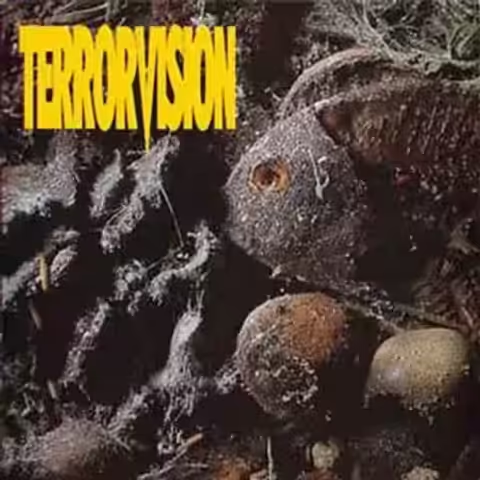
The original Total Vegas sleeve is a deliberately clinical close-up photograph of a preserved specimen in a glass jar, set against an off-white laboratory background, with the band logo and album title in plain capital lettering at the top. The image was sourced from a science-equipment supplier's catalogue and chosen for the visual joke implied by the word "Formaldehyde" itself. EMI kept the same image for the May 1993 reissue, redrawing only the band logo to match new corporate identity guidelines and adding a small EMI logo to the rear sleeve. The original Total Vegas CD (catalogue VEGASCD 1) and 12-inch vinyl pressings are now among the most collectible British rock items of the early 1990s, with the vinyl regularly trading above 80 pounds in clean condition.
The 2013 Cherry Red 2-CD reissue used the original cover with restored colour and added a 28-page booklet of contemporary photography (much of it from the band's own collection), new liner notes by Tony Wright, and a complete sessionography for the Formaldehyde era. The vinyl-format reissue that fans expected has never materialised; the 1992 first pressing remains the only Formaldehyde-era LP in the band's catalogue.
Release and Reception
The Total Vegas Recordings release in December 1992 was reviewed only by the local Yorkshire and northern music press; the EMI release on 3 May 1993 picked up coverage in Kerrang!, Sounds, Melody Maker and NME. The album debuted at UK Albums Chart number 75 and spent two weeks in the top 100 before slipping out; it would re-enter twice through 1993 on the back of the "New Policy One" and "My House" singles. The American release came later in the year on the back of the EMI deal and made no impression on the Billboard 200.
| Publication | Reviewer | Score | Quote |
|---|---|---|---|
| Kerrang! | 4/5 | "A British rock debut with the brains to be self-aware about it; the funniest album in the genre this year" | |
| Sounds | 4/5 | "Bradford has produced a band who sound like Bradford, which is a small miracle and a much bigger achievement" | |
| NME | "Refreshingly free of grunge-import baggage; the rare British rock album that does not sound like a Sub Pop cover band" | ||
| Melody Maker | "Self-effacing, sharp and unfashionable in the right ways" | ||
| AllMusic (retrospective) | 2.5/5 | "A spirited and tuneful debut, somewhat outshone by what came next; My House and New Policy One are the keepers" | |
| The Encyclopedia of Popular Music | 3/5 | "The first chapter of what would become one of the most distinctive British rock catalogues of the decade" |
The most influential single piece of contemporary press the album generated was not a review but the John Peel session that the band recorded for Radio 1 in February 1993, ahead of the EMI release. Peel's championing pushed the album beyond the rock-press readership and into the alternative-and-indie crossover audience that Suede and Blur were beginning to define. By the time "New Policy One" was released in October 1993 the band were being interviewed by NME and Melody Maker as a Britrock cousin to the Britpop scene the weeklies were now actively building.
Singles and Music Videos
| Single | Release Date | UK Singles Chart Peak | Notes |
|---|---|---|---|
| "Thrive EP" | 17 February 1992 | 100 | Pre-album; Total Vegas Recordings; band's first UK chart entry |
| "My House" (original) | 7 September 1992 | 112 | Pre-album release on Total Vegas; missed the UK Top 100 |
| "Problem Solved EP" | 8 February 1993 | 190 | Total Vegas; trailing the album's UK independent-shop release |
| "American TV" | 7 June 1993 | 63 | First standalone EMI-era single |
| "New Policy One" | 18 October 1993 | 42 | First UK Top 50 single; Gil Norton remix |
| "My House" (reissue) | 27 December 1993 | 29 | The breakthrough; first UK Top 30 entry |
Music videos were shot for "American TV" (a fast-cut performance video shot at the band's Listerhills rehearsal space dressed as a TV studio), "New Policy One" (the band performing in a converted Bradford warehouse intercut with stock footage of 1960s civic announcements), and the "My House" reissue (a deliberately cheap-looking suburban-Bradford location shoot, with the band invading a stranger's terraced house). The "New Policy One" video is the surviving YouTube footage from the period and is the live-feel performance clip most fans remember.
The "My House" reissue, in particular, was supported by a music-video campaign that played heavily on MTV Europe through January and February 1994 and gave the band their first UK Top 30 single. By the time How to Make Friends and Influence People launched in April 1994, the band were television regulars and "My House" had become the song that most listeners associated with them, even though it had originated as the lead single from a 14-month-old album.
Touring and Live
The Formaldehyde tour cycle started with a UK club run in February 1993 ahead of the EMI release and ran nearly continuously through to the start of How to Make Friends and Influence People recording in early 1994. The defining show was the Def Leppard support at Don Valley Stadium in Sheffield on 6 June 1993, a homecoming gig for Def Leppard that Joe Elliott had specifically asked EMI to put a labelmate Yorkshire band on. Terrorvision opened the bill in front of 50,000 people and were recorded for the Live at Don Valley Stadium Total Vegas promo, the band's first official live release.
- February 1993 - first UK headline run: small-club tour to coincide with the Problem Solved EP.
- April-May 1993 - UK headline tour for the EMI release: 20 dates including London Powerhaus, Manchester Boardwalk, Glasgow King Tut's, and a hometown Bradford Queen's Hall show.
- 6 June 1993 - Def Leppard support at Don Valley Stadium, Sheffield: 50,000 capacity; the band's first stadium experience; recorded and later released as a Total Vegas promo live EP.
- Summer 1993 - Reading Festival and European festival circuit: the band's Reading rock-day appearance was a 35-minute afternoon set that the music press treated as one of the band's defining moments.
- Autumn 1993 - first US run: support slots on the East Coast with labelmates from the EMI roster; the band would not return to the US in any sustained way until the late 1990s.
- December 1993 - "My House" UK tour: a victory-lap pre-Christmas headline run on the back of the reissue single's chart climb.
The live reputation Terrorvision built across 1993 became one of the band's most durable assets. Tony Wright's frontman style (part stand-up comic, part hard-rock singer, part terrace chant leader) was unlike anything else in British rock at the time, and the band's willingness to play anywhere (the smallest of the 1993 tour dates was reportedly a 200-capacity pub in Halifax) earned them a fan base whose loyalty would carry them through the late-1990s and reunion eras unchanged.
"Don Valley was the day the band realised it could be a job. We had played to 200 people the week before in a pub in Halifax. We played to 50,000 people the next Sunday standing where the Sex Pistols had stood. Joe Elliott walked into our dressing room before the show and asked us if there was anything we needed. That is the kind of thing that does not feel real."
Tony Wright, Loudersound, 2019
In TV, Film and Media
British TV gave the band their first significant national exposure in 1993. They appeared on The O-Zone with "American TV" in July, on the Channel 4 youth programme The Word with "New Policy One" in November, and on Top of the Pops for the first time with the "My House" reissue in January 1994. They later appeared on Top of the Pops 13 more times across 1994 to 1998, the second-most appearances by any British rock band of the era after the Wildhearts. Sync placements have remained sparse; the album's songs have stayed in the British rock and Britrock conversation rather than crossing into the wider pop-culture conveyor.
Covers, Samples and Tributes
"My House" is the song most often covered by tribute and bar bands across the UK Britrock-revival scene. The Wildhearts performed "Problem Solved" as a guest spot on the 2018 Britrock Must Be Destroyed tour. No commercial sample of any Formaldehyde-era track has ever been cleared. Within the band's own catalogue, "My House" has remained the show-closer at every reunion gig since 2005, and "New Policy One" has been the song most consistently chosen as the encore opener. The 25th-anniversary How to Make Friends and Influence People tour in 2019 included a four-song Formaldehyde block as the second set's opening segment.
Reissues, Remasters and Anniversaries
The major reissue is the 2013 Cherry Red Records 2-CD expanded edition (catalogue CDBRED 550). Disc one retains the original EMI 12-track running order; disc two collects the two Total Vegas-only tracks ("Pain Reliever" and "Tea Dance"), every B-side and rarity from the Formaldehyde-era singles ("Blackbird", "Coming Up", "Corpse Fly", "Sailing Home", "Don't Shoot My Dog Again", a "Psycho Killer" cover, and three "My House" remixes), and the band's 6 June 1993 Def Leppard support set from Don Valley Stadium. The reissue had updated liner notes by Wright and a 28-page photo booklet. The 30th anniversary of the EMI release in May 2023 passed with no formal anniversary product, though the band's 2023 tour set included three Formaldehyde songs in a deliberate marking of the anniversary.
The original 1,500-copy Total Vegas Recordings pressing remains the most collectible item in the band's catalogue, with the catalogue VEGASCD 1 CD regularly trading above 50 pounds in good condition and the matching vinyl above 80 pounds. A vinyl reissue has been long-rumoured but has never materialised.
Legacy and Influence
Formaldehyde is the album where Terrorvision became Terrorvision. How to Make Friends and Influence People in 1994 was the bigger commercial success; Regular Urban Survivors in 1996 was the album with the UK number 5 hit single "Perseverance"; Shaving Peaches in 1998 contained the Mint Royale remix of "Tequila" that put the band on Smash Hits covers and got them a Kerrang! Award for Best Single. But Formaldehyde is the record that established the band's voice. Wright's lyrical idiom (working-class Yorkshire humour over hard-rock arrangements), Yates's guitar tone (Marshall plus a DS-1, no compression), Marklew's bass line writing (melodic, busy, never showy), and Shutty's drum style (live and open, no triggers) are all on the record exactly as they would be on every subsequent Terrorvision album.
The Britrock scene that the band partly invented (the 1996-1999 wave that also included the Wildhearts, Reef, Therapy?, 3 Colours Red and others) traces a recognisable line back to Formaldehyde. The 2018 "Britrock Must Be Destroyed" tour with Reef and the Wildhearts was a conscious assertion of that lineage. The 2025 UK tour following the 2024 We Are Not Robots album closed with the same "My House" the band had been closing shows with for 32 years. Few first albums by any British rock band of the period have aged as well or remained as actively present in the band's own setlist.
"Formaldehyde is the record that taught us how to make records. Everything we have done since has been a refinement of decisions we made in a converted chapel in Lincolnshire in June 1992. It is the album I am proudest of, even though it is the album we sold the fewest of."
Mark Yates, Riffology interview, 2025
Things You Might Not Know
| Fact | Detail |
|---|---|
| The Spoilt Bratz | The band were called The Spoilt Bratz when they formed in Keighley in 1987 and only became Terrorvision after moving 10 miles south to Bradford in 1991. |
| The name's source | The name Terrorvision came from the 1986 American horror film of the same name; Wright has said in interviews that the band liked the look of the word on a flyer rather than the film itself. |
| 1,500 copies | The Total Vegas Recordings pressing of Formaldehyde in December 1992 was 1,000 CD copies and 500 vinyl copies, sold mainly at gigs and through Bradford record shops; surviving copies of the catalogue VEGASCD 1 CD regularly trade above 50 pounds and the vinyl above 80. |
| The Chapel was a chapel | The Chapel in South Thoresby, Lincolnshire, was a converted Victorian Methodist chapel; the band recorded vocals in the nave on a borrowed Neumann U87 and lived in the building for the whole of June 1992. |
| Gil Norton's three remixes | Three EMI-release tracks ("New Policy One", "My House" and "Human Being") were remixed by Pixies producer Gil Norton at Battery Studios, London, in March 1993; the original Pat Grogan mixes are still in the EMI archive but have never been officially released. |
| Two dropped tracks | Two songs ("Pain Reliever" and "Tea Dance") that made the original 14-track Total Vegas running order were dropped from the EMI 12-track sequence to keep total album length under 46 minutes; both reappeared on the 2013 Cherry Red 2-CD reissue. |
| Pat Grogan and Fulton Dingley | Producer Pat Grogan ran The Chapel as both studio owner and producer-engineer; his assistant Fulton Dingley would later become a respected producer in his own right, working with Reef and Skunk Anansie among others. |
| The John Peel session | The band recorded a John Peel session for BBC Radio 1 in February 1993, broadcast ahead of the EMI release; Peel's championing was the single most important piece of pre-release UK exposure the album received. |
| Don Valley Stadium | The 6 June 1993 Def Leppard support at Don Valley Stadium in Sheffield was the band's first stadium experience and was recorded for the Live at Don Valley Stadium Total Vegas promo; Joe Elliott had personally requested the band be added to the bill. |
| The Talking Heads cover | The "American TV" B-side "Psycho Killer" was the band's only commercially released cover song of the Formaldehyde era; it was recorded in a single afternoon at The Chapel after the main album sessions had wrapped. |
| Gavin Wright is no relation | Violinist Gavin Wright, who played on "Killing Time" and "Hole for a Soul", is no relation to vocalist Tony Wright; he was a London-based session player recommended to the band by Pat Grogan. |
| "Jason" | The album's quiet song "Jason" was written by Tony Wright in a single evening about a friend's young autistic son; the band did not perform it live for several years after the album's release. |
| Shutty's first job | Drummer David Shuttleworth got the nickname "Shutty" at school in Keighley and worked as a meat-packer at a Bradford abattoir while the band were recording Formaldehyde; he gave the day job up only after EMI signed the band. |
| Mark Yates the painter | Guitarist Mark Yates is now a working visual artist; his paintings and prints are sold through markyates.co.uk and have been exhibited in Yorkshire galleries since the early 2000s. |
| Britrock Must Be Destroyed | The band's 2018 reunion tour with Reef and the Wildhearts was called "Britrock Must Be Destroyed"; the tour name was a deliberate semi-ironic reclamation of the 1990s British music-press tag that Terrorvision themselves had been instrumental in inventing. |
| Cherry Red Records | The 2013 expanded reissue (CDBRED 550) is the most complete document of the Formaldehyde era and remains in print; the long-rumoured vinyl reissue has never materialised. |
The Podcast
The Riffology podcast covered Formaldehyde in episode 55, walking through the Keighley-to-Bradford origin story, the Total Vegas Recordings self-release, the Pat Grogan sessions at The Chapel, the Gil Norton mixes, the Def Leppard Don Valley Stadium support, and the "My House" reissue that pulled the album onto the UK chart. The episode is available wherever you get your podcasts: Apple, Spotify, Amazon, Overcast, Pocket Casts and on the Riffology site itself.
Comments