By the time Pink Floyd booked Studio Three at EMI to begin a follow-up to The Dark Side of the Moon, they had already achieved every rock-star ambition they had ever held. They spent the first six weeks of the sessions playing darts, firing an air rifle around the control room, drinking, and recording wine glasses. Wish You Were Here is what they made when, against the odds, they stopped procrastinating.
The record's centrepiece is a 26-minute elegy in nine parts for Syd Barrett, the founder Pink Floyd had effectively replaced seven years earlier. While the band were mixing it, an overweight stranger with a shaved head and shaved eyebrows wandered into Studio Three carrying a plastic bag, watched a playback for a while, and left. None of them recognised him at first. It was Syd. Almost everything Wish You Were Here is about lined up in the room for one afternoon and then walked out again.
Wish You Were Here Album Facts
| Field | Detail |
|---|---|
| Artist | Pink Floyd |
| Album | Wish You Were Here |
| Release Date | 12 September 1975 (UK) / 13 September 1975 (US) |
| Label | Harvest Records (UK/Europe), Columbia Records (US) |
| Producer | Pink Floyd |
| Studio | EMI Studios (now Abbey Road), Studio Three, London |
| Recording Dates | 13 January – 28 July 1975 |
| Genre / Subgenre | Progressive rock, art rock, experimental rock, concept album |
| Track Count | 5 |
| Total Runtime | 44:05 |
| Billboard 200 Peak | #1 (week 2) |
| UK Albums Chart Peak | #1 (week 2; debut #3) |
| Other Notable Chart Peaks | #1 Italy, Netherlands, New Zealand, Finland, Spain, Australia; UK #1 again as recently as December 2025 |
| Certifications | RIAA 7x Platinum (12 December 2025), BPI 3x Platinum, SNEP Diamond (France), 4x Platinum Italy, 7x Platinum Australia |
| Estimated Sales | ~20 million worldwide |
| Lead Single | Have a Cigar / Welcome to the Machine (US double A-side, November 1975) |
Cultural Context: A Music Industry Pink Floyd No Longer Recognised
By the autumn of 1975 the band whose 1973 album had spent more than a hundred consecutive weeks on the Billboard 200 were not the only people working out what to do next. Bruce Springsteen released Born to Run a fortnight before Wish You Were Here arrived in shops; Patti Smith's Horses dropped two months later; the Sex Pistols played their first gig that November. The progressive-rock peers Pink Floyd had grown up alongside were still in the ascendant , Yes had put out Relayer the previous Christmas, Genesis were about to make A Trick of the Tail without Peter Gabriel , but the cultural ground was visibly moving under them.
The music business itself looked different too. Pink Floyd's North American contract had just shifted from EMI's Capitol affiliate to Columbia Records on a deal large enough to set the label's all-time pre-order record. Manager Steve O'Rourke and the band had spent years feeling that Capitol under-promoted them in the US; Columbia signed a band whose previous album was still in the chart and were rewarded with 900,000 advance orders for an album whose title and cover image had not yet been published. That handshake, all by itself, was part of what Wish You Were Here would end up sneering at.
The Band's Story Up to This Point
Pink Floyd had spent the eighteen months since The Dark Side of the Moon being a different kind of band from the one that recorded it. Dark Side had not only made them rich; it had bought them, in Mason's words, "gargantuan popularity" and an unending second life on FM radio that has since outlasted careers. The 1974 European and British tour had introduced three new songs (Shine On You Crazy Diamond, Raving and Drooling, You Gotta Be Crazy) and a critical review in NME from Nick Kent that Mason later credited with shaming them back into the studio.
The four men who walked back into EMI on 13 January 1975 were thirty-something millionaires with marriages, mortgages and children, all of whom remembered being broke ten years earlier. Alan Parsons, the engineer who had helped them make Dark Side, had politely declined to come back: he had a new band of his own, the Alan Parsons Project, whose debut Tales of Mystery and Imagination he was already working on. In his place came Brian Humphries, who had engineered the band's More soundtrack at Pye Studios and had taken over for a tour the previous year. Humphries was a stranger to Abbey Road's room logic; on one early session he applied echo to the master backing tracks for Shine On that Waters and Mason had laboured over for hours, and the whole thing had to be re-recorded.
Pre-production and Demos: The Household Objects Detour
The album that became Wish You Were Here had been preceded by an album that never existed. Across late 1974 and the very start of 1975, Pink Floyd seriously attempted to record what they called the Household Objects Project: an entire LP made without conventional instruments, using wine glasses, rubber bands, packing tape, aerosol cans and other domestic detritus. Mason later described the idea as "daft, but fascinating." It went absolutely nowhere as an album but it produced one durable artefact , multi-tracked recordings of a wet finger drawn round the rims of partially-filled wine glasses, harmonised into shimmering chords. Those recordings became the opening minutes of Shine On You Crazy Diamond; the glassy drone you hear before the synthesisers fade in is the only piece of the Household Objects sessions to make it onto a Pink Floyd record.
The three songs the band brought to Studio Three from the 1974 tour were the only real material they had. Shine On was a sprawling 20-minute-plus instrumental similar in shape to Echoes from Meddle; Raving and Drooling and You Gotta Be Crazy were faster, angrier pieces that did not yet have proper words. For the first six weeks of sessions, the band could not agree what to do with any of it. Engineer Brian Humphries remembered the period vividly.
"I don't think they knew what they wanted to do. We had a dartboard and an air rifle and we'd play these word games, sit around, get drunk, go home and return the next day. That's all we were doing until suddenly everything started falling into place."
Brian Humphries, engineer, quoted in Sound on Sound, December 2014
The break came when Waters began to hear an album in his own dissatisfaction. The four-note guitar phrase Gilmour had been improvising during one of the Shine On run-throughs hit Waters like a portrait: it sounded, to him, like Syd. From there a concept assembled itself around the band's two most uncomfortable subjects , the friend they had effectively abandoned and the industry they had just been swallowed by. Two of the three 1974 tour songs were set aside because they had nothing to do with that concept. Raving and Drooling and You Gotta Be Crazy would resurface on 1977's Animals, eventually retitled Sheep and Dogs.
Creating the Album: Six Months in Studio Three
Sessions ran in Studio Three at EMI four days a week, from 2:30pm until very late, between 13 January and 28 July 1975. The work was interrupted twice by US tours (April and June) and finished in the days after the band's Knebworth headline on 5 July. Wright later called the period "a difficult period." Waters called the writing "torturous." Mason found multi-track recording "tedious." Gilmour, in a 1992 interview with the syndicated radio show In the Studio with Redbeard, summarised the mood as well as anyone.
"We had realised our dreams of becoming rich and famous musicians, and so had to reassess what we were in it for thereafter, and it was a pretty confusing and sort of empty time for a while."
David Gilmour, In the Studio with Redbeard, 1992
Waters wanted to split Shine On into two halves and sandwich two new songs between them. Gilmour disagreed strenuously and was outvoted three to one , the only time on this record that the band would arrange itself against him. The two new songs, Welcome to the Machine and Have a Cigar, were direct attacks on the music industry; the title track Wish You Were Here, written collaboratively by Waters and Gilmour, became the album's plainest piece of writing, a folk-shaped acoustic ballad that addresses both Syd's absence and what Waters has called the dichotomy of his own character.
The technology pulled together from Studio Three is a snapshot of mid-Seventies studio rock at its most ambitious. Wright's keyboard rig alone included Hammond organ, ARP Solina string ensemble, Hohner Clavinet, Wurlitzer EP-200 and Rhodes electric pianos, a Steinway grand, vibraphone, and his beloved Minimoog. Three of the four band members played the EMS VCS 3 synthesiser at various points; the door-and-machinery opening of Welcome to the Machine is built almost entirely from it. Mason added timpani on Welcome to the Machine. Gilmour played pedal steel on both the title track and the second half of Shine On, twelve-string on the title track, and, on the closing piece, bass , relieving Waters of the part.
Two notable outside contributors recorded in the same building during the sessions. The saxophonist Dick Parry, who had played the solo on Money two years earlier, returned for Shine On. And, most famously, the jazz violinist Stéphane Grappelli , then in his late sixties and playing a concert series at EMI with the classical violinist Yehudi Menuhin , was invited to play on the title track. He recorded a solo while Menuhin watched. The band paid him £300 (about £2,300 in today's money) and then, deciding the part did not sit right in the mix, faded it down to a level so low that for thirty-six years it was widely believed Mason had wiped the tape. He had not; the part is there, technically present and emotionally absent, exactly like the rest of the record. The full Grappelli take was finally restored on the 2011 Experience Edition.
Personnel and Credits
| Role | Player | Notes |
|---|---|---|
| Pink Floyd | ||
| Lead vocals, electric and acoustic guitars, pedal steel, 12-string, bass (track 5), EMS VCS 3 | David Gilmour | Lead vocal on Welcome to the Machine and Wish You Were Here; co-wrote the title track music with Waters |
| Drums, timpani, cymbals | Nick Mason | His first Pink Floyd album with no writing credit |
| Lead vocals, bass (tracks 1–4), EMS VCS 3 | Roger Waters | All lyrics; lost his voice trying to track Have a Cigar after singing Shine On |
| Keyboards (Hammond, ARP Solina, Hohner Clavinet, Wurlitzer EP-200, Rhodes, Steinway, Minimoog, EMS VCS 3), vibraphone | Richard Wright | Cited Wish You Were Here as the only Pink Floyd album he could listen to for pleasure |
| Guest and session musicians | ||
| Lead vocals on Have a Cigar | Roy Harper | Recording his own album next door at EMI; brought in after Waters lost his voice |
| Violin on Wish You Were Here | Stéphane Grappelli | Paid £300; mix faded almost inaudible on 1975 release, restored on 2011 Experience Edition |
| Saxophones on Shine On You Crazy Diamond | Dick Parry | Returning from The Dark Side of the Moon |
| Backing vocals on Shine On (tracks 1 and 5) | Venetta Fields, Carlena Williams | Of The Blackberries; also worked with Humble Pie and Steely Dan |
| Singing wine glasses, sound effects | Unidentified | Remnants of the Household Objects sessions |
| Production and engineering | ||
| Producer | Pink Floyd | Self-produced as a band |
| Sound engineer | Brian Humphries | Replaced Alan Parsons, who left to start the Alan Parsons Project |
| Sound engineer (Shine On) | John Leckie | Later produced Stone Roses, Radiohead and Muse |
| Assistant engineer | Peter James | |
| Artwork | ||
| Design and photography | Hipgnosis (Storm Thorgerson, Aubrey Powell) | Their fourth full Pink Floyd cover |
| Graphics (mechanical handshake logo) | George Hardie | Also designed the prism on The Dark Side of the Moon |
| Design assistants | Peter Christopherson, Jeff Smith, Howard Bartrop, Richard Manning | Christopherson later co-founded Throbbing Gristle and Coil |
| Stunt performers (burning-handshake shoot) | Ronnie Rondell Jr., Danny Rogers | Rondell, set on fire fifteen times, died aged 88 in August 2025 |
The Songs: A 26-Minute Elegy in Two Halves
| # | Title | Writer(s) | Length | Single? | Notes |
|---|---|---|---|---|---|
| 1 | Shine On You Crazy Diamond (Parts I–V) | Gilmour, Waters, Wright (music) / Waters (lyrics) | 13:33 | , | Opens side A with the wine-glass drone from the abandoned Household Objects sessions |
| 2 | Welcome to the Machine | Waters | 7:25 | B-side (US) | Gilmour lead vocal; built almost entirely around the EMS VCS 3 |
| 3 | Have a Cigar | Waters | 5:08 | A-side (US, Nov 1975) | Roy Harper lead vocal; line "By the way, which one's Pink?" is a real quote from an industry rep |
| 4 | Wish You Were Here | Waters, Gilmour | 5:35 | , | Opens with Tchaikovsky's Symphony No. 4 finale on Gilmour's car radio; Grappelli's violin hidden in the mix |
| 5 | Shine On You Crazy Diamond (Parts VI–IX) | Gilmour, Waters, Wright (music) / Waters (lyrics) | 12:24 | , | Closes side B; quotes Syd Barrett's See Emily Play in the closing minute |
The structural decision around which everything else moves is Waters's. Splitting Shine On into two halves and burying the industry songs inside it turns the album into a single piece of music about Syd that is forced, at the midpoint, to confront the world that destroyed him. Welcome to the Machine is the bleakest piece on the record: Waters described the opening door sound as a symbol of musical discovery, and the song's terminating party as the lack of contact and real feelings between people. Gilmour's vocal floats above a relentless throb of synthesiser that does, in fact, sound like a machine.
Have a Cigar is the album's only outright satire, and the closest Pink Floyd ever came to writing a stand-up routine. Every line is a recognisable music-business cliché spat out by a fictional executive, climaxing in the question "By the way, which one's Pink?" , which a real-life record-company representative had, depressingly, asked the band in earnest. Waters and Gilmour both tracked vocals for it and neither was happy; with Waters's voice ruined by the demands of Shine On, the band turned to Roy Harper, who was recording his own album HQ in another EMI studio and had already had Gilmour play guitar on it. Harper's reedy, sneering delivery is one of the most distinctive vocals on any Floyd record. Waters has regretted not singing it himself ever since.
Wish You Were Here, the title track, is the album's plainest piece of writing. It begins with the sound of someone tuning a car radio , Gilmour's actual car radio, with the closing pages of Tchaikovsky's Fourth Symphony just audible , before Gilmour's twelve-string and acoustic guitars take over. The lyric Waters wrote is part-Syd, part-self-portrait: greed and ambition battling compassion and idealism as the band's popularity grew. Buried in the mix is the Grappelli violin take that the band considered too undignified to credit, paid for at a rate that would barely cover a session musician's lunch today.
Shine On You Crazy Diamond (Parts VI–IX) closes the album with Wright's piano fading into a quote from Syd Barrett's 1967 single See Emily Play, performed on synthesiser. It is the most explicit gesture on a record full of indirect ones , Pink Floyd literally letting Syd's own melody back into their music for a few seconds before the album fades.
B-sides, Outtakes and Lost Songs
Wish You Were Here is unusually thin on outtakes for a Pink Floyd album of this era, partly because two of the three pieces brought in from the 1974 tour were deliberately set aside rather than rejected. Raving and Drooling and You Gotta Be Crazy were both performed in lengthy live versions throughout the Wish You Were Here Tour and would eventually be rewritten with new lyrics as Sheep and Dogs on 1977's Animals. Bootlegs of the 1974 and 1975 tour performances circulate freely and were partly drawn on for the 50th-anniversary box set in 2025.
The Stéphane Grappelli violin take, hidden in the mix on the 1975 LP, is in effect the album's most famous outtake. It was first restored to audible levels on the 2011 Experience Edition box set after a 2011 BBC piece by John Wilson confirmed that Mason's longstanding claim that it had been wiped was wrong. There is also no UK B-side: the album was not issued as a single in Britain in 1975. The US Columbia single coupled the album's two industry songs, Have a Cigar and Welcome to the Machine, as a double A-side rather than as A-side and B-side.
- Raving and Drooling , toured 1974–1975, became Sheep on Animals (1977)
- You Gotta Be Crazy , toured 1974–1975, became Dogs on Animals (1977)
- Stéphane Grappelli's full violin solo on the title track , restored 2011
- The original Shine On backing tracks accidentally echo-treated by Brian Humphries , wiped and re-recorded in early 1975
Album Artwork and Packaging
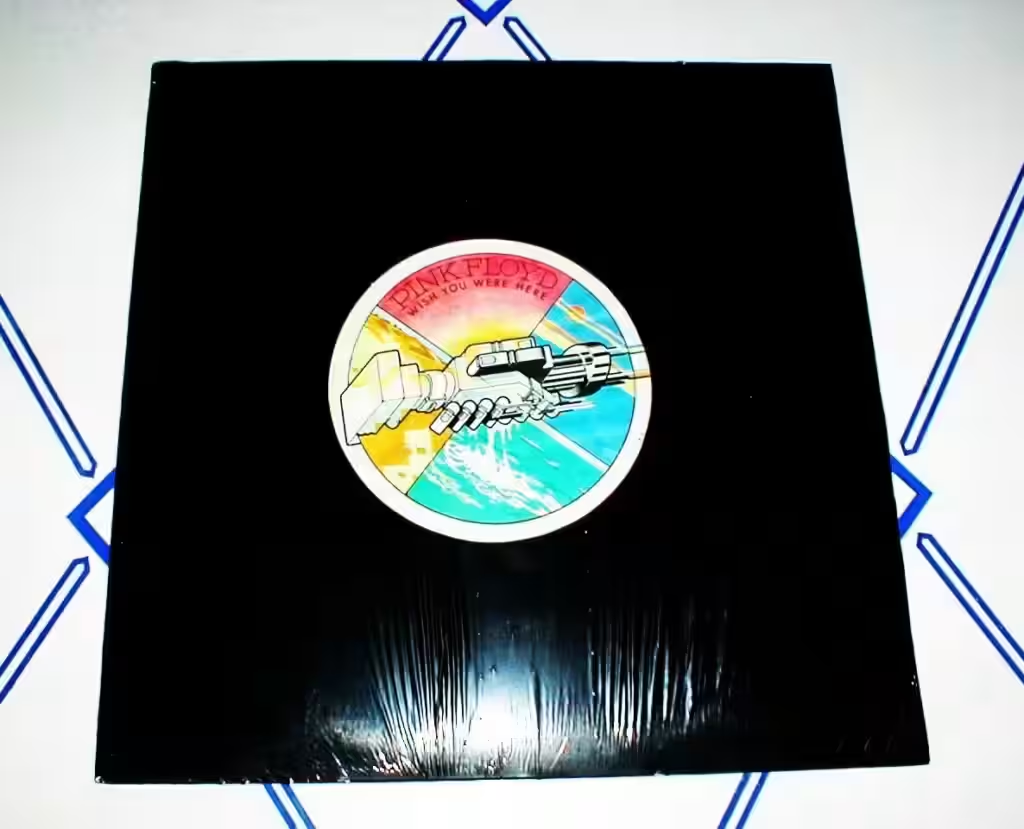
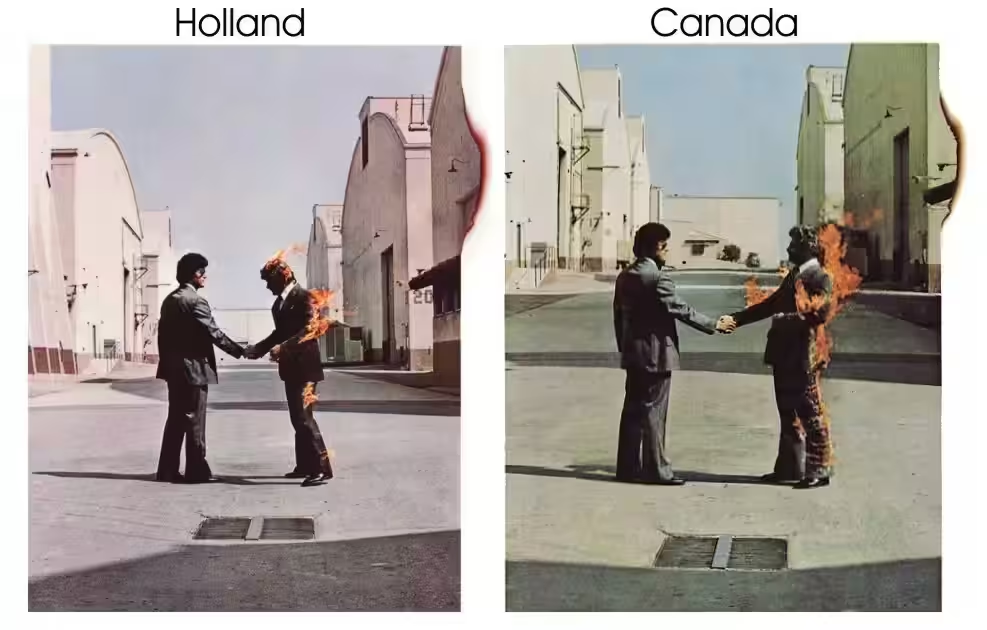
Storm Thorgerson had travelled with the band on the 1974 tour and decided, on listening repeatedly to the new songs, that the album was not about Syd Barrett's illness so much as about what he called "unfulfilled presence." Every element of the package he and his Hipgnosis partner Aubrey Powell built around the record carried that idea. The borrowed mechanic was Roxy Music's Country Life, which had shipped in an opaque green cellophane sleeve to hide its controversial cover; Thorgerson lifted the trick and pushed it to its limit. The 1975 LP was sold sealed inside a fully opaque black shrink-wrap, with only George Hardie's mechanical-handshake sticker visible. The cover image itself , the famous burning-handshake photograph , was, for the customer at the till, literally absent.
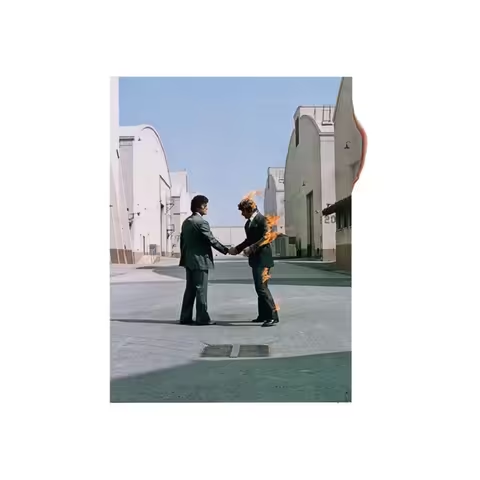
The handshake photograph was shot for real, on the back lot of Warner Brothers Studios in Burbank, California (then operating as The Burbank Studios). Two stuntmen were hired: Ronnie Rondell Jr., who wore a fireproof suit and wig under his business attire and was coated with fire-resistant gel, and Danny Rogers, who shook his hand. Fourteen takes went off cleanly. On the fifteenth, the wind changed and Rondell's moustache was singed. To get the framing right, the photograph was later mirrored so the stuntmen appear to be in swapped positions. Rondell, who had thousands of stunt credits across a sixty-year Hollywood career, was still being asked about that one photo when he died in August 2025 aged 88.
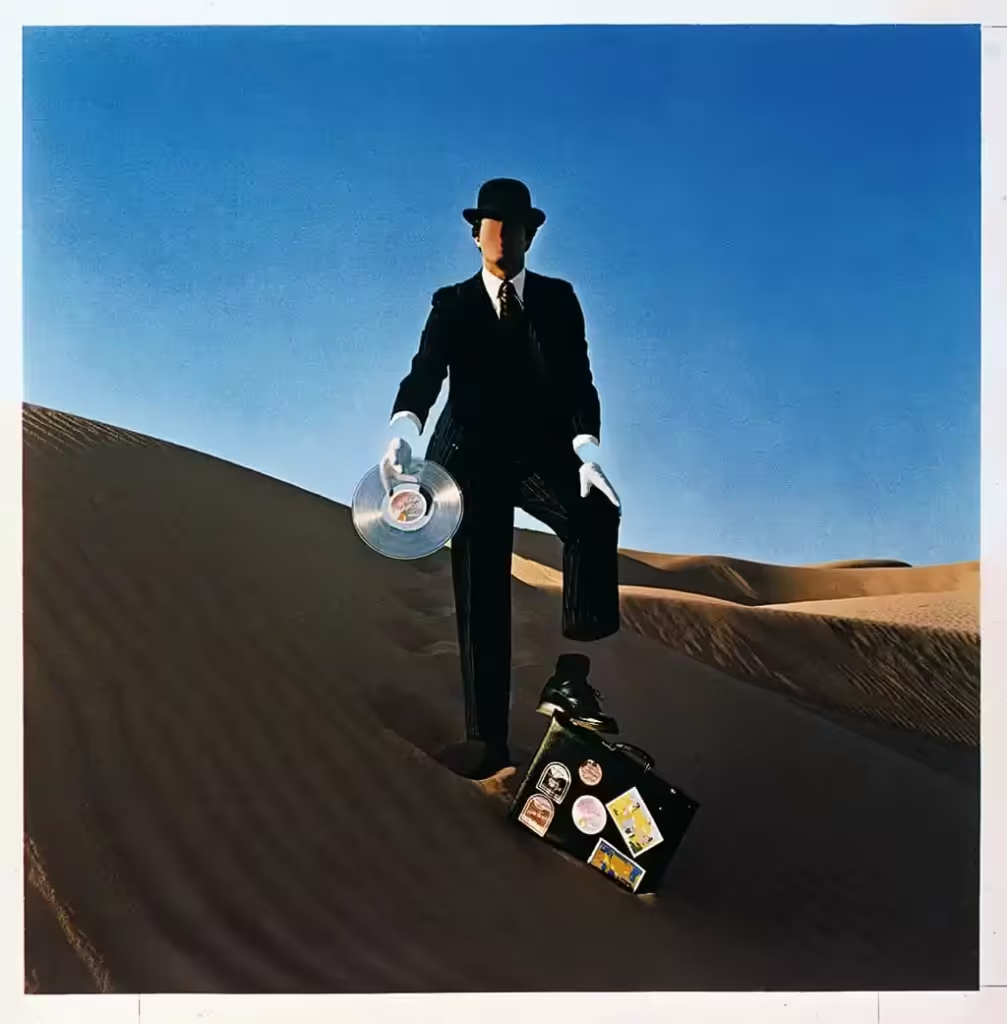
The back cover is a faceless "Floyd salesman" selling his soul, shot in the Yuma Desert by Powell; the absence of wrists and ankles signals an "empty suit." The gatefold interior carries two more photographs in the same vocabulary: a veil concealing a nude woman in a windswept Norfolk grove, and a diver entering Mono Lake in California while making no splash. The diver photograph was titled Monosee in the German liner notes and was included with early vinyl pressings as a postcard. Each image is an absence: no splash, no face, no figure.
Columbia Records hated all of it. The label objected, on commercial grounds, to spending a fortune on a deluxe photographic package and then hiding the cover behind black plastic. The band, having just signed the contract that gave them creative control in North America, overruled the label. When Hipgnosis presented the finished mockup, all four members of the band reportedly broke into a spontaneous round of applause.
Release and Reception
EMI advance orders in the UK ran to 250,000 copies, large enough that the label warned retailers only half of their orders would be fulfilled at launch. Columbia in the US took 900,000 advance orders, the largest pre-release figure in the label's history at the time. Wish You Were Here debuted at #3 on the UK Albums Chart on release week and hit #1 the following week; in the US it reached #1 on the Billboard 200 in its second week. It was certified Gold by the RIAA on 17 September 1975, five days after release, and was Pink Floyd's fastest-selling album to that point.
The reviews were strikingly mixed. Ben Edmonds, writing in Rolling Stone, picked out exactly what Roger Waters had spent six months trying to dramatise , restraint , and presented it as a fatal failure.
"They give such a matter-of-fact reading of the goddamn thing that they might as well be singing about Roger Waters's brother-in-law getting a parking ticket."
Ben Edmonds, Rolling Stone, 6 November 1975
Melody Maker was equally cold, calling the record "unconvincing in its ponderous sincerity" with a "critical lack of imagination in all departments." The most prescient early review came from Robert Christgau in The Village Voice, who awarded the album an A-minus and noted that, unlike Dark Side, it actually achieved the symphonic dignity its predecessor had only simulated. Christgau would later call it his favourite Pink Floyd record: "It has soul. It's Roger Waters's lament for Syd."
Retrospective opinion has corrected the contemporary balance with some force. AllMusic, Blender, the Encyclopedia of Popular Music, the Rolling Stone Album Guide and MusicHound Rock have all subsequently given it five stars. In November 2024 Pitchfork's Sam Sodomsky finally reviewed the album in its retrospective slot and gave it a perfect 10/10. Rolling Stone ranked it the fourth-greatest progressive rock album of all time in 2015. UK readers' polls have repeatedly placed it in the top tier of British albums, and a 2007 WDR listeners' poll in Germany voted it the greatest album of all time, full stop.
The band have been unusually unanimous on the subject. Wright, in an interview not long before his death in 2008, was the most direct.
"It's an album I can listen to for pleasure, and there aren't many Floyd albums that I can."
Richard Wright, interview with Redbeard for In the Studio, 2008
Gilmour has called it an album he can live with "very, very happily." Waters has described Wish You Were Here and The Dark Side of the Moon as Pink Floyd's two "most complete" records, but has also said, more bluntly, that Wish You Were Here and the next album Animals "signalled the end of the band as it had been before."
Singles and Music Videos
| Single | Release | Territory | B-side | Chart Performance |
|---|---|---|---|---|
| Have a Cigar / Welcome to the Machine (double A-side) | November 1975 | US (Columbia), select international | , | Modest radio play; not a charting hit |
| Wish You Were Here (live) | 1988 | Worldwide | From Delicate Sound of Thunder | Rock radio play, did not chart as a single |
Pink Floyd were not a singles band in 1975 and had no intention of becoming one. There was no UK single from Wish You Were Here at all. In the US, Columbia chose Have a Cigar backed with Welcome to the Machine as a double A-side in November , the album's two music-industry tracks, run together so that a label sneered at by the band was, with some grim humour, also the only label to commercialise the sneer. Neither song received a music video; the band had no real interest in television promotion and, with Gilmour's car radio, the Grappelli mystery and the wine-glass orchestra, were not exactly chasing the singles market.
The closest the album has come to a video life is through later use. The title track has been recorded live by Pink Floyd repeatedly, most famously at Live 8 in 2005 with Waters back in the line-up, and that footage has effectively functioned as the song's promo for two decades.
Touring and Live: Knebworth, the Spitfires and a Set Two of Dark Side
Pink Floyd toured Wish You Were Here in 1975 before they had finished recording it, and stopped touring it almost as soon as they had. The Wish You Were Here Tour ran April to July 1975 across North America with a single closing show in Britain at the Knebworth Festival on 5 July. The set was a two-act marathon: a first half drawn from the still-unfinished new album, including Shine On split across Have a Cigar in the same configuration that would appear on the record, plus full versions of Raving and Drooling and You Gotta Be Crazy that would not see vinyl until Animals two years later. The second half was the entire Dark Side of the Moon performed end to end. Welcome to the Machine and the title track , both heavily layered studio pieces , were not attempted live until the In the Flesh tour for Animals in 1977.
Knebworth itself was chaos. Pink Floyd had hired a pair of restored Spitfires to do a low-level flypast over the crowd as the band took the stage; the flypast was contractually fixed and could not be delayed. Earlier in the day Roy Harper, performing at the same festival, had discovered that his custom-made stage suit had gone missing and had taken his frustration out by smashing the windscreen of one of Pink Floyd's equipment vans, cutting his hand in the process. The crew were delayed setting up the PA. The Spitfires came over on schedule. The band came on under a faulty mains supply that pushed Wright's keyboards completely out of tune; at one point he walked off, and the band finished the show on a simpler keyboard, a piano and a stripped-down light rig. Critics savaged the performance, which was also the last time Pink Floyd would ever play Echoes and the complete Dark Side of the Moon as a unit with Waters on bass.
In TV, Film and Media
For a band famously reluctant to license, Wish You Were Here has had a long second life on screen. Richard Linklater used the title track to soundtrack a hand-held campfire scene late in Boyhood (2014), with a college student picking out the chords on an acoustic guitar; the song's themes of absence and longing for an absent father quietly carry the film's last act. Todd Phillips dropped it into a beach-revel montage in War Dogs (2016), using the song's wistfulness to undercut the characters' apparent success. The Person of Interest Season 4 finale "YHWH" closed with Welcome to the Machine as the show's super-intelligent AI was shut down and rebooted; the line "welcome my son, welcome to the machine" was being sung over a literal machine struggling for survival.
The song Wish You Were Here has also become a near-universal acoustic-cover standard. It is one of the most-performed Pink Floyd songs on YouTube, has been covered or referenced by Wyclef Jean, Foo Fighters, Sparklehorse with Thom Yorke, Jeff Beck, and dozens of others, and is often used at celebrity memorials and televised tribute concerts. It was one of the four songs Pink Floyd reunited to perform with Roger Waters at Live 8 in Hyde Park on 2 July 2005, the only time the four classic members shared a stage after 1981.
Controversy, Censorship and Lawsuits
Wish You Were Here is unusually clean of the era's typical controversies. There were no parental-advisory issues, no banned videos, no plagiarism suits, no withdrawn covers. The closest thing to a censorship story is, characteristically, the band's own: Columbia Records would have preferred not to ship the album in opaque black shrink-wrap, and was overruled. Stéphane Grappelli's vanishing violin part has been mythologised as a kind of soft erasure , the band did not credit him on the original release, allegedly because the part was so far down in the mix they considered a credit insulting , but the man was paid in full and the take itself was restored, intact, on the 2011 Experience Edition.
The one piece of folklore that does attach to the record is the persistent claim that the burning man on the cover is not a stuntman at all but a stand-in for Syd Barrett. The claim is wrong; both stuntmen, Ronnie Rondell Jr. and Danny Rogers, were named in Hipgnosis's records at the time and were photographed at the shoot. But the rumour says something about how completely the album's themes have absorbed its imagery.
Covers, Samples and Tributes
The title track is one of the most-covered songs of the rock era. Wyclef Jean turned in a hip-hop reinterpretation on his 2000 album The Ecleftic; Sparklehorse and Thom Yorke recorded a fragile duet version for the In the Fishtank 15 EP in 2009; Foo Fighters have played it live as a set-closer; Jeff Beck and Imelda May performed it at the 2009 White House celebration of Les Paul; Avenged Sevenfold included a heavy version on the bonus disc of Hail to the King. The lyric to Welcome to the Machine has been sampled by Roni Size and others; the four-note Shine On phrase is among the most quoted guitar motifs in rock pedagogy, a fixture on guitar-magazine "greatest opening lines" lists.
Tribute projects to the album as a whole are rarer but include the 2003 Brazilian-jazz reimagining Pink Floyd Wish You Were Here Symphonic, the 2018 Wish You Were Here Symphonic by the Royal Philharmonic Orchestra, and the long-running Australian Pink Floyd Show, which makes the title track the climax of most of its setlists. The album itself samples only one thing: Wright's quote of See Emily Play, played on synthesiser at the end of Shine On VI–IX, by way of letting Syd Barrett's own composition rejoin the band for a few seconds at the close.
Reissues, Remasters and Anniversaries
Wish You Were Here has been reissued more times than is comfortable to list, but a handful of editions are worth knowing about. The 1976 SQ quadraphonic release; the 1980 audiophile Hi-Fi Today pressing; the 1981 Columbia half-speed master LP; the 1994 Sony Mastersound 24-carat gold-plated Super Bit Mapping CD; the 1992 box-set inclusion as part of Shine On; the 2011 stereo remaster by James Guthrie at das boot recording, with a 5.1 surround mix on the same set's Experience and Immersion editions; the 2016 180g vinyl remastered by Guthrie, Joel Plante and Bernie Grundman for the Pink Floyd Records reissue programme.
Key editions worth knowing about:
- 1975 original Harvest / Columbia LP, black shrink-wrap, postcard insert
- 1976 SQ quadraphonic LP
- 1981 Columbia Mastersound half-speed master LP
- 1994 Sony Mastersound 24-carat gold-plated CD with Super Bit Mapping
- 2011 Why Pink Floyd? Experience and Immersion editions, with the restored Grappelli violin and a 5.1 surround mix
- 2016 180g vinyl on Pink Floyd Records, remastered by Guthrie, Plante and Bernie Grundman
- 2025 Wish You Were Here 50 super-deluxe box with Dolby Atmos mix, demos, and 1975 live recordings
The most significant package since 2011 is the Wish You Were Here 50 box set Sony announced in September 2025 for a December release. It contains a new Dolby Atmos mix; previously unreleased session material; live recordings from the 1975 North American tour (some of them sourced from circulating audience tapes the band have officially licensed for the first time); and a hardcover book. The release coincided with the album's RIAA certification jumping to 7× Platinum on 12 December 2025 and with the album returning to UK #1 the same week , a chart return that put a 50-year-old record back at the top of the album chart in the same year as records by Sabrina Carpenter and Taylor Swift.
Legacy and Influence
Wish You Were Here is the last Pink Floyd album that was made by all four members of the band as a functioning collective. Nick Mason, in his memoir Inside Out, points out a small but telling fact: it was the first Floyd album on which he received no writing credit. The pattern would harden on Animals and become a fault line on The Wall, after which Wright was effectively sacked. The collaborative spirit of the Dark Side sessions never quite came back; the band that made Wish You Were Here was already drifting.
Its musical influence has been enormous and almost entirely beneficial. Radiohead's first three albums are unimaginable without it (Thom Yorke has cited Wish You Were Here as a touchstone repeatedly); Porcupine Tree, Anathema, Riverside, Steven Wilson, Opeth and the entire late-90s prog revival quote its dynamics and its long-form patience constantly. Beyond prog, the album's central idea , that fame can be sung about plainly and without sneering, and that absence is a more powerful musical subject than presence , has fed into everything from OK Computer to Bon Iver's For Emma, Forever Ago to the entire Coldplay catalogue.
Inside Pink Floyd, the album is the last unanimous one. Roger Waters has been clearer than anyone about what it represented.
"Shine On is not really about Syd , he's just a symbol for all the extremes of absence some people have to indulge in because it's the only way they can cope with how fucking sad it is, modern life, to withdraw completely. I found that terribly sad."
Roger Waters, quoted in Watkinson and Anderson, Crazy Diamond: Syd Barrett and the Dawn of Pink Floyd, 2001
Things You Might Not Know About Wish You Were Here
| Fact | Detail |
|---|---|
| The wine-glass intro | The shimmering drone that opens Shine On is recorded from a wet finger run around the rims of partly-filled wine glasses, the only surviving piece of the abandoned 1974 Household Objects album. |
| Gilmour's car radio | The radio-tuning intro to the title track is Gilmour's own car radio; the snatch of classical music caught between stations is the finale of Tchaikovsky's Symphony No. 4. |
| The hidden Syd quote | Wright slips a brief synthesiser quote of Syd Barrett's 1967 single See Emily Play into the closing minute of Shine On Parts VI–IX, letting Syd's own composition rejoin the band one last time. |
| The Grappelli that almost wasn't | Stéphane Grappelli recorded a full violin part on the title track for a £300 fee but was mixed almost inaudible on the 1975 release; the band thought a credit would be insulting. The full take was finally restored on the 2011 Experience Edition. |
| Yehudi Menuhin in the room | The classical violinist Yehudi Menuhin, performing concerts at EMI that week, sat in the control room and watched Grappelli record. |
| Roy Harper's missing suit | Hours before Knebworth on 5 July 1975, Harper smashed the windscreen of one of Pink Floyd's equipment vans because his stage suit had vanished, cutting his hand and delaying Floyd's setup. He still joined them onstage to sing Have a Cigar. |
| "Which one's Pink?" | The punchline of Have a Cigar is a verbatim quote: an actual record-company representative really did ask Pink Floyd which one of them was Pink. |
| The man on fire | Stuntman Ronnie Rondell Jr. was set alight fifteen times for the cover shoot; the wind changed on the fifteenth take and singed his moustache. He died aged 88 in August 2025, still being asked about that single photograph. |
| The mirrored handshake | The two stuntmen in the cover photograph are actually standing the other way round in the original shot; the final image was flipped so the burning man is on the correct side. |
| The Roxy Music borrow | The black shrink-wrap idea was lifted from Roxy Music's Country Life, which had been shipped in opaque green cellophane to hide its risqué cover. |
| Nick Mason's first no-credit album | Wish You Were Here is the first Pink Floyd album on which Mason has no writing credit at all, an early sign of the band balance shifting towards Waters. |
| Two future producers on the desk | Engineer John Leckie , who worked on Shine On , went on to produce The Stone Roses, Radiohead's The Bends and Muse's Origin of Symmetry. Design assistant Peter Christopherson co-founded Throbbing Gristle and Coil. |
| Back at #1 fifty years later | In December 2025 the album returned to UK #1, was certified 7x Platinum by the RIAA and topped both German Rock and Metal and Swiss Album charts again, a half-century after its release. |
The Riffology Podcast
This deep dive accompanies the Riffology podcast episode on Wish You Were Here, which is available on Spotify, Apple Podcasts, Amazon Music, YouTube and every other major platform. If the album means something to you, the podcast is the place to talk about it.
Comments