NOFX printed a message to the record industry inside Punk in Drublic: "We've been doing fine all these years without you so leave us alone!" They meant the major labels then circling every punk band in southern California, they meant commercial radio, and within a year they meant MTV as well, because once the band had finished a video for Leave It Alone they simply chose not to send it in. The album came out on 19 July 1994 through Epitaph Records, sold more than a million copies worldwide, and became the only gold record NOFX would ever earn across a forty year career. It did all of that without ever appearing on the Billboard 200.
Seventeen songs in thirty nine minutes and fifty five seconds, cut at Westbeach Recorders in Hollywood with a producer who had come from the world of major label session work and had barely heard of Bad Religion when he took the job. Punk in Drublic contains Linoleum, Don't Call Me White, The Brews and Lori Meyers, and it did more than any other Epitaph release of its era to define what the phrase "skate punk" would mean for the next decade. This is the story of how it was written and recorded, what is actually on it, who played on it, and why a record with no hit single and no chart placing outlived almost everything that beat it that summer.
Album Facts
| Field | Detail |
|---|---|
| Artist | NOFX |
| Album | Punk in Drublic |
| Release Date | 19 July 1994 |
| Label | Epitaph Records (86435-2 CD, 86435-1 LP, 86435-4 cassette) |
| Producer(s) | Ryan Greene and Fat Mike |
| Studio(s) | Westbeach Recorders, Hollywood, California; mixed at EMI Studios, Los Angeles |
| Genre / Subgenre | Skate punk and melodic hardcore, with ska, reggae and calypso detours |
| Track Count | 17 |
| Total Runtime | 39 minutes 55 seconds, including a hidden segment inside the closing track |
| Billboard 200 Peak | Did not chart |
| UK Albums Chart Peak | Did not chart |
| Other Notable Chart Peaks | Number 12 on the Billboard Heatseekers chart; number 37 on the Croatian international albums chart |
| Certifications | Gold (RIAA, United States, roughly six years after release); Gold (Music Canada) |
| Estimated Sales | Over one million worldwide, of which around 500,000 in the United States |
| Key Singles | Don't Call Me White; Leave It Alone |
Punk Breaks in 1994 and NOFX Refuse to Play Along
Nineteen ninety four was the year the American music industry decided punk rock was a growth market. Green Day's Dookie arrived in February on Reprise and eventually shifted more than fifteen million copies. The Offspring's Smash landed in April on Epitaph and became the biggest selling album ever released by an independent label. Rancid put out Let's Go in August on the same label, Bad Religion signed to Atlantic and released Stranger Than Fiction in September, and by the spring of 1995 every A and R department in Los Angeles had a punk band on its wish list. Ian Winwood later built an entire book, Smash!, around the collision, and NOFX are one of the four bands in its subtitle.
That is the context Punk in Drublic dropped into, and it is why the record reads the way it does. NOFX were already ten years old by 1994. They had watched Epitaph label-mates go from playing to eighty people to selling out sheds, and they had sat through the dinners. Fat Mike has been consistent about what those meetings felt like.
"They told us that if we took a deal with Epitaph, we'd be second fiddle to the Offspring our whole lives."
Fat Mike on NOFX's meeting with Hollywood Records, recounted in Grunge, 2020
The band went to the dinner, ate the food, and stayed put. What is easy to miss now is how genuinely eccentric that decision looked at the time. Every commercial signal in 1994 said the same thing: take the advance, make the video, get on the Warped Tour, become famous. NOFX responded by putting a line in their own liner notes telling the industry to go away, and by treating each promotional opportunity as a thing to be declined rather than chased. No radio station acoustic sessions. Very few interviews. No videos sent to the channel that could have made them household names in a fortnight.
The result is one of the strangest commercial trajectories in nineties rock. Punk in Drublic did not chart on the Billboard 200 at all. It went gold anyway, six years later, entirely on word of mouth, skate videos, tape-trading and touring. Fat Mike still finds the plaque funny.
"We have one but the Ramones don't, so that's pretty interesting."
Fat Mike on the album's gold certification, Seattle Weekly
NOFX Before Punk in Drublic
Formed in Los Angeles in 1983 by guitarist Eric Melvin and bassist and vocalist Michael "Fat Mike" Burkett, NOFX took their name from the Boston hardcore band Negative FX. Drummer Erik Sandin was there almost from the start, left briefly in 1985 and came back the following year. The band's first decade was a run of scrappy, funny, fast records that sold modestly and toured relentlessly: Liberal Animation in 1988, produced by Bad Religion's Brett Gurewitz and later reissued by Epitaph, then S&M Airlines in 1989 and Ribbed in 1991.
The line-up that made Punk in Drublic locked in when Aaron Abeyta joined in 1991. Fat Mike gave him the name El Hefe, and has cheerfully admitted the etymology was botched from the beginning.
"I suggested a Mexican-sounding name, like 'El Jefe.' I don't speak Spanish, so I didn't realize the 'h' sound is usually spelled with a 'j.'"
Fat Mike on naming El Hefe
Abeyta brought two things NOFX had never had. The first was a genuinely trained lead guitarist, capable of the fast, clean, melodic runs that would become a signature of the whole Fat Wreck Chords sound. The second was a trumpet, which is why NOFX records from 1992 onwards keep sliding sideways into ska and mariachi and reggae without it ever feeling like a gimmick. His first appearance on record was the 1992 EP The Longest Line, and his first full album with the band was White Trash, Two Heebs and a Bean the same year.
That album is where the band's writing sharpened and where its personal cost showed. According to the band's own memoir, NOFX: The Hepatitis Bathtub and Other Stories, Erik Sandin was given a straightforward ultimatum during the White Trash sessions over his heroin use: get clean or leave. He got clean. By the time NOFX walked into Westbeach to start their fifth album they had a settled four piece, a producer relationship that was about to become the most productive of their career, and a back catalogue that had climbed from around ten thousand copies for Ribbed to something considerably larger.
"I remember Ribbed, our third album, sold 10,000 copies. Then Punk in Drublic, three years later, hit over a million."
Fat Mike, Consequence oral history of Fat Wreck Chords, 2015
The other half of the picture is that Fat Mike was already a label owner. He and Erin Burkett had started Fat Wreck Chords in 1990, initially as a small outlet for seven inches. By 1994 it was signing Lagwagon, No Use For A Name and Propagandhi, and it gave Fat Mike a working knowledge of margins, manufacturing and distribution that almost none of his peers had. That is the single most underrated reason NOFX could afford to say no to a major label. They could do the maths.
Writing the Songs and Pre-Production
Fat Mike wrote fourteen of the seventeen songs alone. Wikipedia credits Eric Melvin as co-writer on Leave It Alone, though the original 1994 sleeve credits Fat Mike as sole writer on every track except Perfect Government, so the co-write appears to be a later attribution rather than a contemporaneous one. Perfect Government is the album's only outright cover, and its presence is a direct consequence of El Hefe joining the band.
Mark Curry, who wrote it, had played with Abeyta before NOFX. Curry's own version appeared on his 1992 Virgin Records album It's Only Time, which is why the Punk in Drublic sleeve carries a publishing credit to Four Hour Bell, EMI and Virgin Music for that one track while everything else is published through West Beach Music and NOFX Music. Curry did not just get covered, either. He turned up at the sessions and sang on the NOFX recording of his own song.
Curry is also, indirectly, the subject of the album's most famous song. Fat Mike has explained Linoleum many times, and the explanation is much more literal than most listeners assume.
"'Linoleum' is about our friend, Mark Curry. He would always just sleep on the kitchen floor. I never chose linoleum, I never chose a kitchen floor, but Mark would always choose a kitchen floor. So, it's about him."
Fat Mike, Songfacts
The writing method Fat Mike describes is far more painstaking than the finished record lets on. He works lyrics over for months, line by line, and has a set of self-imposed rules that shaped Punk in Drublic more than any production decision did. He avoids rhyme where he can, on the theory that rhymes wear out fast. He avoids choruses. He builds long, unrepeating verse structures instead, which is why so many of these songs feel like they are constantly moving forward rather than circling back.
"What's funny about Punk In Drublic is that there's not a lot of choruses. The biggest songs on the album don't have choruses, like 'Linoleum.' I don't think people notice that about NOFX, it's one of our secrets."
Fat Mike, Alternative Press, on the album's twentieth anniversary
Documentation of the demo stage is thin. NOFX were not a band who filed everything, and no widely circulated set of Punk in Drublic home demos exists in the way it does for their better-archived contemporaries. What is on record is that the songs arrived at Westbeach essentially finished, and that the shaping happened in the room rather than before it.
Creating Punk in Drublic at Westbeach Recorders
Recording ran across 1993 and 1994 at Westbeach Recorders in Hollywood, the studio Brett Gurewitz had co-founded and which had already become the de facto house facility for the Epitaph roster. The sessions are consistently described as lasting around two weeks for all seventeen songs. Mixing happened elsewhere: the original sleeve credits the mix to EMI Studios in Los Angeles, a detail that quietly explains a lot about how this record sounds compared to the punk albums around it.
Ryan Greene is the reason for that. Greene was chief engineer at EMI when Gurewitz met him during pre-production with Bad Religion, and Gurewitz handed him a stack of NOFX CDs. Greene's own account of that moment is disarming.
"At the time I'm thinking The Clash. I knew nothing of Bad Religion."
Ryan Greene, interviewed by The Pier
He sent Fat Mike a demo reel. Three weeks later he was in the studio with NOFX, and he would go on to work with the band for years, producing Punk in Drublic, the live album that followed it and a long run of Fat Wreck records besides. The pace was punishing.
"There were no days off. There was a span of time where I worked every single day; Christmas Eve, Christmas Day, New Years Eve, New Years Day, my birthday, Thanksgiving, every single day for a year and a half."
Ryan Greene, interviewed by The Pier
El Hefe's three word summary of Greene as a producer, given to Alternative Press, was meticulous, anal and perfectionist. That is exactly what the record sounds like. Punk in Drublic is not a raw album. It is a tight, bright, heavily separated recording where every guitar part is audible, the bass has an actual midrange, and the drums sit up front without ever sounding processed.
That last part mattered to Greene. Erik Sandin's kit is entirely played rather than triggered, which was not a given for a fast punk record in 1994, and Greene has been pointed about defending it.
"[He] has the best foot in the business and the most relaxed player. People would think that we would run drum samples on him and it was, 'Have you heard him play live?'"
Ryan Greene on Erik Sandin, interviewed by The Pier
Greene's working method started with a scratch guitar track for Sandin to play to, so the drums went down against a fixed reference rather than a click alone. Fat Mike has credited Greene with pushing the guitars to a heavier place than NOFX had previously gone. According to The Pier's twentieth anniversary piece, an equipment shortfall mid-session led to a Marshall rig being rented in, one that had previously belonged to the Swedish rock band Europe. The exact head and cabinet numbers quoted in that account are hard to corroborate elsewhere, so treat the specifics as studio folklore, but the broader point stands: the guitar sound on this album is a rented, hired-in, get-it-done-by-Friday sound, not a curated one.
The other thing Greene did was encourage the band to keep the odd stuff. Punk in Drublic could easily have been seventeen fast songs. Instead it has a steel drum part, a trombone, a trumpet, a reggae section and a calypso pattern, all in among the skate punk. Several of those decisions came from Greene telling the band to try it.
- Chris Dowd of Fishbone plays trombone on Dig.
- Kenny Lyon adds guitars beyond the two band members.
- A player credited as Mr. Rojers plays the steel drums on My Heart Is Yearning.
- A gang of singers credited as the New Jew Revue handle the mass vocals on The Brews.
- Kim Shattuck of The Muffs sings the answering part on Lori Meyers.
The original LP was cut by Eddy Schreyer and pressed by Rainbo Records, with jackets printed in Canada. It is a small detail, but it matters to collectors: the earliest pressings are distinguishable from the 2008 and later repressings by the typeface used for the word Epitaph under the headstone logo.
Personnel and Credits
The joke on the original sleeve is that the four band members are not credited with instruments at all. They are credited with physical attributes. Fat Mike gets "double chin", Eric Melvin gets "dreads", El Hefe gets "talent" and Erik Sandin, under his long-running pseudonym Herb Reathstinks, gets "tattoos". Later reissues quietly replaced the gag with straight instrument credits, which is one of the small ways a record gets sanded down over thirty years.
| Role | Player | Notes |
|---|---|---|
| Core band | ||
| Bass, lead vocals | Fat Mike | Michael Burkett. Credited on the original sleeve as "double chin". Also co-producer. |
| Guitar, vocals | Eric Melvin | Co-founder. Credited as "dreads". |
| Guitar, trumpet, vocals | El Hefe | Aaron Abeyta, in the band since 1991. Credited as "talent", and separately for additional vocals. |
| Drums | Erik Sandin | Credited as Herb Reathstinks, with the attribute "tattoos". |
| Guest and session musicians | ||
| Additional vocals | Kim Shattuck | The Muffs. Sings the answering vocal on Lori Meyers. |
| Additional vocals | Mark Curry | Wrote Perfect Government and sings on the NOFX version. |
| Trombone | Chris Dowd | Of Fishbone. Credited on Dig. |
| Steel drums | Mr. Rojers | Credited on My Heart Is Yearning. |
| Additional guitars | Kenny Lyon | |
| Gang vocals | New Jew Revue | The massed vocal on The Brews. |
| Production and engineering | ||
| Producer | Ryan Greene | Also engineer and mixer. |
| Producer | Fat Mike | |
| Assistant engineer | Steve Kravac | Also assisted on the mix. |
| Lacquer cut | Eddy Schreyer | Original 1994 vinyl. |
| Lacquer cut, reissue | Chris Bellman | 2014 twentieth anniversary vinyl, at Bernie Grundman Mastering. |
| Artwork | ||
| Art | Fred Hidalgo | Credited jointly on the original sleeve. |
| Art | Kevin Head | |
| Crew | ||
| Roadie | Jay Walker | Credited by name on the sleeve. |
| Roadie | Kent Jamieson | |
The Songs
| # | Title | Writer(s) | Length | Single? | Notes |
|---|---|---|---|---|---|
| 1 | Linoleum | Fat Mike | 2:10 | No chorus, no rhymes. About Mark Curry sleeping on kitchen floors. | |
| 2 | Leave It Alone | Fat Mike (Eric Melvin credited later) | 2:04 | Yes | The only track from the album with a video. |
| 3 | Dig | Fat Mike | 2:16 | Chris Dowd of Fishbone on trombone. | |
| 4 | The Cause | Fat Mike | 1:37 | ||
| 5 | Don't Call Me White | Fat Mike | 2:33 | Yes | Issued on limited white vinyl. |
| 6 | My Heart Is Yearning | Fat Mike | 2:23 | Steel drums and a calypso pattern. An El Hefe favourite. | |
| 7 | Perfect Government | Mark Curry | 2:06 | Cover. Listed as A Perfect Government on the LP insert. | |
| 8 | The Brews | Fat Mike | 2:40 | Gang vocals by the New Jew Revue. | |
| 9 | The Quass | Fat Mike | 1:18 | Printed on the LP label as The Qwässitwörsh. | |
| 10 | Dying Degree | Fat Mike | 1:50 | ||
| 11 | Fleas | Fat Mike | 1:48 | ||
| 12 | Lori Meyers | Fat Mike | 2:21 | Duet with Kim Shattuck. Epitaph's own streams spell it Lori Myers. | |
| 13 | Jeff Wears Birkenstocks | Fat Mike | 1:26 | ||
| 14 | Punk Guy | Fat Mike | 1:08 | Full insert title: Punk Guy ('Cause He Does Punk Things). | |
| 15 | Happy Guy | Fat Mike | 1:58 | Listed as The Happy Guy on the insert. | |
| 16 | Reeko | Fat Mike | 3:05 | ||
| 17 | Scavenger Type | Fat Mike | 7:12 | Runs into silence and then a hidden segment. |
Linoleum
Two minutes and ten seconds, a bassline that a generation of teenagers learned before they learned anything else, and a lyric about owning nothing. Linoleum is the song NOFX are most identified with, and Fat Mike's own analysis of why is structural rather than sentimental. There is no chorus. There are no rhymes. The verses simply keep going.
"'Linoleum' has no chorus and no rhymes, and it's our biggest song. The more you rhyme, the quicker people get sick of your song."
Fat Mike, Songfacts
Fat Mike has said that watching hundreds of bands from more than twenty eight countries play the song on YouTube was a humbling experience. It has become a standard in a way very few post-1990 punk songs have.
Don't Call Me White
The most misread song NOFX ever recorded, and the one that put them in front of an audience who had no idea what the band actually stood for. Fat Mike's stated intent in 1994 was narrow and specific.
"Basically, I'm tired of all these correct terms you're supposed to be calling people now."
Fat Mike, 1994
The lyric is a rejection of being assigned a set of inherited assumptions by a label rather than a rejection of the label itself, and the band's own politics before and since have been unambiguous. That has not stopped it being adopted, periodically and unwelcomely, by people who heard only the title. NOFX have handled that live by playing the song with a German expletive substituted for the word white, a piece of stage business that neatly removes any ambiguity for anyone in the room paying attention.
The Brews
Two minutes and forty seconds of Jewish punk pride delivered as a hardcore gang chant, complete with a chorus of voices credited on the sleeve as the New Jew Revue. Fat Mike is Jewish and an atheist, and The Brews is not a religious song. It is an identity song, built on the deliberate absurdity of transplanting the visual language of a hardcore crew onto a group of yarmulke-wearing kids on Fairfax Avenue. It has a Hebrew-flavoured melodic turn in the middle, a stomping half-time section, and it remains one of the most requested songs in the band's set.
Lori Meyers
A conversation set to music, and the album's cleverest bit of construction. Fat Mike plays a man arguing with a woman about her career in pornography; the woman, sung by Kim Shattuck of The Muffs, wins the argument comprehensively, pointing out that she earns more than he does and enjoys the work more. Fat Mike has said the character was inspired by someone he met at college who was making fifty thousand dollars a year in the industry, but that the name itself is invented.
Shattuck's delivery is so specific, so sneering and so perfectly pitched that every subsequent guest who has taken the part on stage is essentially doing an impression of her. She died in 2019, which has given the track a weight it did not have in 1994. Note also that Epitaph's own official streams title the song Lori Myers rather than Lori Meyers, one of several spelling inconsistencies that have followed this record around since day one.
My Heart Is Yearning and the Detours
El Hefe has named My Heart Is Yearning as one of his favourite tracks on the album, and it is the clearest evidence of Ryan Greene pushing the band sideways. Steel drums and a calypso pattern on a Californian skate punk record in 1994 was not an obvious move, and it works precisely because the band commit to it rather than treating it as a joke. Dig does something similar with Chris Dowd's trombone, importing a slice of Fishbone's horn-driven chaos into a two minute punk song.
The Short Ones
Roughly a third of the album goes past in under two minutes a song, and that compression is a large part of why Punk in Drublic still feels quick thirty years on. The Quass is seventy eight seconds. Punk Guy is sixty eight. Jeff Wears Birkenstocks is eighty six, a portrait of a hippie friend whose sandals become shorthand for an entire worldview, and the one whose title Birkenstock themselves eventually acknowledged in a short film in 2017. Dying Degree, Fleas and Happy Guy fill out the run, and Reeko at three minutes and five seconds is practically an epic by the standards of the second side.
B-sides, Outtakes and the Hidden Track
NOFX did not run a B-side operation in the way British bands of the same era did, and Punk in Drublic has no significant vault of unreleased material attached to it. What exists instead is a set of small oddities, and the most interesting of them is hiding at the end of the record.
Track seventeen is listed as Scavenger Type and runs seven minutes and twelve seconds. The song itself takes up a fraction of that. The rest is silence, then a hidden segment usually indexed as 17.3 which is not a song at all: it is Fat Mike rehearsing the chorus of Perfect Government, followed by El Hefe attempting his line from Punk Guy in a succession of cartoon character voices. It is studio floor sweepings, kept in because it was funny, and it is the closest thing Punk in Drublic has to a bonus track.
The other genuine rarity is the Don't Call Me White seven inch itself. Pressed on white vinyl and limited to 1,500 copies, it paired the title track with Punk Guy. Both songs were already on the album, so there was no exclusive music on it, but the format and the pressing size have made it a collector's item in its own right.
Beyond that, the album's afterlife has produced no super deluxe box of demos, no alternate mixes and no legendary shelved session tape. For a record that has been reissued dozens of times, Punk in Drublic has been left almost entirely alone. Whether that reflects the band's disinterest in archaeology or the simple fact that a two week session does not generate much surplus is an open question.
The Album Artwork and Packaging
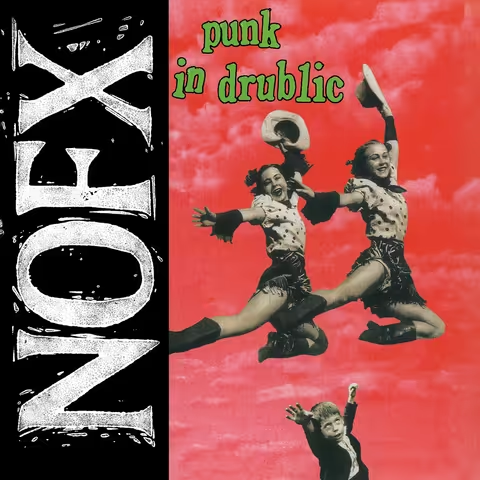
The sleeve is credited on the original release to Fred Hidalgo and Kevin Head, listed simply as "art". It splits the square into two unequal parts. The left third is a solid black panel carrying the NOFX logo in enormous rough white capitals, rotated ninety degrees so it reads from bottom to top; the letterforms look hand-cut or woodblock-printed, pitted with white speckles and nicks, high contrast and deliberately crude.
The remaining two thirds is a mottled hot pink and red sky. Dropped onto it, cut out in black and white, are two young women in Western or square dance costume: polka dot blouses with fringed sleeves, fringed skirts, dark knee socks and boots. Both are caught mid-leap with their arms flung wide, one hat held aloft in each raised hand, both laughing. At the bottom edge of the sleeve, partly cropped by the frame, a young boy in a dark jacket and white shirt jumps with his arms up and his mouth open. The title sits at the top right in bright green rounded lettering with a heavy black outline, all lower case, in a bubbly style that looks lifted from a late sixties poster.
The effect is exactly what the title promises. It is joyful, cheap-looking, slightly unhinged and completely unserious, and it broadcasts the band's tone before a single note plays. It is also worth saying plainly what the cover is not: there is no photograph of NOFX anywhere on the front, no attempt at a band image, and no visual concession to the fact that this was the record everyone in Los Angeles expected to break them.
Packaging details vary by pressing. The original US LP shipped with a twelve inch lyric sheet and jackets printed in Canada. The 2014 twentieth anniversary edition arrived with an embossed cover and a printed inner sleeve. The Japanese edition came with a lyric translation by Marie Nishimori and a full sleeve note by Kensho Onuki, a standard courtesy of the Japanese market that western fans almost never see.
Release and Reception
Punk in Drublic came out on 19 July 1994 in the middle of the loudest year punk rock ever had, and did not chart on the Billboard 200. It reached number 12 on the Billboard Heatseekers chart, the listing reserved for artists who have never had a top 100 album, and it registered at number 37 on the Croatian international albums chart. That is the entire chart record. There was no UK Albums Chart entry, no Australian placing, no European top forty.
Critics were considerably kinder than the charts. Stephen Thomas Erlewine gave it four and a half stars at AllMusic and identified precisely what had changed.
"The quartet didn't change their approach at all, at their core, they remain a heavy, speed-addled, hook-conscious post-hardcore punk group, but their songwriting has improved, as has their attack."
Stephen Thomas Erlewine, AllMusic
Robert Christgau, writing his Consumer Guide column for The Village Voice, gave it an A minus and picked up on the thing most reviewers of comic punk records miss, which is that the jokes are aimed almost exclusively upwards.
"In which these pranksters proceed to prove absolutely that a sense of humor provides useful training in broader human feelings. Among those they don't put down are a porn actress, a happy born-againer, a guy in Birkenstocks and a tie-dyed Rancid T-shirt, Hasidic O.G.'s, and, implicitly, people who like tunes with their rant and rave."
Robert Christgau, The Village Voice, 1994
The Rolling Stone Album Guide later gave it four stars out of five, and Punk Planet reviewed it favourably at the time. The retrospective consensus has been steadily warm rather than reverent, and the list placings tell the story:
- Number 29 on Rolling Stone's 50 Greatest Pop-Punk Albums.
- Number 6 on Kerrang!'s 51 Greatest Pop Punk Albums Ever, published in 2015.
- Number 4 in a 2014 UK-published ranking of the 51 most essential pop punk albums.
- Named by Guitar World in 2014 as one of fifty iconic albums that defined 1994.
The commercial story played out on a much longer timescale. The RIAA certified the album gold roughly six years after release, in 2000, and Music Canada awarded it gold for fifty thousand Canadian sales. Worldwide totals are usually put at over a million. Fat Mike's own explanation of the album's endurance is characteristically deflationary: it sells better than everything else in the catalogue until a new record comes out. He also had between forty and fifty replica gold plaques made at a cost of roughly a hundred and thirty dollars each, so that everyone who had a hand in it could have one, and gave one to his mother.
Singles and Music Videos
Two singles, one video, and a decision that defined the band for the next decade.
| Single | Released | Format | Coupled with | Video |
|---|---|---|---|---|
| Don't Call Me White | 1994, with sources giving both 11 May and 26 August | Seven inch on white vinyl, limited to 1,500 copies | Punk Guy | None |
| Leave It Alone | 1995 | Single release | Directed by Geoff Moore, 1994 |
Sources disagree on the release date of the Don't Call Me White seven inch. The Wikipedia entry for the album gives 11 May 1994, which would place it more than two months ahead of the parent album, while the entry for the song itself gives 26 August 1994, which would make it a follow-up. Both dates are in circulation and neither is well evidenced, so it is worth flagging rather than picking one.
The Leave It Alone video is the interesting artefact. It was made, it was finished, and it was then deliberately withheld from MTV. Fat Mike's stated reasoning was part principle and part grudge.
"We made the 'Leave It Alone' video, and we decided not to send it to MTV. We just didn't want to be a part of that machine."
Fat Mike
Underneath the principle sat the fact that MTV had ignored NOFX videos in earlier years when the exposure would have been transformative, and the band saw no reason to hand them a hit now that the channel had decided punk was fashionable. NOFX would not make another video for around twelve years.
Touring Punk in Drublic
NOFX toured Punk in Drublic the way they toured everything, which is to say constantly and without much regard for the industry calendar. A European run in the summer of 1994 took in dates from late May through mid July, including a Swedish festival appearance on a bill shared with Green Day and Discharge, weeks before the album was even in shops. A second European leg followed in February and March 1995 with Fat Wreck labelmates Lagwagon in support, opening at the Astoria in London on 16 February.
The best surviving document of what the band sounded like on this material is I Heard They Suck Live!!, recorded across two nights on 8 and 9 January 1995 at the Roxy Theatre in Hollywood and released that August on Fat Wreck Chords with Ryan Greene producing. The venue was left off the sleeve at the time, the band citing royalty reasons, and only confirmed later. It opens with a track called (Witty Banter) and closes with (Crowd Leaves), over which you can hear Nina Simone's Love Me or Leave Me playing through the house PA. Linoleum and The Brews are both on it, and the versions are faster and considerably ruder than the studio takes.
Notably, NOFX were absent from the inaugural Vans Warped Tour in 1995 despite the fact that its bill was stacked with their friends and labelmates. They headlined the following year, in 1996, and returned repeatedly across the next decade and a half. The pattern held throughout: no radio sessions, no in-stores of any scale, no television, just an enormous number of shows.
In TV, Film and Games
Sync placement was never a strategy for NOFX, which makes the handful of appearances more notable. Linoleum has had by far the most visible life outside the album, turning up in the video games Guitar Hero World Tour and Grind Session, the latter a skateboarding title whose soundtrack put the song in front of exactly the audience most likely to keep it alive. Skate videos more broadly did more for Punk in Drublic than any television appearance would have, and it is fair to say the record's word-of-mouth spread through VHS tapes and half-pipes rather than radio playlists.
Jeff Wears Birkenstocks got an unexpected corporate nod in 2017, when Birkenstock acknowledged the song in a short-form film. There is a decent joke in a punk band writing a mocking song about a friend's sandals and the sandal company eventually adopting it as heritage marketing.
Controversy and Fallout
The album itself generated remarkably little contemporary controversy. There was no parental advisory campaign, no banned artwork, no lawsuit and no religious backlash, largely because the record was invisible to the mainstream by design. The friction has all come later, and it has attached itself to the album's name rather than its contents.
In 2017 Fat Mike launched the Punk in Drublic Craft Beer and Music Festival, a touring event named after the album that paired punk bills with craft beer tastings. It launched on 16 September 2017 in Tacoma, Washington, ran through Boise, Phoenix, Sacramento, Concord and Huntington Beach, and featured NOFX alongside Bad Religion, Flogging Molly, Goldfinger, Less Than Jake and others. Stone Brewing produced a collaboration beer for it, the Stone and NOFX Punk in Drublic Hoppy Lager.
In May 2018, playing the Punk Rock Bowling festival in Las Vegas, Eric Melvin made a joke about the Route 91 Harvest shooting, saying that you only get shot in Vegas if you are in a country band. Fat Mike added a line about the victims being country fans rather than punk fans. The reaction was immediate and severe. Stone Brewing described the remarks as insensitive and indefensible, cut all ties with the band, ended the beer collaboration and donated the profits from the existing stock to the Las Vegas Metropolitan Police Department Foundation. The festival producers publicly distanced themselves. American shows were cancelled, and the band later pulled out of a Punk Rock Bowling appearance citing threats.
The band apologised. The festival brand survived and continued without them for a period. It is an unusually direct example of an album title outliving its album and then becoming a liability for the people who made it.
Covers, Samples and Tributes
The traffic runs almost entirely one way. Punk in Drublic contains a single cover, Mark Curry's Perfect Government, but Linoleum has become one of the most covered punk songs of its generation, in an unusually broad set of styles.
- Shai Hulud recorded it for A Whole New Level of Sickness in 1999, in a metallic hardcore reading.
- Streetlight Manifesto slowed it right down for 99 Songs of Revolution: Vol. 1 in 2010, stripping out the distortion entirely.
- Frank Turner recorded a solo acoustic version for The Second Three Years in 2011.
- Bad Astronaut and August Burns Red have both released versions.
Frank Turner has also covered Perfect Government, which means Mark Curry's song has now travelled from a 1992 major label album, through a punk record it made famous, and out into the folk-punk circuit. Sampling of NOFX material is rare, in keeping with a catalogue that has never been especially hip-hop adjacent, and no significant tribute album dedicated solely to Punk in Drublic has appeared. The tribute has instead been behavioural: thirty years of bands opening sets with the Linoleum bassline.
Reissues, Remasters and Anniversaries
Punk in Drublic has never been out of print, and the reissue history is remarkable less for its ambition than for its sheer persistence. Discogs lists well over fifty distinct versions. There is no super deluxe edition, no demos disc and no remix. Epitaph have simply kept pressing it, in increasingly decorative colours, for three decades.
| Edition | Year | Detail |
|---|---|---|
| Original US CD, LP and cassette | 1994 | Epitaph 86435-2, 86435-1 and 86435-4. LP lacquers cut by Eddy Schreyer, pressed by Rainbo Records. |
| Japanese edition | 1995 | Epitaph via Epic/Sony, ESCA 6113, with translated lyrics and Japanese sleeve notes. |
| Twentieth anniversary edition | 2014 | Epitaph 87360-1. 180 gram vinyl with the full album on CD, embossed cover, lacquers cut by Chris Bellman at Bernie Grundman Mastering. |
| Hot Topic exclusive | 2014 | Pink marbled vinyl, limited to 800 copies. |
| Record Store Day repress | 2014 | Limited edition pressing on the original 86435-1 catalogue number. |
| Ongoing coloured vinyl | 2021 to 2025 | Numbered, limited and territory-specific variants issued almost annually, including a red with white splatter edition. |
The 2014 anniversary cut is the one audiophiles point at. Chris Bellman's lacquers are generally considered a genuine improvement on the 1994 pressing, and the embossed sleeve gives the twenty year old artwork a physical presence it never had on a jewel case. There has been no fan revolt over a revisionist remaster, mostly because nobody has attempted one.
Legacy and Influence
Punk in Drublic did two things. It gave the melodic Californian punk of the mid nineties a template that was faster and funnier than Green Day's and less polished than The Offspring's, and it proved that a band could reach a million people without touching a single mainstream distribution channel. The bands who cite NOFX as a formative influence are not a short list: Blink-182, Sum 41, MxPx, Anti-Flag and Unwritten Law have all pointed at them. Blink-182's Cheshire Cat arrived the following year, and the DNA is not hard to trace.
The record also indirectly built a label. Fat Wreck Chords was already running when Punk in Drublic came out, but the album's success gave Fat Mike the capital and the credibility to make it a genuine force, and by the second half of the decade Lagwagon, No Use For A Name, Propagandhi, Strung Out and Good Riddance had turned it into one of the most coherent independent rosters in American music. NOFX themselves finally moved to it in 2000.
Fat Mike has never quite embraced Punk in Drublic as his best work, and his reasoning is worth hearing.
"I prefer So Long and Thanks for All the Shoes more, and maybe even War on Errorism."
Fat Mike, Seattle Weekly
His view has consistently been that Punk in Drublic is the public's favourite rather than the band's or the musicians', and there is something to that. So Long and Thanks for All the Shoes in 1997 is more adventurous. The Decline in 1999 is more ambitious. But Punk in Drublic is the one people learned first, and it is the record that turns up in every conversation about what nineties punk actually sounded like.
NOFX announced their retirement in September 2022 and played out over 2023 and 2024 on a farewell run billed around forty years, forty cities and forty songs a night, with no repeated setlists. Fat Mike was unusually blunt about how final it was.
"This is not a final tour like Motley Crue or Black Sabbath. These are the very last shows NOFX will ever be playing. We are gonna play with all our hearts, with all our joy, and then we are done."
Fat Mike, announcing the farewell tour, 2023
The run finished with three hometown Los Angeles shows in October 2024, ending on a new song called We Did It Our Way that the band said would never be recorded. It is a fittingly perverse full stop for a group whose defining album went gold without a chart position, whose only video was deliberately never delivered, and whose sleeve told the record industry to leave them alone in the exact year the record industry finally wanted them.
Things You Might Not Know
| Fact | Detail |
|---|---|
| The title is a spoonerism | Punk in Drublic swaps the opening sounds of "drunk in public". A separate 1994 NOFX live bootleg exists under the literal title Drunk in Public, and the two are routinely confused. |
| Nobody was credited with an instrument | The original sleeve credits Fat Mike with "double chin", Eric Melvin with "dreads", El Hefe with "talent" and drummer Erik Sandin, under the alias Herb Reathstinks, with "tattoos". |
| The label spelling is unpronounceable | Track nine, listed everywhere as The Quass, is printed on the original LP label as The Qwässitwörsh, umlauts and all. |
| It was mixed at a major label studio | Despite being the definitive independent punk record of its year, Punk in Drublic was mixed at EMI Studios in Los Angeles, where producer Ryan Greene was chief engineer. |
| Greene had never heard of Bad Religion | When Brett Gurewitz approached him about producing punk records, Greene's frame of reference was The Clash. He was in the studio with NOFX three weeks after sending Fat Mike a demo reel. |
| The drums are not sampled | Greene has repeatedly defended Erik Sandin's playing against the assumption that the kick was triggered, calling him the best foot in the business and the most relaxed player he worked with. |
| The hidden track is a rehearsal | The seven minute closer Scavenger Type runs into silence and then a hidden segment of Fat Mike practising the Perfect Government chorus, followed by El Hefe delivering his Punk Guy line as an assortment of cartoon characters. |
| Perfect Government came from Virgin | The album's only cover was written by Mark Curry, an old bandmate of El Hefe, and first released on Curry's 1992 Virgin Records album It's Only Time. Curry sang on the NOFX version too. |
| The gold plaques were self-funded | Fat Mike had between forty and fifty replica plaques made at roughly 130 dollars each so everyone involved could have one. One hangs in his mother's house. |
| It never charted properly | Punk in Drublic missed the Billboard 200 entirely. Its only significant placing was number 12 on the Heatseekers chart, which exists specifically for artists who have never had a top 100 album. |
| Epitaph spell a song title wrong | The label's own official audio streams title track twelve as Lori Myers, while the album sleeve and every reference work use Lori Meyers. |
| A beer was named after it, then killed | Stone Brewing made a Punk in Drublic Hoppy Lager for Fat Mike's festival in 2017, then severed ties in 2018 after the band's Las Vegas shooting remarks and donated the remaining profits to a police foundation. |
| Birkenstock got the joke | Jeff Wears Birkenstocks, a song mocking a friend's footwear, was acknowledged by the sandal company itself in a 2017 short film. |
| The insert titles are longer | Several tracks carry different names on the LP insert than on the disc, including Punk Guy ('Cause He Does Punk Things), The Happy Guy and A Perfect Government. |
More From Riffology
Riffology is a podcast about the records that mattered, told the long way round, with the sessions, the arguments, the sleeve notes and the stories that never made it onto the press release. New episodes go up regularly and you can find the show on Apple Podcasts, Spotify, Pocket Casts and everywhere else podcasts live. If Punk in Drublic was your way into all of this, there is a good chance the rest of the catalogue is full of records you already own and have never heard the full story behind.
Comments