At Compass Point Studios in Nassau, late autumn 1986, Eddie Kramer pressed play on his first mix of Among the Living and waited for Anthrax to be impressed. The man who had cut Are You Experienced with Jimi Hendrix, engineered Led Zeppelin II, and captured Kiss in full howl on Alive! had drenched the band third album in giant reverbs and digital sheen, chasing the airbrushed gloss that Mutt Lange had built for Def Leppard on Pyromania. Scott Ian listened. The room went quiet. Then, by his own account, he and one of his idols got into a screaming fight about what a thrash record was supposed to sound like.
Ian held his ground. The reverbs were stripped off, the mix went raw, the playing stayed dry and confrontational, and what came out on 22 March 1987 was the record that took Anthrax from clubs to arenas, hardened the so-called Big Four of thrash into actual currency, and turned a roadie-pit anecdote into a global teenage chant. It was also the album they dedicated to Cliff Burton, who had died in Sweden six months earlier with Anthrax watching from the support slot. The aggression in Among the Living is not theoretical. It came from a specific moment, a specific argument, and a specific loss.
| Field | Detail |
|---|---|
| Artist | Anthrax |
| Album | Among the Living |
| Release date | 22 March 1987 |
| Label | Megaforce (US) / Island (rest of world) |
| Producers | Eddie Kramer, Anthrax |
| Studios | Quadradial Studios, Miami, Florida (tracking, October to November 1986); Compass Point Studios, Nassau, Bahamas (mixing) |
| Mastering | George Marino at Sterling Sound, New York |
| Executive producer | Jon Zazula |
| Genre | Thrash metal |
| Track count | 9 |
| Total runtime | 50:23 |
| Billboard 200 peak | 62 |
| UK Albums Chart peak | 18 |
| Other notable peaks | Finland 8, Sweden 43, Germany 46, Netherlands 46 |
| Certifications | Gold (RIAA, 31 July 1990); Silver (BPI) |
| Singles | I Am the Law (February 1987); Indians (June 1987) |
| Dedicated to | Cliff Burton (1962 to 1986) |
Anthrax Before Among the Living
By the summer of 1986, Anthrax were three years into a frantic build. Fistful of Metal, released through Jon Zazula Megaforce Records in 1984, had introduced them as a New York band with the speed of the new American underground and one foot still in the NWOBHM tradition that had raised them on Iron Maiden, Judas Priest and Motorhead. Singer Neil Turbin and bassist Dan Lilker were both out before the next record, replaced by an unknown crooner from upstate New York called Joey Belladonna and a teenage Frank Bello, drummer Charlie Benante nephew.
That reshuffled lineup made Spreading the Disease in 1985, the first Anthrax album to land on a major label after Island picked up worldwide distribution. It sold more than 100,000 copies worldwide and ran for the next year as the band toured behind it, both as headliners in small clubs and as openers for bigger names. The eye-opener was a support slot on the Black Sabbath Seventh Star tour in early 1986, where Anthrax played mid-sized US arenas for the first time and discovered that the audiences screamed back. By the time they came off that run, the band understood what they wanted the next album to do.
The writing partnership behind Anthrax had also settled into the shape it would keep for the rest of the eighties. Benante wrote riffs and rough song skeletons. Ian wrote almost all of the lyrics and worked with Belladonna on the vocal melodies. Spitz layered the leads. Bello and Benante locked into a rhythm section that was already faster and tighter than most American bands could manage. Ian and Benante had also started Stormtroopers of Death with Lilker in 1985, and the year spent making Speak English or Die with that crossover side project bled hardcore punk attitude back into the parent band. By July 1986, the songs that would become Among the Living were starting to surface.
Writing the Songs in Top Cat
Most of the album was written in July 1986, after the band had come off the road. Anthrax arranged and rehearsed the new material at Top Cat rehearsal studios in New York City, with Benante feeding in riffs and Ian shaping them into songs. Three tracks had been written earlier, during the 1986 tour itself: I Am the Law, Indians and I'm the Man. The first two were rehearsed during soundchecks and dropped into the live set ahead of the record, so by the time the band reached the studio, both songs had already been beaten into shape on a stage.
The lyrics drew from a teenage cosmology of comics, horror paperbacks and protest. Ian was a 2000 AD reader, and the chorus of I Am the Law lifts Judge Dredd verbatim. Both Ian and Benante were Stephen King obsessives; Among the Living took the album its title and the title track from The Stand, and A Skeleton in the Closet was built around the novella "Apt Pupil" from Different Seasons. Indians turned a tour-bus argument about American history into a war chant. One World argued, only partly in jest, that the safest answer to the nuclear arms race was for everyone to admit they lived on the same planet. Imitation of Life, a reworked S.O.D. song called "Aren't You Hungry?" co-credited to Lilker, took aim at industry phonies. Efilnikufesin was a backwards-spelled curse at the music business culture that had killed John Belushi.
The humour mattered to the band. They had grown up on Motorhead and AC/DC as much as on Maiden, and they had no interest in the leather-and-mysticism uniform that thrash was already starting to adopt. Even the structure of Caught in a Mosh was, Ian later said, modelled on AC/DC "Whole Lotta Rosie". The band wrote in shorts and basketball jerseys, ate pizza, made jokes about Judge Dredd, and treated the heaviness as something a 17-year-old should actually want to listen to in a bedroom rather than memorise from an album sleeve.
Cliff Burton, Sweden and the Songs That Got Angrier
After a brief July rehearsal block, Anthrax flew to the UK to join Metallica on the European leg of the Damage, Inc. tour, supporting Master of Puppets. The two bands were already close. They were Megaforce labelmates, they had drunk together, they liked each other. In Sweden, on the night of 27 September 1986, Metallica tour bus skidded off a road outside Ljungby. Cliff Burton was thrown through a window, and the bus rolled on top of him.
The thrash metal scene was small enough in 1986 that the news travelled within hours and personal enough that it changed the rest of Anthrax year. The band dedicated Among the Living to Burton memory. They also wrote one final song specifically for him. "Horror of It All", the second half of the medley track A.D.I./Horror of It All, was the last piece of music written for the album, and it sits at the end of side two as a tribute. Ian has said directly that the rest of the record sounds as angry as it does because of what happened in Sweden.
"Part of the reason that song and the rest of the album sounds so angry is because Cliff died. We had lost our friend and it was so wrong and unfair. Yeah, we were pissed."
Scott Ian, I am the Man (Da Capo Press, 2015)
Recruiting Eddie Kramer
Anthrax wanted a producer who could capture the live energy of the band the way Eddie Kramer had captured Kiss on Alive! in 1975. Ian and Benante had grown up on that record, and the dry, in-the-room presence of those Cobo Hall and Detroit tapes was the sound they thought thrash should have. Manager Jon Zazula reached out, mentioned the band by name, and Kramer agreed to take a meeting.
Kramer arrival was a strange piece of casting. He was, by 1986, a senior figure with three decades of work behind him. He had been at Olympic Studios in London for the Hendrix sessions in 1967, had engineered the second Led Zeppelin album, had worked on the Stones, on Frampton, on Ace Frehley solo records. He had never produced a thrash band. Anthrax knew it. They also knew that if anyone could capture the rehearsal-room version of the band onto tape, it was him.
"Their manager, Johnny Z, said to me, I have got this band, Anthrax. They like the sounds you get, would you like to work with them? That is what started it. We went to Florida and took over a small studio for about a month."
Eddie Kramer, MusicRadar interview with Joe Bosso, December 2013
Quadradial Studios, Miami
The band moved into Quadradial Studios in Miami, Florida in October 1986. Recording lasted around six weeks. Kramer worked with engineer Chris Rutherford and assistant engineers Francis McSweeney and Chip Schane. The setup was group-live as far as the room would allow, with the rhythm section tracked together and the rest of the parts layered on top. The point was to keep the rehearsal-room momentum. The band sat in one space and played the songs at each other rather than building them in isolation.
The technical problem was familiar to anyone who has tried to record thrash. Down-tuned, heavily overdriven guitars sit in the same frequency range as the bass guitar and the kick drum. Smear those three together and the whole record turns to mud. Kramer had not recorded a band like this before, and he was honest about it: he was unsure at first what they were looking for, and it took him time to find ways to record very heavy guitars next to very heavy drums and keep them separate. The band were in their element. The room sound was tight. The performances were locked in. Benante double-bass attack and Belladonna soaring tenor were both new in the band sound, and both pushed harder on this record than on anything they had done before.
"I can safely say we knew who we were, and we certainly knew what we wanted to be, and we knew what we were capable of. We were all completely stoked because we were making our third album, and things had only gotten bigger, and the buzz on the band was awesome."
Scott Ian, Loudwire interview with Jon Wiederhorn, 2020
Compass Point and the Fight About Reverb
From Miami, the production moved to Compass Point Studios in Nassau, Bahamas, the facility owned by Chris Blackwell, the founder and then-president of Island Records. Ian had pushed for the studio for one reason only: Iron Maiden had recorded Powerslave and Somewhere in Time there, and that was good enough for him. The mix would be done in the Caribbean, in a room run by the man who owned the band record label.
Kramer first pass at the mix was the moment the project nearly broke. He had reached for the studio modern arsenal of digital reverbs and effects, and what came back through the monitors was a wash of cavernous ambience and sheen. The benchmark in his head was Pyromania, a record that had sold close to ten million copies in the US by then. The benchmark in Anthrax heads was Kiss Alive! and the dry attack of a band in a rehearsal room. The two ideas were not compatible.
The argument that followed has been described by Ian in print and on camera many times. He pushed back. Kramer pulled rank. Ian pushed back harder. Eventually Ian said, in plainer language than this, that Pyromania would be the end of Anthrax career, that this was an Anthrax record rather than an Eddie Kramer record, and that Kramer had a hundred more albums in him while Anthrax might only have this one. Kramer, by Ian account, switched off every reverb in the room. The next mix was dry and immediate, and the band signed off on it. The whole mix process was wrapped in under two weeks. The record went to George Marino at Sterling Sound in New York for mastering, and then to the pressing plant.
"His attitude was, you need to be modern and on the cusp, using all the technology at your disposal, and we were like, no, we want it to sound like this record was made in 1977. In the end, he basically just turned off every reverb in the room and we were like, okay, that is more like it."
Scott Ian, Loudwire interview with Jon Wiederhorn, 2020
Personnel and Credits
| Role | Player | Notes |
|---|---|---|
| Anthrax | ||
| Lead vocals | Joey Belladonna | Second album with the band; live war-dance chant on Indians |
| Lead guitar, backing vocals | Dan Spitz | Acoustic guitar on A.D.I. |
| Rhythm guitar, backing vocals | Scott Ian | Principal lyricist; held the line in the mix fight with Kramer |
| Bass, backing vocals | Frank Bello | Charlie Benante nephew; second album with Anthrax |
| Drums | Charlie Benante | Primary riff writer; conceived the cover with Brautigam |
| Production and engineering | ||
| Producer, engineer, mixing | Eddie Kramer | First thrash production credit; previously Hendrix, Led Zeppelin, Kiss |
| Engineer | Chris Rutherford | Tracking at Quadradial |
| Assistant engineer | Francis McSweeney | Quadradial Studios |
| Assistant engineer | Chip Schane | Quadradial Studios |
| Mixing | Paul Hamingson | Compass Point Studios, Nassau |
| Mastering | George Marino | Sterling Sound, New York |
| Executive producer | Jon Zazula | Megaforce Records founder and Anthrax manager |
| Artwork and writing credits | ||
| Cover painting | Don Brautigam | Same artist as Metallica Master of Puppets and Anthrax State of Euphoria |
| Co-writer (I Am the Law and Imitation of Life) | Dan Lilker | Former Anthrax bassist, founder of Nuclear Assault and S.O.D. co-writer |
The Songs
The album is nine tracks, fifty minutes, and a strikingly consistent piece of work given how much of it was written in a single summer. The opening half-hour, especially, runs as a single argument: among the living, caught in a mosh, I am the law, nice fucking life, skeleton in the closet. The titles themselves were thrash slogans before half the audience had heard the songs.
Among the Living opens the record with the album thesis statement, sung from inside the head of Stephen King Randall Flagg, the Walking Dude, the dark man at the heart of The Stand. The riff is a chopping mid-pace gallop. Belladonna sings the verses in character, daring the audience to stay on his side. It is one of the more deliberately literary openings on any record from the period.
Caught in a Mosh is the song that turned mosh into a verb. The riff structure leans on the same call-and-response idea that AC/DC built into "Whole Lotta Rosie", with stop-start gang chants where the band drops out and Belladonna shouts the title back at the room. The lyric started life when a roadie was pulled into the pit at an Anthrax show against his will, then mutated into a general complaint about being unable to make people listen. By the end of the year it was being shouted back at the band by audiences who had decided it was about them.
I Am the Law is built on riffs left over from the Spreading the Disease sessions and is co-credited to Dan Lilker. The lyric quotes Judge Dredd directly. Ian was a long-time 2000 AD reader, and the song packs in references to the Justice Department, the academy, the Cursed Earth, and the green visor that had defined Dredd since 1977. Released as the lead single in February 1987, in both 7-inch and 12-inch formats, it charted in the UK and gave the album its first piece of momentum.
Efilnikufesin (N.F.L.) spells "nise fukin life" backwards, a typo as much a part of the joke as the reversal. The song is a protest against drug abuse, and the inspiration was John Belushi death in 1982. Years later Ian has said with some weariness that journalists still ask him whether the parenthetical N.F.L. is about American football, which only confirms that they had not read the lyric or worked out the joke.
A Skeleton in the Closet takes the Stephen King novella "Apt Pupil" from Different Seasons, the collection that also gave the world the source stories for Stand By Me and The Shawshank Redemption, and turns its tale of a teenage boy blackmailing an aged Nazi hiding in suburban California into a chugging thrash narrative. The middle section drops into a half-time stomp before the band put their foot back on the throttle.
Indians closes side one with the song that became the centrepiece of Anthrax live shows for the next four decades. The lyric is about the displacement of Native Americans onto reservations, written by a band fronted by a singer of part-Iroquois descent. The riff is more mid-pace than thrash. The famous war-dance breakdown, with Belladonna roaring "WAR DANCE!" over a tribal-feeling pattern from Benante, was a piece of stagecraft as much as a piece of music. Released as the second single in June 1987, with a 12-inch that bundled covers of Black Sabbath "Sabbath Bloody Sabbath" and S.O.D. "Taint", it picked up MTV rotation in the late-eighties thrash heyday under a video directed by Jean Pellerin and Doug Freel.
One World opens side two with the album most explicit politics, written at the tail end of the Reagan era while Reagan and Gorbachev were still feeling each other out in Geneva and Reykjavik. The song argues that the planet is too small to keep playing nuclear chicken on. The riff is one of Benante punchiest.
A.D.I./Horror of It All is the album emotional climax. It opens with a long, melancholy acoustic guitar passage from Dan Spitz, the only acoustic playing on the record. The full band crashes in and the song builds across nearly eight minutes into a closing thrash storm. "Horror of It All" was the last song written for the album, and it was written as a tribute to Cliff Burton.
Imitation of Life closes the record with a snarl at industry phonies and is the second Lilker co-write on the album. The song is a reworked version of the S.O.D. track "Aren't You Hungry?", and it makes a fitting end to a record made by a band who had spent the last twelve months proving that they would not become anyone else.
| # | Title | Writer(s) | Length | Single? | Notes |
|---|---|---|---|---|---|
| 1 | Among the Living | Anthrax | 5:16 | Inspired by Stephen King The Stand | |
| 2 | Caught in a Mosh | Anthrax | 4:59 | Live staple; modelled in part on AC/DC Whole Lotta Rosie | |
| 3 | I Am the Law | Anthrax, Dan Lilker | 5:57 | Yes (Feb 1987) | Tribute to Judge Dredd; first single |
| 4 | Efilnikufesin (N.F.L.) | Anthrax | 4:54 | Title is "nise fukin life" backwards; about John Belushi death | |
| 5 | A Skeleton in the Closet | Anthrax | 5:32 | Based on Stephen King novella Apt Pupil | |
| 6 | Indians | Anthrax | 5:40 | Yes (June 1987) | Live war-dance breakdown; second single |
| 7 | One World | Anthrax | 5:56 | Cold War anti-nuclear lyric | |
| 8 | A.D.I./Horror of It All | Anthrax | 7:49 | Acoustic intro by Dan Spitz; Horror of It All written for Cliff Burton | |
| 9 | Imitation of Life | Anthrax, Dan Lilker | 4:10 | Reworked S.O.D. song Aren't You Hungry |
The Cover, Don Brautigam and the Randall Flagg Question
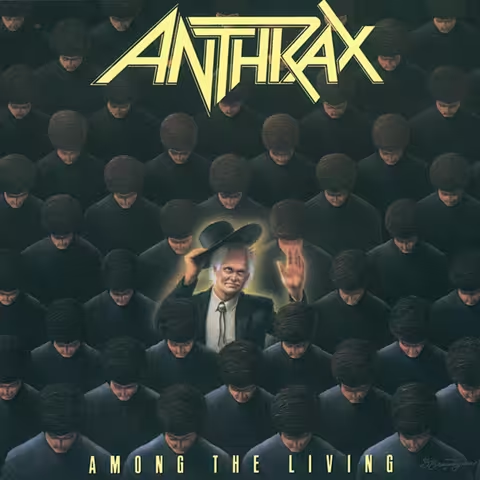
Charlie Benante conceived the cover concept and brought in Don Brautigam to paint it. Brautigam had been a cover illustrator since the early seventies, and in 1986 he had just delivered the haunting graveyard scene on Metallica Master of Puppets. The link between the two records ran through their imagery as well as through Cliff Burton. Brautigam would go on to paint the next Anthrax album, State of Euphoria, in 1988.
The painting is the album most argued-about piece of design. It shows a robed figure rising out of a crowd of faceless people, one hand lifted in something between a wave and a salute. For years fans assumed the figure was Randall Flagg from The Stand, because the title track is sung from his perspective. Others insisted it was the Reverend Henry Kane from Poltergeist II: The Other Side, which had come out in 1986. Benante, who designed the brief, has been clear that the concept was broader than either reading: the figure was supposed to be the unsettling stranger in a crowd of similar people, the idea that evil walks in plain sight among the rest. The Stephen King reading caught on anyway, partly because of the title track, partly because the album dropped at the peak of a King-obsessed decade.
Singles, B-sides and Music Videos
Two singles were lifted from the record, both with B-sides that have outlasted plenty of A-sides from less interesting bands. I Am the Law dropped in February 1987 on 7-inch and 12-inch, ahead of the album, with the non-album B-side "Bud E. Luvbomb and Satan Lounge Band". The 12-inch added "I'm the Man", a rap-metal hybrid recorded in the same sessions that the band management felt did not fit the album sonic identity. They put it on the B-side instead, then watched it become one of the band most recognised songs and re-released it as its own EP later in 1987. It is also one of the first records anyone made that mixed rap and metal, three years before the form became a mainstream commercial proposition.
The second single, Indians, arrived in June 1987. The 12-inch came with two covers recorded specifically for the release: Black Sabbath "Sabbath Bloody Sabbath" and the S.O.D. instrumental "Taint". The video, directed by Jean Pellerin and Doug Freel, picked up moderate rotation on MTV at exactly the moment the network Headbangers Ball programme was finding its audience. Caught in a Mosh was never released as a single but was treated as one by the fanbase, and it has since outlasted both official singles on Anthrax live setlists.
| Single | Release | Formats | B-sides | Chart |
|---|---|---|---|---|
| I Am the Law | February 1987 | 7-inch, 12-inch | Bud E. Luvbomb and Satan Lounge Band (both); I'm the Man (12-inch only) | UK Singles Chart |
| Indians | June 1987 | 7-inch, 12-inch, video | Sabbath Bloody Sabbath; Taint (12-inch); video directed by Pellerin and Freel | MTV rotation |
Charts, Certifications and Commercial Performance
The album shipped on 22 March 1987 and broke Anthrax into the mainstream of metal within the year. It peaked at number 62 on the Billboard 200 in the US and at number 18 on the UK Albums Chart, the band highest UK placing to that point. In Europe it reached 8 in Finland, 43 in Sweden, 46 in Germany and 46 in the Netherlands. Notably, the US chart position was achieved with effectively no commercial radio airplay; the album sold on the strength of MTV, fanzine coverage and touring.
It sold steadily through the late eighties. The RIAA certified it gold on 31 July 1990, the band second gold record after State of Euphoria had been certified in 1989. The BPI in the UK certified it silver. Decades later it re-entered the UK Rock and Metal chart at number 10 in 2010 around the deluxe edition reissue, and as recently as 2026 it has charted in Greece.
Critical Reception
The reviews were almost uniformly strong in 1987 and have grown warmer over time. Rock Hard rated it 9.5 out of 10 on release. AllMusic Steve Huey would later give it four and a half stars. Sputnikmusic settled on 4.5 out of 5. Classic Rock magazine, looking back in 2010, awarded the album 8 out of 10, with Malcolm Dome arguing that the band musicianship by this point was on a par with anything Metallica were doing at the same time. BBC Music Greg Moffitt called it a record that struck a deft balance between marauding speed and the judicious use of melody, a juggling feat the band would later fumble on subsequent records. Rolling Stone J. D. Considine praised the band technical agility and the way they had democratised that brilliance by attaching it to the most approachable material in their catalogue.
The recognition has stacked up. Among the Living was inducted into the Decibel Hall of Fame in July 2005, only the sixth album to be featured. It was included in 1001 Albums You Must Hear Before You Die. Martin Popoff placed it at number 49 in his book The Top 500 Heavy Metal Albums of All Time. Revolver named it on its 2014 list of fourteen thrash albums every fan should own. In 2017 Rolling Stone ranked it 20th on its list of the 100 greatest metal albums ever made. Kerrang! went further: their Nick Ruskell 2020 ranking of the 25 greatest thrash metal albums put it at number six.
"Benante and his bandmates may have been regular guys in other respects, but as musicians there was no denying the technical agility that went into each aural onslaught. Anthrax democratised their brilliance by attaching it to some of the band catchiest, most approachable material."
J. D. Considine, Rolling Stone "100 Greatest Metal Albums of All Time", 2017
The Among the Living World Tour
After a short tour of Japan in the spring, the proper Among the Living World Tour opened on 26 May 1987 at the Penny Arcade in Rochester, New York, with Metal Church as support. The summer was spent headlining mid-sized US venues, and in August the band crossed to Europe for the festival run. They appeared at Monsters of Rock at Castle Donington on 22 August 1987, sharing the bill with Bon Jovi, Dio, Metallica, W.A.S.P. and Cinderella, and played to an audience of around 80,000. The European leg that followed in September and October sold out 7,000-seat venues.
The headline US run that came back in November was the moment Ian later said the realisation hit. The band were standing side-stage at the 5,000-capacity Aragon Ballroom in Chicago, watching Celtic Frost open. The room was already full. A few months earlier they had been thrilled to play to 500 people. The audience had multiplied by ten while they had been on the road. The European Hammersmith Odeon show in December 1987, originally filmed for a VHS release called Oidivnikufesin (N.F.V.), was the headline gig that put the seal on the year. It would later be added to the deluxe reissue of the album as a bonus DVD.
At the start of 1988, Kiss requested Anthrax as the support act for the US leg of their Crazy Nights World Tour. The run ended in early April. Within days, the band were back in the studio recording State of Euphoria. Across the four-year span between 1987 and 1990, Ian later reckoned, Anthrax had gone from selling 500 tickets a night to filling 6,000- and 7,000-seat venues without ever stopping to notice. The songs from Among the Living had been the engine for almost all of it; the album has been represented on every Anthrax tour since 1987, with at least four of its tracks treated as immovable setlist fixtures.
The Big Four and What Among the Living Did For It
The phrase Big Four was coined, in print, by the British journalist Don Kaye in a series of Kerrang! pieces in 1988. The four bands he meant were Metallica, Slayer, Megadeth and Anthrax. The label was meant as a descriptive shorthand and was never claimed by the bands themselves at the time, but it stuck because the records bore it out. Within an 18-month window from autumn 1985 to spring 1987, four American thrash bands released the records that defined the form. Anthrax Spreading the Disease, Metallica Master of Puppets, Megadeth Peace Sells... But Who Buying?, Slayer Reign in Blood, and then Among the Living, lined up like five panels of the same wall.
Anthrax position in that grouping had been the least secure. They had the catchier vocalist, the more pop-aware riff sense, the basketball jerseys and the comic-book lyrics, and a contingent of more traditionally-minded thrash listeners viewed them with suspicion. Among the Living argued the case for them on musicianship grounds. The technical playing was equal to anything the other three were doing in the same period. The songwriting had a clarity the other three did not always reach. The album turned the Big Four label from a journalist conceit into a four-record canon that fans treated as definitional.
Legacy and Influence
Almost every band that mattered in the next decade of American heavy music carried some Among the Living DNA. Pantera, who would themselves become the defining American metal band of the early nineties, were avowed Anthrax fans. Sepultura have cited the album. The entire idea of the gang chant as a piece of song architecture, the kind of full-volume call-and-response that Anthrax wrote into Caught in a Mosh, became foundational for groove metal, hardcore and eventually metalcore. The crossover line Anthrax had been straddling on this record, between metal and hardcore, became its own genre.
The mosh pit lexicon also belongs to this record. Caught in a Mosh did not invent the term, but it took it out of small-club tribal vocabulary and put it onto every record-store wall and bedroom poster in 1987. The "WAR DANCE!" call from Indians has been the standard Anthrax live moment for nearly forty years and counting. In 2005, the album lineup reunited around its anniversary, performed the record in full at selected dates of the 2013 Metal Alliance tour and again in 2017 on the 30th anniversary run. For the 40th anniversary, Anthrax released a graphic novel through Z2 Comics in July 2021, with contributions from Corey Taylor, Grant Morrison, Brian Posehn, Gerard and Mikey Way, Rob Zombie and others, taking each song as the basis for a separate strip.
Reissues, Remasters and Anniversaries
The album has had a relatively restrained reissue history compared with the boxset-and-half-speed treatment that more recent anniversary editions tend to receive. On 10 November 2009, Island released a deluxe edition that paired a remastered audio disc with a concert DVD. The bonus audio included alternate takes of Indians, One World and Imitation of Life, live versions, the I Am the Law B-side "Bud E Luv Bomb and Satan Lounge Band", and an instrumental of "I'm the Man". The DVD was the previously rare Oidivnikufesin (N.F.V.), the Hammersmith Odeon show from December 1987, which had only ever come out on VHS and had been out of print for years. The 40th anniversary in 2027 will be the next obvious window for a fuller archival release.
Where It Sits in the Anthrax Catalogue
Among the Living is the breakthrough album in any reading of the Anthrax discography. Fistful of Metal and Spreading the Disease got the band to a major label. State of Euphoria in 1988 was greeted at the time as a slight disappointment, partly because it had to follow this record, and only in retrospect has it been re-evaluated upward. Persistence of Time in 1990 closed the original Belladonna era. The 1992 to 2003 John Bush years produced one stone-cold great record in Sound of White Noise and a clutch of less essential ones. The reunion era from Worship Music in 2011 onwards has been Anthrax most consistently strong run in three decades. Among the Living remains the bright pole around which the rest of the catalogue is mapped, the record where, as Ian put it, the band did not just have an important moment, they got an actual career.
Things You Might Not Know
| Fact | Detail |
|---|---|
| The last song written | "Horror of It All", the second half of the A.D.I. medley, was the final song completed for the album and was written specifically as a tribute to Cliff Burton. |
| The Pyromania benchmark | Eddie Kramer first mix at Compass Point was deliberately modelled on Mutt Lange production for Def Leppard Pyromania, a record that had sold close to ten million copies in the US by 1986. |
| The reverb fight | Scott Ian has said he had to remind Kramer that the producer would have a hundred more albums to make, while Anthrax might only have this one, before Kramer agreed to switch off every reverb in the room. |
| Why Compass Point | Ian suggested the Bahamas studio for one reason only: Iron Maiden had recorded Powerslave and Somewhere in Time there, and that was enough for him. |
| The first rap-metal B-side | I'm the Man, recorded in the same sessions, was bumped to the I Am the Law 12-inch and is one of the earliest records to fuse rap and heavy metal. |
| The Indians 12-inch | The 12-inch single came with two specially recorded covers: Black Sabbath "Sabbath Bloody Sabbath" and the S.O.D. instrumental "Taint". |
| The Brautigam connection | Don Brautigam painted the cover, the previous year Metallica Master of Puppets, and the following year Anthrax State of Euphoria, linking the three records visually. |
| The Imitation of Life recycle | The album closing track is a reworked version of the S.O.D. song "Aren't You Hungry?" co-written with Dan Lilker in 1985. |
| Donington 1987 | Anthrax played to roughly 80,000 people at Monsters of Rock at Castle Donington on 22 August 1987, between Cinderella and Dio, on a bill headlined by Bon Jovi. |
| No radio, gold record | The album reached number 62 on the Billboard 200 in the US with effectively no commercial radio airplay, and was certified gold by the RIAA on 31 July 1990. |
| Two Lilker credits | Former bassist Dan Lilker, by then in Nuclear Assault, is co-credited on two songs (I Am the Law and Imitation of Life), the only non-Anthrax writing credits on the record. |
| The Decibel Hall of Fame | The album was inducted into the Decibel magazine Hall of Fame in July 2005, only the sixth album so honoured. |
Final Thoughts
Almost forty years on, Among the Living still does the thing the band set out to do in the autumn of 1986. It sounds like five people in a room playing very fast and very tight, with no reverb between them and the listener. The songs have outlived their sources, in some cases by a wide margin. Most teenagers shouting "WAR DANCE!" at an Anthrax show in 2026 have not read Stephen King The Stand, do not know who Cliff Burton was, and have never seen an issue of 2000 AD. They do not need to. The riffs do the work, and they have been doing it without a break since 22 March 1987.
For all that has been written about the Big Four, Anthrax remain the band on that wall who least needed to be there. They had the wrong wardrobe, the wrong sense of humour, the wrong taste in comic books, and they made their case anyway, one record at a time, with this one as the loudest exhibit. It was the record that took them from clubs to arenas, the record that beat their idol Eddie Kramer at his own game, and the record that nine teenagers in nine countries decided, in 1987, was the best thing they had ever heard. It still is.
Riffology covers albums like this on the podcast in proper depth. The show is available on Spotify, Apple Podcasts, Pocket Casts, Overcast and every major platform; come and find us if you want more of where this came from.
Comments