On the first day of February 1971, Tony Iommi sat down with his Gibson SG at Island Studios on Basing Street in London, slackened the strings until the low E was almost flapping against the pickup, and hit a chord that did not really exist in rock music yet. Down a tone and a half from concert pitch, the guitar sounded broken, swollen, faintly menacing. It was the sound of a man trying to make the instrument hurt his hands a little less, and it became the foundation chord of every doom, sludge and stoner-metal band that has followed in the fifty-five years since.
That moment is the reason Master of Reality exists as a separate event in heavy music rather than just Black Sabbath's third album. By any other measure 1971 was a year of consolidation for the Birmingham four-piece. They had two hit albums behind them, a brutal touring schedule, and a producer they trusted in Rodger Bain. What they did not have, until Iommi reached for the tuning pegs, was a sound the rest of rock could not yet imitate.
Album Facts
| Field | Detail |
|---|---|
| Artist | Black Sabbath |
| Album | Master of Reality |
| Release Date | 6 August 1971 (UK), 16 August 1971 (US) |
| Label | Vertigo 6360 050 (UK), Warner Bros. BS-2562 (US) |
| Producer | Rodger Bain |
| Engineer | Tom Allom |
| Studio | Island Studios, Basing Street, London |
| Recording Dates | 7-15 February 1971; 6-13 April 1971 |
| Genre | Heavy metal, doom metal, stoner rock |
| Track Count | 8 |
| Total Runtime | 34:29 |
| Billboard 200 Peak | 8 |
| UK Albums Chart Peak | 5 |
| Other Notable Chart Peaks | Australia 4, Finland 3, Germany 5, Canada 6, Italy 8, Netherlands 10, Norway 12 |
| Certifications | US 2x Platinum (RIAA), Canada Platinum, UK Gold |
| Estimated Sales | Over 2 million in the US; 4 million-plus worldwide |
| Key Singles | Children of the Grave / Solitude (August 1971) |
Cultural Context: A Heavy Summer in a Heavy World
The summer of 1971 was a strange weather system for a record like this to drop into. In the US, Vietnam casualty lists were still rolling across the evening news; the Pentagon Papers were splashed across The New York Times in mid-June; Nixon's silent majority was buying easy-listening records at a record clip. In the UK, the three-day week was less than two years away, Northern Ireland had just seen the introduction of internment, and the country's industrial cities were already sliding into the long economic decline that would define the rest of the decade. Birmingham, the band's home town, was Britain's biggest manufacturing centre and the place where the optimism of the post-war boom had begun visibly to flake.
Look at the British album chart Sabbath were entering. Bridge over Troubled Water by Simon and Garfunkel was still selling. The Carpenters were everywhere. The Rolling Stones had just released Sticky Fingers, Led Zeppelin were finishing the album that would become the untitled fourth, and Deep Purple had spent the previous October finishing Fireball. Music journalists had begun grouping Sabbath, Zeppelin and Purple together as what Mick Wall later called the "unholy trinity of British hard-rock and heavy metal", and of the three Sabbath were the only band the broadsheet press could not bring itself to take seriously.
That hostility matters because it shaped how the record was made. There was no critical pressure on Black Sabbath in the spring of 1971 to do anything except deliver another Paranoid. The freedom that produced Master of Reality, an album with a flute instrumental on side two and a Catholic-themed song in the middle of side one, came partly from the fact that nobody important was watching.
The Band's Story Up to This Point
Black Sabbath in early 1971 were three years old as a unit. They had formed in Aston, Birmingham in 1968 under a string of names, Polka Tulk and then Earth, before settling on Black Sabbath in August 1969. The first album, recorded in a single day at Regent Sound and Trident in October 1969 for under six hundred pounds, had reached number 8 in the UK in February 1970 and stayed in the American chart for over a year. Paranoid, recorded that summer, had been an even bigger hit, reaching number 1 in the UK and producing the title track that gave the band their only top ten US single of the decade.
Behind that success was a brutal schedule. Sabbath were playing well over 150 shows a year by 1971, criss-crossing Britain in a Transit van and beginning to tackle America in earnest. In early February 1971 they flew to Australia for a single appearance at the Myponga Pop Festival in South Australia, returning to London within days to start the third album. They were exhausted, increasingly stoned, and, by their own admission later, financially baffled by their managers.
The line-up was still the original four: Ozzy Osbourne on vocals, Iommi on guitar, Geezer Butler on bass and almost all of the lyrics, and Bill Ward on drums. There would be no personnel changes, no producer wars, no record-label intervention; it is one of the very few albums in the band's catalogue made wholly inside the bubble of the original quartet plus Rodger Bain. That stability is part of why it sounds so confident.
Pre-production and Demos
There was almost no pre-production in the modern sense. Songs were either road-tested fragments that Iommi had brought home from the previous tour, or they were written in the studio between takes. The 2009 deluxe edition's bonus disc, remastered by Andy Pearce, hints at how rough the early shapes were. The most striking item is "Weevil Woman '71", a discarded blues stomp that suggests Sabbath were still considering a more conventional second side as late as April. There is also a piece called "Spanish Sid", which is the early take of what eventually became "Into the Void", with a different riff and a noticeably more upbeat tempo before Iommi slowed and detuned it.
The other surviving outtakes from the 2009 set are instructive. "Children of the Grave" exists as an alternative-lyric take and a full instrumental. "Sweet Leaf" has an alternative-lyric version. "Lord of This World" was tried with piano and slide guitar in the room. "Orchid" exists with Iommi's count-in still on the front, a reminder that even the album's interludes were single-take performances rather than overdubbed miniatures.
The songs Geezer Butler wrote in this period were mostly literal responses to what he was reading or watching: Vietnam coverage, the Manson trial verdicts in early 1971, his own Catholic upbringing reasserting itself against the band's growing reputation for occultism. The lyrics for the album were largely complete in his notebooks before the band reached London. Tom Allom, the engineer, later said he was struck by how often Butler simply handed Ozzy a sheet of paper minutes before the vocal take.
Creating the Album at Island Studios
Island Studios on Basing Street in Notting Hill, opened by Chris Blackwell in 1970 in a converted Welsh Methodist chapel, was the obvious choice. Bain had used the room for Paranoid, the live area had the high ceiling Sabbath wanted for the drum sound, and crucially the band could get in for two short blocks: 7 to 15 February and 6 to 13 April 1971. Total studio time was just under three weeks.
That was, by 1971 standards, a luxury. Bill Ward never tired of pointing out the contrast with the first two albums. In a 2016 interview with Metal Hammer he put it plainly:
"On the first album, we had two days to do everything, and not much more time for Paranoid. But now we could take our time, and try out different things. We all embraced the opportunity: Tony threw in classical guitar parts, Geezer's bass was virtually doubled in power, I went for bigger bass drums, also experimenting with overdubs. And Ozzy was so much better. But this was the first time when we didn't have gigs booked in, and could just focus on making the album a landmark."
Bill Ward, Metal Hammer, 2016
The signature sonic decision, the one that defines the album, was made by Iommi alone. On "Children of the Grave", "Lord of This World" and "Into the Void" he tuned his SG down a tone and a half, taking the low E to C sharp. The official explanation, repeated by Iommi consistently since the 1970s, was that detuning reduced string tension and so reduced the pain in his prosthetic fingertips, the result of a sheet-metal factory accident on his last day of work in early 1965. The unofficial reason is the one he kept giving Guitar World: it sounded heavier. Butler tuned his Fender Precision down with him, and the rhythm section dropped together into a register no other British rock band had visited.
Bain mixed the record almost entirely dry. There is barely any reverb on the album, almost no chorus on the guitar, no overt studio decoration on the vocals beyond a delay added later to Ozzy's "Solitude" take to thicken it. Mick Wall captured the effect well in his 2013 biography:
"The Sabbath sound took a plunge into even greater darkness. Bereft even of reverb, leaving their sound as dry as old bones dug up from some desert burial plot, the finished music's brutish force would so alarm the critics they would punish Sabbath in print for being blatantly thuggish, purposefully mindless, creepy, and obnoxious. Twenty years later groups like Smashing Pumpkins, Soundgarden, and, particularly, Nirvana, would excavate the same heaving lung sound."
Mick Wall, Black Sabbath: Symptom of the Universe, 2013
Not everything came easily. Iommi later admitted to Guitar World in 1992 that the band were beginning to overthink the process:
"During Master of Reality, we started getting more experimental and began taking too much time to record. Ultimately, I think it really confused us. Sometimes I think I'd really like to go back to the way we recorded the first two albums. I've always preferred just going into the studio and playing, without spending a lot of time rehearsing or getting sounds."
Tony Iommi, Guitar World, 1992
The hardest song to capture was "Into the Void", which the band tried in more than one room before Bill Ward could nail the swung shuffle that runs under Iommi's main riff. In Iron Man, his 2011 autobiography, Iommi remembers Ward losing faith and threatening to walk; the track came together late in the April block.
Bain's other contribution was structural. He insisted on the short instrumental linkages, "Embryo" before "Children of the Grave" and "Orchid" before "Lord of This World", as palate cleansers between the heavy tracks. They are the reason side two of the original LP feels paced rather than relentless. Bain finished his work on Black Sabbath after the mixdown in April and was, unusually for the era, never officially fired or replaced; Iommi simply took the producer's chair himself on Vol. 4 the following year. Bain never spoke publicly about it.
Personnel and Credits
| Role | Player | Notes |
|---|---|---|
| Core band | ||
| Lead vocals | Ozzy Osbourne | Delay added to vocal on Solitude to double the track |
| Guitar, synthesiser, flute, piano, cough | Tony Iommi | Synthesiser on After Forever and Children of the Grave; flute and piano on Solitude; acoustic guitar on Orchid; the coughing intro to Sweet Leaf |
| Bass | Geezer Butler | Down-tuned to match Iommi; wrote the bulk of the album's lyrics |
| Drums, percussion, sleigh bells | Bill Ward | Extra percussion on Children of the Grave; sleigh bells on Solitude |
| Production and engineering | ||
| Producer | Rodger Bain | His third and final album with Black Sabbath |
| Engineer | Tom Allom | Later produced classic Judas Priest records including British Steel |
| Remastering (2009 deluxe) | Andy Pearce | Also remastered Black Sabbath and Paranoid for the same series |
| Artwork | ||
| Photography and poster design | Keef (Keith Macmillan) | Also responsible for the inner poster sold with first pressings |
| Art direction | Mike Stanford | Embossed black-on-black title was his idea |
The Personnel list reads short because it is. There were no guest musicians, no string sections, no backing vocalists; every sound on Master of Reality came out of those four men or their instruments. Iommi's expanded credit is the only real surprise. The synthesiser on "After Forever" and the introduction to "Children of the Grave" was a Moog he played himself rather than a hired keyboard player. The flute on "Solitude" was a hangover from his very brief stint in Jethro Tull in late 1968, in which he had spent two performances watching Ian Anderson breath-control the instrument.
Tom Allom's role on the engineering side is worth flagging for the second-most-influential metal connection in the credits: a decade later he produced British Steel, Screaming for Vengeance and four other career-defining Judas Priest albums. The dry, blown-out drum sound he and Bain captured at Island in 1971 fed almost directly into Priest's blueprint for the New Wave of British Heavy Metal.
The Songs
| # | Title | Writer(s) | Length | Single? | Notes |
|---|---|---|---|---|---|
| 1 | Sweet Leaf | Black Sabbath | 5:05 | Philippines-only | Cough intro is Iommi after a joint shared with Ozzy |
| 2 | After Forever | Iommi | 5:27 | B-side | Geezer's pro-Christian lyric; Moog synth intro |
| 3 | Embryo (instrumental) | Iommi | 0:28 | No | Classical-guitar link into Children of the Grave |
| 4 | Children of the Grave | Black Sabbath | 5:18 | A-side, August 1971 | Anti-war; whispered coda titled The Haunting on US LPs |
| 5 | Orchid (instrumental) | Iommi | 1:31 | No | Solo classical-guitar piece |
| 6 | Lord of This World | Black Sabbath | 5:27 | No | Down-tuned; written from Satan's point of view |
| 7 | Solitude | Black Sabbath | 5:02 | B-side | Iommi on guitar, flute and piano; sleigh bells from Ward |
| 8 | Into the Void | Black Sabbath | 6:13 | No | Hardest song to track; survived as Spanish Sid in outtakes |
Sweet Leaf
The album opens on a cough. It is a real cough, recorded in the live room while Iommi was overdubbing acoustic guitar parts and Ozzy passed him an unusually generous joint. Bain looped the choking fit, dropped it onto the front of the tape, and so created the most quoted cannabis reference in rock and a soundbite that Revolver would later call "maybe the most epic smoke sesh in the history of epic metal smoke seshes." The riff that arrives at 0:11, four chords of pure dropped-tuned swagger, is the structural ancestor of every stoner-rock record from Kyuss onward. The title, contrary to long-running misattribution, came from Geezer:
"I do remember writing Sweet Leaf in the studio. I'd just come back from Dublin, and they'd had these cigarettes called Sweet Afton, which you could only get in Ireland. We were going: what could we write about? I took out this cigarette packet, and as you opened it, it's got on the lid: it's the sweetest leaf that gives you the taste. I was like: Ah, Sweet Leaf!"
Geezer Butler, Guitar World, 2001
The song was issued as a single only in the Philippines, with "After Forever" on the B-side. In Britain and America it was an album track that immediately became a live staple and has been a fixture of Black Sabbath setlists ever since.
After Forever
Iommi takes the writing credit on "After Forever", but the song is Geezer Butler's intellectual stand against the band's developing image. Raised Catholic in working-class Birmingham, Butler had grown uneasy at the press characterisation of Sabbath as satanists. The lyric is openly pro-Christian, with lines like "Would you like to see the Pope on the end of a rope?" and "I think it was true, it was people like you that crucified Christ" sitting unmissably in the second verse. It pre-dates Larry Norman's Only Visiting This Planet by a year and is regularly cited as an early example of Christian-themed metal, written by men the church would not have welcomed near a pulpit.
The Moog synthesiser line that opens the song was overdubbed by Iommi himself, picking the melody out on a borrowed instrument. On the original US LP the introduction was given the subtitle "The Elegy", a piece of marketing the band found irritating.
Embryo and Orchid
The two short Iommi instrumentals are easy to overlook and shouldn't be. "Embryo" is twenty-eight seconds of clean classical guitar, plucked with the prosthetic fingertips that allegedly made the rest of the album necessary; "Orchid" is a longer piece on the same instrument, sequenced as the lid-lifter for side two. They are technical statements: a guitarist with two damaged fingers, often described as the godfather of crushing riffs, demonstrating that he could play delicately if he chose. They are also the structural reason the album feels like a record rather than a collection of riffs. Without them, side two would be twenty straight minutes of unbroken heaviness.
Children of the Grave
The album's only proper single, and the song the band themselves rated highest. The galloping bass-and-tom-tom figure under the main riff was a deliberate attempt to evoke marching soldiers; Butler's lyric was a direct response to the Vietnam war casualty figures still climbing on the evening news. The whispered coda, titled "The Haunting" on the original US LP and dropped from later pressings, was the band crowded around a single microphone improvising "children of the grave, children of the grave" into half-silence.
Ozzy summarised it in his own autobiography:
"I can't remember much about recording Master of Reality apart from the fact that Tony detuned his guitar to make it easier to play, Geezer wrote Sweet Leaf about all the dope we'd been smoking, and Children of the Grave was the most kick-ass song we'd ever recorded."
Ozzy Osbourne, I Am Ozzy, 2010
White Zombie covered it for the 1994 Sabbath tribute album Nativity in Black. Lamb of God closed their set with it at Sabbath's farewell "Back to the Beginning" show in Birmingham on 5 July 2025, and released their studio version the next day; it was one of the last songs the original four men ever played together in public before Ozzy Osbourne's death.
Lord of This World
Sometimes overlooked, "Lord of This World" is in some ways the most Sabbath-y song on the album: a down-tuned C-sharp riff, a lurching half-time middle section, and a Butler lyric sung from Satan's perspective complaining about humanity's hypocrisy. It is the song that put rest to any lingering doubt that Iommi's detuning was a one-off gimmick. The 2009 outtake of it, with piano and slide guitar bleeding through, is one of the most revealing items in the Sabbath archive: evidence that the band briefly considered a much busier, more conventionally bluesy arrangement before stripping it back to four instruments and a wall of distortion.
Solitude
The album's quiet song, and an outlier in Sabbath's catalogue. Iommi played guitar, flute and piano; Ward added sleigh bells; Ozzy's vocal was doubled with a tape delay added by Bain after the take. The five-minute melancholy reverie sits between two of the heaviest tracks on the record and is, on paper, the kind of left turn that should kill the album's momentum. In practice it does the opposite, drawing breath before "Into the Void" arrives. Opeth's Mikael Akerfeldt has cited "Solitude" as one of the licences his band took to put clean-vocal interludes inside extreme-metal records two decades later.
Into the Void
The longest, hardest-fought track on the album, and the one Iommi keeps coming back to in interviews. Bill Ward could not initially get the shuffle right, and the band moved between rooms to try and catch it. In Iron Man Iommi remembers Ward at the point of quitting:
"There was one track like that on every album, and Into the Void was the most difficult one on Master of Reality. We tried recording it in a couple of different studios because Bill just couldn't get it right. Whenever that happened, he would start believing that he wasn't capable of playing the song. He'd say: to hell with it, I'm not doing this."
Tony Iommi, Guitar World, 1992
They got it, and the result is a near-six-minute structural masterclass: a slow C-sharp churn, a sudden double-time section ("rocket engines burning fuel so fast"), a return, a fade. Soundgarden's Kim Thayil, Sleep's Matt Pike and Kyuss's Josh Homme have all separately credited it as the riff that pointed them at their genre. The 2009 outtake "Spanish Sid" preserves the earlier, faster, much more conventional version the band rejected.
B-sides, Outtakes and Lost Songs
Sabbath were not a B-side band in the way the Stones or the Beatles were. The single B-sides for Master of Reality were lifted from the album: "Solitude" backed the UK pressing of "Children of the Grave", "After Forever" backed "Fairies Wear Boots" in France and the Netherlands, and "After Forever" sat on the flip of the Philippines-only "Sweet Leaf" single. There were no purpose-recorded extra tracks.
The genuinely unreleased material did not surface until the 2009 deluxe edition, a 29 June UK release that ran the album on disc one and the following on disc two:
- "Weevil Woman '71" - a discarded blues-stomp original
- "Sweet Leaf" studio outtake with alternative lyrics
- "After Forever" instrumental outtake
- Two studio outtakes of "Children of the Grave", one with alternative lyrics, one fully instrumental
- "Orchid" outtake with Iommi's count-in still on the front
- "Lord of This World" outtake with piano and slide guitar
- "Solitude" outtake with an alternative guitar tuning on the intro
- "Spanish Sid", the early version of "Into the Void"
Bootleg collectors have long whispered about additional Bain-era reels said to be sitting in Warner's vault containing further "Weevil Woman" takes and a fragmentary acoustic piece tentatively titled "Sometimes I'm Happy", but nothing else has officially surfaced.
Album Artwork and Packaging
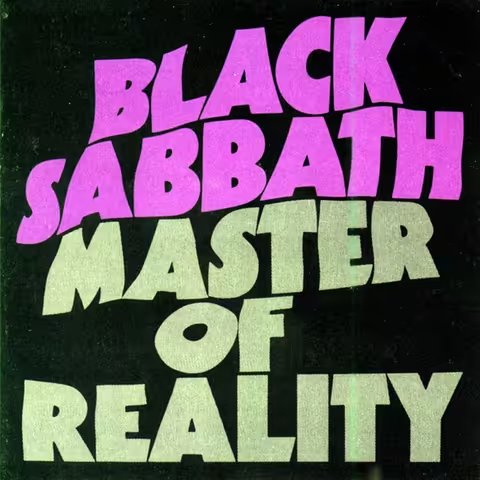
The cover of Master of Reality is one of the most stubbornly minimal sleeves ever put out by a major rock band. First pressings came in an "envelope sleeve" with a separate poster of the band slotted inside. The album title was embossed in black lettering on black card, raised in relief, almost invisible in a record shop until you tilted it under the lights. Iommi's own self-deprecating description in Iron Man captures it: "Slightly Spinal Tap-ish, only well before Spinal Tap." Later reissues, lacking the embossing, rendered the title in grey ink instead, and the original embossed envelope sleeve with intact poster is now one of the harder Sabbath collectibles to find clean.
This was also the first Sabbath sleeve to print the lyrics on the back. The label itself was unusual: Side A used the famous Vertigo "swirl" graphic but with the black-and-white colours inverted, while Side B was a black information label with white text, a one-off variant of the swirl that Vertigo never re-used. Photography and poster design were by Keef, with art direction by Mike Stanford.
The original North American Warner Bros. pressings introduced their own oddity: subtitles inside several songs ("The Elegy" inside "After Forever", "The Haunting" inside "Children of the Grave", "Step Up" inside "Lord of This World", "Deathmask" inside "Into the Void"), which together with an outright typographical mistake renamed the entire record Masters of Reality on first US pressings. Subsequent runs corrected the album title and dropped most of the subtitles, retaining only "The Elegy".
Release and Reception
Vertigo released the album on 6 August 1971; Warner Bros. followed in the United States ten days later. Commercially the response was immediate. It reached number 5 on the UK Albums Chart on 22 August and number 8 on the US Billboard 200, peaking in territories across the world: number 4 in Australia, 3 in Finland, 5 in Germany, 6 in Canada, 8 in Italy, 10 in the Netherlands. It was Black Sabbath's first album to reach the US top ten, the breakthrough that turned them from a successful British band into a global concern. By 1986 it had been certified platinum by the RIAA; double platinum followed in 2001.
Critics did not enjoy it. Rolling Stone's Lester Bangs called it "monotonous" and hardly an improvement on its predecessor, although he conceded the lyrics offered "some answers to the dark cul-de-sacs of Paranoid". Robert Christgau in The Village Voice rated it C-minus, dismissing it as "a dim-witted, amoral exploitation". The British music press was scarcely warmer, and the album received no significant year-end critical attention in 1971 at all.
The retrospective re-evaluation was, by 1990s standards, a near-total reversal. Q magazine awarded it five stars in 2001 and placed it on its 50 Heaviest Albums of All Time, calling it "malevolent... casting Black Sabbath as a Titanic-style house band on the eve of Armageddon, cranking it as the bomb drops." Rolling Stone's own 500 Greatest Albums list placed it 298 in 2003, 300 in 2012 and 234 in the 2020 revision, with the magazine eventually describing the album as representing "the greatest sludge-metal band of them all in its prime." It also ranks 34th on the same magazine's 100 Greatest Metal Albums of All Time. AllMusic's Steve Huey gives it the full five stars.
Within the band, the verdict has always been unambiguous. In 2017 Bill Ward named it his single favourite Sabbath album, fifty years on.
Singles and Music Videos
By 1971 Sabbath were operating, like Zeppelin, mostly outside the singles market. There was no promotional music video for any track on Master of Reality; the period concept of "rock-band promo film" was still embryonic, and Sabbath were a band built for FM album-oriented radio. The single releases were genuinely modest:
| Single | B-side | Territories | Date |
|---|---|---|---|
| Children of the Grave (3:47 edit) | Solitude | UK, Netherlands, Germany, Australia | August 1971 |
| After Forever | Fairies Wear Boots | France, Netherlands | Late 1971 |
| Sweet Leaf | After Forever | Philippines | 1971 |
None of these troubled the international singles charts in any serious way, which only reinforced Sabbath's positioning as an album band. The first proper Sabbath music video would not come until Sabbath Bloody Sabbath in 1973.
Touring and Live
The album drove what Sabbath called the Master of Reality Tour, a near-continuous run from late summer 1971 through summer 1972 with around 130 shows across Europe and North America. Highlights and incidents included:
- A 30 July 1971 warm-up at the Mar Y Sol Pop Festival in Puerto Rico, days before the album hit shops
- A US run sharing bills with Yes, Wishbone Ash, and on some dates the J. Geils Band
- Multiple sold-out nights at the Hollywood Bowl and Long Beach Arena, capturing the band's American breakthrough
- An 18 March 1972 show in Newcastle, Australia, often cited as the loudest concert in the city's history to that point
- Frequent inclusion of "Sweet Leaf", "Children of the Grave" and "Into the Void" in setlists, all three remaining live staples for the next five decades
Sabbath did not record an official live album from this tour, though bootlegs from Paris (December 1970, just pre-release) and various American radio broadcasts circulate widely. The lack of an authorised live document from this peak period remains one of the great Sabbath frustrations for fans.
In TV, Film and Media
The album's tracks have had an unusually long afterlife in screen and game media:
- "Sweet Leaf" recurs in stoner-comedy soundtracks, from Dazed and Confused-era cultural references onward
- "Children of the Grave" appears in the 2022 animated feature Beavis and Butt-Head Do the Universe
- "Children of the Grave" is a playable track in Guitar Hero: Warriors of Rock (2010)
- "After Forever" appeared in the soundtrack to the 2003 film School of Rock
- "Into the Void" provides a recurring needle-drop in stoner-rock and skate documentaries from the 1990s onward
Controversy and the Christian-Satanist Mix-up
The album sits in a strange place in the moral-panic timeline. By 1971 the press had decided Sabbath were satanists, and the embossed black-on-black cover plus the title were taken in some quarters as further evidence. Some American Christian radio stations refused to play "Sweet Leaf" on the grounds that the cough-then-riff opening was code for drug worship. Others, having actually read the lyrics, played "After Forever" approvingly. Black Sabbath in 1971 thus achieved the unlikely double of being denounced and embraced by the same audience for tracks on the same record.
Geezer Butler addressed the contradiction in his lyrics; the band, broadly, did not feel the need to address it elsewhere. Iommi told the BBC in 2017 that they had never thought of themselves as a heavy metal band, let alone a satanic one, and that the entire framing was a press invention. There was no organised censorship of the album, no Parental Advisory sticker (the system did not yet exist), no banned cover, no lawsuit. The "Sweet Leaf" riff was later sampled prominently by the Beastie Boys on "Rhymin and Stealin", the opening track of Licensed to Ill (1986), and quoted by the Red Hot Chili Peppers at the end of "Give It Away" (1991); neither use produced a public objection from Sabbath.
Covers, Samples and Tributes
The album's influence shows up most clearly in what other bands have done with its songs. A non-exhaustive list:
- Beastie Boys built "Rhymin and Stealin" (1986) around a loop of the "Sweet Leaf" riff layered over John Bonham's "When the Levee Breaks" drum break
- Butthole Surfers reworked "Sweet Leaf" as the deranged "Sweat Loaf" on Locust Abortion Technician (1987)
- Red Hot Chili Peppers quote the "Sweet Leaf" riff as the outro of "Give It Away" on Blood Sugar Sex Magik (1991)
- White Zombie covered "Children of the Grave" for the Nativity in Black tribute album (1994) and issued it as a promo single
- Soundgarden regularly closed sets with "Into the Void" with Chris Cornell rewriting the lyrics ("Into the Void (Sealth)")
- Lamb of God covered "Children of the Grave" at Sabbath's "Back to the Beginning" farewell on 5 July 2025, released the studio version the next day
- Sweet Leaf - A Stoner Rock Salute to Black Sabbath (Deadline, 2015) collected covers of the album's songs by Pentagram, Mike Inez, Zakk Wylde and others
The album itself sampled nothing. There was, in 1971, nothing for it to sample from.
Reissues, Remasters and Anniversaries
The album's reissue history is unusually clean for a 1971 record:
- 1986: First Warner Bros. CD pressing in the US
- 1996: Castle UK CD remaster
- 2004: Black Box, the Sabbath remasters box set, included the album on remastered CD with the Bain mix
- 29 June 2009: Sanctuary Deluxe Edition, a double-disc remastered by Andy Pearce with the bonus disc of outtakes (UK first, US import 14 July)
- 2016: Warner mono-mix vinyl reissue using flat-transfer remasters
- 2021: 50th-anniversary half-speed master vinyl from BMG, with restored embossed sleeve and inner poster
The 2009 Pearce remaster is the version most modern streaming services serve. The 50th-anniversary vinyl, with the embossed cover finally reproduced for the first time since 1971, is the version collectors point to as the canonical physical edition.
Legacy and Influence
Of the four original Sabbath members, three have always called Master of Reality the moment Black Sabbath stopped being a fast-rising hard-rock band and became something else: the source of a whole grammar that other bands would then spend fifty years learning. The detuned riffs of "Children of the Grave", "Lord of This World" and "Into the Void" gave doom and stoner metal their tuning convention. The dry, undecorated production gave grunge its sound. The flute-and-piano space of "Solitude" gave progressive doom its permission to be quiet.
Billy Corgan put it most often-quoted:
"I first heard Sweet Leaf from my uncle's copy of Master of Reality when I was eight. I thought: this is what God sounds like. It is the album that spawned grunge."
Billy Corgan, interviewed in The Maker, 1997
Iommi himself, looking back from 2016, was characteristically self-deprecating about the accident that started the whole chain:
"Some people believe the accident invented heavy metal. It helped me invent a new kind of music. I play a new sound and a different style of playing, and a different sort of music. Really, it turned out to be a good thing off a bad thing. But I don't know whether it did. It's just something I've had to learn to live with."
Tony Iommi, BBC, 2016
By the end of 2025 the album had outlived all four of the members who made it as a working unit. Sabbath's "Back to the Beginning" farewell concert in Birmingham on 5 July 2025 closed with songs drawn heavily from the album; Ozzy Osbourne died seventeen days later, on 22 July 2025. The 50-year arc that began with a chord at Island Studios in February 1971 closed in Aston, less than two miles from where Iommi had first picked up a guitar with two missing fingertips.
Things You Might Not Know
| Fact | Detail |
|---|---|
| The Sweet Leaf cough | It is Iommi, recorded while overdubbing acoustic guitar, after Ozzy passed him a joint mid-take. Bain looped it for the album opening rather than re-recording. |
| The Sweet Afton connection | Geezer Butler took the album's most enduring title from the lid of a Dublin-only cigarette brand, Sweet Afton, whose box read "the sweetest leaf that gives you the taste." |
| The tuning | Iommi dropped his SG to C-sharp standard, a tone and a half below concert, on Children of the Grave, Lord of This World and Into the Void. Geezer matched him on bass. |
| The factory accident | Iommi lost the tips of his middle and ring fingers on his last scheduled day at a Birmingham sheet-metal factory in early 1965, and built thimbles for them from a melted-down Fairy Liquid bottle and a leather jacket cut-off. |
| The flute | The Solitude flute was played by Iommi, picking up a skill he had glimpsed during his two-performance stint as Jethro Tull's guitarist in late 1968. |
| The engineer's afterlife | Tom Allom, the album's engineer, went on to produce British Steel, Screaming for Vengeance and four other Judas Priest classics, carrying the dry Sabbath drum sound directly into the New Wave of British Heavy Metal. |
| Bain's silent exit | Rodger Bain finished mixing Master of Reality in April 1971 and never worked with Sabbath again. He was not fired; Iommi simply took the chair himself on Vol. 4 the following year. Bain never spoke publicly about it. |
| The mistake on the US LP | First-pressing North American copies titled the record Masters of Reality, with a stray S that subsequent runs corrected. |
| The Vertigo label variant | Side A used the famous Vertigo "swirl" graphic with its colours inverted. The variant was never used on any other Vertigo release. |
| The embossed sleeve | The original black-on-black embossed envelope sleeve was an art-direction idea by Mike Stanford. Iommi himself later called it "slightly Spinal Tap-ish, only well before Spinal Tap." |
| Spanish Sid | An early, faster, conventionally bluesy version of Into the Void survives on the 2009 deluxe disc under the title Spanish Sid, capturing the song before Iommi detuned and slowed it. |
| The Beastie Boys connection | Rhymin and Stealin, the opening track of Licensed to Ill, is built on a loop of the Sweet Leaf riff layered with John Bonham's When the Levee Breaks drum break. Sabbath did not object. |
| Bill Ward's choice | Asked in 2017 to name his favourite of the eighteen Black Sabbath albums he played on, the drummer picked this one. |
| The final live performance | Lamb of God closed their set at Sabbath's Back to the Beginning farewell in Birmingham on 5 July 2025 with Children of the Grave, releasing the studio recording the following day; it was the last commercially issued Sabbath cover before Ozzy Osbourne's death seventeen days later. |
Listen to the Riffology Podcast
Master of Reality is the kind of record the Riffology hosts could talk about for three hours and still leave material on the table: the cough, the tuning, the Catholic lyric in the middle of side one, the way Bain's dry mix prefigured grunge by twenty years. For long-form conversations on this album and dozens of others, the Riffology podcast is available on Apple, Spotify, Amazon Music and every other major platform.
Comments