On 14 January 1984, James Hetfield walked out of a Boston motel on the Seven Dates of Hell tour with Venom and found that the truck containing every guitar, every amp and every road case Metallica owned had been stolen overnight. Five weeks later, he was standing in a Copenhagen studio with a borrowed Marshall stack, a hired Rickenbacker bass and a producer he had never met, cutting the album that would drag thrash metal out of the tape-trading underground and into the room where rock music was actually argued about.
Ride the Lightning is the eight-song, forty-seven-minute record that resulted. It was tracked in three weeks, mixed in roughly one, released on a tiny New Jersey indie called Megaforce on 27 July 1984, and then re-released by Elektra inside four months once the major-label A and R community caught up with what the underground had already worked out. Within two years it was certified Gold. Today it is 6x Platinum in the United States alone, and it is the bridge between the bratty velocity of Kill 'Em All and the world-conquering chrome of Master of Puppets. It is also, by a comfortable margin, the most musically curious thing Metallica ever made.
Album facts
| Field | Detail |
|---|---|
| Artist | Metallica |
| Album | Ride the Lightning |
| Release date | 27 July 1984 |
| Label | Megaforce Records (US, original); Music for Nations (Europe, original); Elektra Records (US, November 1984 reissue) |
| Producer(s) | Metallica, Flemming Rasmussen, Mark Whitaker |
| Studio(s) | Sweet Silence Studios, Copenhagen (with overflow drum tracking in an adjacent warehouse) |
| Genre / Subgenre | Thrash metal, with strong heavy metal and proto-progressive metal elements |
| Track count | 8 |
| Total runtime | 47:26 |
| Billboard 200 peak | No. 100 on initial run; later re-charted higher with reissues |
| UK Albums Chart peak | No. 87 |
| Other notable chart peaks | Top 40 in West Germany and the Netherlands by 1985; long-tail re-entries across the 1990s |
| Certifications | 6x Platinum (RIAA, USA); Platinum (BPI, UK); multi-Platinum across Canada, Germany, Australia |
| Estimated sales | Well over nine million worldwide across original pressings and reissues |
| Key singles | Creeping Death (also released as a UK twelve-inch EP); Fade to Black promoted to rock radio without a commercial single release |
Cultural context: 1984 was not built for thrash
The year Metallica delivered Ride the Lightning was the year MTV decided what mainstream rock looked like, and what it looked like was hair. Van Halen had opened January 1984 with 1984 itself, "Jump" stomping all over Top 40 radio. Motley Crue were still working Shout at the Devil. Iron Maiden would arrive in September with Powerslave. Bon Jovi released their debut. Prince put out Purple Rain. Bruce Springsteen released Born in the U.S.A.. The biggest rock records of the year were polished, photogenic and explicitly built for television.
Thrash metal, by contrast, had no television presence whatsoever. Slayer's Show No Mercy had crept out on Metal Blade a few weeks before Metallica started tracking. Anthrax were still working on Fistful of Metal. Megadeth did not yet exist as a band, because Dave Mustaine was eight months into stewing in a North Hollywood apartment after being fired. The networks that would carry thrash to a global audience, MTV's Headbangers Ball among them, were still years from existing. Awareness of bands like Metallica was carried by xeroxed fanzines, mail-order catalogues and the cassette-trading network that ran out of bedrooms in Sweden, the East Bay, Birmingham and New Jersey.
What this means in retrospect is that Ride the Lightning achieved its initial reputation in a space the music industry was barely watching. The album sold 15,000 copies on its first Megaforce pressing and was sold out within weeks, not because radio picked it up, but because Metal Forces wrote about it, because Bay Area record shops stocked it, and because the kids who had been recording the previous year's Kill 'Em All off each other's reel-to-reels demanded copies. The major labels noticed only because the indie distribution numbers became impossible to ignore.
The band's story up to this point
The Metallica who walked into Sweet Silence Studios in February 1984 had existed in their final-for-now lineup for less than ten months. Hetfield and Ulrich had founded the band in Los Angeles in October 1981, after Ulrich, the Danish-born son of a tennis pro, had answered Hetfield's response to a classified ad in The Recycler. Their first lead guitarist, Dave Mustaine, joined in early 1982. Bassist Ron McGovney was eased out in late 1982 in favour of Cliff Burton, who had been spotted with Trauma at Hollywood's Whisky a Go Go and who refused to leave the Bay Area, prompting Metallica to relocate to El Cerrito.
Mustaine, by every published account including his own, was a remarkable guitarist and a destructive presence on the road. On 11 April 1983, in Queens, New York, the morning Metallica were due to start recording their debut, Hetfield, Ulrich and Burton put Mustaine on a four-day Greyhound bus back to Los Angeles. Kirk Hammett, summoned from Exodus on Ulrich's say-so, flew in to take the lead chair and learned the entire Kill 'Em All set in roughly two weeks of rehearsal in the basement of label boss Jon Zazula's house.
Kill 'Em All, released that July, did exactly what a debut album by a hungry thrash band ought to do. It went down well in the underground, sold steadily and got them on the road for what would prove a punishing eighteen months. By the autumn the band were demoing material for the follow-up at the same Music Building rehearsal space in Queens. By Christmas 1983 they had four of the eight songs that would make Ride the Lightning in some kind of working shape. They knew, all four of them, that they wanted to make something bigger and stranger than the debut. They had not yet worked out how.
Pre-production and demos
The songs on Ride the Lightning came together in three rough waves. The first wave was Mustaine-era material: the verse riff and key changes of the title track, and the basic theme of the closing instrumental, both of which Mustaine had contributed before his firing and which the band declined to discard. The second wave was Burton-led, the bassist arriving in the writing room with a music-theory vocabulary none of the others possessed and using it to push the band toward minor-key harmonised passages, modal interludes and the long, classically-shaped intro to "Fade to Black". The third wave was the lyrical and conceptual layer Hetfield grafted on once the band came off the European Venom tour in early 1984.
Working titles included Metal Up Your Ass for a moment in late 1983, before the band remembered that this was the title they had wanted for the debut and abandoned. "Fight Fire with Fire" was demoed under that title from the start. "Creeping Death" had been written and arranged in late 1983 after a long, rainy afternoon in front of a television showing Cecil B. DeMille's The Ten Commandments; Hetfield is credited with the "die / die / die" gang vocal idea, although Burton's bassline is what gives the section its shape. "When Hell Freezes Over" was floated as a possible album title before Ride the Lightning took over.
Pre-production demos were tracked at the band's El Cerrito house and at the Music Building in New York, mostly on a borrowed four-track. None has ever received an official release in studio-quality form, although fragments have circulated for years on bootlegs labelled "Garage Demos 1983-84". The defining decision of the pre-production phase was negative: the band agreed they would not record this album at New York's Music America Studios, where Paul Curcio had cut Kill 'Em All. They wanted somewhere none of them had been before, with a producer none of them knew.
Creating the album: three weeks in Copenhagen
The producer they settled on was Flemming Rasmussen, a Danish engineer in his early thirties who had built his reputation at his own facility, Sweet Silence Studios in Copenhagen. Ulrich's exposure to Rasmussen had come through Rainbow's Difficult to Cure, mixed at Sweet Silence, and through Danish hard rock band Pretty Maids. Rasmussen later told Sound on Sound that he had never heard of Metallica when manager Cliff Burnstein's office called.
"I knew nothing about them. I had never heard the first album. I had to go and find a copy in a Copenhagen record shop the week before they arrived, and I remember thinking, this is going to be loud, fast and difficult."
Flemming Rasmussen, Sound on Sound, 2005
Metallica flew into Copenhagen on 19 February 1984 and started tracking the following day. The session ran from 20 February until 14 March, with mixing wrapped by the end of March. The total bill came to roughly $30,000, double the $20,000 Megaforce had originally allocated; Music for Nations, the European label, agreed to cover the overrun in exchange for European rights, an arrangement that would prove generous to Music for Nations and ruinous to nobody at the time.
The shape of the session was dictated by the gear situation. With the Boston theft fresh, Metallica arrived in Denmark with almost nothing of their own. Hetfield played borrowed and rented amps, plus a freshly bought Marshall JCM800 stack purchased on credit from a Copenhagen music shop; Burton's main bass for the record was a rented Rickenbacker through a Mesa Boogie head he had borrowed from Anthrax. Hammett's lead tone came largely through Hetfield's spare ESP and a rented Marshall, and his solos were tracked using a Tube Screamer his friend Joe Satriani had recommended during their pre-Metallica lessons in the Bay Area.
Rasmussen's most consequential production decision involved Ulrich's drums. Sweet Silence's main live room was good but small, and Ulrich wanted a bigger, more naturally reverberant snare than the room could provide. Rasmussen ran cables out of the studio and into an empty warehouse next door, set up Ulrich's kit there and used the space's natural decay as a kind of free reverb chamber. The result is the loudest, longest snare-to-kit ratio in the entire Ulrich discography. Reports vary on which specific tracks were cut in the warehouse versus the studio proper, but Rasmussen has consistently said in interviews that the basic drum tracks for most of the album were recorded there.
Vocals were tracked last and slowly. Hetfield, then twenty, was still figuring out the voice that would become the most recognisable bark in metal. Rasmussen has spoken in several interviews about coaching Hetfield to sing rather than shout on the cleaner sections, particularly the verses of "Fade to Black" and the haunting middle section of "For Whom the Bell Tolls".
"James was a kid. He had never really tried to sing properly before. I just kept telling him to do it again, lower, softer, less angry. He hated it for the first week. After that, he started to enjoy hearing his own voice."
Flemming Rasmussen, Decibel, 2014
The whole record was tracked to two-inch analogue tape on a Studer A800, mixed on Sweet Silence's Neve V Series console, and mastered by George Marino at Sterling Sound in New York, a relationship that would carry forward through the rest of Metallica's eighties output.
Personnel and credits
| Role | Player | Notes |
|---|---|---|
| Core band | ||
| Lead vocals, rhythm guitar | James Hetfield | All lead vocals; principal rhythm guitar throughout; lyric writer on every track |
| Drums | Lars Ulrich | Drum tracks captured partly in warehouse adjacent to Sweet Silence |
| Bass, backing vocals | Cliff Burton | Rented Rickenbacker for most of the record; wah and distortion pedal pioneered the "bell" intro of For Whom the Bell Tolls |
| Lead guitar | Kirk Hammett | First album-length solo showcase with Metallica; Ibanez Tube Screamer in front of borrowed Marshall |
| Songwriting (additional) | ||
| Co-writer | Dave Mustaine | Credited on Ride the Lightning (title track) and The Call of Ktulu, for parts written before his April 1983 firing |
| Production and engineering | ||
| Producer | Flemming Rasmussen | Co-produced with the band; first outside producer Metallica ever hired |
| Producer (associate) | Mark Whitaker | Band's then road manager and informal sound advisor; engineering and arrangement support |
| Engineer | Flemming Rasmussen | Tracked the album personally; assistant engineers at Sweet Silence credited on sleeve |
| Mastering | George Marino | Sterling Sound, New York City |
| Artwork | ||
| Cover concept | Metallica | Electric chair struck by lightning; title from Stephen King's The Stand |
| Cover painting | AD Artists | Airbrushed cover executed by the British design house; original artist's individual name has never been firmly published |
Two production credits warrant a flag. Mark Whitaker is credited alongside Rasmussen on the sleeve and was in the room throughout, but Rasmussen has been consistent in interviews that he engineered and produced the record himself with the band, and that Whitaker's role was closer to that of a trusted ear and band advocate. The Dave Mustaine credits, meanwhile, mean that royalty payments from Ride the Lightning have continued to land in Mustaine's account every quarter since 1984, a point Mustaine has made publicly on multiple occasions with a mixture of pride and lingering resentment about how he came to leave.
The songs
| # | Title | Writer(s) | Length | Single? | Notes |
|---|---|---|---|---|---|
| 1 | Fight Fire with Fire | Hetfield, Ulrich, Burton | 4:44 | No | Opens with a classical-guitar passage Burton arranged; nuclear annihilation theme |
| 2 | Ride the Lightning | Hetfield, Ulrich, Burton, Mustaine | 6:36 | No | Title track; opens with the bass-and-guitar harmonised motif; Mustaine credited for verse riff and bridge |
| 3 | For Whom the Bell Tolls | Hetfield, Ulrich, Burton | 5:10 | Promo only | Title from Hemingway; opening "bell" sound is Burton's bass through wah and distortion, not a guitar |
| 4 | Fade to Black | Hetfield, Ulrich, Burton, Hammett | 6:55 | Album / radio promo | The band's first ballad; Hammett's first major recorded solo; Hetfield's lyric drafted in Boston after the gear theft |
| 5 | Trapped Under Ice | Hetfield, Ulrich, Hammett | 4:03 | No | Reworked from a 1982 Exodus instrumental Hammett brought with him called Impaler |
| 6 | Escape | Hetfield, Ulrich, Hammett | 4:23 | No | The closest thing to a "radio" attempt on the record; Hetfield's least-loved Metallica song |
| 7 | Creeping Death | Hetfield, Ulrich, Hammett, Burton | 6:36 | UK EP, December 1984 | Inspired by Passover narrative in the Book of Exodus; "die" gang vocal became the band's signature live moment |
| 8 | The Call of Ktulu | Hetfield, Ulrich, Burton, Mustaine | 8:53 | No | Instrumental; Burton-led; deliberate alternative spelling of Lovecraft's Cthulhu; Mustaine co-credit for the basic theme |
Fight Fire with Fire
The album opens with thirty-eight seconds of finger-picked classical guitar in E minor before a single hi-hat tick and an avalanche of E5 power chords detonate everything underneath. The classical intro is Cliff Burton's idea, lifted in spirit from the kind of two-part counterpoint he had been studying at California State University Hayward in 1982 and 1983. The lyrical premise is nuclear war and mutually assured destruction, written by Hetfield in the same paranoid pre-Reykjavik mood that produced Sting's "Russians" and most of the era's best dystopian metal.
Ride the Lightning
The title track is the song that most obviously bears Dave Mustaine's fingerprints. The principal verse riff and one of the bridge sections were written when Mustaine was still in the band; he is credited accordingly, and the chord motion in the verses, with its angular, blues-influenced shape, sounds noticeably different from the Burton-influenced harmonic vocabulary on the rest of the record. The lyric is told from the point of view of a condemned man strapped into the electric chair, taking the album's title phrase from the Stephen King passage that gave the record its name. Hammett's solo is the first place on the album where his blues-rooted, Joe Satriani-tutored phrasing fully announces itself.
For Whom the Bell Tolls
The chiming intro that everyone remembers is, in fact, a chime: producer Flemming Rasmussen and the band hit an anvil in the studio with a hammer and tracked it through reverb. The rumbling melodic figure that comes in over the top, often mistaken for a guitar, is Cliff Burton's bass played through a Morley wah pedal and a Big Muff fuzz, a tone Burton had developed years earlier in his pre-Metallica band Trauma. The main riff itself dates back to 1982, predating Burton's joining Metallica. The lyric draws on Ernest Hemingway's Spanish Civil War novel of the same name, though Hetfield's verses describe a generic war-dead scene rather than anything specific to the book.
Fade to Black
The first ballad in the Metallica catalogue, and arguably the song that did more to expand the band's commercial possibilities than any other track on the album. The clean-tone intro is an arpeggiated E-minor figure with open strings, of a kind that owes more to Burton's classical interests than to anything Hetfield had previously written. Hetfield has spoken in multiple interviews, including a long 2014 sit-down with Howard Stern, about drafting the lyric in a Boston hotel room in the hours after the equipment theft, when he found himself contemplating what would be left if the band collapsed there and then. The long outro solo is Hammett's first true showcase on a Metallica record. Fans booed the song when it appeared in setlists in late 1984 and early 1985, dismissing it as a sell-out ballad. By the time of the 1986 Master of Puppets tour it was a setlist fixture, and it has remained one ever since.
Trapped Under Ice
The shortest song on the record and the most direct return to Kill 'Em All-style velocity. The principal riff originated as an instrumental called "Impaler", written by Hammett during his Exodus days; he brought it to Metallica when he joined, and it sat in a working pile until being reshaped for the new album with a Hetfield lyric about cryonic preservation gone wrong. It is the song on the record that benefits most obviously from Hammett's playing style as distinct from Mustaine's.
Escape
The band have never hidden their feelings about "Escape". Hetfield in particular has called it the song he most dislikes in the catalogue, dismissing it across multiple interviews as the closest the band ever came to consciously chasing radio play. The song was not played live in any form between its 1984 release and 24 June 2012, when the band finally performed it at the Orion Music + More festival in Atlantic City after fans voted for it in a poll. It is a perfectly competent mid-paced metal song with a chant-along chorus; in any other discography it would be unremarkable. In Metallica's, it is the odd one out.
Creeping Death
The song with the most uncomplicated origin story. Hetfield and Ulrich watched Cecil B. DeMille's 1956 Technicolor epic The Ten Commandments on a hotel television in late 1983, were struck by the sequence depicting the tenth plague of Egypt, and walked out with the title and the premise written. Burton's bassline gives the song its spine and the gang-vocal section in the middle, the punctuated "die, by my hand" chant, became the audience-participation moment that has defined every Metallica live show since 1985. In the UK, the song was issued in December 1984 as a twelve-inch EP that included cover versions of Diamond Head's "Am I Evil?" and Blitzkrieg's "Blitzkrieg", later to become foundational documents of the band's covers culture.
The Call of Ktulu
The closing track is the most musically ambitious thing Metallica had attempted to that point: eight minutes and fifty-three seconds of instrumental music built around a slow, modal main theme, a long Burton-driven middle section and a building outro powered by his lead bass. The title's idiosyncratic spelling, "Ktulu" rather than H. P. Lovecraft's canonical "Cthulhu", is reportedly because Hetfield and Burton thought it looked more sinister on a page. Mustaine is credited as co-writer because elements of the central theme had been demoed before his firing. Years later, in 1999, the band would re-record it with Michael Kamen and the San Francisco Symphony Orchestra as the opening number of the S&M live album, and it would win a Grammy for Best Rock Instrumental Performance, the first time the song's writers were officially recognised by the Recording Academy.
B-sides, outtakes and lost songs
Metallica are an album-cycle band, not a singles band, and the B-side culture of Ride the Lightning is correspondingly small but interesting. The most significant artefact is the December 1984 UK Music for Nations twelve-inch EP for "Creeping Death", which paired the album cut with two cover versions:
- "Am I Evil?" by Diamond Head, the New Wave of British Heavy Metal song Metallica had been opening live sets with since 1982 and which would become a lifelong setlist option.
- "Blitzkrieg" by the Newcastle NWOBHM band of the same name, recorded in the same sessions and a less obvious choice that announced the band's deep-cut credentials.
Both covers were tracked during or immediately after the Ride the Lightning sessions at Sweet Silence and remained the canonical versions until being collected, along with later cover recordings, on the 1987 EP The $5.98 EP: Garage Days Re-Revisited and the 1998 double album Garage Inc.. Beyond these two, no other Sweet Silence session outtakes have been officially released, and Rasmussen has said in interviews that the band largely tracked only what they intended to use. Bootlegs of working pre-production demos from late 1983 circulate among collectors, but no studio-quality outtakes are known to sit in the Metallica vault.
Album artwork and packaging
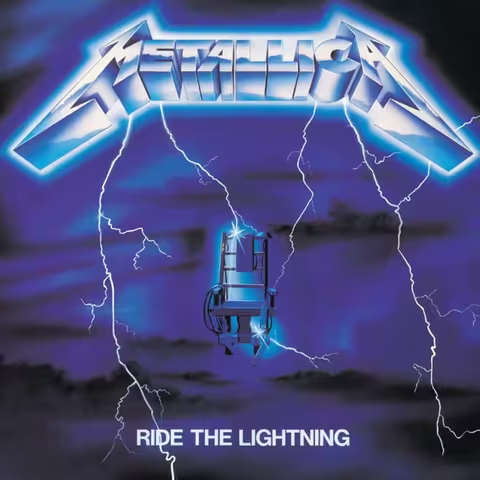
The cover, an airbrushed electric chair suspended in mid-air against a black background and struck by blue lightning bolts, was conceived by the band and executed by the British design house AD Artists, who had previously worked with Music for Nations on other releases. The image is closer to a science-fiction paperback cover of the period than to traditional metal sleeve art, and it is one of the cleanest, most photographic album covers in early-eighties thrash, a quiet contrast to the busy occult imagery dominating sleeves for Slayer, Mercyful Fate and Venom that year.
The cover exists in two pressings that collectors care about. The standard 1984 release prints the lightning in blue. A small early Canadian pressing accidentally went out with the lightning printed in green, the result of a colour-separation error at the pressing plant. The "green misprint" is one of the most sought-after pieces of Metallica memorabilia from the period, with clean copies routinely changing hands at over a thousand pounds at auction.
The title Ride the Lightning is taken directly from a passage in Stephen King's 1978 post-apocalyptic novel The Stand, in which a character recalls hearing a death-row convict's last words. The original passage reads, in part, "once upon a time we had us a fight, five thousand crazies riding the lightning, anything goes". The connection to the title track's electric-chair lyric was the band's, and King has not, as far as has ever been documented, formally commented on the use.
Release and reception
Megaforce released the album in the United States on 27 July 1984, with an initial pressing of around 15,000 units. Music for Nations had it on shelves across Europe at almost the same time. Reviews in the metal press were strongly positive from the outset. Kerrang! awarded the album five Ks. Metal Forces placed it at the top of its 1984 year-end critics' poll. The mainstream press, where it noticed the record at all, was politely baffled.
The commercial picture changed in September 1984 when Cliff Burnstein, then a junior A and R representative at Elektra Records, persuaded the label's senior management to sign Metallica on the basis of the Megaforce sales numbers and a tape of Ride the Lightning he had been carrying around for weeks. The Elektra deal was signed within eight weeks of the album's original release; in November 1984 Elektra issued its own pressing of Ride the Lightning with revised credits, and the album began its slow climb up the Billboard 200. The original Billboard peak on the Megaforce / Elektra release cycle was No. 100, with the UK Albums Chart peak settling at No. 87 some weeks later.
The retrospective re-evaluation has been steady and emphatic. Rolling Stone ranked the album at No. 376 in its 2020 revision of the 500 Greatest Albums of All Time. Q magazine placed it in its eighties albums canon. Loudwire and Decibel have both repeatedly placed it in their top three Metallica albums, with the band's own catalogue rankings tending to settle on Ride the Lightning and Master of Puppets as the consensus joint apex. Certifications followed: Gold in the United States by November 1987, Platinum by July 1989, and 6x Platinum by 2012, with comparable certifications across the United Kingdom, Canada, Germany and Australia. Awards in the contemporary moment were sparse simply because the bodies who handed out awards did not yet recognise the genre; the 1999 S&M Grammy win for the orchestral recording of "The Call of Ktulu" is the closest the album's material has come to formal recognition by the Recording Academy.
"They made a record that had everything. It had speed, it had ballads, it had the long instrumental, it had the political stuff and it had songs from books. It was the first time anyone in our scene had tried all of that on one record."
Scott Ian of Anthrax, Decibel Hall of Fame issue, 2007
Singles and music videos
Metallica did not, in any orthodox sense, "release singles" from Ride the Lightning. There was no commercial seven-inch in the United States and no music video filmed for the album cycle. The closest the band came was the December 1984 Music for Nations twelve-inch EP of "Creeping Death" in the United Kingdom, which qualified the song for the UK singles chart and brought it briefly to No. 92. "Fade to Black" received album rock radio airplay in the United States on the strength of word of mouth, not promotion. The band's first proper music video would not appear until "One" in 1989, by which point the no-videos policy had become an active marketing position.
The absence of videos in the 1984 to 1985 promotion cycle is, with hindsight, part of the record's mythology. Ride the Lightning was a record you had to seek out, on a label you might never have heard of, on a format you might have to mail order from the back of Kerrang!. That friction was part of how the underground was built around it.
Touring and live
The Bang the Head That Doesn't Bang tour opened in February 1985 and ran into the late summer, taking Metallica from clubs to theatres across North America and Europe. The band had previously been the support act for Armored Saint and W.A.S.P. on parts of the late 1984 American touring schedule, before being upgraded to headline status on the back of the European Music for Nations sales numbers. The defining live moments of the album cycle include:
- A 28 January 1985 show at the Lyceum Theatre in London, recorded by the BBC and bootlegged for decades.
- The Monsters of Rock festival at Donington Park on 17 August 1985, where Metallica were third on the bill below Bon Jovi and headliners ZZ Top and famously won the day.
- The Day on the Green festival at the Oakland Coliseum on 31 August 1985, the band's first major US festival headline-rotation slot.
Setlists from the Ride the Lightning touring cycle leaned heavily on the new record but kept the velocity of Kill 'Em All at the heart of the show. "Fade to Black" was the most contentious inclusion, drawing audible boos from some 1984 audiences before sentiment swung. "Creeping Death" was already, by mid-1985, the song the audience came to sing rather than just hear.
In TV, film and media
The album has had a long afterlife in sync placements, video games and sports culture. The most prominent uses include "For Whom the Bell Tolls" in the soundtrack of Oliver Stone's 1986 Vietnam film Platoon alongside other period rock, and the same song as walk-on music for countless boxers, mixed martial artists and NFL teams over the subsequent decades. "Fade to Black" has become a standard rock-radio ballad rotation cut and appears in the Guitar Hero franchise, where it has introduced the song to a generation that did not buy the record on cassette in 1984. "Creeping Death" has been used as the entrance music for WWE wrestler Kane and, more recently, in the soundtrack of multiple horror films and video games. The album material as a whole forms part of the bedrock of every Metallica-themed entry across the Rock Band and Guitar Hero series.
Controversy, censorship and legal matters
Compared to the records that surrounded it on the metal shelf, Ride the Lightning generated relatively little contemporary controversy. The PMRC's Filthy Fifteen list of September 1985 did not include any Metallica track, despite the title song's explicit subject matter; Tipper Gore's committee was more exercised by Prince and W.A.S.P. than by an underground thrash record. There has never been a formal plagiarism lawsuit over any song on the album. The Dave Mustaine credit dispute is occasionally raised by Mustaine in interviews, but it is a credit dispute that was resolved at the time, in Mustaine's favour, by the band electing to keep his name on the relevant songs. The closest the record has come to litigation is the long-running, low-level discussion about the use of the phrase "Ride the Lightning" from The Stand, which has never reached a formal complaint from the King estate.
Covers, samples and tributes
Songs from Ride the Lightning have been covered widely, particularly within the metal scene. Notable recorded covers include Apocalyptica's cello arrangements of "Fade to Black", a recurring fixture in the Finnish quartet's repertoire since their 1996 debut Plays Metallica by Four Cellos. "For Whom the Bell Tolls" has been covered by Dream Theater (live), by Cher (a 2024 release that briefly went viral), and by Trivium. "Creeping Death" appears in the live sets of bands from Children of Bodom to Mastodon. The album also gave its full title to a 2004 tribute compilation, Tribute to Ride the Lightning, on Versailles Records, featuring a span of underground metal acts covering each track in sequence. The album itself contains no samples and interpolates no other material.
Reissues, remasters and anniversaries
The Elektra reissue of November 1984 is, strictly, the album's first reissue, and it remains the canonical US pressing for the rest of the eighties. A vinyl-only remaster appeared in 1995. The most consequential reissue is the 2016 deluxe remaster, supervised by the band, which restored the album's original Sweet Silence mix from the original analogue tapes and added a substantial bonus package of contemporary live tracks and rough mixes. The deluxe box set release ran across multiple discs and included a remastered LP, three live CDs, a CD of rough mixes and a hardback book; this is the pressing the hero image at the top of this article is taken from. A subsequent half-speed-mastered vinyl edition followed. A Dolby Atmos spatial-audio mix was added to streaming services in 2024 to mark the album's fortieth anniversary, with a limited-run anniversary vinyl pressing the same year.
Anniversary live performances of the album in full have been rare. The band have never toured Ride the Lightning as a full-album set, though substantial blocks of the record have appeared in setlists across the WorldWired and M72 tours. Bootleg circulation of the Sweet Silence sessions is limited; the most-circulated artefact is the BBC's 1985 Lyceum live recording, which functions as a de facto contemporaneous live document of the album.
Legacy and influence of Ride the Lightning
The case for Ride the Lightning as the single most important thrash metal album is straightforward enough to make. It was the record on which thrash demonstrated that it could be more than fast. It introduced the long-form instrumental, the ballad, the literary lyric and the harmonised twin-guitar passage to a scene that had been built almost exclusively on speed and aggression. The bands that followed Metallica in the second wave of thrash, including Megadeth, Anthrax in their later eighties phase, Testament, Exodus, Forbidden and the entire Bay Area scene, took permission from Ride the Lightning to write longer, stranger and more harmonically adventurous songs. The progressive metal of Dream Theater, Queensryche's Operation: Mindcrime and the entire technical thrash subgenre are unimaginable without it.
For Metallica themselves, the album opened the door to Master of Puppets, the record on which the ideas of Ride the Lightning were brought to their most polished form. It also crystallised the four-man democratic-writing model that would carry the band through to the catastrophe of Cliff Burton's death in September 1986. Burton's playing and writing presence is so central to Ride the Lightning that listening back to it now, with the awareness that he had only two years left to live, gives the record a melancholy it did not have in 1984. He was twenty-two when it was released.
"Without Cliff there is no Ride the Lightning. He brought all the music theory. He brought the harmonies. He brought the courage to put a ballad and an instrumental on a Metallica record. He was the band's secret musical weapon."
Kirk Hammett, Guitar World, 2014
The retrospective list placements have hardened over time. Rolling Stone placed the album at No. 376 in its 2020 500 Greatest revision. Q, Kerrang!, Loudwire, Metal Hammer and Classic Rock have all run greatest-thrash-albums features in which it placed first or second, usually competing with Master of Puppets for the top slot. It remains the album that long-time Metallica fans, when pressed, will most often nominate as their favourite, even ahead of the more commercially successful records that followed it.
Things you might not know
| Fact | Detail |
|---|---|
| The Boston theft | Metallica's van and entire equipment haul was stolen from a Boston parking lot on 14 January 1984, leaving them to borrow gear from Anthrax, Exciter and locals to finish the European Venom tour. |
| The Marshall on credit | Hetfield bought a new Marshall JCM800 head from a Copenhagen music shop on credit a week before tracking began, and that head is the principal rhythm-guitar amp on the record. |
| Lars in a warehouse | Most of Lars Ulrich's drum tracks were captured not in Sweet Silence's main live room but in an empty warehouse next door, using the building's natural decay as a free reverb chamber. |
| The bell is an anvil | The chime that opens "For Whom the Bell Tolls" was made by hitting an anvil in the studio with a hammer and tracking the result through reverb. |
| The bell-line is bass | The melodic figure that rumbles over the anvil chime, often mistaken for a guitar, is Cliff Burton's bass played through a Morley wah and a Big Muff distortion. |
| Burton studied theory | Burton spent 1982 and 1983 studying music theory at California State University Hayward before joining Metallica, which is where the harmonised passages and modal interludes on the record came from. |
| Mustaine still gets paid | Dave Mustaine has received royalty cheques from Ride the Lightning every quarter since 1984 thanks to his retained credits on the title track and "The Call of Ktulu". |
| Hetfield in a Boston hotel room | The "Fade to Black" lyric was drafted in a Boston hotel room in the hours after the equipment theft, during what Hetfield has described in interviews as a genuine low point. |
| "Escape" stayed unplayed for 28 years | "Escape" was not performed live by Metallica between its 1984 release and 24 June 2012, when it was played at the Orion Music + More festival in Atlantic City after a fan poll. |
| The green misprint | An early Canadian pressing was accidentally printed with green lightning instead of blue and now changes hands for over a thousand pounds at auction. |
| The title comes from Stephen King | The phrase "ride the lightning" is taken from Stephen King's 1978 novel The Stand, in which a death-row prisoner uses it to describe the electric chair. |
| "Trapped Under Ice" was an Exodus piece | The principal riff began life as an Exodus instrumental called "Impaler" written by Kirk Hammett before he was recruited to Metallica. |
| Cthulhu spelled Ktulu | The instrumental closer's spelling of "Ktulu" rather than H. P. Lovecraft's canonical "Cthulhu" was chosen because Hetfield and Burton thought it looked better on the sleeve. |
| Music for Nations covered the overrun | The session cost roughly $30,000, twice the original $20,000 Megaforce budget; Music for Nations covered the overrun in exchange for European rights. |
| Elektra signed them inside eight weeks | Elektra Records' Cliff Burnstein got the band signed within eight weeks of the album's Megaforce release and reissued it in November 1984. |
Ride the Lightning on the Riffology podcast
Every episode of the Riffology podcast puts a single album on the table and pulls it apart, song by song, from the studio session to the legacy. The catalogue is available on Apple Podcasts, Spotify, Amazon Music, Pocket Casts and every other major podcast platform; subscribe wherever you get your podcasts and the new episodes will arrive automatically.
Comments