When Capitol Records' A&R man Tim Carr walked into Music Grinder Studios on Melrose Avenue in the early spring of 1986, Megadeth had already finished tracking their second album on a $25,000 budget from a New York indie label, two of the four band members were openly shooting heroin between takes, and the frontman who had assembled the project had spent most of the previous year sleeping on friends' floors. Capitol bought the master tapes off Combat Records, paid for a different mixer who had never touched a metal record before, and turned the whole thing into the album that broke thrash metal out of the underground.
Peace Sells... but Who's Buying? is the record that proved the genre could sell in six figures without softening, and the record that ended Megadeth's first classic lineup. Within twelve months of its release Dave Mustaine had fired both Chris Poland and Gar Samuelson, the two musicians whose jazz fusion sensibilities are precisely what makes the album sound like nothing else from 1986. Forty years on, it sits on every credible list of the greatest thrash albums ever made, and its opening bass figure became one of the most-played pieces of metal in American broadcasting history. The story of how it got finished at all is messier, funnier and bleaker than the legend usually suggests.
Album Facts
| Field | Detail |
|---|---|
| Artist | Megadeth |
| Album | Peace Sells... but Who's Buying? |
| Release date | 25 September 1986 |
| Label | Capitol Records (originally Combat Records) |
| Producers | Dave Mustaine, Randy Burns |
| Mixed by | Paul Lani, Stan Katayama |
| Studios | Music Grinder, Track Record and Rock Steady, Los Angeles; Maddog, Venice, California |
| Genre | Thrash metal |
| Track count | 8 |
| Total runtime | 36:12 |
| Billboard 200 peak | 76 |
| UK Albums Chart peak | Did not chart on initial release; UK Rock & Metal Albums peak of 21 in 2011 |
| Other notable peaks | Greek Albums (IFPI) 8; Japan Oricon 89 (2011 reissue) |
| Certifications | Platinum (RIAA, October 1992); Platinum (Music Canada); Silver (BPI, 2004 reissue) |
| Estimated sales | Roughly 2 million worldwide |
| Key singles | "Wake Up Dead" (1986), "Peace Sells" (November 1986) |
1986: The Peak Year of Thrash
No genre has ever had a calendar year quite like American thrash metal in 1986. In the same nine-month stretch that produced Peace Sells... but Who's Buying?, the underground also delivered Metallica's Master of Puppets in March, Slayer's Reign in Blood in October, Dark Angel's Darkness Descends, Kreator's Pleasure to Kill, Possessed's Beyond the Gates, and Sodom's Obsessed by Cruelty. The mainstream argument that year was Bon Jovi's Slippery When Wet versus Cinderella's Night Songs; the underground had quietly built a parallel scene with its own logic, its own circuit and, increasingly, its own labels.
Megadeth landed in the middle of all of it with a record that did not really belong to any of the existing camps. Slayer were faster and bleaker. Metallica had moved toward arena-scale composition. Anthrax were embracing crossover. Peace Sells was neither pure speed nor riff-driven anthem; it was a thrash record that owed as much to jazz fusion and political punk as it did to the New Wave of British Heavy Metal that had spawned the genre. The lyrics, almost uniquely for 1986 metal, were about real American politics rather than nuclear allegory or fantasy violence.
The wider context in 1986 was tense and televised. The Space Shuttle Challenger broke up over Florida in January. The Chernobyl Number 4 reactor melted down in April. Ronald Reagan was midway through a second term, the Iran-Contra affair was about to break, and the United States was in the middle of a moral panic about Satanism in popular music that would sweep up Megadeth, Slayer and Judas Priest in turn. Mustaine wrote a record that pointedly refused to be reassuring on any of those fronts.
Three Years of Chaos
The Megadeth that walked into Music Grinder in February 1986 had been together for barely two and a half years and had already cycled through close to a dozen lineups. Mustaine had founded the band in Los Angeles in April 1983, weeks after being fired from Metallica on the tour bus back from a New York demo session, and had vowed to build something faster and heavier than the band that had just sacked him. Slayer's Kerry King filled in on rhythm guitar for five shows during the spring of 1984 before returning to his own band. Bassist David Ellefson, a teenager who had moved to Los Angeles from Minnesota, had been Mustaine's only constant. Drummer Gar Samuelson, who had played in a Detroit jazz fusion outfit called The New Yorkers with guitarist Chris Poland, officially joined the band on 24 October 1984, and recommended Poland for lead guitar two months later.
The debut, Killing Is My Business... and Business Is Good!, had been recorded for Combat Records in 1985 on $8,000, with most of the budget reportedly spent on drugs, alcohol and food before a producer was fired and the band finished the record themselves on a further $4,000 the label scraped together. It sold respectably in the underground and got serious major label interest within months. The cover, designed in a hurry by Combat after Mustaine's original Vic Rattlehead sketch was lost, was widely mocked.
By the end of 1985, three things were true about Megadeth. They were a critically respected speed metal band on the verge of a major label deal. Their internal substance problem was so visible that journalists wrote about it openly. And Mustaine, who had insisted from the start that his second record would be the one that decided whether Megadeth was a career or a curiosity, was deep in heroin addiction.
Pre-production and Demos
Mustaine had been writing for the second album almost from the moment the first was finished. In a December 1985 interview with the British magazine Metal Forces, he revealed that two songs, "Black Friday" and "Bad Omen", were already complete and being played live, and described them as "a total blur" that was much faster than anything on the debut. Both had in fact been part of Megadeth's set since 1984: "Bad Omen" was performed at the band's first ever gig at Ruthie's Inn in Berkeley on 17 February 1984, and "Black Friday" entered the live set in April of the same year at the Keystone in Berkeley.
"Mechanix", the song Mustaine had written for Metallica and later watched them rework as "The Four Horsemen", had already been spent on the first record. What remained was a clutch of new material written largely on the road during 1985's Killing for a Living tour, including the song that would eventually become the title track. According to Ellefson, the band could tell during sound checks on that tour that "Peace Sells" was going to be a hit; the descending bass figure, played by Ellefson over a Mustaine riff, had a hook the others did not.
The album title itself came from an article in Reader's Digest that Mustaine read in late 1985. The original piece was headed "Peace Would Sell But No One Would Buy It". Mustaine compressed it into a question.
Making the Record Twice
Recording began at Music Grinder on Melrose Avenue in Hollywood in February 1986. The producer Combat hired was Randy Burns, a journeyman Los Angeles freelancer whose biggest claim in metal would arrive the following year with Death's Scream Bloody Gore. Burns was cheap and available. He was also, by every account, fundamentally unprepared for what walked into his studio.
The recording budget was $25,000. In 2024 money that is roughly $71,000, which barely covers studio time for a thrash band today, let alone a band whose internal logistics were already collapsing. Mustaine and Ellefson were both homeless for most of the sessions. Poland and Samuelson, both heroin addicts, regularly arrived at the studio hours late or, on bad days, not at all. Poland had been briefly replaced during 1985's Killing for a Living tour by a stand-in named Mike Albert because he had been so deep in addiction that he could not be relied on to perform; he had only rejoined Megadeth in October 1985, weeks before the second album sessions began.
Despite that, the recording itself moved quickly. Sessions ran across February and March 1986 between three Los Angeles studios, Music Grinder, Track Record and Rock Steady, with some additional work at Maddog in Venice. By the end of March the band had a finished mix. Mustaine and Burns are jointly credited as producers, with Burns handling engineering and a second engineer, Casey McMackin, taking on overflow duties. McMackin's other contribution to the album is unusual for a thrash engineer of the period: he sings backing vocals on "Good Mourning/Black Friday" and "My Last Words".
And then, with the album effectively finished, Megadeth changed labels.
The approach came from Tim Carr, an A&R representative at Capitol Records, who had been following the band's underground momentum. Capitol bought Megadeth's contract from Combat outright, took possession of the masters, and decided the mix was not commercial enough for a major label release. The label hired a different mixer, Paul Lani, with Stan Katayama assisting, and put the album through a full remix in the summer of 1986. The original Randy Burns mixes were shelved.
The effect of all of this on the finished record is contested. Mustaine has said in multiple interviews that the Lani mix is too clean and clipped much of the snap from Poland's leads; the four Randy Burns mixes that surfaced as bonus tracks on the 2004 remaster have a rougher low end and a more aggressive vocal sound, and many fans now prefer them. What is not contested is the commercial trajectory. Capitol's intervention turned a $25,000 indie album into a major label release that would stay on the Billboard 200 for 71 weeks.
The producer Burns later acknowledged how difficult the sessions had been. "Dave was Dave," he told Ultimate Guitar in 2021, describing a recording process in which the frontman would dispute almost every creative choice. Mustaine has been more direct in his own memoir, conceding that he was difficult to work with on every record made before he got clean in 1990.
"Whether you heard this record for the first time in 1986, or you hear this record for the first time today or tomorrow, Peace Sells is a great heavy metal album. Nothing more, nothing less. It has stood the test of time. And will continue to do so."
Lars Ulrich, liner notes to the 25th Anniversary reissue, 2011
Personnel and Credits
| Role | Player | Notes |
|---|---|---|
| Core band | ||
| Lead vocals, guitars | Dave Mustaine | Primary songwriter; co-producer |
| Bass, backing vocals | David Ellefson | Iconic opening bass figure on "Peace Sells" |
| Guitars | Chris Poland | Jazz fusion-trained lead player; fired in 1987 |
| Drums | Gar Samuelson | Recruited from Detroit jazz fusion band The New Yorkers; fired in 1987; died 1999 |
| Additional musicians | ||
| Backing vocals | Casey McMackin | On "Good Mourning/Black Friday" and "My Last Words"; doubled as engineer |
| Production and engineering | ||
| Production | Dave Mustaine, Randy Burns | Burns also handled engineering |
| Engineering | Casey McMackin | Additional sessions |
| Mixing | Paul Lani, Stan Katayama | Hired by Capitol after the label bought the album from Combat |
| Artwork | ||
| Cover illustration and album design | Edward J. Repka | 23 years old at the time of commission |
| Cover concept | Dave Mustaine, Andy Somers | |
What jumps off this list, and what most fans miss, is how much of the album's distinctive sound comes from musicians who were not really a thrash metal rhythm section at all. Samuelson was a jazz fusion drummer who had spent his twenties playing in The New Yorkers, a Detroit outfit whose other guitarist was Chris Poland. The swing in his double-kick patterns on "Wake Up Dead" and the title track is not a standard thrash idiom; it is the sound of a jazz drummer pushing through a metal arrangement. Poland's lead playing, similarly, owes far more to Allan Holdsworth and John McLaughlin than to Tony Iommi or Glenn Tipton. Music journalists Pete Prown and Harvey P. Newquist have credited him with making Megadeth's early music "more colorful" specifically because of those jazz influences.
Both men were gone within twelve months of the album's release. Mustaine fired them at the end of 1987 after the conclusion of the album's promotional tour, citing what he described publicly as drug problems and, in Poland's case, an accusation of pawning band equipment to buy heroin. Samuelson would die of liver failure on 14 July 1999 in Orange City, Florida, at the age of 41. Poland returned briefly as a hired session guitarist on Megadeth's 2004 album The System Has Failed, but never rejoined the band.
The Songs
| # | Title | Writer(s) | Length | Single? | Notes |
|---|---|---|---|---|---|
| 1 | "Wake Up Dead" | Mustaine | 3:40 | Yes (1986) | About cheating on the woman he was sleeping with for shelter |
| 2 | "The Conjuring" | Mustaine | 5:04 | No | Occult lyric; dropped from setlists for 17 years |
| 3 | "Peace Sells" | Mustaine | 4:04 | Yes (Nov 1986) | Opening bass figure became the MTV News theme |
| 4 | "Devils Island" | Mustaine | 5:05 | No | About the French penal colony off French Guiana |
| 5 | "Good Mourning/Black Friday" | Mustaine | 6:41 | No | Two-part instrumental and serial-killer narrative |
| 6 | "Bad Omen" | Mustaine | 4:05 | No | Written in 1984; oldest song on the record |
| 7 | "I Ain't Superstitious" | Willie Dixon | 2:46 | No | Howlin' Wolf cover, reworked beyond recognition |
| 8 | "My Last Words" | Mustaine | 4:57 | No | Lars Ulrich's favourite Megadeth song |
"Wake Up Dead" opens the record with a riff played in unison by both guitars and one of the most quoted intro figures in 1980s metal. Mustaine has said in multiple interviews that the lyric is autobiographical, written about cheating on the woman whose floor he was sleeping on at the time, and his fear that if she found out she would actually kill him. The song's tempo modulations and the way Samuelson plays around the beat rather than on it are signature Megadeth moves that no other thrash band of the period was attempting.
"The Conjuring" is the song that would later haunt Mustaine. Lyrically it is a checklist of occult imagery; the American Christian broadcaster Bob Larson devoted pages of his 1989 book Satanism: The Seduction of America's Youth to arguing that it constituted a literal Satanic invocation. Mustaine, after his conversion to Christianity in the early 2000s, refused to play the song live for 17 years, breaking the embargo only on 12 June 2018 at the Home Monitoring Arena in Plzeň, Czech Republic.
The title track is the song that defined Megadeth as a political band rather than a horror band. Mustaine's lyric is an open attack on what he called the American way, and it became one of the band's signature live numbers within weeks of release. Ellefson has said that during the 1985 tour preceding the album, every member could already feel during soundchecks that the song was going to break out of the underground.
"Devils Island" takes its title from the former French penal colony off the coast of French Guiana, where political prisoners were sent to die. Mustaine's narrator is one of them, awaiting execution and reflecting on a life that ended badly. "Good Mourning/Black Friday" is the album's most ambitious composition: a slow instrumental opening, a hinge into the main song's serial-killer narrative, and one of Samuelson's most jazz-coloured drum performances. According to Mustaine, the song was inspired by Dijon Carruthers, an early Megadeth drummer who had introduced the band to people Mustaine described as "practising occultism".
"Bad Omen" is, lyrically, the album's most cartoonishly Satanic moment, which Mustaine has explained in interviews as a deliberately campy joke about "two happy campers who have stumbled onto a Satanic orgy in the middle of the woods". Asked by the Chicago Tribune in 1987 whether the band believed any of it, he was clear: "We're aware of the subjects we write about, witchcraft, Satanic sacrifices and the like, but we're not condoning them."
"I Ain't Superstitious" is Megadeth's cover of the Willie Dixon blues standard originally recorded by Howlin' Wolf in 1961. Megadeth's version has so little in common with the original that the writing credit is almost a courtesy. "My Last Words" closes the record with a five-minute meditation on Russian roulette. It is the least famous song on the album and the most quietly virtuosic, and it is also Lars Ulrich's favourite Megadeth track. He has said so publicly more than once, including in a 2014 Reddit AMA.
B-sides, Outtakes and the Burns Mixes
Because Peace Sells... but Who's Buying? was finished twice, it has an unusually rich set of alternate versions for an album of its era. The most significant are the four Randy Burns mixes that survived Capitol's intervention and surfaced as bonus tracks on the 2004 remaster:
- "Wake Up Dead" (Randy Burns mix), 3:40
- "The Conjuring" (Randy Burns mix), 5:01
- "Peace Sells" (Randy Burns mix), 4:00
- "Good Mourning/Black Friday" (Randy Burns mix), 6:39
These are not demos. They are the album as Burns finished it before Capitol bought the contract, and they make a strong argument that the Lani mix smoothed out more aggression than Mustaine has tended to admit. The full set of Burns mixes for the remaining four tracks has never been officially released. Whether it survives on archived tape at Capitol's Hollywood vault is a question that fans have asked Mustaine in interviews for two decades; he has consistently declined to confirm one way or the other.
The 25th Anniversary box set in 2011 expanded the alternate-version palette further with a previously unreleased live recording from the Phantasy Theatre in Cleveland, Ohio, on 3 June 1987, capturing the original Mustaine, Poland, Ellefson, Samuelson lineup just months before it was dissolved. It is the only commercially available live document of that band.
Vic Rattlehead in a Suit
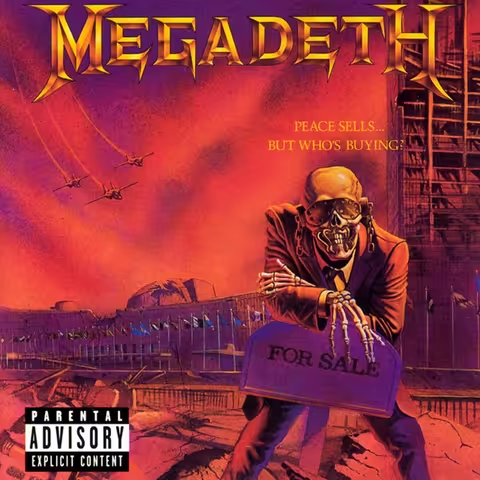
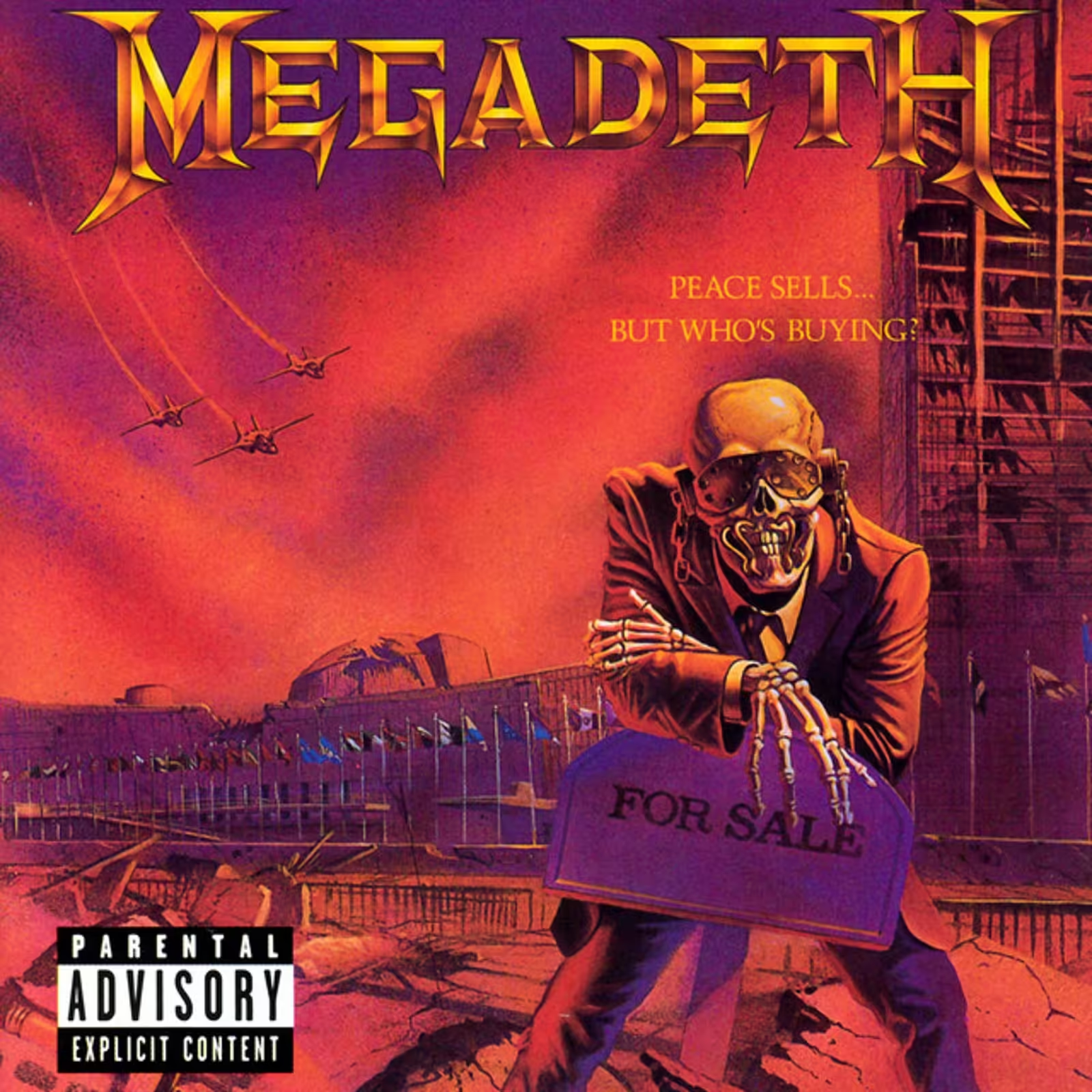
The cover painting is the work of Edward J. Repka, who was 23 years old and based in upstate New York when Megadeth commissioned him. Mustaine and the band's manager Andy Somers gave Repka the concept: Vic Rattlehead, the band's mascot whose first crude appearance had been on the debut album in 1985, redesigned as a corporate real estate agent in a business suit, standing in front of the half-demolished United Nations Headquarters in New York, offering the building's remains for sale. Repka has called the painting a significant milestone in his career and went on to define the visual language of American thrash and death metal with subsequent covers for Death (Leprosy), Atheist (Piece of Time) and many others.
The cover is also the moment that Vic Rattlehead became an enduring metal icon rather than an aborted sketch on a discarded debut. Where the Killing Is My Business cover had used a Combat-Records-improvised, frankly unflattering version of the character after Mustaine's original drawing was lost in the post, Repka's painted Vic, eyes wired shut, mouth clamped, ears bolted, has appeared on Megadeth artwork and merchandise ever since. A full-size costumed Vic has been a fixture of Megadeth's live show off and on for the better part of two decades.
Release and Reception
Capitol released the album on 25 September 1986. Initial sales were modest but persistent. The album peaked at number 76 on the Billboard 200 but, crucially, refused to leave the chart, eventually clocking 71 weeks in the lower reaches and finishing at number 92 on Billboard's 1987 year-end albums chart. Word of mouth, MTV rotation for the title track, and constant touring kept it selling for years rather than weeks.
Contemporary press was supportive without being ecstatic. Billboard's Fred Goodman called the album "an array of impressive tracks" that he did not recommend for "the weak-hearted" in his October 1986 review. Kerrang!'s Howard Johnson, in his late October 1986 review, identified the album as the moment Megadeth's distinctive sound came into focus, and the magazine placed the album at number 6 in its albums of the year list. The Los Angeles Times's Jon Matsumoto profiled the band in October 1986 under the headline "These Heavy Metalers Thrash For Peace", emphasising the political seriousness of Mustaine's lyrics in a way that was unusual for mainstream coverage of thrash at the time.
The retrospective reassessment has been considerably warmer. Pitchfork's Jess Harvell awarded the 2011 reissue 8.7/10 and identified the album as the reason Megadeth developed the cult following they did. Decibel's Jeff Treppel, writing on the 25th anniversary in 2011, described the record as "a leaner, nastier predator" than its contemporaries, arguing that Megadeth "preferred to kill with speed and precision instead of size and power". Spin's Mike Powell, in the same wave of reissue coverage, described it as glossy hardcore with Satanic lyricism.
The certifications, when they finally arrived, were historic. The album was certified Platinum in the United States by the RIAA in October 1992, six years after release, making it the first thrash metal album by a band other than Metallica to sell a million copies in the United States. Music Canada certified it Platinum. The BPI in the United Kingdom certified the 2004 reissue Silver.
The accolades have continued accruing. Robert Dimery's 1001 Albums You Must Hear Before You Die includes it. Martin Popoff's Top 500 Heavy Metal Albums of All Time ranked it 31. About.com placed it third on its Essential Thrash Metal Albums list. Revolver included it in 14 Thrash Albums You Need to Own in 2014. In June 2017, Rolling Stone placed Peace Sells... but Who's Buying? at number 8 on its 100 Greatest Metal Albums of All Time, ahead of every other Megadeth release.
"David, I just want to tell you the Peace Sells album changed my life. It was like a sobering moment right there when he said that."
David Ellefson recalling Dimebag Darrell, in conversation with Loudwire, 2025
Singles and Music Videos
| Single | Released | Director | Notes |
|---|---|---|---|
| "Wake Up Dead" | 1986 | Penelope Spheeris (later, the album's first commissioned video) | Filmed in 1987; band performing in a steel cage |
| "Peace Sells" | November 1986 | Penelope Spheeris | Megadeth's first ever music video; MTV mainstay |
"Wake Up Dead" was the album's lead single, released ahead of the album in 1986. The accompanying music video, shot in 1987, featured the band performing inside a steel cage; it received steady rotation on MTV's late-night metal programming. Neither it nor "Peace Sells" charted on the Billboard Hot 100, but both became permanent staples of US rock and metal radio.
The title track followed as the second single in November 1986. Megadeth filmed the song's video with the director Penelope Spheeris, who had recently completed her landmark Los Angeles punk documentary The Decline of Western Civilization and would shortly start work on its metal-focused sequel, The Decline of Western Civilization Part II: The Metal Years. The "Peace Sells" video features a parental figure switching off a teenager's MTV broadcast of Megadeth and complaining about the noise, with the narrator's response "It's only TV". It was Megadeth's first ever music video and became a regular fixture on MTV's Headbangers Ball, which launched in April 1987 and was directly enabled, in industry terms, by the breakout success of records like this one. Spheeris would direct Megadeth again on "No More Mr. Nice Guy" for the 1989 Shocker soundtrack.
On the Road
The promotional cycle began with Megadeth supporting Motörhead on a short run through California and the American southwest in late 1986. The tour ended badly: due to management disagreements between the two camps, Megadeth were pulled from the final three shows. The band recovered quickly by joining Alice Cooper's Constrictor tour as opening act at the start of 1987, a much higher-profile booking that took Megadeth in front of mainstream rock audiences for the first time.
In March 1987, Megadeth started its first headlining world tour in the United Kingdom, supported by Overkill and Necros. The North American leg ran for the rest of 1987 and is regarded as one of the most chaotic in the band's history. Drummer Chuck Behler began travelling with the band as a backup as the other members became increasingly worried that Samuelson would not be able to finish the dates. By the end of the tour, both Samuelson and Poland had been fired. The 25th Anniversary reissue's live disc, recorded at the Phantasy Theatre in Cleveland on 3 June 1987, captures the original lineup near the end of its existence.
The MTV News Theme
The most widely heard piece of music on Peace Sells... but Who's Buying? is also one of the shortest. David Ellefson's four-bar bass figure that opens the title track was adopted by MTV News as the theme to its bulletin breaks from 1987 onwards, and remained in use for the best part of two decades. Anyone who watched American cable television in the late 1980s and 1990s heard it dozens of times a week without necessarily knowing what it was.
Dave Mustaine has claimed publicly, most prominently in his 2010 memoir, that Megadeth never received royalties for the use, alleging that the song was pulled from the rotation just before the contractual point at which MTV would have had to start paying for it. Whether that is the full story has been disputed; the licensing arrangements between MTV and Capitol's publishing arm in the late 1980s were complex and not always favourable to the bands involved. Either way, the sound of Peace Sells entered the American mainstream in a form most viewers could not even name.
Beyond the MTV News usage, the title track has had a healthy sync life. It appeared in the Showtime drama Billions in 2016, and has been used in trailers and sports broadcast packages too many times to list. The song has become shorthand for political-cynicism scoring in American film and television in a way that few thrash tracks ever have.
"The Conjuring" and the Satanic Panic
The American Christian establishment of the late 1980s was actively looking for music to be offended by, and Peace Sells... but Who's Buying? obliged on three different tracks. The Christian broadcaster Bob Larson devoted significant space in his 1989 book Satanism: The Seduction of America's Youth to a line-by-line analysis of "The Conjuring", arguing that the song was a step-by-step occult instruction. The pastor and author G. Craige Lewis pursued a similar reading in The Truth Behind Hip Hop two decades later.
Mustaine's own position on the songs has shifted significantly. In 1987 he was happy to play the lyrics as transgressive theatre. In the early 2000s, following a born-again Christian conversion in the wake of his 2002 arm injury and recovery, he removed "The Conjuring" from the live set, stating that he regarded its lyrics as a literal invocation he was no longer comfortable performing. The song remained off Megadeth setlists for 17 years before its single, surprise return at the Home Monitoring Arena in Plzeň, Czech Republic on 12 June 2018, an event significant enough to be covered as breaking news by Blabbermouth.
The cover artwork, despite featuring a corporate skeleton in front of a destroyed United Nations building, has never been censored or banned. The Vic Rattlehead mascot did, however, get Megadeth's 2001 concert in Kuala Lumpur cancelled when the Malaysian government determined the image was unsuitable for the nation's youth. That, though, was a battle that would come 15 years later.
Covers, Samples and Tributes
Direct cover versions of the album's tracks are rarer than the album's reputation might suggest, in part because of how technically demanding Mustaine's compositions are to play correctly. The title track has been covered by tribute outfits and on streaming sessions countless times, but high-profile studio covers by named artists are unusual. The album's bigger contemporary footprint is the influence it exerted on later bands. Sepultura, Pantera, Slipknot, Trivium, Lamb of God, Bullet for My Valentine, Avenged Sevenfold, Arch Enemy, Unearth, Darkest Hour and Killswitch Engage have all been on record citing either Megadeth in general or Peace Sells in particular as foundational.
The most famous endorsement remains the one Ellefson recounted to Loudwire in 2025, in which Pantera's Dimebag Darrell, then still going by Diamond Darrell, told him after a long night of drinking that Peace Sells had changed his life. Ellefson initially brushed the compliment off as drunk talk; Darrell, he said, looked him in the eye and repeated it.
Megadeth's only cover on the album, the Willie Dixon-penned "I Ain't Superstitious", is itself a tribute, although delivered at a tempo Howlin' Wolf would not have recognised.
Reissues and Anniversaries
The album has been reissued in three significant rounds.
- 2003 DVD-Audio release. Capitol's first significant repackaging, in 96kHz/24-bit surround and stereo, with the music videos for "Wake Up Dead" and "Peace Sells" included as extras.
- 2004 Mustaine remix and remaster. Part of a complete remix project for Megadeth's Capitol-era catalogue. Adds four Randy Burns mixes as bonus tracks. Mustaine's mix decisions have been controversial with fans; the 2011 reissue went back to the original mix.
- 2011 25th Anniversary editions. Released on 12 July 2011 in both a two-disc reissue and a five-disc plus three-LP box set, with liner notes by Mustaine and Lars Ulrich. The expanded set contains the original mix (remastered in 2011), the 2004 remix, the surviving Randy Burns mixes, and a full 1987 live show recorded at the Phantasy Theatre in Cleveland. The first-week sales were a modest fewer than 2,000 copies, which was reported as news at the time and is one of the clearer indicators of how deluxe-box-set economics have always worked for thrash catalogue titles.
An expanded streaming edition with the Burns mixes appeared on the standard platforms in the 2010s, and the 2004 remix has been the version most commonly heard on streaming services until disputes about which mix should be canonical were partially resolved by Capitol making the original 1986 mix available again.
Legacy
What Peace Sells... but Who's Buying? did, by accident as much as by design, was establish the Big Four as a commercial peer group rather than as Metallica and three smaller bands. In the year of Master of Puppets, an underground band could plausibly have been dismissed as a Metallica also-ran. Capitol's intervention, and the album's stubborn 71-week chart run, made it impossible to make that case any more. Megadeth had a record on a major label, a hit single on rock radio, an opening bass figure on the most-watched music network in America, and a critical reputation that took the band's musicianship seriously. The Big Four taxonomy that Metallica, Slayer, Megadeth and Anthrax would eventually formalise in 2010 with the Sonisphere shows starts here.
For Megadeth, the album sits at a precise hinge in the catalogue. The two records on either side, the rough-and-ready debut Killing Is My Business... and Business Is Good! and the troubled follow-up So Far, So Good... So What!, are now framed largely in relation to it. The lineup that played on Peace Sells, Mustaine, Ellefson, Poland and Samuelson, is widely regarded by long-term Megadeth fans as the band's most musically distinctive, even though the more commercially successful Rust in Peace-era lineup with Marty Friedman and Nick Menza came later. Two of those four members would be dead within twenty years of the album's release: Samuelson in 1999, and Menza, on a different Megadeth record, in 2016.
Loudwire ranked Megadeth the third best thrash metal band of all time. Rolling Stone has the album in its all-time metal top ten. The MTV News theme played for a generation. The first thrash record by a non-Metallica band to go Platinum did all of that on a budget that would not cover the catering on a major-label rock record today, and was finished by people who were, by their own subsequent admission, barely functional. None of that should have worked.
Things You Might Not Know
| Fact | Detail |
|---|---|
| The title's source | Mustaine lifted the phrase from a Reader's Digest article headed "Peace Would Sell But No One Would Buy It" in late 1985. |
| The Combat budget | Combat Records financed the album with $25,000, roughly $71,000 in 2024 money. Capitol bought the masters before they were mixed for release. |
| The mix swap | The album was mixed twice. Randy Burns finished the original Combat version; after Capitol bought the contract, the label hired Paul Lani with Stan Katayama assisting to remix the whole record. |
| The Burns mixes | Four of Burns' original 1986 mixes survived and were released as bonus tracks on the 2004 remaster. The full set has never officially been issued. |
| The first live performance | "Bad Omen" was already in the live set at Megadeth's debut gig at Ruthie's Inn in Berkeley on 17 February 1984, more than two years before the album was recorded. |
| Casey McMackin's other job | The album's additional engineer also sings backing vocals on two tracks, "Good Mourning/Black Friday" and "My Last Words", an unusual double credit. |
| The Repka commission | Cover artist Edward J. Repka was 23 years old when Megadeth hired him for what he later described as a significant milestone of his career. |
| The MTV News theme | David Ellefson's opening bass figure on the title track was used as the introduction to MTV News bulletins for the best part of two decades. Mustaine has said the band never received royalties. |
| Lars Ulrich's pick | "My Last Words", the deepest cut on the album, is Metallica drummer Lars Ulrich's favourite Megadeth song; he confirmed it during a 2014 Reddit AMA. |
| "The Conjuring" in exile | Mustaine refused to play "The Conjuring" live for 17 years following his Christian conversion, finally relenting at a single show in Plzeň, Czech Republic on 12 June 2018. |
| Dimebag's verdict | Pantera's Dimebag Darrell once cornered Ellefson at the end of a night out to tell him, twice, that the album had changed his life. |
| The Penelope Spheeris connection | The "Peace Sells" video, Megadeth's first, was directed by the maker of The Decline of Western Civilization; she later included the band in its sequel The Metal Years and directed their video for "No More Mr. Nice Guy" in 1989. |
| The 25th Anniversary first week | The deluxe 2011 reissue shifted fewer than 2,000 copies in its opening week, an outcome reported as Megadeth news in its own right at the time. |
| The Platinum first | RIAA certified the album Platinum in October 1992, six years after release, making it the first thrash metal album by any band other than Metallica to sell a million copies in the United States. |
| The Rolling Stone ranking | In 2017, Rolling Stone placed the album at number 8 on its 100 Greatest Metal Albums of All Time, the highest position of any Megadeth record. |
The Riffology Podcast
Riffology is also a podcast, available on Spotify, Apple Podcasts, Amazon Music and every other major platform, in which the hosts work through the records that shaped heavy music one album at a time. If the story above made you want to put Peace Sells... but Who's Buying? back on, the podcast is the natural companion. Subscribe wherever you get your shows and join the conversation.
Comments