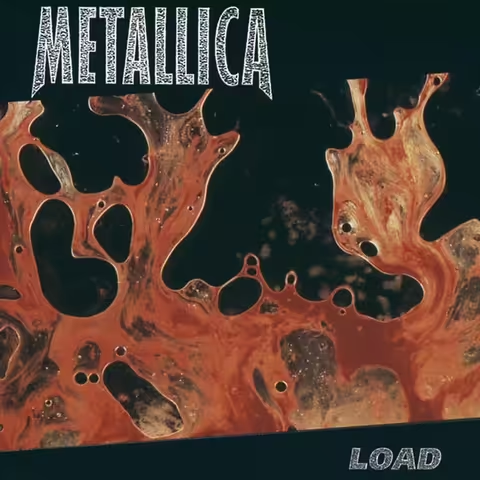
Andres Serrano made the painting on the front of Metallica's sixth album in 1990 by pressing his own semen against a tray of bovine blood between two sheets of Plexiglas. He called it Semen and Blood III, sold it to a New York gallery, and forgot about it. Six years later it was on a million American CD racks under the word LOAD, set in small white type at the bottom right. Kirk Hammett had found it in a coffee-table book at the San Francisco Museum of Modern Art, mistaken it at first for a hot-rod flame job, and quietly insisted on it as the cover when it came time to think about packaging. He did not tell James Hetfield what was actually in the picture until the album was nearly finished.
That single decision, made in a Sausalito control room in early 1996, is a serviceable shorthand for the entire fourteen months that produced Load: the biggest band in heavy music quietly choosing to be a different kind of band, then daring its audience to keep up. By the time the record came out on 4 June 1996, James Hetfield had cut his hair, Lars Ulrich had taken Elektra to court and won, Kirk Hammett was playing rhythm guitar on a Metallica record for the first time in his life, Jason Newsted was leaking demos to San Francisco radio out of frustration, and the four of them had headlined Lollapalooza in eyeliner. It sold 680,000 copies in its first week. It eventually shipped five and a half million in the US alone. And it broke something between Metallica and a significant slice of their audience that has never entirely been put back together. This is how it happened.
Album Facts
| Field | Detail |
|---|---|
| Artist | Metallica |
| Album | Load |
| Release Date | 4 June 1996 (3 June in the UK) |
| Label | Elektra Records (US) and Vertigo Records (UK and Europe) |
| Producer(s) | Bob Rock, James Hetfield and Lars Ulrich |
| Studio(s) | The Plant Studios, Sausalito, California (May 1995 to early 1996); Right Track and Quad Recording Studios, New York City (March to April 1996) |
| Genre / Subgenre | Hard rock and heavy metal, with explicit Southern rock, blues rock, country rock, alternative rock and grunge influences |
| Track Count | 14 |
| Total Runtime | 78:59 (the longest single CD format would allow at the time) |
| Billboard 200 Peak | No. 1 (four consecutive weeks); 680,000 first-week US sales, the biggest debut of 1996 |
| UK Albums Chart Peak | No. 1 |
| Other Notable Chart Peaks | No. 1 in over 15 countries including Australia, Canada, Germany, France, the Netherlands, Sweden, Switzerland, Austria, Denmark, Finland, Norway, Portugal and Scotland |
| Certifications | US 5× Platinum (RIAA, 2003); UK Platinum (BPI); Australia 5× Platinum; Canada 4× Platinum; Germany 5× Gold; Europe 2× Platinum (IFPI) |
| Estimated Sales | 5.4 million in the US (by 2023); over 7 million worldwide |
| Key Singles | "Until It Sleeps", "Hero of the Day", "Mama Said", "King Nothing" |
Cultural Context
The world Metallica returned to in June 1996 was almost unrecognisable from the one they had last released a record into. The Black Album had landed in August 1991, six weeks before Nirvana's Nevermind; by the time Load arrived, grunge had already had its first wave, its commercial peak and its first significant death. Kurt Cobain had been gone for two years. Smells Like Teen Spirit was already a quoted lyric in other people's songs. Pearl Jam were two albums into their war with Ticketmaster. Soundgarden had just put out Down on the Upside; Alice in Chains had cancelled most of their touring; Pantera were the heaviest band in America by most measurable definitions. Britpop had landed and crested in the UK during the same window. The 1996 album charts featured Alanis Morissette, Oasis, Hootie & the Blowfish, Celine Dion and the Fugees in heavy rotation.
What did not exist any more, in 1996, was a clear commercial centre for traditional thrash metal. Slayer were still operating but had begun the slow contraction towards a niche audience. Megadeth had pivoted hard towards radio rock with Youthanasia in 1994 and would do so again with Cryptic Writings in 1997. Anthrax were in the middle of their John Bush years and a label limbo. Pantera were the genre's only true commercial proposition and were doing it by being heavier, not by adapting. Metallica's choice in early 1995 was effectively binary: stay where the Black Album had left them, become more themselves and harder, or risk the audience and follow where the songwriting was leading. They picked the third door.
Records they were jostling with for shelf space and column inches across 1996 included:
- Alanis Morissette, Jagged Little Pill (still on the chart a year after release; second only to The Bodyguard for the decade)
- Pearl Jam, No Code (August)
- The Smashing Pumpkins, Mellon Collie and the Infinite Sadness (still in the top 50 sixteen months in)
- Soundgarden, Down on the Upside (May)
- Sepultura, Roots (February)
- Tool, Ænima (October)
- Korn, Life Is Peachy (October)
- Beck, Odelay (June)
- Rage Against the Machine, Evil Empire (April)
The Band's Story Up to This Point
The Black Album had not just been successful; it had been one of the largest commercial events in rock history. By 1995 it had passed 15 million US sales and would eventually clear 30 million worldwide, becoming one of the best-selling albums of all time in any genre. Metallica toured behind it for almost two and a half years, playing 266 concerts across three tours, then a fourth in mid-1994 behind the Live Shit: Binge & Purge box set. By the time they came off the road in late 1994, all four members were exhausted and barely on speaking terms.
The members spent early 1994 explicitly apart. Hetfield went hunting in Wyoming and Alaska. Hammett enrolled at San Francisco State University to study film theory, jazz and Asian art. Newsted built his own studio in his basement, named it The Chophouse, and began recording side-project material that he had no clear plan for. Ulrich, characteristically, started a lawsuit; he sued Elektra Records to extract Metallica from their contract following a fallout with new label management. The litigation was resolved in late 1994 with the band re-signing to Elektra on dramatically improved terms, an outcome that left Metallica with leverage over the label that very few of their peers had ever held.
When the four of them reconvened in Ulrich's basement (a small home studio he had nicknamed The Dungeon) in May 1994, the bones of what would become Load were already on cassette. The band had been demoing material on the road for two years, often during soundchecks and hotel-room downtime. The first writing sessions were just Hetfield and Ulrich at The Dungeon, listening through that backlog of riffs and ideas, picking the ones worth jamming on. Full-band rehearsals began in October 1994 and ran through to January 1995. By the time they were ready to walk into a proper studio, they had almost thirty completed songs.
"First we chose riffs that were great, and Lars and I would go jam on them. Then, instead of trying to force one riff with another riff, it was like, 'Let's jam on it,' and we'd see what came out of that. ... It was more of a feel thing when we were writing this stuff. So the songs kinda started writing themselves, in a way, which was a little more fun than just trying to stick a bunch of riffs together."
James Hetfield on the Load songwriting process, McIver, 2004
Pre-production and Demos
The most interesting things about the Dungeon and Plant rehearsals are who was listening to what. By the time they were writing the songs that became Load, the band members' listening had drifted decisively outside the metal tent. Hetfield had become immersed in singer-songwriters: Leonard Cohen, Tom Waits, Nick Cave; he was also working his way through American folk and country, including the Waylon Jennings catalogue, after a personal friendship with Jennings that would last until the older man's death. Hammett had moved into David Bowie's Berlin-era records with Robert Fripp and Adrian Belew, and was deep in the blues of Muddy Waters and the harmonic vocabulary of Jimi Hendrix, Stevie Ray Vaughan and Thin Lizzy. Ulrich was listening to Oasis. Newsted was building a hardcore side project, IR8.
The working titles for several album tracks are worth noting because they give a sense of how loose the writing was before it crystallised. The track that became "King Nothing" was rehearsed under the title "Load". "Hero of the Day" was "Mouldy". "Wasting My Hate" was "Streamline". "Devil's Dance" was "Devil Dance". "Fixxxer", which eventually surfaced on Reload, was just "Fixer". The titles tended to crystallise late, often when Hetfield was lyric-writing in the booth.
The single largest pre-production decision had nothing to do with the songs themselves. At Ulrich's insistence, the band agreed for the first time that Hammett would track rhythm guitar parts on a Metallica record. For the band's first five albums Hetfield had played every rhythm guitar on every track, with Hammett confined to leads. The change was deliberate. Hammett wanted, in his words, a "looser sound", more like the bands he was newly into and less like the precision-tooled rhythm-guitar layering that had defined ...And Justice for All and the Black Album. Hetfield agreed. The knock-on effect was that Hammett also became significantly more involved in writing: he ended up sharing co-writing credits with Hetfield and Ulrich on seven of the album's fourteen tracks, the first time he had appeared as a co-writer on more than half a Metallica record.
The cost was Newsted. Despite his fully credited co-writer role on the Justice tour merchandise and the Black Album tour, Newsted's writing ideas were systematically dismissed by Hetfield through this period. He responded by pouring his energy into IR8 and other side projects, one of whose demo cassettes ended up being played on San Francisco's KSJO radio while the Load sessions were under way. Hetfield and Ulrich were furious. Newsted later said he had treated Metallica throughout as Hetfield and Ulrich's band, and that he had not really minded, but it is on the record that he felt trapped by the time Load was finished. The seeds of his 2001 departure are visible in this sentence from a Wall biography interview: he believed the band's fanbase was simply "not ready to hear [them] sounding like more typical hard rock and roll music".
Creating the Album
Tracking began on 1 May 1995 at The Plant Studios in Sausalito, California. The Plant was a venerable Bay Area facility that had previously hosted Fleetwood Mac's Rumours and a long line of West Coast rock records; the band had chosen it partly because they wanted to stay close to home in San Rafael, where Ulrich and Hetfield both lived, and partly because the studio had the kind of large live tracking room that suited the looser approach they wanted to take. Bob Rock returned as producer, having previously made the Black Album with them. Randy Staub returned as engineer and would also mix. Rock, Hetfield and Ulrich shared the producer credit.
The Rock-Metallica relationship had not been an easy one in 1990 and 1991. The making of the Black Album was a famously fraught process, three failed marriages, an arrest, multiple shouting matches between Rock and Hetfield documented later in A Year and a Half in the Life of Metallica. By 1995 those wounds had healed enough for the band to want him back. Hetfield, in his own words: "He tends to help us dig deeper. We tell him what we're after and he tries to help us achieve that." Rock's biggest contribution in the room this time, as in 1991, was vocal performance; Hetfield gives him the credit for the move from shouted-thrash phrasing into something approaching actual singing.
"This album and what we're doing with it, that, to me, is what Metallica are all about: exploring different things. The minute you stop exploring, then just sit down and fucking die."
Lars Ulrich, Rolling Stone (David Fricke), 27 June 1996
The atmosphere at The Plant was reportedly looser than it had ever been on a Metallica session. Hetfield attributed this to the time the four members had spent apart in 1994: "Everybody has their own life [that is] really strong in its own way with their own set of friends, I think we're really comfortable when we do get together." Sessions ran most of 1995, broken by a brief summer tour of European festivals at which the band debuted two of the new songs, "2 X 4" and "Devil's Dance", to crowds with no recorded reference points.
In November 1995, Hetfield's father, Virgil Hetfield, was diagnosed with cancer. James left the sessions for Wyoming to be with him. He returned with a notebook of new lyrics. Virgil died in late February 1996, while the band were tracking overdubs in New York; James later told Rolling Stone he "went back to when [Cliff Burton] died" and "got some of the feelings out through the music". The pair of songs most directly tied to this period are "Until It Sleeps" (about Virgil's illness; the title comes from the way Hetfield described the cancer to himself) and "Mama Said", a country-tinged ballad about Hetfield's late mother and the difficult Christian Science upbringing the brothers had shared.
The most consequential decision of the sessions was made in January 1996. With nearly thirty songs now in various states of completion, the band considered packaging the lot as a double album. They ultimately scrapped that idea for three converging reasons. First, finishing a double album in time for their committed 1996 Lollapalooza appearance would have been impossible. Second, a double album counts as a single album on a recording contract; Ulrich, never not thinking commercially, pointed out that two separate albums "counts as two and we get the pot of gold at the end even quicker". Third, the workload had simply exhausted them; nine months in, they were not yet halfway through. Half the material would come out in June 1996 as Load; the other half would surface seventeen months later as Reload. The split was made on Hetfield's judgement of which songs hung together.
Elektra set a hard mastering deadline of 1 May 1996. The band moved to Right Track Studios in New York City from March to April for overdubs and mixing, with additional mixing at the nearby Quad Recording Studios. The decision to mix in New York rather than at The Plant was Rock's; he liked the rooms there and the available outboard. Local journalists were invited to listening sessions to hear the album in progress, a piece of pre-release marketing that Elektra leaned on heavily through May.
At 78 minutes and 59 seconds, Load is Metallica's longest single studio album to date and effectively the maximum length a single CD could hold in 1996. The closer "The Outlaw Torn" had to be shortened by one full minute to fit; the unedited 10:48 version was eventually released a year later as a B-side on the "Memory Remains" single, with the deeply suffix title "The Outlaw Torn (Unencumbered by Manufacturing Restrictions Version)". Elektra marketed the runtime explicitly, with MTV ads boasting about it and stickers on the initial pressings.
Three production details deserve a closer look. The first is the album-wide drop to E♭ tuning, a half-step below standard. It was Hammett's call; he wanted to play more like Hendrix, Vaughan and Thin Lizzy. Hetfield agreed because the semitone drop gave his voice "a break". Second, the introduction of unusual instrumentation: Hammett played slide guitar on "Ain't My Bitch" and ran the guitar parts on "Hero of the Day" through a stack of different amps for textural variation; Hetfield played a talk box on the solo of "The House Jack Built" (the only time a talk box has appeared on a Metallica album), and a pedal steel guitar on "Mama Said"; Newsted played a fretless bass on "Until It Sleeps". Third, Newsted's bass approach itself was rebuilt at Rock's insistence: rather than doubling Hetfield's rhythm guitar (the band's default since Kill 'Em All), he was told to play counter-figures in his own style.
Additional percussion across most of the album was supplied by Jim McGillveray, an LA session player who had previously appeared on records by Tom Petty, Eddie Money and others. McGillveray's congas, shakers and hand-drums sit just under the kit on every track except "Until It Sleeps", "Poor Twisted Me", "Wasting My Hate" and "The Outlaw Torn"; on close listen they are one of the clearest tells of the band's new direction.
Personnel and Credits
| Role | Player | Notes |
|---|---|---|
| Core band | ||
| Vocals, rhythm and lead guitar | James Hetfield | Talk box on "The House Jack Built"; pedal steel on "Mama Said" |
| Guitars (rhythm and lead) | Kirk Hammett | First time tracking rhythm guitar on a Metallica album; slide on "Ain't My Bitch" |
| Bass | Jason Newsted | Fretless bass on "Until It Sleeps"; encouraged by Rock to play his own basslines rather than doubling guitar |
| Drums | Lars Ulrich | Described by Jon Pareles as landing "with brutal certainty a nanosecond behind the beat" |
| Additional musicians | ||
| Percussion | Jim McGillveray | All tracks except "Until It Sleeps", "Poor Twisted Me", "Wasting My Hate" and "The Outlaw Torn" |
| Production and engineering | ||
| Producer | Bob Rock | Returning from the Black Album |
| Assistant producers | James Hetfield and Lars Ulrich | Co-credited as producers |
| Recording, mixing | Randy Staub | The Plant; also returning from the Black Album |
| Recording assistants (The Plant) | Brian Dobbs, Kent Matcke | Dobbs also did additional engineering at Right Track |
| Assistant engineer (Right Track) | Jason Goldstein | |
| Additional mixing | Mike Fraser | Veteran AC/DC engineer |
| Mixing assistants | Matt Curry, Mike Rew | |
| Mastering | George Marino | Sterling Sound, New York |
| Digital editing | Paul DeCarli | Assisted by Mike Gillies and Chris Vrenna (later of Nine Inch Nails) |
| Artwork | ||
| Cover art | Andres Serrano | Semen and Blood III (1990); the title is omitted from the liner notes by band agreement |
| Design | Andie Airfix | Designer also responsible for several Iron Maiden and Def Leppard sleeves |
| Photography | Anton Corbijn | Former U2 and Depeche Mode collaborator |
The Songs
| # | Title | Writer(s) | Length | Single? | Notes |
|---|---|---|---|---|---|
| 1 | "Ain't My Bitch" | Hetfield, Ulrich | 5:04 | Hammett slide guitar opens the album | |
| 2 | "2 X 4" | Hetfield, Ulrich, Hammett | 5:28 | Debuted live at European festivals in summer 1995 | |
| 3 | "The House Jack Built" | Hetfield, Ulrich, Hammett | 6:39 | Only talk-box solo on a Metallica album (Hetfield) | |
| 4 | "Until It Sleeps" | Hetfield, Ulrich | 4:28 | Single (May 1996) | About Hetfield's father's cancer; first Metallica US Top 10 single (peaked No. 10) |
| 5 | "King Nothing" | Hetfield, Ulrich, Hammett | 5:30 | Single (January 1997) | Working title "Load"; US Mainstream Rock No. 6 |
| 6 | "Hero of the Day" | Hetfield, Ulrich, Hammett | 4:22 | Single (September 1996) | Working title "Mouldy"; US Mainstream Rock No. 1 |
| 7 | "Bleeding Me" | Hetfield, Ulrich, Hammett | 8:18 | Hammett called the solo "a summation of all my influences" | |
| 8 | "Cure" | Hetfield, Ulrich | 4:54 | ||
| 9 | "Poor Twisted Me" | Hetfield, Ulrich | 4:00 | Heavily processed slide-guitar vocal effect from Hetfield | |
| 10 | "Wasting My Hate" | Hetfield, Ulrich, Hammett | 3:57 | Working title "Streamline"; inspired by Hetfield's friendship with Waylon Jennings | |
| 11 | "Mama Said" | Hetfield, Ulrich | 5:20 | Single (November 1996) | Country rock ballad; about Hetfield's late mother; pedal steel guitar |
| 12 | "Thorn Within" | Hetfield, Ulrich, Hammett | 5:52 | ||
| 13 | "Ronnie" | Hetfield, Ulrich | 5:17 | Inspired by a 1995 Washington state shooting; possibly the Ronnie Long case | |
| 14 | "The Outlaw Torn" | Hetfield, Ulrich | 9:49 | Trimmed by one minute to fit on CD; full version released on Reload's "Memory Remains" single |
"Ain't My Bitch" opens the album with two intentions. First: the slide guitar from Hammett, which announces within the first eight bars that this is not ...And Justice for All. Second: Hetfield's vocal, which is recognisably sung rather than barked, with melodic intervals and sustained notes that he had simply not used on a Metallica record before. The riff itself is built around a low-end shuffle that owes more to ZZ Top than to Diamond Head. Critics in 1996 found this either liberating or shocking, depending on temperament.
"2 X 4" is the closest the album comes to a conventional Metallica heavy song, but even here the verse is laid out around Hammett's looser-feeling rhythm guitar with the kind of behind-the-beat phrasing that Pareles flagged in his New York Times review. The track had been in the live set since the summer 1995 European festivals and is the song most fans of the older Metallica reached for first. "The House Jack Built" is the most experimental track on side one, ending with a long Hetfield talk-box solo that nobody who only knew the band from Master of Puppets was prepared for.
"Until It Sleeps" became the first single in May 1996 and the first Metallica song to reach the US Top 10 of the Billboard Hot 100, peaking at No. 10, a chart placement no other Metallica song has matched in the three decades since. It also went to No. 1 on the Mainstream Rock chart, was the band's second UK top five (No. 5), and topped the singles charts in Australia, Sweden and Finland. The Samuel Bayer-directed video, with its Hieronymus Bosch references (The Garden of Earthly Delights, The Haywain, Ecce Homo at Frankfurt) and the band in their new short-haired, leather-jacketed image, won the MTV Video Music Award for Best Rock Video. The song itself is Hetfield's most direct work about his father's cancer: the title comes from his own description of the disease.
"King Nothing" had been rehearsed under the working title "Load", a fact that turned out to be useful when the band needed an album title and could not agree on one. It became the album's fourth single in January 1997 (US and Canada only) and reached No. 6 on the Mainstream Rock chart. "Hero of the Day" was the most pop-radio-friendly thing the band had ever recorded, and the choice of Anton Corbijn (then most famous for U2 and Depeche Mode videos) to direct its music video was a deliberate signal of the band's new positioning. It also reached No. 1 on Mainstream Rock.
"Bleeding Me" is the centrepiece of the album and, by Hetfield's own admission, one of the most personal songs he ever wrote. It was, in his words from a 1996 Stenning interview, an "intensely personal" song about his early experiences with therapy. The lyric "I was going through therapy at the time and I was so unwilling... it was like the therapist had put leeches on me just to get it all out" comes from Hetfield discussing the song's writing. Hammett's eight-minute solo across its outro is the most stretched-out piece of lead playing on any Metallica record; he later called it "a summation of all my influences, with a good dose of my own style".
"Mama Said" is the album's other psychological centrepiece, and the song that arguably travelled furthest from anything Metallica had attempted before. It is a country rock ballad, complete with pedal steel guitar (played by Hetfield himself), about the death of his mother Cynthia, who had died of cancer when James was sixteen and whose Christian Science beliefs had prevented her from seeking medical treatment. The Corbijn-directed video, shot in London in November 1996, places Hetfield alone in the back of a car with an acoustic guitar; at the end, the back seat is revealed to be a studio prop, and Hetfield walks off-screen with a white horse. It reached No. 19 in the UK.
"The Outlaw Torn" closes the album in nine and a half minutes of slow build, with Hetfield's vocal sitting on top of a long droning Hammett figure. The Reload-era full version, released the following year as the B-side to "The Memory Remains", clocks 10:48 and is, in the consensus view, the better edit. The closing minute of the album, with Ulrich's drums finally subsiding into a long fade, is the moment Load most clearly hints at the direction Hetfield would push the band on St. Anger and beyond.
B-sides, Outtakes and Lost Songs
The Load sessions are the deepest outtake vault in the Metallica catalogue. The nearly thirty songs the band cut at The Plant between 1995 and early 1996 split roughly half on to Load, with the remainder going to Reload after further work in mid-1997. The split is the reason both albums feel slightly under-edited: a true single-album distillation of the best fourteen would have been a different and probably better record, an opinion Ulrich himself eventually conceded in 2003, when he told Paul Brannigan that he and Hetfield "didn't have an edit button on our instrument panel".
The two best-known specific outtakes are "Devil's Dance" (debuted live in summer 1995, eventually placed on Reload) and "Fixxxer" (also held back for Reload). The unedited 10:48 version of "The Outlaw Torn" surfaced as a B-side in 1997 under the comedy title "The Outlaw Torn (Unencumbered by Manufacturing Restrictions Version)", a swipe at the CD format's then-78-minute limit.
A bigger surprise was the December 1995 Whisky a Go Go gig in Los Angeles, where Metallica performed several Motörhead covers (under the pseudonym "The Lemmys") to mark Lemmy Kilmister's 50th birthday. Lemmy himself joined in for several songs. The recordings circulated as bootlegs for nearly thirty years before being officially released, finally, on the 2025 super-deluxe box set.
Album Artwork and Packaging
The cover image was, to repeat, an existing Andres Serrano photograph titled Semen and Blood III. Serrano had made it in 1990 by mingling bovine blood and his own semen between two sheets of Plexiglas; it was one of a series of three. Hammett had bought a Serrano monograph called Body and Soul at the San Francisco Museum of Modern Art and shown the image to the rest of the band as a possible cover. At first glance he thought it looked like the kind of hot-rod flame design he already had as a tattoo.
The band's reactions split. Ulrich loved it. Newsted hated it and refused to discuss it in interviews. Hetfield was indifferent at first but worried about retailer pushback (some chains had banned the Black Album's much milder cover); he became actively hostile about it later, and in 2009 publicly called it "a piss-take" around shock art. As a compromise, Serrano remained credited but the title Semen and Blood III was omitted from the liner notes. Hammett's defence at the time was that "it was the form, not the content, that was great". Serrano had not previously heard Metallica's music and only knew them by reputation; he found the collaboration interesting and agreed to a second one a year later for Reload (which used Piss and Blood, a related work).
The booklet photography was by Anton Corbijn, the Dutch photographer best known for his black-and-white work with U2, Joy Division and Depeche Mode. Corbijn shot the band in tailored shirts, leather jackets and (in Ulrich and Hammett's case) eyeliner. The new Metallica logo, redrawn by long-time designer Andie Airfix into a simpler, less Gothic form, was on the spine. At certain press events for the album, Hammett and Ulrich kissed each other on the lips for the camera. None of this was accidental: the band were aware that the visual rebrand would land differently with the metal audience than with the broader rock audience, and they had decided they preferred the broader audience.
Release and Reception
Load was released on 4 June 1996 in the US (3 June in the UK) through Elektra and Vertigo, on CD, cassette and double LP. It debuted at No. 1 on the US Billboard 200 with 680,000 first-week sales, the biggest US debut of 1996, and held the top spot for four consecutive weeks. It also went straight to No. 1 in the UK, Australia, Canada, Germany, France, the Netherlands, Sweden, Switzerland, Austria, Denmark, Finland, Norway, Portugal, Hungary, Iceland, New Zealand and Scotland. The IFPI awarded it 2× Platinum Europe certification within months. By 2003 the RIAA had certified it 5× Platinum in the US, and by 2023 actual US sales tallies had reached 5.4 million units. The album has cleared seven million worldwide.
Critical reception was mixed but more favourable than the band's later reputation suggests. David Fricke at Rolling Stone awarded it four stars in December 1996, calling it "easily the heaviest record of the year" and arguing fans should "get over the change in image" and welcome the band's growth. Q magazine also gave it four stars, praising the "streamlined attack, the focus and, yes, the tunes". Mac Randall at Musician wrote that "the boys are more into cohesion now". The Encyclopedia of Popular Music awarded four stars retrospectively. Kerrang!'s editor Phil Alexander wrote that Metallica had "let their individual talents breathe" and "still tower over the competition with audacity and power".
"For the first time, Metallica sounds as if it's looking over its shoulder, wondering where it fits in the era of grunge."
Jon Pareles, The New York Times, 2 June 1996
The unhappier reviews tended to come from two directions. Pareles's New York Times piece, quoted above, was the most articulate version of the "playing catch-up with grunge" critique. Stephen Thomas Erlewine, writing for AllMusic, gave the album two and a half stars and called it "repetitive, uninteresting, and poorly executed". Melody Maker's reviewer, in the most-quoted line of any 1996 review, wrote that a Metallica record "should rock you to exhaustion, leave you brutalised and drained ... it is, however, the first Metallica album to make me wonder at any point, 'What the fuck was that?' It's as if the jackboot grinding the human face were to take occasional breaks for a pedicure." Slayer's Kerry King, asked about Load by Kerrang! in 1996, dismissed it as lacking "attitude" and "fire".
Singles and Music Videos
| Single | Release | Director / Notes | Chart peaks |
|---|---|---|---|
| "Until It Sleeps" | 20 May 1996 | Samuel Bayer; filmed Los Angeles, May 1996; Bosch references; won MTV VMA Best Rock Video 1996 | US Hot 100 No. 10 (band's first and only Top 10); No. 1 Mainstream Rock; UK No. 5; No. 1 Australia, Sweden, Finland |
| "Hero of the Day" | 10 September 1996 | Anton Corbijn; filmed Los Angeles, August 1996; concept revolves around a "drugged-up kid" watching TV channels of Metallica | US Hot 100 No. 60; No. 1 Mainstream Rock |
| "Mama Said" | 25 November 1996 | Anton Corbijn; filmed London, November 1996; Hetfield with acoustic guitar in back seat of car; white horse cameo | UK No. 19; deliberately not promoted in the US |
| "King Nothing" | 7 January 1997 (US/Canada only) | Matt Mahurin; filmed Park City, Utah, December 1996 | US Hot 100 No. 90; No. 6 Mainstream Rock |
The big single, by any measure, was "Until It Sleeps". Its US Top 10 placement on the Hot 100 was unprecedented for Metallica and has never been repeated; the closest the band have come since is "The Memory Remains" at No. 28 in 1997. The MTV award for the Bayer-directed video was the visual confirmation that Metallica had successfully transitioned into the alt-rock-friendly MTV of the mid-1990s. The Corbijn videos for "Hero of the Day" and "Mama Said" cemented the visual rebrand; the Mahurin-directed "King Nothing" video, more conventionally heavy in its imagery, signalled a partial walk-back even before Reload appeared.
Touring and Live
The Poor Touring Me tour ran from 6 September 1996 to 28 May 1997, spanning 19 countries and 125 shows. Before that, the band had played a series of fan-club shows in June 1996 and then taken the most controversial slot of their career: headlining the 1996 Lollapalooza festival, sharing the bill with Soundgarden, the Ramones, Rancid and Screaming Trees. Lollapalooza had been founded in 1991 by Perry Farrell as a counter-mainstream alternative festival; Metallica's presence as headliners was read by both sides as a problem. Long-time Metallica fans called it a sell-out; long-time Lollapalooza-goers called it a hostile takeover.
- Summer 1995: brief European festival run, including Donington Park, where the band debuted "2 X 4" and "Devil's Dance"
- December 1995: Whisky a Go Go, Los Angeles, Lemmy's 50th birthday tribute, multiple Motörhead covers, the band as "The Lemmys"
- June 1996: fan-club-only North American club shows
- Summer 1996: Lollapalooza headline slot, with Soundgarden, Ramones, Rancid, Screaming Trees, Devo, Shaolin Monks and the Wu-Tang Clan also on the bill
- September 1996: Poor Touring Me tour begins in Europe, including a Cardiff show widely recorded by fans and a high-profile Later... with Jools Holland appearance
- November 1996: European MTV Awards in London
- Late December 1996 to May 1997: North American leg of Poor Touring Me
The Poor Touring Me run was structurally interesting. Metallica played most North American dates with their stage rigged in the round, with the audience surrounding the band on all sides, the "Snake Pit" configuration that would become their default for the next decade. Both Hetfield and Ulrich married their partners during the run: Ulrich in January 1997, Hetfield in August 1997.
In TV, Film and Media
Songs from Load have had a relatively modest sync afterlife compared with the Metallica catalogue's earlier highlights. "Hero of the Day" and "Until It Sleeps" both turned up in late-1990s film trailers and on the soundtracks to several skate and surf video releases. "Mama Said", because of its outlier country sound, has had occasional dramatic-television placements where the producers wanted to signal Hetfield's softer-side reputation specifically. The 2003 documentary Some Kind of Monster includes archival footage of the Plant sessions and a scene in which Hetfield himself describes the artistic risks of the Load period as having been, in retrospect, "necessary but uncomfortable".
Controversy, Censorship and Legal
The biggest controversies of the Load era were all self-inflicted. The Serrano cover drew scattered retailer pushback but no full bans; the much-bigger row was internal, with Hetfield resenting Hammett's lobbying for it. The 1996 Lollapalooza headline slot drew a small wave of opinion pieces in the alternative press accusing Metallica of strip-mining the festival's audience, and the British music press in particular ran a clutch of pieces about the band's haircuts and styling as evidence of betrayal. There were no significant lawsuits arising directly from the album (a fact Ulrich, who had spent 1994 in court with Elektra, would no doubt have appreciated). The album was not banned, parental-advisory-stickered or notably plagiarism-challenged. Kerry King's open dismissal in Kerrang! generated a brief Metallica-Slayer cold war that simmered for several years but never escalated.
Covers, Samples and Tributes
Comparatively few Load tracks have been covered by other significant artists, in part because the songs are difficult to play in the bluesy, behind-the-beat way Metallica recorded them and in part because the catalogue is large enough that most covers gravitate towards the earlier records. The most-covered single is "Mama Said", which has appeared in acoustic-tribute and country-tribute formats; "Hero of the Day" has been covered by Apocalyptica and by various tribute bands. The album does not appear to have been significantly sampled in hip-hop, although the Black Album's "Sad but True" famously was (by Kid Rock and others), giving an oblique sense of which Metallica era survives best in dance-floor terms.
Reissues, Remasters and Anniversaries
For its first nineteen years on shelf the album was reissued only in standard form: black 180-gram vinyl repressings through Warner from 2008 onwards, a handful of regional CD reissues, no expanded-edition treatment. That changed on 13 June 2025, when Metallica's own Blackened Recordings released a comprehensive super-deluxe box set described in its press release as "an ambitious and comprehensive time capsule of 1995-1997 era Metallica". The physical box runs to 15 CDs, 6 vinyl records, 4 DVDs, a 128-page hardcover book and additional ephemera. Contents include:
- A new remaster of the original album by Reuben Cohen
- The unedited 10:48 version of "The Outlaw Torn" restored to the album running order
- Demos and rough mixes from the 1995 to 1996 sessions, including the working-title takes of "King Nothing" as "Load" and "Hero of the Day" as "Mouldy"
- The full 1995 Whisky a Go Go Lemmy 50th-birthday Motörhead-cover set, officially released for the first time
- Live recordings from the Poor Touring Me tour including the 1996 Lollapalooza headline performance
- Music videos for all four singles and additional concert footage on DVD
Reviewing the box for Pitchfork in June 2025, Drew Millard gave it 6.6/10 and described Load itself as "the band's first misstep" but "respectable in retrospect"; he praised the live material as evidence that the new songs blended comfortably with the older catalogue. Rolling Stone's Joe Gross awarded 3.5 stars and concluded that Load "remains a reminder of a very specific musical moment, when the various competing versions of rock remained a subject of vigorous debate: Metallica threw on some makeup and stoked the flames".
Legacy and Influence
For most of the past three decades, Load has placed near the bottom of nearly every "Metallica albums ranked" article in the rock press. Loudwire, Metal Hammer, Spin, Ultimate Classic Rock and Stereogum have all variously parked it alongside St. Anger at the wrong end of the list. The most consistent complaints are length, lack of editing and the perception that the band were chasing rather than leading. Joel McIver, in his 2004 band biography Justice for All, argues that with the experimentation Metallica lost sight of what they were best at: "heavy metal with power, aggression, and kill".
The counter-revisionism began around 2015. Decibel's Joseph Schafer wrote a 20th-anniversary piece arguing that Load was the "definitive Metallica album because it stinks". Louder's Terry Bezer in 2022 called it "Metallica's last great album". Loudwire's Jon Wiederhorn in 2023 wrote that the songs on Load are "solid and well-composed" and that the record rewards repeat listens. In a separate piece, Metal Hammer ranked Load among the ten best albums of 1996.
"[We were] trying to be something we weren't and that confused us even further musically. There's quite a few great songs on there that could have been greater if the cover and the pictures were different I think. A lot of the fans got turned off quite a bit from the music but mostly, I think, from the image. It just doesn't work. You absolutely have to evolve, but let's have it evolve naturally. It didn't seem natural to me."
James Hetfield, Metal Hammer (Paul Brannigan), 2003
Bob Rock, asked about both records by Guitar.com in August 2025, remained unrepentant: "Those records are on par with everything else that we've done creatively ... I'm very proud of those records." Hetfield himself has settled, over the years, on the position that the era "felt like the right thing to do" at the time, though he has also said publicly that he believes the late Cliff Burton would have resisted the band's 1990s direction. Ulrich agreed by 2003 that the two albums could have been condensed into one. Hammett has stayed defensive: surprising fans, he argues, is part of the band's DNA, and the willingness to take risks is what allowed Metallica to be a working band 35 years after they started rather than a heritage act.
The deeper structural legacy of Load is harder to argue with. It built the commercial and stylistic platform Metallica still stand on. The Hammett-rhythm-guitar configuration and the loosened-up arrangement style that began at The Plant in 1995 are still how Metallica records sound in 2026; the half-step tuning has become standard for their songwriters; the willingness to put a Tom Waits riff or a country chord progression into a Metallica song is now uncontroversial. The Lollapalooza-era visual rebrand opened the door to the orchestral collaboration with the San Francisco Symphony on S&M, the documentary openness of Some Kind of Monster and the willingness to play with form on every record from Death Magnetic onwards. The band that headlined Glastonbury in 2014 and the Crystal Palace Park show in 2025 are, in a real sense, the band that Load made possible.
Things You Might Not Know
| Fact | Detail |
|---|---|
| The cover's title | Andres Serrano's photograph is officially called Semen and Blood III. The band agreed to omit the title from the liner notes as a compromise; Serrano remains credited. |
| The Dungeon | The earliest Load demos were worked up by Hetfield and Ulrich alone in Lars's basement home studio, which they had nicknamed The Dungeon. |
| The 30-song stockpile | By the time the band entered The Plant in May 1995 they had almost thirty completed songs from two years of road demoing. |
| Hammett's rhythm-guitar debut | Load is the first Metallica album on which Kirk Hammett tracked rhythm guitar parts. Hetfield had played every rhythm part on every previous album. |
| The tuning | The whole album sits a semitone down in E♭. Hammett wanted to play more like Hendrix and Stevie Ray Vaughan; Hetfield said the lower pitch gave his voice "a break". |
| The talk box | The solo on "The House Jack Built" features Hetfield on a talk box. It is the only time a talk box has appeared on a Metallica record. |
| The pedal steel | "Mama Said" features Hetfield himself on pedal steel guitar, an instrument he had picked up through his friendship with Waylon Jennings. |
| The Outlaw Torn was edited | The album closer was trimmed by one full minute to fit on a single CD. The 10:48 unedited version was issued as a B-side on Reload's "Memory Remains" single under the title "The Outlaw Torn (Unencumbered by Manufacturing Restrictions Version)". |
| The double-album that wasn't | The nearly thirty Plant-session songs were nearly issued as a double album in summer 1996. Three reasons killed the plan: the Lollapalooza date, the contractual maths (a double counts as one), and exhaustion. |
| The Lemmys | In December 1995, in the middle of the Load sessions, Metallica played the Whisky a Go Go as "The Lemmys", performing Motörhead covers for Lemmy Kilmister's 50th birthday with Lemmy himself joining in. The full set finally got an official release on the 2025 deluxe box. |
| The lawsuit before the album | Lars Ulrich sued Elektra Records in 1994 to break the band's contract following a fallout with new label management. The case settled with Metallica re-signing on substantially better terms. |
| The first US Top 10 | "Until It Sleeps" reached No. 10 on the Billboard Hot 100. It is the only Metallica single to reach the US Top 10 in the band's entire history. |
| Hammett at university | During the 1994 inter-album hiatus, Hammett enrolled at San Francisco State University to study film theory, jazz and Asian art. |
| Newsted's leaked demo | A demo cassette from Jason Newsted's side project IR8 was played on San Francisco's KSJO radio during the Load sessions. Hetfield and Ulrich were so angry that Newsted's frustration with the band's writing dynamic became a long-running fault line that contributed to his 2001 departure. |
| The eyeliner press shots | At certain press events promoting Load, Lars Ulrich and Kirk Hammett kissed each other on the lips for the photographers. The intent was deliberately to provoke the metal audience and signal a new posture. |
| The longest single CD ever shipped | At 78:59, Load was effectively the maximum length a single CD could hold in 1996. Elektra marketed the runtime explicitly through MTV ads and stickers on the first pressings. |
Riffology Podcast
If this is the kind of deep dive that scratches an itch, the Riffology podcast covers an album of this stripe most weeks, with the same level of session detail, contemporary review excavation and "wait, who played on what" trivia you've just read here. The show is available on Apple Podcasts, Spotify, Amazon Music, Pocket Casts and every other major podcast platform. New episodes drop weekly.
Comments