
By the spring of 1995, Billy Corgan had written roughly fifty-six songs in a rented Chicago house he called Pumpkinland, told Virgin Records he intended to release a 28-track double album, then sat across a desk from the producer who had just made the band famous and quietly fired him. Butch Vig, the man behind Gish and Siamese Dream and Nirvana's Nevermind, was out. In came Flood and Alan Moulder, the British team behind Depeche Mode's Violator and the Nine Inch Nails records, with a brief from Corgan to do whatever it took to stop the Smashing Pumpkins sounding like the Smashing Pumpkins.
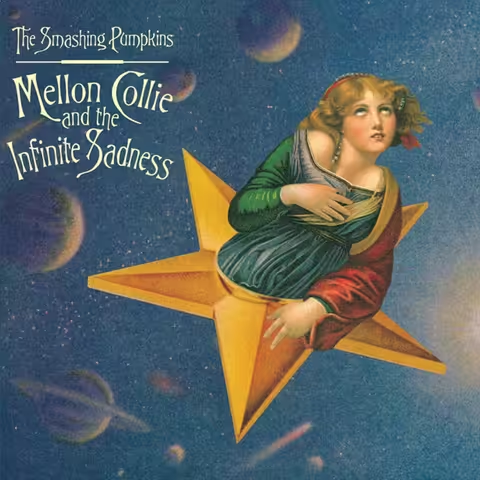
What came out the other side, six months and five studios later, was Mellon Collie and the Infinite Sadness: a 121-minute, two-disc, John Craig-collaged statement that Corgan publicly billed as "The Wall for Generation X", that debuted at number one on the Billboard 200, that spawned five Top 40 singles, that won the band its first Grammy and seven nominations including Album of the Year, and that has since been certified Diamond by the RIAA for ten million units shifted. It is the highest-selling double album of the 1990s, and the last record the original lineup would finish together before Jonathan Melvoin's overdose on a New York hotel room floor blew the touring party apart.
Album facts
| Field | Detail |
|---|---|
| Artist | The Smashing Pumpkins |
| Album | Mellon Collie and the Infinite Sadness |
| Release date | 24 October 1995 (US); 23 October 1995 (UK and several other territories) |
| Label | Virgin (US) / Hut (UK) |
| Producers | Flood, Alan Moulder, Billy Corgan |
| Studios | Pumpkinland, Sadlands and Bugg (all Chicago rehearsal and tracking rooms), Chicago Recording Company, Village Recorder (Los Angeles) |
| Genre | Alternative rock, art rock, alternative metal, grunge, heavy metal |
| Track count | 28 (CD and cassette); 30 (original triple LP pressing) |
| Total runtime | 121:39 (CD and cassette); 128:06 (original vinyl) |
| Billboard 200 peak | No. 1 |
| UK Albums Chart peak | No. 4 |
| Other notable chart peaks | No. 1 in Australia, Canada, New Zealand and Sweden; No. 2 in Belgium (Flanders); No. 3 in Belgium (Wallonia) and Ireland |
| Certifications | Diamond (US, 2012); Diamond (Canada); 4x Platinum (Australia); 2x Platinum (Ireland, New Zealand); Platinum (UK, France, Belgium, Denmark, Portugal); Gold in Germany, Japan, Netherlands, Norway, Spain, Sweden and Greece |
| Estimated sales | Best-selling double album of the 1990s; ten million RIAA-certified discs in the US, with global sales reported in excess of ten million units |
| Key singles | Bullet with Butterfly Wings, 1979, Zero, Tonight Tonight, Thirty-Three (plus the radio-only Muzzle) |
What landed in October 1995
Mellon Collie arrived in a fortnight that was already crowded with statement albums. Coolio's Gangsta's Paradise sat atop the Hot 100. Alanis Morissette's Jagged Little Pill, released that June, was still on its slow march to thirty million copies sold. Oasis released (What's the Story) Morning Glory two weeks earlier and Blur released The Great Escape the same week as Morning Glory: Britpop was at the white-hot peak of its supremacy in the UK. In the United States, the post-grunge wave was breaking. Foo Fighters' debut had arrived in July. Nirvana had been gone for eighteen months. Soundgarden's Down on the Upside was still seven months away.
Alternative rock, in other words, no longer had to pretend it was an outsider genre. It was the music industry's biggest format, and it was beginning to wonder what it wanted to grow into. Corgan's bet with Mellon Collie was that the answer was upward, not sideways: that a generation raised on Pink Floyd records inherited by older siblings would respond to an album of comparable scope made by people their own age.
The Smashing Pumpkins before Mellon Collie
To understand what Corgan was reaching for in 1995, it helps to know what he was running from. The Smashing Pumpkins had formed in Chicago in 1988, made their full-band debut at the Cabaret Metro on 5 October that year, and released their first album, Gish, on Caroline in 1991. The lineup was already what it would remain for the original run: Corgan on lead vocals and guitar, James Iha on guitar, D'arcy Wretzky on bass and Jimmy Chamberlin on drums. Gish sold well for a debut on an independent label, but it was 1993's Siamese Dream that turned them into a commercial force.
Siamese Dream was also, by every public account, a miserable record to make. Butch Vig and Corgan locked themselves in Triclops Sound Studios in Marietta, Georgia, for four months. The budget overran $250,000. Corgan, by his own admission, contemplated suicide and "practically lived in the studio". Chamberlin was deep in heroin and alcohol addiction and would vanish for days. Iha and Wretzky had broken up acrimoniously on the previous tour and were barely speaking. To get the album finished, Corgan re-cut most of Iha's and Wretzky's parts himself, which fuelled a press narrative of Corgan as alternative rock's tyrant-in-chief.
The thirteen-month tour that followed was even worse. By the time the band rolled off Lollapalooza 1994, where they headlined the second stage and Corgan would later compare himself to the biblical Job, they were spent. Corgan went home to Chicago, started writing immediately, and decided the next record would be made on his terms, on his soil, in conditions of his choosing. The fact that the next record would also be twice as long as any reasonable label could comfortably finance was, he later said, the point.
The double-album ambition and Virgin's response
Corgan made no secret of his frame of reference. He told the music press the new album would be "The Wall for Generation X", a direct invocation of Pink Floyd's 1979 double concept record. He cited the Beatles' self-titled White Album as the other touchstone. He wrote about fifty-six songs across late 1994 and the early months of 1995; the band entered the studio with the intent to record more or less all of them.
To his credit, he had been preparing the ground inside the band for some time. "We almost had enough material to make Siamese Dream a double album," Corgan told Guitar World in late 1995. "With this new album, I really liked the notion that we would create a wider scope in which to put other kinds of material we were writing." Virgin, faced with a frontman selling north of four million copies of his last record and demanding the right to release 28 songs on two compact discs at over twenty US dollars retail, blinked. The album would be a double. Original plans called for 31 tracks. The final count came in at 28.
The producers: Flood and Alan Moulder
The decision to drop Butch Vig was, on its face, commercial heresy. Vig had produced Nevermind and Siamese Dream inside an eighteen-month window. He was as bankable as alternative producers got. Corgan explained the split in plain terms to Guitar World: "To be completely honest, I think it was a situation where we'd become so close to Butch that it started to work to our disadvantage. I just felt we had to force the situation, sonically, and take ourselves out of normal Pumpkin recording mode. I didn't want to repeat past Pumpkin work."
In Vig's place came Flood, the British producer born Mark Ellis whose CV ran through Nick Cave, Depeche Mode, U2, Nine Inch Nails and Erasure, and his frequent partner Alan Moulder, whose mix and engineering credits covered My Bloody Valentine, the Jesus and Mary Chain and Nine Inch Nails. Both men had a reputation for getting bands to sound like themselves but better, and for refusing to let perfectionists hide behind overdubs.
"Flood felt like the band he would see live wasn't really captured on record."
Billy Corgan, Guitar World, December 1995
Flood's first intervention was a refusal to walk into a proper studio. In April 1995 he insisted the band set up in a Chicago rehearsal space and start tracking rough rhythm parts there, with no expensive clock ticking. Those rough tracks were notionally a draft. They ended up forming much of the album's rhythm-section spine, because Flood liked the looseness of what came out. He also imposed a daily quota of jamming and writing time, something the Pumpkins had never previously done inside a recording session. Two recording rooms ran at once: Flood and Corgan in one working on vocals and arrangements, Moulder with Iha and Wretzky in the other tracking guitars and bass. Boredom, the curse of the Siamese Dream sessions, was designed out of the schedule.
The studios: Pumpkinland, Sadlands, Bugg, CRC and Village Recorder
Mellon Collie was tracked across five rooms, not one. Most of the writing and demo work happened at Pumpkinland, the nickname Corgan gave to a rented Chicago house kitted out as a working space. Rehearsal and rhythm-section tracking happened at two further Chicago rooms, Sadlands and Bugg. Overdubs and Pro Tools work moved to the Chicago Recording Company (CRC), the city's blue-chip commercial facility. Final mixing and some additional tracking took place at Village Recorder in West Los Angeles. Howie Weinberg mastered.
The technology was a hybrid that, in 1995, was still considered avant-garde for a rock record. Pro Tools was used for guitar-overdub composites and for electronic looping and sampling, which sat alongside conventional analogue tape. "The various sections of 'Porcelina of the Vast Oceans' were recorded at various times, with different instruments and recording setups, and were digitally composited in Pro Tools," engineer Richard Thomas later told EQ Magazine. The same article noted that "To Forgive" survives in the final mix as a single live guitar take; "Thru the Eyes of Ruby" contains roughly seventy.
All guitars on the record were tuned down a half-step. On some songs, including Jellybelly, the sixth string was tuned down a further full step to C-sharp, what Corgan called his "grunge tuning". The producers encouraged a wider instrumental palette than Pumpkins records had previously offered: piano on the title track, drum loops and synthesizers on 1979, a thirty-piece string section on Tonight Tonight, and on the gauzy Cupid de Locke, percussion played on salt shakers and scissors.
Recording sessions and the writing-by-Corgan tension
One persistent rumour about Siamese Dream was that Corgan had played most of the bass and guitar himself, with Iha and Wretzky relegated to figurative passengers. Corgan, Flood and Moulder deliberately reorganised the Mellon Collie sessions to make sure the rumour could not be repeated. Iha and Wretzky played far more on the new record. Wretzky cut backing vocals on multiple tracks, although in the final mix only her vocal on Beautiful survives. The shift was noticed inside the band.
"The big change is that Billy is not being the big 'I do this, I do that'. It's much better. The band arranged a lot of songs for this record, and the song-writing process was organic. The circumstances of the last record and the way that we worked was really bad."
James Iha, US Magazine, December 1995
That said, all but two of the 28 final tracks were written by Corgan alone. James Iha wrote and sang lead on Take Me Down, the closing track of disc one, and Iha is the credited writer on Farewell and Goodnight, the album's actual closer, even though the band's liner notes credit it to Iha and Corgan jointly and all four members trade lead vocals on it. Iha brought several other songs to the sessions; Corgan acknowledged in a 1995 Rolling Stone interview that some of them were "really good" but "didn't fit in the context of the album", and they migrated to B-sides instead.
The pace was, by Pumpkins standards, brutal but functional. Sessions ran from March through August 1995. By the time the band had finished, they had 57 fully realised songs in the can. Around thirty of the rejected pieces would eventually surface, mostly intact, on the box set The Aeroplane Flies High a year later.
Personnel and credits
| Role | Player | Notes |
|---|---|---|
| Core band | ||
| Lead vocals, lead and rhythm guitar, piano, keyboards, autoharp, production, mixing | Billy Corgan | String arrangement (with Audrey Riley) on Tonight Tonight; art direction |
| Rhythm and lead guitar | James Iha | Lead vocals, mixing and additional production on Take Me Down and Farewell and Goodnight |
| Bass guitar | D'arcy Wretzky | Lead vocals on Beautiful and Farewell and Goodnight |
| Drums | Jimmy Chamberlin | Vocals on Farewell and Goodnight |
| Guest and session musicians | ||
| Orchestra | Members of the Chicago Symphony Orchestra (30-piece string ensemble) | Tonight Tonight |
| Pedal and lap steel guitar | Greg Leisz | Take Me Down |
| Production and engineering | ||
| Producer, mixer | Flood (Mark Ellis) | |
| Producer, mixer | Alan Moulder | |
| Recording | Chris Shepard | |
| Additional vocal recording, mixing assistance | Barry Goldberg | |
| String recording assistance | Dave Kresl | |
| Technical assistance | Roger Carpenter, Adam Green, Tim "Gooch" Lougee, Guitar Dave Mannet, Jeff Moleski, Russ Spice | |
| Recording assistance | Claudine Pontier | |
| String arrangement | Audrey Riley | Tonight Tonight |
| Mastering | Howie Weinberg | 1995 original |
| Mastering | Bob Ludwig | 2012 deluxe remaster |
| Artwork | ||
| Illustration and cover collage | John Craig | Wisconsin-based collage artist; worked from Corgan's faxed sketches |
| Art direction and design | Frank Olinsky | |
| Photography | Andrea Giacobbe | |
The songs
Mellon Collie is split into two conceptually distinct discs. Disc one, Dawn to Dusk, gathers the harder, brighter, more day-lit material. Disc two, Twilight to Starlight, leans into the after-dark dream-songs. Corgan has rejected the term concept album more than once, but he has also said the music tracks "the cycle of life and death" and the human condition of mortal sorrow. The audience, he said, was anyone aged roughly fourteen to twenty-four trying to understand what they were feeling.
Tracklist
| # | Title | Writer(s) | Length | Single? | Notes |
|---|---|---|---|---|---|
| Disc 1: Dawn to Dusk | |||||
| 1 | Mellon Collie and the Infinite Sadness (Instrumental) | Corgan | 2:52 | Solo piano overture | |
| 2 | Tonight, Tonight | Corgan | 4:14 | Yes (4th) | 30-piece Chicago Symphony Orchestra strings |
| 3 | Jellybelly | Corgan | 3:01 | Considered as lead single before Bullet was chosen | |
| 4 | Zero | Corgan | 2:40 | Yes (3rd) | Released as a six-B-side EP |
| 5 | Here Is No Why | Corgan | 3:45 | ||
| 6 | Bullet with Butterfly Wings | Corgan | 4:18 | Yes (1st) | Grammy: Best Hard Rock Performance, 1997 |
| 7 | To Forgive | Corgan | 4:17 | One live guitar take | |
| 8 | Fuck You (An Ode to No One) | Corgan | 4:51 | Titled simply An Ode to No One on early pressings | |
| 9 | Love | Corgan | 4:22 | ||
| 10 | Cupid de Locke | Corgan | 2:50 | Percussion includes salt shakers and scissors | |
| 11 | Galapogos | Corgan | 4:46 | Spelled Galapogos on the sleeve | |
| 12 | Muzzle | Corgan | 3:44 | Promo only | No. 8 on US Modern Rock Tracks |
| 13 | Porcelina of the Vast Oceans | Corgan | 9:21 | Built in Pro Tools from sections recorded weeks apart | |
| 14 | Take Me Down | Iha | 2:52 | Iha lead vocal; Greg Leisz on pedal and lap steel | |
| Disc 2: Twilight to Starlight | |||||
| 1 | Where Boys Fear to Tread | Corgan | 4:22 | ||
| 2 | Bodies | Corgan | 4:12 | ||
| 3 | Thirty-Three | Corgan | 4:10 | Yes (5th) | |
| 4 | In the Arms of Sleep | Corgan | 4:12 | ||
| 5 | 1979 | Corgan | 4:26 | Yes (2nd) | Highest US chart entry; written last |
| 6 | Tales of a Scorched Earth | Corgan | 3:45 | ||
| 7 | Thru the Eyes of Ruby | Corgan | 7:38 | ~70 guitar tracks | |
| 8 | Stumbleine | Corgan | 2:54 | Acoustic ballad, solo Corgan | |
| 9 | X.Y.U. | Corgan | 7:07 | Grew from a Pastichio Medley sketch called Rachel | |
| 10 | We Only Come Out at Night | Corgan | 4:05 | ||
| 11 | Beautiful | Corgan | 4:18 | D'arcy Wretzky lead vocal | |
| 12 | Lily (My One and Only) | Corgan | 3:31 | ||
| 13 | By Starlight | Corgan | 4:48 | ||
| 14 | Farewell and Goodnight | Iha (BMI); credited Iha and Corgan on sleeve | 4:22 | Lead vocals from all four band members | |
The standouts
The piano overture that opens the record was Corgan's idea: a two minute fifty-two second statement of theme played on solo piano, the same melody that would return as the closing motif of Farewell and Goodnight forty-five tracks later. It set the bar for ambition before a guitar had been played.
Tonight, Tonight followed and remains, for many listeners, the album's emotional centre. Corgan has said the song addresses his younger self, the boy who survived an abusive Chicago childhood and was being told to keep believing. He wrote it on the Siamese Dream tour, originally in the key of C, then rewrote it during the Mellon Collie sessions in G when his vocal range refused to cooperate. The 30-piece string section was arranged by Corgan with the British cellist Audrey Riley.
"Recording with a 30-piece string-section for the song was probably one of the most exciting recording experiences I have ever had."
Billy Corgan, Guitar World, January 1997
Bullet with Butterfly Wings had begun life on a 1993 tape during the Siamese Dream sessions; Corgan had simply looped the phrase "the world is a vampire" over and over and let it sit. He wrote the "rat in a cage" chorus on acoustic guitar in the same Atlanta session that produced the Pumpkins' cover of Landslide. Two years on, that scrap of tape became the lead single, the band's first Top 40 hit in the US, and the song that would win them their first Grammy.
Zero, the song that gave Corgan his iconic black-and-silver wardrobe, is two minutes forty seconds of compressed industrial menace. Here Is No Why, To Forgive and Love form a deep mid-side run; Fuck You (An Ode to No One), the most ferocious thing on disc one, contains a guitar solo Corgan said he played "until my fingers saw blood".
"You can't play a weak guitar solo in such a propulsive song. It's got to be attack-style. I put on the headphones and stand one foot away from the amp. I turn the amp up so loud that I literally have to play harder than the feedback, because if I stop playing even for an instant, the whole thing explodes."
Billy Corgan on Fuck You (An Ode to No One), interview with James Rotondi, 1995
Cupid de Locke and Galapogos provide the breather before Muzzle reasserts the album's stride; Porcelina of the Vast Oceans then closes the daylight section with a nine-minute, multi-section composite that Flood and Moulder pieced together in Pro Tools from material recorded weeks apart. Take Me Down, sung by Iha with Greg Leisz on lap steel, is the only song on disc one not written or sung by Corgan, and it closes Dawn to Dusk on a note of complete tonal contrast.
Disc two opens with the harder Where Boys Fear to Tread and Bodies before Thirty-Three drops the temperature. Then comes the song that nearly was not on the record. 1979 began life as a demo called Strolling, a couple of chord changes and a melody snippet without words. As the sessions wound down Flood told Corgan the song was "not good enough" and wanted to cut it from the album. Corgan, stung, took the rejection as a challenge, went home and wrote the finished song in about four hours that night. The next morning Flood listened once and put it on the record. Corgan considers it the most personally important song on the album. It became the Smashing Pumpkins' highest-charting US single ever, peaking at number 12 on the Hot 100 and number 1 on both Mainstream Rock and Modern Rock.
From there the record sinks into its long nocturnal stretch. Tales of a Scorched Earth howls; Thru the Eyes of Ruby uses something like seventy individual guitar tracks; Stumbleine is two minutes fifty-four seconds of Corgan and an acoustic guitar; X.Y.U. erupts into a seven-minute fury that evolved from a sketch called Rachel on the Pastichio Medley. Beautiful is the one Wretzky lead vocal on the record. We Only Come Out at Night and Lily (My One and Only) are short, glassy pop miniatures. By Starlight is, with Tonight, Tonight, the album's other show-stopping ballad. Farewell and Goodnight then quietly closes the cycle with all four band members trading lead vocals over a lullaby figure built around the album's opening piano theme.
B-sides, outtakes and The Aeroplane Flies High
Mellon Collie was, for all its size, ruthlessly edited. The band had recorded fifty-seven full songs and released twenty-eight. The original plan called for thirty-one. The triple LP edition added two more in Tonite Reprise and Infinite Sadness, with a fully resequenced track order.
The rest, almost all of it, surfaced on The Aeroplane Flies High, the five-EP box set released on 26 November 1996. Virgin pressed 200,000 copies, intending it as a fan-only limited edition; demand was so heavy that further runs were authorised. The box gathered the five Mellon Collie singles, each expanded with every B-side, plus the 23-minute Pastichio Medley, a single track Corgan, Iha, Wretzky and Chamberlin assembled from roughly seventy riff fragments left over from the Siamese Dream and Mellon Collie writing sessions. Highlights of the B-sides cache include:
- ...Said Sadly, an Iha-led ballad with Veruca Salt's Nina Gordon on guest vocals
- Medellia of the Gray Skies, a Pumpkins-meets-the-Frogs piece featuring Dennis and Jimmy Flemion
- A Night Like This, a fully-realised cover of the Cure
- You're All I've Got Tonight (the Cars), Clones (We're All) (the Alter Boys), Dreaming (Blondie) and Destination Unknown (Missing Persons), all from the Bullet single's covers EP
- The Aeroplane Flies High (Turns Left, Looks Right), an eight-and-a-half minute Corgan composition that has no business being a B-side
- Set the Ray to Jerry, a fan-favourite Corgan original from the 1979 EP
The Aeroplane Flies High box peaked at number 42 on the Billboard 200, an unusually high placement for what was nominally a singles compilation. A 2013 6-CD/DVD deluxe reissue nearly quadrupled its size with 90 additional tracks including the Gravity Studios demos that the band cut at the very start of the Mellon Collie writing process.
Album artwork and packaging
The cover is the work of John Craig, a Wisconsin-based illustrator who had spent most of his career taking magazine commissions. He worked almost entirely from rough sketches Corgan faxed him. The central image, the woman on the starry blue field, is a collage assembled from two old-master paintings: the face is taken from Jean-Baptiste Greuze's The Souvenir (Fidelity), and the body is lifted from Raphael's portrait of Saint Catherine of Alexandria.
The internal artwork carried the same antique-collage vocabulary across both discs, with smoking animals, anthropomorphised celestial bodies and dreamlike children wandering through eerie landscapes. Frank Olinsky handled art direction and design, Andrea Giacobbe the photography. The package was tactile and expensive-looking: a fold-out double digipak, a fat lyric booklet, and a sense throughout that the band had spent the money. The cover sleeve has become one of the most recognisable in 1990s rock, parodied, referenced and tattooed at a rate disproportionate to all but a handful of records from the decade.
Release and reception
Mellon Collie was released on 24 October 1995 in the United States, a day after it had appeared in the UK, Italy and several other territories. The band marked the release with a show at the Riviera Theater in Chicago on the eve of US street date and a simultaneous live FM broadcast across the country. The following week the album entered the Billboard 200 at number one, a remarkable feat for a double album retailing at over twenty US dollars. It would chart at number one in Australia, Canada, New Zealand and Sweden, number four in the UK, number two in Belgium, and inside the top ten in most of the rest of the developed world. By the end of 1996 it had sold six million copies. RIAA Diamond certification, recognising ten million certified discs (each disc of a double album is counted), arrived in October 2012.
Critically the album drew almost uniform praise tempered by a few familiar reservations about Corgan's lyrics. Christopher John Farley in Time called it "the group's most ambitious and accomplished work yet" and Time put it at number one on its Best of 1995 list. David Browne gave it an A in Entertainment Weekly. AllMusic's Stephen Thomas Erlewine gave it four and a half stars. Q gave it four. NME scored it 8/10 and Spin the same. The Guardian's Adam Sweeting made it CD of the week.
"Mellon Collie and the Infinite Sadness is more than just the work of a tortured, finicky pop obsessive. Corgan presents himself as one of the last true believers: someone for whom spewing out this much music results in some sort of high art for the ages."
David Browne, Entertainment Weekly, 27 October 1995
Rolling Stone's Jim DeRogatis was more divided, awarding three stars and calling the record "one of the rare epic rock releases whose bulk is justified in the grooves" while criticising Corgan's lyrics. Pitchfork at the time was lukewarm, scoring it 6.8/10 in 1995, but reversed itself emphatically in 2012, awarding the deluxe reissue 9.3/10. The Village Voice's Robert Christgau dismissed the album as a "dud" in his Consumer Guide.
Retrospective assessment has been kinder. Rolling Stone placed Mellon Collie at number 487 on its 2003 list of The 500 Greatest Albums of All Time and folded it into its 2019 list of the 50 Greatest Grunge Albums. The record made the 1001 Albums You Must Hear Before You Die book. Loudwire named it the Best Hard Rock Album of 1995 in their year-by-year retrospective. The Triple J Hottest 100 of 1996 put 1979 at number 13; by 2013 it had risen to 21 in the Hottest 100 of the past 20 years.
Singles, music videos and chart performance
The Mellon Collie singles campaign ran for thirteen months and reshaped Pumpkins commerce. Bullet with Butterfly Wings landed on 16 October 1995, a week ahead of the album, and gave the band its first US Top 40 hit, peaking at number 22 on the Hot 100 and number 4 on Mainstream Rock. The video, directed by Samuel Bayer (best known for Nirvana's Smells Like Teen Spirit), was shot in the Gillibrand Industrial Sands mining pits near Simi Valley, California, in late September 1995. The visual reference point was Brazilian photographer Sebastiao Salgado's gold-mining images, but the video doubled as the debut of Corgan's now-iconic black-letter ZERO shirt and silver pants. It was the last footage of Corgan with hair.
| Single | Released | Director | US Hot 100 | UK | Notable |
|---|---|---|---|---|---|
| Bullet with Butterfly Wings | 16 October 1995 | Samuel Bayer | 22 | 20 | Grammy: Best Hard Rock Performance, 1997 |
| 1979 | 23 January 1996 | Jonathan Dayton and Valerie Faris | 12 | 16 | MTV VMA Best Alternative Video, 1996 |
| Zero | 23 April 1996 (US) | No video; sleeve art by Yelena Yemchuk | EP | Sold strongly as a B-sides EP | |
| Tonight, Tonight | 6 May 1996 (UK), 11 June 1996 (US) | Dayton and Faris | 36 | 7 | Six 1996 MTV VMAs including Video of the Year |
| Thirty-Three | 11 November 1996 | Billy Corgan with Yelena Yemchuk | 39 | Final Mellon Collie-era single | |
| Muzzle | Radio promo only | n/a | No. 8 on US Modern Rock |
1979 followed on 23 January 1996 in the US. It became the band's highest-charting single ever, hitting number 12 on the Hot 100 and number 1 on both Mainstream Rock and Modern Rock. The Jonathan Dayton and Valerie Faris-directed video, a sun-soaked teenage road movie shot around suburban California with a 1972 Dodge Charger, was originally an alien-hotel concept costing a million dollars that the band scrapped. The footage of the famous version was also lost once, accidentally left sitting on the roof of a car as the driver pulled away in New York. The band re-shot the party scene. The video won Best Alternative Video at the 1996 MTV VMAs and is the one Corgan still calls the Pumpkins' best.
Tonight Tonight's music video deserves a paragraph of its own. Jonathan Dayton and Valerie Faris took their cue from the album cover, which reminded them of early silent films, and built the entire video as an homage to Georges Melies' 1902 silent A Trip to the Moon. The video stars Mr. Show's Tom Kenny and Jill Talley as a turn-of-the-century couple who fly a zeppelin to the moon, fight off umbrella-vaporised aliens, and are rescued by an ocean liner christened S.S. Melies. Costumes were a problem because James Cameron's Titanic was filming in Los Angeles simultaneously and had rented most of the available period wardrobe in the city. Wayne White built the backdrops and puppets. The video took three days to shoot. It won six awards at the 1996 MTV Video Music Awards, including Video of the Year, Breakthrough Video, Best Direction, Best Special Effects, Best Art Direction and Best Cinematography. Stylus Magazine ranked it the 40th greatest music video of all time.
Zero was issued in the US in April 1996 packaged as a CD EP with six B-sides, an unusual move that drove its sales despite the lack of a conventional music video. Tonight Tonight as a single reached number 7 in the UK, number 36 on the Billboard Hot 100, and number 1 in Iceland. Thirty-Three, released in November 1996, became a quieter modern-rock hit and closed out the singles campaign. Muzzle was never commercially released as a single but reached number 8 on US Modern Rock Tracks on airplay alone.
Touring and the Infinite Sadness Tour
The band toured Mellon Collie across most of 1996 under the Infinite Sadness Tour banner. The Zero shirt, the shaved head, the long-sleeved black tops with silver detail and the band's growing fluency in arena-sized presentation made Corgan an MTV staple. The Pumpkins appeared in The Simpsons' Homerpalooza episode in 1996. The Zero shirt sold in malls.
Two events darkened the campaign. On 13 May 1996 at the Point Theatre in Dublin, a seventeen-year-old fan named Bernadette O'Brien was crushed to death in the moshing crowd despite repeated band requests for the audience to stop. The concert ended early and the following night's Belfast show was cancelled out of respect. Corgan publicly said moshing's "time had come and gone".
Then, on the night of 11 July 1996 in New York City, touring keyboardist Jonathan Melvoin and Jimmy Chamberlin overdosed on heroin in a hotel room. Melvoin died. Chamberlin was arrested for drug possession. The following week the band issued a statement firing Chamberlin.
"For nine years we have battled with Jimmy's struggles with the insidious disease of drug and alcohol addiction. It has nearly destroyed everything we are and stand for. We wish him the best we have to offer."
The Smashing Pumpkins, official statement, 17 July 1996
The Pumpkins finished the tour with drummer Matt Walker (Filter) and keyboardist Dennis Flemion of the Frogs. Corgan later said the decision to continue rather than cancel was "the worst decision the band had ever made", damaging both the music and the band's reputation. Chamberlin would not return to the band until 1998.
Awards and accolades
- Seven nominations at the 39th Annual Grammy Awards, 1997
- Album of the Year nomination (lost to Celine Dion's Falling Into You)
- Record of the Year nomination for 1979
- Best Rock Performance by a Duo or Group with Vocal nomination for 1979
- Best Alternative Music Performance nomination
- Grammy win: Best Hard Rock Performance with Vocal, Bullet with Butterfly Wings (the band's first Grammy)
- Nine 1996 MTV Video Music Awards nominations; eight for Tonight Tonight
- Six wins at the 1996 MTV VMAs for Tonight Tonight, including Video of the Year, Breakthrough Video and Best Direction
- Best Alternative Video at the 1996 MTV VMAs for 1979
- Time magazine: Best Album of 1995
- Number 487 on Rolling Stone's 500 Greatest Albums of All Time (2003)
- Number 14 in the 1995 Village Voice Pazz and Jop critics' poll
- Number 76 in Colin Larkin's All Time Top 1000 Albums (2000)
- 1001 Albums You Must Hear Before You Die
- Loudwire's Best Hard Rock Album of 1995 (2024)
Reissues, anniversaries and the Lyric Opera adaptation
A limited-edition triple LP appeared in the UK on 29 April 1996, with 23,000 hand-numbered first-pressing copies, two extra tracks (Tonite Reprise and Infinite Sadness) and a completely rearranged track listing. The pressing was later reissued in a blank white box without the numbering, but original first-pressing copies are now collector items.
On 4 December 2012, EMI issued the deluxe reissue: a 5-CD set with 64 bonus tracks of previously unreleased material, demos, alternate versions and six new mixes of original songs, including the full versions of several pieces excerpted on the Pastichio Medley. A DVD added live footage from Brixton Academy (15 May 1996, filmed by MTV Europe) and the Philipshalle in Dusseldorf (7 April 1996, filmed by Rockpalast). Bob Ludwig remastered from the original tapes. Pitchfork's Ian Cohen scored the reissue 9.3/10, an enormous upward reappraisal of the 6.8 the magazine had given the album in 1995.
For the album's 30th anniversary in 2025, Corgan partnered with the Lyric Opera of Chicago for A Night of Mellon Collie and Infinite Sadness, a staged operatic reimagining that ran for seven performances at the Lyric Opera House from 21 to 30 November 2025. New arrangements were commissioned, conductor James Lowe led the orchestra, and the cast included soprano Sydney Mancasola, mezzo-soprano Zoie Reams, tenor Dominick Valdes Chenes and baritone Edward Parks alongside Corgan himself on select songs. It was the kind of high-art capstone that would have seemed faintly delusional in 1995 and that, thirty years later, felt entirely earned.
Legacy and influence
Mellon Collie sits at an unusual point in the Pumpkins' arc. It is at once the climax of their guitar-rock years and the doorway to everything that came next. 1979's drum loops and vocal sampling pointed directly at the electronica that would dominate 1998's Adore, and Corgan himself flagged this in a 1996 Spin interview:
"Between 'Bullet with Butterfly Wings' and '1979' you have the bookends of Mellon Collie and the Infinite Sadness. You've literally heard the end of the rock thing, and the beginning of the new thing."
Billy Corgan, Spin, June 1996
James Iha, asked at the end of 1996 what the next Pumpkins record would sound like, replied flatly: "The future is in electronic music. It really seems boring just to play rock music."
Inside the genre, Mellon Collie is regularly cited as one of the records that legitimised alternative rock as a vehicle for serious long-form ambition. My Chemical Romance's Gerard Way has explicitly compared the band's own conceptual ambitions to the Pumpkins' template. Marilyn Manson, Deftones, Third Eye Blind, Tegan and Sara, Fall Out Boy and Kill Hannah have all cited the Pumpkins more broadly as foundational; Mellon Collie is invariably the album they reach for in interviews. The 2007 MySpace Records Smashing Pumpkins tribute album drew artists including Hawthorne Heights to cover Bullet with Butterfly Wings. MO released a one-off cover single of the same song in 2019. My Chemical Romance performed it on the Long Live The Black Parade tour at Oracle Park.
The synch placements have been steady. 1979 appears in Clerks II (2006), in the credits of Gran Turismo 5 (2010), in Guitar Hero World Tour, and was for ten years part of the Liberty Rock Radio soundtrack in Grand Theft Auto IV until Rockstar's licence expired in April 2018. Bullet with Butterfly Wings has soundtracked Whale Wars, the South Park episode Whale Whores, Dead Space 2, parts of Black Adam (2022), and a stripped-down 2016 remix by A.P. Laurenson has been licensed into trailers for Rampage, Call of Duty: Modern Warfare II, The Last Voyage of the Demeter and Battlefield 6.
For Generation X listeners, the album is something close to a totem. It is the record you put on as a teenager and discover something new in at thirty, and at forty, and at fifty. Pitchfork's 2012 reassessment put the case neatly: at 28 songs, the album is at once gigantic and ruthlessly edited, an act of bombast that turns out to have been an act of discipline.
Where it sits in the Smashing Pumpkins catalogue
By the time the Pumpkins reached Mellon Collie they had built a near-perfect three-album opening run: Gish in 1991, Siamese Dream in 1993, Mellon Collie in 1995. All three appear on respected best-of-the-1990s lists. Two of them, Siamese Dream and Mellon Collie, made Rolling Stone's 500 Greatest Albums of All Time.
What followed was the unwinding. Adore in 1998, recorded after the death of Corgan's mother and his divorce, swapped guitars for drum machines and Matt Walker session drumming, and sold a third of what Mellon Collie had managed. Machina and Machina II in 2000 closed out the original run. The band broke up that December. Corgan and Chamberlin reformed under the Smashing Pumpkins name in 2006 and have released seven further albums since, including the deliberate Mellon Collie sequel Atum: A Rock Opera in Three Acts (2022 to 2023) and 2024's Aghori Mhori Mei. Original guitarist James Iha rejoined in 2018. Original bassist D'arcy Wretzky has not.
Across all of that, Mellon Collie remains the high water mark. It is the band's best-selling album, their only Diamond-certified album, the source of their highest-charting single, the source of their only competitive Grammy win, and the record other bands now point at when they want to argue that alternative rock could carry serious weight.
Things you might not know
| Fact | Detail |
|---|---|
| The song that nearly was not on it | 1979 was a wordless sketch called Strolling that Flood told Corgan was "not good enough" and wanted to cut. Corgan wrote the finished song in roughly four hours that same night. It became the band's highest-charting US single. |
| 57 finished songs | Sessions yielded 57 fully realised songs. Twenty-eight made the album; about thirty more landed on The Aeroplane Flies High in November 1996. |
| Bullet's two-year demo loop | Corgan kept a 1993 cassette of himself looping the phrase "the world is a vampire" during the Siamese Dream sessions. It eventually became Bullet with Butterfly Wings, the band's first Top 40 hit and first Grammy. |
| The cover is two paintings | The woman on the front is a John Craig collage. The face is from Jean-Baptiste Greuze's The Souvenir (Fidelity). The body is lifted from Raphael's portrait of Saint Catherine of Alexandria. |
| 30 strings from the Chicago Symphony | Tonight, Tonight features a 30-piece string section recorded with members of the Chicago Symphony Orchestra, arranged by Corgan with cellist Audrey Riley. |
| The Titanic costume problem | The Tonight, Tonight music video shoot in Los Angeles ran into James Cameron's Titanic production, which had rented most of the available turn-of-the-century costumes in the city. The Pumpkins' crew had to remake leftovers into the elaborate period clothing on camera. |
| The lost 1979 video tapes | All the original 1979 footage was accidentally left sitting on top of a car in New York and lost when the driver pulled away. The band flew back to re-shoot the party scene from scratch. |
| Salt shakers and scissors | The percussion on Cupid de Locke is built around household objects, including salt shakers and scissors. |
| One take versus seventy takes | To Forgive survives as a single live guitar take. Thru the Eyes of Ruby contains roughly seventy guitar tracks layered in Pro Tools. |
| Wretzky's vanishing harmonies | D'arcy Wretzky recorded backing vocals on numerous tracks during the sessions. Only the part on Beautiful made the final mix. |
| The vinyl is a different album | The original triple-LP UK pressing, limited to 23,000 hand-numbered copies, includes two bonus tracks (Tonite Reprise and Infinite Sadness) and a completely rearranged track order across six sides called Dawn, Tea Time, Dusk, Twilight, Midnight and Starlight. |
| The lost Grammy | Mellon Collie's Album of the Year nomination at the 1997 Grammys lost to Celine Dion's Falling Into You. |
| Pitchfork's 13-point swing | Pitchfork rated the original 1995 album 6.8/10. When the 2012 deluxe reissue arrived, Ian Cohen rescored it 9.3/10, one of the largest retroactive reappraisals in the magazine's history. |
| The Pastichio Medley | Disc three of The Aeroplane Flies High contains a single 23-minute track called Pastichio Medley, a sequence of roughly seventy riff fragments from the Siamese Dream and Mellon Collie writing sessions, credited to all four band members. |
| Becoming an opera | For the album's 30th anniversary in 2025, Billy Corgan partnered with the Lyric Opera of Chicago for A Night of Mellon Collie and Infinite Sadness, a staged operatic reimagining that ran for seven performances and featured four operatic soloists alongside Corgan. |
Final thoughts
Thirty years on, Mellon Collie and the Infinite Sadness still does the thing it set out to do: it makes you feel that being fourteen, or twenty-four, or any age in between was an actual cosmic event. Corgan billed it as The Wall for Generation X and meant it, and the record turned out to deserve the comparison, not because it copies Roger Waters but because it shares the gall to assume an album can be that important to a teenager. Flood and Alan Moulder gave him the discipline to make the bombast work, and the band, for all the noise around Corgan's domination of the writing room, played with a kind of focused fury that nothing they made before or after quite touched.
The Smashing Pumpkins would never sound this way again. The Infinite Sadness tour ended with a man dead, the drummer fired, the band's pop-cultural moment leaking away into the late-1990s electronica that 1979 had so accurately foreseen. But for the year and a half between October 1995 and the summer of 1996, this 121-minute, two-disc, John Craig-collaged behemoth was the most ambitious thing in alternative rock. It still is.
If this is the kind of deep dive that scratches an itch for you, the Riffology podcast does the same job out loud. New episodes drop regularly and are available on Apple Podcasts, Spotify, Amazon Music, Pocket Casts and wherever else you get your shows.
Comments