A 19-year-old former Canadian child star, dropped by her label and written off as a faded teen-pop curiosity, walked into a producer's home studio in the San Fernando Valley in 1994 and walked out, eighteen months later, with one of the best-selling albums in history. That is the improbable arc of Jagged Little Pill, released on 13 June 1995, an album that turned Alanis Morissette from a forgotten dance-pop also-ran into the defining voice of confessional 1990s rock.
Co-written entirely with producer Glen Ballard and recorded fast and cheap, the album captured a raw, unguarded honesty that millions of listeners recognised as their own. It sold over 33 million copies, won five Grammy Awards including Album of the Year, and opened the door for a generation of women songwriters who followed. This is the story of how it was made, why it connected with so many people so deeply, and how a record dismissed by some early critics as overwrought became a permanent fixture in the rock canon.
| Field | Detail |
|---|---|
| Artist | Alanis Morissette |
| Album | Jagged Little Pill |
| Release Date | 13 June 1995 |
| Label | Maverick / Reprise |
| Producer | Glen Ballard |
| Genre / Subgenre | Alternative rock, post-grunge, pop rock |
| Recording Studios | Westlake, Los Angeles; Signet Sound, West Hollywood |
| Track Count | 13 (including a hidden track) |
| Total Runtime | 57:23 |
| Billboard 200 Peak | 1 (twelve weeks) |
| UK Albums Chart Peak | 1 |
| US Certification | 17x Platinum (Diamond) |
| Estimated Worldwide Sales | Over 33 million |
| Key Singles | "You Oughta Know", "Hand in My Pocket", "Ironic", "You Learn" |
Cultural Context
By 1995 the grunge explosion was beginning to settle, and the alternative-rock mainstream it had built was hungry for new voices. Nirvana's Kurt Cobain had died the year before, Pearl Jam were locked in their war with Ticketmaster, and the radio dial was crowded with flannel-clad guitar bands. What it conspicuously lacked was a young woman speaking plainly and angrily about her own life, and into that gap stepped a singer almost nobody in the United States had heard of.
The timing mattered enormously. Modern-rock radio, led by powerful tastemaker stations such as Los Angeles' KROQ-FM, had the reach to break a record overnight, and MTV still ran music videos around the clock. An unknown artist with the right song could go from obscurity to ubiquity in a matter of weeks. Morissette had the song, and she had a producer who understood exactly how to frame it. The cultural ground was perfectly prepared for an album that put a furious, funny, vulnerable young woman front and centre.
From Child Star to Reinvention
Long before she became a symbol of nineties candour, Alanis Morissette was a Canadian teen-pop product. In 1991, MCA Records Canada released her debut album Alanis, a dance-pop record that went platinum in her home country and earned her comparisons to the bubblegum stars of the day. Her second album, Now Is the Time, arrived in 1992 and sold barely half as many copies. With her two-album deal complete, Morissette found herself a teenager without a recording contract and without an obvious future.
Morissette had grown up in the public eye in more ways than one. As a child she had appeared on the Canadian sketch series You Can't Do That on Television, written songs from the age of nine, and pressed her first independent single at twelve. The teen-pop deal was the logical next step, but by 1992 the formula had run dry, and the dance-pop sheen that had once seemed like a fast track to fame now felt like a cage. The challenge was to convince an industry that had already filed her away that she had something far more substantial to offer.
The reinvention was deliberate. In 1993 her publisher introduced her to manager Scott Welch, who told HitQuarters he was struck by her "spectacular voice", her character and her lyrics. Together they decided she needed to leave Ottawa, where she was still living with her parents, and start writing with new collaborators. After finishing high school she moved first to Toronto and then to Los Angeles, chasing a sound that had nothing to do with the polished pop of her past. To mark the break she also began using her full name professionally, dropping the single-word "Alanis" branding of her teenage records.
Meeting Glen Ballard
The crucial encounter came in 1994, when Morissette's publishing company matched her with Glen Ballard, an established songwriter and producer who had worked with Michael Jackson and Wilson Phillips. The chemistry was immediate. According to Ballard, the connection was instant, and within thirty minutes of meeting they were already experimenting with sounds in his home studio in the San Fernando Valley.
"I just connected with her as a person, and, almost parenthetically, it was like 'Wow, you're 19?' She was so intelligent and ready to take a chance on doing something that might have no commercial application. Although there was some question about what she wanted to do musically, she knew what she didn't want to do, which was anything that wasn't authentic and from her heart."
Glen Ballard, Rolling Stone, 1995
The pair worked at extraordinary speed. The very first song they wrote together, "The Bottom Line", was completed in roughly an hour, immediately after they met, though it did not make the album's final running order. "Ironic", which would become the album's biggest hit, was the third song they wrote. Ballard later recalled the sheer momentum of those early sessions, telling Billboard that within fifteen minutes of meeting they were "at it, just writing", with no concern for genre or commercial fit.
Writing and Recording
The working method that produced Jagged Little Pill was unusually intimate. The demo sessions began in 1994 at Ballard's home studio, with only Morissette and Ballard in the room. He played the rough tracks, handling guitars, keyboards and programmed drum machines, while she added harmonica and, crucially, her lyrics and voice. The duo set themselves the goal of writing and recording one song a day across twelve and sixteen-hour shifts, capturing the songs as they were being written rather than labouring over them afterwards.
That spontaneity is baked into the finished record. Morissette's singing on the album respects the same rule the writing did: each vocal was recorded in one or two takes, with minimal overdubbing. When tracks were later rebuilt with full band arrangements in a professional studio, the original demo vocals were kept, preserving the unvarnished immediacy of the first performance. The first song shown to record-company people was "Perfect", a stark arrangement of nothing but Morissette's vocal and Ballard's acoustic guitar.
In December 1994 the duo took the demos into a studio and began building full-band versions of five songs: "You Oughta Know", "Right Through You", "Forgiven", "Wake Up" and "Mary Jane", with Los Angeles engineer Chris Fogel handling the sessions. By January 1995 the album had been passed over by many labels. Ballard was even considering an independent release when Morissette's lawyer arranged a meeting with Guy Oseary of Maverick Records, the label co-owned by Madonna. Oseary said he was hooked from the opening of "Perfect", later describing it as the first time he had heard anyone tell stories in quite that way, and within two days Morissette was signed.
Personnel and Credits
For all its later scale, Jagged Little Pill was fundamentally the work of two people, supplemented by a small cast of session musicians who added colour to Ballard's framework. The most famous guest contribution came from two members of Red Hot Chili Peppers, who turned up to rework the lead single.
| Contributor | Role |
|---|---|
| Alanis Morissette | Vocals (all tracks), harmonica |
| Glen Ballard | Producer, guitar, keyboards, programming, mixing |
| Dave Navarro | Guitar on "You Oughta Know" |
| Flea | Bass on "You Oughta Know" |
| Benmont Tench | Organ on several tracks |
| Michael Landau | Guitar on "Forgiven" |
| Lance Morrison | Bass guitar |
| Matt Laug / Rob Ladd | Drums and percussion |
| Chris Fogel | Engineering and mixing |
| Tom Recchion / John Patrick Salisbury | Art direction and photography |
The presence of Dave Navarro and Flea on "You Oughta Know" gave the song a heavyweight rock pedigree, but the collaboration was looser than it sounds. The music had originally been written differently, and the pair were asked to rework it. Navarro likened the process to a remix, noting that the structure was in place but there were no guide tracks to follow, so they simply jammed against Morissette's vocal until they found something everyone was happy with.
The Songs
| # | Title | Length | Single? | Notes |
|---|---|---|---|---|
| 1 | All I Really Want | 4:45 | Yes | Grunge-pop opener with harmonica |
| 2 | You Oughta Know | 4:09 | Yes | Lead single, Navarro and Flea guest |
| 3 | Perfect | 3:08 | First song played to A and R | |
| 4 | Hand in My Pocket | 3:42 | Yes | A catalogue of contradictions |
| 5 | Right Through You | 2:56 | Aimed at sleazy record bosses | |
| 6 | Forgiven | 5:00 | Draws on a Catholic upbringing | |
| 7 | You Learn | 4:00 | Yes | Source of the album title |
| 8 | Head over Feet | 4:27 | Yes | A plainspoken love song |
| 9 | Mary Jane | 4:41 | Addresses depression and self-image | |
| 10 | Ironic | 3:50 | Yes | The album's biggest hit single |
| 11 | Not the Doctor | 3:48 | A statement of independence | |
| 12 | Wake Up | 4:54 | A cry to an apathetic world | |
| 13 | You Oughta Know (Jimmy the Saint Blend) / Your House | 8:13 | Hidden track, CD only |
The album opens with "All I Really Want", a grunge-pop blast of harmonica, swirling guitars and canned drums that sets the tone of restless yearning. Then comes "You Oughta Know", the song that changed everything: a scalding portrait of raw anger and frank female sexuality that remains one of the most visceral kiss-off songs in rock. The video for it became a fixture on MTV, and it is the obvious place to start for anyone meeting the album for the first time.
From there the record balances fury with warmth. "Hand in My Pocket" is a cheerful catalogue of contradictions set over fuzzy guitar and a nineties drum machine, while "You Learn" is a mid-tempo self-help anthem that gave the album its title. "Head over Feet" is a disarmingly plain love song, and "Ironic" is the breezy pop-rock single whose lyrics sparked a decade of pedantic debate about whether its examples actually describe irony. Across the running order, Ballard's pop sensibility keeps the songs hooky and accessible even as Morissette's words stay confessional and sharp.
The sequencing is part of the album's craft. Rather than front-loading the singles and letting the rest sag, Morissette and Ballard scattered the hits throughout, so that a furious opener gives way to a tender love song, which is in turn followed by a bruised confessional. The hidden track that closes the CD, a remixed version of "You Oughta Know" blended with an a cappella reading of "Your House", became a small ritual for fans who let the disc run on in silence after "Wake Up" had faded. It was the kind of detail that rewarded repeat listening, helping the album live in people's lives rather than merely on the radio.
Lyrical Themes
What gives Jagged Little Pill its staying power is the unflinching honesty of the lyrics, all of which Morissette wrote herself. She has spoken about making the album while in a bad mental state, suffering daily panic attacks after being robbed at gunpoint, and using the songs to externalise feelings she could not otherwise voice. Her stated goal was to do work that revealed a completely truthful side of herself, and she admitted to saying things in her songs that she would never say in normal conversation.
The subject matter ranges widely. "Right Through You" is an angry swipe at the sleazy record executives who prey on young female artists. "Forgiven" wrestles with the guilt of a Catholic upbringing, while "Mary Jane" addresses depression and self-image as Morissette tries to reassure a struggling friend. "Wake Up" closes the standard album as a cry for help aimed at an apathetic world. Taken together, the songs form a portrait of a young woman refusing to be polite about her own pain, which is precisely why so many listeners heard their own lives in them.
Part of the lyrics' power lies in their refusal to resolve neatly. "Hand in My Pocket" piles up contradictions without smoothing them over, insisting that a person can be broke and happy, sane and overwhelmed, all at once. "You Learn" reframes failure and heartbreak as the raw material of growth rather than something to be hidden. Morissette delivered these lines in a distinctive vocal style, full of unexpected glides and emphases, that some critics found mannered but that countless fans found liberating. It was the sound of someone working out how she felt in real time, and it gave the album a sense of lived experience that polished songwriting rarely achieves.
Album Artwork and Packaging
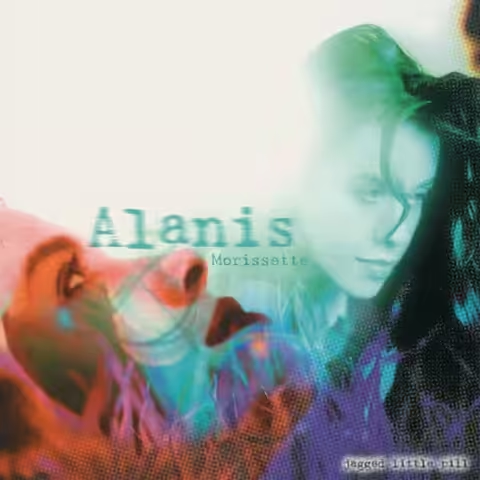
The album's visual identity matched its emotional rawness. The cover, featuring photography by John Patrick Salisbury and art direction by Thomas Recchion, combines an image of Morissette crouched atop a cliff in Malibu with a blurred close-up of her face rendered in shifting shades of red, blue and green, overlaid with typewriter-style fonts. The effect is deliberately unglamorous, presenting the singer as a real and slightly indistinct presence rather than a polished pop product. Later reissues would update the palette, with the 2005 acoustic edition tinted in sepia and the 2015 collector's edition recast in white and gold.
Release and Reception
Maverick released Jagged Little Pill in June 1995 with modest expectations, hoping it would sell well enough to justify a follow-up. The situation changed the moment KROQ-FM began playing "You Oughta Know". The song's scathing, explicit lyrics drew instant attention, its video went into heavy rotation, and it climbed to number one on the Billboard Modern Rock Tracks chart, where it stayed for five weeks, the longest run by a female artist to that point.
Critics were largely, though not universally, won over. In a retrospective review for AllMusic, Stephen Thomas Erlewine highlighted the intensely personal nature of the lyrics and found it remarkable that such an insular record connected with millions of listeners.
"As slick as the music is, the lyrics are unvarnished and Morissette unflinchingly explores emotions so common, most people would be ashamed to articulate them."
Stephen Thomas Erlewine, AllMusic
Writing in his Consumer Guide, Robert Christgau saw past the controversy to the album's underlying appeal, framing its success in pointedly feminist terms.
"Happy to help 15 million girls of many ages stick a basic feminist truth in our faces: privileged phonies have identity problems too. Not to mention man problems."
Robert Christgau, Consumer Guide
Not everyone was convinced. David Browne of Entertainment Weekly was intrigued by "You Oughta Know" but found the rest of the album much harder to swallow, complaining that what sounded arresting on a single grew wearing across a full record and that Morissette tended to oversing. Greg Kot of the Chicago Tribune felt she often sounded histrionic rather than cathartic. Such reservations did nothing to slow the album's momentum.
Singles and Music Videos
The campaign of singles was relentless and perfectly paced. "You Oughta Know" arrived first in July 1995 and detonated on modern-rock radio. "Hand in My Pocket" followed and also topped the Modern Rock chart. "All I Really Want" was worked at alternative stations, but it was the fourth single, "Ironic", that became Morissette's biggest hit. Its memorable video, featuring four identically dressed Alanises driving around in the same car, was nominated for six MTV Video Music Awards in 1996 and won three, including Best Female Video.
Because "Ironic" was the first track from the album released as a physical single, it was also the first eligible for the Billboard Hot 100, where it peaked at number four. "You Learn" and "Head over Feet", the fifth and sixth singles, kept the album in heavy rotation deep into 1996, both topping the Mainstream Top 40 chart. The steady parade of hits kept Jagged Little Pill inside the Billboard 200 top ten for an astonishing seventy-two weeks.
Commercial Performance
The commercial numbers are difficult to overstate. The album debuted at a modest number 117 on the Billboard 200 and then climbed slowly but relentlessly, finally reaching number one in October 1995, almost four months after release, and holding the top spot for twelve weeks in total. It became the first album to pass both twelve and thirteen million in US sales since Nielsen SoundScan began tracking in 1991, and was eventually certified seventeen times platinum.
At twenty-one, Morissette became the youngest artist to be certified diamond in the United States, a record she held until Britney Spears claimed it in 1999. The album was a global phenomenon, hitting number one in the United Kingdom, Australia, Canada and across much of Europe. By 1996 it had sold 18.7 million copies worldwide that year alone, making it the best-selling album of the year. As of 2009 its worldwide total stood at 33 million.
The international certifications matched the American scale. In the United Kingdom the album was certified ten times platinum, representing three million copies sold, while in Canada it reached double diamond status, an almost unheard-of figure in a market of that size. In Australia it climbed to fourteen times platinum. Few records of the decade travelled so completely across borders, and fewer still did so on the strength of an artist who had been an international unknown only a year earlier. The album's commercial run effectively turned a domestic radio story into a worldwide one.
Awards and Accolades
The awards followed the sales. At the 1996 Grammy Awards the album received nine nominations and won five, a haul that confirmed Morissette's arrival as a major artist:
- Album of the Year, making her the youngest winner of that award at the time
- Best Rock Album
- Best Female Rock Vocal Performance for "You Oughta Know"
- Best Rock Song for "You Oughta Know"
- Best Long Form Music Video, awarded in 1998 for the concert film Jagged Little Pill, Live
In her native Canada she swept the 1996 Juno Awards, winning five trophies including Album of the Year, Single of the Year for "You Oughta Know", Female Vocalist of the Year, Songwriter of the Year and Best Rock Album. The album would go on to appear on countless best-of lists in the decades that followed, including Rolling Stone's 500 Greatest Albums of All Time, where it placed at number 327 in 2003 and climbed sharply to number 69 in the 2020 revision.
Touring and Promotion
Morissette took Jagged Little Pill on the road for eighteen relentless months, transforming from studio unknown to arena headliner over the course of the campaign. Among her support acts on the tour was a then-rising British band called Radiohead, who opened several dates in 1996, an arrangement that now reads as a remarkable footnote given the trajectory both artists would take.
She also stepped out as an opening act herself for several European dates that summer, supporting Neil Young and Crazy Horse on bills that also featured Foo Fighters, Manic Street Preachers and Dodgy. The tour was documented in the concert film Jagged Little Pill, Live, co-directed by Morissette, which was released on VHS and DVD and went on to win the 1998 Grammy for Best Long Form Music Video.
The relentlessness of that schedule took its toll, and Morissette has spoken since about the disorientation of being thrust into global fame so suddenly. The experience fed directly into her next album, Supposed Former Infatuation Junkie, released in 1998 after a period of travel and reflection in India. That follow-up could never replicate the cultural lightning of its predecessor, but it confirmed that Morissette was no one-album phenomenon and that the songwriting partnership with Ballard, who returned as co-writer and producer, had real staying power.
Reissues and Anniversaries
The album has been revisited repeatedly to mark its milestones. On its tenth anniversary in 2005, Morissette released Jagged Little Pill Acoustic, a full acoustic re-recording, initially sold through an exclusive deal with Starbucks' Hear Music brand. The arrangement prompted the retailer HMV to boycott her entire catalogue in Canada for the duration, a small commercial skirmish that underlined how big a property the album had become.
For its twentieth anniversary in October 2015, Rhino Records reissued the album in a two-disc deluxe edition, newly remastered and appended with ten demo recordings, alongside a four-disc collector's edition that added the acoustic album and a full 1995 London concert. A further 25th anniversary deluxe edition arrived in June 2020. Each reissue has helped introduce the record to new listeners while giving longtime fans a deeper look at how it was assembled.
Legacy and Influence
The influence of Jagged Little Pill rippled outward almost immediately. Morissette's success was widely credited with opening the door for a wave of women songwriters who arrived in its wake, and the list of artists who cite it as a touchstone is long:
- Fiona Apple, Meredith Brooks and Tracy Bonham in the immediate aftermath
- Shakira, Pink, Michelle Branch and fellow Canadian Avril Lavigne in the years that followed
- Katy Perry, who later worked with Glen Ballard partly because of her love for the record
- Kelly Clarkson, who said the album made her a better writer and a better singer
Its critical standing has only grown. Rolling Stone, ranking it among the best albums of the nineties, captured why the record cut so deep.
"Jagged Little Pill is like a Nineties version of Carole King's Tapestry: a woman using her plain soft-rock voice to sift through the emotional wreckage of her youth, with enough heart and songcraft to make countless listeners feel the earth move."
Rolling Stone, 100 Best Albums of the Nineties
For the artists who grew up on it, the album occupies an almost sacred place. Katy Perry, named Billboard's Woman of the Year in 2012, summed up that devotion in the simplest possible terms.
"Jagged Little Pill was the most perfect female record ever made. There's a song for anyone on that record; I relate to all those songs. They're still so timeless."
Katy Perry, Billboard, 2012
The Stage Musical
The album's reach eventually extended to the theatre. A stage adaptation built around its songs, with a book by the Oscar-winning screenwriter Diablo Cody, premiered at the American Repertory Theater in Cambridge, Massachusetts in May 2018, twenty-three years after the album was released. It transferred to Broadway the following year and was nominated for fifteen Tony Awards, including Best Musical, an extraordinary second life for a record that began as two people writing songs in a Valley home studio.
The musical wove the album's themes of trauma, addiction and family secrets into an original story, demonstrating just how durable and adaptable Morissette's writing had proven to be. It was a fitting tribute to an album whose appeal had always rested on the universality of its emotions rather than the specifics of any one performer's biography.
Things You Might Not Know
| Fact | Detail |
|---|---|
| A pop past | Before this album, Morissette released two dance-pop records in Canada as a teenager, the first of which went platinum there. |
| Written in a day | Ballard and Morissette aimed to write and record one song a day, capturing vocals in just one or two takes. |
| The first song they wrote | "The Bottom Line", written in about an hour at their first meeting, did not make the album but surfaced on the 2015 reissue. |
| Chili Peppers on the single | Dave Navarro and Flea of Red Hot Chili Peppers played guitar and bass on "You Oughta Know". |
| Rejected by many labels | The demos were passed over repeatedly before Guy Oseary signed Morissette to Maverick within two days of hearing "Perfect". |
| A slow climb | The album debuted at number 117 and did not reach number one until almost four months after release. |
| Youngest to go diamond | At twenty-one, Morissette became the youngest US artist certified diamond, a record she held until 1999. |
| Radiohead opened for her | Radiohead supported Morissette on several dates of her 1996 tour. |
| Where the title comes from | The phrase "jagged little pill" is lifted from a line in the song "You Learn". |
| A Broadway second life | The album became a Tony-nominated stage musical with a book by Diablo Cody, opening in 2018. |
Listen to the Riffology Podcast
The Riffology podcast digs into the records that shaped rock and the stories behind how they were made, and is available on all major podcast platforms. We would love to hear your memories of Jagged Little Pill, whether you bought it in 1995 or only discovered later just how many of its lyrics you already knew by heart.
Comments