By the late summer of 1997, the band were back at The Plant Studios in Sausalito, finishing the songs they had begun tracking two and a half years earlier. There were thirteen of them. Bob Rock was in the building. So were James Hetfield, Lars Ulrich, Kirk Hammett and Jason Newsted. They were working out of three rooms simultaneously to make a release deadline, because the album in front of them, Reload, had to be on shelves by 18 November and they had run themselves out of road. In one room, Hetfield was tracking vocals and the band was redoing guitar parts. In a second room, Newsted was overdubbing bass. In a third, Ulrich was tweaking the drum tracks he had originally cut while Hetfield and Ulrich were still in their thirties and unmarried. The drum tracks were now nearly two years old. Both Hetfield and Ulrich were now newlyweds. Hetfield's first child would be born the following June, in the middle of the Poor Re-Touring Me tour.
The album they were finishing was, by any honest accounting, the second half of an unreleased double LP. Almost 30 songs had been written during the original May 1995 to February 1996 Load sessions; the band had committed to releasing thirteen of them in June 1996 and the rest, eventually, when there was a slot in the diary. The slot turned out to be 17 months later. By then a generation of Metallica fans who had loved Master of Puppets had quietly stopped showing up to record-store midnight openings, the band had cut their hair and added eyeliner for the Load era, the cover art was about to come from an artist who had spent the previous decade dipping crucifixes in urine, and the singer who had written "Battery" and "One" was about to tell interviewers that he had been following Lars and Kirk's vision rather than his own. Reload would top the Billboard 200 anyway, debut at number one in seven countries, sell 4.5 million in America and 8 million worldwide, and then become the album its own band would spend the next thirty years quietly arguing over.
Album Facts
| Field | Detail |
|---|---|
| Artist | Metallica |
| Album | Reload (stylised as ReLoad) |
| Release Date | 18 November 1997 (reportedly 17 November in the UK) |
| Label | Elektra Records (US); Vertigo Records (UK and Europe) |
| Producer(s) | Bob Rock, James Hetfield and Lars Ulrich |
| Studio(s) | The Plant Studios, Sausalito, California (main sessions May 1995 to February 1996; additional sessions July to October 1997); Faithfull vocals at Windmill Lane Studios, Dublin (9 October 1996) |
| Genre / Subgenre | Hard rock and heavy metal, with blues, country, Southern rock, alternative rock and grunge inflections |
| Track Count | 13 |
| Total Runtime | 76:03 |
| Billboard 200 Peak | No. 1 (debut); 436,000 first-week copies; 75 weeks on chart |
| UK Albums Chart Peak | No. 4 |
| Other Notable Chart Peaks | No. 1 in Austria, Finland, Germany, New Zealand, Norway and Sweden; No. 2 in Australia, Canada, Denmark and Hungary; No. 3 in France, Switzerland and the Netherlands; No. 5 in Ireland and Spain |
| Certifications | US 4× Platinum (RIAA, 2025); Australia 5× Platinum; Germany 5× Gold; Canada 2× Platinum; Platinum in Argentina, Finland, Japan, New Zealand, Poland, Spain, Sweden and Switzerland; UK Gold; Europe 2× Platinum (IFPI) |
| Estimated Sales | 4.48 million in the US; over 8 million worldwide |
| Key Singles | "The Memory Remains", "The Unforgiven II", "Fuel" |
Cultural Context
November 1997 was the month the American mainstream finally agreed on what late-1990s rock was supposed to sound like, and the answer was not Metallica. Hanson had been the biggest pop story of the summer. The Spice Girls had been the biggest pop story of the year. Radiohead's OK Computer had landed in June and turned over the critical agenda for the entire decade in one stroke. The Verve's Urban Hymns was at the top of the UK chart. Sublime, Foo Fighters and Matchbox 20 owned American rock radio. Puff Daddy had spent the autumn at number one on the Hot 100 with "I'll Be Missing You". Hip-hop was, finally and decisively, the dominant commercial form in America.
Heavy music was in a strange place. The thrash genre that Metallica had helped invent in 1983 was effectively dead as a commercial concern: Slayer's Diabolus in Musica would not arrive until summer 1998, Megadeth had moved fully into alternative rock with Cryptic Writings in June, Anthrax had released Volume 8: The Threat Is Real in July to almost no impact. The next wave was already visible: Korn's Follow the Leader would arrive nine months later and make nu-metal the genre that Metallica's old constituency now bought records in. Marilyn Manson's Antichrist Superstar from October 1996 was still on the charts. The albums that defined the November 1997 rock landscape, the ones Reload was competing against on shelves and on radio, included:
- Foo Fighters, The Colour and the Shape (May 1997)
- Radiohead, OK Computer (June 1997)
- Smash Mouth, Fush Yu Mang (July 1997)
- The Prodigy, The Fat of the Land (June 1997)
- Oasis, Be Here Now (August 1997)
- The Verve, Urban Hymns (September 1997)
- Portishead, Portishead (September 1997)
- Sevendust, Sevendust (April 1997)
- Days of the New, Days of the New (June 1997)
- Bjork, Homogenic (September 1997)
The Band's Story Up to This Point
Metallica had arrived at this album from one of the most disruptive eighteen months of their career. Load, released in June 1996, had sold around five million copies in the US within a year but had alienated a substantial portion of the band's pre-1991 fanbase. The short hair, the eyeliner, the country and blues inflections, the Anton Corbijn promo photography and the Andres Serrano cover were a deliberate stylistic break from everything the band had built between 1983 and 1991. Hetfield had famously been the most reluctant. He had argued during the Load sessions that the songs were strong enough to stand alone without the image overhaul; Ulrich and Hammett had argued, with eventual success, that Metallica had to demonstrate it could move with the times the way Bowie or U2 had.
The Poor Touring Me tour ran from September 1996 to May 1997 in support of Load, taking in arenas, sheds and the band's headline slot at Lollapalooza 1996 (the festival's first to feature a metal act in the headline position, and a tour leg that critics widely treated as a sign of how unfashionable mainstream metal had become). Newsted's relationship with the other three members was deteriorating. Since 1995 he had been writing and recording with outside musicians at his own studio, The Chophouse, and Hetfield had reacted by explicitly forbidding him from releasing any of that material commercially. The Echobrain confrontation that would finally end Newsted's tenure was still three years away but already taking shape.
The decision to release Reload separately from Load was made during this Load touring cycle. Hetfield's comment to Guitar World the following year was characteristically self-deprecating:
"Reload has all of the crappy ones [laughs] ... But really, these aren't the rejects, they're just all the songs that weren't finished when we released Load."
James Hetfield, Guitar World, 1997
Ulrich, characteristically, took the opposite view:
"I know a lot of people think [Reload is] just the scraps, but it's not. We normally stop at 12 songs when we write albums, but we knew we wanted to develop all of them, that they were all good enough."
Lars Ulrich, 1997
At the end of the Poor Touring Me tour, in May 1997, the band announced Reload as the follow-up, to be released that November. They had five months to finish thirteen songs they had stopped working on more than a year earlier. The Plant Studios in Sausalito was booked again.
Pre-production and Demos
The pre-production for Reload had, in effect, happened twice. The first time was the long, exploratory songwriting period of 1994 and early 1995, when Hetfield and Ulrich had begun working through a catalogue of riffs and song ideas that drew on influences far outside the band's thrash-metal vocabulary. Hetfield had been listening to Leonard Cohen, Tom Waits and Nick Cave. Hammett had moved into David Bowie's Berlin trilogy, Robert Fripp and Adrian Belew, and the Chess Records blues catalogue. Ulrich was citing Alice in Chains, Soundgarden, Primus, Pantera, Ted Nugent, Oasis and Alanis Morissette as touchstones. The Black Album's tight, radio-shaped writing was deliberately abandoned in favour of longer, looser, riff-heavy structures that played to a band of musicians who, after fifteen years together, had earned the right to follow an idea through five tempo shifts if they felt like it.
The second pre-production phase happened in mid-1997. With the Load tour finished and a November deadline locked in, the band returned to the rough mixes and unfinished masters they had set aside in February 1996. Some songs were essentially complete and needed only final vocals and mixing. Others, the ones the Load committee had not preferred, required substantial work on guitars, vocals and arrangement. Hetfield's lyric writing for Reload happened largely in this second window. The 1997 sessions were, in Ulrich's later description, a kind of hands-on archaeology, with the band re-evaluating each track and deciding what had to be reworked.
Hammett's expanded role on Reload was the most significant structural change. On every previous Metallica album, Hammett had played only lead parts while Hetfield had played all rhythm guitar. For Reload, encouraged by Ulrich, Hammett tracked rhythm guitar for the first time on songs across the album, and ended up with co-writing credits on six of the thirteen final tracks ("Fuel", "The Unforgiven II", "Slither", "Carpe Diem Baby", "Bad Seed" and "Fixxxer"). He later told Guitar World the dual-rhythm approach was about feel:
"It was done to achieve a looser sound."
Kirk Hammett, Guitar World, 1997
Newsted, excluded from the songwriting on Load, finally received a Reload co-credit on "Where the Wild Things Are", which he had originally brought to the band as a complete musical sketch. It would be the only Newsted songwriting credit on a Metallica studio album beyond "Blackened" on ...And Justice for All nine years earlier.
Creating the Album
The first phase of Reload's recording, the May 1995 to February 1996 sessions at The Plant, ran in parallel with Load. Producer Bob Rock had produced the 1991 Black Album with the band and Load before this; this was his third consecutive Metallica record. The Plant had been Sly Stone's old studio, repurposed under the Lou Reed-era Plant name and turned into one of the most-booked rock-and-roll facilities in Northern California by the mid-1990s. The band had moved to Sausalito largely because The Plant offered the kind of relaxed, residential-studio working pattern that suited Ulrich and Hetfield's preferred long-session style, and because Rock liked the rooms.
The original plan had been a double album. The band wrote almost 30 songs by mid-1995 and recorded basic tracks for most of them. The logistics broke down. Recording 30 songs at one time in a state where each player wanted multiple takes and Ulrich would later admit the band had no "edit button on our instrument panel" was impossible to finish in any reasonable window. The decision to split the material into two records was, by all subsequent accounts, made jointly by the band and Rock in early 1996, with the strongest and most cohesive thirteen songs going to Load for a June 1996 release and the remaining thirteen held back for the follow-up.
The 1997 finishing sessions, between July and October, ran in compressed parallel to make the November deadline. Steffen Chirazi's Kerrang! feature on the album, published a week after release, described the parallel-room workflow:
"Due to tight deadlines, work was split between three rooms at The Plant: guitars and vocals were recorded in one room, while Newsted overdubbed bass in another and Ulrich tweaked his drum parts in a third."
Steffen Chirazi, Kerrang!, 22 November 1997
The sessions also extended the experimentation that had begun on Load. On Faith No More guitarist Jim Martin's recommendation, Hetfield hired the musician David Miles to play hurdy-gurdy on "Low Man's Lyric", while assistant engineer Bernardo Bigalli added violin to the same track. Hammett's pedalboard expanded substantially: Electro-Harmonix and Roland pedals on "Prince Charming", a DigiTech Whammy across "Devil's Dance", wah-wah throughout the album and especially on "Where the Wild Things Are". The percussionist Jim McGillveray, a Bob Rock regular, added auxiliary percussion across several tracks. Randy Staub recorded and mixed; Mike Fraser handled additional mixing; George Marino mastered at Sterling Sound in New York.
Working at distance from the band, Marianne Faithfull recorded her "The Memory Remains" vocal at Windmill Lane Studios in Dublin on 9 October 1996, during a Load tour stop in the city. Hetfield and Ulrich went to the session in person. Reports from the time, repeated in Mick Wall's Metallica biography, describe Faithfull as intoxicated during the take. Hetfield, asked about her contribution in 1997, said only that she had given the song something the band could not have produced any other way.
Personnel and Credits
| Role | Player | Notes |
|---|---|---|
| Core band | ||
| Lead vocals, rhythm guitar | James Hetfield | Assistant producer; lyricist on all 13 tracks |
| Drums | Lars Ulrich | Assistant producer |
| Lead and rhythm guitar | Kirk Hammett | First Metallica album on which Hammett tracked rhythm guitar; co-writes on six tracks |
| Bass | Jason Newsted | Final Metallica studio album; sole non-Hetfield/Ulrich co-write on "Where the Wild Things Are" |
| Guest and session musicians | ||
| Additional vocals on "The Memory Remains" | Marianne Faithfull | Recorded at Windmill Lane Studios, Dublin, 9 October 1996; band's first guest vocalist on a studio album |
| Hurdy-gurdy on "Low Man's Lyric" | David Miles | Recommended to Hetfield by Faith No More's Jim Martin |
| Violin on "Low Man's Lyric" | Bernardo Bigalli | Also assistant engineering |
| Additional percussion | Jim McGillveray | Bob Rock regular collaborator |
| Production and engineering | ||
| Producer | Bob Rock | Third consecutive Metallica album as producer |
| Recording and mixing | Randy Staub | |
| Additional mixing | Mike Fraser | |
| Mastering | George Marino | Sterling Sound, New York; would later remaster ...And Justice for All in 1995 |
| Additional engineering | Brian Dobbs | |
| Assistant engineering | Kent Matcke, Darren Grahn, Gary Winger, Bernardo Bigalli | Grahn also handled digital editing |
| Digital editing | Paul DeCarli, Mike Gillies | |
| Artwork | ||
| Cover art | Andres Serrano | Piss and Blood, from the Bodily Fluids series; pair-piece to Load's Semen and Blood III |
| Design | Andie Airfix | Also designed Load's sleeve |
| Photography | Anton Corbijn | Continued from the Load era |
The Songs
| # | Title | Writer(s) | Length | Single? | Notes |
|---|---|---|---|---|---|
| 1 | "Fuel" | Hetfield, Ulrich, Hammett | 4:29 | Single (June 1998) | Hetfield's love of custom cars; opener; Wayne Isham video shot in Tokyo |
| 2 | "The Memory Remains" (feat. Marianne Faithfull) | Hetfield, Ulrich | 4:39 | Single (November 1997, lead) | Fading Hollywood star theme; partly inspired by Sunset Boulevard; first Metallica studio guest vocal |
| 3 | "Devil's Dance" | Hetfield, Ulrich | 5:18 | DigiTech Whammy guitar effects throughout; character possessed by the Devil | |
| 4 | "The Unforgiven II" | Hetfield, Ulrich, Hammett | 6:36 | Single (February 1998) | Sequel to the 1991 Black Album track; sung in first person; Hetfield wrote the new riff on a Fender Telecaster with a B-Bender |
| 5 | "Better than You" | Hetfield, Ulrich | 5:21 | US promo single (July 1998) | Hammett's double-stop solo; won 1999 Grammy for Best Metal Performance |
| 6 | "Slither" | Hetfield, Ulrich, Hammett | 5:13 | 1970s hard-rock inflections, Led Zeppelin and AC/DC frequently cited | |
| 7 | "Carpe Diem Baby" | Hetfield, Ulrich, Hammett | 6:12 | Hetfield and Hammett's dual rhythm guitar at its most prominent | |
| 8 | "Bad Seed" | Hetfield, Ulrich, Hammett | 4:05 | Title alludes to Nick Cave and the Bad Seeds; lyric draws on Hetfield's childhood | |
| 9 | "Where the Wild Things Are" | Hetfield, Ulrich, Newsted | 6:52 | Named for the 1963 Maurice Sendak children's book; Newsted's only Reload co-write; childhood-trauma lyric | |
| 10 | "Prince Charming" | Hetfield, Ulrich | 6:04 | First-person malevolent character; Electro-Harmonix and Roland pedal experimentation | |
| 11 | "Low Man's Lyric" | Hetfield, Ulrich | 7:36 | Hurdy-gurdy and violin; ballad about a homeless man; debuted live at the Bridge School Benefit, October 1997 | |
| 12 | "Attitude" | Hetfield, Ulrich | 5:16 | Anger-and-aggression lyric; Hetfield's most direct vocal on the record | |
| 13 | "Fixxxer" | Hetfield, Ulrich, Hammett | 8:15 | Narrator is a voodoo doll; album closer at 8:15; AllMusic singled out as the track that "successfully pushes the outer edges of Metallica's sound" |
"Fuel" opens the record at full sprint, a 4:29 hymn to fast cars and the closest Reload comes to a conventional thrash tempo. The lyric is drawn from Hetfield's car obsession (custom hot rods would become a public-facing Hetfield hobby for the next thirty years). Hammett's solo on the track is the busiest on the album. It would not get its own single release until June 1998, six months after the album, but became the song the band most consistently retained in the live set, performed at almost every Metallica show into 2026.
"The Memory Remains" was the lead single and the song around which the whole album's promotional cycle was built. Hetfield's lyric, partly inspired by Billy Wilder's 1950 film Sunset Boulevard, addresses a fading Hollywood actress at the end of her useful life. Marianne Faithfull was contacted at Bob Rock's recommendation after the band briefly considered Carly Simon, Patti Smith and Joni Mitchell. Hetfield and Ulrich later said no other vocalist could have provided what Faithfull did. The chorus's wordless "la la las" became the song's central hook and the only sustained guest-vocal passage in the band's entire discography apart from the 2011 Lou Reed collaboration Lulu. Paul Andresen's anti-gravity music video, shot at Van Nuys Airport in October 1997 for over $400,000, was a critical and commercial hit and pushed the single to number 28 on the Billboard Hot 100 (the band's last Top 40 American single until "The Day That Never Comes" in 2008), number three on the Mainstream Rock chart and number 13 in the UK.
"Devil's Dance" runs on a slow, churning groove that Hammett saturated in DigiTech Whammy effects. "The Unforgiven II" came out of a session in which Hetfield was working through ideas on a new Fender Telecaster fitted with a B-Bender, the mechanical bridge device that pulls the B string to a higher pitch when the guitarist pushes the strap. The riff that emerged sounded enough like the original "Unforgiven" from the Black Album that the band decided not to hide it. Hetfield's recollection in Guitar World:
"It sounded new enough. So I thought, 'Fuck. This could be another song. Well, should we hide the fact that it's "Unforgiven"? No, let's just make it a continuation.'"
James Hetfield, Guitar World, 1997
"Better than You" became the album's surprise critical and award success. Hammett's solo featured double-stops in the style he had largely retired after the 1980s; he later told Guitar World he had played it that way because a fan had confronted him about abandoning the technique in 1994. The song was released as a US promotional single in July 1998 and won the Grammy for Best Metal Performance at the 41st Annual Grammy Awards in February 1999, Metallica's fifth metal Grammy in nine years. "Fuel" was nominated in the same category and lost to its album-mate.
"Slither" and "Bad Seed" are the most overtly 1970s hard-rock songs on the record, drawing audibly on Led Zeppelin and AC/DC. "Bad Seed" takes its title from Nick Cave and the Bad Seeds, the band Hetfield was most consistently citing as a lyrical reference point throughout the Reload period; the song's lyric draws on what Benoit Clerc later identified as Hetfield's childhood, when fights at home were a daily occurrence. "Carpe Diem Baby" features the most extended dual-rhythm-guitar work on the album, with Hammett and Hetfield trading and layering parts in a way that the band's previous records, with Hetfield handling all rhythm parts, had structurally prevented.
"Where the Wild Things Are" was Jason Newsted's song. He had written the music as a complete sketch, then brought it to Hetfield and Ulrich who shaped it into the final form. The title refers to the 1963 Maurice Sendak children's book. The lyric, like "Bad Seed", returns to childhood, in this case to a darker register of childhood trauma rather than direct autobiography. Hammett's wah-wah work on the song is the most prominent of any track on Reload.
"Prince Charming" is told from the perspective of a malevolent character placed in successive unpleasant scenarios; Hetfield called it a "first-person bad guy" lyric. "Low Man's Lyric" is the most musically adventurous song on the record, a 7:36 ballad about a homeless man addressing the world that drew on the country and folk experiments Load had begun with "Mama Said". Ulrich's framing for the song was direct:
"It's in the same vein as [the Load track] 'Mama Said', which had kind of a country feel."
Lars Ulrich, Rolling Stone, November 1997
The hurdy-gurdy and violin parts elevate the song into territory no Metallica record had previously visited. It debuted live at the Bridge School Benefit at the Shoreline Amphitheatre on 19 October 1997, an acoustic-only event Neil Young's wife Pegi organised annually for the school. Metallica played two acoustic sets across that weekend; "Low Man's Lyric" was one of the songs they unveiled.
"Attitude" returns the album to direct riff-heavy hard rock, with one of Hetfield's most uncompromising vocals on the record. "Fixxxer" closes the album at 8:15, a song whose narrator is a voodoo doll begging its tormentor to stop. AllMusic's Stephen Thomas Erlewine, otherwise mixed on the album, singled it out as the song that justified the entire record.
B-sides, Outtakes and Lost Songs
The Reload era was the briefest of Metallica's career for B-side production, partly because the album had itself been engineered out of B-side material from the Load period. The "Memory Remains" single included radio edits and the album version. "The Unforgiven II" single included the album version plus a live "Sad but True" recorded on the Load tour. The "Fuel" single included live versions of "Sad but True" and "Memory Remains" recorded at Wembley Arena in 1998. There were essentially no studio outtakes, because every studio song the band had finished during the 1995 to 1996 sessions had ended up on either Load or Reload.
The Reload era did produce one significant non-album recording: the DJ Spooky remix of "For Whom the Bell Tolls", titled "For Whom the Bell Tolls (The Irony of It All)", commissioned for the soundtrack of the 1997 New Line Cinema adaptation of Todd McFarlane's Spawn. The remix paired DJ Spooky's atmospheric textures with the original 1984 master and was released in July 1997 ahead of Reload. It was widely cited at the time as further evidence of the band's deliberate genre-bending in the Load and Reload era.
The vault has not been opened officially in the way the ...And Justice for All vault was for 2018. The 2026 super-deluxe Reload box set, scheduled for release on 26 June 2026, contains a Reuben Cohen remaster, live recordings, rough mixes and demos, but the band have not previously made the Load-era multitracks available, and the demos in the box set will represent the first significant document of how Reload's songs evolved through the 1995-to-1997 cycle.
Album Artwork and Packaging
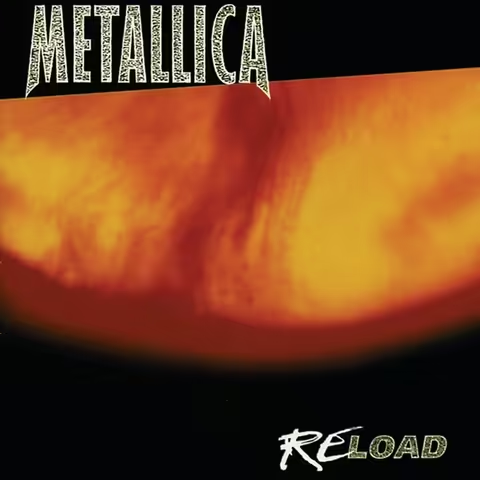
The cover artwork was created by the New York artist Andres Serrano, the same artist who had produced Load's cover image Semen and Blood III. The Reload image, titled Piss and Blood, was created in 1996 by mixing cow's blood and the artist's own urine and photographing the resulting swirl, then printing the photograph at high resolution to resemble a painting. The two Metallica covers belong to Serrano's Bodily Fluids series, which the artist later described to Metal Hammer as "photographs intended to look like paintings, using milk, blood, piss and semen". The pair-piece relationship of Semen and Blood III with Piss and Blood was explicit. Hetfield, in 1997:
"They belong together. The artwork had to match."
James Hetfield, Guitar World, 1997
Hetfield's enthusiasm did not extend to the work itself. In a 2009 interview he described Serrano's pieces as art made "for the sake of shocking others". Hammett and Ulrich, by contrast, were committed Serrano admirers. Ulrich named both Load and Reload as his favourite Metallica album covers in a 2018 Revolver interview, twenty-one years after the fact. The new Metallica logo introduced on Load and continued on Reload, designed by Andie Airfix to simplify and modernise the original 1980s wordmark, completed the visual reset. The author Mick Wall described the new logo as moving the band's branding from "metal to alternative" in a single design decision.
Anton Corbijn provided the band photography for the gatefold and inner sleeve, continuing the high-contrast monochrome portraiture he had introduced on Load. The combination of Serrano cover, Airfix typography and Corbijn portraiture made Load and Reload the most visually unified pair of records in the Metallica catalogue.
Release and Reception
Reload was released on 18 November 1997 in the US and (reportedly) 17 November in the UK. It debuted at number one on the US Billboard 200 with first-week sales of 436,000 and stayed on the chart for 75 weeks. It topped the charts in Austria, Finland, Germany, New Zealand, Norway and Sweden; reached number two in Australia, Canada, Denmark and Hungary; number three in France, the Netherlands and Switzerland; number four in the UK and Flanders; and number five in Ireland and Spain. The album was a commercial unqualified success, selling more than 8 million copies worldwide and reaching 4.48 million in the US by 2025, when the RIAA upgraded its certification to four-times platinum.
Contemporary reviews were mixed to favourable. Billboard's Paul Verna described Reload as "darker, more immediate, and more rough-edged than its predecessor" and predicted that the band's exploration of "hard-edged modern rock" would "bode well for long-term success". USA Today's Edna Gundersen wrote that the songs "stack up against Load's mother lode of rock riches". Rolling Stone's Lorraine Ali called it not Metallica's best but named it and Load as stepping stones in the band's legacy. Musician magazine felt the album "captures one of rock's greatest bands at its peak". Uncut's Neil Kulkarni called it one of the best metal albums of the 1990s, arguing it was on par with the Black Album. Marc Weingarten in the Los Angeles Times said Reload was "strong enough to make you forgive the band its past concessions to mass tastes".
The negative reviews focused on the same complaint that would dog the album in retrospect: that it was Load's leftovers presented as a new statement. Greg Kot in the Chicago Tribune argued that Load and Reload could have been combined into one "great" album rather than presented as "two solid but flawed ones". James Muretich in the Calgary Herald compared the band to ZZ Top, "the increasingly weary purveyors of recycled riffs". Gary Blockus in The Morning Call described Reload as the first Metallica album "with nothing remarkable or magic". Several critics dismissed "The Unforgiven II" outright as an unnecessary sequel. AllMusic's Stephen Thomas Erlewine summed up the consensus most concisely:
"Multiple filler tracks prevent Reload from being a 'full success', although certain songs, such as 'Fixxxer', successfully push the outer edges of Metallica's sound and make the record worthwhile."
Stephen Thomas Erlewine, AllMusic
The lasting critical verdict has been harsher. Mick Wall, in his 2012 biography Enter Night, called Reload "the nadir of Metallica's recording career". Joel McIver, in 2004's Justice for All: The Truth About Metallica, called the album "pure mediocrity" and worse than Load. Retrospective rankings consistently place the record in the bottom half of the Metallica catalogue, typically alongside St. Anger and Lulu. Metal Hammer nevertheless included it in their 2020 list of the top 10 albums of 1997, an outlier defence among the major surveys.
Singles and Music Videos
| Single | Release | Director / location | Chart peaks |
|---|---|---|---|
| "The Memory Remains" (feat. Marianne Faithfull) | 10 November 1997 | Paul Andresen; Van Nuys Airport, Los Angeles, October 1997; budget over $400,000 | US Hot 100 No. 28; US Mainstream Rock No. 3; UK No. 13 |
| "The Unforgiven II" | 23 February 1998 | Matt Mahurin (director of original "The Unforgiven" video); Los Angeles, December 1997 | US Hot 100 No. 59; US Mainstream Rock No. 2; UK No. 15 |
| "Fuel" | 22 June 1998 | Wayne Isham; Tokyo, May 1998 | US Mainstream Rock No. 6; UK No. 31 |
| "Better than You" | July 1998 (US promotional) | No commercial video | Won 1999 Grammy for Best Metal Performance |
The "Memory Remains" video, with the band on a suspended platform surrounded by a rotating structure that gave the impression of anti-gravity, was Metallica's biggest commercial video since "Enter Sandman" and remains one of the most-played heavy rock videos of the late 1990s. The "Unforgiven II" video, Matt Mahurin's return to the franchise four years after directing the original, featured a young man whose hand becomes stuck in a wall and who is eventually freed; it was filmed in Los Angeles in December 1997 and aired throughout early 1998. The "Fuel" video was Wayne Isham's contribution to the band's catalogue and was shot in Tokyo in May 1998, a year after the album's main promotional cycle had wound down.
Touring and Live
The Poor Re-Touring Me tour ran from April 1998 through to September 1998, picking up directly from where the Poor Touring Me tour had finished. Key dates:
- April to May 1998: Australia, New Zealand, Korea and Japan
- 11 June 1998: Hetfield's daughter Cali Tee Hetfield born during the US leg
- June to September 1998: US leg, mostly arenas, with support acts including Days of the New and Jerry Cantrell
- 5 August 1998: Ulrich's son Myles born
- Late 1998: the day after the tour ended, the band began recording Garage Inc.
The promotional run for Reload preceded the tour proper. The band performed at three European festivals in August 1997 ahead of release. On 11 November 1997, they played a free concert in Philadelphia ahead of release week, featuring a mix of old and new songs including "The Memory Remains" and "Fuel". Two days later they played another free show at the Ministry of Sound nightclub in London. In December 1997 they performed with Marianne Faithfull on NBC's Saturday Night Live, on the BBC's Top of the Pops and at the Billboard Music Awards. The Bridge School Benefit acoustic sets on 18 and 19 October 1997 included the live debut of "Low Man's Lyric".
The post-tour activity in late 1998 set the band up for the most successful late-period 1990s run of their career. Garage Inc., the cover-album double released on 24 November 1998 with the original Metallica logo restored on the sleeve, debuted at number two on the Billboard 200. Mick Wall has argued that Garage Inc. was released in part to combat bootlegs and in part to reestablish credibility within the metal community after the Load and Reload pivot. The Anton Corbijn band photograph on the front cover, with the four members in casual dress and the original logo above, was a deliberate visual reset.
Metallica then performed at Woodstock '99 in Rome, New York on 24 July 1999 (a chaotic event with the festival's most-discussed weekend in rock history), and recorded the S&M live album with the San Francisco Symphony in April 1999 for November 1999 release. By the end of the decade Reload had been folded into a catalogue arc that ended in the Napster lawsuit of 2000, Newsted's January 2001 departure and the four-year St. Anger gestation that followed.
Grammy and Awards
"Better than You" won the Grammy for Best Metal Performance at the 41st Annual Grammy Awards on 24 February 1999. It was Metallica's fifth metal Grammy in nine years, after "One" (1990), "Stone Cold Crazy" (1991), the Black Album (1992) and "Better than You"'s predecessor in the category. "Fuel" was nominated in the same category and lost to its album-mate, giving the band the unusual distinction of competing against themselves in the same year. The Grammy was the album's only major industry award.
In TV, Film and Media
"Fuel" became the album's most enduring cultural placement. It was used as the theme song for NASCAR on NBC's coverage from 2001 to 2006, on ESPN's monster-truck and motorsport coverage, in commercials, in The Fast and the Furious franchise (briefly in the 2001 first film), in the video game Crazy Taxi 3, and as the opening music for countless sports broadcasts in the 2000s and 2010s. "Fuel" appeared on Guitar Hero: Metallica in 2009 and on the band's own apps and rhythm games subsequently. "The Memory Remains" remained a fixture of late-1990s alternative-rock retrospective compilations and 1990s-music documentary soundtracks. "The Unforgiven II" became a karaoke and cover-band staple in continental Europe, where the original "The Unforgiven" had been the band's most-streamed pre-2000 song.
Controversy, Censorship and Legal
Reload itself drew no significant legal controversy at release. The album cover art prompted some complaint in retail chains, particularly in conservative US states where shelf-fronts of Andres Serrano work prompted occasional store-level decisions to display the album face-in or to refuse stock entirely. No major chain pulled the album. Andres Serrano's earlier Piss Christ (1987) had been the subject of US Congressional debate in 1989 around the National Endowment for the Arts; by 1997 the artist was an established figure in the New York art world and the Metallica covers caused less commercial friction than might have been expected from a 1989 perspective.
The Napster controversy that erupted in 2000 sits adjacent to Reload's history but is properly the next album cycle's story. "I Disappear", the song that triggered the Metallica v. Napster, Inc. lawsuit, was a 2000 recording made for the Mission: Impossible 2 soundtrack and is not a Reload track. Newsted's January 2001 departure from the band, citing "private and personal reasons", was years in the making and substantially predated Reload's recording but became public in the post-Reload window.
Covers, Samples and Tributes
Reload has produced fewer covers than the Black Album or ...And Justice for All, partly because the album's songs are tightly arranged around Hetfield's specific vocal register and Hammett's pedalboard. The most covered song on the record is "Fuel", which has been performed by countless tribute bands and rendered in symphonic-metal, country and bluegrass arrangements over the years. "The Memory Remains" has been performed live by Marianne Faithfull herself in occasional retrospective set list slots since the 2000s. "Low Man's Lyric" was covered by Norah Jones in a 2018 charity benefit performance and by several country and folk artists subsequently.
The album's structural influence on later metal records has been moderate. The expanded role of dual rhythm guitar pioneered by Hetfield and Hammett on Reload became standard for the next decade of Metallica records and was widely adopted across the post-1997 metal landscape. The use of guest vocalists on metal records, almost unheard of in 1997 outside specific power-metal and progressive contexts, became significantly more common after Reload demonstrated that a Marianne Faithfull cameo could co-exist with a heavy track without diminishing either. The genre-bending of "Low Man's Lyric" presaged the country-leaning work of Death Magnetic-era Metallica and arguably the Hardwired... to Self-Destruct deluxe-edition tracks.
Reissues, Remasters and Anniversaries
Reload was repressed in standard form throughout the 2000s and 2010s on the band's own Blackened Recordings imprint after the catalogue revert from Warner/Elektra in 2012. The first major reissue is the super-deluxe box set scheduled for 26 June 2026, the album's 29th-anniversary edition (deliberately not pegged to a round number to align with the band's broader 2026 reissue cycle). The box contains 15 CDs and four DVDs, including:
- A new 2026 remaster of the original album by Reuben Cohen
- Live recordings from the Poor Re-Touring Me tour and selected 1998 venues
- Rough mixes from the 1995-to-1996 and 1997 sessions, including bass-forward versions some critics have predicted will reveal more of Newsted's parts than the original mix
- Demo recordings of Reload tracks, including early Hetfield/Ulrich pre-production work
- The DJ Spooky "For Whom the Bell Tolls (The Irony of It All)" remix and adjacent 1997-era material
- A hardcover book, posters and other memorabilia
Rolling Stone's Kory Grow and Consequence's Langdon Hickman both announced the box on 28 April 2026 alongside the band's own metallica.com release. The 2026 box completes a remaster cycle that began with the ...And Justice for All 30th-anniversary edition in 2018 and ran through Master of Puppets and the Black Album editions.
Legacy and Influence
The Reload legacy splits along band-internal and external lines. Externally, the album is the second-half partner of Load in the longest-running fan debate in the Metallica catalogue: were Load and Reload a brave reinvention that earned the band another two decades of commercial relevance, or a misstep that diluted the catalogue and alienated the band's original constituency? Both readings have substantial support. The albums kept Metallica visible through the late 1990s grunge-to-nu-metal transition that ended the careers of most of their thrash-metal contemporaries. They also produced a generation of fans whose first Metallica record was Load or Reload, and whose expectations of the band were shaped accordingly.
Internally, the band have become progressively more candid about the Load and Reload period. Hetfield's 2017 comment to Loudwire's Joe DiVita was the most direct admission yet that the period was driven by Ulrich and Hammett rather than by him:
"I felt like I was following the vision of Lars and Kirk on Load and Reload."
James Hetfield, Loudwire, 24 November 2017
In a separate Loudwire interview the year before, Hetfield speculated that Cliff Burton, had he lived, would likely have "shown resistance" to the direction the band took on the two albums. He has also said the large number of songs released across the pair "diluted the potency of the poison of Metallica". Ulrich, while defending the music, agreed by 2003 that the two albums could have been condensed into one but said they had "lacked an edit button on our instrument panel" at the time. Hetfield ultimately stopped short of regret:
"It felt like the right thing to do at the time."
James Hetfield, Loudwire, 24 November 2017
The album's place in the Metallica catalogue has stabilised at the lower end of the rankings. Loudwire's 2023 ranking placed it 11th of 11 Metallica studio albums. Metal Hammer's 2024 ranking placed it 9th of 11. Spin's 2023 ranking placed it 10th. Ultimate Classic Rock's 2023 ranking placed it 9th. The album that opens with "Fuel", closes with "Fixxxer" and carries a Grammy-winning track in between is, by collective critical consensus three decades later, the second-weakest record the band has ever made (with only St. Anger reliably ranked lower). The 2026 box-set reissue may not change that consensus, but it will give the album its first proper archival treatment and an opportunity for a new generation of listeners to encounter the music separately from the band's own subsequent disclaimers.
Things You Might Not Know
| Fact | Detail |
|---|---|
| The 30-song double | Metallica wrote close to 30 songs across the 1995 to 1996 sessions and originally intended a double album, before realising the volume of work was impossible to finish in one cycle. The 13 strongest songs went to Load; the remaining 13 became Reload 17 months later. |
| The three-room finish | The 1997 finishing sessions at The Plant ran in three rooms simultaneously to meet the November release deadline: Hetfield tracking vocals and guitar overdubs in one, Newsted overdubbing bass in another, Ulrich tweaking drum parts in a third. |
| The Marianne Faithfull session | Faithfull recorded her vocal for "The Memory Remains" at Windmill Lane Studios in Dublin on 9 October 1996, during a Load tour stop. Reports from the time describe her as intoxicated during the take. The band considered Carly Simon, Patti Smith and Joni Mitchell before settling on her. |
| The Hammett rhythm-guitar debut | Reload was the first Metallica album on which Kirk Hammett played rhythm guitar, a role Hetfield had played exclusively on every previous record. The change was suggested by Ulrich and adopted for a "looser sound". |
| The B-Bender Unforgiven | "The Unforgiven II" came out of Hetfield playing the original "Unforgiven" riff on a newly purchased Fender Telecaster fitted with a B-Bender. The new guitar made the riff sound enough like a different song that the band decided to lean into the resemblance. |
| The hurdy-gurdy man | The hurdy-gurdy on "Low Man's Lyric" was played by David Miles, recommended to Hetfield by Faith No More's Jim Martin. Assistant engineer Bernardo Bigalli added violin to the same track. |
| The Sendak homage | "Where the Wild Things Are" is named for Maurice Sendak's 1963 children's picture book. It is the only song on the album to carry a Newsted co-writing credit. |
| The Nick Cave connection | "Bad Seed" alludes in its title to Nick Cave and the Bad Seeds, the band Hetfield was most consistently citing as a lyrical inspiration throughout the Reload period. |
| The Piss and Blood cover | Andres Serrano's Reload cover, titled Piss and Blood, was created by mixing cow's blood with the artist's own urine, photographing the swirl and printing it to look like a painting. It is the companion to Load's Semen and Blood III in Serrano's Bodily Fluids series. |
| The Hetfield-disliked cover | Hetfield publicly disliked both the Load and Reload covers, calling Serrano's work in 2009 art made "for the sake of shocking others". Ulrich, in 2018, named both covers as his favourite Metallica artwork. |
| The Bridge School debut | "Low Man's Lyric" debuted live at the Bridge School Benefit at the Shoreline Amphitheatre on 19 October 1997, an acoustic-only event Neil Young's wife Pegi organised annually. Metallica played two acoustic sets that weekend. |
| The $400,000 video | Paul Andresen's anti-gravity "The Memory Remains" video, shot at Van Nuys Airport in October 1997, cost more than $400,000 and featured a rotating set rather than rotating cameras. |
| The last Hot 100 top 40 single until 2008 | "The Memory Remains" reached number 28 on the Billboard Hot 100, the last Metallica single to break the top 40 until "The Day That Never Comes" eleven years later. |
| The Better than You Grammy | "Better than You" was a US-only promotional single but won the 1999 Grammy for Best Metal Performance, beating "Fuel" from the same album. It was Metallica's fifth metal Grammy in nine years. |
| The DJ Spooky remix | The 1997 DJ Spooky remix of "For Whom the Bell Tolls", titled "For Whom the Bell Tolls (The Irony of It All)", was released on the Spawn film soundtrack on 29 July 1997 and is the only authorised electronic remix of a 1980s Metallica track ever commercially released. |
| Newsted's last record | Reload was Jason Newsted's final Metallica studio album. He left the band in January 2001 after years of escalating conflict, particularly over his side project Echobrain, which Hetfield had explicitly forbidden him from releasing commercially. |
Riffology Podcast
If this is the kind of deep dive you enjoy, the Riffology podcast covers an album of this stripe most weeks, with the same level of session detail, contemporary review excavation and "wait, who played on what" trivia. The show is available on Apple Podcasts, Spotify, Amazon Music, Pocket Casts and every other major podcast platform. New episodes drop weekly.
Comments