The single most-anticipated nu-metal album of 1996 was written in roughly six weeks by a band that, by their own subsequent admission, were drinking and using so heavily that the producer's principal job was getting them upright in front of a microphone. Bakersfield's Korn had spent the previous fourteen months playing somewhere between 200 and 250 shows in support of their 1994 self-titled debut, watched that record claw its way up to gold certification through pure word of mouth, and then walked back into Indigo Ranch Studios in Malibu in April 1996 with almost nothing written and a record-company deadline that did not care.
What came out the other side, on 15 October 1996, was Life Is Peachy. A record named after a high-school stationery folder, with cover art the band failed to license, a song titled after a sportswear brand the band could not get a deal with, three UK singles, a Kerrang! Award for Best Album, a Grammy nomination, double-platinum certification in the United States and a tour that ended with the guitarist in hospital. The making of it is the story of a band catching the slipstream of their own debut and trying not to fall off.
Album Facts
| Field | Detail |
|---|---|
| Artist | Korn |
| Album | Life Is Peachy |
| Release Date | 15 October 1996 |
| Label | Immortal Records, in association with Epic (Sony Music) |
| Producer | Ross Robinson, with the band as co-producers |
| Studio | Indigo Ranch Studios, Malibu, California |
| Genre | Nu metal, alternative metal, with hip-hop and funk-metal underpinnings |
| Track Count | 14, with one hidden a cappella reprise of "Twist" tucked after "Kill You" |
| Total Runtime | 48 minutes 14 seconds |
| Billboard 200 Peak | 3 |
| UK Albums Chart Peak | 32 |
| Other Notable Chart Peaks | New Zealand 1, Australia 26, Austria 21, Norway 24, Sweden 36, Canada 32 |
| Certifications | 2 times platinum (RIAA, November 1999); platinum (ARIA); gold (BPI, Music Canada, RMNZ) |
| Estimated Sales | Approximately three million copies worldwide by 2009 |
| Key Singles | "No Place to Hide", "A.D.I.D.A.S.", "Good God" |
Cultural Context: The Underground Surfacing in 1996
The autumn of 1996 was the moment when the music press began noticing that something was happening at the harder end of American alternative rock. Sepultura had put out Roots in February. Tool's Aenima arrived on 17 September. Metallica had taken Korn out on the second leg of their Load tour in late 1996 after a chance hearing in a tour bus. Marilyn Manson's Antichrist Superstar landed exactly the same week as Life Is Peachy and would chart at number three on the Billboard 200 too, a fact that gave both bands a useful enemy in the next year of magazine column inches.
What did not yet exist was a name for the thing Korn were doing. The phrase "nu metal" would not appear in print, at least according to most surviving accounts, until Simon Reynolds used it in Spin in 1999. Throughout the Life Is Peachy promotional cycle, journalists reached for hyphenated paraphrases instead. Entertainment Weekly called it a "fusion of heavy riffs and tight hip-hop beats". The New York Times said Korn "applies hip-hop's noise aesthetics to a hard-rock lineup". The French press preferred "metal's mutants". The classification problem was a feature, not a bug, of the moment, and Life Is Peachy is the record that made the classification an industry necessity.
The Band's Story to This Point
Korn's debut self-titled album had been released through the new Immortal Records imprint on 11 October 1994. It crept rather than charged into the public consciousness. By September 1995 it had reached number one on the Billboard Heatseekers chart, the dedicated chart for new acts who had yet to crack the Billboard 200 proper. It would not crack the 200 itself until February 1996, peaking at number 72, and the RIAA gold certification finally arrived on 29 January 1996.
The driver was touring. A direct support slot on Ozzy Osbourne's US arena run with Deftones in February 1996, club headlines in the UK and Europe through the spring, festival appearances in mainland Europe and a steady upward drip of late-night MTV plays for "Blind" produced the kind of grass-roots momentum that record labels paid lip service to and rarely got to see in person. Epic's Al Masocco told Billboard in September 1996, with audible relief, that the campaign for the debut had been "completely grass-roots".
By the time the band had to come off the road to write album two, they were exhausted, addicted and rich for the first time in their lives. Jonathan Davis had been collecting source material for lyrics, but the band as a whole, as Brian "Head" Welch later put it in his autobiography, were "in a serious state of disarray".
Pre-production and Demos
Korn took a single month off the road in early 1996 and then booked their rehearsal space, Underground Chicken Sound in Huntington Beach, for pre-production. Two songs were written there before they decamped to Malibu: "No Place to Hide" and "A.D.I.D.A.S.". Davis had begun writing "Mr. Rogers" while on tour in the autumn of 1995. Everything else, by the band's own account, was generated in the studio in real time.
"Right after we got done touring with Ozzy Osbourne, Ross hooked up with us. We went into a rehearsal studio and started writing. The pattern that followed would be faster and thrashier."
Jonathan Davis, Artistdirect interview, 2011
The compositional method, as drummer David Silveria described it to Modern Drummer in early 1997, was anti-method. "Somebody will start playing something and the rest of us will work around it and see where it goes," he said, naming "Twist" and "Good God" as songs whose drum beats had come first. Munky Shaffer summarised the pre-production phase, with characteristic Korn elegance, as "two years of blue balls of creativity".
Songs were referred to internally by working titles such as "Dick Nose" until Davis got to the lyrics, which he wrote, almost without exception, alone in a small isolated rehearsal space he called the Magic Room in Los Angeles. The Pee Chee folder that would give the album its title sat on Fieldy's desk through this period, doodled on, never explicitly proposed as a cover idea but quietly waiting.
Creating the Album: Indigo Ranch, April to July 1996
Indigo Ranch sat at the top of a hill above Malibu, a converted ranch building running an all-analog, all-tube signal chain under the proprietorship of co-founder Richard Kaplan. Korn had recorded their debut there in May 1994. Returning to the same studio with the same producer was, as Fieldy told the press at the time, an attempt to bottle the energy of the first album rather than reinvent it. The bassist's words were: "We wanted that same energy and inspiration we found up in the Malibu Hills."
The sessions ran from April through July 1996. The album cost approximately 150,000 US dollars to make, ten times the budget of the debut and still cheap by major-label standards. Robinson, who had spent the eighteen months between Korn's first and second records establishing himself as the in-demand producer of the new heavy underground (he had just completed Sepultura's Roots and would shortly produce Limp Bizkit's Three Dollar Bill, Yall), set the technical brief himself. Chuck Johnson, Kaplan's assistant, was hired to be the house engineer for the duration. Kaplan ended up mixing most of the album himself, as Johnson was, by Kaplan's later account, frequently unreliable at the desk; Robinson eventually mixed "K@#Ø%!" personally.
Fieldy's bass setup for the entire album was a single Ibanez SR1305 Soundgear five-string run through one Mesa/Boogie head and a single 4x10 cabinet with the horn miked. The direct signal was turned all the way off. The percussive, click-heavy bass tone that came to define Korn's first decade, the sound that often reads on record as a kick drum rather than a bass, was already locked in by the time the band reached Malibu.
"It was a real challenge because we drank so much. We were so out of it. Half the time, Head couldn't even play his guitar. He'd pass out on the floor. Ross had to be the babysitter who got us to sit up and focus."
Jonathan Davis to Jon Wiederhorn, Loudwire retrospective, 2022
Robinson's working method, refined on the first Korn album, was to provoke the band into the take he wanted rather than rehearse it out of them. Vocal sessions in the isolation booth saw him drag Davis back into the emotional context of the lyric by talking him through it, or, when talking failed, by physical force. Between sixty and seventy percent of Davis's vocal takes on the record were the first take. Korn launched a partnership with QuickTime called Korn Mangling the Web that streamed studio footage to fans in real time, one of the earliest serious uses of webcasting by a major-label rock band, and crashed Sony's servers when a preview of the album went up.
- Recording medium: analog tape throughout, mixed at Indigo Ranch on the in-house console.
- Mastering: Eddy Schreyer at Oasis Mastering Studio City.
- Guest engineering: Rob Agnello and Jamie Leavitt assisted.
- One song, "Proud", was completed during the sessions but cut from the final tracklist. It would later appear on the I Know What You Did Last Summer soundtrack in 1997.
- The 15th song would have brought the album to a more conventional 14-track album shape; the band preferred the asymmetry.
Welch later said in his 2008 autobiography that he did not love the artistic direction of his own subsequent records but that he had no such complaint about Life Is Peachy. Davis, ranking Korn's catalogue for Vice in 2015, called it "a killer record" but pointed to its rushed production as the reason it was not among his favourites. "But yeah," he added, "very rushed, very raw, it's still a cool-ass record."
Personnel and Credits
| Role | Player | Notes |
|---|---|---|
| Core band | ||
| Vocals, bagpipes | Jonathan Davis | Additional guitars on "Kill You" and "Mr. Rogers" |
| Guitar | Brian "Head" Welch | Lead vocal on "Lowrider" as a birthday present from the band |
| Guitar | James "Munky" Shaffer | Seven-string Ibanez throughout |
| Bass | Reginald "Fieldy" Arvizu | Ibanez SR1305 Soundgear five-string; came up with the album title |
| Drums | David Silveria | Roland TR-808 trigger integrated into kick drum for the live shows that followed |
| Guest and additional musicians | ||
| Lead vocals on "Wicked" | Chino Moreno | Deftones frontman, taking the Ice Cube rap part on the cover version |
| Additional vocals on "A.D.I.D.A.S." | Nathan Davis | Jonathan Davis's young son, then aged around two |
| Additional guest appearance on "Swallow" | Sugar and Earl | Credited in the sleeve, otherwise mysterious |
| Cowbell on "Lowrider" | Chuck Johnson | The engineer credited as a player for the only time on the record |
| Production and engineering | ||
| Producer, engineer, mixing | Ross Robinson | His second Korn album in eighteen months |
| Engineer, mixing | Chuck Johnson | Indigo Ranch's house engineer for the session |
| Mixing, additional engineering | Richard Kaplan | Indigo Ranch owner; mixed most of the record after Johnson went absent |
| Assistants | Rob Agnello, Jamie Leavitt | Tracking assistants |
| Mastering | Eddy Schreyer | Oasis Mastering, Studio City |
| Artwork | ||
| Cover photography | Martin Riedl | The boy-in-the-mirror image |
| Booklet photography | Stephen Stickler | Band portraits |
| Design and concept | Scott Leberecht | Including the back-cover Cyrillic R in the band logo |
Two footnotes in the credits are worth pulling out. Welch's lead vocal on "Lowrider" was a 26th birthday present from the rest of the band, agreed during the sessions; it remains his only lead vocal on a Korn studio recording. Chino Moreno's appearance on "Wicked" cemented a friendship between the two California bands that had begun on the Ozzy support tour and would continue through Korn's later cover of Deftones' "Engine No. 9" in live sets toward the end of the Life Is Peachy Tour.
The Songs
| # | Title | Writer(s) | Length | Single? | Notes |
|---|---|---|---|---|---|
| 1 | Twist | Korn | 0:49 | Improvised scat, the word "twist" the only intelligible lyric | |
| 2 | Chi | Korn | 3:54 | Named after Deftones bassist Chi Cheng | |
| 3 | Lost | Korn | 2:55 | About Davis losing a close friend to a relationship | |
| 4 | Swallow | Korn | 3:38 | Drug-induced paranoia; features Sugar and Earl | |
| 5 | Porno Creep | Korn | 2:01 | Jazz-funk instrumental | |
| 6 | Good God | Korn | 3:20 | Yes (1997) | UK 25; the album's critical and emotional pinnacle |
| 7 | Mr. Rogers | Korn | 5:10 | About children's-TV presenter Fred Rogers | |
| 8 | K@#Ø%! ("Kunts!") | Korn | 3:02 | Censored title on most pressings | |
| 9 | No Place to Hide | Korn | 3:31 | Yes (1996) | Grammy nomination, Best Metal Performance, 1998 |
| 10 | Wicked | O'Shea Jackson | 3:58 | Ice Cube cover, feat. Chino Moreno of Deftones | |
| 11 | A.D.I.D.A.S. | Korn | 2:32 | Yes (1997) | UK 22, US Bubbling Under 13, Australia 45 |
| 12 | Lowrider | War (Allen et al, Goldstein) | 0:58 | War cover, lead vocal by Brian Welch | |
| 13 | Ass Itch | Korn | 3:39 | About Davis's difficulty with songwriting | |
| 14 | Kill You | Korn | 8:37 | Closes the record proper at 5:04, then 2:30 of silence and a hidden a cappella reprise of "Twist" |
"Twist" is the band's deliberate decision not to give the album a single. Forty-nine seconds of guttural improvised scat singing, with the word "twist" as the sole intelligible word in the lyric, Davis recorded it in a single take. Kerrang! reviewer Mörat heard the underlying message clearly: the much-anticipated second album opens not with a hook but with a "great big 'Fuck you'" to radio.
"Chi" is a tribute to Deftones bassist Chi Cheng, who loved reggae and, according to Davis, mistakenly thought "Chi" was actually a reggae song when he first heard it. (Davis would later say the song's lyrics remained "a mystery" even to him.) "Good God" is the album's most-discussed track, an account of a parasitic school friend who, in Davis's words, "came into my life with nothing, hung out at my house, lived off me, and made me do shit I didn't really wanna do". Kerrang!'s Ashley Bird, reassessing the album in 2002, named "Good God" the "pinnacle" of Life Is Peachy and said "never has a metal mantra been delivered with more tortured passion".
"Mr. Rogers" is Davis's bitter open letter to the late children's-TV presenter Fred Rogers, the man whose gentle on-air persona, Davis felt, had taught him to trust adults too freely as a child. The track's slow build and seven-string Ibanez riff is one of the heaviest things on a record full of heavy things. "K@#Ø%!", titled with a grawlix to allow it onto retailer shelves, is a four-minute torrent of profanity that Shaffer once said the band considered submitting to rock radio stations as a joke. "We knew they wouldn't play it, then follow up about a week later with the real thing."
"No Place to Hide" is the song that ran point on the album's promotion. Released as a single on 14 September 1996, a month ahead of the album, it was serviced first to heavy-metal radio and only later to alternative stations. There was no music video; Davis told MTV the band considered a clip a "waste of time and money" and chose instead to put a live performance of "Good God" on the enhanced CD version of the album. The track was nominated for Best Metal Performance at the 40th Annual Grammy Awards in February 1998 and lost to Tool's "Aenima".
"Wicked" is the Ice Cube cover, with Deftones' Chino Moreno taking the rap part. It is also the song that, on the 1997 tour, Limp Bizkit's Fred Durst would walk on stage to perform when Moreno was unavailable, marking the beginning of the Korn–Limp Bizkit professional relationship that would shape the Family Values Tour the following year.
"A.D.I.D.A.S." stands for "All Day I Dream About Sex" and is the song that built the band's ongoing entanglement with the German sportswear brand. The video, directed by Joseph Kahn in Los Angeles in January 1997, has the band lying on cold metal mortuary slabs, eyes filmed over with dirty blue contact lenses that Arvizu later complained "made us partially blind while they were in". The clip was nominated in the hard-rock category at the 1997 Billboard Music Video Awards. Davis's young son Nathan provides the additional vocals at the end. The song became Korn's first US chart entry of any kind, hitting number 13 on Billboard's Bubbling Under Hot 100 Singles chart in April 1997.
"Lowrider" is the band's 58-second take on the War standard, a piece of comedy relief that gives Welch his one and only Korn lead vocal and Davis a chance to deploy the bagpipes he had played since teenage years in marching pipe bands in Bakersfield. "Kill You" closes the record proper at 5:04, addresses Davis's ex-stepmother in lyrics of extreme directness, then leaves two and a half minutes of silence before an a cappella reprise of "Twist" arrives as a hidden track. Korn's hidden-track habit, established here, would persist through Follow the Leader and Issues.
B-sides, Outtakes and Lost Songs
The Life Is Peachy sessions left more material around than the album could hold, and the singles campaign hoovered most of it up. The 15th song completed at Indigo Ranch and dropped from the running order, "Proud", went on to soundtrack a sequence in I Know What You Did Last Summer in late 1997, with a Dust Brothers remix of the 1994 debut's "Shoots and Ladders" tucked alongside it on B-side service.
- "Proud", recorded at Indigo Ranch, omitted from the final tracklist, used on the I Know What You Did Last Summer soundtrack (1997).
- "Sean Olson", B-side of "No Place to Hide", named for a young Korn fan who died of leukaemia; placed on The Crow: City of Angels soundtrack (1996).
- "Dust Brothers remix of Shoots and Ladders", B-side of "No Place to Hide".
- Remixes of "A.D.I.D.A.S.", "Good God" and "Wicked" across the various CD-single formats.
- Live tracks: "Chi" (US Tour Autumn 1996) on the Life Is Peachy Tour Sampler, distributed in Europe to promote the headlining run.
Album Artwork and Packaging
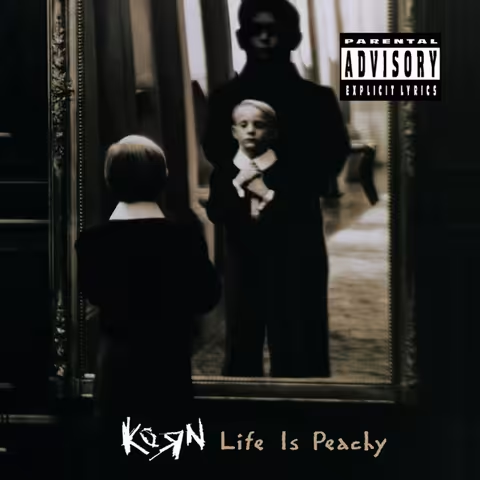
The cover, photographed in black and white by Martin Riedl, shows a small blond boy adjusting his tie in a gilt-framed mirror while the shadow of a much larger figure looms behind him. Designer Scott Leberecht built the concept around it, continuing what writer Doug Small later called Korn's "threatened child" iconography from the first album. Stephen Stickler shot the band portraits inside the booklet, all of which avoid printing any of the album's lyrics, a Korn rule that has held to this day. Davis once told MTV's Serena Altschul that printing lyrics "limits the listener's musical experience".
The album title came, as the band has cheerfully repeated in every interview since, from Fieldy's school stationery folder. He used to scribble the words "Life Is" in front of the Pee Chee folder's logo, found it funny enough that he held onto the joke, and proposed both the title and the folder's actual artwork to the rest of the band as a cover concept. Korn formally approached Mead, the manufacturer of the Pee Chee folder, offering 20,000 US dollars to license the design. Mead refused. The title stayed. The cover did not.
Life Is Peachy is, to date, the only Korn studio album whose sleeve spells the band name with both standard letters; every other album has used the reversed Cyrillic R that became the band's most-identifiable typographic mark.
Release and Reception
Sony's Epic distributed the album worldwide on Tuesday, 15 October 1996. It entered the Billboard 200 at number three, behind only Celine Dion's Falling Into You and Toni Braxton's Secrets, with 106,000 US copies sold in its opening week. It topped the New Zealand chart, reached number 32 in the UK, and charted across Europe. The RIAA certified it gold on 8 January 1997, platinum on 9 December 1997 and double platinum on 10 November 1999.
"Life Is Peachy shows no let-up in the psychotic style, and is safely tipped to establish Korn as the new standard in metal."
Dominic Hilton, Guitarist, November 1996
Reviews split. Kerrang!'s Mörat awarded four out of five stars and praised the "bare emotion" in Davis's voice. Ian Winwood of Metal Hammer matched that score and concluded his review with one word: "Classic." Stephen Thomas Erlewine at AllMusic gave it three stars and called the songwriting a clear improvement on the debut. The New York Times's Jon Pareles ran a favourable notice, with the line that the album's "chip on its shoulder sounds genuine". The dissent was loudest from the American alternative press: Entertainment Weekly's David Grad gave it a C minus and said it "may be of interest to mental-health professionals", and the A.V. Club's Stephen Thompson dismissed it as "ham-fisted, butt-stupid heavy metal".
Retrospective revaluation has been kinder. Q gave it three stars in 2002 and called it "harsher and harder than their groundbreaking debut". Metal Hammer placed it in its Top 20 Best Metal Albums of 1996 list in 2021 and at number 13 on its 50 Best Nu Metal Albums of All Time list in 2022. Rolling Stone included it on its 20 Rock Albums Turning 20 in 2016 retrospective. Alternative Press named it among the best records of 1996 in a 2021 list. Korn's Kerrang! Award for Best Album, picked up in September 1997, was the band's first major industry award. "No Place to Hide" then earned the Grammy nomination for Best Metal Performance at the 40th Awards in February 1998.
Singles and Music Videos
| Single | Release | UK Singles Chart | Australia | Director | Notes |
|---|---|---|---|---|---|
| "No Place to Hide" | 14 September 1996 | 26 | No video | Grammy nomination 1998; live video of "Good God" used in place of a video for the enhanced CD | |
| "A.D.I.D.A.S." | 4 March 1997 | 22 | 45 | Joseph Kahn | US Bubbling Under Hot 100 13; mortuary-slab video shoot in Los Angeles, January 1997 |
| "Good God" | 7 November 1997 | 25 | 81 | (performance footage) | Released after the band had moved on to recording Follow the Leader |
The band's decision not to make a video for "No Place to Hide" had been a deliberate snub at MTV. Davis told Billboard in September 1996 that he wanted Korn to "stay underground" and pointed to the band's "integrity" as the reason. Twelve months later, the calculus had shifted. The Joseph Kahn-directed "A.D.I.D.A.S." video, with its mortuary-slab imagery and frequent MTV rotation, was the moment the band stopped pretending they did not want a music-television career. By the time the campaign for Follow the Leader began in 1998 they had given up the resistance entirely and made a weekly online TV show called KornTV.
Touring and Live
The Life Is Peachy Tour began before the album was on the shelves. Korn headlined the second stage of the UK Monsters of Rock festival at Donington on 17 August 1996, with MTV's Vanessa Warwick interviewing them for Headbangers Ball backstage. The North American leg launched in October 1996 with Limp Bizkit as opener, a slot they had been given on the strength of the Three Dollar Bill, Yall sessions Ross Robinson had just produced.
In mid-December 1996, the band joined Metallica's Load tour in the United States as direct support, an arena-scale promotion that exposed Life Is Peachy to thirty-thousand-seater crowds for the first time. Korn's own UK and European headline tour kicked off in Germany on 21 January 1997 with Incubus and the Urge supporting, ran through Denmark, France, Italy, the Netherlands, Norway, Spain and Sweden and closed at London's LA2 on 24 February. Davis appeared on Canal+'s prime-time Nulle Part Ailleurs in Paris on 20 February performing "No Place to Hide" live.
"Aggressive. And there, right away, exhausted."
Munky Shaffer to Katia Kulawick, Rock Sound, January 1997, asked about the band's mental state during the Life Is Peachy Tour
The Davis-in-purple-sequined-Adidas-tracksuit period is captured in countless 1997 photographs from this run. Stage lighting was vertical, pink and purple, occasionally green; the pit at most shows was full of fans copying Welch's hairstyle. Set lengths were 70 to 75 minutes, no encores. The 24 January 1997 show at Glasgow's Barrowland Ballroom earned a five-out-of-five live review from Kerrang!'s Clare Dowse.
The 1997 North American leg with Helmet and Limp Bizkit supporting ran from 6 March in Mesa, Arizona to 27 March in Maine. An Australian tour in May 1997 followed, including a guest-programming slot on Sydney music show Rage where the band aired videos by Ice Cube, Faith No More, Filter, Red Hot Chili Peppers, Cypress Hill and the D.O.C.
Then came Lollapalooza. The 1997 line-up, co-headlined by Jane's Addiction, the Prodigy, Snoop Dogg, Tool, Tricky and Korn, was Perry Farrell's attempted return to a more underground bill after the previous year's Metallica-led edition that he had publicly disowned. Korn began the run on 25 June 1997. On 18 July, at Cleveland's Blossom Music Center, Munky was diagnosed with viral meningitis. Davis released a statement the next day cancelling the remainder of Korn's Lollapalooza appearances and noting that "there is no suitable replacement for Munky during his recuperation". That show was the last of the Life Is Peachy Tour.
In TV, Film and Media
- The omitted Indigo Ranch session track "Proud" soundtracked I Know What You Did Last Summer (1997).
- "Sean Olson" appeared on The Crow: City of Angels soundtrack (1996), released a month before Life Is Peachy.
- Korn appeared in Korn's biographical video Who Then Now? in 1997, with extensive Life Is Peachy session footage shot by Danny "Ham Cam" Hamilton.
- The Korn Mangling the Web QuickTime webcast partnership during the sessions was one of the earliest meaningful uses of streamed video by a US rock band.
- Davis's purple sequined Adidas tracksuit became, in the wake of "A.D.I.D.A.S.", the photograph of the band that ran in most 1997 magazine features.
Controversy, Censorship and Lawsuits
Life Is Peachy generated less courtroom drama than Korn's later work but enough press friction to keep them visible. The "Kunts!" track had to be retitled with a grawlix on most printings of the CD sleeve, including the US Sony pressings. Some Christian conservative US retail chains refused to stock the album at all. Mead's refusal to license the Pee Chee folder design forced the late commission of Riedl's substitute cover photograph. The Adidas relationship, which the song "A.D.I.D.A.S." was widely assumed to be a marketing tie-in for, was not in fact a sponsorship arrangement; Adidas turned down a 1998 partnership offer with the band, telling them in a much-quoted line, "We do sports, not music." Puma stepped in with a 500,000 US dollar deal instead. Adidas Originals would eventually launch a full Korn x Life Is Peachy capsule collection in October 2023.
Covers, Samples and Tributes
The album contains two cover versions of its own: "Wicked", from Ice Cube's 1992 Lethal Injection album, and a 58-second take on War's 1975 hit "Lowrider". Davis's bagpipes on "Lowrider" sit on top of the original arrangement rather than reinterpreting it. "Good God" has been cited by a generation of post-Korn vocalists as a foundational moment for the strangled, half-spoken vocal style that defined late-90s heavy music; in Kerrang!'s 2002 reappraisal, Ashley Bird wrote that "legions of down-tuned wannabes ripped off this singing style" but that none ever matched Davis's "tortured passion".
Younger bands who have cited Life Is Peachy specifically include Sleep Token, Code Orange and the Spanish nu-metal revivalists Vukovi. Slipknot's Joey Jordison spoke at length about how the Korn debut and Life Is Peachy shaped his approach to drum-kit micing on the 1999 Slipknot debut.
Reissues, Remasters and Anniversaries
Life Is Peachy has not been the subject of an anniversary super-deluxe edition in the manner of Follow the Leader's 20th anniversary remaster. A standard 25th anniversary vinyl reissue arrived in 2021 through Music On Vinyl. Sony/Legacy's various greatest-hits compilations have hoovered up the singles as a matter of routine. The most substantial archival project of the period has been the 2023 Korn x Adidas Originals capsule, which included reissued merchandise tied to "A.D.I.D.A.S." and the original Davis tracksuit silhouette, alongside a limited Life Is Peachy picture-disc edition shipped through Adidas retail channels.
Legacy and Influence
Life Is Peachy did exactly what the second album of a hyped underground band needed to do in 1996. It converted a grass-roots fanbase into platinum sales. It cemented a producer (Robinson), a studio (Indigo Ranch) and a sonic template (Fieldy's clicky bass under Munky and Head's de-tuned seven-string riffs under Davis's everything-at-once vocal range) that the rest of the nu-metal first wave would borrow wholesale. It set up Follow the Leader, which arrived in August 1998 with Ice Cube, Fred Durst and Cheech Marin guesting, to debut at number one on the Billboard 200 with 268,000 first-week sales and become a five-times-platinum global hit.
"Many have divergent opinions of the album; for some, it was disjointed, and for others, it was regarded as the finest hour of the band. In Faith No More terms, this was Angel Dust. In Nirvana terms it was In Utero. In anyone's terms, it's one hell of a ride."
Ashley Bird, Kerrang! Legends: Korn, 2002
The Korn–Adidas adoption typified by the song "A.D.I.D.A.S." reshaped what an "alternative" band looked like at the moment of crossover. The Davis tracksuit photographs ran in every music magazine in the western world through 1997. Sportswear became the alt-rock costume of late nu metal, a direct legacy traceable to one song and one tracksuit on one record. Kerrang!'s Sam Law put it cleanly in 2023: "This wasn't just about music, but about what being 'alternative' actually meant."
Things You Might Not Know
| Fact | Detail |
|---|---|
| The Pee Chee origin | Fieldy got the album title from doodling "Life Is" in front of the Pee Chee folder brand name on his school stationery. Korn formally offered Mead 20,000 US dollars for the folder artwork. Mead said no. |
| The Adidas reality | The song "A.D.I.D.A.S." is not, and never was, an Adidas-sponsored campaign. Adidas turned down a 1998 partnership offer; Puma signed Korn for 500,000 US dollars instead. |
| The Pareles line | The New York Times's Jon Pareles said in his November 1996 review that the band was "mad at everybody, including themselves". |
| Head's birthday gift | Brian Welch's lead vocal on "Lowrider" was a birthday present from the rest of the band, and remains his only lead vocal on a Korn studio recording. |
| The fifteenth song | "Proud" was recorded at Indigo Ranch for the album, then cut. It surfaced a year later on the I Know What You Did Last Summer soundtrack. |
| A toddler on the credits | The additional vocals on "A.D.I.D.A.S." are by Nathan Davis, Jonathan's young son, then aged around two. |
| The Chi confusion | "Chi" was named after Deftones bassist Chi Cheng because he loved reggae and somehow thought, when he first heard it, that it actually was a reggae song. |
| The hidden track | "Kill You" ends at 5:04. After two and a half minutes of silence, an a cappella reprise of "Twist" arrives as a hidden track called "Twist A Capella". |
| The webcast that crashed Sony | The Korn Mangling the Web QuickTime partnership streamed Indigo Ranch session footage live. When a preview of the album went up on Sony's website, the server crashed under the traffic. |
| Live tracking, drunk band | Welch later wrote that he passed out on the studio floor multiple times during the sessions. Robinson's main job, Davis has said, was getting the band upright. |
| The Grammy that lost to Tool | "No Place to Hide" was nominated for Best Metal Performance at the 40th Annual Grammy Awards in February 1998. It lost to Tool's "Aenima". |
| The Kerrang Award | Life Is Peachy won Best Album at the 1997 Kerrang! Awards, the band's first major industry award and Korn's only Best Album win at that ceremony. |
| The Cyrillic letter | Life Is Peachy is the only Korn studio album whose sleeve spells the band name with two standard Rs rather than the band's now-trademark reversed Cyrillic Я. |
| One song for a fan | "Sean Olson", a B-side to "No Place to Hide", was named after a young Korn fan who died of leukaemia. |
| The Lollapalooza ending | The Life Is Peachy Tour did not end at a planned final date. It ended on 18 July 1997 at Cleveland's Blossom Music Center when Munky was hospitalised with viral meningitis and the band cancelled the rest of Lollapalooza. |
The Riffology Podcast
If you want to hear a long-form conversation about Life Is Peachy, the Korn Mangling the Web webcast, the Pee Chee folder, the Lollapalooza disaster and the Korn-Adidas relationship that the band never actually had with Adidas, the Riffology podcast covers Korn's second album in proper detail. The show is available on Apple Podcasts, Spotify, Amazon Music, Pocket Casts and every other major platform. Search Riffology, hit subscribe and the new episodes will arrive in your feed automatically.
Comments