Lars Ulrich heard the snare drum on Mötley Crüe's Dr. Feelgood in late 1989 and decided that whoever had recorded it was going to make the next Metallica record. Eighteen months later, after eight months in the studio, three failed marriages inside a four-man band, a budget that crossed one million US dollars and three full remixes of a finished album, Bob Rock handed Metallica back a self-titled fifth record that would sell over thirty million copies and become the first metal album in history to be certified twice Diamond by the RIAA.
That is the short version. The long version is one of the most consequential pivots in heavy music, the moment a Bay Area thrash group decided it had spent the eighties proving how clever it was and would now spend the nineties proving how big a song could be. The Black Album is not the most adventurous Metallica record, and the band would be the first to tell you so. It is the one that took the air out of the room.
Album facts at a glance
| Field | Detail |
|---|---|
| Artist | Metallica |
| Album | Metallica (known as The Black Album) |
| Release date | 12 August 1991 |
| Label | Elektra (US), Vertigo (rest of world) |
| Producers | Bob Rock, with James Hetfield and Lars Ulrich as assistant producers |
| Studios | One on One Recording (North Hollywood); Little Mountain Sound (Vancouver); A&M Studios (Hollywood, overdubs and mixing) |
| Genre | Heavy metal |
| Track count | 12 |
| Total runtime | 62:40 |
| Billboard 200 peak | 1 (four consecutive weeks) |
| UK Albums Chart peak | 1 |
| Other notable chart peaks | 1 in Australia, Canada, Germany, New Zealand, Norway, the Netherlands, Sweden, Switzerland, Finland, Portugal; 2 in Italy and Ireland |
| Certifications | 2× Diamond (RIAA, 2025); Diamond (Canada); 13× Platinum (Australia); 3× Platinum (UK); 4× Platinum (Germany) |
| Estimated sales | Over 30 million copies worldwide; over 20 million in the United States |
| Key singles | Enter Sandman, The Unforgiven, Nothing Else Matters, Wherever I May Roam, Sad but True |
What was happening when the Black Album landed
August 1991 was the last month of a particular kind of rock. Guns N' Roses were finishing both halves of Use Your Illusion for a 17 September release. Nirvana would put Nevermind into stores three days after that. Pearl Jam's Ten arrived on 27 August. Soundgarden's Badmotorfinger was weeks away. Inside the space of eight weeks the entire commercial geometry of hard rock would tilt towards the Pacific Northwest and away from Los Angeles. Metallica beat the lot of them to the shops on 12 August and then refused to leave.
The band were not chasing grunge. They were chasing themselves. ...And Justice for All in 1988 had been a critical and commercial breakthrough at number six on the Billboard 200, but it was an album whose audible flaws, particularly the near-invisible bass of new arrival Jason Newsted, were impossible to defend in interviews. By the time the Damaged Justice tour ended in late 1989, the band had spent the better part of the decade making longer songs in more complicated time signatures for an audience that was, by their own admission, almost entirely male, almost entirely under 25, and almost entirely happy to stay in the basement. Hetfield's verdict in the Classic Albums documentary later was blunt: they had been making music to prove they were capable musicians, and somewhere in the proving the songs had stopped being songs.
The wider world was on a similar swing. Hair metal had peaked. Mötley Crüe's Dr. Feelgood, released in September 1989 and produced by a Canadian called Bob Rock, had spent two weeks at number one and brought a heavier, cleaner production aesthetic to a sub-genre most critics had written off. Aerosmith were two years into a Rock-assisted comeback with Pump. The Cult were getting heavier. The line between hard rock and metal was being redrawn in the mixing booth, not on the stage.
The band's story up to this point
Metallica had begun in Los Angeles in October 1981 with a small ad placed by Lars Ulrich, a Danish drummer who had moved to California chasing his hero, Diamond Head. Within two years they had relocated to the Bay Area, sacked Dave Mustaine and replaced him with Kirk Hammett from Exodus, and released Kill 'Em All on Megaforce. Ride the Lightning in 1984 caught Elektra's attention. Master of Puppets in 1986 made them, with hindsight, the most important thrash band on the planet. In September of that year their bassist Cliff Burton was killed when the band's tour bus overturned outside Ljungby in Sweden.
Jason Newsted, plucked from Flotsam and Jetsam, joined within weeks. ...And Justice for All followed in 1988 and earned Metallica their first Grammy nomination, although the actual trophy notoriously went to Jethro Tull. By early 1990 the band had played Donington, Moscow's Tushino Airfield was on the calendar for the following year, and Ulrich had spent enough nights in hotel rooms staring at the ceiling to know that the next record could not be another Justice. The riffs needed to land harder and the songs needed to end sooner.
Pre-production and demos
Songwriting began in earnest in the spring of 1990 in Ulrich's house in El Cerrito. Many of the riffs had been kicking around since the Damaged Justice tour. Kirk Hammett wrote the main riff to Enter Sandman late one night on a four-track recorder, looped it twice and presented it to Ulrich the next day. Ulrich's instinct, which became the template for the entire record, was to repeat the riff over and over again until it stopped being a riff and started being a song. The lyrics were the last thing written for it, well into the recording sessions.
Four demos were committed to tape on 13 August 1990: Enter Sandman, The Unforgiven, Nothing Else Matters and Wherever I May Roam. Sad but True followed on 4 October, two days before recording proper began. The working title for the album was Married to Metal, a running joke between Ulrich, Hammett and Newsted that lost its humour over the next year as all three of them divorced their wives during the sessions. Other rejected titles included Five and the names of various individual songs. The band eventually went with an eponym because, Hetfield said in Guitar World, they wanted to keep it simple.
Creating the album
Recording began on 6 October 1990 at One on One Recording Studios in North Hollywood, a room chosen because it had the live drum sound Ulrich had been chasing since the Dr. Feelgood sessions. Bob Rock had originally been hired only to mix the record. The band were uneasy about a producer associated with hair metal taking control of a Metallica session. Within weeks of pre-production the brief expanded to full production duty. Ulrich's later explanation was characteristically direct.
"We felt that we still had our best record in us, and Bob Rock could help us make it."
Lars Ulrich, quoted in The Billboard Book of Number One Albums, 1996
Rock, who had grown up on Deep Purple and AC/DC and produced The Cult's Sonic Temple, had a method that ran straight into Metallica's working habits and broke them. On every previous record, Hetfield and Ulrich had built the rhythm tracks alone, then brought in Hammett and Newsted to overdub. Rock asked the four of them to play in the same room at the same time. Hetfield, in the Classic Albums documentary, conceded the point.
"What we really wanted was a live feel. In the past, Lars and I constructed the rhythm parts without Kirk and Jason. This time I wanted to try playing as a band unit in the studio. It lightens things up and you get more of a vibe."
James Hetfield, Guitar World, December 2008
That was the polite version. The truth was that Rock spent eight months extracting performances from a band that was constitutionally incapable of accepting a first take. The Unforgiven's rhythm guitar took the better part of a fortnight. Nothing Else Matters required Hetfield, who had written the song over the telephone to a then-girlfriend while on tour, to record a vocal in a register he had never used live. Rock raised the bass volume on the mix, the bass that had been buried on Justice, until Newsted's parts were finally audible. He brought in cellos for The Unforgiven and the full London Symphony Orchestra, arranged by Michael Kamen, for Nothing Else Matters. None of this was the way Metallica records had ever been made.
The friction was constant. Rock briefly swore he would never work with the band again after the record was delivered. The entire album was mixed three times, twice by Rock and engineer Randy Staub, before anyone was satisfied. The final budget came in just above one million US dollars, an enormous figure for a heavy metal record in 1990. During the same period, Ulrich, Hammett and Newsted all separated from their wives. Hammett's later assessment, given to Playboy in 2001, sits at the centre of the record's emotional weather.
"Lars, Jason and I were going through divorces. I was an emotional wreck. I was trying to take those feelings of guilt and failure and channel them into the music, to get something positive out of it."
Kirk Hammett, Playboy, April 2001
About a week of overdubs were tracked at Little Mountain Sound in Vancouver, Rock's home base. Final mixing and additional overdubs were done at A&M Studios in Hollywood. The whole process was filmed for the documentary A Year and a Half in the Life of Metallica, broadcast in two parts in 1992, which remains the most honest fly-on-the-wall account ever shot inside a successful rock band at war with itself.
Gear and production tricks
- Ulrich's drum kit was tuned and miked for impact rather than speed, the snare deliberately closer to Tommy Lee's snare on Dr. Feelgood than to anything on a thrash record.
- Hetfield's primary rhythm tone came from his ESP Explorer through a Mesa Boogie Mark IIC+, double-tracked, then layered with a Marshall for upper-mid bite.
- Hammett used a Bradshaw rack with Marshalls for solos. Many of the leads were doubled.
- Newsted's bass was finally allowed to breathe in the mix, played through an Ampeg SVT and lightly distorted to sit underneath the rhythm guitars.
- Rock and Staub used a deliberately wet reverb on snare and vocal, the opposite of Justice's dry, cardboard sound.
- The orchestral overdubs for Nothing Else Matters were tracked separately at Abbey Road by Michael Kamen with the London Symphony Orchestra.
Personnel and credits
| Role | Player | Notes |
|---|---|---|
| Core band | ||
| Rhythm guitar, lead vocals | James Hetfield | Assistant producer |
| Lead guitar | Kirk Hammett | Acoustic guitar on Nothing Else Matters |
| Bass | Jason Newsted | Co-wrote My Friend of Misery, the only Newsted writing credit on the album |
| Drums | Lars Ulrich | Assistant producer; additional percussion on The God That Failed and My Friend of Misery |
| Guest and session musicians | ||
| Orchestral arrangement | Michael Kamen | Nothing Else Matters, conducted at Abbey Road |
| Orchestra | London Symphony Orchestra | Nothing Else Matters |
| Tambourine | Randy Staub | Nothing Else Matters (the engineer played the part) |
| Keyboard | "Scott" (uncredited) | The Unforgiven, per the band's commentary in A Year and a Half in the Life of Metallica |
| Production and engineering | ||
| Producer | Bob Rock | First of five consecutive Metallica studio albums |
| Engineer | Randy Staub | Tracking and mix |
| Assistant engineer | Mike Tacci | One on One sessions |
| Mastering | George Marino | Original 1991 master, cut at Sterling Sound |
| Mastering (2021 reissue) | Bob Ludwig | Gateway Mastering, with Greg Fidelman as executive producer |
| Artwork | ||
| Sleeve concept | Metallica with art director Andie Airfix | Embossed snake and logo on a black field |
| Band photography | Ross Halfin | Inner sleeve portraits |
The songs
| # | Title | Writer(s) | Length | Single? | Notes |
|---|---|---|---|---|---|
| 1 | Enter Sandman | Hetfield, Ulrich, Hammett | 5:31 | Yes | Lead single; US Hot 100 #16 |
| 2 | Sad but True | Hetfield, Ulrich | 5:24 | Yes (1993) | Drop D tuning |
| 3 | Holier than Thou | Hetfield, Ulrich | 3:47 | No | The closest the album gets to thrash |
| 4 | The Unforgiven | Hetfield, Ulrich, Hammett | 6:27 | Yes | Opening horn sample from a Sergio Leone film |
| 5 | Wherever I May Roam | Hetfield, Ulrich | 6:44 | Yes | Sitar-style 12-string intro by Hetfield |
| 6 | Don't Tread on Me | Hetfield, Ulrich | 4:00 | Promo | Borrows a phrase from Bernstein's America |
| 7 | Through the Never | Hetfield, Ulrich, Hammett | 4:04 | No | Title later used for the 2013 concert film |
| 8 | Nothing Else Matters | Hetfield, Ulrich | 6:28 | Yes | Originally written down a hotel phone line |
| 9 | Of Wolf and Man | Hetfield, Ulrich, Hammett | 4:16 | No | Werewolf lyric, deeply atypical for Hetfield |
| 10 | The God That Failed | Hetfield, Ulrich | 5:08 | No | About the death of Hetfield's mother |
| 11 | My Friend of Misery | Hetfield, Ulrich, Newsted | 6:49 | No | Originally intended as a Newsted bass instrumental |
| 12 | The Struggle Within | Hetfield, Ulrich | 3:53 | No | The album's quiet closer in plain sight |
Enter Sandman is the song that turned Metallica from a metal band into a culture. Hammett's riff is one of the most recognisable in rock music, a four-bar figure built around an E minor pentatonic descent that almost any guitarist who picks up a Stratocaster eventually plays by accident. Hetfield's lyric, which began as a much darker meditation on sudden infant death syndrome, was softened at Rock's insistence into the nightmare-bedtime piece the world knows. The Wayne Isham video, with a small boy falling through a procession of bad dreams, won the MTV Video Music Award for Best Rock Video at the 1992 ceremony.
Sad but True drops the entire band tuning a whole step to D and crawls along at 100 bpm in 4/4. It is the simplest song Metallica had ever recorded, and it is monstrous, two minutes longer than Holier than Thou and four times as heavy. The Unforgiven, by contrast, is the closest the band had come to a power ballad. Its opening horn fanfare is widely understood to be a quotation from For a Few Dollars More, though Metallica have never confirmed the borrowing in writing. The song's central conceit, of a life lived under another's verdict, gave Hetfield his most ambitious vocal performance to date and earned the band their first sustained airplay on adult rock radio.
Nothing Else Matters is the song Bob Rock fought hardest for. Hetfield had written it on an acoustic, alone, and resisted bringing it to the band on the grounds that it was not Metallica. Rock disagreed, brought in Michael Kamen and the London Symphony Orchestra, and produced what would become the band's most-covered song. Wherever I May Roam opens with Hetfield playing a 12-string electric through a sitar-style passage, the most overtly Eastern figure on a Metallica record before Kashmir-ish moments on Load. Don't Tread on Me sets a phrase from Leonard Bernstein's America to a riff Hetfield had been carrying for years, and reads more uncomfortably now than it did in 1991.
The album's emotional centre is The God That Failed, a song Hetfield wrote about his mother, who had refused medical treatment for cancer on Christian Science grounds and died when he was sixteen. He had never written directly about her before. He has rarely written about her since. My Friend of Misery began as Newsted's bass-led instrumental, in the tradition of Cliff Burton's Anesthesia (Pulling Teeth) and Orion. The band added vocals and a verse, leaving Newsted with one writing credit on the entire album. He has spoken since about how much that disappointed him.
B-sides, outtakes and lost songs
Twenty-eight songs were demoed during the Black Album sessions. Only the twelve that made the album have ever surfaced in finished form. The 2021 box set added a wealth of rehearsal tapes, riff demos and rough mixes, including an alternate Enter Sandman with Hetfield's original SIDS lyric and a much harder-edged early Don't Tread on Me. The B-sides released alongside the singles are mostly live recordings rather than studio cuts: So What, the Anti-Nowhere League song that became a fixture of Metallica's encore, appeared on the back of Enter Sandman and is now the best-known item in that catalogue. Killing Time and the Diamond Head cover of The Prince showed up on the cassette singles. None of this is unreleased gold sitting on a shelf, but for a band that had previously been generous with B-sides on the Garage Days EPs, the Black Album marked the moment the studio output became almost entirely the record itself.
Album artwork and packaging
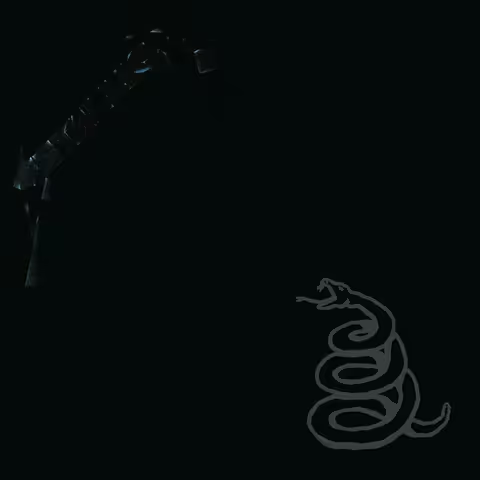
The sleeve is the most famous black-on-black design in rock. Art director Andie Airfix worked with the band on an embossed cover that put the Metallica logo in the top-left corner and a coiled snake, lifted from the Gadsden flag and tied lyrically to Don't Tread on Me, in the bottom-right. On first pressings the embossing was so subtle that a customer looking at the cover in a shop could mistake it for a blank piece of card. Later pressings rendered the logo and snake in dark grey so they stood out under normal lighting.
The band were openly amused that their decision recalled Spinal Tap's Smell the Glove. In A Year and a Half in the Life of Metallica the actual members of Spinal Tap appear and ask Metallica about it on camera. Ulrich's response, mostly serious, was that the real reference point was Status Quo's Hello!, whose mostly-black cover predated Tap by a decade. The inner sleeve carried four band portraits by Ross Halfin against the same black field, and the lyrics were printed on a grey ground that took some squinting to read.
Release and reception
Metallica went on sale on 12 August 1991. It debuted at number one on the Billboard 200 with 598,000 copies in its first week, the largest opening of any Metallica record before or since at that point. It spent four consecutive weeks at number one and was certified platinum within two weeks. It topped charts in the United Kingdom, Australia, Canada, Germany, the Netherlands, New Zealand, Norway, Sweden, Switzerland and Finland. By the end of 1991 it had outsold every other album released in the second half of the year.
The reviews were unusually positive for a band the rock press had spent the previous decade keeping at arm's length. David Browne in Entertainment Weekly called the record "rock's preeminent speed-metal cyclone" and suggested the band "may have invented a new genre: progressive thrash". Robert Palmer, writing in Rolling Stone, called it "an exemplary album of mature but still kickass rock and roll". Q's Mark Cooper credited Metallica with "rekindling the kind of intensity that fired the likes of Black Sabbath before metal fell in love with its own cliches". Pitchfork came late to the party with a 7.7 in a 2017 retrospective and a write-up that conceded the record had earned its position.
Not everyone clapped. Robert Christgau, then writing his Consumer Guide column for The Village Voice, marked the album a dud and claimed he had given up on Hetfield "in under five plays". A vocal section of the thrash community accused the band of selling out, an accusation that would intensify with the haircuts of Load in 1996 but which began in earnest the day Enter Sandman went to radio. In 1992 the album won the Grammy for Best Metal Performance. Ulrich's reaction to the band's first-ever number one record, recalled later for Rolling Stone, was instructive.
"You think one day some fucker's gonna tell you, 'You have a number one record in America,' and the whole world will ejaculate. I stood there in my hotel room, and there was this fax that said, 'You're number one.' And it was, like, 'Well, okay.' It was just another fucking fax from the office."
Lars Ulrich, Rolling Stone, November 1991
Singles and music videos
| Single | Released | US Hot 100 | UK Singles | Director | Notes |
|---|---|---|---|---|---|
| Enter Sandman | 29 July 1991 | 16 | 5 | Wayne Isham | Won MTV VMA Best Rock Video 1992 |
| The Unforgiven | 28 October 1991 | 35 | 15 | Matt Mahurin | Black-and-white, almost no live performance footage |
| Nothing Else Matters | 20 April 1992 | 34 | 6 | Adam Dubin | Documentary-style studio footage |
| Wherever I May Roam | 19 October 1992 | 82 | 25 | Wayne Isham | Filmed during the Wherever We May Roam tour |
| Sad but True | 8 February 1993 | 98 | 20 | Wayne Isham | Final single from the album |
Don't Tread on Me was issued as a promotional rock-radio single shortly after the album dropped, with no commercial release and no video. It charted briefly on the US Mainstream Rock chart and was retired from setlists by the late nineties. The five proper singles between them gave Metallica a longer run on MTV than any of their peers in the genre, and the rotation of Enter Sandman in the autumn of 1991 was instrumental in convincing programmers that heavy metal had broader commercial life left in it than the late hair-metal collapse implied.
Touring and live
The Wherever We May Roam tour ran for fourteen months from August 1991 to November 1992 and included the band's first headline arena dates in the United States, Europe, Japan and the UK. Production featured a triangular stage with a central "Snake Pit" surrounded by catwalks, an audience area inside the stage itself that became a fixture of the band's live design for decades afterwards. The opening night in San Diego in January 1992 saw the Snake Pit floor partially collapse. Two shows from that run were later released as part of the Live Shit: Binge and Purge box set in November 1993.
On 28 September 1991, before the album tour had even formally begun, Metallica headlined the Monsters of Rock festival at Tushino Airfield in Moscow, alongside AC/DC, Pantera and the Black Crowes. The official crowd estimate was 150,000. Unofficial estimates by Soviet authorities, who feared a riot, put it nearer 500,000. Some reporting at the time guessed at 1.6 million. Whatever the true figure, it was the largest free outdoor rock concert in Soviet history.
The most notorious incident of the album cycle came on 8 August 1992 at the Olympic Stadium in Montreal, during a co-headline tour with Guns N' Roses. Hetfield walked into a pyrotechnic charge during Fade to Black and suffered second- and third-degree burns to his arms, face, hands and legs. Newsted's later description, that Hetfield's skin was "bubbling like on The Toxic Avenger", is the line everyone remembers. The band returned to the stage seventeen days later, with guitar technician John Marshall of Metal Church filling in on rhythm guitar so Hetfield could sing standing up. The Montreal crowd, with Guns N' Roses then bailing on the rest of their set, rioted. It is the only night either band would prefer to forget.
Other highlights of the touring cycle:
- Freddie Mercury Tribute Concert at Wembley Stadium, 20 April 1992, performing a three-song set and Hetfield joining the surviving members of Queen and Tony Iommi for Stone Cold Crazy.
- Woodstock '94 on 13 August 1994, in front of a reported 350,000, sandwiched between Nine Inch Nails and Aerosmith.
- Five nights in Mexico City in February and March 1993 on the Nowhere Else to Roam tour, the band's first encounter with a Suicidal Tendencies bassist called Robert Trujillo.
- 2012 European Black Album Tour, during which the band performed the entire album in reverse running order every night.
In TV, film and other media
Enter Sandman has become the kind of cultural shorthand a song earns once a generation. It is the entrance music for New York Yankees closer Mariano Rivera from 1999 until his retirement in 2013, a usage so deeply associated with Yankee Stadium that the song was retired from the ballpark's PA when he left. Virginia Tech's American football team has run out to it for over two decades. It has appeared in The Sopranos, Shrek the Third, Zombieland and countless trailers. Nothing Else Matters has been covered by everyone from Lucia Micarelli to Miley Cyrus with Elton John and Yo-Yo Ma on the 2021 tribute album The Metallica Blacklist. The Unforgiven has soundtracked a generation of crime drama montages. Sad but True is one of the most-sampled metal riffs in hip-hop, most famously interpolated by Kid Rock on American Bad Ass in 2000.
Controversy, censorship and lawsuits
The Black Album avoided the parental advisory stickering that derailed several of its peers, but it was not without legal aftermath. In late 1994, after the touring cycle ended, Metallica sued Elektra Records under a section of the California Labor Code that limits personal-services contracts to seven years, seeking ownership of their masters and a new deal. By the time the suit was filed the album had sold over forty million copies worldwide. Elektra counter-sued. Doug Morris, then chairman of Warner Music US, intervened with a more generous deal in December 1994 and the matter was settled out of court in January 1995 under a non-disclosure agreement. The settlement laid the groundwork for the band eventually leaving Warner in 2012 to form their own label, Blackened Recordings, with the masters intact.
A separate controversy bubbled inside the fanbase rather than the courts. In 2006 a petition signed by 1,500 fans demanded Metallica drop Bob Rock as producer, claiming he had taken the band's sound somewhere unrecoverable. Rock's response was characteristically wry.
"Sometimes, even with a great coach, a team keeps losing. You have to get new blood in there."
Bob Rock, quoted in Blabbermouth.net, September 2006
Covers, samples and tributes
Nothing Else Matters is the most-covered song in Metallica's catalogue. Notable readings include those by Lucia Micarelli, Apocalyptica (whose entire 1996 debut Plays Metallica by Four Cellos arose from the band's prominence on rock radio), Phoebe Bridgers, Macy Gray and the 2021 Miley Cyrus version produced by Andrew Watt with Elton John, Chad Smith and Yo-Yo Ma. The 30th-anniversary Metallica Blacklist compilation released on 10 September 2021 collected 53 covers of Black Album songs by 50-plus artists, with profits split between the band's All Within My Hands Foundation and each contributor's chosen charity. It remains the largest single-artist tribute album ever assembled.
Sad but True's riff has been interpolated and sampled across hip-hop, most prominently by Kid Rock. Enter Sandman has been covered by Pat Boone (a sincere big-band version on his 1997 album In a Metal Mood), Motorhead, and most marching bands in the United States with brass.
Reissues, remasters and anniversaries
The Black Album has been reissued repeatedly. A 25th-anniversary vinyl edition appeared in 2016. The major archival release came on 10 September 2021 to mark the album's 30th anniversary: a Bob Ludwig remaster cut at Gateway Mastering, overseen by Greg Fidelman, accompanied by a deluxe box set built around the remastered album plus three live LPs, 14 CDs and six DVDs of unreleased rehearsals, demos, alternate mixes and live recordings. Classic Rock's Stephen Dalton gave the box set four stars and said the reissue "reinforces Metallica as one of rock's greatest albums". Most reviewers agreed the live discs ran long, but everyone broadly accepted the remaster as a careful job that left the original mix recognisable rather than re-engineered.
Vinyl variants have proliferated. A coloured-vinyl edition arrived in 2008. A clear white-vinyl run came out in 2010. The 2021 box included a 180-gram double LP and a half-speed master test pressing. A Dolby Atmos spatial-audio mix of the album was issued through Apple Music in 2021. Bootleg recordings of the One on One sessions, including alternate Enter Sandman vocals, circulate widely among collectors and were partly officialised on the 2021 box.
Legacy and influence
The Black Album made Metallica the third-best-selling music artist in the SoundScan era behind only Garth Brooks and the Beatles. As of 2025 the RIAA has certified it 2× Diamond, the first heavy metal album to reach that tier. It has spent more than 600 cumulative weeks on the Billboard 200, behind only Pink Floyd's The Dark Side of the Moon and Bob Marley's Legend among traditional studio releases. In 2020 Rolling Stone ranked it at number 235 on the revised 500 Greatest Albums list, up from earlier placements. Q, Classic Rock, Kerrang!, Loudwire and most other rock-press canonical lists have placed it inside the top 25 metal albums of all time.
Its influence on what followed is harder to summarise because the record both opened a door and slammed it. Every nineties hard-rock band that built around mid-tempo riffs and a singable chorus, from Alice in Chains' Dirt to Sevendust's debut to Godsmack's entire catalogue, owes part of its commercial existence to the Black Album. Equally, every act associated with the next decade of "extreme" metal, from Mastodon to Lamb of God, came up partly as a reaction against the simplification the Black Album endorsed. Iron Maiden's Bruce Dickinson, speaking to Louder Sound on the album's 30th anniversary, gave it the most generous compliment a peer can give.
"It's one of those seminal albums that just gets it right. It's extremely well-produced, and every note on that album is totally under control. I admire how they did it, and what they did with the songs, and it was very effective: it undoubtedly did help push metal into the mainstream."
Bruce Dickinson, Louder Sound, August 2021
For Metallica the album set a bar they would spend the next thirty years simultaneously trying to clear and trying to escape. Load, Reload and St. Anger each, in different ways, walked away from the Black Album's formula. Death Magnetic in 2008 walked back towards it. Every Metallica record since 1991 has been assessed, fairly or otherwise, against the one that came before it.
Things you might not know
| Fact | Detail |
|---|---|
| Working title | The album was nearly called Married to Metal as a black-humoured nod to the three divorces under way among the band |
| The Sandman riff's birthplace | Kirk Hammett wrote the main riff late one night on a Tascam four-track in his apartment, looped it twice and brought it to rehearsal the next day |
| Original Enter Sandman lyric | Hetfield's first draft was about sudden infant death syndrome; Bob Rock pushed him to soften it into the nightmare imagery on the final cut |
| The Unforgiven horn sample | The opening fanfare is widely understood to be lifted from Ennio Morricone's score for For a Few Dollars More, although the band have never officially confirmed it |
| Tambourine credit | The tambourine on Nothing Else Matters is played by the album's engineer, Randy Staub |
| Phantom keyboard player | An uncredited musician known only as "Scott" played a keyboard part on The Unforgiven; he has never been publicly identified |
| Number of remixes | The album was mixed three times in full before Bob Rock and the band agreed it was finished |
| Sleeve nod to Status Quo | Lars Ulrich insisted in the documentary that the all-black cover concept was inspired by Status Quo's Hello! rather than by Spinal Tap |
| The Snake Pit collapse | The floor of the audience area inside the tour stage partially collapsed on opening night in San Diego in January 1992 |
| The Newsted writing credit | Jason Newsted received only one writing credit on the album, on My Friend of Misery, having originally written it as an instrumental in the tradition of Cliff Burton's bass features |
| The Yankee Stadium connection | Mariano Rivera ran out to Enter Sandman from 1999 until 2013; the Yankees have not used the song as a closer's entrance since |
| The Blacklist record | The 2021 tribute album collected 53 cover versions by more than 50 artists, the largest single-album tribute project ever released |
| Double Diamond first | In May 2025 Metallica became the first heavy metal album certified 2× Diamond by the RIAA, for shipments above twenty million copies in the United States |
Listen to the Riffology podcast
Riffology's episode on the Black Album walks through the songs, the sessions and the cultural impact in conversation rather than in print. You can listen on Apple Podcasts, Spotify, Pocket Casts, Overcast and any other podcast app of your choice. New episodes drop regularly. If the album means something to you, the conversation will.
Comments