Rage Against the Machine got their debut album onto tape by turning a studio into a gig. After struggling to capture the band's live power on Rage Against the Machine, they invited a crowd of friends in one night, played their set, and got about half the record's basic tracks down before the night was out. Then Epic's A&R man suggested, as the first single, the song that ends with "Fuck you, I won't do what you tell me" sixteen times and one "motherfucker".
Nobody involved expected anyone to hear it. Tom Morello has said the band "harboured no anticipation of success" with a sound built from genres "at war with each other". Instead the album went triple platinum in America, broke the band in Britain after a Radio 1 blunder, and left behind a song that beat The X Factor to the Christmas number one seventeen years later.
Album Facts: Rage Against the Machine (1992)
| Field | Detail |
|---|---|
| Artist | Rage Against the Machine |
| Album | Rage Against the Machine |
| Release Date | 6 November 1992 |
| Label | Epic |
| Producer(s) | GGGarth (Garth Richardson) and Rage Against the Machine |
| Studio(s) | Sound City, Van Nuys; Scream Studios, Studio City; Industrial Recording, North Hollywood ("Bullet in the Head") |
| Genre / Subgenre | Rap metal, funk metal, alternative metal, rap rock |
| Track Count | 10 |
| Total Runtime | 52:55 |
| Billboard 200 Peak | No. 45 (February 1994), 97 weeks on chart |
| UK Albums Chart Peak | No. 17 (March and May 1993) |
| Other Notable Chart Peaks | Netherlands 5, France 8, New Zealand 9, Australia 12; No. 1 on Billboard Heatseekers |
| Certifications | RIAA 3x Platinum (24 May 2000) |
| Estimated Sales | More than 3 million worldwide by April 1996 |
| Key Singles | Killing in the Name, Bullet in the Head, Bombtrack, Freedom |
Cultural Context: Rap and Metal at War in 1992
When Rage arrived, SPIN's 2012 retrospective on "Killing in the Name" notes, the only well-known rap and metal successes were "somewhat novel one-offs": Aerosmith with Run-DMC, and Public Enemy with Anthrax. It was also the year Body Count released "Cop Killer" and Sinead O'Connor tore up a picture of the Pope on Saturday Night Live.
Then Los Angeles burned. In April 1992 four police officers were acquitted of beating Rodney King and the city erupted in riots. Morello has stressed that "All of those songs were written prior to the Rodney King riots." He also noted that none of the big alternative bands of the day, Jane's Addiction, Nirvana or Soundgarden, were "of mixed ethnicity". Rage were, as Morello put it, "an interracial band, which was never heard on the radio, certainly in rock."
Rage Against the Machine's Story Up to 1992
Morello had already had one go at the major-label dream. His band Lock Up released an album on Geffen in 1990, got dropped, and left him at 26 thinking that was it. After Lock Up broke up in 1991, their former drummer Jon Knox encouraged Tim Commerford and Zack de la Rocha, who had known each other since childhood, to jam with him. Morello then called Brad Wilk, who had already failed auditions for both Lock Up and the band that became Pearl Jam.
The name came from a song de la Rocha had written for his previous band, the hardcore outfit Inside Out. De la Rocha was the son of the Mexican-American political artist Robert de la Rocha, and Morello the Harvard-educated son of an activist mother and a Kenyan diplomat. Their first gig was a house party in Huntington Beach, where they played "Killing in the Name" with no vocals because de la Rocha had not finished the words. "It felt like holding on to a fucking live wire," said Commerford.
"When we were getting together, we agreed that we wanted our record to sound somewhere between Ice Cube's AmeriKKKa's Most Wanted and Led Zeppelin's Houses Of The Holy."
Brad Wilk, Metal Hammer, 2017
Labels moved fast. Morello told SPIN they had record-company interest after only their second show. Michael Goldstone, the Epic A&R man who had signed Pearl Jam, saw them in a San Fernando Valley rehearsal room in 1991. "I had never seen anything like it," he told the Los Angeles Times. Other labels, Morello said, "kept talking about the message of the music as a gimmick". Epic, by contrast, "agreed to everything we asked".
Pre-production and the 1991 Demo
Everything started on a cassette. The band recorded a 12-track demo in August and September 1991, before they had played live, and sold it at shows for $5, shifting around 5,000 copies. The artwork used newspaper clippings from the stock-market pages with a single match taped to the inlay, and the cover already carried the line about no samples, keyboards or synthesizers. Seven of its songs ended up on the album, some barely changed.
"Killing in the Name" arrived during one of Morello's guitar lessons. He was showing a student drop-D tuning when the riffs "spontaneously combusted" on his fingers, so he stopped the lesson and taped them on his "little RadioShack $20 recording device". Commerford added the off-kilter opening riff and Wilk the beat. Morello says it was the first song of the band's second batch. When the band played it to visiting Atlantic Records executives, according to Morello, one of them squeaked: "So is that the direction you're heading in?"
"Our expectations were very humble. When we were writing the songs for the first record we really didn't even think we'd be able to book a club gig."
Tom Morello, Metal Hammer, 2012
Creating the Album: GGGarth, Sound City and a Concert PA
Garth Richardson was a young Canadian engineer whose biggest credit was a White Lion album. He was also the son of Jack Richardson, who had produced the Guess Who and Alice Cooper. According to Metal Hammer, when Epic asked his boss, the producer Michael Wagener, who should make the record, Richardson was the obvious choice. Richardson heard the demo and went "Holy shit", then went to their jam space, heard four songs and was so floored he couldn't speak afterwards "because my stutter was so bad".
He reckoned the songs were "about 85 to 90% there", so the job was to capture them. Work began at Sound City in Van Nuys in the spring of 1992, and Richardson brought in a full concert PA to get the band's live firepower into the room. Even so, the band struggled at first to capture what they sounded like on stage.
"The way we turned the corner was one night we invited a bunch of friends into the studio and basically just played the set. So it was like a show, rather than, "Now we're going to record the hi-hat.""
Tom Morello, SPIN, 2012
That night produced about half the album's basic tracks. Even so, Morello remembers the record taking "a long time to finish". De la Rocha, Richardson says, "gave it his all" every time he sang, and his voice paid for it. Anyone who asked him to hold back got told: "No, fuck off, leave me alone."
"The problem is that sometimes Zack's voice went. He was working it so hard. The end of Freedom, where he's screaming, 'Freedom!', that's just one take."
GGGarth Richardson, Metal Hammer, 2017
The arguments were over "Killing in the Name". According to Metal Hammer, Epic suggested removing the line "Now you're under control". Goldstone also rang Richardson wanting to "cut the song down in half". Morello remembers the objection was that the breakdown stopped the flow of "an otherwise rampaging rhino of a song". Richardson passed messages back and forth until it became an exchange of "fuck you"s. "He lost," Richardson told SPIN, "which was really good." When the finished take was played back, he says, "we all smiled and went, 'Holy shit. It's real.'"
Most of the album was tracked at Sound City by Richardson and Stan Katayama, with extra recording at Scream Studios in Studio City. "Bullet in the Head" was the exception. It came from the demo, recorded at Industrial Recording in North Hollywood by Auburn Burrell, and the liner notes say it "was recorded before ever playing live". Only the verse vocals were re-recorded. Andy Wallace mixed the album at Quantum Studios in Jersey City and Bob Ludwig mastered it at Masterdisk in New York. Richardson, Katayama and Wallace were nominated for Best Engineered Album, Non-Classical at the 36th Grammy Awards.
Personnel and Credits
| Role | Player | Notes |
|---|---|---|
| Core band | ||
| Vocals, lyrics | Zack de la Rocha | Also production and art direction |
| Guitar | Tom Morello | Also production and art direction |
| Bass, backing vocals | Tim Commerford | Credited as Timmy C. |
| Drums, percussion | Brad Wilk | Also production and art direction |
| Guest musicians | ||
| Additional vocals | Maynard James Keenan | Bridge of "Know Your Enemy" |
| Additional percussion | Stephen Perkins | "Know Your Enemy"; liner lists it as trashcan |
| Production and engineering | ||
| Producer, recording | GGGarth (Garth Richardson) | All tracks except "Bullet in the Head" |
| Recording | Stan Katayama | All tracks except "Bullet in the Head" |
| Recording | Auburn Burrell | "Bullet in the Head" |
| Additional recording, assistant | Craig Doubet | |
| Assistant engineer | Jeff Sheehan | |
| Mixing | Andy Wallace | Quantum Studios, Jersey City |
| Mixing assistant | Steve Sisco | |
| Mastering | Bob Ludwig | Masterdisk, New York |
| A&R | Michael Goldstone | Epic |
| Artwork | ||
| Art direction | Nicky Lindeman | With the band |
| Photography | Associated Press; Lindsey Brice | Cover photo by Malcolm Browne |
Keenan had met Morello when he first came to Los Angeles to apply for a job, and the two jammed a little. Perry Farrell was originally asked to sing the "Know Your Enemy" bridge, but his absence meant it went to Keenan, who had once been a candidate to front Rage.
"I definitely didn't have anything to contribute to what Rage Against The Machine became, other than being friends, and they wanted to have me on one of the songs."
Maynard James Keenan, Stereogum, 2026
The Songs on Rage Against the Machine
| # | Title | Writer(s) | Length | Single? | Notes |
|---|---|---|---|---|---|
| 1 | Bombtrack | Rage Against the Machine | 4:02 | Yes | De la Rocha counts the album in |
| 2 | Killing in the Name | Rage Against the Machine | 5:14 | Yes | Drop-D riff found during a guitar lesson |
| 3 | Take the Power Back | Rage Against the Machine | 5:36 | No | Demo version much slower, different final verse |
| 4 | Settle for Nothing | Rage Against the Machine | 4:49 | No | Live version on the Bullet in the Head single |
| 5 | Bullet in the Head | Rage Against the Machine | 5:08 | Yes | Carried over from the demo |
| 6 | Know Your Enemy | Rage Against the Machine | 4:57 | No | Maynard James Keenan sings the bridge |
| 7 | Wake Up | Rage Against the Machine | 6:06 | No | Quotes a J. Edgar Hoover FBI memo |
| 8 | Fistful of Steel | Rage Against the Machine | 5:32 | No | Main riff taken from demo song "The Narrows" |
| 9 | Township Rebellion | Rage Against the Machine | 5:22 | No | Bass over a cowbell-and-snare beat |
| 10 | Freedom | Rage Against the Machine | 6:06 | Yes | Final screams done in one take |
All music is credited to the band and all lyrics to de la Rocha.
Killing in the Name
Built on heavy drop-D riffs, the song ties the Los Angeles police to the Ku Klux Klan with the line "some of those that work forces are the same that burn crosses". Morello played his part on a Fender Telecaster, and the solo comes from a DigiTech Whammy pedal he had just got. On those early songs, he said, he was trying to approximate Dr. Dre's production, Cypress Hill or the Bomb Squad. It is the only song whose lyrics are missing from the inner sleeve. Morello's explanation: "if you printed out the lyrics then it reads somewhat less like poetry." He has called it "the most important song on the record".
Know Your Enemy
Commerford wrote the main riffs on an acoustic bass. Morello opens it by flicking his pickup toggle switch on and off for a tremolo effect, and solos on the Whammy's harmonizer setting. Keenan's bridge, with Perkins on percussion, comes before that solo, and the song ends with de la Rocha repeating "All of which are American dreams" eight times. It was never a single, but it was getting significant radio play by 1993, and Robert Christgau picked it out as a highlight.
Wake Up
"Wake Up" targets the FBI's COINTELPRO programme. Its spoken section reads from a real memo by J. Edgar Hoover, and it closes with "How long, not long", borrowed from Martin Luther King's speech at the end of the Selma to Montgomery march. Pitchfork heard it pivot "between worship of Led Zeppelin's 'Kashmir' and a delirious breakbeat". Parts of the demo song "Mindset's a Threat" ended up in it.
Bullet in the Head and Township Rebellion
"Bullet in the Head" compares ordinary homes to Alcatraz in an attack on government control through the media, over guitar lines Pitchfork said "whir like air-raid sirens". "Township Rebellion" contains what Pitchfork called the band's best credo: "Why stand on a silent platform? Fight the war. Fuck the norm."
B-sides, Outtakes and Lost Songs
Five demo songs missed the album: "Darkness of Greed", "Clear the Lane", "Mindset's a Threat", "Auto Logic" and "The Narrows". The first two were remastered as B-sides on the "Killing in the Name" single. "Darkness of Greed" went back to de la Rocha's Inside Out days, and the band re-recorded it as "Darkness" for The Crow soundtrack in 1994. Two more songs, "Hit the Deck" and a cover of The Clash's "Clampdown", were played at Cal State Northridge on 23 October 1991, but no studio version of either is known to exist.
The most interesting B-side is the "Bombtrack" session recorded for Mark Goodier's Evening Session on BBC Radio 1. It reworks the song as a slower swing with different lyrics.
Album Artwork and Packaging
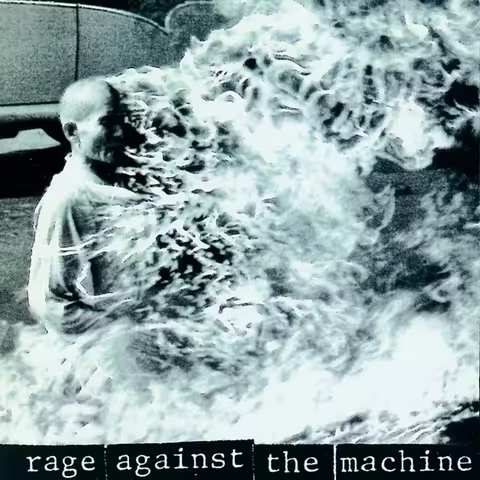
The cover is a cropped, monochrome image of a monk sitting upright inside a wall of flame, with a car behind him at the top left. The band's name runs along the bottom in lowercase typewriter letters on black strips. The photograph is Malcolm Browne's Pulitzer Prize-winning picture of Thich Quang Duc burning himself to death in Saigon in June 1963, in protest at the shooting of Buddhists by the US-backed regime of Ngo Dinh Diem. The liner credits the photography to Associated Press and the art direction to Nicky Lindeman and the band. "Yeah, one more reason we thought people would never hear the record!" Morello told Metal Hammer.
The sleeve notes go further. The "Thanks For Inspiration" list includes the Black Panther founder Huey P. Newton and the IRA hunger striker Bobby Sands, which Metal Hammer called "a contentious move on both sides of the Atlantic", along with Ian and Alec MacKaye. The band credit themselves as "Guilty Parties", and the sleeve notes end by repeating the demo's promise: "No samples, keyboards or synthesizers used in the making of this recording." Morello later explained that people would otherwise have assumed his guitar noises came from a keyboard or a DJ.
Release and Reception
Sales started slowly. The album entered the UK chart at No. 52 in February 1993 and reached No. 17 twice, in March and again in May. In America it did not reach the Billboard 200 until May 1993, and only peaked, at No. 45, in February 1994. It topped the Heatseekers chart and stayed on the Billboard 200 for 97 weeks.
Reviews were strong. NME wrote that "the results burn with an undeniable conviction", Q called it "a record of real attitude and energy", and Robert Hilburn in the Los Angeles Times hailed "a striking, politically conscious debut". Robert Christgau was cooler, calling it "metal for rap-lovers". Later verdicts went further: AllMusic's Eduardo Rivadavia called it the first album "to successfully merge the seemingly disparate sounds of rap and heavy metal", and Pitchfork gave it 9.1 in 2017.
- Grammy nomination: Best Engineered Album, Non-Classical (36th Grammy Awards)
- Rolling Stone 500 Greatest Albums: No. 368 (2003), No. 365 (2012), No. 221 (2020)
- Rolling Stone 100 Greatest Metal Albums: No. 24
- Included in 1001 Albums You Must Hear Before You Die
Singles and Music Videos
| Single | Released | UK Peak | B-sides |
|---|---|---|---|
| Killing in the Name | 20 October 1992 (US radio) | 25 (1993); 1 (Christmas 2009) | Darkness of Greed, Clear the Lane |
| Bullet in the Head | 26 April 1993 | 16 | Remix by Sir Jinx; live Bullet in the Head and Settle for Nothing |
| Bombtrack | 7 June 1993 (US radio); 23 August 1993 (UK) | 37 | Evening Session version; live Bombtrack |
| Freedom | 6 December 1993 | Live Freedom; live Take the Power Back |
"Killing in the Name" helped break the band in Britain by accident. On 21 February 1993 Bruno Brookes played the uncensored version on Radio 1's Top 40 countdown, drawing 138 complaints and, according to Metal Hammer, a week's suspension for Brookes. Its video, shot at the Whisky a Go Go and the Club With No Name by Morello's guitar student Peter Gideon for what Morello thinks was "literally $500", was banned by MTV in the US but played uncensored on MTV in Europe.
"The UK was the first place people lost their minds over this music. One of the principal reasons was that there were more lax lyrical censorship laws on your MTV and radio."
Tom Morello, Metal Hammer, 2017
Pitchfork notes the band made just four videos for the album, and calls the "Bombtrack" and "Freedom" clips advertisements for "unapologetically radical politics". The "Bullet in the Head" clip is a live performance recorded for the BBC's The Late Show. In "Bombtrack" the band play inside a steel cage, in what Pitchfork read as a sympathetic portrait of Peru's Shining Path. "Freedom" was Epic's own idea. With the swearing keeping Rage off American radio, Morello says the label suggested "a six-and-a-half-minute song without a chorus" and a video about Leonard Peltier. Peter Christopherson directed it with footage from Michael Apted's Incident at Oglala, and it premiered on MTV's 120 Minutes on 19 December 1993.
Touring and Live
In America Rage were still opening clubs for House of Pain while Britain treated them as teen idols, and they also toured Europe with Suicidal Tendencies. The turning point was the 1993 Lollapalooza tour, where they were an opening act. US sales stood at around 75,000 before Lollapalooza and reached 400,000 by the end of the year. At the Philadelphia show the four members walked onstage naked with tape over their mouths, a protest against music censorship.
- Pinkpop 1994: a crowd pogoing to "Killing in the Name" registered 1.1 on the Richter scale.
- Woodstock '99: the American flag burned during "Killing in the Name" was Commerford's plan, and Morello says the rest of the band did not know about it.
- "Wake Up" became the usual last song before the encore, its Hoover section often replaced by a de la Rocha speech.
Killing in the Name and the 2009 Christmas Number One
In December 2009 the DJ Jon Morter and his wife Tracy started a Facebook group urging people to buy "Killing in the Name" in the week before Christmas, to stop The X Factor winner taking the UK Christmas number one for a fifth year in a row. On 20 December Radio 1 announced that it had won, selling more than 500,000 copies and becoming the first download-only Christmas number one. The band celebrated with a free show for 40,000 people in Finsbury Park on 6 June 2010. Morello told SPIN it was "really one of the highlights of the entire Rage experience for me personally."
In TV, Film and Media
- "Wake Up" plays at the end of The Matrix (1999) and is on its soundtrack; Brass Against covered it for the end credits of The Matrix Resurrections.
- "Bombtrack" appears in Oliver Stone's Natural Born Killers.
- The band sued the US State Department over the use of "Killing in the Name" at Guantanamo Bay, and lost.
Covers and Tributes
Phish have covered "Killing in the Name", and the comedian Bill Hicks closed some of his shows with it, which Morello called "a badge of honor". Stone Sour recorded "Bombtrack" for Metal Hammer's Metal Hammer Goes '90s compilation in 2017.
Reissues and Anniversaries
Australia got a 1995 reissue with a bonus disc, Anger Is a Gift. The main anniversary release was XX, issued on 27 November 2012 with a Vlado Meller remaster. The deluxe box contained two CDs, two DVDs, a 180-gram LP, a 40-page booklet and a poster. It put the 1991 demo on disc for the first time, alongside B-sides, the 2010 Finsbury Park show and footage of the band's first public performance at Cal State Northridge. Steve Hoffman remastered the album again for a hybrid SACD in 2016.
Legacy and Influence of Rage Against the Machine
By April 1996, just before Evil Empire, the debut had sold more than a million copies in the US and two million elsewhere. The RIAA certified it triple platinum on 24 May 2000. Metal Hammer credits the band with dragging the dormant rap-metal movement out of its stupor, noting that a new band in Bakersfield called Korn "were certainly paying attention". It shaped Richardson's career too: L7 chose him to co-produce Hungry for Stink because of the heavy guitar sound on his records with Melvins and Rage.
Pitchfork thought the band never again sounded "so casually confident". Richardson has his own view of why it lasts: "Human strife has not changed. Racism has not changed. Things have actually gone backwards."
Things You Might Not Know
| Fact | Detail |
|---|---|
| The want ad | According to Pitchfork, Morello's ad asked for "a socialist frontman who likes Black Sabbath and Public Enemy". |
| The fifth Beatle | Morello has said A&R man Michael Goldstone, sympathetic to the band's message, was their "fifth Beatle" for a while. |
| Guinness record | Killing in the Name entered Guinness World Records as the UK's fastest-selling digital track, with 502,672 downloads in its first week. |
| A billion streams | In January 2025 it became the first Rage Against the Machine song to pass one billion streams on Spotify. |
| Britain's favourite | A 2021 poll for the Official Charts Company named it the UK's favourite Christmas number one of all time. |
| Triple J | Australian listeners voted Killing in the Name No. 2 in Triple J's Hottest 100 of All Time in 2009. |
| Peltier's release | More than 30 years after the Freedom video, Joe Biden commuted Leonard Peltier's life sentence to home confinement on 20 January 2025. |
| Where GGGarth came from | The Red Hot Chili Peppers credited Richardson as "GGGarthatron". When a bass player said reusing it would be bad luck, he became "GGGarth", which added up to seven. |
Listen to the Riffology Podcast
The Riffology podcast has an episode on Rage Against the Machine's debut, available on all major podcast platforms. Press play above and turn it up loud.
Comments