Ross Robinson took a phone call in early 1994 from a band so unsigned and so unfashionable they were still rehearsing in a Huntington Beach house called Underground Chicken Sounds, asked them to drive up to Malibu, and over six weeks at a hilltop ranch full of vintage tape machines he produced a record that quietly detonated American metal. The album was called Korn, the band were also called Korn, and the only thing about it that anyone agrees on thirty-two years later is that nothing in heavy music looked or sounded the same after 11 October 1994.
Five Bakersfield outsiders, a then-unknown producer working largely on instinct, two boys playing seven-string Ibanezes tuned to a sub-baritone A, a bassist who slapped his strings like Les Claypool with a grudge, and a singer who tracked his vocal to "Daddy" alone in the dark, weeping, while Robinson left the tape rolling without telling him. By the time the smoke cleared a decade later Rolling Stone had called it "the most important metal record of the last 20 years" and Loudwire had voted it the greatest nu-metal album ever made. This is how Korn happened.
Album Facts
| Field | Detail |
|---|---|
| Artist | Korn |
| Album | Korn (stylised KoRn) |
| Release date | 11 October 1994 |
| Label | Immortal / Epic |
| Producer | Ross Robinson |
| Studios | Indigo Ranch Studios, Malibu, California (main); Fat Tracks, Bakersfield (additional) |
| Recorded | May to June 1994 |
| Genre / Subgenre | Nu metal, alternative metal, funk metal |
| Track count | 12 |
| Total runtime | 65:45 |
| Billboard 200 peak | 72 |
| UK Albums Chart peak | 181 |
| Other notable peaks | 10 (New Zealand), 46 (ARIA Australia), 5 (US Top Pop Catalog), 56 (Netherlands) |
| Certifications | 2x Platinum (RIAA, USA), Platinum (ARIA), Platinum (RMNZ), Gold (BPI, UK) |
| Estimated sales | 2.1 million plus (USA, per Billboard 2003 reporting), with continued catalogue sales since |
| Key singles | Blind, Need To, Shoots and Ladders, Clown |
The Cultural Context of 1994
October 1994 is one of the more crowded shelves in modern rock history. Nirvana had broken up in April with the death of Kurt Cobain. Soundgarden had just released Superunknown, Nine Inch Nails had drowned the radio in The Downward Spiral, Green Day had defected from punk to platinum with Dookie, Oasis had dropped [Definitely Maybe](/posts/the-making-of-definitely-maybe-by-oasis/), and Pearl Jam Vitalogy was a month away. Grunge was reaching its commercial summit at the exact moment its emotional centre collapsed. The American mainstream was looking for whatever came next, and the labels were busy throwing flannel-shirted bands at the wall hoping one of them would stick.
Heavy metal, meanwhile, was wandering. Metallica had cut their hair and were two years past [The Black Album](/posts/metallica-the-black-album/). Pantera were the loudest, fastest band in the world but lived in a self-contained universe. Faith No More had already proved that funk, hip-hop and metal could share a stage, and [Rage Against the Machine](/posts/the-making-of-rage-against-the-machine-by-rage-against-the-machine/) had weaponised the combination two years earlier on their self-titled debut. What did not yet exist, in a single coherent record, was the sound of suburban American adolescence at its most vulnerable, tuned to A and recorded live to two-inch tape. Korn arrived to fill that gap before anyone realised the gap was there.
Two Bands, One Rebirth: From LAPD to Sexart to Korn
Korn prehistory runs through two short-lived Bakersfield bands. James "Munky" Shaffer, Brian "Head" Welch, Reginald "Fieldy" Arvizu and David Silveria had played together as LAPD (Love And Peace, Dude) and then Creep, a funk-metal outfit that toured the West Coast bar circuit without ever quite landing. Jonathan Davis, the coroner assistant from Bakersfield with the eyeliner and the Duran Duran obsession, was singing for a separate band called Sexart with Ryan Shuck and Dennis Shinn. One night the Creep boys watched Sexart play "Blind", a Shuck-and-Shinn song built around the now-immortal opening line "Are you ready?!", and the next day they asked Davis to leave Sexart and join them.
Davis spent two weeks paralysed by indecision, then a psychic he had visited in Bakersfield told him to "take the chance". He took it. The new band moved into a rental house in Huntington Beach south of Los Angeles, took the name Korn, and began rebuilding the four-piece funk-metal song fragments around Davis voice and lyrics. "Blind" came with him from Sexart and remains the only song on the album with outside co-writers (Shuck and Shinn).
Huntington Beach and the Underground Chicken Sounds Demo
The five-piece rented a small studio called Underground Chicken Sounds from a local engineer named Jeff Creath, who had previously allowed Davis to sleep in his garage. Inside Underground Chicken Sounds they cut a three-song cassette demo, Neidermayer Mind, that contained "Blind", "Predictable" and "Daddy". A tape-trading network of Californian metal kids did the rest. By the summer of 1993 Korn were playing clubs from Huntington Beach to Anaheim alongside Pennywise, No Doubt, Testament and Deftones, and a crowd would gather every time they soundchecked the prelude to "Clown" because the noise was so disorienting nobody had heard it before. Fieldy later told the press the crowds came because the band sound was so different that people did not know what to make of it.
Crucially the demo also reached the desk of producer Ross Robinson, then known almost exclusively for engineering work with hardcore and death-metal acts. Robinson asked if he could produce the band. Equally crucially it reached Paul Pontius, A&R for Immortal Records (a metal-focused imprint distributed by Epic). Pontius drove down to Huntington Beach to see them play and signed them in person. Several other labels had offered deals; Korn picked Immortal because, in Davis words, they did not want to sign away all of their creative freedom.
Signing to Immortal and Epic
The Immortal/Epic deal gave the band an unusually modest first-album budget and an unusual amount of artistic latitude. Crucially it also gave them their producer. Robinson had already begun talking through the songs with the band, and when the recording budget arrived he made one immovable demand: they would not track in Los Angeles. He wanted Indigo Ranch.
The decision shaped everything that followed. Had the album been recorded inside a city studio with a corporate A&R clock ticking, the rawness that defines it would almost certainly have been smoothed away. By the time the sessions started Robinson had also persuaded Korn that they would not be overdubbing the rhythm section. The whole band would play live in the room together, and what they got was what would land on tape.
Ross Robinson and the Indigo Ranch Method
Indigo Ranch sat on a Malibu hillside, accessible by a long dirt road, with vintage Neve and API outboard, a wall of tube microphones, and a tracking room large enough to set up the entire band and leave the doors open to the outside. Robinson method, which would later define his work with Sepultura, Limp Bizkit, Slipknot and At the Drive-In, was already crystallising in 1994. He did not engineer for clean takes. He engineered for emotional confrontation. He played the band their own demos at painful volume, screamed in their faces between takes, asked Davis about his childhood until the singer cracked, and rolled tape continuously so that nothing was ever off the record.
"Ross is a very pure and clean-spirited person, and you feel it when you are with him. He is the kind of person that can draw that out of you. I felt very safe with Ross."
Jonathan Davis, Metal Hammer, 1998
Robinson himself credits the album with teaching him his trade. "It taught Robinson how to produce," Joel McIver wrote in his 2002 book on nu-metal, and Robinson has repeated the line since. He arrived at Indigo Ranch as a competent engineer with a punk-rock instinct; he left it as the genre defining producer, with a methodology refined enough to be reapplied verbatim to Sepultura Roots two years later and to Slipknot self-titled debut after that.
Pre-Production: The Songs Before the Sessions
The album that arrived at Indigo Ranch was already mostly written. The Huntington Beach house had been a year-long pre-production environment in its own right: Fieldy, Munky and Head jammed riffs nightly while Davis sat above them writing lyrics into a notebook. Most songs began with a guitar pattern, a bass figure from Fieldy underneath it, and a phrase Davis had been chewing on for weeks. "Once we started playing," Fieldy said later, "there was a complete sense of concentration among all of us. It was truly the only time we were all focused. Before we knew it, a song would start."
Davis lyrics were already drawing on material the press would later spend twenty years dissecting. "Faget" was about being called a homosexual through high school in Bakersfield for wearing eyeliner and listening to Duran Duran. "Helmet in the Bush" was about methamphetamine, a drug the band were quite open about using during the sessions. "Shoots and Ladders" was a meditation on the hidden violence inside nursery rhymes. And "Daddy", the album closer, was about the sexual abuse Davis had suffered as a child at the hands of someone other than his father. None of these songs were finished in the studio; they arrived at Indigo Ranch fully formed and were tracked live.
Recording the Album: May and June 1994
Sessions began in May 1994 and were completed by the end of June. Korn tracked the bulk of the record live as a quintet in Indigo Ranch main room, with additional work captured at Fat Tracks in Bakersfield. Engineering was split between Richard Kaplan and Chuck Johnson, with Johnson also co-mixing alongside Robinson. The album was mastered by Eddy Schreyer at Future Disc.
The technical signatures of the record were almost all happy accidents. The banging that scrapes through the end of "Ball Tongue" was a guitar cord swung against a music stand. The bagpipes that open "Shoots and Ladders" are commonly assumed to have been recorded on a mountaintop; in fact a microphone was set up at Indigo Ranch back door while Davis walked out of the studio playing, the natural fade as he moved further from the mic creating the famously eerie distancing effect. The vocal at the end of "Daddy", a lullaby sung by a woman called Judith Kiener, was recorded as a counterpoint to Davis breakdown. And the closing minutes of "Daddy" itself, in which Davis sobs uncontrollably over the fading instrumental, were caught on tape because Robinson never told him the recorder was still rolling.
The band have since been frank about the drug intake during the sessions. Davis described a daily routine in which methamphetamine was lined up for breakfast and stayed in their bloodstreams for the duration. Munky later added that the title "Helmet in the Bush" was a literal description of the physical consequences of that intake on a young man. The fact that anyone got out of Indigo Ranch alive, let alone with a finished album, is itself part of the legend.
- All-band live tracking, almost no rhythm overdubs.
- Vintage Neve and API outboard chained to two-inch analogue tape.
- Doors of the live room left open to capture hilltop ambience.
- Davis breakdown during "Daddy" recorded without his knowledge.
- Total session length: roughly six weeks across May and June 1994.
- Four outtakes recorded but cut: "Christmas Song", "Sean Olson", "Layla" and "This Broken Soul".
The Seven-String Sound and Downtuned Architecture
The single most influential technical choice on Korn is the guitar tuning. Munky and Head had been playing seven-string Ibanez Universe models, originally designed for Steve Vai, dropped a full step from the factory tuning. The result was an open low string of A, an octave below the low E most metal guitarists were working with, played through high-gain amplifiers but with the gain pulled back enough to leave attack and clarity. No metal band had used the seven-string this way before; for the previous five years it had been an instrumental-shred curiosity. Korn turned it into a riffing instrument.
The pairing of two seven-strings is what gives Korn its bottom-end signature. Munky and Head play interlocking parts rather than doubled rhythm parts, so that the low A string functions almost as a third bass note underneath Fieldy already detuned five-string. Within five years every nu-metal band on Earth, plus modern progressive metal acts who would never accept the nu-metal label, had adopted the seven-string Ibanez as their default instrument. The Ibanez Apex and Ibanez K7 signature models, both named after Korn members, are still in production three decades later.
Fieldy and the Slap Bass That Should Not Have Worked
Reginald "Fieldy" Arvizu bass playing on Korn is the second great structural oddity of the record. Funk metal had used slap and pop bass for years, most prominently in [Faith No More](/posts/the-making-of-the-real-thing-by-faith-no-more/) and Primus, but no metal band had built an entire rhythm section around it. Fieldy detuned his five-string bass, muted the strings heavily with his palm, and treated the instrument as a percussion instrument first and a melodic instrument a distant second. His parts on "Ball Tongue" and "Need To" are practically drum machine programmes played by a human hand.
The technique baffled traditional bass players when the album appeared. Three decades on it is the default voice of an entire generation of metal bassists. Fieldy himself credits Les Claypool and Faith No More Bill Gould as the springboards, but the percussive deadening, dropped tuning and complete refusal to play melodic counterpoint were his alone.
David Silveria Breakbeat Drumming
David Silveria drumming completes the rhythm-section heresy. He played a conventional rock kit but phrased it in a way that owed as much to hip-hop programming and breakbeat as to John Bonham. His hi-hat work in particular pulled from the loops being assembled across Los Angeles in the same year by producers like the Dust Brothers and DJ Muggs. Silveria ability to drop a double-kick gallop into the middle of a hip-hop swing pattern, without breaking the groove, is part of what made the album impossible for traditional metal drummers to imitate cleanly. It is also why subsequent nu-metal bands so often sounded stiff when they tried.
Personnel and Credits
| Role | Player | Notes |
|---|---|---|
| Core band | ||
| Lead vocals, bagpipes | Jonathan Davis | Bagpipes on Shoots and Ladders only; scat and scream vocal technique throughout. |
| Seven-string guitar, backing vocals | Brian "Head" Welch | Co-architect of the dual-guitar low-A voicing. |
| Seven-string guitar | James "Munky" Shaffer | Plays the interlocking counter-riff to Welch throughout. |
| Five-string bass | Reginald "Fieldy" Arvizu | Percussive slap and pop technique, heavily palm-muted. |
| Drums | David Silveria | Hybrid breakbeat and metal kit phrasing. |
| Guest and session musicians | ||
| Vocals (lullaby on Daddy) | Judith Kiener | Counterpoint to Davis closing breakdown. |
| Co-writer (Divine) | Robert Trujillo | Then of Suicidal Tendencies, later Metallica. Credit confirmed by Davis and Welch in subsequent interviews. |
| Co-writers (Blind, Daddy) | Dennis Shinn, Ryan Shuck | Both formerly of Davis pre-Korn band Sexart. Blind was originally a Sexart song. |
| Production and engineering | ||
| Producer, engineer, mixer | Ross Robinson | First major-label production credit. Indigo Ranch sessions launched his career. |
| Engineer, mixer | Chuck Johnson | Co-mix with Robinson at Indigo Ranch. |
| Engineer | Richard Kaplan | Bagpipe-at-the-back-door capture credited to Kaplan. |
| Mastering | Eddy Schreyer | Mastered at Future Disc. |
| Artwork | ||
| Photography | Stephen Stickler | Cover and back-cover photographs shot in a single Los Angeles afternoon. |
| Art direction, design | Jay Papke, Dante Ariola | Childlike Korn logo drawn by Jonathan Davis himself. |
Tracklist
| # | Title | Writer(s) | Length | Single? | Notes |
|---|---|---|---|---|---|
| 1 | Blind | Korn, Dennis Shinn, Ryan Shuck | 4:19 | Yes | Pre-Korn Sexart song. Are you ready opening line became the band calling card. |
| 2 | Ball Tongue | Korn | 4:30 | No | Davis later said he did not sing a single word in that song. Largely improvised scat vocal. |
| 3 | Need To | Korn | 4:02 | Yes | Released as second single in April 1995. |
| 4 | Clown | Korn | 4:35 | Yes | Lyrics about a skinhead who took a swing at Davis in San Diego. |
| 5 | Divine | Korn, Robert Trujillo | 2:52 | No | Co-written with the then Suicidal Tendencies bassist. |
| 6 | Faget | Korn | 5:50 | No | Lyrically rooted in Davis Bakersfield high school years. |
| 7 | Shoots and Ladders | Korn | 5:22 | Yes | Bagpipe intro, nursery-rhyme lyric medley. |
| 8 | Predictable | Korn | 4:32 | No | Originally on the Neidermayer Mind demo. |
| 9 | Fake | Korn | 4:51 | No | One of Munky favourite riff sketches from the Huntington Beach house. |
| 10 | Lies | Korn | 3:22 | No | Shortest pure-band track on the record. |
| 11 | Helmet in the Bush | Davis, Welch, Ross Robinson | 4:02 | No | Only Robinson co-write on the record. Lyrically a meth diary. |
| 12 | Daddy | Korn, Shinn, Shuck | 17:31 | No | Ends at 9:32. After 4:33 of silence the hidden segment Michael and Geri begins at 14:05. |
Blind
"Blind" is the song Davis brought with him from Sexart, the song the band had been playing live for over a year before they tracked it, and the song Korn knew would have to open the record. Its function is structural: the slow build of feedback, the prowling bass figure, the moment Munky and Head come crashing in together, and Davis opening "Are you ready?!" are an unmistakable signature, every bit as recognisable as the opening of "Smells Like Teen Spirit" or "Enter Sandman".
The video, directed in 1994 on a microscopic budget, follows the band performing in a dilapidated industrial space, intercut with Davis claustrophobic close-ups. MTV gave it almost no daytime rotation but pushed it hard on Headbanger Ball, where it became one of the most-requested clips of the show final years. It is the song that pulled the entire album into existence in the public eye.
Shoots and Ladders
"Shoots and Ladders" was the song that announced Korn were not a metal band with rap influences but something stranger. Davis bagpipes, learned through years of Scottish-American cultural society performances, drift in over an Indigo Ranch dirt-road ambience, and then the riff drops and Davis begins singing nursery rhymes. "Baa Baa Black Sheep", "London Bridge", "Ring Around the Roses", "Little Red Riding Hood". Davis later explained the concept directly: each rhyme had been chosen for its hidden violence. He noted that London Bridge talks of all the people of London dying from the Black Plague, as does Ring Around the Roses, and that one version of Little Red Riding Hood is a story about the wolf raping Red Riding Hood and killing her.
The track was released as the third single in June 1995 and, against every commercial logic, became one of the band most enduring live staples. The bagpipes still open the song in concert thirty-plus years later, although Fieldy admitted that early audiences on the 1995 Megadeth support tour did not always know what to do when Davis walked onstage with a piping bag instead of a microphone.
Daddy and the Confession Left in the Mix
"Daddy" is the song nobody who has heard Korn ever forgets, and the song Davis still refuses to perform live. It is seventeen and a half minutes long. It addresses the sexual abuse Davis suffered as a child, abuse perpetrated, he has clarified more than once, not by his father but by another adult who was never named publicly. Davis told the press that people think the song was written because his father abused him, but that is not what it is about. As a child he was being abused by someone else, and he does not really like to talk about that song.
"In the studio I was freaking out and bawling. I had no idea Ross Robinson was getting it all on tape until I came back a couple of days later and he said, listen to this."
Jonathan Davis, Louder Sound, 2025
The breakdown left in the mix is the moment that defines the album. The instrumental fades, Davis composure goes, and what is left is the closest thing American rock had produced to a confessional public weeping since John Lennon primal-scream work. Buried in the wake of that breakdown, after roughly four and a half minutes of silence, is "Michael and Geri", a found recording of a married couple arguing about a Dodge Dart carburetor, which appears at 14:05 of the track. On some pressings it is listed as a separate 3:26 track. The closing lullaby, sung by Judith Kiener, gives the album the only flicker of warmth it ever earns.
Album Artwork and the Stickler Photograph
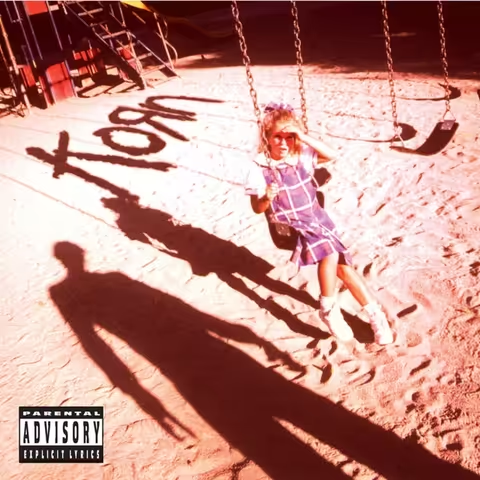
Stephen Stickler cover photograph was shot in a single Los Angeles afternoon. The girl on the swing was the eight-year-old niece of Immortal A&R Paul Pontius. She is dressed in a blue school uniform with a matching ribbon in her blonde hair, sitting upright on a swing she has braked to a stop with her feet, squinting into the sun at a figure standing in front of her. The figure itself is never seen; only the long shadow he casts on the sand. Beside the shadow, scratched in the ground, is the band name in the childlike handwriting Davis himself drew in the studio. The back cover shows the same playground, empty.
It remains one of the most discussed album covers of the decade. There is no overt violence in the image, no menace beyond the implication of an adult standing too close to a child. That implication is the entire record in a single frame. Jay Papke and Dante Ariola directed the art and booklet around the image. The reverse-R logo, scrawled and self-conscious, became the most recognisable band logo of the late 1990s.
The Singles and Their Videos
Four singles were lifted from the record, none of which behaved like ordinary radio singles. "Blind" arrived as a radio promo on 1 August 1994, two months ahead of the album. "Need To" followed in April 1995, "Shoots and Ladders" in June 1995, and "Clown" in July 1995. Only the first two received any meaningful video budget; "Shoots and Ladders" earned its own visual chiefly because the bagpipes were considered too unusual to leave on a label shelf without promotion.
| Single | Released | B-side / extras | Notable chart placing |
|---|---|---|---|
| Blind | 1 August 1994 | Live demo of Need To on some pressings | 15 (Canadian Alternative 30) |
| Need To | 8 April 1995 | Radio edit | Charted on US mainstream rock airplay |
| Shoots and Ladders | 30 June 1995 | Outtake Sean Olson; later licensed to The Crow: City of Angels soundtrack | Grammy nominated 1997 for Best Metal Performance |
| Clown | 12 July 1995 | Radio promo only in many territories | Limited chart action; heavy Headbanger Ball rotation |
The B-side trail is short but worth knowing about. "Sean Olson", one of the four shelved Indigo Ranch outtakes, was lifted off the bench and tucked onto the "Shoots and Ladders" CD single; it later resurfaced on The Crow: City of Angels soundtrack. The other three outtakes, "Christmas Song", "Layla" and "This Broken Soul", have circulated in low-quality form among collectors for decades but have never received an official release.
Release, Reviews and Slow-Burn Chart Trajectory
Released on 11 October 1994, the album did almost nothing commercially for a year. The US press were divided. Mike Boem of the Los Angeles Times compared it to Nine Inch Nails The Downward Spiral but concluded that as the album goes on, Korn blasting and hammering becomes more head-on, the results less distinctive. The Village Voice Robert Christgau gave it a derisive C-minus. Rock Hard in Germany rated it 7/10. Vox magazine in the UK gave it 6/10. The most enthusiastic contemporary review came from Jason Arnopp at Kerrang!, whose four-star write-up in November 1995 was a year after the fact.
"Davis voice overflows with cracked, frustrated emotion, often lapsing into uncontrollable screams like a mental ward. Korn have injected their own special insanity into the music, crafting a horribly sleazy sound that matches their bleak outlook on life."
Jason Arnopp, Kerrang!, November 1995
The chart story is one of the great slow burns in 1990s metal. Korn did not enter the Billboard 200 until 10 February 1996, sixteen months after release, peaking at number 72. It went gold in the United States on 29 January 1996, platinum on 8 January 1997, and double platinum on 10 November 1999. New Zealand was an early adopter (peak of 10). The UK Albums Chart did not register the record at all until 10 February 2001, when it scraped in at 181 on the back of Issues and Untouchables publicity. Korn is one of the very few albums in modern metal history whose chart peak arrived seven years after release.
Touring the Record Into Existence
The album sold because the band toured. After release Korn ran the California club circuit hard, then went out with Biohazard and House of Pain at free promotional shows where they personally handed flyers to the queues. The label gave them money for a tour bus; the bus broke down halfway through and they had to scramble for a replacement. None of it shifted records in the short term. Then on 21 January 1995 they joined the Sick of It All tour and stayed out for two months, slept on floors, ran their own merch.
The Sick of It All run rolled into the Danzig 4 tour alongside Danzig and Marilyn Manson, then into a Megadeth support slot in the summer of 1995 playing to crowds of 3,500 to 5,000 a night with Fear Factory and Flotsam and Jetsam. Davis introduced the bagpipes into the live show during the Megadeth tour. Crowds were, as Fieldy put it diplomatically, not initially enthusiastic. Korn played their UK debut at LA2 in London on 27 October 1995, then their Paris debut at L Arapaho a few days later. By October 1995 they had logged somewhere between 200 and 250 shows on the album.
- Sick of It All tour, January to March 1995.
- Danzig 4 tour, spring 1995 (with Marilyn Manson).
- Megadeth support, summer 1995 (with Fear Factory, Flotsam and Jetsam).
- First UK show, LA2 London, 27 October 1995.
- First Paris show, L Arapaho, October 1995.
- Ozzy Osbourne support (with Deftones), early 1996.
OZZfest, Lollapalooza and the Festival Breakthrough
The single most consequential booking of Korn post-album life was OZZfest 1996. The first edition of Sharon Osbourne festival was a modest affair (two shows at first), but Korn second-stage performance functioned as a public coronation by Ozzy Osbourne. By the time OZZfest expanded into a full national tour in 1997 Korn were main-stage. In 1997 they also took the headline slot of Lollapalooza, becoming the first nu-metal-coded band ever to do so. The Lollapalooza booking is the single moment most American music historians point to as the public acknowledgement that nu-metal had won.
By the time the band returned to record their second album Life Is Peachy (1996) and then the genre-defining [Follow the Leader](/posts/the-making-of-follow-the-leader-by-korn/) (1998), the debut had become a touchstone. Every band on the early Family Values Tour, every Roadrunner Records signing of 1998 and 1999, every second-stage OZZfest act, had a copy of Korn in the van.
Sales, Certifications and the Two-Million Mark
By 2003 Billboard reported that Korn had sold at least 2.1 million copies in the United States. The RIAA double-platinum certification dates to 10 November 1999, which makes the album a literal late-bloomer in a market that ordinarily writes a record off if it has not gone gold inside its first year. Australian Recording Industry Association certified it platinum, with Recorded Music NZ matching the same level. The British Phonographic Industry certified it gold in 1999. By every traditional industry metric the album underperformed at launch and overachieved in catalogue, and remains a slow seller more than three decades later.
Legacy: The Ground Zero of Nu-Metal
Almost every credible history of nu-metal positions Korn as the founding text. Joel McIver, in his 2002 book on the genre, wrote that the band was almost solely responsible for the tidal wave of change that subsequently swept the metal scene. Rolling Stone in 2014 called it the most important metal record of the last 20 years. Loudwire in 2018 named it the greatest nu-metal album of all time, and reaffirmed the verdict in a 2026 list of the top fifty nu-metal records.
The list of bands who have publicly cited it is exhausting. Limp Bizkit, who hired Ross Robinson to produce their debut in 1997 on the strength of Korn alone. Slipknot, whose first two albums Robinson also produced, with the methodology refined on Korn. System of a Down, Linkin Park, Coal Chamber, Static-X, Sevendust, Mudvayne, the early [System of a Down](/posts/the-making-of-toxicity-by-system-of-a-down/) wave. Beyond nu-metal, the dropped-tuning seven-string vocabulary on Korn became the harmonic basis of progressive bands as distant as Meshuggah late 1990s output and the entire djent movement that followed a decade later. Korn influence is the single largest tonal shift in heavy music between [Nevermind](/posts/the-making-of-nevermind-by-nirvana/) in 1991 and Slipknot Iowa in 2001.
"Nirvana provided the soundtrack to the trials of disaffected youth. Korn debut album was the manifestation of disaffected youth itself. Korn itself was the forebear of a musical movement."
Catherine Yates, Kerrang!, 2002
Reissues, Anniversaries and Retrospective Praise
Korn has been reissued repeatedly. A 1999 European pressing carried the bonus track "Sean Olson". A 2011 super-deluxe pressing in remastered form added demo material and live recordings. For the 20th anniversary in 2014 Rolling Stone commissioned an oral history of the album from Christopher R. Weingarten that remains the definitive long-form account of the sessions. The 30th anniversary in 2024 brought another wave of retrospective coverage from Metal Hammer, Revolver, the Grammy organisation and others. Guitar World ranked the album 27th in their Superunknown: 50 Iconic Albums That Defined 1994 feature.
Critically the record has only risen. AllMusic Stephen Thomas Erlewine gave it five stars on retrospective reissue. Pitchfork 2025 retrospective from Grayson Haver Currin awarded it 8.6/10. Blender, The Encyclopedia of Popular Music, the Collector Guide to Heavy Metal, Sputnikmusic and Kerrang! 2011 666 Albums You Must Hear Before You Die all rated it four stars or higher. Jonathan Davis himself, in a 2015 Vice ranking of every Korn album, placed the debut at number one. The band have toured and re-toured the album in full on various anniversary runs, with Davis citing it as the easiest record in their catalogue to perform live because every song was tracked live in the first place.
Things You Might Not Know
| Fact | Detail |
|---|---|
| The Underground Chicken Sounds connection | The pre-Indigo Ranch demo cassette Neidermayer Mind was tracked in a Huntington Beach studio rented from Jeff Creath, who had previously let Jonathan Davis sleep in his garage. |
| Blind is a Sexart song | The album opening track was originally written by Dennis Shinn and Ryan Shuck for Davis pre-Korn band Sexart. Both men kept the songwriting credit when Davis took it with him. |
| The bagpipe location myth | The bagpipes that open Shoots and Ladders were not recorded on a mountaintop, despite the legend. Engineer Richard Kaplan set up a microphone at Indigo Ranch back door and Davis walked out of the studio playing. |
| The Daddy breakdown was unplanned | Davis was not told the tape was rolling during his vocal breakdown at the end of Daddy. Robinson played it back to him days later and asked permission to leave it on the record. |
| Robert Trujillo co-write | The current Metallica bassist, then in Suicidal Tendencies, helped Korn write Divine during the album pre-production. He is credited on the song. |
| The hidden track has a name | The 14:05 segment buried inside Daddy is officially titled Michael and Geri and is, on some pressings, listed as a separate 3:26 track. It is a found recording of a couple arguing about a Dodge Dart carburetor. |
| The cover girl identity | The girl on the album cover is Paul Pontius niece. Pontius was the Immortal A&R who signed the band, and he brought his niece to the photo session himself. |
| The Korn logo is Davis handwriting | The reverse-R logo that became one of the most recognisable in 1990s metal was drawn by Jonathan Davis with a pen during the sessions. |
| Four outtakes still circulate | Christmas Song, Sean Olson, Layla and This Broken Soul were recorded and shelved. Only Sean Olson has ever received an official release, on the Shoots and Ladders CD single and the Crow: City of Angels soundtrack. |
| The album charted in the UK seven years late | Korn did not register on the UK Albums Chart until 10 February 2001, peaking at number 181 on the back of publicity for later releases. |
| Davis was a coroner assistant | Before joining Korn full-time, Jonathan Davis worked as a deputy coroner assistant in Bakersfield, an experience he has cited as one of the sources of the album mortality-saturated imagery. |
| The Ibanez signature models | The Ibanez Apex (Munky) and Ibanez K7 (both guitarists) signature seven-string models, still in production today, were developed in direct response to the album popularising of the instrument. |
| Methamphetamine was the unofficial fifth member | Davis and Munky have both confirmed in subsequent interviews that the band were on methamphetamine through most of the recording. Helmet in the Bush is a literal physical description of one of the drug side-effects. |
| Pitchfork only got around to it in 2025 | The album did not receive a Pitchfork review until October 2025, when Grayson Haver Currin awarded it 8.6/10 in a retrospective reassessment. |
Final Thoughts
Korn is the rarest of debut albums: a record whose stylistic decisions, taken under modest commercial pressure by a band nobody had yet heard of, hardened almost overnight into a template for an entire genre. The dropped seven-string voicing, the slap-and-pop palm-muted bass, the breakbeat-meets-double-kick drumming, the screamed and whispered confessional vocal, the producer who treated tape as a confessional rather than a document: all of it is on the record, all of it is intentional, and almost none of it had existed in a single coherent place before October 1994.
What makes the album endure is that it is not, finally, a manifesto. It is the sound of five young men from Bakersfield being honest in front of a producer who refused to look away, on a hilltop in Malibu with the doors of the live room open and the tape running. The genre it founded splintered and decayed; Korn the album never did. Riffology covers Korn and the wider nu-metal canon in considerable depth on the podcast, available on Apple Podcasts, Spotify and every other major platform.
Comments