Two tracks vanished from the album six months after it landed in record shops. A 500,000-dollar contract, nine men in homemade masks, a producer who threw potted plants across the live room at the drummer, and the first platinum certification in the 19-year history of Roadrunner Records, Slipknot's self-titled debut arrived in the summer of 1999 already at war with itself.
The record that turned a basement covers band from Des Moines, Iowa into one of the most commercially successful metal acts of the next two decades was, by every account from the people who made it, recorded as if the building were on fire. Drums tracked in three days. The whole band in a single room, headphones lashed to their heads with gaffer tape, smashing into each other while Ross Robinson stalked the floor goading them into the next take. A mix done end-to-end on analog tape because everything else felt too clean. Six months later, two tracks pulled from every new pressing thanks to a lawsuit nobody had seen coming. This is the story of how that record got built.
Album Facts
| Field | Detail |
|---|---|
| Artist | Slipknot |
| Album | Slipknot |
| Release Date | 29 June 1999 (original); revised pressing December 1999 |
| Label | Roadrunner Records, in association with Robinson's I Am imprint |
| Producer(s) | Ross Robinson and Slipknot |
| Studio(s) | Indigo Ranch Studios, Malibu, California; additional sessions early 1999 |
| Genre | Nu metal, alternative metal, with audible groove metal and hardcore traces |
| Track Count | 15 |
| Total Runtime | 60 minutes 24 seconds |
| Billboard 200 Peak | 51 |
| UK Albums Chart Peak | 37 |
| Other Notable Chart Peaks | Canadian Albums 89, Australian ARIA 65, French SNEP 91 |
| Certifications | 3 times platinum (RIAA, 2025), platinum (BPI, 2008), double platinum (Music Canada, 2021) |
| Estimated Sales | More than three million copies in the United States alone |
| Key Singles | "Wait and Bleed" (Grammy-nominated, UK 34); "Spit It Out" |
Cultural Context: The Summer Nu Metal Broke
The album dropped into a heavy-music landscape that, for a brief 18-month window, was the most commercially dominant force in the American mainstream. Korn had released Issues a few months earlier. Limp Bizkit's Significant Other arrived a week before Slipknot, on 22 June 1999, and went straight to number one on the Billboard 200. Deftones were in the studio finishing White Pony. Woodstock '99 was three weeks away, and the cocktail of nu metal aggression, Y2K anxiety and post-Columbine moral panic that lit the petrol fires of Rome, New York was already in the air.
Roadrunner Records, the New York affiliate of a Dutch independent that had built its reputation on death metal, thrash and Sepultura, was deliberately repositioning itself for that mainstream. The label's A&R man Monte Conner had been chasing the Korn-Limp Bizkit slipstream for a year. Slipknot were not the obvious shape of that slipstream, they had more members than most bands have records, they wore boilersuits and self-built horror masks, and their existing demo tape was a 12-track grind of percussion-heavy industrial metal called Mate. Feed. Kill. Repeat. But Robinson had heard them, told Conner they were the future, and Roadrunner signed them on the strength of a producer's word.
The Band's Story to This Point
Slipknot began life on 4 September 1995 as The Pale Ones, a side project assembled by drummer Shawn Crahan, bassist Paul Gray and singer Anders Colsefni out of a cluster of Des Moines acts including Heads on the Wall and Modifidious. By the second rehearsal on 15 September they had written a song called "Slipknot" so unanimously liked that the band took its name within the month. Drummer Joey Jordison joined that autumn and the lineup began to expand outward in concentric rings: percussionist Greg "Cuddles" Welts, guitarist Donnie Steele, sampler Craig "133" Jones, second guitarist Mick Thomson.
Their first proper recording, Mate. Feed. Kill. Repeat., was self-released on 31 October 1996 in a run of around a thousand cassettes and CDs. It is a stranger, jazzier, less focused record than the album that followed, with Colsefni's death-metal bellow at the centre and a barcode (742617000027) on the cover that would later be reincarnated as the catalogue number burned onto the debut's artwork.
The 18 months between that demo and the move into Indigo Ranch were a churn of personnel changes. Welts was sacked. A second percussionist, Brandon Darner, came and went. Chris Fehn took the percussion seat. A young DJ called Sid Wilson, recruited after pestering Crahan with cassette tapes, became the ninth member and took the number zero. Most importantly, Colsefni stepped aside in 1997 in favour of Corey Taylor, then fronting another Des Moines band called Stone Sour. By the time Roadrunner signed them on 8 July 1998 for a seven-album, half-million-dollar deal, the nine-headed lineup that would record the album was finally in place, with the original guitarist Josh Brainard alongside Thomson on the second guitar slot.
Pre-production and Demos
The songs Slipknot took to Malibu were not new. Most had been part of the live set for two or three years and several had appeared in earlier form on Mate. Feed. Kill. Repeat. "Tattered & Torn", "Me Inside", "Scissors" and the song originally called "Slipknot" all dated to the Pale Ones era. The pre-production task, as Robinson saw it, was not writing but stripping.
Robinson had spent the back half of the 1990s producing albums for Korn, Sepultura, Limp Bizkit and Deftones, and he came in with a clear idea of what the band should sound like on tape, leaner, more focused, with the jazzy detours and extended instrumental passages of the demo cut away. The band, by their own later admission, were initially resistant. Several solos were dropped. The opening "742617000027" interlude, with its sample of Charles Manson's prison cellmate Charles Watson, was kept in part because it gave the producer a way to bait the listener before the album proper began.
- Songs carried over from the Mate. Feed. Kill. Repeat. demo: "Slipknot" (renamed "(sic)"), "Tattered & Torn", "Me Inside", "Scissors", "Do Nothing/Bitchslap" fragments, "Carve" and "May 17".
- Songs written fresh for the album: "Wait and Bleed", "Surfacing", "Spit It Out", "Eyeless", "Diluted", "Only One", "Purity".
- Working title for the band throughout pre-production: still informally "The Pale Ones" in some session paperwork.
Creating the Album: Indigo Ranch, Autumn 1998
Indigo Ranch sat at the top of a hill above Malibu, surrounded by chaparral and reachable only by a single-track road. It had been built by Richard Kaplan in the 1970s and run on a strict no-digital, all-analog policy. Robinson loved the building, the all-tube signal chain and the live room large enough to set the entire band up facing each other with sightlines through the glass. That single architectural fact shaped almost every decision that followed.
The sessions began on 29 September 1998 and ran until 11 November, with a further block in February 1999 for vocals and the recording of Jim Root's contribution to "Purity". Robinson insisted the whole band track live in the same room rather than overdub in sequence. Headphones were taped to skulls. Crahan and Fehn ran around their drum kits in masks. The drummer's monitor mix was deliberately set so hot that Jordison could not hear himself think.
"All of us were in the same room when we recorded this. It was hilarious. Everyone had their headphones tied to their head so we could all slam and go crazy while we played. Ross was throwing potted plants at Joey."
Shawn Crahan, Kerrang!, 2012
Jordison's drums for the entire album were captured in three days. Robinson, who had developed his shouting-the-band-into-greatness method on the first two Korn records, prowled the live room demanding more, then sitting in front of Taylor's vocal mic and telling him to make the lyrics hurt. The intent, by every account, was to record a documentary of nine people losing control in real time and to capture it before anybody could overthink it.
Mixing, by contrast, was glacial. Jordison and Robinson mixed end-to-end on analog tape, no automation, hands on the desk. Robb Flynn of Machine Head, who visited the sessions, has said in interviews that "Purity" alone took close to a month, the band using it as a sonic template against which every other mix was then dialled. Brainard had quit the band over the Christmas break, citing personal disagreements and unhappiness with creative decisions; Root, recruited in late January from Iowa's Atomic Opera, came in for the February sessions and recorded his single album-credit part on "Purity".
"There were some decisions that were made that I wasn't particularly happy with. I didn't want my family life to be a casualty of the band."
Josh Brainard, quoted in Joel McIver's Slipknot biography, 2003
Personnel and Credits
| Role | Player | Notes |
|---|---|---|
| Core band | ||
| #8 Vocals | Corey Taylor | His first album with Slipknot, having replaced Anders Colsefni in 1997 |
| #7 Guitar | Mick Thomson | Recruited 1996 after Robb Flynn turned the slot down |
| #4 Guitar | Jim Root | Joined February 1999; recorded only on "Purity" |
| #2 Bass | Paul Gray | Founding member; died 2010 |
| #1 Drums | Joey Jordison | Drum tracking completed in three days; also co-mixed the record |
| #6 Percussion | Shawn "Clown" Crahan | Founding member; the masked-band concept originated with his clown mask at early rehearsals |
| #3 Percussion (credited) | Chris Fehn | Credited but did not perform on the recording |
| #5 Samples and media | Craig "133" Jones | Originally joined as second guitarist before moving to samples |
| #0 Turntables | Sid Wilson | Recruited 1998; the youngest member of the band |
| Guests, uncredited and disputed | ||
| Guitar (uncredited) | Josh Brainard | Performed on 14 of the 15 tracks before quitting; uncredited in the original sleeve |
| Percussion on demos | Greg "Cuddles" Welts | Played on the "Spit It Out" demo recordings; fired before the album sessions |
| Production and engineering | ||
| Producer | Ross Robinson | Signed the band to his I Am imprint as a stepping stone to the Roadrunner deal |
| Co-producer | Slipknot | Credited collectively |
| Engineer | Chuck Johnson | Tracking and mixing at Indigo Ranch |
| Additional engineer | Sean McMahon | Mixing on "Spit It Out" |
| Pro-Tools and digital edits | Rob Agnello, Steven Remote | Final assembly |
| Mastering | Eddy Schreyer | Oasis Mastering, Studio City |
| Artwork | ||
| Cover photography | Stefan Seskis | Tribal-skull mask logo against black |
| Band photography | Dean Karr | Inside-sleeve portraits in jumpsuits and masks |
| Design | T42Design | Including the barcode motif (742617000027) carried across from the demo |
| Creative direction | Lynda Kusnetz | Roadrunner art department |
The footnote that has rattled around Slipknot fandom for 25 years is the Fehn-and-Brainard situation. The sleeve credits Fehn as one of the nine, even though he played no audible part in the recorded album; Brainard, who played the second-guitar parts on every track except "Purity", does not appear in the credits at all. The decision was less malice than logistics, Brainard had quit by the time the sleeve went to print, Fehn had already been adopted as part of the public-facing nine, and the band wanted the iconography intact for the campaign. Both versions of the story have been told by participants in various interviews since, and neither party has ever contradicted the other in any meaningful detail.
The Songs
| # | Title | Writer(s) | Length | Single? | Notes |
|---|---|---|---|---|---|
| 1 | 742617000027 | Slipknot | 0:36 | Title is the Mate. Feed. Kill. Repeat. barcode | |
| 2 | (sic) | Crahan, Jordison, Gray, Taylor | 3:19 | The song that gave the band its name | |
| 3 | Eyeless | Slipknot | 3:56 | Cronenberg's Videodrome sample at the head | |
| 4 | Wait and Bleed | Jordison, Taylor | 2:27 | Yes | UK 34; Grammy-nominated 2001 |
| 5 | Surfacing | Slipknot | 3:38 | Live-set staple from the first tour | |
| 6 | Spit It Out | Jordison, Taylor | 2:39 | Yes | Demo take used on the album |
| 7 | Tattered & Torn | Slipknot | 2:53 | Pale Ones-era composition | |
| 8 | Frail Limb Nursery | Slipknot | 1:43 | Pulled from the December 1999 pressing | |
| 9 | Purity | Slipknot | 4:13 | Pulled from the December 1999 pressing; Root's only credit | |
| 10 | Liberate | Slipknot | 3:06 | One of the album's most direct grooves | |
| 11 | Prosthetics | Slipknot | 4:55 | One of the slowest, most claustrophobic cuts | |
| 12 | No Life | Slipknot | 2:46 | Live favourite, still in setlists 25 years later | |
| 13 | Diluted | Slipknot | 3:25 | The one song from the album never played live | |
| 14 | Only One | Slipknot | 2:26 | Slayer "South of Heaven" sample buried in the intro | |
| 15 | Scissors | Slipknot | 19:15 | Roughly five minutes of song, ten minutes of silence and a hidden conversation at 2:48 of the ghost track |
"(sic)" is the song that walked into the room before the band even had a name. Written on 15 September 1995 at the second-ever rehearsal of The Pale Ones, it carried the working title "Slipknot" for weeks before everybody agreed that the song's name was simply better than the band's. The percussion break that drops at 1:40 is essentially the band's argumentative thesis statement, two drum kits and two percussion rigs hitting in close, deliberate sync.
"Wait and Bleed" is the record's accidental pop song, and its accidental introduction for the rest of the world. Built around a clean-sung Taylor melody he had reportedly written years earlier for a different project, it lasts barely 150 seconds and crams a hook so direct into a chorus that it ended up nominated for the Best Metal Performance Grammy at the 2001 ceremony, where it lost to Deftones' "Elite". Thomas Mignone's video, shot in summer 1999, is mostly the band thrashing inside a single warehouse while a goat looks on. VH1 later placed the song at number 36 on its 40 Greatest Metal Songs list.
"Eyeless" opens with a David Cronenberg sample from Videodrome and rides a Gray bassline that is essentially one repeated rhythmic figure for four minutes. Taylor has said in interviews that it was the song that gave him the most trouble during tracking, in part because Robinson kept insisting on more takes after takes Taylor thought were already finished. "Surfacing" couples a Fatboy Slim drum sample to the album's most quotable chorus, a 12-word obscenity that any festival crowd from 2000 onwards could and did chant back at the band on command.
"Spit It Out" was meant to be re-recorded for the album. The producer and band, late in the sessions, decided the original demo take, with a borrowed General Degree dancehall sample running underneath the chorus, simply could not be improved upon. Mignone's video for the follow-up single, all paddleball and silent comedy, was nominated at the 2001 MTV Video Music Awards.
"Purity" and the spoken-word interlude "Frail Limb Nursery" that introduces it tell the album's strangest story. The lyrics describe the kidnap, burial-alive and death of a fictional woman called Purity Knight, a character lifted from a website called Crime Scene that the band had stumbled across online. The site was a fiction. Its owner, however, had registered the Purity Knight character as a copyrighted work, and in late 1999 he threatened legal action against Roadrunner. The label pulled both tracks from every pressing struck from December 1999 onwards, replacing them with "Me Inside" (carried over from the demo). Both songs were restored on the 2009 anniversary edition.
"I still think the story's real. It fucked our whole world up when we read it. To find out it wasn't, it was almost worse. It made us feel like we'd been duped."
Corey Taylor, quoted by Jason Arnopp in Kerrang!, 2001
"Scissors" closes the original album with a 19-minute coda. Roughly five and a half of those minutes are the song itself. The rest is silence, broken at the 2:48 mark of the silent run by a buried audio passage in which the band can be heard performing an unplanned jam variously called "Mudslide" or "Eeyore", with samples from Carlito's Way, Ice Cube and Duke Nukem 3D threaded through it. It was the band's idea of an Easter egg long before the modern streaming era made hidden tracks impractical.
B-sides, Outtakes and Lost Songs
The Indigo Ranch sessions and the subsequent single campaigns generated more material than the original album could hold. Several of those tracks resurfaced on the 2002 digipak reissue and the 2009 anniversary edition.
- "Get This", a session outtake later released on a Japanese edition and on the digipak reissue.
- "Despise" and "Snap", earlier-era songs cut as demos during the sessions and held back for the anniversary edition.
- "Interloper", another period outtake released for the 10th anniversary edition.
- The Terry Date remix of "Wait and Bleed", commissioned but never released as a single.
- The "Hyper" and "Stamp You Out" remixes of "Spit It Out", and a "Molt-Injected" mix of "(sic)", all single-era B-sides.
- The original "Wait and Bleed" demo, with a noticeably different guitar arrangement.
Album Artwork and Packaging
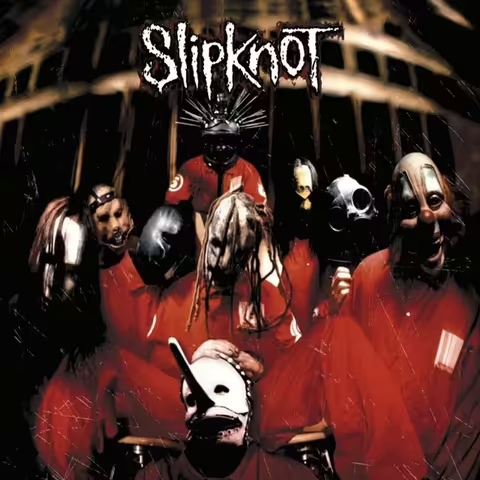
Stefan Seskis shot the front cover, a stark photograph of the cracked tribal-skull mask logo against an empty black background, in a single afternoon. The mask itself, designed by Crahan and adopted as the band's emblem before the Roadrunner deal, was inverted on later pressings of the booklet as the design evolved.
The internal sleeve carried Dean Karr's full-band photographs, with each member numbered and named only by alias, and the barcode 742617000027 reproduced in several places, a deliberate echo of Mate. Feed. Kill. Repeat. and a small private joke for the listeners who had bought the demo cassette. The catalogue number on the spine of the album was also encoded into the same barcode, blurring the line between artwork and packaging metadata.
Roadrunner's UK arm pushed an unusual amount of investment into the physical packaging of the early pressings, including a digipak edition and a strictly limited Australian tour-edition pack. The 2009 super-deluxe anniversary edition, by contrast, was shipped in a steel case modelled on a US safety deposit box and contained a T-shirt, a fabric patch, a set of nine masked cards, a beanie, a keychain and a personal handwritten note from Taylor, plus a DVD called Of the Sic: Your Nightmares, Our Dreams.
Release and Reception
The album shipped on 29 June 1999 to reviews that ranged from cautious admiration to outright thrill. The British press, which had been writing about the band since import copies of the demo had surfaced in 1997, was the most enthusiastic. Kerrang! gave it five Ks. Q awarded it four stars and called it "a terrifying racket". AllMusic's Rick Anderson gave it four stars and noted that the album was "an auspicious debut" while warning, with the magazine's typical understatement, that "those lyrics that are discernible are not generally quotable on a family website."
"A clever synthesis of slasher movie aesthetics with grindingly heavy metal, the album is exciting but not, perhaps, built to endure."
Jon Hotten, Classic Rock, retrospective review, 2009
The American press was slower to catch up. Rolling Stone ran two notices in 2000, including an Anthony Bozza piece that branded the band "the first death metal jam band" and gave the record three stars. Chart-wise, the album entered the Billboard 200 at a modest position and crept up to number 51, the climb sustained almost entirely by touring rather than radio. In the UK it reached number 37 on the albums chart.
The award-show recognition came later. "Wait and Bleed" earned a Best Metal Performance Grammy nomination at the 2001 ceremony. The album itself appeared on the Q "50 Heaviest Albums of All Time" list in 2001, in 1001 Albums You Must Hear Before You Die, and was voted Best Debut Album of the Previous 25 Years by Metal Hammer readers in 2011. Revolver readers placed it second on the Greatest Nu-Metal Album of All Time poll in 2018; Loudwire put it at number 7 on the Top 50 Nu-Metal Albums of All Time in 2025.
Singles and Music Videos
| Single | Release | UK Singles Chart | Director | B-sides | Notes |
|---|---|---|---|---|---|
| "Wait and Bleed" | 28 July 1999 | 34 | Thomas Mignone | "Wait and Bleed" (Terry Date Mix); demo | Grammy nomination 2001 |
| "Spit It Out" | 19 September 2000 | 34 | Thomas Mignone | "Hyper" and "Stamp You Out" remixes | MTV VMA nomination 2001 |
| "Welcome to Our Neighborhood" | December 1999 | n/a | Slipknot, with Crahan | Home-video documentary release rather than single | Live, behind-the-scenes and video footage |
Mignone's "Wait and Bleed" video became, in the absence of meaningful US radio play, the single most-watched route into the band for new listeners. MTV's Headbangers Ball had been off the air for two years; the video found its audience through the network's late-night specialist programming, 120 Minutes and the early days of MTV2. In the UK, Kerrang! TV's heavy rotation of the clip from late 1999 onwards drove most of the initial album sales.
Touring and Live
The campaign that broke the album was relentless. Slipknot toured almost continuously from May 1999 to the end of 2000. A support slot on the second stage of Ozzfest 1999 introduced them to a US festival audience while the record was still climbing. They opened for Coal Chamber and Machine Head on the Livin' La Vida Loco tour, headlined club shows on their own World Domination Tour, and joined Tattoo the Earth in 2000 alongside Slayer, Sepultura and Sevendust.
The live shows were the campaign's secret weapon. The stage was tiered to give Crahan and Fehn elevated platforms from which to climb, jump and on one Donington occasion in 2002 fall. Crahan was photographed at various points on the 1999 tours tying audience members to the stage with his microphone cable; Gray and Wilson developed a habit of catching each other mid-stage-dive; the band's pyrotechnics, against the advice of every venue insurance broker who looked at them, often involved members setting other members briefly on fire. Several of those shows ended early when the band physically could not continue.
"We were animals on that tour. We didn't know how to behave because no one had ever told us. Every night was the last night."
Paul Gray, Revolver, 2008
A feud with Limp Bizkit's Fred Durst escalated through the autumn of 1999 and provided convenient column inches for the music weeklies. A more enduring rivalry with the Cleveland masked-band Mushroomhead, who had been wearing masks on stage since 1993 and accused Slipknot of borrowing their visual concept, began around the same time and dragged on for the better part of a decade.
In TV, Film and Media
- "Wait and Bleed" appeared at number 36 on VH1's 40 Greatest Metal Songs (2006) and has soundtracked sequences in WWE programming, the 2003 horror film Freddy vs. Jason trailer and multiple video-game compilations including Tony Hawk's Pro Skater 3.
- "Surfacing" has been used by sports broadcasters as an entrance theme for combat-sport athletes throughout the 2000s and 2010s, including UFC pre-fight reels.
- The Welcome to Our Neighborhood home video, released in December 1999, became one of the better-selling music VHS releases of the year.
Controversy, Censorship and Lawsuits
The Purity Knight lawsuit was the most consequential, costing the band two tracks of the album for a decade. There were others. In the wake of the April 2002 Erfurt school shooting in Germany, several newspapers attributed the killer's actions to the influence of a Slipknot song called "School Wars", a track that does not exist and never has. A 2003 double homicide in the United States produced a similar set of headlines attempting to link the killings to "Disasterpiece", a song that had not appeared on the debut at all. In 2006 a British tabloid found "Surfacing" lyrics spray-painted on a vandalised gravestone and made the obvious leap. None of the press attempts to connect the band to real-world violence were ever supported by either the police or the courts.
The Mushroomhead dispute simmered into the early 2000s. The Burger King "Coq Roq" advertising campaign of 2005, in which a fake masked-band parody appeared in commercials, prompted Slipknot to threaten legal action over trade-dress similarities; Burger King quietly retired the campaign in early 2006.
Covers, Samples and Tributes
"Wait and Bleed" has been covered live by acts including Bring Me the Horizon and the Norwegian black-metal band Anaal Nathrakh, and string-quartet versions appear on the Cellos vs. Slipknot tribute album. The album itself draws on samples and audio fragments from Videodrome, Carlito's Way, Ice Cube's catalogue, Duke Nukem 3D, Fatboy Slim and Slayer's South of Heaven, with the snippet of Charles Manson's cellmate Charles Watson opening "742617000027" the most overtly provocative.
The band's own influence is now traceable through a generation of younger heavy bands, Code Orange, Knocked Loose, Bad Omens, Sleep Token, Slaughter to Prevail and Vended (the latter fronted by Corey Taylor's son Griffin) have all cited the record in interviews. Infant Annihilator's drummer has named "(sic)" as the first metal song he learned to play.
Reissues, Remasters and Anniversaries
The December 1999 reissue with "Purity" and "Frail Limb Nursery" replaced by "Me Inside" remains the most-pressed version of the album in the world. A 2002 digipak repackaging added "Get This" and the "Wait and Bleed" demo. The 10th anniversary edition, deliberately released on 9 September 2009 (9/9/09, one nine for each member of the band) restored the original tracklist, added the unreleased outtakes "Despise" and "Interloper", and packaged the whole thing with a bonus DVD Of the Sic: Your Nightmares, Our Dreams containing the three original music videos in restored form and a full concert from Dynamo Open Air 2000.
The super-deluxe edition of the 2009 release, the safety-deposit-box pack described earlier, was limited and quickly went out of stock. Vinyl reissues have appeared on Roadrunner's catalogue programme several times since, including a 2014 picture-disc edition and a 2024 25th anniversary half-speed master cut at Abbey Road.
Legacy and Influence
Slipknot became Roadrunner Records' first ever platinum album when the RIAA certified it on 2 May 2000. Triple platinum followed in September 2025. The label's catalogue total for the band's first three records is now in the eight-figure US-sales range, and the parent group Warner Music Group's recent acquisition of HarbourView Equity Partners' stake in the Slipknot catalogue in November 2025 valued the back catalogue itself in nine figures.
For the band, the album set up everything that followed. Iowa, the abrasive 2001 follow-up, cemented their reputation for hostility and gave the catalogue its critical credibility. The masked-band concept, the boilersuits, the numbered aliases and the personnel logic of "we are nine, not one" have remained intact across the deaths of Gray and Jordison and the departures of various members in the years since. A whole subgenre of theatrical, mask-and-uniform-led heavy bands now exists in the album's wake, with Sleep Token currently demonstrating that the model still has commercial life 25 years on.
Things You Might Not Know
| Fact | Detail |
|---|---|
| The song that named the band | "(sic)" was written at the second-ever rehearsal of The Pale Ones on 15 September 1995. It was originally called "Slipknot", and the band liked the title so much they took it as their own name within weeks. |
| That barcode | The 742617000027 on the back cover and threaded through the booklet artwork is the actual catalogue barcode of the Mate. Feed. Kill. Repeat. demo cassette from 1996. |
| The missing guitarist | Josh Brainard played guitar on 14 of the 15 tracks but is uncredited in the sleeve, having quit during the Christmas 1998 break before the album shipped. |
| The credited guitarist | Chris Fehn is one of the nine credited members but did not perform on the recording. He had been adopted as part of the band's public-facing lineup before the sessions began. |
| Jim Root's lone contribution | The current guitarist's only credit on the debut album is the song "Purity", recorded in February 1999 after Brainard's departure. |
| Three days for the drums | Joey Jordison tracked the drums for the entire album in approximately three days at Indigo Ranch in autumn 1998. |
| One room, one take | Ross Robinson insisted the whole band record in the same live room simultaneously, with headphones gaffer-taped to skulls so they would not fall off during the performance. |
| Plants as motivation | Robinson is reliably reported to have hurled potted plants across the live room at Joey Jordison during drum takes whenever he wanted more aggression on tape. |
| All analog, no automation | The mix was done entirely on analog tape, with Jordison and Robinson on the desk and no mix automation, taking close to a month on "Purity" alone as the template for everything else. |
| One song never played live | "Diluted" is the only track from the album that the band have, as of 2025, never performed live. |
| The Grammy that got away | "Wait and Bleed" lost the 2001 Best Metal Performance Grammy to Deftones' "Elite". |
| Roadrunner's first platinum | In May 2000, after 19 years of operation, Roadrunner Records achieved its first ever RIAA platinum certification, courtesy of the Slipknot debut. |
| The safety deposit box | The 2009 super-deluxe anniversary edition was shipped in a steel case modelled on a US safety deposit box, complete with a fabric patch, a beanie, a keychain and a handwritten note from Corey Taylor. |
| Fantomas was a turning point | The band attended a Fantomas show at the Troubadour in Los Angeles mid-recording. Corey Taylor later said it "made Mr Bungle look like Lawrence Welk" and changed his sense of what the band could attempt next. |
| The hidden conversation | The "Scissors" coda hides a band conversation at the 2:48 mark of the long silent passage, complete with samples from Carlito's Way, Ice Cube and the video game Duke Nukem 3D. |
The Riffology Podcast
If you want to hear two of us sit down and pull this album apart at length, the Riffology podcast covers Slipknot, the Roadrunner deal, the lawsuit that pulled the tracks and the live shows that nearly maimed the band over the course of a long-form conversation. The show is available on Apple Podcasts, Spotify, Amazon Music, Pocket Casts and every other major platform. Search for Riffology, hit subscribe, and the new episodes will land in your feed automatically.
Comments