Trent Reznor built The Downward Spiral out of noises that were never meant to be music: a handful of cutlery dropped on the floor, the test tone of a man hired to tune the studio, insects sampled until they sounded like strings, and the soundtracks of roughly 3,000 films that drummer Chris Vrenna listened to with the picture covered. He did it in a rented house in Benedict Canyon, 10050 Cielo Drive, where Sharon Tate and four others were murdered by members of the Manson Family in August 1969, and he named the studio Le Pig after the word written on its front door.
The second Nine Inch Nails album, often shortened to just Downward Spiral, came out on 8 March 1994. It is a concept record about a man stripping away everything he has until nothing is left, made by a 28-year-old who was fighting depression and a growing drug habit while he wrote it. It debuted at number two in America, went four times platinum, turned "Closer" into the most unlikely MTV hit of the year, and ended with a song Johnny Cash would one day take for his own.
Album Facts
| Field | Detail |
|---|---|
| Artist | Nine Inch Nails |
| Album | The Downward Spiral |
| Release Date | 8 March 1994 |
| Label | Nothing / Interscope (US); Island (Europe) |
| Producer(s) | Trent Reznor, Flood |
| Studio(s) | Le Pig (10050 Cielo Drive, Benedict Canyon); Record Plant, Los Angeles; A&M Studios, Hollywood |
| Genre / Subgenre | Industrial rock, alternative rock, industrial metal |
| Track Count | 14 |
| Total Runtime | 65:02 |
| Billboard 200 Peak | 2 (nearly 119,000 first-week copies) |
| UK Albums Chart Peak | 9 |
| Other Notable Chart Peaks | Scotland 8, Australia 12, Canada 13, New Zealand 23 |
| Certifications | 4x Platinum (RIAA); 3x Platinum (Canada); Gold (BPI, ARIA) |
| Estimated Sales | Over 4 million worldwide; 3.7 million in the US by 2011 |
| Key Singles | March of the Pigs; Closer; Hurt (promo) |
The World The Downward Spiral Landed In
Guitar rock owned 1994, and Reznor knew he was swimming against it. "I think keyboards have been given a bad rap in rock music," he told Keyboard that March. "The Pearl Jams and whoever, that's not what I'm about. I like keyboards. I like technology."
His label was already in the firing line. Interscope was being pilloried by politicians for gangsta rap by Dr. Dre, 2Pac and Snoop Dogg, and Nine Inch Nails were about to join that list. On release day itself, Soundgarden put out Superunknown, and a week later the two records sat at one and two on the Billboard 200, 310,000 copies to nearly 119,000. In most weeks, Reznor's figure would have been enough for the top spot.
At the 1995 Grammys, the Best Alternative Music Performance shortlist showed just how strange the company was:
- Green Day, Dookie (the winner)
- Nine Inch Nails, The Downward Spiral
- Tori Amos, Under the Pink
- Crash Test Dummies, God Shuffled His Feet
- Sarah McLachlan, Fumbling Towards Ecstasy
From Cleveland to Cielo Drive: Nine Inch Nails Before The Downward Spiral
Nine Inch Nails began in Cleveland, where Reznor worked as an assistant engineer and janitor at Right Track Studios and used the empty rooms between bookings to make his demos. Inspired by Prince, he played everything himself. The result, Pretty Hate Machine, came out on TVT Records in 1989, spent 113 weeks on the Billboard 200 and became one of the first independently released records to go platinum.
The live band that toured it was a different animal, smashing equipment by the first Lollapalooza in 1991. Opening day in Phoenix, a melted power box kept killing their backing tape. "We smashed all the gear and ran to the bus," Reznor recalled.
Success soured his relationship with TVT. When the label refused to let him go, he and Flood recorded the Broken EP in secret under another band name so TVT could not seize the tapes. Then Interscope boss Jimmy Iovine struck a deal with TVT chief Steve Gottlieb, and Reznor found himself, in his words, "slave-traded" to a new home, with his own imprint, Nothing Records, run with manager John Malm Jr. Broken reached the Billboard top ten in 1992, and its single "Wish" won a Grammy for Best Metal Performance, prompting Reznor to note that it was the only Grammy winner with the words "fist fuck" in the lyrics.
Guitarist Richard Patrick left during the early sessions for the next record and formed Filter. He later said he believed "Piggy", his nickname, was about him. Reznor said the song was written long before.
Le Pig: Writing The Downward Spiral
Reznor had wanted to make the album in New Orleans, but a property deal there fell through. In mid-1992 he flew to Los Angeles instead. "It was a whirlwind tour: I looked at maybe 15 houses in one day, and at that time I had no idea one of them was the Tate house," he told Keyboard. He moved in on 4 July 1992 with Malm, bought a big Amek console and two Studer multitrack machines because it was cheaper than renting a studio, and discovered the house's history from a legal notice in the lease.
Building the studio took three times as long as planned. By Christmas 1992 he had "about four songs that I thought were decent", and when he tried to deliver in early 1993 he hit a wall. He told Rick Rubin he just wanted to get the thing finished. Rubin told him that was "the stupidest fucking reason" to make an album, and not to release it until he had made "music that it's a crime not to let other people hear."
"This was a difficult record to make. I didn't have a definite idea of how it should sound. I mean, I had a theme lyrically and vibe-wise, but musically I wanted to put more emphasis into textures and mood."
Trent Reznor, Keyboard, 1994
The theme came from notebooks Reznor had kept since Lollapalooza: a man who sheds career, religion, relationships and belief until he reaches nothing. The models were David Bowie's Low and Pink Floyd's The Wall. When Flood asked for at least eight demos as a starting point, he found "the songs were already there", and parts of those demos survive in the finished mixes. "Piggy" had started life as a poem written after Broken, and "Hurt" was something Reznor had been working on alone for a long time.
Making The Downward Spiral Inside Le Pig
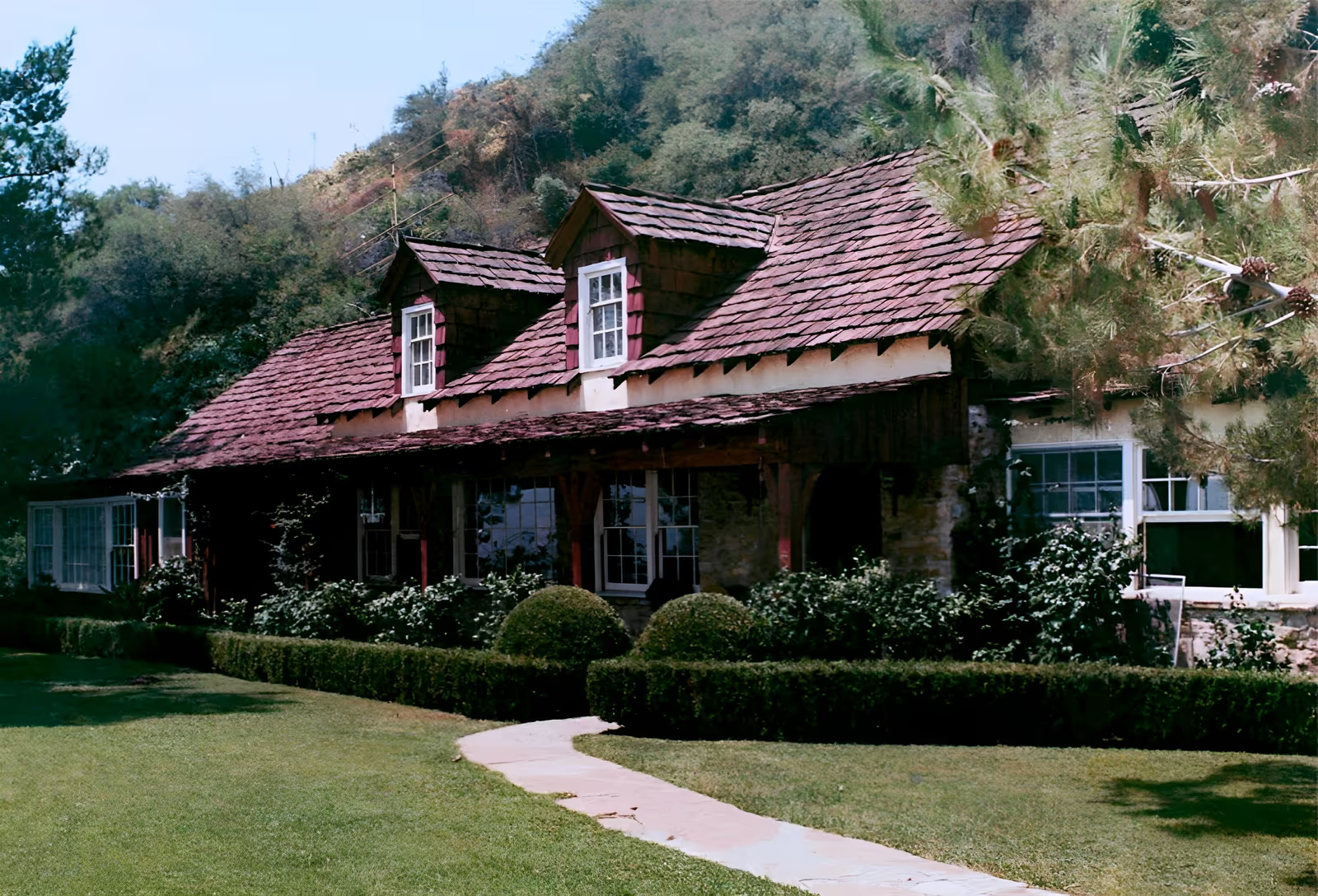
Visitors remember a strange-looking place. Adrian Belew, called in on a whim, found "a big electric fence around it and every single window was blacked out." Inside, the crew kept nocturnal hours, "isolated by choice" as Flood put it. Manson obsessives climbed the hill through the brush and turned up in the front yard, and on the anniversary of the murders the band left for the day and came back to find flowers covering the street outside the gate.
The method was part laboratory, part junk shop. Vrenna trawled films for sounds, not dialogue, and fed Reznor DAT tapes of them. Reznor sampled the noise generator the studio tuner brought. Rather than mic a drum kit up close, they carried one through about 25 rooms, from A&M's live rooms to bathrooms and a garage, recorded each drum from a distance with two PZM mics and loaded the results into a pair of Akai S1100s, so programmed beats sounded like a real, slightly shoddy kit. Guitars went through a Zoom 9030 and a Marshall JMP-1, then into Digidesign TurboSynth until they stopped being guitars.
"I'd stay up all night and come in with, like, 40 different new loops or noises or samples or parts. I'd give them to Trent in the morning while he was in the bedroom working on lyrics."
Chris Vrenna, Metal Hammer, 2019
The tech fought back. A Timeline Micro-Lynx synchroniser meant to lock the Studers to Pro Tools failed "ten times a day", and the Amek's automation was "terrible". Belew's first session set the tone for the guests. "All right, what key is it in?" he asked. Reznor and Flood looked at each other: "Probably E." He played four or five passes on six or seven songs, told to think about rhythm, then countermelody, then pure noise.
Flood and Reznor clashed as well. The producer disliked the falsetto on "Heresy", thought "Hurt" too straight, objected to a verse on "Mr. Self Destruct" because of friends they had lost to suicide, and would not work on a joke song called "Just Do It", saying Reznor had "gone too far". It was his last Nine Inch Nails album. When the mixes started at the Record Plant, Alan Moulder took over because Flood could not be there, recording the last few parts and mixing almost everything. "Ruiner" was the worst: "A bastard track, it fought us the whole way," Moulder told Spin.
In December 1993 Reznor met Patti Tate, Sharon's youngest sister, and moved out of the house that month.
"She said: 'Are you exploiting my sister's death by living in her house?' For the first time, the whole thing kind of slapped me in the face... I went home and cried that night."
Trent Reznor, Rolling Stone, 1997
He took the front door with him to his new studio in New Orleans. The owner, Alvin Weintraub, had both houses demolished in early 1994.
Personnel and Credits
| Role | Player | Notes |
|---|---|---|
| Core | ||
| Vocals, everything else | Trent Reznor | Also arranged, produced and mixed Hurt |
| Programming, sampling, sound design | Chris Vrenna | Drums on Hurt |
| Programming | Charlie Clouser | Also credited with continuity |
| Guest musicians | ||
| Texture guitar, ring mod guitar | Adrian Belew | Mr. Self Destruct, The Becoming |
| Drums | Stephen Perkins | Jane's Addiction; I Do Not Want This |
| Drums | Andy Kubiszewski | Title track; told to "make it shittier" |
| Additional guitar | Danny Lohner | Big Man with a Gun |
| Production and engineering | ||
| Producer | Mark "Flood" Ellis | Eight tracks; also hi-hats on Closer, ARP 2600 |
| Mixing | Alan Moulder | Tracks 1 to 8 and 10 to 13 |
| Mixing | Sean Beavan, Bill Kennedy | Big Man with a Gun |
| Additional engineering | John Aguto, Brian Pollack | |
| Mastering | Tom Baker | |
| Artwork | ||
| Paintings | Russell Mills | Cover piece titled Wound |
| Photography | David Buckland | |
| Package | Gary Talpas | Co-designed the NIN logo |
The sleeve credits Reznor with "all performance except where noted", and the list of exceptions is short. The surprise is how little Flood's name covers: eight of the 14 tracks, with Reznor producing the rest alone. The most unlikely credit belongs to Tommy Lee, listed for a studio-altered porn recording called "Steakhouse" that opens "Big Man with a Gun".
The Songs on The Downward Spiral
| # | Title | Writer(s) | Length | Single? | Notes |
|---|---|---|---|---|---|
| 1 | Mr. Self Destruct | Reznor | 4:31 | Opens on a beating sampled from THX 1138 | |
| 2 | Piggy | Reznor | 4:24 | Promo | Began as a poem; 65bpm |
| 3 | Heresy | Reznor | 3:54 | "God is dead"; Flood objected to the falsetto | |
| 4 | March of the Pigs | Reznor | 2:59 | Yes | Three bars of 7/8, one of 8/8 |
| 5 | Closer | Reznor | 6:14 | Yes | Kick drum sampled from Iggy Pop's Nightclubbing |
| 6 | Ruiner | Reznor | 4:58 | Two songs welded together by a guitar solo | |
| 7 | The Becoming | Reznor | 5:31 | Rhythm made from dropped cutlery | |
| 8 | I Do Not Want This | Reznor | 5:41 | Stephen Perkins' drums, looped and treated | |
| 9 | Big Man with a Gun | Reznor | 1:36 | Recorded at A&M as an afterthought | |
| 10 | A Warm Place | Reznor | 3:22 | Instrumental; echoes Bowie's Crystal Japan | |
| 11 | Eraser | Reznor | 4:53 | A Flood and Moulder favourite | |
| 12 | Reptile | Reznor | 6:52 | Samples Aliens and The Texas Chain Saw Massacre | |
| 13 | The Downward Spiral | Reznor | 3:58 | The recurring piano motif's final appearance | |
| 14 | Hurt | Reznor | 6:16 | Promo | Last song written; vocal in three takes |
Mr. Self Destruct opens with a prisoner being beaten by a guard in George Lucas's THX 1138, the blows getting louder until the song detonates. The whole mix went through old Neve mic preamps for distortion, and a sampled noise generator hums beneath it "like a vacuum cleaner running through the whole thing". Belew's guitar, recorded with no key and no brief, forms the chaos around it.
Piggy is the album's first sly trick: slow, near-whispered, with an organ playing the chromatic motif that returns in "Heresy", "Closer" and the title track. The frantic drumming at the end is the only time Reznor plays drums on the record. He was testing the mics in the dining room, playing along to a pattern he could barely hear. "Someday I'll come back and fix it," he said. "And of course I never did."
March of the Pigs is under three minutes of lurching 7/8 aggression, interrupted twice by a jaunty piano figure that stops dead in silence. Nothing on it is a live drum, yet it sounds like one, thanks to those room-sampled kits.
Closer was built around the kick drum from Iggy Pop's "Nightclubbing" and was the nearest thing to pop Reznor had written, until Vrenna saw the lyrics. "Well, you had the pop single for the record until you said 'fuck' in every line of the chorus," he told him. Reznor laughed and said, "I know." The song is about self-loathing, which is not how its audience heard it.
"I hated the [initial] chorus. It was a load of power chords. It sounded plain. I kept digging at Trent, and so I went away, left him to it, and that prompted him to sample a load of insects, which ended up sounding like strings."
Flood, Spin, 2024
The deep cuts are the ones the producers love. Flood and Moulder both named the run of A Warm Place, Eraser and Reptile as their favourites. "A Warm Place" gave Reznor a shock after release when he played a Scary Monsters reissue and heard Bowie's "Crystal Japan", a near-identical melody. When he confessed to Bowie, the reply was: "It's from a gin advert I did in Japan!"
Hurt was the last song, and it was not made at the house. Reznor brought it to A&M's Studio B, free because Bob Seger was on Christmas break, and ignored Seger's pristine vocal chain to sing into a handheld Shure Beta 58 at the console.
"It was just the two of us in the room, sitting side by side. We did three takes, each one was incredible, I remember being in tears most of the time, and I think we just used the third take in its entirety."
Sean Beavan, Loudwire, 2024
B-sides, Outtakes and Lost Songs
The sessions produced 16 songs, and the leftovers leaked out across the singles and soundtracks of 1994 and 1995:
- A Violet Fluid: a one-minute instrumental on the March of the Pigs single.
- Memorabilia: a Soft Cell cover on the Closer to God single, alongside the instrumental March of the Fuckheads.
- Dead Souls: a Joy Division cover for The Crow soundtrack, added to Japanese pressings.
- Burn: written for Oliver Stone's Natural Born Killers soundtrack.
- Demos: early versions of Ruiner, Heresy and Reptile (then called Liar), released in 2004.
"Just Do It" was never finished; Moulder remembers it only as a working title. Both he and Flood think there are still outtakes in the vault, with a track called "Rotation" rumoured among them. In May 1995 came Further Down the Spiral, a remix companion featuring Aphex Twin, Coil, J.G. Thirlwell and Rick Rubin with Dave Navarro. It reached number 23 and went gold in the US.
The Downward Spiral Cover: Russell Mills' Wound
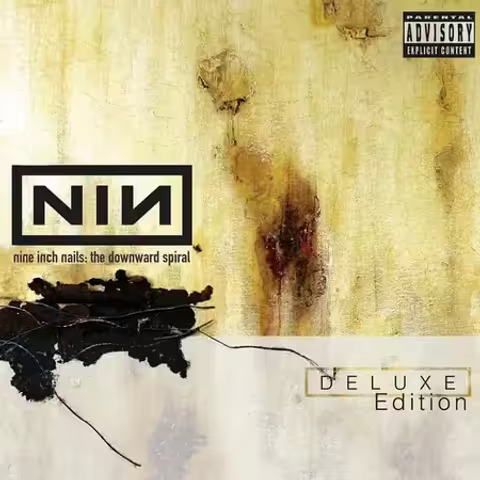
The cover is a real object, a mixed-media panel by the British artist Russell Mills called Wound. It shows a weathered, cream and ochre surface stained with rust, a dark red gash bleeding down the middle, and a torn black mass on the left trailing thin dark threads across a pale grey strip at the bottom. The NIN logo sits in a black box on the left with the album title in small lowercase type. The 2004 Deluxe Edition, pictured at the top of this page, adds a Parental Advisory sticker and "DELUXE Edition" lettering in the lower right.
"It is made of plaster, acrylics, oils, rusted metals, insects, moths, blood (mine), wax, varnishes, and surgical bandaging on a wooden panel."
Russell Mills, on Wound
Mills wanted "beautiful surfaces that partially revealed the visceral rawness of open wounds beneath". His artwork for the album and its singles was shown at Glasgow School of Art as an installation, Committere. David Buckland shot the photography and Gary Talpas designed the package; the curled millipede on the March of the Pigs disc reappeared on the Closer sleeve.
Release and Reception
Reznor expected the worst. Some early listeners called the album "commercial suicide", and he thought he might have shot himself in the foot with fans of both Pretty Hate Machine and Broken. Instead it debuted at number two, reached number nine in the UK, and was certified four times platinum on 28 October 1998. By 2011 it had sold 3.7 million copies in the US.
Most critics saw it coming. Rolling Stone gave it four stars and Entertainment Weekly a B+, with Tom Sinclair praising "hooks that hit your psyche with the force of a blowtorch." Robert Christgau called it "musically, Hieronymus Bosch as postindustrial atheist". NME gave it 4/10, and Cleveland's Plain Dealer called Reznor "a demented poster child for Psychotics Anonymous", a hometown slight he was still complaining about in Rolling Stone months later.
"Beneath its carefully constructed clangor lies something akin to what Yeats described as 'a terrible beauty', music that elevates and inspires even as it delves into the darkest corners of anguish, self-loathing and despair."
J.D. Considine, The Baltimore Sun, 1994
"Hurt" added a Best Rock Song Grammy nomination in 1996.
Singles and Music Videos
| Single | Released | US Hot 100 | US Modern Rock | UK | Video |
|---|---|---|---|---|---|
| March of the Pigs | 25 February 1994 | 59 | 45 | Peter Christopherson | |
| Closer | May 1994 | 41 | 11 | 25 | Mark Romanek |
| Piggy (promo) | December 1994 | 20 | None | ||
| Hurt (promo) | 17 April 1995 | 8 | Live, Omaha, 13 February 1995 |
"March of the Pigs" was the band's first Hot 100 entry. Its video, by Coil's Peter Christopherson, came at the second attempt after an elaborate first version was abandoned: the new live band thrash through the song against a white wall while Reznor knocks everything over and stagehands keep handing him a microphone. Beavis and Butt-Head liked it, apart from the piano bits.
"Closer" went to number three in Australia and was the real breakthrough. Romanek filmed it in April 1994, partly in the abandoned Linda Vista Community Hospital, recreating images inspired by Joel-Peter Witkin, the Brothers Quay and Man Ray. MTV's cut replaced banned shots with "Scene Missing" cards, and the radio edit trimmed "fuck" so tightly you can still hear the "f" and the "k". The uncut video now sits in the Museum of Modern Art's permanent collection.
The Self Destruct Tour
The tour started the day after release, on 9 March 1994 at Helter Skelter in Los Angeles, and did not finish until September 1996. Vrenna and James Woolley returned, with Robin Finck on guitar and Danny Lohner on bass; Charlie Clouser replaced Woolley from late December 1994. The band came on in rags smeared with corn starch, attacked each other and wrecked their gear.
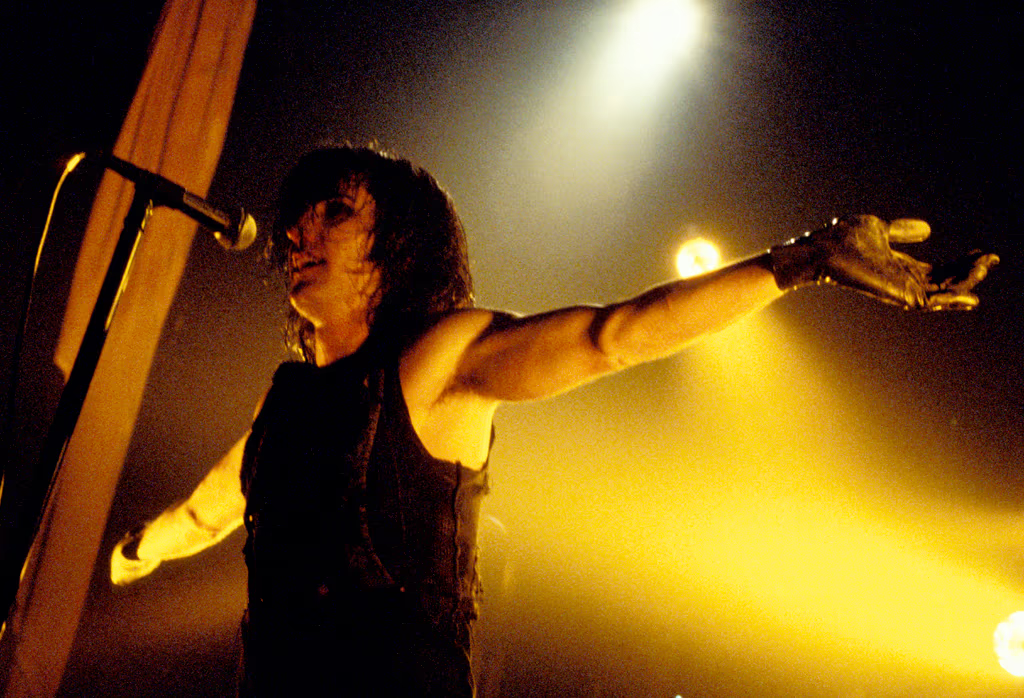
- Support acts included Marilyn Manson, Type O Negative, Hole, the Melvins, Pop Will Eat Itself and the Jim Rose Circus.
- 13 August 1994: a mud-caked Woodstock '94 set, broadcast to as many as 24 million homes.
- Their Woodstock "Happiness in Slavery" won the 1996 Grammy for Best Metal Performance.
- From 14 September 1995: 26 co-headline dates with David Bowie, who sang "Hurt" with Reznor.
- Late summer 1996: three Nights of Nothing showcases for the label's acts.
The mud at Woodstock was long explained as backstage horseplay until 2024, when home video surfaced of Reznor asking the stage manager for "5 minutes for mud". It left him half-blind on stage and he disliked the show, but the pay-per-view crowd saw Nine Inch Nails steal the weekend from the classic rock acts. He later admitted he barely remembered much of the tour, which had been one long binge.
The Downward Spiral in TV, Film and Media
- Se7en (1995): Kyle Cooper's opening titles run to Coil and Danny Hyde's "Closer (Precursor)" remix.
- Logan (2016): the trailer used Johnny Cash's "Hurt" to set Wolverine apart from other superheroes.
- Rick and Morty: the season two finale plays "Hurt" over Rick's surrender.
- Rock Band (2008) and Fortnite Festival (2024): both added "March of the Pigs".
Big Man with a Gun, Bob Dole and Columbine
In 1995 William Bennett and C. Delores Tucker pressed Time Warner's Michael Fuchs to read out the lyrics of "Big Man with a Gun", and Senator Bob Dole lined up behind the attack on Time Warner, which then owned Interscope's parent company. Tucker called Nine Inch Nails gangsta rap. Reznor called her "such a fucking idiot" and said the song was a satire of gangsta rap. Robert Bork later cited it repeatedly in Slouching Towards Gomorrah.
After the Columbine shooting, where Dylan Klebold's journals quoted the album, a US Senate hearing on 4 May 1999 heard it criticised alongside Marilyn Manson and The Matrix.
Covers, Samples and Tributes
Rick Rubin asked Reznor if Johnny Cash could cover "Hurt" for American IV: The Man Comes Around. Reznor was "flattered" but thought it "sounded a bit gimmicky". Cash cut it in 2002 with Mike Campbell and Benmont Tench of the Heartbreakers, and Mark Romanek, the "Closer" director, filmed the video in February 2003, seven months before Cash died. It won the CMA Single of the Year and a Grammy for Best Short Form Music Video.
"Tears welling, silence, goose-bumps... Wow. I just lost my girlfriend, because that song isn't mine any more."
Trent Reznor, Alternative Press, 2004
"Closer" has been covered by Maroon 5, Asking Alexandria and In This Moment, and "Weird Al" Yankovic dropped it into "The Alternative Polka". In November 2025 Magnetic Eye Records released The Downward Spiral Redux, covering every track, with Black Tusk on "Mr. Self Destruct" and Between the Buried and Me on "Hurt".
Reissues, Remasters and Anniversaries
- 2004: a tenth-anniversary Deluxe Edition on SACD and DualDisc, mastered by Bob Ludwig with a 5.1 mix, plus a bonus disc of B-sides, remixes and three demos.
- 23 August 2009: the band played the whole album live for the first time, at Webster Hall in New York. Fans filmed it and released it free.
- 2017: a Definitive Edition double LP, remastered at Baker Mastering with remastered artwork.
- 2024: a 30th anniversary Dr. Martens range, including a 1460 boot printed with Mills' Wound.
The Legacy of The Downward Spiral
Nine Inch Nails became unavoidable. In 1997 Time named Reznor one of its 25 most influential people, and a wave of bands, from Filter and Stabbing Westward to Gravity Kills and even Mötley Crüe, borrowed the sound. His own follow-up, The Fragile, took five years, cut with Moulder in New Orleans, and debuted at number one in 1999. Reznor completed rehab in 2001.
The critical standing only grew. Rolling Stone ranked it 200th in its 500 Greatest Albums in 2003 and 122nd in 2020, calling it "an overpowering meditation on NIN's central theme: control". Spin placed it tenth of the best albums of its previous 25 years, and Pitchfork 39th of the 1990s. Stylus's Adrien Begrand put it alongside Loveless as the best-produced album of the decade.
"I just spent an hour listening to this time capsule of what 28 year old me had to say, and it still excites me and breaks my heart. Be kind to yourselves."
Trent Reznor, nin.com, 2024
Things You Might Not Know
| Fact | Detail |
|---|---|
| The door's last sale | The Cielo Drive front door went from Nothing Studios to a New Orleans artist, then sold at Julien's Auctions in September 2023 for $127,000. |
| The Nights of Nothing reunion | On the second Nights of Nothing show in 1996, Richard Patrick rejoined for "Head Like a Hole", three years after leaving to form Filter. |
| The borrowed synth | The bass on "The Becoming" is a prototype Oberheim-Moog lent by Reznor's repairman Richard Bugg; the project was scrapped. |
| Tommy Lee's office | Lee heard "Hurt" at A&M, demanded a cassette and marched everyone to a strip club across the street, where he played it on the sound system. |
| The Manson connection | Marilyn Manson recorded parts of his debut, Portrait of an American Family, at Le Pig in 1992. |
| The first house video | Nine Inch Nails also recorded Broken at the house and filmed the "Gave Up" video there. |
| A broken Australian pressing | The first Australian CD had index errors, so late tracks selected individually started up to 41 seconds early, although the album played correctly straight through. |
| A rejected app | In 2009 Apple rejected a Nine Inch Nails iPhone app over "objectionable content" in the title track, then reversed itself days later without explanation. |
| The Closer to God single | Most "Closer" singles are titled "Closer to God", a rare case of a single named after a remix on it rather than its A-side. |
| Reznor combat boots | In 2015 the clothing brand N.I.C.E. Collective sold replicas of the boots Reznor wears in the "March of the Pigs" video. |
Hear More on the Riffology Podcast
If the story of Le Pig, the cutlery drum loops and the song Johnny Cash took for his own has you reaching for the headphones, the Riffology podcast digs into records like The Downward Spiral every week. Find it on all the major podcast platforms and pick your next deep dive.
Comments