Polydor's American plan for Little Angels was straightforward: take four young men from Scarborough on the North Yorkshire coast, fly them to Bearsville Studios in Woodstock, hand them to Steve Thompson and Michael Barbiero (fresh off mix work on Guns N' Roses' Appetite for Destruction follow-up sessions and Tesla's The Great Radio Controversy), and ship the resulting record to American FM rock radio. What Polydor got instead was an album that broke Little Angels in Britain.
Young Gods was released in February 1991 and reached UK number 17, a 25-place leap from the debut. It threw off four UK Singles Chart entries inside ten months, all of them between 26 and 40 on the chart. It led to the band's first proper headline tour. It also led, midway through that tour at a date in New York City, to the firing of the drummer for auditioning for The Cult behind the band's back, and to a chain of events that would put Mark Richardson on the kit for the UK number-one follow-up Jam two years later. The whole story is in this record.
Album Facts
| Field | Detail |
|---|---|
| Artist | Little Angels |
| Album | Young Gods |
| Release Date | February 1991 (UK) |
| Label | Polydor Records |
| Producers | Steve Thompson and Michael Barbiero |
| Studios | Bearsville Studios, Woodstock, New York (recording, 1990); New York City mixing facilities (Thompson/Barbiero mixing); Fairview Studios, Willerby, Hull (pre-production demos) |
| Genre / Subgenre | British hard rock, glam metal |
| Track Count | 13 (UK CD) |
| Total Runtime | Approximately 54 minutes |
| UK Albums Chart Peak | 17 (March 1991) |
| Certifications | Silver (BPI), 60,000+ units |
| Estimated Sales | Over 60,000 in the UK; combined worldwide figure unreported |
| Key Singles | "Boneyard", "Product of the Working Class", "Young Gods", "I Ain't Gonna Cry" |
Cultural Context
The week Young Gods hit British record shops in February 1991, RAF Tornados were flying sorties over Iraq in the closing weeks of the Gulf War, Bryan Adams had not yet released the single that would spend 16 consecutive weeks at UK number one, and the highest-grossing film at the British box office was Dances with Wolves. British hard rock had spent 1990 having a quietly excellent year, with Thunder's Backstreet Symphony, the Almighty's Soul Destruction and the Quireboys' A Bit of What You Fancy all charting, all selling, and all redrawing the British rock map back from the American glam-metal redrawing of it.
Little Angels arrived into the same scene Thunder had arrived into twelve months earlier, but from a different angle. Where Thunder were Wimbledon professionals with a Duran Duran producer and a Mike Fraser mix, Little Angels were a North Yorkshire band who had paid their dues on the seaside-resort and northern-club circuit and now had two Americans flying them out to Woodstock to make a record. The autumn ahead would produce Metallica's black album, Guns N' Roses' twin Use Your Illusion volumes, the Red Hot Chili Peppers' Blood Sugar Sex Magik, Skid Row's Slave to the Grind and, in September, Nirvana's Nevermind. By the time the dust settled on 1991, the rules for British hard rock had already begun to change. Young Gods caught the last clear moment when a British band could lean into the late-1980s sound without apology.
The Band's Story Up to This Point
Toby Jepson, Mark Plunkett and Dave Hopper started the band in May 1984 in Scarborough as Zeus. They changed the name to Mr Thrud in September 1985. By the time they walked into Fairview Studios in Willerby, near Hull, in 1987 to record their mini-album Too Posh to Mosh, they had changed the name a third and final time to Little Angels, and the brothers Bruce John Dickinson on guitar and Jimmy Dickinson on keyboards had joined. On 16 August 1988 the drummer Dave Hopper was replaced by Michael Lee, a 19-year-old who had been gigging round Yorkshire clubs since his early teens.
Their manager Kevin Nixon, who had signed the band to his own York-based Powerstation Records, brokered a major-label step up to Polydor on 19 May 1988. The debut Don't Prey for Me followed in 1989 and reached UK number 42, a respectable opening that earned the band UK and European support slots with Van Halen and Bon Jovi. The early singles ("90 in the Shade", "Do You Wanna Riot", "Don't Prey for Me", "Kicking up Dust", "Radical Your Lover", "She's a Little Angel") were a slow climb from the lower reaches of the chart into the top 40, with "She's a Little Angel" peaking at UK number 21 in mid-1990 and providing the lift that took the band into the recording of Young Gods.
By the time Polydor approved the budget for the second album in mid-1990, Little Angels had played over 200 club and theatre shows across the UK in two years. They had a horn section in The Big Bad Horns (Dave Kemp on saxophone, Frank Mizen on trombone, Grant Kirkhope on trumpet) that had toured with them since 1989 and appeared on most of their recorded output. They had a singer, Toby Jepson, who at 24 had the bearing of a frontman with a decade of experience. They had a label which had decided that the breakthrough was within reach but needed an American gear-shift on production. The two producers Polydor's A and R team handed them were Steve Thompson and Michael Barbiero.
"Polydor were absolutely convinced that to make us into a band who could sell records globally, we had to make a record that sounded global. Steve and Michael had just done Tesla, they had mixed Guns N' Roses, they were the names everyone in our genre wanted. So we flew to Woodstock and went to work."
Toby Jepson, Classic Rock, 2012
Pre-production and Demos
Pre-production happened in two stages. The first was a writing block at home in Yorkshire across the spring of 1990, with Jepson and Bruce Dickinson building up song sketches at the Dickinson family piano and at the Powerstation rehearsal room in York. The second was a two-week residency at Fairview Studios in Willerby through May 1990, the same studio the band had recorded both Too Posh to Mosh and Don't Prey for Me in. Fairview engineer John Spence had been with the band since they were still calling themselves Mr Thrud and ran the demo session as in-house engineer.
The Fairview demos gave the band a working version of every song on the album plus three or four that would not survive the New York sessions. "Boneyard", "Young Gods" and the title-track-in-waiting "I Ain't Gonna Cry" were all in nearly finished form by the time the band flew to JFK in late June. The horn-section parts were not on the demos; Thompson and Barbiero would build them with the Big Bad Horns later, in New York.
- "Boneyard" was written in a single weekend at the Powerstation rehearsal room, with Jepson's lyric responding to the early-1990 deaths of three young British rock musicians in unrelated incidents.
- "Young Gods" began life as a Bruce Dickinson piano figure (the same piano his brother Jimmy played) and was originally titled "Stand Up Stand Up" until Jepson rewrote the chorus.
- "Product of the Working Class" was the most autobiographical song the band had ever attempted; Jepson has said the lyric was finished on the plane to New York.
- An early demo called "Hold On to Your Heart" was dropped from the sessions at the producers' suggestion and never released.
Creating the Album
Tracking moved to Bearsville Studios in Woodstock, New York, in July 1990. The studio had been founded by Bob Dylan's manager Albert Grossman in 1969 and had cut records for the Band, Todd Rundgren, R.E.M. and Patti Smith. Steve Thompson and Michael Barbiero were the producer-engineer team in residence; the band were given the Bearsville barn for tracking and the smaller adjacent studio for overdubs.
The approach Thompson and Barbiero brought was the late-1980s American hard rock template at its most polished: drum machine for click and reference, drums tracked live to two-inch analogue tape over a click, every guitar part double-tracked, every vocal part triple-tracked at minimum, the Big Bad Horns brought in to lay their parts in the last week of tracking. The fidelity was high. The room sound was muted. The producers wanted a record that would translate to American FM, and that meant a clean, dry, percussive mix that Jepson has since described as further from the band's live sound than they had wanted.
The band lived in a rented house in Woodstock for the duration. Mike Lee, the drummer, finished his tracks in the first ten days and spent the rest of the sessions in New York City, partly socialising with American musicians and (it would later transpire) auditioning. Bruce Dickinson played most of the rhythm and lead guitar; an additional acoustic 12-string was overdubbed on "I Ain't Gonna Cry". Jimmy Dickinson's Hammond organ and piano parts are mixed prominently throughout the record, a deliberate Thompson/Barbiero choice to differentiate the band from the guitar-only American glam metal acts on their own roster.
"We wanted to make a record that was big, bold and said something about who we were. Young Gods was that record. Whether the mix was the one we'd have made ourselves is a separate question, but the songs got the treatment we'd been told they needed, and the band coming off the back of it was a different proposition to the one that walked in."
Bruce John Dickinson, Powerplay, 2013
Personnel and Credits
| Role | Player | Notes |
|---|---|---|
| Little Angels | ||
| Lead vocals | Toby Jepson | All lead vocals; co-writer on every track on the album |
| Guitar | Bruce John Dickinson | Rhythm and lead; co-writer on every track; acoustic 12-string on "I Ain't Gonna Cry" |
| Keyboards | Jimmy Dickinson | Hammond organ, piano, synthesiser; backing vocals |
| Bass | Mark Plunkett | Bass guitar; backing vocals |
| Drums and percussion | Michael Lee | Drum kit; tracked in the first ten days at Bearsville; fired during the New York leg of the Young Gods tour |
| Additional musicians | ||
| The Big Bad Horns | Dave "Big" Kemp, Frank Mizen, Grant Kirkhope | Saxophone, trombone and trumpet respectively; credited separately and toured with the band |
| Production and engineering | ||
| Producers | Steve Thompson and Michael Barbiero | Bearsville Studios, Woodstock, July-October 1990 |
| Mixers | Steve Thompson and Michael Barbiero | Mixed in New York at the producers' base studio in the autumn of 1990 |
| Engineering assistance | John Spence (Fairview pre-production) | Long-term Little Angels engineer; ran the May 1990 demo block |
| Management and label | ||
| Management | Kevin Nixon | York-based manager since 1988; also ran Powerstation Records |
| Label A and R | Polydor Records | Signed the band on 19 May 1988 |
| Artwork | ||
| Cover concept and design | Charles Cutforth | Sleeve design and art direction |
The Songs
| # | Title | Length | Single? | Notes |
|---|---|---|---|---|
| 1 | "Back Door Man" | 5:00 | The album opener; not the Willie Dixon blues, an original Jepson/Dickinson composition | |
| 2 | "Boneyard" | 6:00 | First single (March 1991) | UK 33; mortality-as-metaphor lyric in response to deaths of British rock musicians earlier in 1990 |
| 3 | "Young Gods" | 5:30 | Third single (September 1991) | UK 34; the album's anthem and live set-closer for the rest of the band's career |
| 4 | "I Ain't Gonna Cry" | 5:30 | Fourth single (November 1991) | UK 26; the album's highest-charting single, a Jepson power ballad |
| 5 | "The Wildside of Life" | 4:00 | Brisk mid-album rocker, often a live set highlight | |
| 6 | "Product of the Working Class" | 5:30 | Second single (June 1991) | UK 40; the band's most autobiographical lyric, finished on the flight to New York |
| 7 | "That's My Kinda Life" | 3:00 | The shortest song on the record; a horn-section feature | |
| 8 | "Juvenile Offender" | 4:00 | Up-tempo album track | |
| 9 | "Love Is a Gun" | 4:30 | A Bruce Dickinson riff cycled into a Jepson chorus | |
| 10 | "Sweet Love Sedation" | 4:00 | Big Bad Horns feature; a band favourite | |
| 11 | "Smoke In My Eyes" | 4:00 | Second horn-section showcase | |
| 12 | "Natural Born Fighter" | 3:30 | Late-album rocker, frequently played on the 1991 tour | |
| 13 | "Soapbox" | 4:00 | Album closer; a forerunner to the song that would lend its name to the band's 1993 follow-up single |
"Back Door Man" opens the record, a 5-minute Bruce Dickinson riff over Jimmy Dickinson's Hammond, with Jepson stating the album's case in the first verse. The choice to open with this song rather than one of the singles was a deliberate Thompson/Barbiero decision; they wanted the album to begin as a band statement rather than as a chart-bound first impression. It worked. The song became the live opener for the entire 1991-92 touring cycle and is what you hear on the surviving YouTube live broadcast of the band's BBC sessions of the period.
"Boneyard" was the first single and, in some ways, the song that defined the album's contemporary critical reception. Q's Dave Henderson, in his March 1991 review, singled out "Boneyard" as the album's clearest signal that Little Angels had outgrown their debut. Jepson's lyric is half a meditation on the deaths of three young British musicians in early 1990 (which he has declined in interviews to name) and half a self-protective fan letter to his own future. The arrangement, with Jimmy Dickinson's Hammond carrying the verses and the Big Bad Horns punching the choruses, is the cleanest demonstration of the band's chemistry on the album.
"Young Gods", the title track and third single, is the song the band closed every show with for the rest of their career. The Bruce Dickinson piano figure that opens it, the gradual build under Jepson's "stand up, stand up" vocal motif, and the gear-change into the final chorus are pure late-eighties FM rock writing, but rendered with a Scarborough hard-rock band's snap. "I Ain't Gonna Cry", the fourth single, was the album's highest-charting single at UK number 26 and was the song that put the band on Top of the Pops for the first time in November 1991. "Product of the Working Class" was the band's manifesto: a Jepson lyric about pride in roots that the band have said is the song most regularly requested at the 2012 reunion shows.
"'Product of the Working Class' is the only song I have ever written that has had grown men come up to me afterwards and say 'that was about me'. Toby finished the lyric on a Pan Am 747 over the Atlantic on the way to make the record, and the rest of it was already there waiting."
Bruce John Dickinson, EverythingRock, 2012
B-sides, Outtakes and Lost Songs
The four singles from Young Gods all carried B-sides that were either contemporaneous outtakes or live recordings from the album cycle. The most notable were:
- The "Boneyard" 12-inch single carried a non-album B-side, "Kickin' Up Dust" (a live version recorded at the Marquee in February 1991), and an extended mix of "Boneyard" itself.
- The "Product of the Working Class" single included a B-side cover of Status Quo's "Down Down", a live favourite on the 1991 tour.
- The "Young Gods" single was packaged with a live recording of "Don't Prey for Me" from the band's Hammersmith Odeon show on 26 March 1991, later released in full on the Live at Hammersmith Odeon EP.
- The "I Ain't Gonna Cry" single included two non-album originals, "Hold On to Your Heart" (the song dropped from the album sessions) and a piano-and-vocal-only acoustic remake of "Young Gods" credited to Toby Jepson and Jimmy Dickinson.
A handful of additional tracks were recorded at Bearsville and never released in any form: a Jepson lyric titled "Walk Out into the Daylight", a horn-led instrumental jam called "Bearsville Boogie", and a cover of Bob Dylan's "All Along the Watchtower" attempted in the second week of sessions and abandoned. Some of the rehearsal demos from the Powerstation room in York have circulated on Yorkshire trading lists in the years since but have never been officially issued.
Album Artwork and Packaging
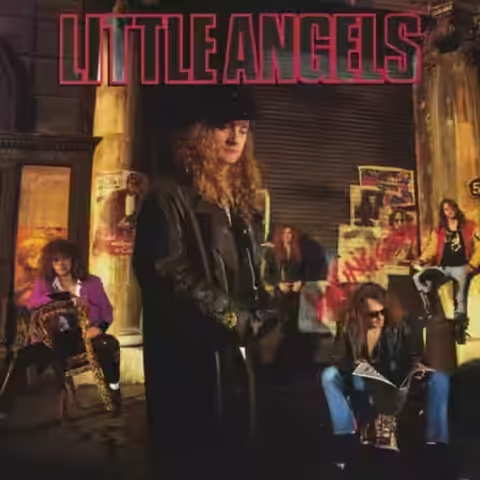
The artwork was designed by Charles Cutforth, the Polydor in-house designer assigned to the project. The front cover is a moody, painterly close-up of the band members against a dark gold-and-burgundy background, with the band logo at the top in heavy serif lettering and "Young Gods" set below in a smaller italic. The CD booklet ran to 16 pages with full lyrics, photographs by Roger Sargent of the Bearsville sessions, and a band-signed dedication page. The vinyl release came in a gatefold sleeve with a 12-by-12 photographic insert.
The artwork concept came in for some quiet criticism from the band themselves; Jepson has said in interviews since that the painterly cover did not capture the band's live energy as well as a band photograph might have. The 2009 Bad Reputation Records remaster used a different, more contemporary photographic treatment, which Jepson has described as closer to what the band would have chosen first time around.
Release and Reception
Polydor released Young Gods in February 1991. It entered the UK Albums Chart at number 17, the band's highest position to date and a 25-place leap from Don't Prey for Me's debut peak of 42. It spent six weeks in the top 40 before settling into the lower reaches of the top 100, and re-entered the chart twice through 1991 on the back of the "Young Gods" and "I Ain't Gonna Cry" singles. The BPI certified it Silver later in the year for sales above 60,000 units, the band's first official UK certification.
| Publication | Reviewer | Score | Quote |
|---|---|---|---|
| Q Magazine | Dave Henderson | 4/5 | "Finely produced and well-arranged; the album that should turn Little Angels into chart contenders" |
| Kerrang! | 4/5 | "A British hard rock band who finally know what they are; the songwriting is two notches above the debut" | |
| Sounds | "The horn section gives Little Angels a sonic identity nobody else in this scene has, and 'Boneyard' is the song of the year" | ||
| Metal Hammer | "Slick American production on tough Yorkshire songs; the package works" | ||
| AllMusic (retrospective) | "A significant leap forward in songwriting and performance over the debut" |
The British press treated the record as a coming-of-age statement for the band. Kerrang! ran a cover feature in March 1991. Sounds awarded it a high four-star review in the same week. Q's review, by Dave Henderson, became the most-quoted single line of contemporary coverage. The album's US release was less successful, with Polydor's American arm under-promoting it; the band's US chart presence remained largely confined to college and Mainstream Rock airplay around "Boneyard" and "I Ain't Gonna Cry".
Singles and Music Videos
| Single | Release Date | UK Singles Chart Peak | Notes |
|---|---|---|---|
| "Boneyard" | March 1991 | 33 | The album's first single; band's first UK Top 40 entry off Young Gods |
| "Product of the Working Class" | June 1991 | 40 | The most autobiographical single; included a Status Quo cover B-side |
| "Young Gods" | September 1991 | 34 | The title track; packaged with live B-sides from Hammersmith |
| "I Ain't Gonna Cry" | November 1991 | 26 | The album's highest-charting single; the band's Top of the Pops debut |
Music videos were shot for all four singles. "Boneyard" was a tightly cut performance video shot at a converted warehouse in Camden. "Product of the Working Class" used a Scarborough seafront location, the band performing against the harbour and the Grand Hotel. "Young Gods" was a soundstage performance piece. "I Ain't Gonna Cry", the most polished of the four, was a narrative clip directed by Marcus Nispel of Propaganda Films, the same director responsible for several of the era's high-profile MTV videos.
"Back Door Man" was not released as a single but was the album's most-played track on the 1991 tour, opening every set. The performance video above, from the band's BBC Two Rock at the Beeb appearance in April 1991, captures the band at their pre-Lee-firing peak.
Touring and Live
The Young Gods Tour opened with a UK club run in February 1991 and quickly upgraded to theatre and academy-level venues as the album charted. The headline show that defined the album's commercial moment was the 26 March 1991 Hammersmith Odeon date in London, which sold out three weeks in advance and was recorded for what became the Live at Hammersmith Odeon EP later in the year.
- February 1991 - first UK club run: Marquee, Newcastle Mayfair, Glasgow Barrowland; mostly sold out within a week of going on sale.
- March 1991 - Cardiff St David's Hall, 15 March: a typical full-tour setlist: "She's a Little Angel", "Young Gods", "Product of the Working Class", "Kickin' Up Dust", "I Ain't Gonna Cry", "That's My Kinda Life", "Boneyard", "Natural Born Fighter", and a closing cover of Bryan Adams's "Kids Wanna Rock".
- 26 March 1991 - Hammersmith Odeon, London: sold-out headline; recorded for the Live at Hammersmith Odeon EP and the band's first London arena-class headline show.
- Spring 1991 - support for ZZ Top: European arena dates including Milton Keynes Bowl; the band's first sustained mainland European exposure.
- Summer 1991 - festival circuit: Reading rock day appearance; second-on-the-bill at multiple European festivals.
- Late summer 1991 - North American tour: the band's first US dates, supporting Bryan Adams across the East Coast; the New York leg was where Michael Lee's Cult audition came to light.
The Cult firing is the story most people who remember the band remember. Michael Lee had auditioned, by his own later admission, for The Cult during the band's New York stay, hoping to land a job that would put him on a bigger tour and a bigger paycheck. The band found out on tour. Jepson, Plunkett and the Dickinson brothers made the decision to fire him within 48 hours. Mark Richardson, then a young Yorkshire drummer who had subbed in for the rest of the dates, joined for the remainder of the cycle and would record the follow-up Jam. Lee went on to play the full Ceremony world tour with The Cult and later became Robert Plant's touring drummer, until his death in 2008.
"We were a brotherhood. To find out from a third party that one of your brotherhood has been quietly auditioning for the band who is going to take you off their support tour was a knife to the gut. We didn't even argue about it. We let him go in New York and flew Mark over to finish the dates."
Toby Jepson, Planet Rock Profile, 2018
In TV, Film and Media
British rock TV in 1991 still offered the kind of mainstream outlets that have since vanished. Little Angels appeared on Top of the Pops in November 1991 to perform "I Ain't Gonna Cry", on BBC Two's Rock at the Beeb series in April 1991, and on Channel 4's The Word in the autumn of the same year. American daytime and late-night TV did not pick the album up in any sustained way, a sign of how poorly Polydor's American operation supported the band. Subsequent sync placements of Young Gods material have been minimal; the album's songs have remained the property of UK rock fans rather than the wider pop-culture conveyor.
Covers, Samples and Tributes
The album's covers afterlife has been modest. "Young Gods" is the song most often picked up by tribute and covers acts; "I Ain't Gonna Cry" is performed solo by Toby Jepson at his acoustic shows; "Boneyard" is the song Mark Richardson has played live with both Skunk Anansie and Feeder when those bands have wanted a fast hard-rock encore. No commercial sample of any Young Gods track has ever been cleared. The band's own 2012-2013 reunion sets returned the album to live performance, with "Young Gods", "Product of the Working Class" and "Back Door Man" the most regularly played tracks on the comeback tour.
Reissues, Remasters and Anniversaries
The most significant reissue is the 2009 Bad Reputation Records 2-CD remaster, which paired the original album with a second disc collecting B-sides, the Live at Hammersmith Odeon EP recordings in full, the Top of the Pops performance, and three Powerstation-era demos from May 1990. The reissue had new sleeve photography and updated liner notes written by Jepson. The album has never been officially issued as a deluxe vinyl boxed set; the original 1991 vinyl pressings remain sought after by UK rock collectors, with the gatefold UK first pressing typically commanding 30 to 50 pounds in good condition.
The 2012-2013 reunion was treated as a 21st-22nd anniversary celebration of the album in the absence of formal anniversary product. The 2026 "Big, Bad and Back" reunion tour, announced in February 2026 with Luke Morley of Thunder as support, is the band's first activity since 2013, and the Jepson-Dickinson-Dickinson-Plunkett-Richardson Jam-era line-up is the configuration the reunion will play.
Legacy and Influence
Young Gods is the album that turned Little Angels from a Polydor-development-deal hard rock band into a UK chart act. Its commercial trajectory paved the way for Jam, the 1993 follow-up that entered the UK Albums Chart at number one and made the band, however briefly, a major British rock proposition. The line that runs from Young Gods through Thunder's Laughing on Judgement Day, the Wildhearts' Earth Versus the Wildhearts, the Almighty's Powertrippin' and on into the mid-1990s wave of British rock and Britpop-adjacent rock is harder to draw cleanly, because the British music press's pivot toward grunge and shoegaze in late 1991 stranded much of that scene before it could consolidate. But the song-craft template is there, in the records that came afterwards.
The band's wider legacy lives in the careers of its members. Mark Richardson, who joined on the back of the Michael Lee firing, became Skunk Anansie's drummer and then Feeder's, a CV that no other British rock drummer of his generation matches. Toby Jepson fronted Gun in the late 2000s and has since become a respected producer in his own right, working with the Virginmarys, Falling Red and Toseland. Bruce John Dickinson now runs the Brighton Institute of Modern Music; Jimmy Dickinson teaches commercial music at Bath Spa University. The 2026 reunion arrives with all five core members, and Mark Richardson, still active musicians.
"Young Gods is the record we became a band on. Don't Prey for Me was the apprentice piece, Jam was the success, but Young Gods was the one where we figured out who we were. It is the album that I still measure everything I do against."
Toby Jepson, Big Bad and Back tour announcement, February 2026
Things You Might Not Know
| Fact | Detail |
|---|---|
| Zeus, Mr Thrud, Little Angels | The band changed name twice before settling on Little Angels in 1987: from Zeus (1984-85) to Mr Thrud (1985-87) to Little Angels during the recording of the Too Posh to Mosh mini-album at Fairview Studios. |
| The producers' day job | Steve Thompson and Michael Barbiero were responsible for mix work on Guns N' Roses' Appetite for Destruction follow-up sessions and Tesla's The Great Radio Controversy before producing Young Gods. They subsequently mixed parts of Metallica's 1991 self-titled "Black Album". |
| Powerstation Records | The band's first label was their manager Kevin Nixon's own York-based Powerstation Records, before they were upgraded to Polydor on 19 May 1988. |
| The Bon Jovi Milton Keynes show | Little Angels opened for Bon Jovi at the Milton Keynes Bowl on 25 August 1990, six weeks into the Bearsville recording sessions, then flew straight back to New York the next day to finish tracking. |
| The Dylan cover that wasn't | An attempted cover of Bob Dylan's "All Along the Watchtower" was tracked at Bearsville in the second week of sessions and abandoned. No surviving tape of the take is known to exist. |
| Michael Lee's Cult audition | Drummer Michael Lee secretly auditioned for The Cult during the band's New York stay in mid-1991 and was dismissed from Little Angels within 48 hours of the news reaching the band. He played the entire Ceremony world tour with The Cult and was later Robert Plant's touring drummer until his death in 2008. |
| Mark Richardson's audition | Mark Richardson, the drummer who replaced Lee, was sourced through the band's Yorkshire scene contacts; he had played in the band Skin Trade and was on a plane to New York to finish the support dates within 72 hours of Lee's firing. |
| The Big Bad Horns independence | The Big Bad Horns (Dave Kemp on sax, Frank Mizen on trombone and Grant Kirkhope on trumpet) were credited separately from the band and kept that independence throughout the band's career. On record they are credited as "Little Angels and The Big Bad Horns". |
| Grant Kirkhope's afterlife | Big Bad Horns trumpet player Grant Kirkhope went on to become one of the best-known video-game composers of his generation, scoring Banjo-Kazooie, GoldenEye 007, Perfect Dark and the Mario + Rabbids series. |
| The Hammersmith recording | The 26 March 1991 Hammersmith Odeon show was recorded for posterity and provided the live B-sides on three of the four album singles. The full recording was released in 1991 as the Live at Hammersmith Odeon EP. |
| The 25-place chart jump | Young Gods peaked at UK number 17, a 25-place leap from Don't Prey for Me's number 42 peak. The band's third album, Jam, would go a further 16 places to UK number one. |
| Marcus Nispel's "I Ain't Gonna Cry" | The "I Ain't Gonna Cry" music video was directed by Marcus Nispel of Propaganda Films, who later directed George Michael's "Too Funky", Janet Jackson's "Love Will Never Do (Without You)" and the 2003 remake of The Texas Chain Saw Massacre. |
| The Marquee residency | Little Angels played a four-night residency at the Marquee in Wardour Street, London, in early February 1991 ahead of the Young Gods release; all four shows sold out and the closing-night recording provided the "Kickin' Up Dust" B-side on the "Boneyard" 12-inch. |
| The 2026 reunion | The Big Bad and Back tour announced in February 2026 is the band's first activity since 2013 and features the full Jam-era line-up of Jepson, the Dickinson brothers, Plunkett and Mark Richardson, with Luke Morley of Thunder as support. |
| Charles Cutforth's cover | The painterly Young Gods sleeve was designed by Polydor's in-house art director Charles Cutforth; the band have since said in interviews that they would have preferred a band photograph and the 2009 Bad Reputation remaster used exactly that. |
The Podcast
The Riffology podcast covered Young Gods in episode 49, walking through the Scarborough origins, the leap from Powerstation Records to Polydor, the Bearsville sessions with Thompson and Barbiero, the four-singles run, and the New York drummer firing that reshaped the band for Jam. The episode is available wherever you get your podcasts: Apple, Spotify, Amazon, Overcast, Pocket Casts and on the Riffology site itself.
Comments