Mike Clink walked into Rumbo Recorders on 18 January 1987 with the worst job in Los Angeles. Spencer Proffer had already been auditioned and dropped. Paul Stanley of Kiss had wanted Steven Adler's drum kit dismantled before he'd consider the gig. Mutt Lange had been priced out. Manny Charlton of Nazareth had cut a tape full of demos that nobody at Geffen wanted to release. Clink, an engineer best known for tracking Heart's Barracuda, had produced a couple of Triumph records and almost nothing else. The band he was about to record had a $370,000 budget, a heroin problem, a singer who would only deliver one line at a time, and a guitarist still hunting for a sound. The album they made together, Appetite for Destruction, would take 57 weeks to reach number one in America, sell more than 30 million copies and rewrite the rules for what a hard rock debut could do.
What follows is the long version of how a five-piece nobody at Geffen Records really believed in went from sleeping on the floor of a Hollywood rehearsal room to the top of the Billboard 200, and why the record they made between January and June 1987 still sounds, nearly four decades later, like the moment hair metal swallowed its own tongue.
Album facts
| Field | Detail |
|---|---|
| Artist | Guns N' Roses |
| Album | Appetite for Destruction |
| Release date | 21 July 1987 |
| Label | Geffen Records |
| Producer | Mike Clink |
| Studios | Rumbo Recorders (Canoga Park), Take One (Burbank), Record Plant (Los Angeles), Can Am (Tarzana), Mediasound (New York, overdubs and mixing) |
| Genre | Hard rock, heavy metal, glam metal |
| Track count | 12 |
| Total runtime | 53:52 |
| Billboard 200 peak | 1 (4 non-consecutive weeks; 147 weeks on chart) |
| UK Albums Chart peak | 5 |
| Other notable peaks | New Zealand 1, Germany 2, Canada 2 (RPM), Austria 3, Netherlands 3, Spain 3 |
| Certifications | 18x Platinum (RIAA), 8x Platinum (BPI), Diamond (Music Canada), 7x Platinum (ARIA) |
| Estimated sales | Over 18 million in the US; over 30 million worldwide |
| Key singles | It's So Easy / Mr. Brownstone, Welcome to the Jungle, Sweet Child o' Mine, Paradise City, Nightrain |
Cultural context: what 1987 actually sounded like
The summer Guns N' Roses released their debut, the American rock charts were dominated by polish. U2's The Joshua Tree had come out in March and was still untouchable on MTV. Whitesnake's self-titled record was halfway up the Billboard 200 with Tawny Kitaen rolling around on a Jaguar bonnet. Bon Jovi's Slippery When Wet from the previous summer was a year deep into a victory lap. Def Leppard's Hysteria, with the Mutt Lange production gloss that Geffen had passed on for Appetite, would land three weeks after the Guns record and immediately steal whatever radio oxygen was going. Aerosmith's Permanent Vacation, their comeback after years lost to addiction, arrived in August.
Those were the comparisons Geffen was making when Appetite was scheduled. Music journalist Stephen Davis, writing later in Watch You Bleed, attributed the album's slow start to exactly this competition: U2's spiritual rock dominating MTV's prime-time slots, Def Leppard owning rock radio, and Aerosmith pulling the older audience back. The market for a hard, mean, blues-and-punk record made by five Sunset Strip burnouts was, on paper, vanishingly small. Mainstream metal at the time wanted big hair, big choruses, big productions and big videos. Appetite arrived with none of the above.
- The Joshua Tree by U2, released March 1987, the omnipresent MTV record of the year
- Hysteria by Def Leppard, released 3 August 1987, the Mutt Lange mega-production that ate rock radio
- Permanent Vacation by Aerosmith, released 18 August 1987, the comeback Geffen feared would overshadow them
- Girls, Girls, Girls by Motley Crue, released May 1987, the Strip's reigning champions
- Among the Living by Anthrax, released March 1987, the year thrash also went above ground
Hollywood Rose, LA Guns and the classic lineup
The band that recorded Appetite was less than two years old when the tape started rolling. Guns N' Roses came together in June 1985 as a merger of two existing Sunset Strip bands. Axl Rose and Izzy Stradlin were the founders of Hollywood Rose, a glam-influenced outfit that had passed Chris Weber's "Anything Goes" through several lineups. Tracii Guns had his own band, LA Guns, with the name that would survive the merger. The first Guns N' Roses gig, on 6 June 1985 at the Troubadour, featured Tracii on lead guitar and a then-unknown Saul Hudson as a back-up plan.
Tracii Guns lasted about seven or eight months. He and Axl, in his own later telling, "got into an extraordinary fight" and Tracii walked. Slash, who had been auditioning for everything in Hollywood, slid into the lead guitar chair. Steven Adler, his childhood friend from Fairfax High, took over from a string of temporary drummers. Duff McKagan, a Seattle punk who had played in Ten Minute Warning and the Fastbacks before moving south, locked in on bass. By mid-1985 the classic lineup was settled, and would remain so through the entirety of the Appetite era.
The next twelve months are the bit that gets romanticised. The band lived in a rehearsal room behind the Guitar Center on Sunset, the so-called "Hell House", a 12-by-12 storage space with no shower. They played the Troubadour, the Roxy, Madame Wong's, the Whisky and a circuit of smaller West Hollywood clubs while drinking the cheapest fortified wine they could find (Night Train Express, which would supply the title of Nightrain). They burned through advance money from a Chrysalis offer they turned down before signing with Geffen in March 1986 for a $75,000 advance and full creative control. Many of the songs that would become Appetite were written and stress-tested live during this period.
Pre-production: the great producer search
Geffen released the four-song EP Live ?!*@ Like a Suicide in December 1986 to keep the band visible (and to soothe a label that worried they didn't have a full album in them). What followed was a frantic year of demo sessions designed to find someone who could actually corral the record. Spencer Proffer was hired first, recording Nightrain, Sweet Child o' Mine, Welcome to the Jungle, Heartbreak Hotel, Don't Cry and Shadow of Your Love at Sound City through nine song attempts. The chemistry wasn't there.
Paul Stanley of Kiss was approached. Stanley wanted to rework Steven Adler's drum setup. Adler refused. Slash later said the band wasn't really interested anyway but "sort of had him around because he was Adler's hero". Mutt Lange and Tom Werman were both floated and both knocked back by Geffen on cost grounds. The Manny Charlton demos, recorded in mid-1986, were filed away (and would not see the light until the 2018 Super Deluxe edition).
Mike Clink got the gig on the back of a test recording of Shadow of Your Love. Clink had engineered for Eddie Kramer, tracked Heart's Barracuda and produced a couple of Triumph records, but the Appetite job was an order of magnitude above anything he had previously done. He impressed the band quickly. Slash later said he could "speak music" with Clink in a way none of the producers had managed before. Adler, in his memoir My Appetite for Destruction, was blunter: Clink was the first person in the process who treated the band as a band rather than a problem.
Creating the album: 18 January to 23 June 1987
Sessions began on 18 January 1987 at Daryl Dragon's Rumbo Recorders in Canoga Park and ran until 23 June. The basic tracks were finished in roughly two weeks, with Clink splicing best takes line by line. Adler's drums, in his own account, were nailed in six days. Clink then worked eighteen-hour shifts for the next month with Slash overdubbing guitars in the afternoon and evening, before Rose came in to do vocals through the night.
"We thought we'd made a record that might do as well as, say, Motorhead. It was totally uncommercial. It took a year for it to even get on the charts. No one wanted to know about it."
Slash, Select / Musician, February 1991
The studio set-up was deliberately minimal. Slash spent a fortnight hunting for a guitar sound he liked. The Marshall Super Lead he ended up with was a rental; the famous story, since corroborated by Slash in interviews, has him telling the studio it had been stolen so he could keep it. The Gibson Les Paul Standard he played on most of the album was a Kris Derrig hand-built replica fitted with Seymour Duncan Alnico II pickups, because he could not afford an actual Les Paul. Izzy ran a Gibson ES-175D into a Mesa Boogie, which is why the rhythm tracks have such a different texture from Slash's leads in the stereo image. Duff drove his bass into a Urei LA-2A. Axl's vocals went through a Neumann U87 and were double-tracked across the entire record.
Tracking moved between studios for specific tasks. The Record Plant in Los Angeles handled overdubs. Can Am in Tarzana, then a relatively new room owned by John Pavlick, hosted further sessions through the spring. Final mixing and additional overdubs were done at Mediasound in New York by Steve Thompson and Michael Barbiero, and George Marino mastered the LP and cassette at Sterling Sound. Barry Diament handled CD mastering separately, which has produced decades of audiophile arguments about which version of Appetite is the "real" one.
Rose's perfectionism was the single biggest factor in the schedule. He insisted on recording vocals one line at a time, and his hours drove the rest of the band out of the building. Adler's memoir describes weeks where Slash, Izzy and Duff barely set foot in the control room because Rose was working alone with Clink at four in the morning. The Rocket Queen story is the one that always gets told: Rose brought drummer Steven Adler's then-girlfriend Adriana Smith into the live room and recorded the audio of the two of them having sex onto the track, with Mike Clink running the tape. Smith's credit was eventually added decades later (background vocals on Rocket Queen, uncredited on the original sleeve).
Personnel and credits
| Role | Player | Notes |
|---|---|---|
| Core band | ||
| Lead and backing vocals | W. Axl Rose | Synthesizer on Paradise City; percussion |
| Lead guitar | Slash | Acoustic, slide and talk box; Kris Derrig Les Paul copy with Seymour Duncan Alnico II pickups |
| Rhythm and lead guitar | Izzy Stradlin | Backing vocals, percussion; Gibson ES-175D into Mesa Boogie |
| Bass guitar | Duff McKagan | Backing vocals; Fender Jazz / Precision into Urei LA-2A |
| Drums | Steven Adler | Six days of basic tracking; entire album except where noted |
| Guest and session | ||
| Background vocals | Adriana Smith | Rocket Queen, originally uncredited; restored on later editions |
| Production and engineering | ||
| Producer and engineer | Mike Clink | Eighteen-hour days for over a month at Rumbo |
| Mixing | Steve Thompson and Michael Barbiero | Mediasound, New York |
| LP and cassette mastering | George Marino | Sterling Sound, New York |
| CD mastering | Barry Diament | Separate master from the vinyl |
| Assistant engineers | Dave Reitzas, Micajah Ryan, Andy Udoff, Jeff Poe, Julian Stoll, Victor Deyglio | Across multiple studios |
| Box-set remastering (2018) | Ted Jensen | Sterling Sound, for Locked N' Loaded |
| Artwork | ||
| Original cover painting | Robert Williams | "Appetite for Destruction"; pulled within weeks of release |
| Replacement cover design | Bill White Jr. | Based on the Celtic cross tattoo on Axl Rose's arm |
| Cover redrawing | Andy Engell | Adapted White's design for the sleeve |
| Art direction and design | Michael Hodgson | Sleeve and packaging |
| Photography | Robert John, Marc Canter, Jack Lue, Leonard McCardie, Greg Freeman | Sleeve and inner photography |
The personnel list is unusually clean for a 1987 hard rock record. There are no string sections, no celebrity producers ghosting in, no uncredited co-writes to settle later. Adriana Smith on Rocket Queen is the only true guest, and her contribution wasn't a vocal in the traditional sense. The chemistry that everyone talks about on Appetite is the chemistry of five band members, an engineer-turned-producer and almost nobody else.
The songs: a side-by-side walkthrough
On the original vinyl and cassette pressings, the two sides were labelled "G" and "R" rather than A and B. Side G ran from Welcome to the Jungle to Paradise City and was meant to deliver, in Rose's words, the "drugs and hard life in the big city" half of the record. Side R, from My Michelle to Rocket Queen, was the "love, sex and relationships" side. The split is sharper than fans tend to remember; the album has two distinct moods sequenced as front-to-back blocks.
| # | Title | Writer(s) | Length | Single? | Notes |
|---|---|---|---|---|---|
| 1 | Welcome to the Jungle | Guns N' Roses | 4:31 | Yes (Sept 1987) | Lyrics inspired by a New York street encounter |
| 2 | It's So Easy | Guns N' Roses, West Arkeen | 3:21 | Yes (UK June 1987) | Co-written with friend West Arkeen |
| 3 | Nightrain | Guns N' Roses | 4:26 | Yes (July 1989) | Named after Night Train Express fortified wine |
| 4 | Out ta Get Me | Guns N' Roses | 4:20 | No | About Rose's juvenile run-ins in Indiana |
| 5 | Mr. Brownstone | Guns N' Roses | 3:46 | B-side | Heroin; the title is a slang reference |
| 6 | Paradise City | Guns N' Roses | 6:46 | Yes (Jan 1989) | Tempo shift in the outro; synthesizer by Axl |
| 7 | My Michelle | Guns N' Roses | 3:39 | No | Written about a real friend of Rose, Michelle Young |
| 8 | Think About You | Guns N' Roses | 3:50 | No | An Izzy song dating back to Hollywood Rose |
| 9 | Sweet Child o' Mine | Guns N' Roses | 5:55 | Yes (June 1988) | Only US number one in the band's career |
| 10 | You're Crazy | Guns N' Roses | 3:16 | No | Originally written as an acoustic blues |
| 11 | Anything Goes | Guns N' Roses, Chris Weber | 3:25 | No | Hollywood Rose song, rewritten |
| 12 | Rocket Queen | Guns N' Roses | 6:13 | No | Two-part structure; live-room sex recording on the bridge |
Welcome to the Jungle started as a Slash riff that Axl took to a place none of them had been before. The chorus line "You know where you are? You're in the jungle, baby, you're gonna die!" is a near-verbatim quote from a homeless man Rose met not long after he stepped off the bus from Indiana into the Port Authority bus terminal in New York. The song was demoed with Spencer Proffer at Sound City a year before Clink got hold of it. The Clink recording is tighter and meaner; the snare has an AMS delay set to about 125 ms that gives the verses their famous loping feel.
Sweet Child o' Mine is the song everybody knows and the song Slash spent years pretending to hate. The opening lick was, by his own account, a finger-warmup exercise he was playing in the Hell House one afternoon. Izzy locked it in with a chord pattern. Axl, watching from upstairs, took the riff into a lyric he had been writing about his then-girlfriend Erin Everly. The whole song was apparently sketched in something close to an afternoon.
"I hated that song with a huge passion for the longest time, and it turned out to be our hugest hit."
Slash, quoted in Ultimate Classic Rock, July 2017
Paradise City uses the only synthesizer on the album, played by Rose, layered into the outro. The famous tempo shift, where the song doubles in speed for the final minute, was Adler's idea in rehearsal and has been borrowed by every stadium-rock songwriter since. The "Take me down" chorus was written by Duff on a tour bus and originally went "where the grass is green and the girls are fat", which the rest of the band thankfully voted down.
Rocket Queen is the album's strangest piece of construction. It splits in half about three minutes in: the first part is the band roaring through a song Slash, Duff and Adler had been kicking around since their pre-Guns project Road Crew, and the second part is an entirely different song with a softer, almost soulful coda. The infamous live-room sex audio bridges the two halves. Adriana Smith later said in interviews that she did the session expecting it to be a joke and did not realise until much later that it had stayed on the record.
Mr. Brownstone is the heroin song. Izzy and Slash wrote the riff on acoustic guitars at Rose's apartment one afternoon; the lyric was Axl's. It would become the song the band played at their Rock and Roll Hall of Fame induction in 2012, with Myles Kennedy on vocals because Rose did not attend. Out ta Get Me draws directly on Rose's juvenile record in Lafayette, Indiana, where he had been arrested more than twenty times before he moved to Los Angeles at eighteen.
B-sides, outtakes and lost songs
The Appetite era produced more material than the twelve-track album lets on. Shadow of Your Love, a Hollywood Rose song written by Rose, Stradlin and Paul Tobias, was Clink's audition piece and was held back until the 2018 Locked N' Loaded box. Reckless Life, Move to the City, Mama Kin (the Aerosmith cover) and Nice Boys (Rose Tattoo) had appeared on the Live ?!*@ Like a Suicide EP and were re-cut or remixed for B-side use. The Marquee Club shows of June 1987 yielded a clutch of live recordings, including the take of Whole Lotta Rosie that was issued in Japan as Live from the Jungle.
The bigger shelved hoard is the Sound City demos with Manny Charlton from mid-1986: full early versions of Welcome to the Jungle, Nightrain, Out ta Get Me, Paradise City and My Michelle, plus covers of Heartbreak Hotel (Elvis) and Jumpin' Jack Flash (the Rolling Stones). These were locked in a Geffen vault until the 2018 box. The Sound City Welcome to the Jungle in particular is half a minute longer than the album version and has a noticeably looser feel.
Three songs that were demoed during the period would resurface on later Guns N' Roses albums: Back Off Bitch, You Could Be Mine and November Rain (in a ten-minute solo piano version Rose recorded at Sound City as early as 1986). Don't Cry, also demoed with Proffer, would wait until 1991's Use Your Illusion records. The decision not to use November Rain on Appetite, Slash later said, came down to the band agreeing they could only have one ballad on the album and Sweet Child o' Mine was already in.
Album artwork and packaging: the cover that lasted four weeks
The first pressing of Appetite for Destruction shipped with Robert Williams's painting Appetite for Destruction on the front. The image, a surreal Williams piece in his usual lowbrow style, depicts an open-shirted woman slumped against a wooden fence, a robotic assailant in the act of being executed by a dagger-toothed monster overhead. The band described the artwork at the time as "a symbolic social statement, with the robot representing the industrial system that's raping and polluting our environment".
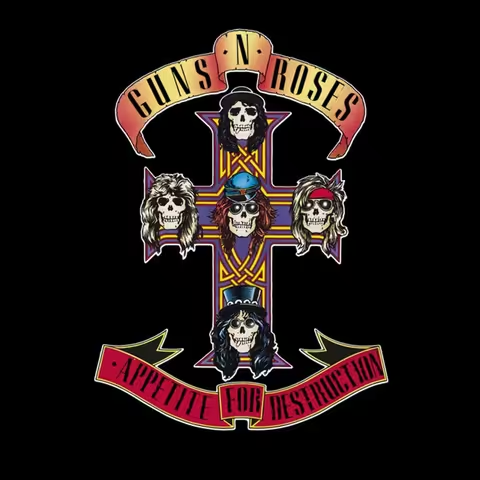
Retailers did not buy that reading. Within weeks, major chains refused to stock the album. Geffen executives capitulated and folded the Williams painting into the inner sleeve, replacing the front cover with an image based on a Celtic cross and skulls tattoo on Axl Rose's arm. Bill White Jr. had designed the original tattoo (Rose later credited the cross-and-skulls concept as Axl's idea and the Celtic knotwork as White's tribute to Thin Lizzy, a band Axl and White both loved). Andy Engell redrew the design for the sleeve. Five skulls represent the five band members, arranged on the cross: Izzy at the top, Adler on the left, Axl in the centre, Duff on the right, Slash at the bottom.
Even the redrawn cover wasn't safe everywhere. Walmart refused to stock the album for years on grounds of the title alone. The original Williams painting was supposed to be restored for the 2008 vinyl reissue and was pulled at the last minute. It finally came back, in its original front-cover position, on the 2018 Locked N' Loaded box. Rose, in a 2011 interview on That Metal Show, said his first choice of cover image had actually been the Time magazine photograph of the Challenger space shuttle exploding. Geffen, predictably, told him it was in bad taste.
Release and reception: 57 weeks to the top
The album came out on 21 July 1987 and was greeted with what can charitably be called indifference. American press largely ignored it. Radio outside California refused to play Welcome to the Jungle. Appetite entered the Billboard 200 at number 182 the week of 29 August and sold around 200,000 copies in its first several months. Geffen, by their own later admission, was preparing to write the record off.
UK critics were more interested. Kerrang!, whose Malcolm Dome had reviewed the band's Marquee Club shows in August, called the album a moment when "rock is at last being wrestled from the hands of the bland, the weak, the jaded, the tired, the worn, and being thrust back into the hands of the real raunch rebels". Sounds and Metal Hammer were less convinced. Dave Ling, writing in Metal Hammer at release, dismissed it as a thin recombination of Aerosmith, Hanoi Rocks and AC/DC.
"A watershed moment in '80s rock that chronicled every vice of Los Angeles led by the lye-voiced Axl Rose and a legendary, switchblade-sharp band."
Maura Johnston, Pitchfork, July 2017 (retrospective 10/10 review)
The turn came when David Geffen personally lobbied MTV to play the Welcome to the Jungle video in late-night rotation. The clip aired once, at four in the morning on a Sunday. The phones started ringing the next day. By the spring of 1988, MTV had moved the video into heavier rotation, and when Sweet Child o' Mine was issued as a single on 3 June 1988 it climbed steadily to the top of the Billboard Hot 100 by 10 September, the band's only US number-one single. Appetite for Destruction itself topped the Billboard 200 on 6 August 1988, 57 weeks after release, spending four non-consecutive weeks at number one and a total of 147 weeks on the chart.
Retrospective re-evaluation has been kinder than the original press. AllMusic's Stephen Thomas Erlewine calls it "the best metal record of the late '80s". Pitchfork's 2017 retrospective by Maura Johnston gave it a perfect 10/10. Rolling Stone ranked it 27th best album of the 1980s in 1989 and 62nd on the 500 Greatest Albums of All Time in both the 2012 and 2020 updates. Kerrang! named it the most essential hard rock album of all time in 2004. Q ranked it as one of the heaviest albums ever made. The album was a 2018 Grammy nominee in the Best Boxed Set category for the Locked N' Loaded reissue (it lost to Weird Al Yankovic's Squeeze Box).
Singles and music videos
The singles strategy was unusual. The first commercial single, It's So Easy backed with Mr. Brownstone, was issued only in the UK on 15 June 1987 and reached number 84. The first US single, Welcome to the Jungle, did not arrive until 21 September 1987, two months after the album, and originally peaked outside the top 40 before being reissued in October 1988 on the back of Sweet Child o' Mine's success. The reissued version finally cracked the US top 10 at number 7.
| Single | Released | US Hot 100 | UK | B-side(s) | Video director |
|---|---|---|---|---|---|
| It's So Easy / Mr. Brownstone | 15 June 1987 (UK only) | Not released | 84 | Mr. Brownstone | Nigel Dick (unreleased video, surfaced 2018) |
| Welcome to the Jungle | 21 September 1987 | 7 (1988 reissue) | 24 | Whole Lotta Rosie (live) | Nigel Dick |
| Sweet Child o' Mine | 3 June 1988 | 1 | 6 | It's So Easy (live) | Nigel Dick |
| Paradise City | January 1989 | 5 | 6 | Move to the City (live) | Nigel Dick |
| Nightrain | July 1989 | 93 | 17 | Reckless Life | Live concert footage compilation |
Nigel Dick directed every official Appetite-era music video except for Nightrain. The Welcome to the Jungle clip, shot in a near-derelict Los Angeles building with Rose arriving fresh off the bus from Indiana in a Pat Boone t-shirt, is the one that broke the album. The Sweet Child o' Mine video, filmed in Huntington Beach on a soundstage in a single day in May 1988, was put together fast and cheap; Erin Everly appears in the band-and-friends crowd shots. The Paradise City video was shot partly at the Monsters of Rock festival at Castle Donington in August 1988, and partly at the Giants Stadium support for Aerosmith. The It's So Easy video, with footage of Rose's then-girlfriend Erin Everly in restraints and a bondage scene Geffen refused to release, was suppressed by the label and not seen publicly until the 2018 reissue campaign.
Touring and live: 16 months on the road
The Appetite for Destruction Tour ran from 7 March 1987 (a pre-release warm-up at the Music Machine in Los Angeles) through to 28 December 1988, when the band closed at the Forum in Inglewood. Across roughly 18 months they played more than 200 shows on five continents.
The early dates were as opening act for the Cult on the North American leg of their Electric tour in summer 1987, then as second-on-the-bill for Motley Crue's Girls Girls Girls run. By 1988 they had moved up to opening for Aerosmith on the Permanent Vacation tour, and by autumn were ready to co-headline. The British live debut at the Marquee Club in London on 19, 22 and 28 June 1987 (three sold-out nights billed at the band's first overseas dates) became one of the most-discussed runs in mid-Eighties hard rock. Recordings from the third Marquee night ended up on the Live from the Jungle EP and on the 2018 reissue.
- March 1987: opening dates for Iron Maiden's Somewhere in Time tour (cancelled by Maiden's management after a couple of dates)
- June 1987: three nights at the Marquee, London, first overseas shows
- August 1987: US support to the Cult on the Electric tour
- October 1987 to early 1988: support to Motley Crue's Girls Girls Girls tour
- February to October 1988: support to Aerosmith on Permanent Vacation
- August 1988: Monsters of Rock at Castle Donington (two fans crushed to death in the crowd during the band's set)
- December 1988: own-headlining North American arenas
The Donington tragedy on 20 August 1988, where Landon Siggers and Alan Dick died in the crush during Guns N' Roses' set, would haunt the band for years. Rose stopped the set twice to plead for the crowd to move back. The festival was suspended the following year as a direct result. The band's response, on stage and in subsequent interviews, was widely praised at the time as remarkably mature given how green they were.
Adler broke his hand in a fight during the Aerosmith tour and was temporarily replaced on a handful of dates by Fred Coury of Cinderella. By the end of the touring cycle, Adler's heroin and cocaine use was so severe that the band would fire him during the Use Your Illusion sessions in mid-1990 after he could not get a usable take on Civil War in roughly thirty attempts. Matt Sorum, then with the Cult, replaced him.
In TV, film and media
Welcome to the Jungle made its first major film appearance in The Dead Pool, the 1988 Dirty Harry sequel, in which the band themselves appear as funeral attendees firing at Clint Eastwood. The song has been a sports anthem staple ever since, used as a New York Jets entry track for years, as a wrestling theme, and as a default needle drop for any film montage where a director needs to telegraph "Los Angeles, late Eighties". Sweet Child o' Mine appeared over the credits of Big Daddy (1999, Adam Sandler) in a unique cut that spliced a live performance with a partial re-recording from Rose's late-Nineties Chinese Democracy lineup sessions. Paradise City has been used in commercials, sports stadia and as a stadium walk-on song for over thirty years, from Major League Baseball walk-ups to NHL openers.
The album's tracks have been comparatively rarely licensed for major TV syncs, which has more to do with Axl Rose's grip on the band's publishing than with lack of demand. Outside the videos and the films named above, the songs tend to surface on screen via cover versions, particularly Sheryl Crow's Sweet Child o' Mine for Big Daddy and various sports broadcasters' choirs of It's So Easy and Paradise City.
Controversy, censorship and lawsuits
The Robert Williams cover is the most visible piece of Appetite's controversy file, but it isn't the only one. Walmart's refusal to stock the album persisted into the Nineties. The PMRC, then at the height of its lyric-warning campaign, used Appetite as a Parental Advisory test case, even though the album was released before the standardised PA sticker was rolled out. Songs from the album were singled out in PMRC literature, and Rose's response in interviews at the time was characteristically unrepentant.
One in a Million, from the follow-up EP G N' R Lies, drew the most lasting backlash and is largely responsible for the omission of the song from the 2018 Locked N' Loaded box. The Appetite-era band were also dogged by the Atlanta arrest of August 1991 (where Rose punched a police officer), the 1992 St. Louis riot, and a Steven Adler lawsuit settled out of court in mid-1993 (Adler reportedly received $2.25 million in back-payments and 15 per cent royalties on the songs he recorded). The post-Appetite years would be more litigation than music for long stretches.
Covers, samples and tributes
The album has been covered by everyone from Sheryl Crow (Sweet Child o' Mine, for Big Daddy in 1999, a US top 30 hit) and Taken by Trees (a Swedish indie-folk Sweet Child o' Mine that made a UK ad for John Lewis) to a string-quartet treatment of Welcome to the Jungle by the Vitamin String Quartet, a slowcore Paradise City by Yo La Tengo, and innumerable hardcore-band desecrations of It's So Easy. The Tori Amos cover of Welcome to the Jungle, performed live in 2006, was the unexpected one that most people heard.
Sample-wise, the album is rarer territory than you'd expect, again because of how tightly the publishing is controlled. The most famous interpolation is in Lil Wayne's Prom Queen, which lifts the chord shape of Sweet Child o' Mine's intro. Avenged Sevenfold have cited the album as the single biggest influence on their City of Evil and Hail to the King records. Buckcherry's entire career is essentially an Appetite homage. The Manic Street Preachers' Generation Terrorists was openly modelled on the album down to the catalogue ambition of a one-shot debut. Mother Love Bone, Pearl Jam's antecedent, formed largely on the strength of Andrew Wood hearing Appetite and deciding Seattle could do its own version.
Reissues, remasters and anniversaries
Appetite has had a relatively quiet reissue history compared with most of its catalogue peers. A 1999 remaster was issued as a CD with slight tweaks to George Marino's original masters. The 2008 vinyl reissue was set to restore the Robert Williams cover but had it pulled at the last minute. Greatest Hits in 2004 (released against the band's wishes and the subject of a failed Slash and Duff McKagan lawsuit) collected six of the twelve Appetite tracks for the wider audience.
The major event in the reissue history is Appetite for Destruction: Locked N' Loaded, released on 29 June 2018 to mark the 31st anniversary. The full Locked N' Loaded edition is a $999 box containing seven 180-gram LPs, four CDs (73 tracks in total, 49 of them previously unreleased), a Blu-ray with new 5.1 surround mixes by Elliot Scheiner and Frank Filipetti, a 96-page book of unreleased Robert John photographs, twelve lithographs visualising the songs, an Easter-egg cassette of a 1985 Mystic Studios demo session and assorted replica memorabilia from Axl Rose's personal archive. A Super Deluxe four-disc edition and a two-disc Deluxe edition were also released at saner price points, and the deluxe content streamed on the usual services. The remastered album re-entered the Billboard 200 top 10 for the first time in 29 years on the back of the campaign.
The 2018 reissue is the first complete official airing of the band's pre-Clink era. The 25 Sound City recordings with Manny Charlton, the Mike Clink session for Shadow of Your Love, the unreleased It's So Easy video and the full Marquee Club live tape are all on it. The box was nominated for the 2019 Grammy for Best Boxed Set (it lost to the Weird Al Yankovic Squeeze Box). A standalone CD and vinyl remaster of the album was issued alongside the box for buyers who did not need 49 outtakes.
Legacy and influence
The follow-up, the half-acoustic, half-live G N' R Lies, was issued in November 1988 and went on to sell ten million copies worldwide on the strength of Patience and the controversy around One in a Million. The Use Your Illusion albums in September 1991 debuted at numbers one and two on the Billboard 200 the same week and sold a combined 35 million worldwide. Adler was already gone by then, fired in July 1990; Izzy Stradlin left in November 1991. Slash and Duff McKagan departed in 1996 and 1997 respectively. Rose held onto the band name and spent the next decade making Chinese Democracy, eventually released in 2008 at a reported cost of around $13 million.
"Guns were five dudes with this shared vision. We met and it was the exact five right guys. The moment we got in a room and played the first three chords, we all knew it."
Duff McKagan, quoted in It's So Easy (and other Lies), 2011
Slash and McKagan rejoined Rose in 2016 for the Not in This Lifetime tour, which grossed $563.3 million by its close in December 2018 and remains one of the highest-grossing concert tours in history. Steven Adler has guested on the tour intermittently. Izzy Stradlin has not returned. The band's current touring lineup (as of 2026) is Rose, Slash, McKagan, Richard Fortus on rhythm guitar, Isaac Carpenter on drums (announced in late 2025), and Dizzy Reed and Melissa Reese on keyboards.
Appetite's wider influence is mostly negative space: it killed the late-Eighties hair-metal industry it ostensibly belonged to. By the time Use Your Illusion came out in 1991 the bands Guns N' Roses had opened for four years earlier were essentially extinct as a commercial force. Grunge gets the historical credit for finishing them off, but the work was largely done by a Sunset Strip band that played louder, dirtier and meaner than the polished hair acts could compete with. Avenged Sevenfold, Buckcherry, the Hellacopters, the Datsuns, Velvet Revolver, the Last Internationale, Airbourne, Halestorm and a generation of Sunset-Strip nostalgia acts all trace back to a record made for $370,000 in five rooms in Los Angeles in the first half of 1987.
Things you might not know
| Fact | Detail |
|---|---|
| The slow burn to number one | The album took 57 weeks to top the Billboard 200, finally reaching number one on 6 August 1988, more than a year after its release. |
| Slash's "stolen" Marshall | The Marshall Super Lead Slash played on the entire record was a rental he kept by telling the studio it had been stolen. |
| The Les Paul was a fake | Slash's main guitar on the album was a Kris Derrig replica with Seymour Duncan Alnico II pickups, used because he could not afford a real Gibson Les Paul. |
| Six days of drums | Steven Adler tracked the entire drum part of the album in six days, then largely vanished from the studio while Axl recorded vocals one line at a time. |
| The G and R sides | The original vinyl and cassette labelled the two sides "G" (drugs and hard city living) and "R" (love and sex) rather than A and B. |
| Adriana Smith on Rocket Queen | The vocal sounds on the bridge of Rocket Queen are an actual live-room recording of Steven Adler's then-girlfriend during a sexual encounter with Axl; Smith was uncredited on the original sleeve. |
| Sweet Child o' Mine started as a warm-up | The opening riff was a finger exercise Slash was playing in the Hell House rehearsal room before Izzy turned it into chord changes; Axl finished the lyric in roughly an afternoon. |
| David Geffen's MTV call | Geffen personally lobbied MTV to play the Welcome to the Jungle video; it aired once at 4 a.m. on a Sunday and the demand spiked immediately. |
| Mike Clink's Triumph CV | Clink had produced two Triumph albums and engineered Heart's Barracuda before getting the Appetite job, having beaten Spencer Proffer, Paul Stanley, Mutt Lange, Tom Werman and Manny Charlton in the audition process. |
| The Donington tragedy | Two fans, Landon Siggers and Alan Dick, died in a crowd crush during the band's Monsters of Rock set at Castle Donington on 20 August 1988; the festival was suspended the following year. |
| The unreleased It's So Easy video | Geffen filmed and then suppressed the It's So Easy video, which featured Erin Everly in bondage scenes; it did not see public release until the 2018 Locked N' Loaded campaign. |
| The original cover painter | Robert Williams's surrealist Appetite for Destruction painting was on the front of the first pressings for only a few weeks before retail pressure forced Geffen to swap it for the Bill White Jr. tattoo design. |
| Walmart held out for years | Walmart refused to stock Appetite for Destruction for years on the strength of the title alone, even after the cover was changed. |
| The Locked N' Loaded box | The 2018 anniversary box contained 73 tracks (49 previously unreleased) across seven LPs, four CDs and a Blu-ray, originally retailed for $999, and was nominated for the 2019 Grammy for Best Boxed Set. |
| Re-recorded for Chinese Democracy | Rose re-recorded the entire album with his late-Nineties Chinese Democracy lineup, replacing two tracks with Patience and You Could Be Mine; a fragment of the new Sweet Child o' Mine appears in the end credits of Big Daddy (1999). |
Riffology podcast: hear the full conversation
Appetite for Destruction is the album the Riffology hosts return to most often, and this article is the long-form companion to the episode we recorded on it. The full conversation, including the bits we couldn't get into print, is available on the Riffology podcast on Apple Podcasts, Spotify, Pocket Casts and every other major platform, or via the episode embed at the top of this page. If this is your first time on the site, the back catalogue covers most of the records mentioned above; the album deep dives on Hysteria, Permanent Vacation and the Use Your Illusion records are the natural next listens.
Comments