Andy Cairns was sixteen when he wrote the riff to "Screamager", and twenty-seven when he and his bandmates finally agreed to put it on a record. Therapy? had spent four albums and three years on the British noise-rock circuit pretending the riff did not exist, terrified that something so unguardedly melodic, so obviously Ulster-punk, so obviously pop, would torpedo their underground credibility. In the summer of 1993, in a converted Oxfordshire farmhouse with a young producer who had just engineered the Pixies' final album, they finally relented.
The single went to number nine. The album that followed in February 1994 sold more than a million copies, was nominated for the Mercury Prize, voted album of the year by Kerrang!, and stuck three short-haired men from County Antrim on the main stage at Monsters Of Rock between Zakk Wylde's Pride & Glory and an in-the-ascendency Pantera. None of them quite believed it at the time, and Cairns admits he isn't entirely sure he believes it now.
Album Facts
| Field | Detail |
|---|---|
| Artist | Therapy? |
| Album | Troublegum |
| Release date | 7 February 1994 |
| Label | A&M Records |
| Producer | Chris Sheldon |
| Studios | Chipping Norton (Oxfordshire); RAK, Livingstone and The Church (London); Black Barn (Surrey) |
| Genre / subgenre | Alternative metal, alternative rock, punk metal |
| Track count | 14 (UK / EU); 15 with hidden track on US/Japan editions |
| Total runtime | 45:37 (UK) |
| Billboard 200 peak | Did not chart |
| UK Albums Chart peak | 5 |
| Other notable chart peaks | Sweden 5, Ireland 5, Netherlands 19, Germany 20, Austria 21, Scotland 29, Switzerland 36, New Zealand 44 |
| Certifications | UK Gold (September 1994); over one million copies worldwide |
| Estimated sales | 1,000,000+ worldwide |
| Key singles | "Nowhere", "Trigger Inside", "Die Laughing"; precursor EPs "Shortsharpshock" ("Screamager") and "Face the Strange" ("Turn") |
A Crowded, Confused Moment in 1994
When Troublegum arrived on 7 February 1994 the rock landscape was simultaneously the healthiest it had been in a decade and the most internally suspicious. Nirvana's In Utero had been out four months. Pearl Jam were in the long shadow of Vs.. Soundgarden were six weeks away from releasing Superunknown, which would end up keeping Troublegum off the top of the Metal Hammer end-of-year poll. Pantera had just delivered Far Beyond Driven. Smashing Pumpkins were finishing Mellon Collie. In Britain, Blur's Parklife would land in April and tip Britpop into its winning year. Oasis's Definitely Maybe was scheduled for late August.
The tribes were at war. Grunge had broken the wall down, but a metalhead who liked Vulgar Display of Power was not necessarily on speaking terms with a baggy-jumpered indie kid who liked Pavement, and neither of them was going to admit they secretly owned a Therapy? EP. Magazines split along the same lines: Kerrang! covered Slayer one week and Sebadoh the next and pretended that was normal; NME wrote about Therapy? with the suspicious affection it reserved for noisy bands who had been clever enough to come up through the Wiiija catalogue rather than Music for Nations.
What no one quite saw coming was a record from a three-piece in County Antrim that ignored the tribal lines and simply absorbed them. Troublegum took the riffing weight of Helmet, the structural economy of the Ramones and Stiff Little Fingers, the introspective lyric voice of Husker Du, and the studio precision of the early Pixies records, then rolled the lot into pop songs three minutes long with choruses you could shout drunk. The metallers played it. The indie kids played it. The punks already owned the earlier records. Troublegum united the lot of them within a fortnight of release.
From a Larne Front Room to a Major Label Deal
The story begins at a charity gig at Jordanstown Polytechnic in 1988, where Andy Cairns watched a wiry drummer called Fyfe Ewing in a punk covers band and decided he wanted to play with him. They began rehearsing the following year in Ewing's parents' house in Larne, on the County Antrim coast, Cairns plugged into a tiny practice amp, Ewing playing his kit with brushes so as not to enrage the neighbours. In April 1989 they recorded the four-track demo Thirty Seconds of Silence with Cairns playing a bass borrowed from Ewing's classmate Michael McKeegan. When they decided to start gigging, they simply recruited the man whose bass they had borrowed. Cairns moved back to guitar. The lineup was set.
Their first gig, on 20 August 1989, was a support slot for Decadence Within at Belfast Art College. Two more demos followed, and a self-released debut single, "Meat Abstract", which Lesley Rankine of Silverfish passed to Gary Walker at the London independent Wiiija. By 1991 they had Wiiija deal and a debut album, Babyteeth; by 1992 a follow-up, Pleasure Death, plus a major-label deal with A&M.
The first A&M record, Nurse, scraped into the UK Top 40 in November 1992. Its lead single "Teethgrinder", a chorus-free three-minute slab of industrial-edged noise rock whose title referred to the long-term effects of speed use, also breached the Top 30. The grunge bandwagon was being loaded that year and every A&R man in London was looking for "the British Nirvana"; Therapy? had heavy guitars, oddball lyrics, and a frontman willing to talk about anxiety, so they got slotted into that conversation whether they liked it or not.
By the end of 1992 they had toured the United States twice, supporting Kings X and then Helmet and The Jesus Lizard. They had played their debut Japanese shows. They had earned a reputation for delivering chest-caving live performances with a setlist that was getting progressively less abstract and more direct. And, crucially, they had befriended Page Hamilton of Helmet, whose drop-D-tuned, single-riff approach to alt-metal would shortly leave a fingerprint all over Troublegum.
Pre-production: "Screamager" and the One-Off That Refused to Stay Off
The pivot moment came in March 1993, with an EP that was meant to be a curiosity. Therapy? released Shortsharpshock, a four-track 12-inch led by a song called "Screamager" that did not sound much like Therapy? at all. It was pop-punk: stop-start intro, melodic verse, soaring chorus, three and a half minutes flat. The riff was something Cairns had been carrying since he was sixteen, written on a borrowed bass and tucked into the outro of a long-dead Lurgan-studio demo called "Spide With Tache" (a "spide", Cairns has explained, was Belfast slang for a chav, "because they had spider webs tattooed on their necks"). He had never dared bring it into the band until producer Chris Sheldon heard them messing around with it in rehearsal and asked, brightly, "That's fantastic, what is it?"
"We were playing it and Chris went, 'That's fantastic, what is it?' We just went, 'Well, it's a bit too poppy for us.' But he said, 'Well, let's stick with it a while.'"
Andy Cairns, Metal Hammer, 2019
The title came from a hotel room in Nottingham. Cairns and McKeegan were sharing a room on tour, were too tired to leave, had the TV on, and were watching the Smash Hits Poll Winners' Party. McKeegan pointed at the audience screaming at Phillip Schofield and said, "Look at all those screamagers." Cairns thought it was a great song title. A week or so later, "Screamager" was being arranged in a studio.
The band's own A&R man at A&M was unimpressed. He told them their fans liked Nine Inch Nails, not the Ramones, and predicted the single would sink. A&M put limited promotion behind it. Shortsharpshock went into the UK chart at number nine, with "Screamager" doing the heavy lifting; it also reached number two in Ireland and number sixteen on the Billboard Modern Rock Tracks chart in the United States. Two more EPs followed in 1993, Face the Strange in May and Opal Mantra in summer, and both hit the UK Top 40 too. By autumn, Therapy? had a problem they had never imagined having: people wanted more songs like "Screamager".
- Working titles binned along the way. "Die Laughing" was originally written as "Reality Fuck". "Stop It You're Killing Me" started life as a much rougher acoustic-based song called "Body OD". "Brainsaw" was an old, never-recorded number called "Window Wall" about the bricked-up houses around the Holylands in Belfast.
- Songs nearly given to other people. "Nowhere" had effectively been written years earlier by a parallel Cairns project called Catweazle (with Michael McKeegan's brother Charlie on drums), under the title "Unbeliever". Cairns admits he had been too embarrassed to bring its hooky chord progression to a band as scared of being called sell-outs as Therapy? were.
- The producer everyone expected they would use. Butch Vig, fresh off Nevermind and Siamese Dream, was floated as a candidate by A&M. The band killed the idea themselves before any meeting happened. "We didn't think we were ready for that," Cairns has said. "We were three kids from Northern Ireland from this punk background. It didn't feel right."
They convened a band meeting before going into the studio proper and asked themselves a single question: do they double down on the "Screamager" direction or revert to noise-rock type? They chose the former, on the proviso that they would only do it if the new songs kept enough edge that the result could not be reasonably accused of being a sell-out. The riffs Cairns was bringing in, most of them written on tour buses on an acoustic between dates with Helmet, passed that test.
Creating the Album: Four Studios, Two Months, One Reel of Tape Per Song
The band started recording basic tracks at Chipping Norton Recording Studios in Oxfordshire on or around 14 July 1993 and spent ten to twelve days laying down drums, bass and rhythm guitars for the bulk of the album. Overdubs, lead vocals and additional sessions then moved between RAK Studios, Livingstone Studios and The Church in London, and, according to Wikipedia's session credits, additional tracking at Black Barn in Surrey. Production and engineering were handled throughout by Chris Sheldon, with Darren Allison as second engineer.
Sheldon was a calculated bet. He was only a few years older than the band, had just engineered the Pixies' Trompe Le Monde, and had a reputation for working fast with small budgets and analogue tape. He arrived with a clear philosophy on tracking the kind of songs Therapy? had brought him: keep the count of overdubs low, leave plenty of room around each instrument, and let the band's actual sound be the record's sound rather than reaching for studio polish.
"When we did 'Screamager', a normal reel of tape was twenty-four tracks. I didn't even fill it up. It was just drums, bass and three tracks of guitar because we worked out a sound that we liked. Maybe there was a solo guitar, a lead vocal, and a harmony vocal. That was it. Boom. Done."
Chris Sheldon, Kerrang!, 2019
Sheldon used the same restraint on the rest of the record. Most songs were tracked as a power-trio playing together, with Ewing's drums and McKeegan's bass committed first, then two or three Cairns guitar passes layered for chorus weight. Vocal arrangements were equally lean: lead, occasional double-track, the odd harmony, and on one or two tracks a guest cameo. The album's punchiness on speakers comes from how little is there to fight for the listener's attention, not from how much.
That is not to say the studio was a polite environment. Sheldon has cheerfully recalled looking up from the desk at Chipping Norton during work on "Stop It You're Killing Me" to see Cairns gripping the whammy bar of his guitar and physically bouncing the instrument up and down to generate the noise that ended up underpinning the song's solo section. "That is not normal behaviour," he conceded. "I fully support that. I love it."
"I remember I double-tracked Andy's vocals on 'Knives', so when you're listening on headphones, suddenly he's drilling into you like the scary bastard you do not want to meet. That's exactly what we wanted."
Chris Sheldon, Kerrang!, 2019
The band's biggest creative anxiety in the studio was structural rather than sonic. They were terrified, Cairns especially, that they were drifting further from the noise-rock heroes who had given them permission to exist as a band. Big Black, The Jesus Lizard, Fugazi, The Membranes; this was the wallpaper of Cairns' record collection, and he could not entirely shake the feeling that writing a four-on-the-floor pop song was a small betrayal of it. The way he reconciled it was to embed quiet little tributes throughout the record. "Die Laughing", he has said, is "completely Fugazi" in its palm-muted G-to-Em fifths. "Hellbelly" reaches openly for the Pixies' Trompe Le Monde. The opening of "Stop It You're Killing Me" buries a feedback Morse code that nods to Steve Albini's recording techniques. None of these signal to a casual listener; they signal to Cairns himself that he had not gone soft.
Sessions wrapped around September 1993. Mixing was done at the same studios with Sheldon at the desk. Mastering was completed in time for an early-February 1994 release, allowing A&M to roll the lead single "Nowhere" out on 17 January, three weeks ahead of the album, to seed the chart.
Personnel & Credits
| Role | Player | Notes |
|---|---|---|
| Therapy? | ||
| Vocals, guitar | Andy Cairns | All lead vocals; all main rhythm and lead guitar except where noted. |
| Bass, backing vocals | Michael McKeegan | Larne-born; co-writer on "Screamager", "Die Laughing" and "Turn". |
| Drums, backing vocals | Fyfe Ewing | Co-writer on "Screamager", "Die Laughing" and "Turn"; departed Therapy? in early 1996. |
| Guest musicians (credited) | ||
| Lead guitar on "Unbeliever" | Page Hamilton | Helmet frontman; flew to Chipping Norton to track the solo after Cairns asked him over beers on the 1993 US tour. |
| Additional vocals on "Lunacy Booth" | Lesley Rankine | Silverfish vocalist and long-standing Therapy? ally; was the figure who first passed the band's debut single to Wiiija in 1990. |
| Cello on "Unrequited" | Martin McCarrick | Then a touring sideman; would join Therapy? as a permanent member in 1996. |
| Additional vocals on "Femtex" | Eileen Rose | American-born singer-songwriter based in London at the time. |
| Backing vocals on "Unrequited" outro | Chris Sheldon | The high voice singing "I know that you'll understand" at the end of the track is the producer himself. |
| Production & engineering | ||
| Producer, engineer | Chris Sheldon | Came off the back of engineering the Pixies' Trompe Le Monde; would later return to produce Therapy?'s 2018 album Cleave and 2023's Hard Cold Fire. |
| Engineer | Darren Allison | Engineered the bulk of the London-studio overdub sessions. |
| Artwork | ||
| Photography | Nigel Rolfe, Stuart Smyth, Valerie Phillips | Three photographers contributed band and inner-sleeve images. |
| Design | Jeremy Pearce, Simon Carrington | Responsible for the green-on-green colour scheme that ran across cover, CD tray and limited-edition vinyl. |
The most-asked question about the credits has always been about "Unbeliever". Page Hamilton's solo is short, melodically perfect and entirely uncharacteristic of his own band's slash-and-grind approach to lead guitar at the time. Cairns had originally intended to drop a sampled dialogue clip from John Huston's Wise Blood over the section, decided it would stick out on a record that otherwise had almost no samples, and tried a solo himself. He gave up. Sheldon suggested asking Page direct.
"We were working on songs on tour, and that's when stuff like 'Unbeliever' came about. Helmet played in that drop-D tuning, and we'd an acoustic guitar on the bus and I remember Andy playing the riff. By the fourteenth of July we were in the studio in Chipping Norton and spent ten or twelve days doing the basic tracks. In that time we asked Page if he would do the solo."
Michael McKeegan, Kerrang!, 2019
The Songs: A Track-by-Track Walk
What follows is the UK and European running order. The US edition omitted Joy Division's "Isolation" by mistake on first pressings and added the country standard "You Are My Sunshine" as a hidden track at the end of "Brainsaw"; the Japanese release added an extra song, "Pantopon Rose", as track fifteen.
| # | Title | Writer(s) | Length | Single? | Notes |
|---|---|---|---|---|---|
| 1 | "Knives" | Cairns | 1:55 | Inspired by Cairns playing Elvis's "Jailhouse Rock" backwards; opening vocal whisper double-tracked by Sheldon as a deliberate scare-tactic. | |
| 2 | "Screamager" | Cairns, McKeegan, Ewing | 2:36 | EP lead, March 1993 | Built on a riff Cairns wrote at sixteen; title coined by McKeegan watching the Smash Hits Poll Winners' Party in a Nottingham hotel. |
| 3 | "Hellbelly" | Cairns | 3:21 | Pixies' Trompe Le Monde-style riffing; lyrics drawn from Cairns' Flannery O'Connor reading and his attack on Northern Irish Christianity. | |
| 4 | "Stop It You're Killing Me" | Cairns | 3:50 | Originally demoed as "Body OD"; rebuilt with feedback Morse-code intro and a whammy-bar noise solo. | |
| 5 | "Nowhere" | Cairns | 2:26 | UK 22, January 1994 | Chord progression Cairns had been hiding since his pre-Therapy? band Catweazle; B-sides included a cover of Judas Priest's "Breaking the Law". |
| 6 | "Die Laughing" | Cairns, McKeegan, Ewing | 2:48 | UK 29, May 1994 | Previously titled "Reality Fuck"; openly Fugazi-influenced palm-muted fifths; David Holmes mixes appeared on the 12-inch. |
| 7 | "Unbeliever" | Cairns | 3:28 | Page Hamilton plays the lead guitar solo; the song shares its title with an unrelated Catweazle track that fed into "Nowhere". | |
| 8 | "Trigger Inside" | Cairns | 3:56 | UK 22, February 1994 | Inspired by Brian Masters' The Shrine of Jeffrey Dahmer; got Cairns roasted in the press for the line "I know Jeffrey Dahmer feels". |
| 9 | "Lunacy Booth" | Cairns | 3:55 | Lesley Rankine of Silverfish on additional vocals; title was the band's own nickname for the vocal booth. | |
| 10 | "Isolation" | Curtis / Sumner / Hook / Morris | 3:10 | Germany only, Sept 1994 | Joy Division cover incorporating elements of "Atrocity Exhibition"; the German single appeared with two Consolidated remixes. |
| 11 | "Turn" | Cairns, McKeegan, Ewing | 3:49 | EP, May 1993 | Earlier than the album; chorus phrase "turn and face the strange" was, Cairns admits, lifted accidentally from Bowie's "Changes" via Jay Stevens' book Storming Heaven. |
| 12 | "Femtex" | Cairns | 3:14 | US only, 1994 | Title is a punning twist of the Northern Irish explosive Semtex; song is a tribute to the women of the early 90s alt-rock scene; Eileen Rose on additional vocals. |
| 13 | "Unrequited" | Cairns | 3:03 | Cairns trying to play the Peter Gabriel song "Salisbury" badly on guitar; Martin McCarrick on cello; Sheldon on the high backing vocal at the end. | |
| 14 | "Brainsaw" | Cairns / Davis / Mitchell | 3:58 | Reworking of a never-recorded early song called "Window Wall" about Belfast's Holylands; closes with a fragmentary "You Are My Sunshine" cover (full hidden track on US/Japan editions). |
"Knives" and the scary-bastard whisper
The album opens at one minute fifty-five with a track Cairns put together while obsessively listening to Elvis Presley's "Jailhouse Rock" backwards on a tape deck, the kind of behaviour that, he has explained, was perfectly normal when he was searching for writing inspiration. He would also try to learn oboe parts from film orchestras on guitar. The riff is essentially Big Black with the dynamics of a Texas country song. "Knives" works as an opener because of Sheldon's vocal trick: Cairns' opening whisper of "My girlfriend says…" is double-tracked, which on headphones produces a stereo-image effect of someone breathing directly into both ears at once. By the time the chorus arrives, the listener is already braced.
"Screamager" and a riff that waited eleven years
The riff Cairns had been carrying since he was sixteen had previously been heard only in the outro of a long-dead Lurgan-studio demo called "Spide With Tache". When the band sat down to record it properly with Sheldon, the producer's chief contribution was to talk Ewing out of a "really bizarre Neil Peart, eight-bar fill" that the drummer had planned for the intro; Sheldon's advice was that if the song was an Ulster-punk love letter then it should open with the kind of straight-in attack the Undertones would have used. Cairns added the stop-start chord stab at the very start, openly stolen from Helmet's Strap It On, and the rest of the song wrote itself.
"Nowhere" and the chord change Cairns was too embarrassed to bring in
For all that "Screamager" is the song people remember from the EPs, "Nowhere" was the single that broke Therapy? from cult act into household name in the UK. Released on 17 January 1994 it crashed into the UK Singles Chart at number eighteen and stayed there long enough to soundtrack what felt like every metal and indie club night of the spring. The two-note "siren" guitar that runs underneath the verses was created with a sampler pedal Cairns had just bought, he would play a phrase, stop, and the pedal would loop it while he played rhythm underneath. The chord progression itself, as Cairns has cheerfully admitted, is one of the most overused in rock history: it is the chord change of The Cars' "Just What I Needed", The Only Ones' "Another Girl Another Planet", U2's "With Or Without You" and Adele's "Someone Like You". He had been embarrassed about it since he was a teenager.
"I will be the first to admit, it's one of the most hackneyed chord progressions in the world of rock'n'roll. But I had it from whenever I was young, and I always thought it was really catchy. Whenever Therapy? started I'd never even dare bring it into the rehearsal studio."
Andy Cairns, Kerrang!, 2019
"Trigger Inside", "Hellbelly" and the lyrical engine room
Lyrically, Troublegum is darker and more specific than the cleanness of its surfaces suggest. "Trigger Inside" took its central line, "I know Jeffrey Dahmer feels", from Cairns reading Brian Masters' The Shrine of Jeffrey Dahmer and finding a passage about the young Dahmer giving a present to a teacher and watching her drop it in the bin. Cairns had had exactly the same experience at Ballyclare Primary School, where his mother had packed Rice Krispie cakes in his lunchbox with instructions to share one with the teacher. The song is not a sympathy piece for a serial killer; it is, as Cairns has been careful to clarify, an attempt to describe how an eight-year-old can feel utterly betrayed by an authority figure in a single act of casual cruelty. The press misread it anyway and Cairns spent a chunk of 1994 explaining it.
"Hellbelly", "Lunacy Booth" and "Unbeliever" are similarly tangled up in Cairns' reading: Flannery O'Connor's Southern Gothic, the Catholic-haunted American South, mapped onto the Protestant-haunted Northern Irish childhood he had grown up in. "Hellbelly", he has said, was him "trying to write a Pixies-esque, slightly bizarre, off-kilter riff" and pouring over it lines about Christianity in Ulster covering for "child abuse, money laundering, things like that".
"Turn" and the Bowie line Cairns did not know he was stealing
"Turn" had been released back in May 1993 as the lead track of the Face the Strange EP, but the band re-cut it for Troublegum alongside two further EP tracks ("Screamager" and "Opal Mantra"). The chorus phrase was lifted, not entirely deliberately, from a chapter heading in Jay Stevens' Storming Heaven, a book about the history of LSD. Cairns had no idea it was originally a David Bowie lyric from "Changes". McKeegan didn't either. The story has a punchline: in 1996 Therapy? were billed to play the Werchter Festival in Belgium on the same day as Bowie. Cairns clocked Bowie standing at the side of the monitor desk, watching, three songs into the set. He turned to play "Turn", glanced over again, and Bowie was gone. After the set the monitor guy passed on the only thing Bowie had said: "Great band. Lots of energy." No reference to the stolen line. Cairns took the win.
"Isolation", Joy Division done as if Martin Hannett had been even more ominous
The Joy Division cover, sequenced as track ten, is the most overt outside reference on the album. Cairns had originally been working on the bassline on guitar, the way he often did with Joy Division songs (he had started as a bass player and had a tendency to translate their basslines to six strings). The recording incorporates elements of "Atrocity Exhibition", both songs are from Closer, and McKeegan added a low octave-bass overdub that sits beneath the guitar bass and only becomes audible on a proper hi-fi. Richey Edwards of the Manic Street Preachers reportedly disliked the cover when he first heard it. Most of the rest of the press treated it as one of the more imaginative Joy Division covers of the era and Germany liked it enough to release it as a single in its own right that September, backed with a string version of "Lunacy Booth" and a Consolidated remix.
"Femtex", a tribute to the women they had toured with
"Femtex" is the album's most-overlooked song, lyrically because it does the same Ulster-punning trick as the album title (Semtex was a household word in early-90s Northern Ireland; "Femtex" was the obvious next step), and musically because it sits between "Turn" and "Unrequited" on the running order and tends to get skipped. It deserves better. The song is Cairns' direct tribute to the women he had toured with in the early 90s, Lori Barbero of Babes In Toyland, Lesley Rankine of Silverfish, Hole, Daisy Chainsaw, and the way he had watched them get patronised, talked down to, ignored at venues and ripped off by promoters in ways his own band were not. Eileen Rose's additional vocal in the chorus carries the song's central line.
B-sides, Outtakes and Lost Songs
Therapy? approached the Troublegum singles campaign as if it were a separate album in its own right. Each of the five singles came with multiple B-sides, covers, live tracks, remixes, demos and the kind of throwaways most bands save for box-set fodder fifteen years later. The 2014 deluxe edition rounded up most of them across two extra discs, and many resurfaced again in the 2013 Gemil Box.
Highlights worth tracking down on a wet Sunday:
- "Breaking the Law", straight-faced cover of the Judas Priest standard, on the "Nowhere" CD single. Andy Cairns has always been an unembarrassed metalhead.
- "C. C. Rider", Elvis Presley standard, also on "Nowhere". Same logic: Cairns' first musical memory is The Sweet doing "Blockbuster" on Top of the Pops; he is not above an old rock'n'roll standard.
- "Nice 'n' Sleazy", Stranglers cover, "Trigger Inside" single. The band's love of UK punk in all its forms got a workout on the B-sides.
- "Reuters", Wire cover, also from "Trigger Inside".
- "Tatty Seaside Town", Membranes cover from the same single. The Membranes are a band Cairns has cited as foundational to his guitar sound; this is him paying it back.
- "Pantopon Rose", original Cairns/McKeegan composition on the "Nowhere" UK B-side, named after a William Burroughs character; added as track fifteen on the Japanese album edition.
- "Evil Elvis (The Lost Demo)", on the "Die Laughing" CD single; one of several previously-unreleased session demos to surface across the 1994 single campaign.
- The David Holmes "Die Laughing" mixes, the Belfast DJ produced two extended remixes for the "Die Laughing" 12-inch single, presaging the more openly experimental directions Holmes would help steer Therapy? into on the 1995 follow-up Infernal Love.
Beyond the B-sides, the deluxe-edition reissues collect a clutch of demo versions of album tracks, "Totally Random Man", "Turn", "Knives" and "Unbeliever" all exist in their pre-Sheldon shapes, and a "Knives (Kiddie Version)" that A&M cut for a US promo single. Of the songs the band wrote in the same period but did not record for the album, the most-mentioned in interviews is "Body OD", the rougher acoustic-leaning song that became "Stop It You're Killing Me" once the band added the harmonic Morse-code intro and tightened the chorus into double time. The original "Body OD" demo, by Cairns' own account, had a much more Butthole Surfers-style outro that did not survive the rebuild.
Album Artwork & Packaging
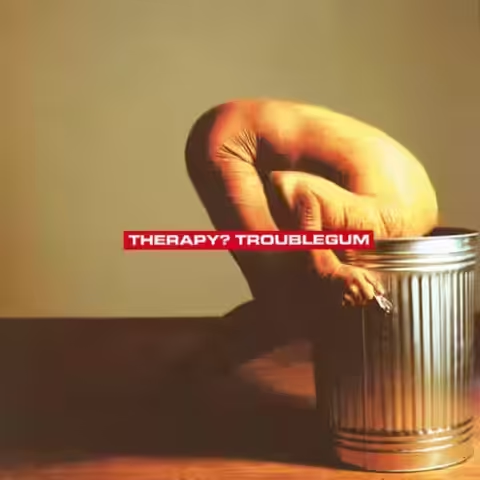
The sleeve is one of the more identifiable pieces of mid-90s alt-rock packaging, and it is identifiable because of the green. The UK first-pressing CD shipped with a green CD tray; the cassette came in a green shell; A&M pressed a limited-edition 12-inch vinyl on bright green vinyl. The cover art itself is comparatively restrained, a wash of muted colour over the band name in a sober sans-serif, but everything about how it was packaged signalled "this is not the same band that made Nurse". Nurse had been black-and-white, gothic, hospital-room-bleak. Troublegum was deliberately bright.
Three photographers split the imagery: Nigel Rolfe (an Irish artist known for his performance and photographic work), Stuart Smyth, and Valerie Phillips (the New York-based photographer who later did extensive work with British bands of the era). Jeremy Pearce and Simon Carrington handled the design. The 2014 deluxe reissue restored the green colour scheme across the box and reproduced unused alternative shots from the same sessions.
Release and Reception
Troublegum was released on 7 February 1994. It went into the UK Albums Chart at number five and was certified gold by the BPI on 1 September 1994. International chart positions painted a picture of a record that did real work outside the UK too: number five in Sweden and Ireland, the Top 20 in the Netherlands and Germany, the Top 30 in Austria and Scotland, and Top 40 placings in Switzerland and New Zealand. By the time the band stopped touring the album in early 1995 it had sold over a million copies worldwide.
Contemporary reviews were enthusiastic across the tribal lines. NME awarded it 8/10. Entertainment Weekly in the US gave it a B. The Los Angeles Times ran a three-star review. Kerrang! went the furthest, naming it the best album of 1994 outright. The wider press recognised something the band themselves were still figuring out: that Troublegum had managed to be a metal album that the indie press took seriously, a pop record that metalheads were not embarrassed to own, and a Northern Irish record that did not depend on a Troubles framing to be heard.
"I was nervous. I loved Nurse and 'Teethgrinder', but I was so worried that people were going to say, what has this idiot done? I was so worried that it was such a radical departure that people would say I'd ruined the band. But of course, people loved it."
Chris Sheldon, Kerrang!, 2019
In the autumn the album was shortlisted for the 1994 Mercury Music Prize, the youngest of the major UK album prizes and one that A&R departments at the time still treated with cautious respect. M People's Elegant Slumming took the award; Troublegum took the publicity. At the inaugural Kerrang! Awards later that year, Therapy? collected the Best Album prize, beating both Soundgarden and Pantera on the night. Metal Hammer's end-of-year poll placed Troublegum at number two behind only Superunknown. A decade later, in 2005, the same magazine ranked it number thirty-one in its 100 Best British Rock Albums Ever list. Kerrang!'s 1,000th issue retrospective in 2004 named it the best album of 1994 a second time.
Singles & Music Videos
| Single | Released | UK Singles peak | Other peaks | B-sides | Video director |
|---|---|---|---|---|---|
| "Screamager" (on Shortsharpshock EP) | 8 March 1993 | 9 | Ireland 2; Billboard Modern Rock 16 | "Auto Surgery", "Totally Random Man", "Accelerator" (re-recorded) | Jon Klein |
| "Turn" (on Face the Strange EP) | 31 May 1993 | 18 | Ireland 5 | "Speedball", "Bloody Blue", "Neck Freak" (re-recorded) | Julie Hermelin |
| "Nowhere" | 17 January 1994 | 22 | Ireland 6 | "Pantopon Rose", "Breaking the Law" (Priest cover), "C. C. Rider" (Elvis cover), Sabres of Paradise remixes | Nico Beyer |
| "Trigger Inside" | 28 February 1994 | 22 | Ireland 16 | "Nice 'n' Sleazy" (Stranglers), "Reuters" (Wire), "Tatty Seaside Town" (Membranes) | Uncredited |
| "Die Laughing" | 30 May 1994 | 29 | Ireland 16 | "Stop It You're Killing Me" (live), "Trigger Inside" (live), "Evil Elvis (The Lost Demo)", David Holmes mixes | Matt Mahurin |
| "Isolation" | September 1994 (Germany only) | , | , | "Lunacy Booth" (string version), Consolidated remix | Michelle Spillane (v1) |
| "Femtex" | 1994 (US only, 7-inch, 500 copies) | , | , | "Pantopon Rose" | , |
The most expensive and most-aired of the videos was Matt Mahurin's clip for "Die Laughing". Mahurin, the American photographer and filmmaker who had also directed Metallica's "The Unforgiven" and U2's "One", brought his trademark sepia-toned, slow-shutter, semi-narrative style to the band. The "Nowhere" clip by Nico Beyer is the polar opposite: harsh white-light performance footage shot in stark contrasts. Both got heavy MTV Europe rotation across 1994 and both gave Top of the Pops producers something they could use on the show without it visually scaring their primary audience.
Touring: Reading, Donington, Phoenix and the Marquis de Sade
Therapy? toured Troublegum harder than any of their other records. The band were on the road for the bulk of 1994, with the album cycle including their third consecutive Reading Festival appearance, an inaugural Phoenix Festival slot, and, the headline date of the year, a main-stage appearance at the 1994 Monsters Of Rock at Donington Park on 4 June, sandwiched between Zakk Wylde's Pride & Glory and Pantera, with Aerosmith headlining. For three short-haired Ulstermen with no leather trousers between them, this was as far as it was possible to get from where they had started five years earlier in a Belfast art-college support slot.
"We'd been warned beforehand that this could go horrendously wrong. We were this band from the noise-rock underground, our bassist wore glasses, we had short hair at a time when short hair was viewed with suspicion in the world of metal. We had visions of getting bottled off. With bottles of piss at that."
Andy Cairns, Metal Hammer, 2019
The Donington set went the opposite way. The crowd took to them by the third song; the band came offstage having pulled off, as Metal Hammer's Dave Everley later put it, "a musical smash-and-grab that no one expected". Cairns' favourite memory of the day, though, is what happened backstage. As he came out of the dressing-room area, somebody behind him said, "I hear you like the Marquis de Sade." He turned around to find Bruce Dickinson, who had read a Cairns interview in which the singer had mentioned Sade as one of his favourite authors. The two men sat down and talked about the Marquis de Sade for forty-five minutes without ever once discussing music.
The wider tour folded in TV appearances that would have been unthinkable two years earlier. The band played Top of the Pops for "Screamager", "Nowhere" and "Die Laughing", the last of which gave Cairns one of his career-defining "what am I doing here" moments, given that the first piece of music he could remember as a child was The Sweet doing "Blockbuster" on the same show. There were Dave Grohl and Debbie Harry sightings at gigs. There was a one-off live cover of Black Sabbath's "Iron Man" with Ozzy Osbourne on guest vocals. There was a Werchter Festival slot that ended with David Bowie giving the band three words of feedback.
By the time the band came offstage on something like 23 December 1994, A&M's marketing department was already on the phone wanting the follow-up. The band were back in a studio in Lincolnshire the day after Boxing Day with no songs, trying to start work on what became Infernal Love. They were exhausted.
In TV, Film and Media
Cairns' songs from this era have travelled further than most of his contemporaries'. "Nowhere" was used by EA Sports on NCAA Football 2006 for the Xbox, GameCube and PlayStation 2; older Therapy? tracks "Auto Surgery" and "Teethgrinder" had previously appeared on Road Rash for the 3DO, Sega Saturn and PlayStation. "Screamager" and "Nowhere" both turn up on the soundtrack to the BBC sitcom Game On. "Speedball", a "Screamager" EP B-side, appears in the 1994 Greg Araki film S.F.W.. "Come and Die", a track from the same writing period, was contributed by the band (with rap group Fatal) to the much-loved 1993 Judgment Night soundtrack, the rock-meets-hip-hop crossover album that brought together Slayer with Ice-T and Sonic Youth with Cypress Hill.
Controversy: Trigger Inside and a Misread Lyric
The closest Troublegum came to actual controversy was the press storm around "Trigger Inside". The line "I know Jeffrey Dahmer feels" was widely read in the spring of 1994 as either a celebration of, or at minimum a flippant reference to, the Milwaukee serial killer who had been convicted three years earlier and was still alive in prison at the time of recording (Dahmer was beaten to death by another inmate in November 1994). Cairns spent considerable interview airtime trying to explain that he was using Dahmer as a vehicle for talking about childhood betrayal, not as a hero figure, and that the line had been triggered specifically by reading Brian Masters' biography of him.
Beyond that, the record had a remarkably non-controversial life. No covers were withdrawn or stickered. No religious organisation organised a boycott (the rather more anti-clerical lyrics of "Hellbelly" and "Lunacy Booth" sailed under the radar in part because Therapy? were known as a Northern Irish band and the press tended to assume that any anti-clericalism was an Ulster-political position to be respected rather than condemned). The "Nowhere" video had no censorship issues. The album was sold without parental-advisory stickers in any major market.
Covers, Samples and Tributes
The most-noted cover of a Troublegum song in its early years was Therapy?'s own re-recording of the lot: in November 2019 the band went into Abbey Road and re-cut twelve of their biggest singles (from Nurse, Troublegum, Infernal Love and Semi-Detached) for Greatest Hits (The Abbey Road Session). The Abbey Road versions of "Screamager", "Nowhere", "Die Laughing", "Trigger Inside" and "Stories" are, for a band still routinely playing the originals live, the most-recommended way to hear what Cairns and McKeegan think of these songs three decades on.
"Screamager" has been covered live by a long list of British alt-rock bands who treat it as their generational standard: the Wildhearts have referenced the riff in soundchecks for years; Biffy Clyro have publicly cited Troublegum as foundational. Frank Carter has done "Knives" live more than once. In the metal world, the album's influence travels through bands like Halestorm, who have repeatedly invoked Therapy? as a model for how to write hooks under heavy guitars.
The album's own borrowings are documented in the credits: Joy Division's "Isolation" (with elements of "Atrocity Exhibition" baked in), and the trad "You Are My Sunshine" as the hidden track on the US/Japan editions of "Brainsaw". The Helmet-style stop-start guitar intro on "Screamager" is openly an homage to Strap It On. The Bowie reference in "Turn" is, as Cairns has admitted, accidental rather than deliberate.
Reissues, Remasters and Anniversaries
Troublegum has been reissued more times than almost anything else in Therapy?'s catalogue, in part because of the strength of the singles' B-side material that has been waiting to be heard properly ever since.
- The Gemil Box (November 2013), a career-spanning box set whose contents included remastered Troublegum, three CDs of rare and unreleased material, a DVD of the band's 2010 Sonisphere full-album performance of Troublegum, official bootlegs from London ULU '91 and the Mean Fiddler '92, a 12-inch of the early demos, and a cassette of a 1990 Dublin live recording.
- 20th-anniversary deluxe edition (31 March 2014), Universal Music's three-disc set carrying the album, a disc of associated B-sides, demos and remixes, and a third disc of EP rarities. The 2014 reissue is the version most fans now own and the easiest way to hear the full singles-campaign material in one place.
- 2010 Sonisphere full-album performance, on 31 July 2010 at Knebworth, Therapy? performed Troublegum in its entirety, the cleanest documentation of the 20th-anniversary "Troublegum & more" live touring run that followed through Europe later that year.
- Greatest Hits (The Abbey Road Session) (2020), re-recorded versions of twelve Top 40 singles, including the bulk of the Troublegum singles. The album was tracked at Abbey Road Studios in November 2019 specifically as a 30th-anniversary marker for the band, and ended up serving as a 25th-anniversary marker for Troublegum as a side effect.
- 30th-anniversary "Troublegum" UK tour (November 2024), Therapy? played the album in its entirety on a UK run "along with a host of other musical treats from around the same era", as Kerrang! put it.
- Bootlegs in circulation, fan tape-trader circles still pass around two informally archived recordings: the 1993 Reading Festival set (a stop on the EP campaign that previewed several Troublegum songs in live form months before release), and a Town & Country, Leeds 1994 show that contributed officially-released live tracks to the "Die Laughing" CD single B-sides.
Legacy: The Album That Didn't Need a Tribe
Therapy? did not stay this big. Infernal Love in 1995 was a more cinematic, more divisive record that included a strings-heavy cover of Hüsker Dü's "Diane" (a Top 10 hit across fifteen European countries that autumn) but did not match Troublegum's commercial reach. Fyfe Ewing quit in January 1996, citing the relentless pace; he was replaced by Graham Hopkins, with Martin McCarrick joining permanently on guitar and cello. The label support began to wane around Semi-Detached in 1998 and A&M dropped the band before the end of the decade.
What none of that touched was Troublegum's standing as a permanent fixture of the 1990s rock canon. The band themselves treat it as their OK Computer: the album that defines them, the one that has to be played live in some form on every tour. They have re-recorded its singles at Abbey Road, they have played it front-to-back at festivals across Europe, they have built deluxe reissues around it, and they have continued to credit Chris Sheldon as the man who saw what they could be before they did, going back to him to produce 2018's Cleave and 2023's Hard Cold Fire.
"I think Troublegum remains quite unsung in what it did for rock music and how it crossed over into other tribes. Killing off indulgent blues-based solos, having intelligent lyrics that dealt with issues of self-help and self-effacement, there weren't a lot of bands doing that in the metal sphere at the time. And it's got great songs on it."
Andy Cairns, Metal Hammer, 2019
That "crossed over into other tribes" is the key to its survival. Troublegum arrived at the exact moment alternative rock was big enough to be commercially attractive but young enough to still have rigid lines between sub-genres. Without trying to be a unifier, by simply taking the strongest tools from each adjacent box, Therapy? made a record that any of those tribes could legitimately claim. Three decades on, the playlist that pairs it with Burn My Eyes, Superunknown, Definitely Maybe, Vulgar Display of Power and Mellon Collie and the Infinite Sadness sounds neither incongruous nor cute. It sounds like the 1994 those records were actually competing in.
Things You Might Not Know
| Fact | Detail |
|---|---|
| The riff was sixteen years old | The "Screamager" riff was originally written by Andy Cairns on a borrowed bass when he was sixteen, and tucked into the outro of a forgotten Lurgan-studio demo called "Spide With Tache", Belfast slang for a chav, "because they had spider webs tattooed on their necks". |
| The title came from a TV show | "Screamager" was coined in a Nottingham hotel room when Michael McKeegan watched the Smash Hits Poll Winners' Party on television and described the screaming teenage girls in the audience as "screamagers". Andy Cairns immediately decided it was a song title. |
| Butch Vig was on the producer shortlist | A&M floated the Nevermind producer as a candidate for the follow-up to Nurse. Therapy? killed the idea themselves before any meeting happened. Cairns has explained: "We didn't think we were ready for that. We were three kids from Northern Ireland from this punk background. It didn't feel right." |
| The A&R man hated "Screamager" | Cairns has recalled the A&R man at A&M coming down to hear the song, listening once, and saying: "Oh, man… I don't think your fans will like it. Your fans like Nine Inch Nails, they don't like the Ramones." The single went to number nine. |
| Page Hamilton was asked over beers | The Helmet frontman who plays the lead guitar solo on "Unbeliever" was first approached by Cairns "a few nights over beers" on the band's 1993 US support tour with Helmet. He flew to Chipping Norton specifically to track the solo. |
| The producer sings on track 13 | The high backing vocal at the end of "Unrequited", "I know that you'll understand", is Chris Sheldon. Cairns thought it suited a higher register than he could comfortably hit. |
| The "Turn" chorus was an accidental Bowie steal | "Turn and face the strange" appears on Bowie's "Changes". Cairns had read it as a chapter heading in Jay Stevens' LSD history Storming Heaven and assumed Stevens had coined it. McKeegan also did not realise. Bowie himself, watching the band play it at Werchter 1996, said only: "Great band. Lots of energy." |
| The Sheldon whisper trick on "Knives" | The opening "My girlfriend says…" vocal on the album opener is intentionally double-tracked so it appears in both ears simultaneously on headphones. Sheldon's stated goal was to make Cairns sound like "the scary bastard you do not want to meet". |
| The Jeffrey Dahmer line came from Rice Krispie cakes | The "I know Jeffrey Dahmer feels" line on "Trigger Inside" was triggered by Cairns reading a passage in Brian Masters' Dahmer biography about the young Dahmer watching a teacher drop a present in the bin. Cairns had had the same experience at Ballyclare Primary School with cakes his mother had made. |
| Bruce Dickinson knew Cairns' reading list | After Therapy?'s 1994 Monsters Of Rock set, Cairns found himself ambushed backstage by the Iron Maiden frontman, who had read a Cairns interview mentioning the Marquis de Sade. The two men spent forty-five minutes discussing the eighteenth-century French libertine and did not mention music once. |
| The album cost most fans nothing extra to own all formats | The first UK pressing was issued simultaneously on green-vinyl 12-inch, green-shell cassette, and CD with a green tray, and at the time the price difference between formats was small enough that completist fans simply bought all three. |
| An Ozzy collaboration nearly happened | Therapy? recorded a one-off cover of Black Sabbath's "Iron Man" with Ozzy Osbourne on guest vocals during the Troublegum touring cycle. There is a long-running fan debate about whether the recording was finished and shelved or never completed at all; Cairns has been cagey about its current status in interviews. |
| "Femtex" was an explosive pun | The song's title is a deliberate twist on Semtex, the Czech plastic explosive that had been a household word in early-90s Northern Ireland. Cairns intended it as a tribute to the women of the alt-rock scene, Lori Barbero of Babes In Toyland, Lesley Rankine of Silverfish, the women of Hole and Daisy Chainsaw, who had been "patronised, talked down to" on the touring circuit Therapy? had come up through. |
| The album beat Pantera and Soundgarden at the Kerrang! Awards | The 1994 Kerrang! Awards were the first the magazine had ever held. Therapy? won Best Album, beating Far Beyond Driven, Superunknown and Vitalogy, the latter of which Pearl Jam had only just released in November. |
Listen on the Riffology Podcast
If Troublegum is the album you keep coming back to, or if you have only ever known "Screamager" from a club night and want the full story behind the band that made it, Riffology has a full episode on the album, available on Apple Podcasts, Spotify, Amazon Music, Pocket Casts and every other major platform. Andy Cairns' Ulster-punk record collection, the four studios it took to make the thing, the Donington set that turned the metal world around, and the Marquis de Sade detour with Bruce Dickinson, it's all in there. Press play, pour something cold, and turn it up to where it belongs.
Comments