Capitol Records had a phrase for what Radiohead delivered them in the spring of 1997. The phrase was "commercial suicide". The American label looked at a record that opened with a programmed drum loop and a song about a car crash, contained a six-and-a-half-minute prog suite, a spoken-word lecture delivered by an Apple Macintosh, and a closing waltz built around the words "idiot, slow down", and quietly halved its sales forecast from two million copies to five hundred thousand. OK Computer went on to sell more than 7.8 million copies, win a Grammy, headline Glastonbury, top almost every album poll of the next quarter-century and, in 2014, be inducted into the United States National Recording Registry as a recording of permanent cultural, historical and aesthetic significance.
This is the story of how five musicians from Abingdon spent eight months in a 15th-century mansion owned by a Hollywood actress, made the third great anti-corporate rock album of the decade, and detonated Britpop on their way out the door.
Album Facts
| Field | Detail |
|---|---|
| Artist | Radiohead |
| Album | OK Computer |
| Release date | 21 May 1997 (Japan); 16 June 1997 (UK); 1 July 1997 (US) |
| Label | Parlophone (UK); Capitol (US) |
| Producer(s) | Nigel Godrich; Radiohead |
| Studio(s) | Canned Applause, Didcot; St Catherine's Court, Bath; The Church, Crouch End; Abbey Road, London (strings) |
| Genre / Subgenre | Alternative rock; art rock; post-Britpop |
| Track count | 12 |
| Total runtime | 53:21 |
| Billboard 200 peak | 21 |
| UK Albums Chart peak | 1 (two weeks) |
| Other notable chart peaks | No.1 in Ireland, New Zealand, Scotland and Flanders; No.2 in Canada and the Netherlands; No.6 in Italy; No.7 in Australia |
| Certifications | 5x Platinum (UK, BPI); 2x Platinum (US, RIAA); 5x Platinum (Canada); 3x Platinum (Europe, IFPI) |
| Estimated sales | More than 7.8 million worldwide |
| Key singles | "Paranoid Android"; "Karma Police"; "Lucky"; "No Surprises" |
Cultural Context: The Year Britpop Cracked
To understand why OK Computer landed the way it did, picture the British rock landscape of June 1997. Tony Blair had been Prime Minister for six weeks. Cool Britannia was at its giddy peak. The same month OK Computer went to number one in the UK, The Verve were finishing Urban Hymns, Oasis were mixing the bloated Be Here Now, and the Spice Girls were the biggest pop act on Earth. Britpop was a nostalgia project, Beatles and Kinks and Small Faces filtered through fags-and-football lad culture, and it had run out of new things to say.
Radiohead were, on paper, a Britpop-adjacent band. They were British. They played guitars. The Bends had spawned tender, melodic hits like "Fake Plastic Trees" and "Street Spirit (Fade Out)" that fitted snugly on the same Radio 1 daytime playlists as Blur and Cast. But the band did not see themselves that way, and neither did the small group of journalists paying close attention.
1997 was also the year IBM's Deep Blue beat Garry Kasparov, the year Princess Diana died in a Paris tunnel, the year of the Hong Kong handover and the dawn of mass-market mobile phones. Thom Yorke, holed up in a converted shed and then a Tudor mansion, was reading Noam Chomsky and Will Hutton, watching American freeways crawl past, and writing songs about people being trapped in transit, trapped in offices, trapped in their own paranoia. The album would arrive at the precise moment when the optimism of the New Labour landslide collided with a widespread, half-articulated fear of where modernity was about to take everyone next.
The Band's Story Up To This Point
Radiohead had been On A Friday at Abingdon School in the late 1980s. By 1992 they had been renamed and signed to Parlophone, and by 1993 they had a global novelty hit in "Creep", a song the band came to resent so deeply that they refused to play it for years. Pablo Honey, the debut that contained it, was a competent grunge-era rock record that nobody, least of all the band, particularly believed in.
The Bends, in 1995, changed everything. Produced by John Leckie, it was a confident, lyrically introspective second album that drew Pink Floyd comparisons the band rejected and made them, almost overnight, a critically respected proposition. They opened arena tours for R.E.M. on the back of it. Michael Stipe became a public champion. But the touring nearly broke them. By January 1996, Phil Selway said, they had had enough of soul-searching. "To do that again on another album would be excruciatingly boring," he told the Ottawa Sun.
Yorke, exhausted, told one interviewer he no longer wanted to make "another miserable, morbid and negative record". He was, he insisted, writing down all the positive things he could hear or see. He admitted he hadn't yet worked out how to put them into music.
Crucially, The Bends had given Radiohead the leverage to do something almost no British band of their stature attempted in 1996: they decided to produce themselves. Parlophone handed them £100,000 for equipment. They used it to fit out their own rehearsal space, bought a vintage plate reverb unit from the songwriter Jona Lewie (best known as the voice on "Stop the Cavalry"), and quietly invited the 25-year-old engineer who had worked on The Bends to come and "advise". His name was Nigel Godrich.
Pre-Production: Lucky, A Shed and a Plate Reverb
The first piece of OK Computer was recorded eighteen months before the rest of it, and not for the album at all. In September 1995, Brian Eno commissioned a song from Radiohead for The Help Album, a War Child charity record to be tracked, mixed and released in a single week. Radiohead recorded "Lucky" in five hours with Godrich at the desk. Both parties walked out of the studio elated.
"Those things are the most inspiring, when you do stuff really fast and there's nothing to lose," Godrich told The Mix magazine in August 1997. "We left feeling fairly euphoric. So after establishing a bit of a rapport work-wise, I was sort of hoping I would be involved with the next album."
Yorke, looking back at "Lucky" later, described it as "indicative of what we wanted to do. It was like the first mark on the wall." The song's three-guitar arrangement, with Ed O'Brien strumming above the nut to produce a high, chiming overtone in the intro, would set the sonic template for half of what followed.
Demos began in early 1996 at Chipping Norton Recording Studios in Oxfordshire. Then, in July 1996, the band moved into their own converted apple shed near Didcot, christened Canned Applause. The location was a deliberate rejection of London studio culture and a deliberate embrace of the band's home turf. It also, almost immediately, ran into problems. The shed had no kitchen and no toilet. Yorke complained that being so close to their own houses made it impossible to focus. Jonny Greenwood, more pragmatic, simply pointed out that there was nowhere to eat. They got four songs into reasonable shape, "Electioneering", "No Surprises", "Subterranean Homesick Alien" and "The Tourist", and then went to America to open for Alanis Morissette in front of, as Greenwood later put it, "an audience full of quietly despairing teenage girls".
On that tour, Baz Luhrmann sent them the final thirty minutes of his upcoming Romeo + Juliet and asked for a song. Watching Claire Danes lift a Colt .45 to her temple, Yorke began writing "Exit Music (For a Film)" in the back of the tour bus. It became, in Yorke's words, "the first performance we'd ever recorded where every note of it made my head spin", and it changed the shape of the album that didn't exist yet.
Creating the Album: St Catherine's Court
In September 1996, Radiohead moved into St Catherine's Court, a 15th-century manor house in a hidden valley near Bath. The Court was owned by the British actress Jane Seymour, who let it for corporate functions and film shoots and occasional residencies by bands who could afford the rates. Radiohead, flush from The Bends, could. They installed their gear in different rooms, drums in the ballroom, guitars in the long gallery, vocals in stone passageways, and lived in the house for weeks at a time.
Yorke became convinced the building was haunted. The rest of the band were politer about it. What everyone agreed on was that the building sounded extraordinary. Most of "Exit Music (For a Film)" was recorded on the stone staircase to use its natural reverberation rather than any plate or digital plug-in. "Let Down" was tracked in the ballroom at three in the morning. Throughout the record, Godrich and the band refused to use audio separation, preferring to let instruments bleed into each other's microphones; Ed O'Brien estimated that eighty per cent of the album was recorded live.
"The biggest pressure was actually completing it," O'Brien told Guitar Player in October 1997. "We weren't given any deadlines and we had complete freedom to do what we wanted. We were delaying it because we were a bit frightened of actually finishing stuff."
Godrich, half their age in production experience, settled into the role that would define the next thirty years of his career. Officially, he was co-producer. In practice, he was an outside ear in a room full of close friends with strong opinions. He described the job as "taking responsibility for the record" and ensuring the band's ideas got across. By the end of the sessions he was being referred to in the press as Radiohead's sixth member, a deliberate echo of George Martin's role with the Beatles. He has produced every Radiohead album since.
The band also reached for instruments that had no place in the Britpop arsenal. A Mellotron, an electric piano, a glockenspiel, a programmed Akai sampler full of chopped-up drum hits, and the speech-synthesis "Fred" voice from the Macintosh SimpleText application. Jonny Greenwood, whose musical reference points by this point included Krzysztof Penderecki and Olivier Messiaen, wrote a sixteen-instrument string arrangement for "Climbing Up the Walls" modelled on Penderecki's Threnody to the Victims of Hiroshima. "I got very excited at the prospect of doing string parts that didn't sound like 'Eleanor Rigby'," he told The Guardian at the end of 1997, "which is what all string parts have sounded like for the past thirty years."
Returning to Canned Applause in October for rehearsals, then back to St Catherine's Court, the band finally finished tracking in early 1997. Strings were recorded at Abbey Road in January 1997, conducted by Nick Ingman. Godrich mixed in various London studios, preferring to spend no more than half a day on any given mix because, he said, "I start fiddling with things and I fuck it up." Chris Blair mastered the album at Abbey Road. The masters were delivered on 6 March 1997. Two and a half months later it would be in the shops.
Personnel and Credits
| Role | Player | Notes |
|---|---|---|
| Core band | ||
| Vocals, guitar, piano | Thom Yorke | All lead vocals; all lyrics |
| Guitar, keyboards, strings arrangement | Jonny Greenwood | Wrote 16-instrument string arrangement for "Climbing Up the Walls" |
| Guitar, backing vocals, effects | Ed O'Brien | Chiming above-the-nut intro on "Lucky" |
| Bass | Colin Greenwood | Dub-influenced playing on "Airbag" |
| Drums, percussion | Philip Selway | Drum loop on "Airbag" sampled from his own playing and rearranged on a Macintosh |
| Production and engineering | ||
| Producer, engineer ("committing to tape") | Nigel Godrich | First album as Radiohead's producer; has produced every album since |
| Mastering | Chris "King Fader" Blair | Mastered at Abbey Road; 6 March 1997 |
| String conductor | Nick Ingman | "Climbing Up the Walls"; recorded at Abbey Road, January 1997 |
| Studio assistance | Gerard Navarro; Jon Bailey; Chris Scard | Across Canned Applause and St Catherine's Court |
| Artwork | ||
| Cover art and packaging | Stanley Donwood | First Radiohead album cover; began a partnership that continues to this day |
| Co-art / "The White Chocolate Farm" | Thom Yorke | Yorke's standing artwork pseudonym |
| Additional artwork | Matt Bale | |
| 2017 OKNOTOK additions | ||
| Remastering | Bob Ludwig | For OKNOTOK 1997 2017 |
| Orchestral strings on "Man of War" | Royal Philharmonic Orchestra | Conducted by Robert Ziegler |
Notably absent from the credits: any guest soloists, any name producers brought in to mix the singles, any uncredited session players. The closed-circle nature of the personnel was a deliberate choice. After the rigid pop-rock production of The Bends, Radiohead wanted a record that could only have been made by them and the one outsider they had decided to trust. That decision quietly shaped the rest of their career.
The Songs
| # | Title | Writer(s) | Length | Single? | Notes |
|---|---|---|---|---|---|
| 1 | Airbag | Yorke / J. Greenwood / Selway / O'Brien / C. Greenwood | 4:44 | Drum loop programmed on a Mac after DJ Shadow; lyrics from The Tibetan Book of the Dead | |
| 2 | Paranoid Android | as above | 6:23 | Yes (May 1997) | Four sections; inspired by Beatles' "Happiness Is a Warm Gun" and Queen's "Bohemian Rhapsody" |
| 3 | Subterranean Homesick Alien | as above | 4:27 | Rooted in a school assignment to write "Martian poetry" at Abingdon | |
| 4 | Exit Music (For a Film) | as above | 4:24 | Written for Luhrmann's Romeo + Juliet; vocal recorded on the stone staircase at St Catherine's Court | |
| 5 | Let Down | as above | 4:59 | Promo (US) | Recorded in the ballroom at 3am; reached the Billboard Hot 100 in 2025 after going viral on TikTok |
| 6 | Karma Police | as above | 4:21 | Yes (Aug 1997) | Chord progression indebted to Beatles' "Sexy Sadie"; title from a band in-joke during The Bends tour |
| 7 | Fitter Happier | as above | 1:57 | Lyrics recited by the Macintosh SimpleText "Fred" voice; Yorke wrote them in ten minutes | |
| 8 | Electioneering | as above | 3:50 | Most rock-oriented track; inspired by the poll tax riots and Chomsky's Manufacturing Consent | |
| 9 | Climbing Up the Walls | as above | 4:45 | Sixteen-piece string arrangement after Penderecki's Threnody to the Victims of Hiroshima | |
| 10 | No Surprises | as above | 3:48 | Yes (Jan 1998) | Recorded in a single take; glockenspiel-led arrangement modelled on Louis Armstrong's "What a Wonderful World" |
| 11 | Lucky | as above | 4:19 | Yes (France only, Dec 1997) | Recorded in five hours in September 1995 for War Child; the seed of the entire album |
| 12 | The Tourist | as above | 5:24 | Written by Jonny Greenwood; Yorke's lyric is "from me to me, saying, 'Idiot, slow down'" |
"Airbag" opens the album with what sounds at first like a conventional rock band tuning up and then reveals itself to be anything but. Selway's drum part was tracked, sampled in chunks, then rearranged on a Macintosh, Radiohead's first stumbling, deliberately imperfect attempt to play like DJ Shadow. The lyric layers The Tibetan Book of the Dead over a magazine article called "An Airbag Saved My Life" and emerges as a meditation on the illusion of safety inside modern machinery. As Tim Footman noted in his book on the album, the song establishes the central tension of the entire record: the band delighting in the possibilities of new technology while the singer rails against its psychological cost.
"Paranoid Android" is the song every Capitol executive must have stared at in horror. Six minutes and twenty-three seconds. Four distinct sections. No real chorus. A Yorke lyric inspired by a violent altercation in a Los Angeles bar, a title nicked from Marvin in Douglas Adams's Hitchhiker's Guide, and a structure stitched together from "Happiness Is a Warm Gun" and "Bohemian Rhapsody". The band knew, and so did Parlophone, that it had no business being a lead single. They released it anyway. It reached number three in the UK and made the album impossible to ignore.
"Exit Music" remains the great hidden centre of the record. Yorke had wanted to incorporate lines from Shakespeare; the final lyric instead became a defiant summary of the play's narrative, delivered as a near-whisper that slowly accumulates Mellotron choir, fuzz bass and finally drums. He compared the opening of the song to Johnny Cash at Folsom Prison. The climax, Colin Greenwood admitted, was an attempt to play like Portishead, "but more stilted and leaden and mechanical".
"Let Down" pairs three guitarists in three different time signatures, an arrangement Ed O'Brien attributed to a Phil Spector influence. The lyric is about being stuck in transit, dissociating from the world streaming past the window. Yorke later told Q: "Sentimentality is being emotional for the sake of it. We're bombarded with sentiment, people emoting. That's the Let Down." Twenty-eight years after release, in August 2025, the song became Radiohead's fourth Hot 100 entry after a TikTok trend pushed it to a new generation.
"Karma Police", with its Beatles-by-way-of-"Sexy Sadie" piano figure, came out of an in-joke from The Bends tour: whenever a tour-bus driver, promoter or executive behaved badly, somebody in the band would mutter "the karma police will catch up with him sooner or later." The song ends with a delay-pedal feedback loop that consumes the entire arrangement.
"Fitter Happier" is the closest the album gets to a manifesto and almost certainly the moment that confirmed Capitol's worst fears. Yorke described the lyrics, recited by the Mac's stilted "Fred" voice over a sampled loop from the 1975 film Three Days of the Condor, as "the most upsetting thing I've ever written". He found it liberating, he said, to hand the words to a computer rather than sing them himself. The band briefly considered using it as the opening track of the album, before deciding the effect was off-putting. They were right; it would have been.
"Climbing Up the Walls", with its atonal string section and Yorke's blood-curdled scream, draws on his time as an orderly in a mental hospital during the era of "care in the community" deinstitutionalisation. Melody Maker called it "monumental chaos". "It was hailing violently when we recorded this," Yorke said. "It seemed to add to the mood."
"No Surprises" was tracked in a single take, the glockenspiel and acoustic guitar disguising a lyric about either suicide or a quietly desperate suburban life, depending on whether you trust Yorke's interview or his lyric sheet. "Lucky", originally a War Child throwaway, sits at track eleven like the bedrock of the entire enterprise. And "The Tourist", written by Jonny Greenwood rather than the usual Yorke-led collective, draws to a close with a small bell, the entire album's restless motion finally surrendering to stillness. "A lot of the album was about background noise and everything moving too fast and not being able to keep up," Yorke said. "It was really obvious to have 'Tourist' as the last song. That song was written from me to me, saying, 'Idiot, slow down.' Because at that point, I needed to."
B-Sides, Outtakes and Lost Songs
The B-sides of the OK Computer singles are, by general fan consensus, the strongest set the band ever produced. There were eight of them, and a respectable fraction would have made the parent album on most other releases:
- "Polyethylene (Parts 1 & 2)", released on the "Paranoid Android" single, a Yorke folk fragment grafted onto a heavy second movement.
- "Pearly*", also on "Paranoid Android"; a snarling slab of guitar rock the band rarely played live.
- "A Reminder", "Paranoid Android"; a meditation on memory that fans regularly cite as a missing album track.
- "Melatonin", "Paranoid Android"; brief, Mellotron-led lullaby.
- "Meeting in the Aisle", "Karma Police"; an entirely instrumental electronica piece that pre-empted Kid A by three years.
- "Lull", "Karma Police"; a brief, ambient sketch.
- "Palo Alto", "No Surprises"; originally working-titled "OK Computer", which is how the album got its name.
- "How I Made My Millions", "No Surprises"; a home demo of Yorke at the piano, with his then-partner Rachel Owen audibly emptying the dishwasher in the background.
Three songs from the period took even longer to surface officially. "Lift" had been a fan-favourite live track since 1996 and had been considered for the album proper; the band concluded that releasing such a deliberately uplifting song would, as O'Brien later put it, have changed their career. "Man of War" was attempted multiple times across the OK Computer and Kid A sessions and shelved each time. "I Promise", a strummed acoustic ballad, had been demoed and then quietly abandoned. All three finally appeared on the 2017 OKNOTOK reissue. And in 2019 the floodgates opened, with the leak of more than sixteen hours of demos, alternate mixes, rehearsals and extended versions from Thom Yorke's personal MiniDiscs.
Album Artwork and Packaging
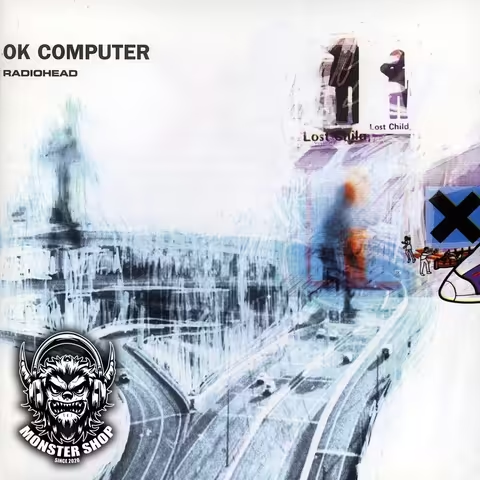
OK Computer was the first Radiohead album cover designed by Stanley Donwood, an Exeter-educated artist Yorke had known since their student days. Together, credited as Stanley Donwood and "the White Chocolate Farm" (Yorke's pseudonym), they produced what Donwood later described as an attempt to make something "the colour of bleached bone". The cover collage is built from photographs Yorke had taken of an interstate flyover near Hartford, Connecticut, on the 1996 American tour, layered with white-scribbled corrections rather than digitally undone mistakes.
The packaging carries on the theme. The booklet contains phrases in Esperanto, health instructions in English and Greek, the words "lost child" repeated as a near-mantra, and the now-iconic motif of two stick figures shaking hands. Yorke explained the figures as an image of exploitation: "Someone's being sold something they don't really want, and someone's being friendly because they're trying to sell something." The same image would later become the cover of the 2008 best-of compilation Radiohead: The Best Of.
The credits include an ironic copyright notice that should be reproduced in any honest history of the record: "Lyrics reproduced by kind permission even though we wrote them." It was the band's first explicit broadside against the corporate machinery whose product they were technically still manufacturing.
Release and Reception
Capitol's "commercial suicide" verdict turned out to be one of the more spectacularly wrong predictions in major-label history. OK Computer entered the UK Albums Chart at number one with 136,000 first-week sales, held the top spot for two weeks and stayed in the top ten for several more, becoming the eighth-bestselling album of 1997 in Britain. In the United States, it debuted at number twenty-one on the Billboard 200, Radiohead's highest American chart entry to that point, and went on to double-platinum certification.
The critical reaction was, even by 1997 standards, lopsided. The British press treated the album as a generational event. Nick Kent, writing in Mojo in July 1997, set the tone:
"Others may end up selling more, but in twenty years' time I'm betting OK Computer will be seen as the key record of 1997, the one to take rock forward instead of artfully revamping images and song-structures from an earlier era."
Nick Kent, Mojo, July 1997
NME gave it ten out of ten. Q gave it five stars. Select's John Harris called it an album where "every word sounds achingly sincere, every note spewed from the heart, and yet it roots itself firmly in a world of steel, glass, random-access memory and prickly-skinned paranoia." Pitchfork's Ryan Schreiber awarded a perfect ten in one of the first reviews to put the new American webzine on serious critics' radar.
In America, the reaction was more divided. Rolling Stone and Spin were positive, but Entertainment Weekly gave it a B+, Time ran a piece headlined "Lost in Space", and Robert Christgau in The Village Voice dismissed the record as "arid" art rock that drowned Yorke's vocals in "enough electronic marginal distinction to feed a coal town for a month". (He warmed to the album later.)
The awards followed quickly. OK Computer won the Grammy for Best Alternative Music Album at the 1998 ceremony and was nominated for Album of the Year. It was nominated for Best British Album at the 1998 Brit Awards. The 1997 Mercury Prize shortlisted it; on the eve of the ceremony, oddsmakers had it as the clear favourite. The award went to Roni Size and Reprazent's New Forms instead, in a result that has not aged especially well. Mojo, Vox, Entertainment Weekly, Hot Press, HUMO and The Face all named it their album of the year. In 2014 the US National Recording Registry took it in for permanent preservation. In 2026 it was inducted into the Grammy Hall of Fame.
Singles and Music Videos
| Single | Release | UK peak | US Modern Rock peak | Director / notes |
|---|---|---|---|---|
| "Paranoid Android" | 26 May 1997 | 3 | Animated video directed by Magnus Carlsson, repurposing his Swedish cartoon character Robin; went over budget and helped kill the band's plan to make a video for every track | |
| "Karma Police" | 25 August 1997 | 8 | 14 | Directed by Jonathan Glazer; the now-iconic clip of a Yorke passenger watching a man run from the headlights of a 1976 Chrysler New Yorker |
| "Lucky" | 26 December 1997 (France only) | No promotional video; did not chart | ||
| "No Surprises" | 12 January 1998 | 4 | Directed by Grant Gee; Yorke filmed in a single take with his head submerged in a water-filled astronaut helmet, almost drowning during the shoot | |
| "Let Down" (promo) | September 1997 (US) | 29 | No official video at the time; eventually entered the Billboard Hot 100 in August 2025 |
Radiohead's original plan was to commission a music video for every track on the album. By the time the "Paranoid Android" and "Karma Police" videos had run wildly over their respective budgets, the project was quietly shelved. Plans for the trip-hop collective Massive Attack to remix the entire record were also abandoned. Parlophone's marketing department went in a different direction entirely: full-page newspaper adverts in the UK and posters in the London Underground, plastered with the "Fitter Happier" lyrics in stark black on white. In America, Capitol mailed out a thousand Walkman cassette players with the album permanently glued inside, on the theory that prominent press and industry figures would be more likely to listen if they couldn't put any other tape in.
Touring and Live: Against Demons
The Against Demons tour opened with the album's launch party in Barcelona on 22 May 1997 and concluded in New York on 18 April 1998, almost a year of constant travel. The setlists ranged across the band's three albums and pulled in B-sides and Grant Gee documentary footage as backdrops. Highlights included:
- A first-ever headline at Glastonbury Festival on 28 June 1997, in front of an estimated 40,000 people, plagued by monitor failures that almost caused Yorke to walk offstage in the middle of "Lucky".
- Festival sets and TV appearances across Europe, North America, Japan, Australia and New Zealand.
- The Hammerstein Ballroom shows in New York in April 1998, the final dates of the tour and the closing scene of Meeting People Is Easy.
- The American radio festival circuit, including a notorious appearance at KROQ's Weenie Roast in Irvine, California, immortalised in Grant Gee's film.
Despite the technical chaos, the Glastonbury set was widely regarded at the time, and has been almost continuously rated since, as one of the greatest live performances in the festival's history. Q magazine named it the greatest concert of all time in 2004. In 2023 The Guardian's Alexis Petridis named it the greatest Glastonbury headline set ever, writing that "frustration and tension led to the band playing out of their skins, adding a startling potency to a set that confirmed OK Computer as the defining sound of rock's post-Britpop shift".
It nearly destroyed the band. Yorke later said the tour was "a year too long. I was the first person to tire of it, then six months later everyone in the band was saying it. Then six months after that, nobody was talking any more." Colin Greenwood, looking back from 2003, was even bleaker:
"There is nothing worse than having to play in front of 20,000 people when someone, when Thom, absolutely does not want to be there, and you can see that hundred-yard stare in his eyes. You hate having to put your friend through that experience."
Colin Greenwood, Spin, July 2003
The whole campaign was filmed by Grant Gee, whose hour-and-forty-minute documentary Meeting People Is Easy, released in November 1998, became the definitive on-record portrait of post-fame collapse. Watching it back, the path to Kid A's electronic withdrawal makes obvious sense.
In TV, Film and Media
For an album so determined not to flatter modern consumer culture, OK Computer has had a long and prosperous afterlife inside it. "Exit Music (For a Film)", written for Luhrmann's Romeo + Juliet, then withdrawn from its soundtrack album at the band's request, has soundtracked sequences in The Umbrella Academy, The 100 and a memorable Father Ted moment. "Karma Police" turns up in the dystopian Ricky Gervais workplace comedy Invincible. "Let Down" became a 2019 viral after-life moment in After Life and a 2025 TikTok hit. "No Surprises" featured in New York, I Love You and Drew Barrymore's Whip It. "Paranoid Android" provided a deliciously incongruous closing-credit cue for an episode of The Crown. The songs have repeatedly outgrown the contexts the band wrote them in.
Covers, Samples and Tributes
The album has been covered, in part or in whole, more times than is strictly reasonable. The American reggae collective Easy Star All-Stars released Radiodread in 2006, a track-for-track reggae reimagining of the entire album. The Stereogum-curated OKX: A Tribute to OK Computer appeared in 2007, with Vampire Weekend, Cold War Kids, Marissa Nadler and others taking on individual songs. Christopher O'Riley has built a small cottage industry of solo-piano Radiohead reinterpretations. Brad Mehldau has played "Exit Music" and "Paranoid Android" in his jazz trio for over twenty years.
The album sampled relatively little, the loop from Three Days of the Condor embedded in "Fitter Happier" being the most prominent, but its influence on samplers is everywhere. From Bloc Party (who cite it as the reason they formed) to TV on the Radio (whose debut OK Calculator is a deliberate tribute), to most of the British rock balladry of the 2000s, the lineage runs straight through these twelve songs.
Reissues, Remasters and Anniversaries
The album has been reissued repeatedly, with varying degrees of band involvement:
- 2008, Capitol "From the Vaults" 180g double LP. The tenth-best-selling vinyl record in the US that year, sold around 10,000 copies, and a key data point in the wider vinyl revival.
- 2009, EMI Collector's Edition, two CDs plus a DVD, released without the band's involvement. All material had been released before; nothing was remastered. The band publicly disowned it.
- 2016, XL Recordings acquired the back catalogue from EMI and quietly pulled the unauthorised EMI reissues from streaming services.
- 2017, OK Computer OKNOTOK 1997 2017, released by XL on 23 June 2017 to mark the 20th anniversary. Bob Ludwig remastered. The package contains all eight original B-sides plus three previously unreleased songs: "I Promise", "Man of War" (with new strings by the Royal Philharmonic Orchestra) and "Lift". The boxed special edition added a hardback art book, Yorke's notebook of lyrics and Donwood's sketches, and a cassette of demos including a ZX Spectrum program. OKNOTOK debuted at number two in the UK and was the bestselling album in UK independent record shops between April 2017 and April 2018. It is dedicated to Rachel Owen, Yorke's partner of more than twenty years, who died of cancer six months before release.
- 2019, MiniDiscs [Hacked]. Sixteen-plus hours of OK Computer-era demos, stolen from Yorke's cloud archive and leaked online by a collector calling himself Zimbra. Radiohead's response was to put the entire archive on Bandcamp themselves for eighteen days at £18, with all proceeds going to Extinction Rebellion. The release raised roughly £500,000. Jonny Greenwood, on Twitter, described the material as "only tangentially interesting". Yorke wrote on the Bandcamp page: "As it's out there it may as well be out there until we all get bored and move on."
Legacy and Influence
The straightforward measure of legacy is the polls. OK Computer sits at number 42 on the 2020 edition of Rolling Stone's 500 Greatest Albums of All Time, up from 162 in the 2003 and 2012 editions. It is routinely in the top three or four greatest-albums-of-the-1990s lists in NME, Pitchfork, Spin, Slant, Time and Alternative Press. Pitchfork's Marc Hogan argued in a 2017 essay that the album marked "an ending point" for the rock-oriented album era, "as its mainstream and critical success remained unmatched by any rock album since".
The less tidy measure is the wave of British bands who chased it. Travis, working with Godrich, produced The Man Who in 1999 and reached number one. Coldplay, Snow Patrol, Keane, Doves, Elbow, Editors and Muse all worked, to varying degrees of success, in territory Radiohead had opened up. Chris Martin's famous tribute is so over-the-top it deserves to be quoted in full:
"It would be interesting to see how the world would be different if Dick Cheney really listened to Radiohead's OK Computer. I think the world would probably improve. That album is fucking brilliant. It changed my life, so why wouldn't it change his?"
Chris Martin, The Guardian, May 2005
The other measure, and perhaps the most telling, is what Radiohead themselves did next. By their account, the fact that bands were starting to "sound like us" was one of the reasons they broke entirely with the OK Computer style for their next album. Kid A, in 2000, all but jettisoned guitars in favour of modular synths, Ondes Martenot and Aphex Twin-shaped beats. It was a deliberate exit from a sound the band had perfected, just as that sound was being widely imitated. The road from OK Computer's closing bell to Kid A's opening burble of "Everything in Its Right Place" runs directly through the burnout captured in Meeting People Is Easy.
DJ Shadow, whose programmed drums helped trigger the album in the first place, perhaps captured its legacy best, looking back a decade later:
"A lot of people have taken OK Computer and said, 'This is the yardstick. If I can attain something half as good, I'm doing pretty well.' But I've never heard anything really derivative of OK Computer, which is interesting, as it shows that what Radiohead were doing was probably even more complicated than it seemed."
Josh Davis (DJ Shadow), Uncut, February 2007
Things You Might Not Know
| Fact | Detail |
|---|---|
| The plate reverb's previous owner | The vintage plate reverb unit Radiohead bought with their £100,000 Parlophone equipment advance had previously belonged to Jona Lewie, the songwriter behind the Christmas single "Stop the Cavalry". |
| The album was named after a B-side | "OK Computer" was originally the working title for "Palo Alto", a song that ended up as a B-side on the "No Surprises" single. Other titles considered for the album included "Ones and Zeroes" and "Your Home May Be at Risk If You Do Not Keep Up Payments". |
| The title's true source | Yorke took it from a 1978 episode of The Hitchhiker's Guide to the Galaxy radio series, in which Zaphod Beeblebrox demands "Okay, computer, I want full manual control now." |
| Capitol's glued-shut Walkmans | To promote the album in America, Capitol shipped 1,000 portable cassette players to journalists and industry figures with the OK Computer cassette permanently glued inside, so the recipient could not switch tapes. |
| The "Fred" voice on Fitter Happier | The spoken word on the track is the Macintosh SimpleText application's stock "Fred" text-to-speech voice; Yorke wrote the lyric in ten minutes and called it "the most upsetting thing I've ever written". |
| Let Down's ballroom session | The song was recorded in the ballroom of St Catherine's Court at 3 a.m. with three guitarists each playing in different time signatures, an approach modelled on Phil Spector's Wall of Sound. |
| Penderecki in Bath | Jonny Greenwood wrote the sixteen-instrument string arrangement on "Climbing Up the Walls" in the deliberate style of Krzysztof Penderecki's Threnody to the Victims of Hiroshima. |
| The cover photo's location | The blue-and-white motorway interchange on the album cover is built from photographs Yorke took of an interstate flyover near Hartford, Connecticut, on the band's 1996 American tour. |
| Grant Gee almost drowned Yorke | The "No Surprises" music video, in which Yorke's head fills slowly with water inside an astronaut helmet, was shot in a single take. Yorke later admitted he came close to drowning during the filming. |
| The Mercury Prize that got away | Bookmakers had OK Computer as the clear favourite for the 1997 Mercury Prize on the eve of the ceremony. The award went to Roni Size and Reprazent's New Forms instead. |
| The Glastonbury monitor disaster | Halfway through "Lucky" at Radiohead's 1997 Glastonbury headline set, monitor failures left Yorke unable to hear himself. He nearly walked offstage. Twenty-six years later The Guardian named the resulting performance the greatest Glastonbury headline set of all time. |
| OKNOTOK contains a ZX Spectrum program | The cassette in the OKNOTOK boxed edition closes with a track called "OK Computer Program". Loaded into a 1980s ZX Spectrum home computer, the tones become a working program that lists the band members, prints the date 19 December 1996, and displays the text: "Congratulations…you've found the secret message syd lives hmmmm. We should get out more." |
| The £500,000 leak | When sixteen hours of OK Computer-era demos leaked in June 2019, Radiohead rejected the collector's reported six-figure ransom demand. They instead released the entire archive themselves on Bandcamp for eighteen days, raising approximately £500,000 for Extinction Rebellion. |
| Let Down's afterlife | In August 2025, "Let Down" became Radiohead's fourth-ever Billboard Hot 100 entry, twenty-eight years after release, after going viral on TikTok. |
On the Riffology Podcast
The Riffology hosts dig into OK Computer at length in episode seven, working through the St Catherine's Court sessions, the haunted-staircase reverb on "Exit Music", the Capitol "commercial suicide" verdict, the Glastonbury monitor disaster, and the long road from Bath to Kid A. The episode is embedded above and available on Apple Podcasts, Spotify, Pocket Casts, Overcast and every other major podcast platform. If you've enjoyed reading this far, subscribe, the next album deep dive will be along shortly.
Comments