Billy Corgan overdubbed much of James Iha's guitar and D'arcy Wretzky's bass himself, drove Siamese Dream about $250,000 over budget, and by his own later account spent the sessions plotting his own death. That is the record The Smashing Pumpkins made in Georgia between December 1992 and March 1993, and it is why it sounds the way it does: guitar parts stacked in dense layers, each one placed by a man who would "happily spend ten hours on one guitar part to get it right," in the words of producer Butch Vig.
It was released in July 1993 on Virgin and debuted at number 10 on the Billboard 200. Vig said it "almost killed me at the end." Corgan called it "my big middle finger to the indie world." This is how the band got there, who played what, and what came out of the sessions.
Album Facts
| Field | Detail |
|---|---|
| Artist | The Smashing Pumpkins |
| Album | Siamese Dream |
| Release Date | 19 July 1993 (UK), 27 July 1993 (US) |
| Label | Virgin Records |
| Producer(s) | Butch Vig and Billy Corgan; mixed by Alan Moulder |
| Studio(s) | Triclops Studios, Marietta, Georgia |
| Genre | Alternative rock, grunge, alternative metal |
| Track Count | 13 (14 on the Japanese edition) |
| Total Runtime | 62:08 |
| Billboard 200 Peak | 10 |
| UK Albums Chart Peak | 4 |
| Other Notable Chart Peaks | Canada 3, New Zealand 3, Australia 7 |
| Certifications | UK Platinum, Canada 4x Platinum, Australia Platinum, New Zealand Platinum; US figures vary (see Release & Reception) |
| Estimated Sales | Over six million worldwide, as commonly reported |
| Key Singles | "Cherub Rock", "Today", "Disarm", "Rocket" |
Cultural Context
The alternative boom was at its height. Stereogum's Tom Breihan later called 1993 the peak of the alt-rock boom, and argued that Siamese Dream was marketed as grunge without being one. In the weeks either side of its release, the Billboard 200 was topped by U2's Zooropa and then Cypress Hill's Black Sunday. Nirvana's In Utero reached number one in October.
Breihan also paired it with Liz Phair's Exile in Guyville as 1993 standouts from artists alienated by Chicago's underground scene. The album's opener, "Cherub Rock", is Corgan's answer to that scene.
The Band's Story Up to Siamese Dream
Corgan and Iha formed The Smashing Pumpkins in Chicago in 1988, playing their first show on 9 July that year with a drum machine. Cabaret Metro owner Joe Shanahan would only book them with a live drummer, which is how Jimmy Chamberlin joined. The full lineup debuted at Cabaret Metro on 5 October 1988.
Their 1991 debut Gish was made with Vig at Smart Studios in Madison, Wisconsin, for about $20,000. Corgan played most of the instruments apart from the drums, which strained the band. After Nirvana's Nevermind, the Pumpkins were hyped as "the next Nirvana", and Virgin, the parent company of their label Caroline, signed them. Corgan objected to being grouped with Nirvana and Pearl Jam.
The Gish tour took them out as an opening act for the Red Hot Chili Peppers, Jane's Addiction and Guns N' Roses, and the strain showed. Iha and Wretzky ended their relationship, Chamberlin developed a heroin addiction, and Corgan suffered weight gain, writer's block and a nervous breakdown before he began seeing a therapist.
Pre-production & Demos
"Today" was one of the first songs Corgan wrote for the album. He said his manager called the demo "a hit" the day after it was written, and the opening riff came later, turning a quiet song into a loud one. Virgin executives visited the band, liked what they heard and left again, which added to the pressure on Corgan. "Cherub Rock" was among the last songs written.
The 2011 deluxe edition's bonus disc, Lollipop Fun Time, dates much of the earlier material. A rehearsal demo of "Rocket" and an apartment demo of "Luna" are both from 1991, and a 1991 rehearsal demo of "Silverfuck" is listed under the title "Ache". "Siamese Dream" and "Today" have 1992 "Broadway Rehearsal" demos. Soundworks demos from spring 1992 include "Frail and Bedazzled", "Moleasskiss" and "Hello Kitty Kat"; the first and last of those later surfaced on Pisces Iscariot.
Most of the lyrics were about Corgan's girlfriend, Chris Fabian, who later became his wife and then his ex-wife.
Creating Siamese Dream
The band decamped to Triclops Studios in Marietta, Georgia, to escape local distractions and to separate Chamberlin from his drug contacts. Everything was recorded to analogue tape, which made it slow. By Wikipedia's account the sessions ran about three months at 12 hours a day, six days a week, then seven days a week at 14 to 15 hours in the last two months. Vig remembered it more bleakly.
"Five straight months of working six, sometimes seven days a week, 15, 16 hours a day."
Butch Vig, Hot Press, 2002
Accounts of the length differ (the recording window is usually given as December 1992 to March 1993), and Wikipedia puts the overspend at about $250,000. Corgan and Vig sometimes spent two days on a 45-second passage. Vig said he had to deal with "the whole dysfunctional breakdown of the band", including Chamberlin going missing for days and "everybody threatening to quit, including Billy". He put much of the band's survival down to Billy's "sheer ambition, his willpower to keep them going."
Chamberlin played every drum part. During one absence of two or three days, Vig has said, Corgan pushed him to record the drums for "Cherub Rock" until his hands bled. Chamberlin later entered rehab.
Corgan overdubbed much of Iha's and Wretzky's parts. Wretzky said Corgan did it because he could record the parts faster and in fewer takes. Corgan's own account to NME in 2011 was darker.
"I was suicidal, and I'd been plotting my own death for about two months."
Billy Corgan, NME, 2011
He told NME he had been giving away records and guitars, and that the album "destroyed my health" and "destroyed my relationships". He said Wretzky and Iha "actually really believed in the album".
One piece of gear explains a lot of the lead tone. Studio engineer Mark Richardson owned a lap steel guitar with a distortion unit, and Vig asked him to take it out.
"And it just had this most insane buzz, it just would kind of stir your brain right up."
Butch Vig, Guitar.com, 2020
Vig said the tiny box had "a really narrow focus" and was used on a lot of the lead solo parts. Corgan still has it.
For the mix, Corgan suggested Alan Moulder, whose credits included My Bloody Valentine's Loveless. Moulder booked two weeks and took 36 days.
Personnel & Credits
| Role | Player | Notes |
|---|---|---|
| Core band | ||
| Vocals, guitars, bass | Billy Corgan | Also Mellotron on "Spaceboy", string arrangements |
| Guitars | James Iha | Co-writer of "Soma" and "Mayonaise" |
| Bass, backing vocals | D'arcy Wretzky | Much of her part overdubbed by Corgan |
| Drums | Jimmy Chamberlin | Played all drum parts |
| Guest and session musicians | ||
| Piano | Mike Mills | "Soma" |
| Cello, string arrangement | Eric Remschneider | "Disarm" and "Luna" |
| Violin, string arrangement | David Ragsdale | "Disarm" and "Luna" |
| Production and engineering | ||
| Producers | Butch Vig, Billy Corgan | Vig also engineered, mixed and arranged strings |
| Engineering | Jeff Tomei, Tim Holbrook | Holbrook credited for special technical engineering |
| Studio engineer | Mark Richardson | Source of the lap steel distortion box |
| Mixing | Alan Moulder | 36 days |
| Mastering | Howie Weinberg | Bob Ludwig remastered it in 2011 |
| Artwork | ||
| Photography | Melodie McDaniel | Cover |
| Art direction, design | Len Peltier, Steve J. Gerdes | Sleeve credits |
| Rumoured or disputed | ||
| All guitars and bass | Billy Corgan | A rumour from the sessions; the band gave Iha and Wretzky bigger roles on the next album to counter it |
Mills, of R.E.M., played the piano on "Soma". Wikipedia's credits list Corgan for mixing as well as production, alongside Moulder, so the division of labour behind the desk is blurrier than a single credit suggests.
The Songs
| # | Title | Writer(s) | Length | Single? | Notes |
|---|---|---|---|---|---|
| 1 | Cherub Rock | Corgan | 4:58 | Yes | Opening riff admittedly borrowed from Rush |
| 2 | Quiet | Corgan | 3:41 | No | BBC session version appears on 2011 bonus disc |
| 3 | Today | Corgan | 3:19 | Yes | One of the first songs written for the album |
| 4 | Hummer | Corgan | 6:57 | No | Played at the 2023 Tower Records recreation |
| 5 | Rocket | Corgan | 4:06 | Yes | Fourth and final single, December 1994 |
| 6 | Disarm | Corgan | 3:17 | Yes | Strings by Remschneider and Ragsdale |
| 7 | Soma | Corgan, Iha | 6:39 | No | Mike Mills on piano; dozens of guitar overdubs |
| 8 | Geek U.S.A. | Corgan | 5:13 | No | Robert Christgau singled it out |
| 9 | Mayonaise | Corgan, Iha | 5:49 | 2023 | Whistling feedback from a cheap guitar |
| 10 | Spaceboy | Corgan | 4:28 | No | Tribute to Corgan's half-brother Jesse; Mellotron |
| 11 | Silverfuck | Corgan | 8:43 | No | Longest track; 1991 demo was called "Ache" |
| 12 | Sweet Sweet | Corgan | 1:38 | No | Shortest track |
| 13 | Luna | Corgan | 3:20 | No | Strings by Remschneider and Ragsdale |
"Cherub Rock" opens the album, and Corgan insisted that it be the first single, over Virgin executives who preferred "Today". In 1995 he said it "is about my relationship to the indie world and the media". He has called the opening riff and drums ripped off from Rush's "By-Tor and the Snow Dog", saying in a 2022 interview, "That's basically us doing Rush." The solo was recorded to two tapes run together, with the speed of one slightly altered. The song is in standard tuning, with an E octave at the seventh fret that Corgan calls the "Pumpkin Chord".
"Today" is in E-flat major in standard tuning; Corgan deliberately kept it there rather than tuning down a half-step and playing it in E shapes. Quiet, dreamy verses give way to loud choruses of layered, distorted guitars. The lyrics describe a suicidal day, which many listeners missed because the song sounds so upbeat. Corgan said writing it and "Disarm" felt like "ripping [his] guts out".
"Disarm" is about his difficult relationship with his parents as a child. Summing up the album's extremes to NME, Corgan said, "here's my pop song about suicide and here's my epic song about child abuse".
"Soma", co-written with Iha, reportedly has up to 40 overdubbed guitar parts, while Vig said as many as 100 guitar parts were compressed into a single song. R.E.M.'s Mike Mills plays the piano.
"Mayonaise" (spelled "Mayonnaise" by some writers, including Albumism) gets its whistling feedback from a cheap guitar that whistled whenever Corgan stopped playing it, and the band kept the noise. The title started as a joke. A Japanese fan booklet mistranslated a Gish lyric as "mayonnaise seas", which the band found funny and used as a temporary title.
"Spaceboy" is a tribute to Corgan's half-brother Jesse, with Corgan playing Mellotron.
B-sides, Outtakes & Lost Songs
The B-sides, by single:
- "Cherub Rock": "Pissant", "French Movie Theme"/"The Star-Spangled Banner" and "Purr Snickety".
- "Today": "Hello Kitty Kat", "Obscured" and "Apathy's Last Kiss".
- "Disarm": "Siamese Dream", "Soothe", Iha's "Blew Away", and covers of Fleetwood Mac's "Landslide" and Phil Lynott's "Dancing in the Moonlight".
- "Rocket": a Depeche Mode cover, "Never Let Me Down Again", recorded at the BBC, possibly in one take, at Wretzky's request.
"Landslide" reached number 3 on the US Modern Rock chart. In October 1994 Corgan assembled many of these on Pisces Iscariot, a compilation of B-sides and outtakes that included the Siamese Dream leftovers "Frail and Bedazzled", "Whir" and "Spaced". With no marketing push, it reached number 4 on the Billboard 200, higher than Siamese Dream had managed, and went platinum that November.
Album Artwork & Packaging
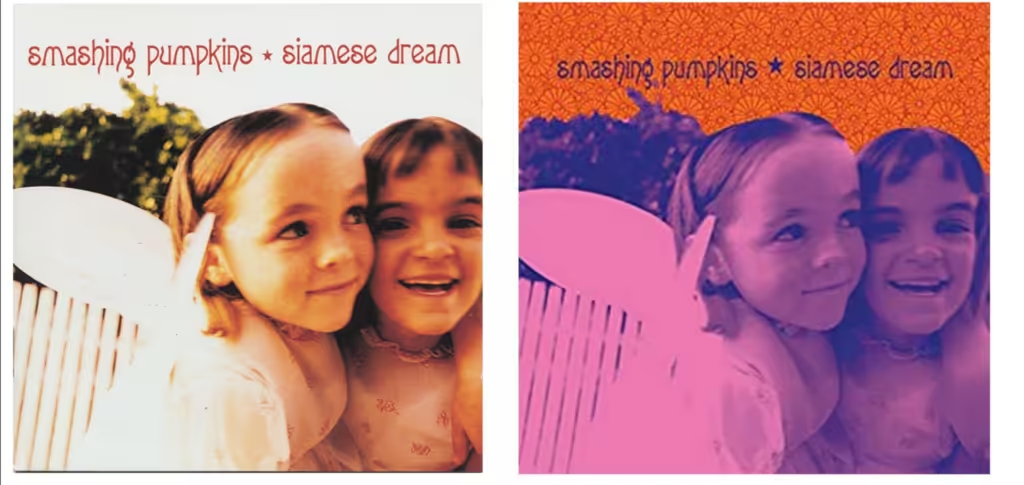
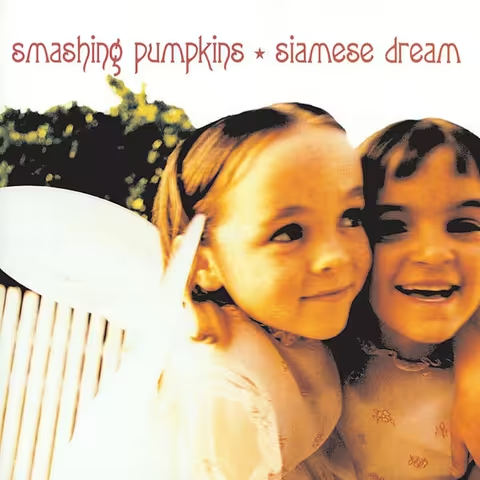
The cover is a close, over-warm photograph of two young girls, one fair-haired and one dark-haired and grinning, cheeks pressed together against dark foliage and white slats, under red-brown decorative lettering. Wikipedia's account has them in dresses and fairy wings. They were child models, Ali Laenger and Lysandra Roberts, who had not met before the shoot. Melodie McDaniel took the photograph.
Laenger said she was seven, booked "just through my headshot", and that they ate lemon heads and rocket pops from an ice cream truck. Roberts said the Pumpkins audition was the first she had ever been on, and recalled "a beautiful Southern California day".
The artwork was first going to be made by an outsider artist, but after disagreements with the label Corgan stepped in at the last minute, and he and his wife assembled the booklet the day after their wedding. The pair drew and wrote lyrics on old photographs to look like a lost photo album. Corgan was not satisfied with the result. The first CD pressing had a 20-page booklet, later pressings a four-panel fold-out, and Virgin restored the 20-page version in 1999. Len Peltier art-directed and Steve J. Gerdes designed the sleeve.
In February 2011 Corgan claimed that bassist Nicole Fiorentino was one of the girls. An assistant photographer disputed this, as did Laenger, citing the age gap. The two cover girls reunited in 2018 for a video announcing the Shiny and Oh So Bright Tour.
Release & Reception
The reviews were warm. David Browne's Entertainment Weekly grade was a B, calling the band "slackers with a vision". NME's John Harris gave it 8/10 and called it "a startling, deeply satisfying record". Rolling Stone's Lorraine Ali awarded 3.5 stars and described a "strong, multidimensional extension of Gish". Select gave it 5/5, Kerrang! 4/5 and Vox 9/10. Simon Reynolds of the New York Times dissented, finding the band lacking the zeitgeist-defining edge of Nirvana.
It debuted at number 10 on the Billboard 200 and peaked at number 4 in the UK. It was the 15th biggest album of 1994 in the US. The US certification is reported inconsistently: Wikipedia's table lists 7x Platinum from the RIAA, while other accounts, including Wikipedia's article on the band, put US sales at more than four million. In the UK it is Platinum.
The album earned the band its first Grammy nominations at the 36th Annual Grammy Awards, for Best Alternative Music Performance and Best Hard Rock Performance with Vocal. "Cherub Rock" lost the hard rock category to Stone Temple Pilots' "Plush".
Opinion has risen since. Rolling Stone placed it at 360 on its 500 greatest albums list in 2003, 362 in 2012 and 341 in 2020. Alternative Press ranked it fourth best album of the 1990s, Pitchfork 18th and Spin 23rd. The deluxe edition scores 96 on Metacritic. For its 20th anniversary, Stereogum's Tom Breihan summed it up this way:
"...merely a record that wants to be huge, and it succeeds on every level."
Tom Breihan, Stereogum, 2013
Singles & Music Videos
| Single | Released | Chart peaks | Video director |
|---|---|---|---|
| Cherub Rock | 21 June 1993 | UK 31; US Alternative 7, Mainstream Rock 23 | Kevin Kerslake |
| Today | 13 September 1993 | UK 44; US Alternative 4, Mainstream Rock 28 | Stéphane Sednaoui |
| Disarm | 21 February 1994 | UK 11; US Alternative 8, Mainstream Rock 5 | Jake Scott |
| Rocket | December 1994 | UK 89; US Mainstream Rock 28 | Jonathan Dayton and Valerie Faris |
Kerslake shot the "Cherub Rock" video on Super 8 in a forest outside San Francisco on a modest budget, and it premiered on MTV's 120 Minutes on 11 July 1993. Corgan reportedly disliked the shoot.
"Today" was Virgin's choice for lead single, and Corgan's ice cream van concept drew on a memory of a driver giving away his remaining stock, combined with Sednaoui's ideas inspired by Zabriskie Point. It was filmed on 29 August 1993.
The "Disarm" clip is mostly black and white, with the band floating over images of a house, an older man in an underpass and colour home-movie footage of a young boy. The "Rocket" video has scientifically minded children receive an interplanetary broadcast, build a rocket and find the band aged on arrival.
Touring & Live
The last of three record-release shows, at Chicago's Metro on 14 August 1993, ran nearly two hours, and the 2011 deluxe edition carries 17 songs from it on DVD. The band also played an in-store acoustic set at Chicago's Tower Records on release night. On 30 October 1993 they appeared on Saturday Night Live.
In 1994 the band took a bigger stage. Nirvana had been due to headline Lollapalooza and withdrew on 7 April, the day before Kurt Cobain was found dead, and the Pumpkins stepped up. "So we're headlining what became historically the biggest Lollapalooza ever," Corgan recalled in an oral history of the festival. At the Philadelphia date, Courtney Love used time Corgan had given her.
In TV, Film & Media
The album's biggest recent sync was "Mayonaise" in the closing scene of Netflix's Beef in April 2023, which sent it to number 5 on the Billboard LyricFind Global and US charts.
Controversy & Criticism
The BBC banned "Disarm" from Top of the Pops over one lyric about a child, and the single got little UK radio airplay. Indie peers were less kind. Pavement's "Range Life" (1994) took aim at the band, Bob Mould called them the "grunge Monkees", and Steve Albini compared them unfavourably to REO Speedwagon.
Covers, Samples & Tributes
- Fruit Bats covered the whole of Siamese Dream in 2020.
- "Today" has been covered by Shining, Solomon Burke Jr., Armor for Sleep, Fruit Bats, A. G. Cook and Olivia Holt, among others. Dragon Ash sampled its main guitar passage in "Grateful Days".
- "Cherub Rock" was covered by Roses Are Red for the 2005 tribute The Killer in You and sampled by HXG in "5G".
- "Mayonaise" was covered by The Academy Is... in 2007 and by Emanuel on The Killer in You.
Reissues, Remasters & Anniversaries
EMI's 2011 deluxe edition, issued on 29 November in North America and 6 December elsewhere, was among the first in a planned series. Bob Ludwig remastered the album, and a second disc, Lollipop Fun Time, collected 18 demos, alternate mixes and BBC session tracks, including the Depeche Mode cover. The DVD, Live at the Metro, opens with an introduction from Joe Shanahan. Corgan contributed an interview and track-by-track commentary.
For the 30th anniversary in September 2023, Corgan's Madame ZuZu's tea shop in Highland Park, Illinois, was dressed up as a Tower Records store for two acoustic performances. In November came "Mayonaise" as a limited 12-inch maxi single on Capitol, with a live acoustic version from Vieuphoria as the B-side. A wooden Collectors Edition box limited to 1,000 copies is not an official Virgin or HUT release.
Legacy & Influence
Siamese Dream made the Pumpkins a mainstream act, and Corgan reacted by changing how they worked. For Mellon Collie and the Infinite Sadness, released in October 1995 as a 28-track double album that debuted at number one with first-week sales of 246,500, the band decided against working with Vig, and Corgan wanted to "take ourselves out of normal Pumpkin recording mode". Iha and Wretzky were given larger roles to counter the rumours about the previous record.
Corgan's own verdict, given to NME in 2011: "Even though it wasn't the one that sold the most, it's the one that seems to have come through the best." Its deep cuts keep their audience. Rolling Stone readers named "Mayonaise" their favourite Pumpkins song in 2012, Kerrang ranked it the band's fourth best in 2021, and at the 2023 anniversary shows the band played "Luna" live for the first time since 2006.
Things You Might Not Know
| Fact | Detail |
|---|---|
| Hikari Express | The Japanese edition adds "Pissant" as a 14th track, labelled "Hikari Express". |
| The Cheap Trick echo | As well as Rush, the chorus of "Cherub Rock" has been compared to Cheap Trick's "Oo La La La". |
| Solo rankings | Guitar World readers ranked the "Cherub Rock" solo number 97, and Q placed the song 67th in its 2005 list of 100 greatest guitar tracks. |
| Corgan's mother | Corgan identified the girl in the back-of-booklet photograph as a childhood picture of his mother, Martha, and later wrote "For Martha" on Adore. |
| Two Pitchfork verdicts | Pitchfork gave the album 10/10 in 2011 and 9.1/10 in 2023. |
| First time ever | At the 2023 Tower Records recreation, the band played the outtake "Spaced" live for the first time ever. |
| A tea-shop Tower | Corgan said the 2023 pop-up was the first physical Tower Records store since 2006. |
Listen to the Riffology Podcast
The Riffology podcast has dug into Siamese Dream in full. Find it on all major platforms, and let us know whether you think "Today" or "Cherub Rock" should have been the lead single.
Comments