
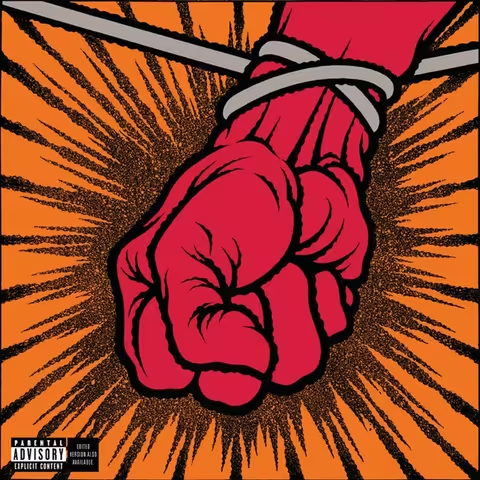
From Napster to the Presidio: the band that needed a record
By the closing months of 2000, Metallica was the most discussed and least understood rock band in the world. Load in 1996 and Reload in 1997 had pulled the band away from the thrash purism of the Black Album years and divided their audience cleanly down the middle. Garage Inc., the 1998 covers compendium, had bought back some goodwill from the lifers. S&M, the 1999 live double recorded with the San Francisco Symphony under Michael Kamen, had been a commercial victory and an artistic curio that pointed nowhere in particular. Then, in the spring of 2000, drummer Lars Ulrich filed suit against Napster on behalf of the band, and Metallica spent the next year defined in the press by a question that had very little to do with music: were they the principled defenders of the working musician, or the richest band in metal punching down at their own fans?
The original answer to all of this was a new studio album. In January 2001 the four members of Metallica were due to convene at the Presidio of San Francisco, a decommissioned US Army post on the city's northern shore, where Bob Rock, the Canadian producer who had shaped every Metallica record since 1991, would help them turn whatever they had into a record. The Presidio was an unconventional choice, an old officers' building converted into a working studio for the project. The lineup was unchanged from the previous five albums: James Hetfield on vocals and rhythm guitar, Ulrich on drums, Kirk Hammett on lead guitar and Jason Newsted on bass. None of that survived the first three weeks of the year.
17 January 2001: Newsted walks
On 17 January 2001, Newsted announced he was leaving Metallica. The official statement cited "private and personal reasons" and the cumulative physical damage of fourteen years of touring with one of the loudest live bands on earth. Newsted had spent much of 2000 working on side material with his project Echobrain, and the friction between that work and his place in Metallica had been an open secret for some time. The break was abrupt enough that the album the band had spent late 2000 talking about now had no bass player, no songs, and a producer waiting at the Presidio with a calendar that had already turned.
The departure mattered for the music in ways that took years to surface. Newsted had been a writer on Metallica's previous records; his absence meant the new material would be assembled entirely by the three remaining members, with Rock filling the rhythm-section hole. It also meant that whatever record they made would carry, by simple absence, an audible reminder of what had broken. The Presidio sessions began later in January with the band still in shock and a producer suddenly cast as a temporary bandmate.
The framing the band reached for in public was that of a self-imposed reset rather than a crisis. Ulrich gave interviews in early 2001 in which he talked about wanting to make a record that did not sound like a Metallica record, with no firm timetable and no commercial pressure. The label, Elektra, agreed to leave the band alone and to ask no questions about delivery dates. That latitude was unusual at any point in the major-label era and almost unthinkable for a band of Metallica's stature; it was also, in retrospect, the only condition under which the album that became St. Anger could have been made at all.
Into the Presidio barracks
The Presidio building Metallica took over was, in plain terms, a barracks. It had concrete floors, military-grade fixtures and the kind of acoustic dryness that comes from a hundred years of being used for everything except music. The band liked that. Hetfield, Ulrich and Hammett wanted to break the cycle of polished studio comfort that had defined their work with Rock since the Black Album, and a converted barracks on the edge of the Pacific was about as far from One on One in Los Angeles as a Metallica record could get. Equipment was trucked in, the live room was set up around the drum kit and the band began writing and recording at the same time, with tapes running through every jam.
The methodology was a deliberate inversion of how Metallica had worked since the late Eighties. There would be no pre-production in the conventional sense. Riffs that survived the morning would be played in the afternoon and recorded in the evening, with the goal of capturing a band thinking rather than a band executing. By May 2002 the band would walk away from this approach with roughly fifteen songs in various states of completion, none of which made the finished album. Almost everything from the Presidio was eventually shelved, but the working method, and the deliberately raw room sound, became the DNA of the record they would eventually finish a long way south of where they started.
Bob Rock on bass
With Newsted gone and no replacement in sight, the bass parts had to come from somewhere. Bob Rock, who had played in the Payola$ and Rock and Hyde before producing Mötley Crüe's Dr. Feelgood, picked up the instrument and took the role. He played bass on every song that ended up on St. Anger, which makes the album the only Metallica studio record in the band's history without an official Metallica bassist performance. Rock was clear, then and later, that he was a stand-in rather than a candidate for the job, and that the eventual successor would re-record the parts live in any case. He was right about the second point and overruled on the first: the album's bass tracks stayed as he played them.
The arrangement said something about the state of the band. The producer who had spent twelve years shaping Metallica's sound from outside the glass was now in the live room with them, playing on the records he was also producing. The line between band and production team, which had been blurry for years, briefly disappeared entirely. The bass was tracked with the kind of distortion that buries definition; in the final mix it sits as a low-end pulse rather than a melodic instrument, which suits the album's textural priorities but also, in retrospect, sounds exactly like a producer playing bass.
Rock's later commentary on the experience was characteristically unsentimental. He described his bass parts as functional rather than expressive, designed to lock to the kick drum and to give Hetfield's rhythm guitars a low-end shadow to push against. He did not consider himself a bass player in any serious sense, and the decision to keep his takes on the finished record was, he has said, a band decision rather than his own. By the time Trujillo joined in February 2003 the album was effectively complete and re-tracking the bass would have meant unwinding mixes the band had already signed off on. The parts stayed.
July 2001: Hetfield enters rehab
In July 2001, six months into the Presidio sessions, James Hetfield checked himself into rehab. The official statement cited "alcoholism and other addictions", with the second phrase left undefined and never publicly clarified. Recording was suspended immediately. No firm return date was given. For nine months Metallica was, in any working sense, not a band: the three remaining members carried on with their lives, Rock returned to other projects, and the Presidio sat with its tapes wound back and its drum kit untouched.
Hetfield came back to work in April 2002 on terms that had been negotiated with his family and his treatment programme. He was restricted to a fixed shift of noon until four and no more. The schedule was non-negotiable. For a band that had built its career on marathon studio days and the kind of late-night writing sessions that produced most of Master of Puppets, the new arrangement was a culture shock. It also reframed every other working relationship in the room. Ulrich, in particular, had spent decades operating on the assumption that the singer would meet him wherever he wanted to go; that assumption was now off the table, and the resulting friction would shape both the album and the documentary that captured it.
The therapist in the room
To navigate the band through the recovery period and back into a working relationship, Metallica hired Phil Towle, a Kansas-based therapist who was given the title "performance enhancement coach". Towle was reportedly paid $10,000 per week and embedded with the band for the duration of the recording, attending sessions, mediating arguments and conducting group meetings that became the dramatic spine of the project. The arrangement, which had begun as a temporary measure during Hetfield's return, ran for more than two years. By the back end of it the band were openly arguing about whether Towle was helping or whether he had simply become a fifth member with no exit clause.
The therapy mattered for the album because it changed what got written. Lyrics that, on previous Metallica records, would have been routed through the Hetfield process of editing and re-editing now went down in a rougher, more confessional form. Frantic, the opening track, addresses Hetfield's drinking directly. Sweet Amber is a song about a brown liquid that has the singer in a grip. The Unnamed Feeling describes the panic-attack physiology of early sobriety. Towle's presence is audible on the album not as a sound but as a permission structure: the band were saying things on tape they would not have said before.
Abandoning the Presidio for HQ
In May 2002, with Hetfield back at work and the Presidio sessions producing material the band were unhappy with, Metallica abandoned the barracks and moved to a new facility in San Rafael, north of San Francisco. The space, internally referred to as HQ, would eventually become the band's permanent headquarters and rehearsal complex. It was here, between mid-2002 and 8 April 2003, that the album as released was written and recorded, in most cases from scratch. The roughly fifteen songs developed at the Presidio were left behind; only ideas, fragments and the working method survived the move.
HQ was a different room with different acoustics, but the band kept the Presidio's recording philosophy: live takes, minimal overdubs, the producer in the room rather than behind the glass, and a constant willingness to chase a sound that did not match anything previously associated with Metallica. The new studio also housed Berlinger and Sinofsky's film crew, who had been embedded since the Presidio and were now committed for the duration. The cameras' presence was both a pressure and a release valve, and most of the album's recorded arguments, including the famous Hetfield-Ulrich confrontation that opens Some Kind of Monster's second act, were shot in the HQ live room.
February 2003: Trujillo joins on the way out
On 24 February 2003, with the album effectively in the bag, Metallica announced that Robert Trujillo, the bassist who had come up through Suicidal Tendencies and Ozzy Osbourne's band, was joining as a full member. The audition process had run through late 2002 and was filmed in detail for Some Kind of Monster; Trujillo's hiring is, for many viewers, the documentary's emotional climax. He was paid a $1 million signing bonus, openly negotiated on camera, and was on stage with the band within months.
For St. Anger as a recorded object, none of this mattered: Trujillo plays on no album track. He appears in band photographs, on the album's promotional cycle and in the rehearsal footage that filled out the bonus DVD packaged with the original release. The bass on the record is Bob Rock's; the bassist on the tour is Trujillo. That gap between credit and performance, a small thing in itself, became another argument for and against the album in the months after its release.
A deliberately ugly sound
The sonic decisions on St. Anger are easier to defend as a coherent strategy than they were at the time. Rock approached the album as his first all-digital project, with analogue tape reserved only for mastering. Tracking was fast and uncompressed in the editorial sense: takes that would once have been refined were kept as the band played them, with mistakes and tuning drift left in. The most contested single decision was the snare drum sound. Ulrich, by his own later account, left the snare wires turned off during one early session and discovered at the playbacks that he liked what he was hearing. "One day I forgot to turn the snare on," he told an interviewer afterwards, "at the playbacks I decided I was really liking what I was hearing, it had a different ambience." The ringing, trash-can attack stayed on every track on the record.
Rock's contribution to the drum sound was a deliberately stripped-back microphone setup. He has said, more than once, that "we spent 15 minutes getting the drum sound" with significantly fewer mics than a Metallica record would normally use. The room was dry. The cymbals were close-miked but barely. The bass drum was kept loose and slightly under-tuned. The intention, articulated more clearly in retrospect than at the time, was a record that sounded like a band playing in a converted barracks, because at one point that is what they had been. The result was a percussive surface that critics described variously as "trash can lid", "broken church bell" and "metallic ring", and that fans either accepted as the album's point or treated as the album's terminal flaw.
No solos, drop tunings and the NS10 test
Among the more remarkable absences on a Metallica album is the absence of Kirk Hammett's solos. Lead guitar parts were tracked and then, song by song, removed. "We tried to put guitar solos on but they kept on running into this problem," Hammett told interviewers later, "it really sounded like an afterthought." St. Anger is the only Metallica studio album without lead breaks, a point that gets disputed less than it ought to because the rhythm guitar arrangements are so dense that the absence is easy to miss on first listen.
The guitars are tuned down across the album, mostly to drop C, with three exceptions: Dirty Window in drop C#, Invisible Kid in drop G# and The Unnamed Feeling in drop A#. Hetfield's rhythm tone is thick and bottom-heavy, with picking dynamics that lean closer to the metalcore and nu-metal records dominating American radio in 2002 than to anything on Metallica's previous albums. Hammett's signal chain was reportedly captured through Yamaha NS10 monitors, the famously unforgiving near-field speakers used as a reality check in mixing rooms since the early Eighties. The rationale was that if the guitars sounded right on NS10s, they would sound the same in a car as they did in the control room. They did. Whether that was a good thing depended entirely on what the listener thought a Metallica record should sound like in a car.
The songs
St. Anger runs to 75 minutes and 1 second across eleven tracks, the longest Metallica studio record by some distance. The pace is relentless and the dynamic range is narrow, which makes the album difficult to discuss song by song in conventional terms; the songs work as a single block of sound more readily than as individual statements. That said, the eleven tracks do have distinct identities, and a thematic walk through them is the only way to understand the record's internal logic.
Frantic opens the album and was its second single, a five-minute thrash about anxiety, sobriety and the velocity of relapse. The lyric "my lifestyle determines my deathstyle" is the most-quoted line on the record. The chorus hook, "Birth is pain. Life is pain. Death is pain. It's all the same", was supplied by Hammett, who attributes it to a Buddhist axiom. St. Anger, the title track and lead single, is the album's mission statement: seven minutes of metallic-ringing snare, palm-muted breakdowns and a chorus that demands to be shouted rather than sung. It won the Grammy for Best Metal Performance at the February 2004 ceremony, an outcome that startled the critics who had spent the previous summer dismantling the record.
Some Kind of Monster, the eight-minute middle song that lent its name to the documentary, is the album's most adventurous structure, with passages that rise and fall before collapsing into the closing chant. Dirty Window, with its drop C# riff, is the closest the album comes to a conventional Metallica gallop. Invisible Kid runs to eight and a half minutes of mid-tempo grind and contains some of the record's most personal Hetfield lyrics, written from the perspective of a child shutting the world out. My World repeats the title relentlessly across a pile-driving rhythm and is, depending on the listener, either the album's manifesto or its lowest point. Shoot Me Again is a slow-building dirge built around a single phrase. Sweet Amber addresses the lure of alcohol in barely coded terms.
The Unnamed Feeling, the third single, is the album's centrepiece for many of its defenders, a song about the physiology of a panic attack with a chorus that genuinely modulates rather than simply repeats. Purify lives up to its name with a near-hardcore intensity. All Within My Hands closes the record at eight minutes and forty-eight seconds, a tightly controlled rumination on possession and obsession that Hetfield would later rework as an acoustic piece for the Bridge School Benefit, a version that quietly made the case that the songs themselves were better than the production let on.
Heard end to end, the album's running order makes a kind of internal sense that defied most contemporary reviewers' patience. The first half is the noisier and more direct of the two, anchored by Frantic and the title track and reaching its peak with the structural ambition of Some Kind of Monster. The second half is darker and more interior, with Invisible Kid, Shoot Me Again and All Within My Hands building a slow-moving block of mid-tempo material that asks listeners to sit with the band rather than be hit by them. The criticism that the album is too long is harder to argue against than the criticism of any single song; very few records of any genre sustain seventy-five minutes at this register, and St. Anger does not always manage it, but the attempt is the point.
Release week and the charts
St. Anger was released on 5 June 2003, five days ahead of its originally scheduled 10 June date. The shift was a direct response to the band's fears of pre-release leaks, fears shaped by the Napster lawsuit and the changed distribution landscape of the early-2000s music industry. The strategy worked in the sense that mattered most. First-week US sales came in at 417,000 copies, enough for a debut at number one on the Billboard 200. The album also topped the charts in thirty other countries on its release week, including Australia, Austria, Belgium (Flanders), Canada, Denmark, Finland, France, Germany, Greece, Hungary, Ireland, Japan (on the Oricon chart), New Zealand, Norway, Poland, Portugal and Sweden.
The territories where it stopped short of the top were almost as notable for the company they kept. The UK Albums Chart placed it at number three, with Italy, the Netherlands, Spain and Switzerland all stalling at number two. Certifications followed the sales: 2x Platinum from the RIAA in the United States, 3x Platinum from ARIA in Australia, 2x Platinum from Music Canada, 2x Platinum in Germany, Gold from the BPI in the UK, Gold from the RIAJ in Japan and a Platinum IFPI Platinum Europe award for sales of more than a million across the continent. Worldwide sales over the album's life sit at roughly 6 million, a figure that would dominate most rock catalogues and that ranks well down the order in Metallica's.
The critics split in two
Few major-label albums of the 2000s produced a reception as binary as St. Anger's. Metacritic returned an aggregate of 65 out of 100 from 20 reviews, but the spread of those reviews was wider than that average suggests. NME's Ian Watson gave it 9 out of 10 and called it "heroically brutal". Rolling Stone awarded four stars. Blender went 4 out of 5. Spin gave 8 out of 10. Entertainment Weekly went B+. Uncut gave 4 out of 5. AllMusic's Johnny Loftus, with a 3 out of 5 rating, called the album a "punishing, unflinching document of internal struggle". PopMatters' Adrien Begrand said it was "a band playing with passion for the first time in years".
Against that ran a body of reviews that read the record as the worst thing the band had ever put out. Pitchfork's Brent DiCrescenzo gave it 0.8 out of 10 and described the production as "steel drums, aluminum toms, programmed double kicks, and a broken church bell". Houston Press's Phil Freeman wrote that the lyrics sounded "co-written by Hetfield's AA sponsor". Playlouder's William Luff judged the album "just too dense and daunting to be truly enjoyable". The Encyclopedia of Popular Music gave it 2 out of 5; the Rolling Stone Album Guide marked it down to 2.5 out of 5 in retrospect. The split has remained the album's defining critical fact for more than twenty years.
Singles, videos and Summer Sanitarium
Four singles were lifted from St. Anger across thirteen months. The title track was released first on 23 June 2003 and climbed to number two on the US Billboard Mainstream Rock chart. Frantic followed on 15 September 2003, reaching number twenty-one. The Unnamed Feeling appeared on 12 January 2004 and peaked at number twenty-eight. Some Kind of Monster, the last single, came out on 13 July 2004 and reached number nineteen, in the slipstream of the documentary's theatrical release.
Promotional videos were produced for all four. The Frantic clip was directed by Wayne Isham, premiered on 15 August 2003 and was filmed in Montreal. The Some Kind of Monster video was credited to the Alan Smithee pseudonym, the directors' guild's traditional name for a director disowning their own work, and was shot during the recording sessions in the San Rafael HQ studio. It premiered on 28 June 2004. The St. Anger and Unnamed Feeling videos were produced in the same period, the title-track clip filmed inside San Quentin State Prison and broadcast widely on rock television in the second half of 2003.
The album was supported on the road by the Summer Sanitarium Tour 2003, a US stadium run with Limp Bizkit, Deftones, Linkin Park and Mudvayne all on the bill. The lineup spoke clearly to where Metallica had decided to position the new record: in a nu-metal radio landscape rather than in any traditional thrash environment. Summer Sanitarium ran from late June to mid-August 2003. It was followed by the Madly in Anger with the World Tour, which continued through late 2004 with Godsmack and Lostprophets as principal supports across most legs and Slipknot opening certain European dates.
Live, the St. Anger material behaved differently to its recorded form. Trujillo's bass, melodic where Rock's had been functional, gave the songs a moving low end that the album lacked. Hammett began to insert tasteful, restrained solo flourishes into the live arrangements, partly because audiences expected them and partly because the songs benefited from the contrast. By the time the Madly in Anger tour reached its closing legs in late 2004, the St. Anger songs had quietly become better live than they were on record, a state of affairs Metallica fans would spend the next decade arguing about whenever the band dropped one back into the setlist.
Legacy and the snare that would not die
St. Anger's afterlife has been longer and stranger than most albums achieve. The songs largely disappeared from Metallica setlists by 2009, with only the title track surviving as a regular live fixture into the second half of the decade. Frantic returned to the set during the Metallica by Request voting tour in 2014 and re-entered the regular rotation on the WorldWired Tour in Lisbon on 1 May 2019, a moment received by audiences with the cheerful surprise of finding a long-banished song forgiven at last. Some Kind of Monster and All Within My Hands have been played in arrangements that lean on the songs' bones rather than the album's production.
The album's place in the broader story of metal in the 2000s is similarly contested. For some listeners it sits as the moment thrash's founding generation conceded ground to nu metal; for others it reads as the moment one of those founding bands refused to make the album their fanbase expected and accepted the commercial cost of refusing. Both readings are partly true and neither captures the record fully. What is not contested is that no major-label rock album of the decade was more talked about in proportion to the speed at which its songs left the live set, and that the songs themselves have outlasted the noise around them by some distance.
The production itself has, with time, become its own object of study. Hetfield, speaking to Guitar World in 2017, gave the album a careful and qualified embrace. "St. Anger could use a little less tin snare drum," he said, "but those things are what make those records part of our history." Ulrich, speaking to NME in 2020, was less qualified: "I stand behind it 100%. At that moment, that was the truth." The album has remained a fixture on worst-records-ever lists (Flavorwire in 2014, Rolling Stone in 2023), and an equally regular feature on best-comeback and most-honest-record lists in the same outlets. Neither category captures the strangeness of its actual standing in the Metallica catalogue: a record that almost nobody from any side of the argument considers ordinary, made by a band that was not, at that moment, ordinary either.
Personnel
- James Hetfield - lead vocals, rhythm guitar
- Kirk Hammett - lead guitar, backing vocals
- Lars Ulrich - drums
- Bob Rock - bass guitar (all tracks), producer, additional guitars on selected passages
- Robert Trujillo - credited band member from February 2003 (appears on the bonus DVD rehearsal footage but plays on no album track)
- Mike Gillies - engineering, Pro Tools and digital editing
- Eric Helmkamp - engineering, additional Pro Tools
- Vlado Meller - mastering at Sony Music Studios, New York
- Pushead (Brian Schroeder) - cover artwork, packaging design
- Anton Corbijn - band photography
- Matt Mahurin - additional illustrations and interior artwork
- Joe Berlinger and Bruce Sinofsky - documentary directors, Metallica: Some Kind of Monster (2004), embedded across the sessions
Tracklist
| # | Title | Length |
|---|---|---|
| 1 | Frantic | 5:50 |
| 2 | St. Anger | 7:21 |
| 3 | Some Kind of Monster | 8:26 |
| 4 | Dirty Window | 5:25 |
| 5 | Invisible Kid | 8:30 |
| 6 | My World | 5:46 |
| 7 | Shoot Me Again | 7:10 |
| 8 | Sweet Amber | 5:27 |
| 9 | The Unnamed Feeling | 7:09 |
| 10 | Purify | 5:14 |
| 11 | All Within My Hands | 8:48 |
| Total runtime | 75:01 |
Things you might not know
| Fact | Detail |
|---|---|
| Bob Rock played all the bass | Producer Bob Rock recorded every bass part on the album in Jason Newsted's absence, making St. Anger the only Metallica studio record without an official band bassist performance. |
| 15-minute drum sound | Rock has said that the basic drum sound was set up in roughly fifteen minutes with fewer microphones than a typical Metallica record, part of the deliberate strategy to capture a live, untreated band. |
| No guitar solos | Kirk Hammett tracked lead lines for several songs that were then removed because, in his words, they "sounded like an afterthought" against the rough production. St. Anger remains the only Metallica studio album with no solos. |
| Phil Towle at $10,000 a week | The band's "performance enhancement coach" was reportedly paid $10,000 per week and stayed embedded with Metallica for more than two years, becoming the documentary's most controversial figure. |
| Presidio barracks-turned-studio | The album's first recording base, set up in January 2001, was a converted US Army barracks inside the Presidio of San Francisco, a deliberate move away from a conventional studio environment. |
| Trujillo is credited but does not play | Robert Trujillo was hired in February 2003 and appears in the album's photography and bonus DVD rehearsals, but performs on none of the eleven recorded tracks. |
| Bob Rock's first all-digital project | St. Anger was the first Metallica album, and the first major Bob Rock production, tracked entirely in the digital domain, with analogue tape used only at the mastering stage. |
| Fifteen unused Presidio songs | Roughly fifteen songs developed during the 2001-2002 Presidio sessions were left behind when the band moved to the HQ studio in San Rafael; almost nothing from those sessions made the finished album. |
| Some Kind of Monster documentary | Joe Berlinger and Bruce Sinofsky filmed the entire recording process and released the resulting documentary in 2004; it was the first major rock film to put group therapy at the centre of its narrative. |
| Release brought forward by five days | The album's release was moved from 10 June 2003 to 5 June 2003 to head off the kind of pre-release leak the band associated with the Napster era. |
How to listen now
St. Anger is available on all major streaming platforms in its original 75-minute, 11-track sequence; the title track and Frantic also appear on most Metallica career-spanning playlists. The original 2003 CD release came packaged with a bonus DVD of the full album performed live in the band's HQ rehearsal room, with Trujillo on bass, and that DVD edition still surfaces in good condition on the second-hand market for collectors who want to hear the songs as the band first played them on the road. The album has been pressed on vinyl in subsequent reissues, including a standard 2x LP, and is the kind of record best heard at full volume on a system that can handle the low end, ideally in one sitting from Frantic through to the close of All Within My Hands. Listeners coming to it for the first time after a long absence will probably find the snare exactly as they remember it.
Comments