Two minutes. That is how long Nikki Sixx was clinically dead on the floor of an apartment at the Franklin Plaza Suites in West Hollywood on 23 December 1987, a needle of pure China White still in his arm, before a Mötley Crüe fan working that night as a paramedic recognised him, pulled out two shots of adrenaline, and slammed them through his ribcage into his heart. Sixx came back, ripped out the tubes, walked out into the parking lot in his leather pants, and within twenty months had turned that two minutes of death into the riff that opens Kickstart My Heart, the song on the album that put his band at number one in America for the first and only time in their forty-five-year career.
The album was Dr. Feelgood. It arrived on 1 September 1989, the fifth Mötley Crüe studio record and the first made cold sober. It was the moment a band that had spent eight years synonymous with overdoses, car wrecks, dead Finnish drummers and tabloid headlines stopped self-destructing for long enough to make the record their talent had always promised. It was also the record that turned Bob Rock from the house engineer at a Vancouver studio into the most in-demand metal producer of the next decade, the man Metallica would phone the very next year to make their Black Album sound the same way.
Album Facts
| Field | Detail |
|---|---|
| Artist | Mötley Crüe |
| Album | Dr. Feelgood |
| Release date | 1 September 1989 (lead single released 28 August 1989) |
| Label | Elektra |
| Producer | Bob Rock |
| Studios | Little Mountain Sound Studios, Vancouver. Mastered at Sterling Sound, New York |
| Genre / Subgenre | Glam metal, heavy metal, hard rock |
| Track count | 11 |
| Total runtime | 45:07 |
| Billboard 200 peak | 1 (band's only US number one) |
| UK Albums Chart peak | 4 |
| Other notable peaks | Australia 5, New Zealand 5, Sweden 6, Finland 6, Switzerland 7, Norway 7, Canada 7, Germany 21 |
| Certifications | 6x Platinum US (RIAA), 3x Platinum Canada, Platinum Australia and New Zealand, Gold UK, Switzerland and Japan |
| Estimated US sales | Over six million copies shipped |
| Key singles | Dr. Feelgood, Kickstart My Heart, Without You, Don't Go Away Mad (Just Go Away), Same Ol' Situation (S.O.S.) |
Cultural Context
By the late summer of 1989 the album charts on both sides of the Atlantic were a peculiar place. Hair metal was at the absolute apex of its commercial power, but the seeds of what would kill it were already in the soil. The previous summer Guns N' Roses had taken Appetite for Destruction to number one in America after a thirteen-month slow burn, proving the format could still produce something dangerous. Aerosmith were quietly recording Pump in a Vancouver studio next door to Mötley Crüe, completing their second-act comeback. Skid Row, Warrant, Winger and Bon Jovi were on heavy MTV rotation. Madonna, Janet Jackson, Paula Abdul and New Kids on the Block dominated the pop side.
But two thousand miles north of Los Angeles, in a Seattle club called the Vogue, a band called Nirvana had played its first ever live show only the year before. Pearl Jam did not yet exist. Soundgarden had a single record out. The Berlin Wall would fall ten weeks after Dr. Feelgood's release, and the cultural reset that would make leather trousers, Aqua Net and lyrics about strippers feel suddenly embarrassing was about ten Kurt Cobain interviews away. Mötley Crüe did not know any of that yet. What they knew was that they had been the biggest hard rock band in America for the past six years and that they had nearly killed themselves doing it.
Their direct competition in the autumn of 1989 told the story. The Crüe's number one was followed in the upper reaches of the Billboard 200 by the New Kids, Tom Petty's Full Moon Fever, Janet Jackson's Rhythm Nation 1814, the Forrest Gump-friendly soundtrack to The Little Mermaid, and, climbing fast, Aerosmith's Pump. The hair-metal pack had cleared a runway for the genre's biggest record. It was the last clean runway it would ever get.
The Band's Story Up to This Point
Mötley Crüe had been a four-piece since April 1981, when Tommy Lee and Nikki Sixx, on the lookout for a singer, watched a high-school acquaintance called Vince Neil shouting his way through a Hollywood club gig with a covers band and decided he was the man. Mick Mars had answered Sixx's Recycler classified a few months earlier (the famous advert read, in full, "loud, rude and aggressive guitar player available") and the line-up was set. Within eighteen months they had self-released Too Fast for Love on the band's own Leathür Records, signed to Elektra, and become the loudest, sleaziest band on the Sunset Strip.
The records came fast and the success grew faster. Shout at the Devil in 1983 went four times platinum. Theatre of Pain in 1985 reached number six on the Billboard 200, threw out Home Sweet Home as a power-ballad blueprint for every band that would follow, and was dedicated to Hanoi Rocks drummer Nicholas Dingley, killed when a drunk Vince Neil crashed his De Tomaso Pantera in December 1984. Neil served eighteen days of a thirty-day sentence for vehicular manslaughter. Theatre of Pain was made by a band in free-fall. Girls, Girls, Girls in 1987 was made by a band whose bassist had already overdosed once in a London hotel that February, been dumped in a dumpster by his dealer, and lived to write Dancing on Glass about it.
And then the second overdose. The one that did kill him, for two minutes, in the bedroom of guitarist Robbin Crosby of Ratt's suite at the Franklin Plaza. The band's management, Doug Thaler and Doc McGhee, gave the four of them an ultimatum the following month: rehab now, or no European tour, or no band. All four checked in. Lee, Mars and Neil came out clean. Sixx came out with a notebook of lyrics that he would eventually publish, twenty years later, as The Heroin Diaries.
1988 was the first year Mötley Crüe did not tour. They sat in Los Angeles, sober and bored and starting to write the songs that would become Dr. Feelgood, while their lawyers fought a lawsuit from a man named Matthew Trippe who claimed he had been hired as Sixx's body double after a fictional 1983 car crash. The Trippe case dragged on into 1993 and was eventually dropped. The album would not wait.
Pre-Production and Demos
The writing took place in Los Angeles across late 1988 and the early weeks of 1989, mostly with Sixx and Mars in a room together. The two men had been the band's primary writing partnership since the start; Sixx brought the lyrics and chord ideas, Mars supplied the riffs. The new sobriety meant something genuinely had changed about that partnership. There was no longer anything else to do.
Several of the songs that ended up on the finished record started as demos that did not survive the trip to Vancouver intact. The title track was the most heavily rewritten of them. Sixx had a song called Dr. Feelgood whose lyric had nothing to do with a drug dealer at all. He told Rolling Stone two decades later that the original was on a completely different subject, with only the title and the basic groove surviving the rewrite that turned it into the story of a Caribbean cocaine kingpin called Jimmy.
"It had a whole different theme to it. It was called Dr. Feelgood, but a whole different thing lyrically. In the end it was inspired by drug dealers."
Nikki Sixx, Rolling Stone, 2009
Other songs travelled with their demo intact. Kickstart My Heart was a Sixx solo composition built around the descending bass figure that opens the song, lyrics already drafted from notebook entries he had made in rehab. Without You was a Sixx and Mars co-write that Tommy Lee took home with him and finished in private; the words ended up being addressed to his wife at the time, the actor Heather Locklear, whom he had married in 1986. Time for Change started life as a demo by the band's longtime backing singer Donna McDaniel, who shared a writing credit with Sixx on the finished song and provided a chunk of the harmony arrangement.
The band also brought one song that did not make it. A track called Get It for Free, written by Sixx, was demoed at Little Mountain but cut from the running order before mastering. It surfaced years later as a bonus track on the 1999 Crücial Crüe reissue and on the 2003 Music to Crash Your Car To box set.
Creating the Album
The choice of Vancouver was the choice of Bob Rock. Rock was a Canadian guitarist who had spent the back half of the 1980s working as in-house engineer at Little Mountain Sound Studios on West 7th Avenue, where Bruce Fairbairn had become the producer everyone in hard rock wanted after pulling Bon Jovi's Slippery When Wet and Aerosmith's Permanent Vacation through the door in consecutive years. Rock had engineered both of those records. He had also just finished co-producing The Cult's Sonic Temple, his first major credit as a producer in his own right, when the call came from Doc McGhee about the next Crüe record. Rock said yes on the condition that the band came to him.
That decision alone changed the album. Los Angeles was where Mötley Crüe drank, fought, missed sessions and turned studios into parties. Vancouver was a city where they knew nobody and where the management could keep the bar tabs and dealer phone numbers a continent away. The sobriety was new and brittle and the geography helped.
Rock's next decision was even more important. He had inherited a band who, as he later put it, were "four LA bad asses who used to drink a bottle of wine and want to kill each other," and he refused to let them work in the same room. Each member tracked his parts alone. Lee laid down the drums with Rock and engineer Randy Staub. Sixx came in for bass when Lee left. Mars built the guitar layers track by painstaking track. Neil was the last in, sometimes pulling a single usable vocal phrase out of a full day's work. Sixx described the regime in The Dirt:
"Bob whipped us like galley slaves. His line was, 'That just isn't your best.' Nothing was good enough. Mick recorded all the guitar for Shout at the Devil in two weeks, but now Bob Rock would make him spend two weeks doubling a guitar part over and over until it was perfectly synchronized. And even though the process aggravated and frustrated Mick, he had it much easier than Vince, who on some days would only get a single word on tape that Bob liked."
Nikki Sixx, The Dirt, 2001
The technical setup matched the perfectionism. The album was recorded digitally to a Sony 3324 24-track machine, which gave Rock the layering headroom he needed for vocal stacks of up to twenty parts on the bigger choruses. Mars detuned his guitars a half-step to E flat throughout, a small change that gave the rhythm tracks a fatter low end without making the songs feel ponderous. Lee's kit was recorded close, dry and aggressively compressed, the snare crack so distinctive that it became the single most copied drum sound in hard rock for the next three years.
The band were not alone in the building. Aerosmith were in the room next door cutting Pump with Bruce Fairbairn, and the two camps shared an addiction counsellor flown in from Los Angeles. Tommy Lee, in an interview around the album's twentieth anniversary, remembered the move north as the moment the band realised it might actually work:
"We all took a break from a lot of crazy shit. Everybody was sort of at their peak, you know, like drugs and alcohol, and we basically moved to Vancouver to embark on this amazing new record with everybody feeling good and focused. It was a really good time."
Tommy Lee, on the album's 20th anniversary, 2009
Sober rock-star pastimes in Vancouver, Sixx told the same interviewer, included drinking Perrier and jogging around Lost Lagoon in Stanley Park. The do-or-die feeling in the studio was less serene. Rock pushed and the band pushed back, sometimes for days at a time. Sixx remembered the air in the control room:
"Six months of rigor combined with six months of sobriety tore the life out of us, and we all had to put up with each other's violent and sudden mood swings. Before we walked into the studio each day, we never knew whether we'd leave that evening feeling like the best band in the world or four angry clowns who couldn't even play their instruments."
Nikki Sixx, The Dirt, 2001
Recording stretched from late 1988 into the summer of 1989. Randy Staub mixed alongside Rock at Little Mountain. George Marino mastered the final assembly at Sterling Sound in New York. The band were back in Los Angeles by July, watching Elektra cut the lead single ahead of an autumn release.
Personnel and Credits
| Role | Player | Notes |
|---|---|---|
| Core band | ||
| Lead vocals | Vince Neil | Backing vocals on six tracks. Plays harmonica on Slice of Your Pie, shakers on Sticky Sweet, and rhythm guitar on Don't Go Away Mad and Same Ol' Situation |
| Guitars | Mick Mars | All lead and rhythm guitar. Credited additionally with the "demonic voice" on the title track |
| Bass | Nikki Sixx | Bass on every track except Time for Change. Backing vocals on Dr. Feelgood, Rattlesnake Shake and Sticky Sweet |
| Drums and percussion | Tommy Lee | Backing vocals on five tracks. The album's drum sound became the template for the entire genre |
| Guest and session musicians | ||
| Backing vocals | Steven Tyler | Sticky Sweet. Recorded next door while making Aerosmith's Pump |
| Backing vocals | Bryan Adams | Sticky Sweet |
| Backing vocals | Robin Zander, Rick Nielsen | She Goes Down. The Cheap Trick frontmen passed through Vancouver mid-session |
| Backing vocals | Jack Blades | Same Ol' Situation, Sticky Sweet. The Night Ranger bassist |
| Backing vocals | Skid Row | Time for Change. The whole band, who were opening Crüe gigs that year |
| Backing vocals | Marc LaFrance | Every track except T.n.T. A Vancouver session staple |
| Backing vocals | Emi Canyn, Donna McDaniel | Eight tracks. Touring Crüe backing singers; McDaniel co-wrote Time for Change |
| Backing vocals | David Steele | Eight tracks. Long-time Bob Rock collaborator |
| Backing vocals and bass | Bob Rock | Backing vocals on four tracks. Plays bass on Time for Change |
| Honky tonk piano | John Webster | Rattlesnake Shake |
| Margarita Horns | Tom Keenlyside, Ian Putz, Ross Gregory, Henry Christian | Brass section on Rattlesnake Shake. Vancouver-based players, credited under the studio nickname Rock gave them |
| Production and engineering | ||
| Producer | Bob Rock | His first major-label hard rock production credit as lead producer |
| Engineering and mixing | Bob Rock, Randy Staub | Both at Little Mountain Sound |
| Assistant engineering | Chris Taylor | |
| Mastering | George Marino | Sterling Sound, New York |
| Artwork | ||
| Art direction | Bob Defrin | Long-serving Elektra in-house art director |
| Cover illustration | Don Brautigam | Best known for the Metallica Master of Puppets cover three years earlier |
| Photography | William Hames | Inner-sleeve band shots |
| Design | Kevin Brady | Sleeve typography and layout |
The most surprising name on the additional-musicians list is Steven Tyler. He and Sixx had become friendly in rehab months earlier; Tyler simply wandered across the Little Mountain corridor between Pump takes and added his voice to the Sticky Sweet vocal stack. The detail Mick Mars set his amps so loud during the same session that they bled into Tyler's vocal recording has become Vancouver session lore. Tyler later remembered the visit fondly:
"Nikki and Tommy and I hung out a lot. Of course, we're all akin by our old drinking and drugging days."
Steven Tyler, quoted in Rolling Stone, 1989
The Songs
| # | Title | Writer(s) | Length | Single? | Notes |
|---|---|---|---|---|---|
| 1 | T.n.T. (Terror 'n Tinseltown) | Sixx | 0:42 | No | Instrumental intro with sampled hospital page |
| 2 | Dr. Feelgood | Sixx, Mars | 4:50 | Yes (#6 US, #50 UK) | Album's title track and lead single |
| 3 | Slice of Your Pie | Sixx, Mars | 4:32 | No | Outro built on a Beatles homage |
| 4 | Rattlesnake Shake | Sixx, Mars, Lee, Neil | 3:40 | No | Features Margarita Horns and honky tonk piano |
| 5 | Kickstart My Heart | Sixx | 4:48 | Yes (#27 US) | About Sixx's overdose |
| 6 | Without You | Sixx, Mars | 4:29 | Yes (#8 US, #39 UK) | The album's ballad |
| 7 | Same Ol' Situation (S.O.S.) | Sixx, Mars, Lee, Neil | 4:12 | Yes (#78 US) | One of two full-band writing credits on the record |
| 8 | Sticky Sweet | Sixx, Mars | 3:52 | No | Steven Tyler and Bryan Adams on backing vocals |
| 9 | She Goes Down | Sixx, Mars | 4:37 | No | Robin Zander and Rick Nielsen guest |
| 10 | Don't Go Away Mad (Just Go Away) | Sixx, Mars | 4:40 | Yes (#19 US, #51 UK) | Lyric references Too Young to Fall in Love |
| 11 | Time for Change | Sixx, McDaniel | 4:45 | No | Bob Rock plays bass; Skid Row sing backing vocals |
The album does not waste a second easing the listener in. T.n.T. (Terror 'n Tinseltown), all forty-two seconds of it, is built around a sample of a woman's voice calling "Dr. Davis, telephone please" over a slowly rising guitar squall. The same sample had been used twelve months earlier by Queensrÿche on Eyes of a Stranger, the closing track of their Operation: Mindcrime concept album. Whether Rock or Sixx knew that and used it deliberately, or whether both records sourced the same library tape, has never been confirmed in print.
The squall resolves straight into the four-note guitar figure that opens Dr. Feelgood, the song. Vince Neil, twenty years later, still remembered the moment he heard the demo for the first time:
"I knew it was a classic from the time I heard that very first bomp bomp bomp bomp, that intro just kind of grabs you. This song has been popular for 20 years. It was funny because I was watching VH1 and they had the Greatest Hard Rock Songs and Feelgood was 15 or something. I was like, wow, of all time. Then you have Led Zeppelin and Aerosmith and AC/DC and Feelgood. I was like, wow, that's cool. It's our signature song in some ways."
Vince Neil, Rolling Stone, 2009
The lyric, once Sixx had rewritten it, follows a Caribbean dealer called Jimmy, his Cadillac and his Smith and Wesson, all the way to his eventual fall. The Crüe were no longer using and they knew exactly what they had got out of when they wrote it.
Slice of Your Pie, the third track, is the album's clearest Aerosmith homage, a straight piece of bar-room blues rock with Neil playing harmonica over the verses. The outro takes a sharp left turn into a slow, layered guitar passage that lifts its descending chord shape directly from the coda of the Beatles' I Want You (She's So Heavy). It is the kind of in-joke Bob Rock would smuggle into a Mötley Crüe record and almost no one would notice.
Rattlesnake Shake, the only song on the album with a full-band writing credit other than Same Ol' Situation, breaks the second side wide open with the Margarita Horns, the four-piece brass section Rock named on the spot after the cocktail the players were not drinking. It is also the song that gives John Webster his honky tonk piano credit. The four horn players, all Vancouver session players, would go on to appear on dozens of other Little Mountain records through the early Nineties.
Then comes Kickstart My Heart, the album's emotional centre and Sixx's direct address to his own overdose. The descending bass riff, the revving Harley sample at the top, the call-and-response chorus where Neil shouts kickstart and the rest of the band shout my heart back: all of it is built around a single autobiographical fact, that Nikki Sixx was clinically dead for two minutes and was brought back by adrenaline. The song was nominated for the 1991 Grammy for Best Hard Rock Performance. It lost, like the title track the year before, to Living Colour.
Without You, the album's power ballad, is the song Tommy Lee took home and finished about Heather Locklear. Sixx and Mars wrote the music; Lee added the lyric. It reached number eight on the Hot 100 in spring 1990, the band's second-highest charting single after the title track, and remains the only Mötley Crüe single to receive significant US adult-contemporary radio play.
The album's deepest cut is Time for Change, the closing track. Sixx wrote it with Donna McDaniel, the touring backing singer who had been with the band since the Theatre of Pain tour. Bob Rock plays bass on it because Sixx wanted to focus on the chorus arrangement, and Skid Row appear on backing vocals because they were in town that week. Lyrically it is the closest the album comes to addressing the addiction head-on. Musically it is the closest the band ever got to a Beatles ballad.
Two YouTube embeds anchor the song discussion. The title track video, directed by Wayne Isham, is below.
B-sides, Outtakes and Lost Songs
The Dr. Feelgood sessions produced fewer outtakes than most albums of its commercial weight, partly because Rock's perfectionism meant every song that was started was finished and partly because Sixx had brought a tight stack of demos to Vancouver and almost all of them were used. The known unreleased material comes down to a small handful:
- Get It for Free, a Sixx composition that was tracked at Little Mountain and cut from the running order. It surfaced in 1999 on the Crücial Crüe digital remaster series and again in 2003 on the Music to Crash Your Car To: Vol. 1 box set.
- Demo versions of Dr. Feelgood, Without You, Kickstart My Heart and Time for Change, the latter with Donna McDaniel's original lead vocal still on it. All four were released on the 1999 reissue and the 2009 twentieth anniversary deluxe edition.
- A handful of live tracks captured on the 1989 to 1990 world tour appeared as B-sides on the various twelve-inch singles, including a live Girls, Girls, Girls, a live Red Hot, and a live All in the Name of Rock.
The most-discussed missing piece is whatever the original Dr. Feelgood demo sounded like before Sixx rewrote the lyric. He has referred to it in interviews several times but has never released it.
Album Artwork and Packaging
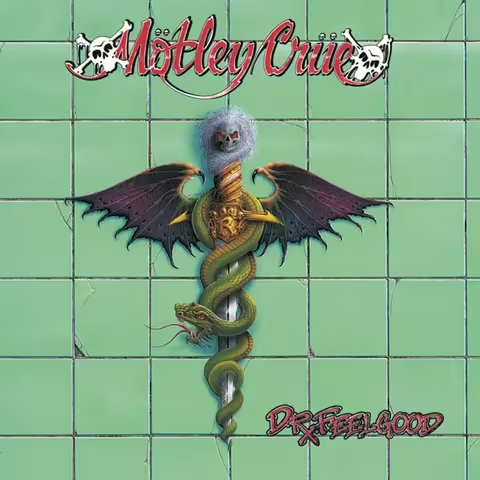
The sleeve is one of the most recognisable in late-80s hard rock and almost none of it was made by the people you would expect. The cover illustration, a black background containing a stylised cross of two hypodermic syringes inside a circle, with the word "FEELGOOD" rendered in serpent-green capitals split by a prescription Rx symbol, was painted by Don Brautigam. Brautigam was the illustrator who, three years earlier, had painted the strings-and-crosses sleeve for Metallica's Master of Puppets, and he was art director Bob Defrin's first call. The "D" of "Dr." was stylised as a script "D" with an Rx ligature, a typographic detail the band insisted on retaining across every territory and every reissue since.
The inner gatefold featured William Hames band photography shot in Vancouver during the sessions, the four members in matching black leather and almost no make-up, a deliberate visual break from the Aqua-Net hair and lipstick of the Girls, Girls, Girls sleeve two years earlier. The sober band wanted to look like a sober band.
One territorial oddity: the original Korean LP edition omitted the opening two tracks, T.n.T. and Dr. Feelgood, presumably on censorship grounds tied to the title song's drug-dealer subject matter. The Korean release ran nine tracks instead of eleven and is now a collector's item.
Release and Reception
The album hit US shelves on 1 September 1989. By mid-October it was at number one on the Billboard 200, the first and last time Mötley Crüe would top the American album chart. It stayed on the chart for one hundred and fourteen weeks, more than two years, and was certified platinum the same month it was released. The 6x Platinum RIAA certification came in 1995 and has not been updated since, leaving actual cumulative US sales somewhere north of the official six million figure.
Internationally it was the band's most successful album in almost every territory it reached. It went to number four in the UK and Gold; number five in Australia and New Zealand, with Platinum certifications in both; top ten in Sweden, Finland, Switzerland, Norway and Canada; Gold in Switzerland and Japan; 3x Platinum in Canada. Even Germany, where the band had never been a major commercial force, took it to number twenty-one.
Critical reception was the warmest the band had ever received. The Los Angeles Times' Jonathon Gold gave it four and a half stars and praised the riffs. AllMusic's Alex Henderson later called it the record on which the band "savoured the joys of trashy, unapologetically decadent fun". The Chicago Tribune's David Silverman gave it four stars and acknowledged the band were not "out to win humanitarian awards or impress us with lyrical muscle". The retrospective consensus has been even more generous. Reviewing the 2009 twentieth anniversary deluxe edition for Classic Rock, Mick Wall delivered the most-quoted line in the album's critical history:
"Dr. Feelgood was the first time Mötley Crüe actually became well-known for music. Until then, their unthinking mash-up of glam and metal had made them a hoot onstage but a disappointment on record. The best Mötley Crüe have ever released."
Mick Wall, Classic Rock, November 2009
The awards followed. The title track was nominated for the 1990 Grammy for Best Hard Rock Performance and lost to Living Colour's Cult of Personality. Kickstart My Heart was nominated the following year and lost to Living Colour again, for Time's Up. The Crüe's consolation came at the American Music Awards in January 1991, where Dr. Feelgood won Favourite Heavy Metal/Hard Rock Album, beating both Guns N' Roses and Aerosmith.
Singles and Music Videos
The campaign ran five singles deep across nearly a year, an unusually long rollout for a hard rock record even at the format's commercial peak. Wayne Isham, the in-house Mötley Crüe video director since Theatre of Pain, shot four of the five videos.
| Single | Release date | US Hot 100 | UK Singles | Director | Notes |
|---|---|---|---|---|---|
| Dr. Feelgood | 28 August 1989 | 6 | 50 | Wayne Isham | Band's only Gold-certified single. The video was filmed at the Mile High Stadium soundcheck in Denver during the start of the world tour |
| Kickstart My Heart | 20 November 1989 | 27 | Wayne Isham | Live performance footage cut with bike-riding sequences. Grammy nominated 1991 | |
| Without You | February 1990 | 8 | 39 | Wayne Isham | The band's second-highest US chart placing of any single |
| Don't Go Away Mad (Just Go Away) | 28 May 1990 | 19 | 51 | Wayne Isham | Lyric explicitly references the band's 1985 hit Too Young to Fall in Love |
| Same Ol' Situation (S.O.S.) | 31 July 1990 | 78 | Wayne Isham | The campaign's commercial endpoint |
The B-sides through the singles campaign were almost all live recordings, sourced from the early dates of the world tour and the small US club warm-up shows. The most collectible is the twelve-inch promo of Dr. Feelgood, which carried a live version of Wild Side from the Girls, Girls, Girls tour on the flipside, and the cassette single of Without You, which paired the song with a recording of Slice of Your Pie performed in Denver in November 1989.
All five videos were collected, along with concert and behind-the-scenes footage, on the home video release Dr. Feelgood: The Videos in 1990. It was certified Platinum by the RIAA the following year for shipments above 100,000.
Touring and Live
The Dr. Feelgood World Tour ran from September 1989 through to autumn 1990, more than a hundred and forty dates across North America, Europe, Japan and Australia. The American leg was the band's biggest arena run, with Faster Pussycat as the principal support act through the autumn of 1989 and Whitesnake co-headlining a stadium run the following summer. Skid Row, by then almost as commercially successful as the headliners, opened most of the spring 1990 European leg.
The stage production was the largest of the band's career to that point. Tommy Lee's drum riser was built on a track that ran out over the crowd; Mick Mars used a guitar tech rotation of around twelve different instruments per show; Sixx triggered actual pyrotechnics from the bass. The Crüe were sober but the spectacle had not been dialled back.
A few touring milestones stand out:
- Mötley Crüe headlined the Moscow Music Peace Festival in August 1989, two weeks before the album's release, alongside Bon Jovi, Ozzy Osbourne, Skid Row and the Scorpions. The bill was put together by Doc McGhee as part of his community-service settlement for a marijuana-trafficking conviction; the band fell out with McGhee over his alleged preferential booking of his other client Bon Jovi and fired him weeks later.
- The band closed out the 1989 MTV Video Music Awards by handing the Best Heavy Metal Video trophy to Guns N' Roses, after which Vince Neil rushed offstage and threw a punch at Izzy Stradlin, starting one of the longest-running feuds in glam-metal history.
- In April 1990, Tommy Lee suffered a concussion when his rappelling drum-kit harness failed during a show in New Haven, Connecticut. He played the rest of the tour with a custom-built foam helmet under his hair.
By the end of the tour the band was, by every member's subsequent account, exhausted. Tommy Lee summed up the closing weeks in The Dirt:
"For our whole lives, every one of us had fucking fantasized about being exactly where we were on that tour, but after two years, we came to hate and dread our jobs. Nikki liked to compare it to an erection: it feels great for a few minutes, but when it won't go down after hours, it starts to hurt like no other pain known to man. Dude, you've never seen four motherfuckers split up and go their own way faster than we did."
Tommy Lee, The Dirt, 2001
The split that followed produced the 1991 compilation Decade of Decadence, the three new songs tacked onto it (Primal Scream, Anarchy in the U.K., Angela), and then Vince Neil's departure or firing, depending on which member is telling the story, in February 1992. The Crüe would not appear on a studio album as the original four again until 1997's Generation Swine.
In TV, Film and Media
The songs from Dr. Feelgood have had a longer afterlife in syncs and trailers than almost any other Crüe record. Kickstart My Heart, in particular, has become a kind of all-purpose adrenaline cue. It opens Adam McKay's 2015 The Big Short, soundtracks the Diet Coke vending-machine sequence in the 2009 Star Trek reboot, plays over the Tony Stark workshop montage in Iron Man 2, anchors a key driving scene in the 2010 reboot of Knight and Day, and appears in literally dozens of NFL hype reels and Monster Energy promos. Within the video-game space the entire album appeared as downloadable content for the original Rock Band in October 2008 (excluding the T.n.T. intro), and Kickstart My Heart returned in Guitar Hero: Warriors of Rock the following year.
The title track has its own sync life as a workout and entrance theme. Without You, the album's ballad, has been used at more than one celebrity wedding and at least one televised funeral. Don't Go Away Mad turns up in nostalgia-driven 1980s comedies on a regular basis. The album, taken collectively, is one of the most-licensed metal records of the late 1980s and has paid the band's mortgages many times over.
Controversy, Censorship and Lawsuits
The album itself attracted less controversy than its predecessors. The Parents Music Resource Center sticker that had ended up on the original 1985 pressings of Theatre of Pain appeared again on Dr. Feelgood, but no major retailer refused to stock the record and there were no formal boycotts. The Korean territorial cut of the first two tracks, mentioned above, was the only outright censorship. The video for Same Ol' Situation, which contains a lingering shot of a stripper, was lightly trimmed for daytime MTV play but ran uncut after nine in the evening.
The legal trouble around the record came from the business side. The band's split from Doc McGhee in late 1989, following the Moscow Music Peace Festival, escalated into formal litigation that was eventually settled out of court. The Matthew Trippe body-double lawsuit, mentioned earlier, was still active when Dr. Feelgood was being recorded and was not dismissed until 1993. And John Corabi's 1997 lawsuit against the band over publishing on the post-Dr. Feelgood albums, while not directly about this record, was indirectly traceable to the songwriting splits Bob Rock's sessions had hardened into formal practice.
Covers, Samples and Tributes
The album's songs have been covered far more than they have been sampled. The 2014 Nashville Outlaws: A Tribute to Mötley Crüe collection produced a country reading of Kickstart My Heart by Florida Georgia Line, a Without You by The Mavericks, and a Same Ol' Situation by LeAnn Rimes. The tribute album debuted at number five on the Billboard 200 and number two on the Country Albums chart.
Direct sampling has been rarer. Lil Jon used a recognisable snippet of the Kickstart My Heart bass riff on the 2004 track Aww Skeet Skeet. The Dr. Feelgood intro motif has turned up in dozens of mash-ups and remix bootlegs but in only a handful of officially cleared records.
The album itself samples sparingly. The T.n.T. opening features the Dr. Davis page sample noted above. The outro of Slice of Your Pie is an interpolation rather than a sample but the debt to the Beatles' I Want You (She's So Heavy) is acknowledged in interviews.
Reissues, Remasters and Anniversaries
Dr. Feelgood has been reissued more often than any other Mötley Crüe album. The major editions, in order:
- 1999 Crücial Crüe digital remaster. Released as part of the band's blanket reissue of its Elektra catalogue after the move to their own Mötley label. Added Get It for Free and demo versions of Dr. Feelgood, Without You, Kickstart My Heart and Time for Change.
- 2003 Music to Crash Your Car To: Vol. 1 box set. Repackaged Dr. Feelgood alongside the previous four Crüe albums with additional demo and live material.
- 2008 Rock Band downloadable content. The entire album was released as playable tracks for the Harmonix video game (excluding T.n.T.), the first full Crüe album to receive the treatment.
- 2009 twentieth anniversary Deluxe Edition. Two-disc set with the demos collected on the first disc and a live recording of the album played in full at Crüe Fest 2 on the second. The original masters were treated to a fresh remaster by Stephen Marcussen.
- 2021 BMG catalogue acquisition. The entire Mötley Crüe back catalogue was sold to BMG Rights Management in November 2021 for a figure widely reported at $150 million; Dr. Feelgood was the highest-valued individual asset in the deal. BMG has issued a hi-resolution streaming master and several picture-disc vinyl pressings since.
The most-discussed live revisitation of the album was the Crüe Fest 2 performance in summer 2009, when Mötley Crüe played Dr. Feelgood in full as the closing run of their headline set on the festival's North American dates. The Detroit show from 2 August 2009 ended up on the 2009 deluxe edition.
Legacy and Influence
The single most direct piece of Dr. Feelgood's legacy is the Metallica self-titled album of 1991, the so-called Black Album. Lars Ulrich, asked in numerous interviews what the trigger was, has consistently named the same record. Bob Rock's drum sound on the Crüe album was what got him hired. The fact that Rock then helped Metallica deliver fifteen million US copies and the biggest metal record of the decade is, in the most material sense, a direct downstream consequence of the Vancouver sessions in early 1989.
Rock himself went on to produce every Metallica album from the Black Album to St. Anger, plus Bon Jovi's Keep the Faith and These Days, the Cult's Ceremony, the Cure's Wild Mood Swings, Veruca Salt, Bryan Adams, the Tragically Hip and dozens of others. His career as the dominant hard-rock producer of the 1990s starts with Dr. Feelgood.
For Mötley Crüe themselves, Dr. Feelgood was both the peak and the end of an era. The original four-member line-up would record only four more songs as a unit (the three new tracks for Decade of Decadence and a fourth, Bitter Pill, for the 1998 Greatest Hits) before fragmenting through the John Corabi years and the Lee departure. Every commercial yardstick the band have hit since, from the 2005 reunion tour through to the 2022 Stadium Tour, has been measured against the bar Dr. Feelgood set. The album has placed on retrospective greatest-metal-albums lists from Rolling Stone, Loudwire, The Telegraph and Ultimate Classic Rock. Spin, in 2019, ranked it among the best forty metal albums of all time.
The wider cultural reading is that Dr. Feelgood was both the apex and the obituary of glam metal as a mainstream commercial force. The album hit number one in October 1989. Twenty-three months later, in September 1991, Nirvana released Nevermind, and within a year Sub Pop bands were what MTV played in the slots that had belonged to Mötley Crüe. The band would survive the shift, eventually, but the format would not. Dr. Feelgood was the last hair-metal album to feel inevitable.
Things You Might Not Know
| Fact | Detail |
|---|---|
| The Dr. Davis sample | The hospital page sample at the start of T.n.T. (Terror 'n Tinseltown) had already been used by Queensrÿche on Eyes of a Stranger, the closing track of their Operation: Mindcrime album in 1988. |
| The original Dr. Feelgood | The historical nickname Dr. Feelgood was attached to a New York physician, Dr. Max Jacobson, who administered amphetamine injections to John F. Kennedy, Marilyn Monroe and Elvis Presley in the 1960s before losing his medical licence in 1975. |
| Sixx's two minutes of death | The paramedic who revived Sixx with two adrenaline shots after his December 1987 overdose was a Mötley Crüe fan who recognised him immediately and later said he ran two red lights getting to the apartment. |
| Bob Rock's bass cameo | The producer played bass on Time for Change because Nikki Sixx wanted to concentrate on the chorus vocal arrangement; it is the only album track on which Sixx does not play bass. |
| Mick Mars's leaking amp | During Steven Tyler's vocal session for Sticky Sweet, Mars had his amplifier turned up so loud in the adjacent room that the guitars bled audibly onto the vocal mic, a detail Tyler later claimed he liked enough to leave in the mix. |
| The Nike SB Dunk High | In 2008 Nike SB released a commemorative Dunk High sneaker coloured to match the album cover: snake-print panels, three shades of green and red Rx accenting. It sold out within a day. |
| Vince Neil on guitar | Neil plays rhythm guitar on two album tracks (Don't Go Away Mad and Same Ol' Situation) and harmonica on Slice of Your Pie. He continued to play guitar on those songs in the live set throughout the world tour. |
| The cover artist's other big credit | The Don Brautigam painting that became the Dr. Feelgood cover was the same illustrator who had created the cross-and-strings cover for Metallica's Master of Puppets three years earlier. |
| The Aerosmith next door | While the Crüe were tracking Dr. Feelgood, Aerosmith were in the adjacent studio at Little Mountain recording Pump with Bruce Fairbairn. The two bands shared the same Los Angeles-based addiction counsellor, who flew up to Vancouver on alternating weeks. |
| The Korean censorship | The original Korean LP pressing omitted the first two tracks entirely, presumably on drug-content grounds, leaving a nine-track version of the album that is now a collector's item. |
| Two Grammy losses to Living Colour | Both Dr. Feelgood (1990) and Kickstart My Heart (1991) were nominated for the Best Hard Rock Performance Grammy and both lost to Living Colour, the first to Cult of Personality and the second to Time's Up. |
| The Slice of Your Pie ending | The descending guitar coda at the end of Slice of Your Pie is a deliberate homage to the closing minutes of the Beatles' I Want You (She's So Heavy) from Abbey Road; Mars and Sixx have both confirmed it in interviews. |
| Donna McDaniel's writing credit | The album's closing track Time for Change was co-written with backing singer Donna McDaniel, the only co-writing credit on the album that goes outside the four band members. |
| The BMG sale | When BMG Rights Management bought the entire Mötley Crüe back catalogue in November 2021, the deal was reported at $150 million; Dr. Feelgood was the single highest-valued album in the package. |
Listen to the Riffology Podcast
If you want to hear the full story of Dr. Feelgood broken down song by song, head over to the Riffology podcast where we go deep on everything from Bob Rock's Vancouver perfectionism to the night Vince Neil swung at Izzy Stradlin at the VMAs. Riffology is available on Apple Podcasts, Spotify, Pocket Casts and every other major podcast platform. Subscribe, leave a review if you like what you hear, and we will see you next episode.
Comments