Linkin Park finished a song for Meteora, mixed it, and then put it on a shelf because, in Mike Shinoda's words, "we can't have two Numbs." The song was "Lost," and nobody outside the band heard it for twenty years. That one decision tells you most of what you need to know about Linkin Park's second album: it is a record built by a band who edited themselves without mercy, wrote more than 30 choruses for one song, and got the whole thing down to 36 minutes and 41 seconds.
The discipline paid off. Meteora sold 810,400 copies in its first week in the United States, went to No. 1 on both sides of the Atlantic, and produced five singles that topped Billboard's Modern Rock chart. It has sold around 16 million copies worldwide. Critics at the time were split on whether that discipline was craft or calculation. The sales gave the band their answer.
Album Facts
| Field | Detail |
|---|---|
| Artist | Linkin Park |
| Album | Meteora |
| Release Date | 25 March 2003 |
| Label | Warner Bros. Records, Machine Shop |
| Producer(s) | Don Gilmore and Linkin Park |
| Studio(s) | NRG Recording Studios, North Hollywood; mixed at Soundtrack Studios, New York |
| Genre / Subgenre | Nu metal, rap metal, rap rock, alternative rock |
| Track Count | 13 |
| Total Runtime | 36:41 |
| Billboard 200 Peak | 1 |
| UK Albums Chart Peak | 1 |
| Other Notable Chart Peaks | No. 1 in Germany, Austria, Ireland, Italy, New Zealand, Norway, Sweden and Switzerland; No. 2 in Canada and Australia |
| Certifications | Diamond (US, 2026); 7x Platinum (Canada); 5x Platinum (Germany); 4x Platinum (UK and Australia) |
| Estimated Sales | Around 16 million worldwide |
| Key Singles | "Somewhere I Belong", "Faint", "Numb", "From the Inside", "Breaking the Habit" |
Linkin Park Before Meteora
Hybrid Theory was a brutal act to follow. Released on 24 October 2000, it sold more than 4.8 million copies in its first year and became the best-selling album of 2001. "Crawling" won a Grammy for Best Hard Rock Performance, and within a year of release the band had played more than 320 concerts. It went on to be certified Diamond.
The road to that record had been rough. The band had been turned down by virtually every label before Warner Bros. took them on, and producer Don Gilmore had driven Shinoda and Chester Bennington, who had joined in 1999, to rewrite the chorus of "One Step Closer" some 50 times. When the six of them came off the road, though, they hired him again. Bassist Dave "Phoenix" Farrell was back in the fold, and the lineup that made Meteora was Bennington, Shinoda, Farrell, guitarist Brad Delson, drummer Rob Bourdon and turntablist Joe Hahn.
"When we went to make our next record, we hired him, because we love the record we made and we really wanted to make sure the process remained sacred and protected."
Brad Delson on Don Gilmore, SPIN, 2020
Before a second album there was a detour. Reanimation, a remix record produced by Shinoda, arrived on 30 July 2002 and reached No. 2 on the Billboard 200. It turned out to be a rehearsal for what came next. Delson told MTV that it let the band see "a lot of different styles of writing that we ordinarily wouldn't have explored," and the experience convinced them they wanted to co-produce their next album alongside Gilmore rather than simply hand it over.
Pre-production and Demos
Writing started in early 2001 while the band were still touring Hybrid Theory, in the studio set up on their tour bus. One of the songs born there was "Faint." Delson recorded scratch guitar over a bare click, expecting a tempo of around 70 beats per minute. A couple of days later Shinoda had built the beat at 135, nearly twice as fast, and after some deliberation the two agreed the faster version was more fun.
In early 2002 the work moved to Shinoda's home studio, where pre-production began in earnest. The band split into pairs to write, with Shinoda involved in every song, and the material was built largely in Pro Tools. Pre-production wrapped in June. Shinoda later told The FADER there were around 40 demos, which the band sorted ruthlessly: songs without vocals were dropped, the near misses were worked on, and the keepers were shortlisted for an album of about a dozen tracks.
That process came with its own weight. Delson put it in blunt terms to MTV.
"We really learned the meaning of pressure. But it wasn't pressure from outside people. It was artistic pressure from ourselves. You can't control the commercial success of a record, so there's no point in investing energy in that."
Brad Delson, to MTV
He added that before starting, he had listened back to Hybrid Theory and Reanimation and thought, "I don't remember how we did it, and I don't know how we're gonna do it again." What saved them, he said, was being able to "invest ourselves fully in the process for 18 months."
Creating Meteora at NRG
Linkin Park moved into NRG Recording Studios in North Hollywood by August 2002, with rough versions of many songs already finished. The studio time went on sound and lyrics. Bennington joined the writing sessions there, and Bourdon spent eight hours a day in the studio. The work ran in strict layers. The drums were complete by October, guitars went on after that, bass parts came in by mid-October, and Hahn's scratching and samples arrived just a month before the deadline. No vocal was cut until every instrument on that song was done.
Bennington remembered a band "just going for it," without worrying whether the songs fitted together stylistically.
"We were testing. We were students in college. We were in the lab, and we happened to stumble across something everybody liked and it worked. I think Meteora was an extension of that."
Chester Bennington, ArtistDirect
Bourdon described the goal from the other end. He told MTV: "We wanted a group of songs that would sit well together because we wanted to make a record that you could pop into your CD player and, from beginning to end, there would never be a spot where you start daydreaming." The finished record swerves between styles, but at 36 minutes it never stops long enough to drift.
The hardest song to finish was the lead single. Shinoda and Bennington wrote more than 30 complete choruses for "Somewhere I Belong," scrapping each in search of something better, and cut the final version a week after the rest of the album was done, in the New York studio where Andy Wallace was mixing. Wallace finished the mix at Soundtrack Studios in December 2002. Brian "Big Bass" Gardner mastered it at Bernie Grundman Mastering.
Warner Bros. treated the finished tapes like contraband. Hybrid Theory had been the No. 1 album of 2001 for illegal downloads as well as sales, so there was 24-hour security during mastering. Critics got no advance copies; instead the label held a playback with a guard on the door, frisking attendees for recording devices.
Personnel and Credits
| Role | Player | Notes |
|---|---|---|
| Core band | ||
| Lead vocals | Chester Bennington | Also the acoustic guitar behind the "Somewhere I Belong" intro |
| Rap vocals, samples, keys | Mike Shinoda | Rhythm guitar, piano and string arrangements on several tracks |
| Lead guitar | Brad Delson | Backing vocals |
| Bass | Dave "Phoenix" Farrell | Backing vocals |
| Drums | Rob Bourdon | Backing vocals |
| Turntables, samples | Joe Hahn | Backing vocals |
| Guest and session musicians | ||
| String arrangement | David Campbell | "Faint" and "Breaking the Habit" |
| Violins | Joel Derouin, Charlie Bisharat, Alyssa Park, Sara Parkins, Michelle Richards, Mark Robertson | |
| Violas | Evan Wilson, Bob Becker | |
| Cellos | Larry Corbett, Dan Smith | |
| Shakuhachi | David Zasloff | "Nobody's Listening" |
| Production and engineering | ||
| Producers | Don Gilmore, Linkin Park | Gilmore also recorded the album |
| Engineer | John Ewing Jr. | |
| Assistant engineer | Fox Phelps | |
| Mixing | Andy Wallace | Soundtrack Studios, New York; assisted by Steve Sisco |
| Mastering | Brian "Big Bass" Gardner | Bernie Grundman Mastering; also digital editing |
| Artwork | ||
| Creative direction | Mike Shinoda, The Flem | The Flem also handled art direction and design |
| Installation artists | Delta, Mike Shinoda, Joseph Hahn, The Flem | |
| Photography | James R. Minchin III | Spray-can close-ups by Nick Spanos |
The credits show how much of Meteora ran through Shinoda. Besides rapping, he played rhythm guitar on four tracks, piano on "Somewhere I Belong," "Session" and "Numb," keyboards on six tracks, and co-arranged the strings on "Faint" and "Breaking the Habit" with David Campbell. The most unusual outside colour was David Zasloff's shakuhachi, a Japanese bamboo flute, which threads through "Nobody's Listening."
The Songs on Meteora
| # | Title | Writer(s) | Length | Single? | Notes |
|---|---|---|---|---|---|
| 1 | Foreword | Linkin Park | 0:13 | Thirteen-second intro | |
| 2 | Don't Stay | Linkin Park | 3:07 | Opened Projekt Revolution 2003 sets | |
| 3 | Somewhere I Belong | Linkin Park | 3:33 | Yes | Lead single; reversed guitar intro by Bennington |
| 4 | Lying from You | Linkin Park | 2:55 | Radio only | Samples a car burning out |
| 5 | Hit the Floor | Linkin Park | 2:44 | ||
| 6 | Easier to Run | Linkin Park | 3:24 | Live version used as a "Numb" B-side | |
| 7 | Faint | Linkin Park | 2:42 | Yes | Beat nearly doubled in tempo during writing |
| 8 | Figure.09 | Linkin Park | 3:17 | ||
| 9 | Breaking the Habit | Linkin Park | 3:16 | Yes | No rapping, no distorted riffs |
| 10 | From the Inside | Linkin Park | 2:55 | Yes | Written in 6/8 time |
| 11 | Nobody's Listening | Linkin Park | 2:58 | Shakuhachi by David Zasloff | |
| 12 | Session | Linkin Park | 2:24 | Instrumental; Grammy-nominated | |
| 13 | Numb | Linkin Park | 3:07 | Yes | Album closer and biggest hit |
Somewhere I Belong
The keyboard-like shimmer at the start of the album's lead single is not a keyboard at all. Bennington had recorded an acoustic guitar part that Bennington thought sounded too folky. Shinoda and Hahn treated it, flipped it backwards and chopped it up. "Since I reversed it, it was playing 4-3-2-1," Shinoda explained. "Then I cut it into four pieces, and I played it 1-2-3-4. And that's why it has that sweeping sound." He also pointed out that the lyric gave the band their first genuinely optimistic moment on record.
Lying from You
Built on a viola-like keyboard loop and the sound of a car burning out, "Lying from You" was, for Shinoda, a showcase for his singer. "That song will be impossible for any cover bands to play! Chester just sings too damned hard," he told ShoutWeb in March 2003. It became a No. 1 at Modern Rock radio a year later without ever getting a commercial release.
Breaking the Habit
Shinoda had been trying to write this lyric for five or six years. "For the last five years, I've been wanting to write this song," he told Rolling Stone before release. "It's about some friend of mine that had some really awful events happen to his family." It started life as an instrumental interlude of programmed beats, strings and piano called "Drawing," until Delson and Hahn talked him into turning it into a song. With the music in front of him, the lyric he had chased for years took less than two hours. There is no rapping and no distorted guitar, and Rolling Stone's review called it the moment where "Linkin Park make some risky, beautiful art." For Bennington, it cut far closer to home.
"Mike had written the song and he hands me a sheet with the lyrics on it, and I'm reading them and listening to them and it was like waterworks. I felt like he was writing about my life."
Chester Bennington, MTV's The Ride, 2014
He said he would get through two lines, start crying, leave the room and come back. The band did not play it live until the 2003 Smokeout Festival.
From the Inside and Nobody's Listening
"From the Inside" is one of the album's heaviest moments, written in 6/8 time and building to a bridge where Bennington screams for around ten seconds without a break. It runs straight into "Nobody's Listening," where David Zasloff's shakuhachi weaves through the track. After that comes "Session," a two-and-a-half-minute instrumental that earned the band a Grammy nomination for Best Rock Instrumental Performance in 2004.
Numb
The closing track became the defining song of the record. Shinoda saw it as a summing-up: "It's kind of about those times when you've got no feeling left or you just don't care. It's almost like exhaustion or something which funny enough is how we felt after touring last year." It went on to top the Modern Rock chart for 12 weeks and reach No. 11 on the Hot 100, the album's best showing there.
Lost and the Meteora Outtakes
The most famous song from the Meteora sessions is the one that missed the cut. Shinoda told The FADER exactly how close "Lost" came.
"We realized that tonally, it was the same kind of emotion and energy as 'Numb,' and 'Numb' was arguably a better song. We liked it better at the time. So we were like, 'Well, we can't have two Numbs.'"
Mike Shinoda, The FADER, 2023
The song had been fully recorded and mixed with the rest of the album, then forgotten until the 20th anniversary. It was released on 10 February 2023 and reached No. 18 in the UK and No. 38 on the Hot 100. "Finding it was like, 'Oh my God, the song got all the way to the finish line,'" Shinoda said. Two more unreleased songs from the era, "Fighting Myself" and "More the Victim," followed on the reissue.
Other early versions had already surfaced through the band's fan club, Linkin Park Underground:
- "Drawing," the instrumental that became "Breaking the Habit," on Underground 9.0.
- A "Faint" demo with Shinoda rapping different lyrics, also on Underground 9.0.
- A 2002 "Breaking the Habit" demo with Shinoda on lead vocals, on LP Underground XIV.
The singles themselves leaned on live recordings for their B-sides rather than unreleased songs: "Step Up" and "My December" behind "Somewhere I Belong," a live "Lying from You" and a reanimated "One Step Closer" behind "Faint," and "Crawling" live plus "Session" behind "Breaking the Habit."
The Meteora Album Cover
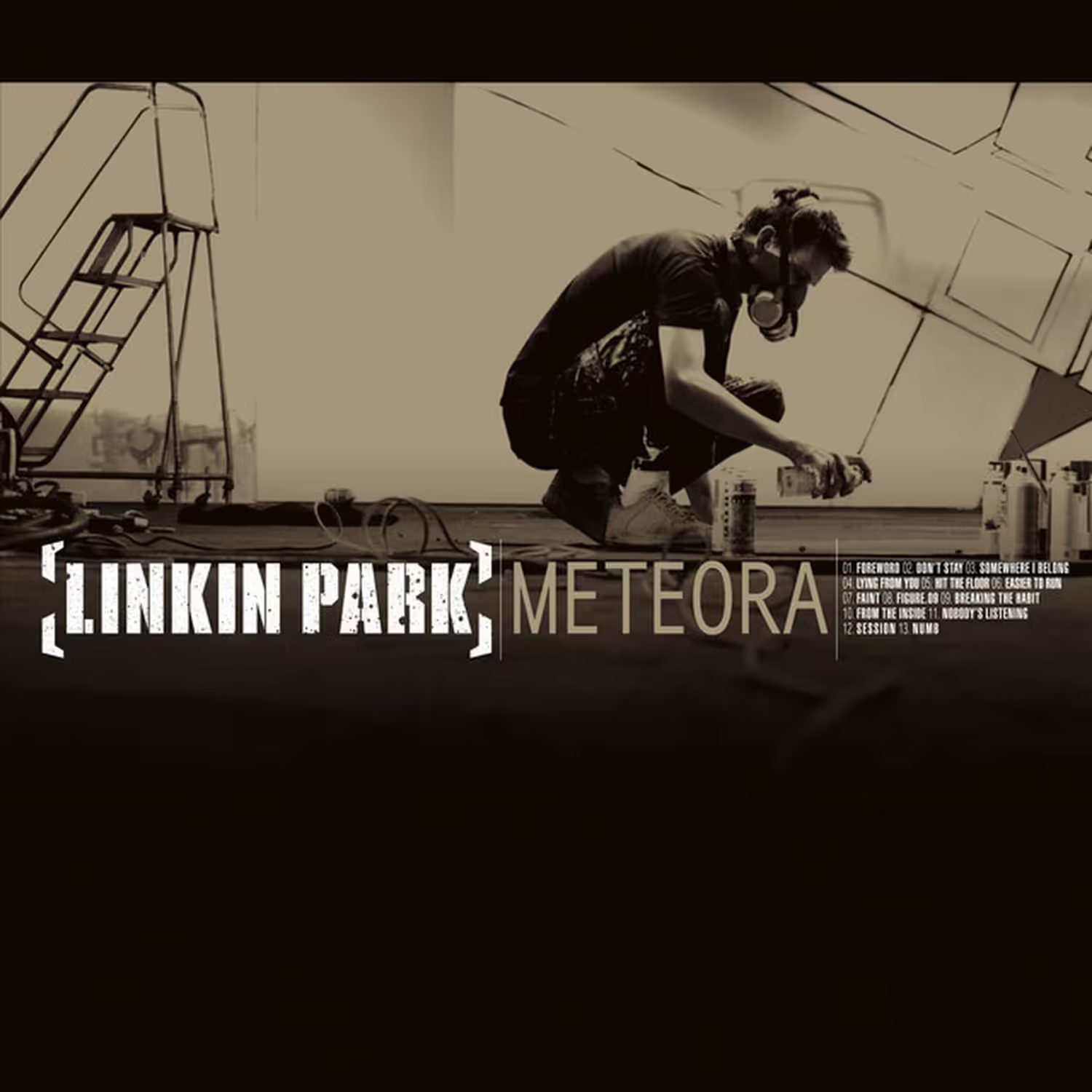
Shinoda and Hahn met at art school, and Meteora was the album where that background took over the packaging. The sleeve is a sepia photograph of a man in a respirator mask, crouched on a floor strewn with cables and spray cans, spraying towards a vast, half-finished mural, with a metal stepladder behind him. The band's name sits in white stencil type inside square brackets, the title in thin capitals beside it, and the whole tracklist is printed on the front.
The man is not a band member. He is Boris Tellegen, the Dutch graffiti artist known as Delta, who came in to help with the artwork. The original plan was to use the huge mural the team painted as the cover; instead it ended up photographed throughout the liner notes, and the quieter shot of Tellegen at work took its place. "We chose the image of Boris for the cover of the album because of that quiet power of it," Shinoda explains in The Art of Meteora, a 17-minute documentary about the artwork. A separate 33-minute documentary on the music came on the special edition's bonus DVD.
The title came from the rock pillars of Meteora in Greece, topped by monasteries. Shinoda said it simply "caught my attention because it sounded huge."
Release and Reception
Meteora came out on 25 March 2003 and sold 810,400 copies in the US in its first week, plus 36,700 in Canada. It debuted at No. 1 on the Billboard 200 and held the top spot the following week with another 265,000. It also went to No. 1 in the UK and across much of Europe, and finished 2003 as the third best-selling album in America.
The reviews were more divided than the sales. Metacritic averages them at 62 out of 100.
- AllMusic (4.5 stars): Stephen Thomas Erlewine called it "nothing more and nothing less than a Hybrid Theory part 2," but praised the band's "discipline and editing skills."
- Entertainment Weekly (B+): "thunderously hooky album that seamlessly blends the group's disparate sonic elements into radio-friendly perfection."
- Rolling Stone (3 stars): the band "manages to squeeze the last remaining life out of this nearly extinct formula."
- Blender: "harder, denser, uglier."
- Q: "less an artistic endeavor than an exercise in target marketing."
- NME (7/10): acknowledged its "massive commercial appeal" but was left "underwhelmed."
Rolling Stone's Barry Walters at least gave credit where it was due. He singled out Bourdon for "the greatest instrumental leap" and noted there was hardly a moment that did not sound "assiduously rehearsed, sampled and Pro Tools tweaked." The awards followed the singles: "Somewhere I Belong" won Best Rock Video at the 2003 MTV Video Music Awards, "Breaking the Habit" took the Viewer's Choice award in 2004, and "Numb" was named Song of the Year at the 2004 Radio Music Awards, where Linkin Park also won Artist of the Year.
Singles and Music Videos
| Single | Released | US Hot 100 | US Modern Rock | UK | Video director |
|---|---|---|---|---|---|
| Somewhere I Belong | 24 Feb 2003 | 32 | 1 | 10 | Joe Hahn |
| Faint | 9 Jun 2003 | 48 | 1 | 15 | Mark Romanek |
| Numb | 8 Sep 2003 | 11 | 1 | 14 | Joe Hahn |
| From the Inside | 12 Jan 2004 | Joe Hahn | |||
| Lying from You (radio only) | 16 Mar 2004 | 58 | 1 | Live in Texas footage | |
| Breaking the Habit | 14 Jun 2004 | 20 | 1 | 39 | Joe Hahn |
Joe Hahn directed most of the clips, and each one looks different. "Somewhere I Belong" set the band in front of fire and a waterfall. For "Faint," Mark Romanek filmed them in downtown Los Angeles almost entirely from behind, so they appear as silhouettes against floodlights in front of an audience of fan club members, only turning to face the camera for the final chorus.
"Numb" was filmed in Prague, with scenes on the Charles Bridge, and follows an outcast art student played by Briana Evigan. The band's performance was shot afterwards in the First Congregational Church of Los Angeles because Bennington was suffering severe abdominal and back pains. "From the Inside," a riot scene centred on a screaming child, was also filmed in Prague. "Breaking the Habit" was an anime, animated by Studio Gonzo under the supervision of Kazuto Nakazawa, who had directed the animated sequence in Kill Bill: Volume 1.
"Breaking the Habit" was the fifth Meteora single to reach No. 1 on the Modern Rock chart. Only "From the Inside" missed both the Modern Rock chart and the Hot 100.
Touring and Live
The band launched the album with their own package tour. Projekt Revolution 2003 ran from 9 to 26 April with Mudvayne, Xzibit and Blindside, and Linkin Park opened their sets with "Foreword" into "Don't Stay." That summer Metallica invited them on to the Summer Sanitarium stadium tour alongside Limp Bizkit, Mudvayne and Deftones.
Two of those stadium shows, at Reliant Stadium in Houston on 2 August and Texas Stadium in Irving on 3 August, became Live in Texas, released on 18 November 2003. It reached No. 23 on the Billboard 200, and the DVD has a surprise cameo from Lars Ulrich during "From the Inside," dressed as a bunny with Hulk fists. The Meteora World Tour followed in early 2004, and the band closed the cycle with the longest Projekt Revolution yet, 32 shows between 23 July and 5 September 2004 with Korn, Snoop Dogg and The Used on the main stage.
Collision Course, Covers and Samples
Meteora's strangest afterlife came from hip-hop. Inspired by Danger Mouse's Grey Album, MTV planned to mash up a song or two by Linkin Park and Jay-Z. Instead the project grew into Collision Course, a six-track mash-up EP recorded between 16 and 19 July 2004 and filmed live at the Roxy Theatre on 18 July. Released on 30 November 2004, it debuted at No. 1 with 368,000 copies. Three Meteora songs were reworked: "Numb" became "Numb/Encore," "Faint" met "Jigga What," and "Lying from You" was paired with "Dirt off Your Shoulder." "Numb/Encore" won Best Rap/Sung Collaboration at the 48th Grammy Awards and turned up in the 2006 film Miami Vice.
The songs have travelled widely since:
- Tarja Turunen covered "Numb" at Wacken in 2016, later releasing it on Rocking Heels: Live at Metal Church.
- "Breaking the Habit" became downloadable content for Rock Band 3 in 2012.
- "Numb" was added to Fortnite Festival in 2024.
- "Numb" passed a billion Spotify streams in 2022, followed by "Faint" in 2025 and "Somewhere I Belong" in 2026.
Reissues and Meteora 20
An iTunes-only live companion, Meteora: Live Around the World, appeared on 5 June 2012. The major reissue came on 7 April 2023. The 20th anniversary edition arrived as a super deluxe box set, a deluxe vinyl box, a three-CD set and a download. Between them, the editions included:
- The original album, plus the 2002 Andy Wallace mix of "Lost" on the deluxe CD.
- An extended Live in Texas and a previously unreleased Live in Nottingham 2003.
- LPU Rarities 2.0, Live Rarities 2003-2004 and Lost Demos.
- Three DVDs: the original making-of and art documentaries, a new film called Work in Progress, and unreleased live shows from 2003 and 2004.
Shinoda deliberately left the album unremastered, preserving the original sound and building around it. The demos embarrassed him a little. He called his own vocal demo of "Breaking the Habit" "the most embarrassing one to me," cut in a few hours with "no autotune, no compression, no EQ." Lost Demos got its own vinyl release for Record Store Day's Black Friday in 2023. "Lost" itself made its live debut on 5 September 2024 as a short piano version sung by Emily Armstrong at the band's comeback show, and the full line-up played it complete in Mexico City on 31 January 2025.
The Legacy of Meteora
Linkin Park never made another album like this. Minutes to Midnight arrived four years later, and the band's relationship with Warner Bros. soured in the meantime. "Breaking the Habit," with no rapping and no distorted riffs, pointed toward the style they would explore on later records.
Commercially it has only grown. The RIAA certified it 8x Platinum in 2023 and Diamond on 5 October 2026, and Billboard placed it at No. 36 on its albums of the 2000s chart. It is the eighth best-selling album of the 21st century worldwide. The "Numb" video became the first song from the 2000s to reach a billion views on YouTube, in 2018, and it went on to pass two billion. Loudwire's Top 50 Nu-Metal Albums of All Time, updated in January 2026, ranks Meteora No. 9.
Shinoda's own verdict, two decades on, was short and sure: "In terms of the shape of the music, it's stood up."
Things You Might Not Know
| Fact | Detail |
|---|---|
| Faint's placeholder name | "Faint" was a working title the band decided to keep. As Shinoda told ShoutWeb, "That word doesn't even appear in the song." |
| A Bond theme in reverse | In 2025 a WhoSampled user traced the "Faint" intro to John Barry's "Tania Meets Klebb" from From Russia with Love, reversed, pitched up and looped. |
| Numb's late arrival | "Numb" was conceived only a week before the band entered NRG Studios to begin recording, and came together quickly around its intro hook. |
| A first for Fuse | The "Somewhere I Belong" video, which won Best Rock Video at the 2003 MTV VMAs, was the first music video ever broadcast on Fuse. |
| Top of the world in New Zealand | "Somewhere I Belong" jumped from No. 33 to No. 1 in New Zealand in April 2003, becoming Linkin Park's most successful single there. |
| Lost's AI video | The 2023 video for "Lost" was an AI-generated anime piece by Maciej Kuciara and pplpleasr, and was nominated for Best Rock Video at the 2023 VMAs. |
| Radio king in 2023 | Twenty years after it was shelved, "Lost" spent four consecutive weeks at No. 1 at US Alternative and Rock radio. |
| All-time radio hits | For the Alternative Airplay chart's 35th anniversary in 2023, Billboard ranked "Numb" its 59th-biggest hit ever and "Faint" its 92nd. |
Listen to the Riffology Podcast
If you want more stories like this, the Riffology podcast digs into the records that shaped rock and metal, from the sessions to the songs to everything that happened next. You can find it on all major podcast platforms.
Comments