
By the spring of 1994 Dave Mustaine had decided that the only way to make a sixth Megadeth album was to build the studio first. Megadeth had outsold every thrash band of their generation with [*Countdown to Extinction*](/posts/the-making-of-countdown-to-extinction-by-megadeth/), and Mustaine had no intention of repaying that success by driving across Los Angeles every morning to share a console with someone else's vocal comps. He moved the band to Phoenix, leased a warehouse in the southern industrial belt of the city, and let producer Max Norman draw a recording room on top of the concrete floor from a blank sheet of paper.
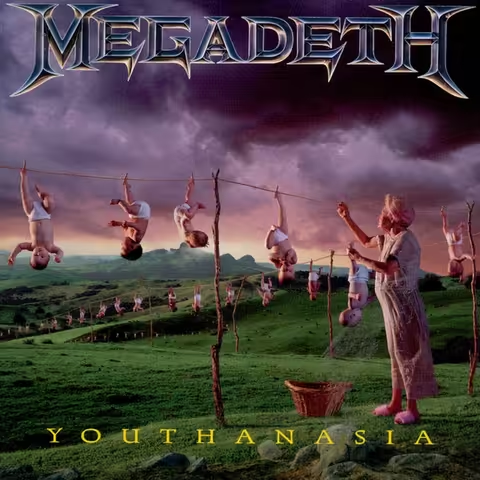
The album that came out the other end was called Youthanasia: a portmanteau of youth and euthanasia, a Hugh Syme cover painting of an old woman hanging swaddled babies by their feet from a clothesline, and twelve songs that traded thrash metal's open-throttle attack for mid-paced grooves and choruses you could sing in the shower. It debuted at number four on the Billboard 200 with 143,000 copies in a week, went RIAA Platinum inside two months, and gave the band an MTV-banned ballad in A Tout le Monde that fans still raise lighters for thirty years on.
Album Facts
| Field | Detail |
|---|---|
| Artist | Megadeth |
| Album | Youthanasia |
| Release date | 1 November 1994 |
| Label | Capitol Records |
| Producers | Max Norman and Dave Mustaine |
| Engineering | Mike Tacci (assistant), Bruce Jacoby (2nd assistant and drum tech), Michael Kaye (guitar/bass/amp tech and demo engineer) |
| Mastering | Bob Ludwig at Gateway Mastering, Portland, Maine |
| Studios | Phase Four Studios, Tempe; Vintage Recorders, Phoenix; a purpose-built modular studio in a South Phoenix warehouse |
| Genre | Heavy metal, with thrash and hard rock elements |
| Track count | 12 (original LP); 16 on the 2004 remixed edition |
| Total runtime | 49:57 |
| Billboard 200 peak | 4 (debut, 143,000 first-week copies) |
| UK Albums Chart peak | 6 |
| UK Rock and Metal Albums peak | 1 |
| Other notable peaks | Finland 2, Portugal 3, Sweden 4, Australia 9, Denmark 9, Europe 9, New Zealand 10, Canada 11, Japan 11 |
| Certifications | US Platinum (RIAA, 1995), Canada Platinum, Malaysia Platinum, UK Gold, Japan Gold, Finland Gold, Argentina Gold |
| Estimated US sales | 1.3 million copies |
| Singles | Train of Consequences, A Tout le Monde, Reckoning Day (promo) |
Where Megadeth Stood in 1994
Megadeth had spent the previous two years on the road behind their fifth album, the 1992 commercial breakthrough that finally drew them level with Metallica's Black Album in arena attendance and platinum sales. Countdown to Extinction peaked at number two on the Billboard 200, became double platinum and turned Mustaine, bassist David Ellefson, guitarist Marty Friedman and drummer Nick Menza into a genuine touring force across the United States, Europe, South America and Japan. By the end of the cycle the band had played to arenas every night for almost eighteen months.
The follow-up was always going to be the most exposed record of their career. Grunge and the post-Nirvana wave of alternative rock had pushed the visible mainstream away from speed metal. Pantera had picked up Metallica's old groove-metal mantle and pushed it heavier. Korn were a year away from rewriting the rulebook on what a metal band could even be. Megadeth's commercial position was suddenly less about hanging on to the thrash audience that had bought Rust in Peace than about not losing the much larger crossover audience that had only just shown up.
Internally the band were not coping well with success. Mustaine has spoken in interviews about a period of "outrageous emotional interventions" roughly every two weeks, with the rest of the lineup pushing back on what they saw as his hold on the songwriting. The compromise that fell out of those meetings was that Mustaine would loosen his grip on arrangements and let the others write into the songs, but the lyrics and direction would still be his.
Why Phoenix and Not Los Angeles
The first big creative decision was geographic. Mustaine had no appetite for another long Los Angeles session and the distractions and old contacts that came with them. Most of the band were by then living in Arizona anyway, so Phoenix won by default. What no-one quite agreed on at first was where in Phoenix they would actually record.
Two existing studios got the first call. Sessions began at Phase Four Studios in Tempe in January 1994 and ran for a few weeks before the band moved across town to Vintage Recorders in Phoenix proper, where they continued into May. Vintage Recorders shows up in much of the footage from the Evolver home video that documented the album's making. Neither room, though, was quite what Norman or Mustaine had in mind for the album they were trying to write on the fly.
Building a Warehouse Studio in South Phoenix
Norman's proposal was to stop renting other people's rooms and build their own. With funding pooled between Capitol Records, the band and Norman himself, a modular studio was constructed inside a warehouse in South Phoenix and dedicated to Youthanasia for the duration of the project. The room was tailored to the songs Norman wanted to capture: a large, dead drum space for Menza, isolated guitar booths feeding live amps in a separate room, and a control area built around a single shared workstation rather than a traditional console layout.
The decision turned the record from a hire-and-go session into something closer to an artist residency. There were no scheduled hand-overs to other bands, no client outside the band paying for the room, and no clock to beat on a Sunday night. Mustaine has said the album was "written solely in the studio" without leaning on any old catalogued riffs, with the other members invited in earlier and more openly than on any previous Megadeth record. He later credited the full lineup as co-writers in spirit, even where the formal credits stayed mostly in his name.
Max Norman, Dave Mustaine and the Producer's Chair
Max Norman was on his second Megadeth album as producer, having mixed Rust in Peace in 1990 and co-produced Countdown to Extinction in 1992. Before Megadeth he was best known for tracking and mixing the early Ozzy Osbourne records, including the Randy Rhoads sessions for Blizzard of Ozz in 1980 and [*Diary of a Madman*](/posts/the-making-of-diary-of-a-madman-by-ozzy-osbourne/) in 1981. By the time he sat down in Phoenix he had spent more than a decade pulling tight, multi-tracked metal guitars into focus on tape, and he was one of the first metal producers to make serious use of computers for tuning, comping and sample replacement.
Mustaine's role was no longer the watching co-producer of earlier Megadeth records. He was now genuinely a co-producer, signing off mixes alongside Norman and steering arrangements during tracking. The credited team also included Mike Tacci as first assistant engineer, Bruce Jacoby as second assistant and drum technician, and Michael Kaye as guitar, bass and amp tech as well as demo engineer. Final mastering was handled by Bob Ludwig at Gateway in Portland, Maine, a credit that effectively guaranteed the record would translate to American rock radio.
| Producer | Album | Artist | Year |
|---|---|---|---|
| Max Norman | Blizzard of Ozz | Ozzy Osbourne | 1980 |
| Max Norman | Diary of a Madman | Ozzy Osbourne | 1981 |
| Max Norman | No More Tears (mix) | Ozzy Osbourne | 1991 |
| Max Norman, Dave Mustaine | Countdown to Extinction | Megadeth | 1992 |
| Max Norman, Dave Mustaine | Youthanasia | Megadeth | 1994 |
The Pro Tools Experiment That Failed
The ambition for Youthanasia went beyond the songs. Norman and Mustaine wanted it to be one of the first major rock albums committed entirely to hard disk rather than magnetic tape, using an early multi-track version of Digidesign's Pro Tools. Digidesign was at that point pushing Pro Tools out from a single-track editor towards a true multi-track recording platform, and Norman, who had been using Macs for sample editing for years, believed they could chain enough Macintosh Quadras together to handle a full forty-eight track session.
The reality turned out to be less elegant. Synchronisation, track count, file management and the sheer processing required for full-band tracking at industry sample rates kept falling over. After a serious effort by the engineering team to make the digital chain stick, both producers conceded that the album would need to go back to magnetic tape for the bulk of the basic tracks, with Pro Tools used for editing, comping and selected overdubs. The failed experiment is one of the reasons the record arrived later than Capitol's original schedule and went over its initial budget.
Writing in the Room
Because so little of Youthanasia was pre-written, much of its character was built session by session. Friedman, who had joined Megadeth for Rust in Peace in 1990, brought a more melodic lead voice than Chris Poland or Jeff Young before him, and he was openly given room to shape the harmony parts on songs like Elysian Fields and I Thought I Knew It All. Menza, who had played on Rust in Peace and Countdown to Extinction, was now confident enough to push back on tempos and song structures rather than just tracking what was put in front of him. Ellefson, the band's diplomat, helped resolve lyric directions on songs like Reckoning Day and Elysian Fields, both of which carry shared writing credits with Mustaine.
Mustaine framed the album's musical reach pragmatically. "It's been called a thrash album, it's been called a rock album, and it's even been called an alternative album," he said in 1995. "To me it can only be called a Megadeth album. That should be enough." Friedman, asked at the time whether the band were chasing the post-grunge mood, was equally blunt:
"We pretty much stick to our guns. It's not like we're gonna change our next album to try and follow the trend. We don't really change with the times."
Marty Friedman, interview with Famous Interview, 1995
The Title and the Hugh Syme Cover
Mustaine arrived at the title Youthanasia from two directions at once. He had been reading about Jack Kevorkian, the American physician who had spent the early 1990s publicly assisting terminally ill patients to end their own lives, and the word euthanasia was already lodged in his head. He was also writing about what he saw as the casual abandonment of young people, citing drugs, crime, violence and absent parenting. The portmanteau of youth and euthanasia gave the lyric a single grim image to hang the album on.
For the cover he turned to Hugh Syme, the Canadian designer best known for the long run of Rush sleeves that began with 2112 in 1976. Syme produced a painting of an elderly woman in a long apron pegging more than thirty swaddled babies by their feet to a clothesline that runs across a barren brown landscape. Ellefson has said the concept came directly from a line in the title track: "we've been hung out to dry." Like Countdown to Extinction before it, the front cover dispenses with Megadeth's skull-faced mascot Vic Rattlehead, who is relegated to the back of the sleeve. A live re-creation of the same scene appears in the Train of Consequences music video.
Personnel and Credits
| Role | Player | Notes |
|---|---|---|
| Core band | ||
| Lead vocals, rhythm guitar | Dave Mustaine | Producer; primary songwriter on all twelve tracks |
| Lead guitar | Marty Friedman | Co-write credits on Elysian Fields, I Thought I Knew It All, Black Curtains |
| Bass | David Ellefson | Co-write credits on Reckoning Day, Elysian Fields, Family Tree, I Thought I Knew It All |
| Drums, percussion | Nick Menza | Co-write credits on Family Tree and I Thought I Knew It All |
| Additional musicians | ||
| Harmonica | Jimmie Wood | Plays on Train of Consequences and Elysian Fields |
| Production | ||
| Produced and mixed by | Max Norman, Dave Mustaine | Self-built modular studio, South Phoenix |
| Assistant engineer | Mike Tacci | |
| 2nd assistant engineer, drum tech | Bruce Jacoby | |
| Guitar/bass/amp tech, demo engineer | Michael Kaye | Effects programming |
| Mastering | Bob Ludwig | Gateway Mastering, Portland, Maine |
| Artwork and design | ||
| Cover painting | Hugh Syme | Long-time Rush sleeve designer |
| 2004 remix and remaster | ||
| Produced by | Dave Mustaine | |
| Mixed by | Ralph Patlan, Dave Mustaine | |
| Engineered by | Ralph Patlan with Lance Dean | |
| Edited by | Lance Dean, Scott "Sarge" Harrison, Bo Caldwell | |
| Mastered by | Tom Baker | |
The Tracklist
| # | Title | Writers | Length | Single? | Notes |
|---|---|---|---|---|---|
| 1 | Reckoning Day | Mustaine, Ellefson / Mustaine, Friedman | 4:34 | Promo | Opens the record with a half-time gallop |
| 2 | Train of Consequences | Mustaine | 3:26 | Yes (Nov 1994) | Lead single; Jimmie Wood on harmonica |
| 3 | Addicted to Chaos | Mustaine | 5:26 | Acoustic-led, longest cut on the album | |
| 4 | A Tout le Monde | Mustaine | 4:28 | Yes (Feb 1995) | French-language chorus; MTV banned the video |
| 5 | Elysian Fields | Mustaine, Ellefson / Mustaine | 4:03 | Harmonica returns; fan-favourite riff | |
| 6 | The Killing Road | Mustaine | 3:57 | Title taken from the band's road slang | |
| 7 | Blood of Heroes | Mustaine | 3:57 | Written as a salute to working-class soldiers | |
| 8 | Family Tree | Mustaine / Mustaine, Ellefson, Menza | 4:07 | Lyric tackles incest and generational abuse | |
| 9 | Youthanasia | Mustaine | 4:09 | Title track and the artwork's source line | |
| 10 | I Thought I Knew It All | Ellefson, Mustaine / Mustaine, Ellefson, Friedman, Menza | 3:44 | Only song with the whole band on music credit | |
| 11 | Black Curtains | Mustaine / Mustaine, Friedman | 3:39 | Friedman lead guitar feature | |
| 12 | Victory | Mustaine | 4:27 | Lyric quotes titles of every previous Megadeth song |
Reckoning Day and the Opening Salvo
The album opens with the only song on which Ellefson takes a lyric co-write, a deliberate signal that Mustaine had stopped guarding the front door of the catalogue. Reckoning Day is built on a half-time gallop, more Peace Sells than Hangar 18, and Friedman's solo unspools over a clean middle eight rather than a sprint. It later became the album's third single in promotional form and was the song the band leaned on to open most nights of the 1994 to 1995 tour. For listeners who feared a soft pivot after the album's early reviews, Reckoning Day was reassurance that the band could still hit.
Train of Consequences
The album's lead single, released to radio on 10 November 1994 and to retail on early 7-inch and CD-single formats shortly after, is the song the rest of Youthanasia is hung from. The riff is a Mustaine workout in dropped-D, but the new ingredient is Jimmie Wood's harmonica, which doubles the main lick and gives the whole track a kicked-in-the-saloon-doors feel that no previous Megadeth single had even gestured towards. The lyric is a first-person confession from a compulsive gambler about to lose everything, and Mustaine sings it from inside the character rather than at him.
Reviewing the album for AllMusic, Stephen Thomas Erlewine singled it out for its "jackhammer riffs", and it was the song Capitol pushed hardest to American rock radio. It charted at number 31 on the US Mainstream Rock Tracks chart and became the band's most-played single in the United States until Trust in 1997. The accompanying music video, directed by Wayne Isham, builds out a live action version of the album's clothesline scene with the band performing in front of it.
A Tout le Monde and the MTV Ban
The second single is the one that argued with MTV. A Tout le Monde is essentially a power ballad with a French refrain (a tout le monde, a tous mes amis, je vous aime, je dois partir, or to everyone, to all my friends, I love you, I must go) sung over an arpeggiated clean intro that opens into Friedman's most overtly melodic guitar solo on the record. The intro guitars are tuned a half-step down to E flat, putting the song in F minor, and Friedman has said in interviews that he treated the solo as a piece of contained lyrical writing rather than a virtuoso showcase.
The Wayne Isham video, released to MTV in early 1995, was rejected by the channel. MTV's standards-and-practices position was that the chorus and the imagery suggested suicide. Mustaine has been clear in every interview since that the song was written from the perspective of someone dying who wants to say a last goodbye, and that calling it a suicide song missed the point entirely:
"It's not a suicide song. It's when people have a loved one that dies and they end on a bad note, you know, they wish that they could say something to them. So this is an opportunity for the deceased to say something before they go."
Dave Mustaine, Arsenal of Megadeth DVD interview, 2006
The video stayed banned even when the song was re-recorded as a duet with Cristina Scabbia of Lacuna Coil on the band's 2007 album United Abominations, where it appeared under the corrected French spelling A Tout le Monde (Set Me Free). The duet version did make it onto MTV2's Headbangers Ball, but the original 1995 clip has never been on the main MTV grid. On the chart side the song reached 12 on the Finnish singles chart and 31 on US Mainstream Rock.
Addicted to Chaos, Elysian Fields and the Slow Burners
Addicted to Chaos is the longest track on the album and the most patient. It opens on clean acoustic figures, layers in Friedman's harmony lead and only kicks fully into distortion two and a half minutes in. The lyric, about somebody hooked on their own destructive behaviour, sits very close to Mustaine's own well-documented history with substances at the time, although he has always declined to spell that out on the record.
Elysian Fields brings Jimmie Wood's harmonica back for a second appearance and pairs Friedman's most thrash-leaning lead on the album with one of Ellefson's strongest bass performances. The Killing Road and Blood of Heroes sit in the middle of the album as straight-down-the-line mid-paced metal, the former taking its title from the band's slang for tour life, the latter written as a salute to soldiers Mustaine had met on tour and which the band has frequently dedicated to American servicemen in live introductions.
Family Tree and the Difficult Songs
Family Tree is the song fans still bring up first when asked which Youthanasia tracks made them put the lyric sheet down. The narrator's voice belongs to a victim of intra-family sexual abuse confronting their abuser, and the lyric is detailed enough that several radio stations declined to playlist it. Mustaine has said he wrote it after reading about a series of court cases involving recovered memories of childhood abuse, and that the song is meant as solidarity with survivors rather than provocation. Musically it is one of the more breakneck songs on the album, with Menza pushing the tempo and Friedman dropping in a short atonal solo to underline the unease.
I Thought I Knew It All is the only song on the album whose music credit goes to the full lineup, and you can hear the negotiation in the structure: a more progressive opening section that drops into a Mustaine chorus and an Ellefson-led bridge before Friedman closes the lead.
The Title Track and Victory
The title track sits ninth, late enough to function as a thesis rather than an opening statement. The line "we've been hung out to dry" is the one Hugh Syme drew the cover from, and the chorus is one of the most overtly singalong moments on any Megadeth record up to that point. The album closes on Victory, a four and a half minute mid-paced track whose lyric is built almost entirely from quoted titles of every previous Megadeth song: a closing wink for catalogue listeners and a structural conceit that no other Megadeth album has tried before or since.
Singles, Formats and Promo Oddities
| Single | Released | Formats | B-sides and bonus tracks | Notable chart |
|---|---|---|---|---|
| Train of Consequences | 10 November 1994 | CD single, 7-inch, cassette | Live tracks on European editions | US Mainstream Rock 31 |
| A Tout le Monde | February 1995 | CD single (US promo, UK, Dutch) | Sex Pistols cover of Problems; demo of New World Order; demos of Symphony of Destruction and Architecture of Aggression (Dutch CD) | Finland 12, US Mainstream Rock 31 |
| Reckoning Day | 1995 | Promo only | Promotional radio single |
The promotional run for the album included two genuinely odd artefacts. A special promo edition of Youthanasia was issued with a printed essay by horror and suspense novelist Dean Koontz called "Godzilla vs. Megadeth". And a B-side of the A Tout le Monde US promo carried a previously unreleased Megadeth cover of the Sex Pistols' Problems, the only Sex Pistols song the band has ever officially released.
- An unreleased demo of New World Order, written during the Youthanasia sessions, was used as a B-side on multiple territories of the A Tout le Monde single and only made its way to an album proper as a bonus track on the 2004 reissue.
- Vinyl pressings of Youthanasia in 1994 were limited and quickly went out of print; the album was effectively a CD-and-cassette release for most of its first decade.
- A 2014 Music On Vinyl reissue restored the album to 180-gram black vinyl with the original gatefold artwork.
Release Day and First-Week Numbers
Youthanasia was released through Capitol Records on Tuesday, 1 November 1994. The lead single had already shipped to American rock radio in October and the band had spent September and October on a heavy press cycle: cover features in Kerrang!, RIP, Metal Hammer, Q and Hit Parader, and a major television push that ran from The Tonight Show with Jay Leno through to Top of the Pops.
The album debuted at number four on the Billboard 200, the band's second top-five entry in the United States. First-week US sales of 143,000 copies were a step down from Countdown to Extinction's 192,000 but solid for an album released into a market still dominated by Pearl Jam's Vitalogy, Hootie and the Blowfish's Cracked Rear View and the soundtrack to Forrest Gump. Several weeks later, the RIAA certified Youthanasia Platinum for one million American shipments, the band's third platinum studio album in a row after Rust in Peace and Countdown to Extinction.
Critical Reception
The contemporary reviews were warm without being unanimous. Q magazine awarded the album four stars and wrote that it had "greater depth and breadth than its predecessors". The Los Angeles Times gave it a three-star review, Sandy Masuo noting the new emphasis on songwriting and dynamic range. Tom Sinclair, writing in Entertainment Weekly, gave it a B-minus and a deliberately backhanded one-liner that the record would "impress, but not impact".
The longer-form assessments tended to pair praise for the production with mild regret that the band had eased off the throttle. Stephen Thomas Erlewine, reviewing for AllMusic, wrote that the album lacked the focus of Countdown to Extinction but that the production "makes up for it", calling out Train of Consequences for its "jackhammer riffs". Neil Arnold at Metal Forces went further and named the record "the last true Megadeth opus before the mid-to-late 90s slump". Two decades later, Guitar World placed Youthanasia at number 29 on its "Superunknown: 50 Iconic Albums That Defined 1994" list, an explicit retrospective endorsement of its standing in the 1994 conversation.
"From the drumbeat opening of Addicted to Chaos to the precise instrumentation of Train of Consequences, Megadeth deliver trademark aggressive rage 'n' roll to powerful effect."
Paul Verna and Peter Cronin, Billboard, 26 November 1994
The Charts Around the World
| Territory | Chart | Peak | Certification |
|---|---|---|---|
| United States | Billboard 200 | 4 | Platinum (RIAA) |
| United Kingdom | Official Albums Chart | 6 | Gold (BPI) |
| United Kingdom | Rock and Metal Albums | 1 | |
| Finland | Suomen virallinen lista | 2 | Gold |
| Portugal | AFP Albums | 3 | |
| Sweden | Sverigetopplistan | 4 | |
| Australia | ARIA Albums | 9 | |
| Denmark | IFPI Albums | 9 | |
| Europe | Eurochart Top 100 | 9 | |
| New Zealand | RMNZ Albums | 10 | |
| Canada | RPM Top Albums | 11 | Platinum (Music Canada) |
| Japan | Oricon Albums | 11 | Gold (RIAJ) |
| Germany | Offizielle Top 100 | 13 | |
| Scotland | Scottish Albums | 13 | |
| Netherlands | Album Top 100 | 20 | |
| Argentina | CAPIF | Gold (1994 and 2004 reissue) | |
| Malaysia | Platinum |
Megadeth, Arizona: The First Band Website
One of the more easily missed legacies of the Youthanasia rollout is that the album was the launch vehicle for what is widely cited as the first dedicated artist website in the music business. Robin Sloan Bechtel, then working at Capitol's marketing team, built a site called Megadeth, Arizona, conceived as a "virtual cybertown" where fans could read tour news, post messages, swap setlists and play with album promotional materials. It launched ahead of the album in 1994, before most major bands had so much as registered a domain, and predated even the early Bowie and Public Enemy net experiments by a clear margin. Bechtel has written that the site quickly became a hub for the band's most online fans and was a template Capitol later rolled out across other rosters.
The Youthanasia World Tour
The touring cycle behind the album was one of the longest of Megadeth's career to that point. The first leg opened in South America in November 1994, the band having decided to take the album to their fastest-growing audience first. They picked up Korn, Flotsam and Jetsam and Fear Factory as opening acts on the 1995 North American and European legs, an early platform-share that helped pull Korn from cult curiosity to genuine arena draw within twelve months.
The European leg ran for eight weeks across the spring of 1995. Ellefson told the Megadeth CyberArmy newsletter at the time that European audiences had become the band's most reliable: "The audiences have been really good and it seems to me that heavy metal and especially Megadeth are very much at the forefront of music in Europe. It seems like the attendance is better than it has ever been." The tour closed in September 1995 with appearances on Monsters of Rock dates in South America under Ozzy Osbourne and Alice Cooper.
Behind the scenes the road cycle ended in turmoil. Manager Ron Lafitte left to take a job at EMI Records and effectively folded his management company, forcing Megadeth to sign with ESP Management and bring in Bud Prager, the long-serving manager of Foreigner and Bad Company, as their new creative steward. Prager would push the band further towards mainstream rock structures on 1997's Cryptic Writings.
1994 in Context: What It Competed Against
Releasing a metal album in late 1994 meant releasing into one of the most crowded calendars in modern rock history. Within roughly a year of Youthanasia's street date, listeners had to choose between
- Pearl Jam, Vitalogy, also out in late 1994
- Soundgarden, Superunknown, March 1994
- Hole, [Live Through This](/posts/the-making-of-live-through-this-by-hole/), April 1994
- Green Day, Dookie, February 1994
- Nine Inch Nails, The Downward Spiral, March 1994
- Beastie Boys, Ill Communication, May 1994
- Stone Temple Pilots, Purple, June 1994
- Alice in Chains, Jar of Flies EP, January 1994
- The Cranberries, No Need to Argue, October 1994
- Pantera, Far Beyond Driven, March 1994
That Youthanasia still managed a top-five Billboard debut and a number six placing in the United Kingdom against that field is one of the strongest pieces of evidence that Megadeth's commercial constituency had genuinely grown beyond thrash by 1994. The album also arrived in a year in which the world was still processing the death of Kurt Cobain in April, The Lion King was rewriting box-office records and Disney's grip on the soundtrack chart, and [the Rolling Stones](/posts/the-making-of-the-rolling-stones-by-the-rolling-stones/)' Voodoo Lounge tour was setting new highs for arena ticketing revenues.
The 2004 Remix and the Anniversary Plans
On 27 July 2004, Capitol issued a remixed and remastered edition of Youthanasia as part of a wider Megadeth catalogue programme. Mustaine produced and co-mixed the remix with Ralph Patlan; engineering was by Patlan with Lance Dean, editing by Dean, Scott "Sarge" Harrison and Bo Caldwell, and Tom Baker remastered. The reissue added four bonus tracks: an alternate-vocal demo of A Crown of Worms, plus live versions of Holy Wars... The Punishment Due, Symphony of Destruction and Sweating Bullets drawn from a 1995 club show.
The 2004 mixes were not universally welcomed. Some long-term fans found them brighter and more compressed than Bob Ludwig's 1994 master and preferred the original CD. Chris Ayers, writing for Exclaim!, felt the wider 2004 catalogue programme had "eroded their brilliant thrash to mid-paced chug". The original 1994 mix has since been restored on subsequent vinyl reissues and on most digital editions of the album, so both versions now coexist on streaming platforms.
In a 2013 interview with Hard Rock Examiner, Mustaine raised the possibility of Megadeth performing the entire album live in 2014 for the twentieth anniversary, although the only place that actually happened in full was as one-off album-in-full performances during the band's 2014 European run.
Legacy and Influence
Three decades on, Youthanasia sits at the hinge of Megadeth's catalogue. It is the last album where the classic Rust in Peace through Countdown to Extinction lineup of Mustaine, Friedman, Ellefson and Menza were operating as a genuine four-way creative unit, and it is the last Megadeth album where Max Norman was the dominant production voice. Both relationships frayed during the next album, 1997's Cryptic Writings, and were gone entirely by 1999's Risk.
Its commercial reach proved that an American thrash band could survive into the grunge era without abandoning either their riffs or their fanbase, and several of the next generation of metal acts have cited the album directly. Trivium's Matt Heafy has named it among his formative listening; Lamb of God's Mark Morton has talked about Friedman's lead work on Elysian Fields as a key teenage reference. The 2007 duet remake of A Tout le Monde with Cristina Scabbia gave the album a second life among a younger European metal audience who had grown up on Lacuna Coil and discovered Megadeth backwards.
The 1994 to 1995 tour cycle also locked in two of the more durable supporting-act careers in modern metal. Korn cut their teeth on the Megadeth North American leg and were headlining clubs of their own twelve months later. Fear Factory and Flotsam and Jetsam likewise used the exposure to push out into Europe.
Things You Might Not Know
| Fact | Detail |
|---|---|
| Built from scratch | The South Phoenix studio used for most of Youthanasia was a modular room that Max Norman, Capitol and the band funded together inside a leased warehouse, dedicated to the album for its entire making. |
| Pro Tools first, tape second | Norman and Mustaine intended Youthanasia to be one of the first major rock albums recorded entirely on hard disk using early multitrack Pro Tools running on Macintosh Quadras; technical limits forced them back to magnetic tape for most of the basics. |
| First band website | The album was the launch vehicle for Megadeth, Arizona, conceived by Capitol's Robin Sloan Bechtel and widely cited as the first dedicated artist website in the music industry. |
| Dean Koontz essay | A special promo pressing of the album shipped with a printed essay by horror novelist Dean Koontz titled "Godzilla vs. Megadeth". |
| Hugh Syme connection | The clothesline-of-babies cover was painted by Hugh Syme, the same Canadian artist who has designed almost every Rush album sleeve since 2112 in 1976. |
| Hung out to dry | Ellefson has said the cover concept came directly from the title track's line "we've been hung out to dry", an unusually direct chain from lyric to artwork. |
| French chorus, missing accent | The original 1994 release of A Tout le Monde drops the grammatically required grave accent on the title's first "a"; the 2007 remake corrected it to "A Tout le Monde (Set Me Free)". |
| MTV ban that stuck | MTV refused to play the original A Tout le Monde video in 1995 and never reversed the decision, even when the 2007 duet remake aired freely on MTV2's Headbangers Ball. |
| Sex Pistols B-side | The US promo CD single of A Tout le Monde carries Megadeth's only officially released Sex Pistols cover, a previously unreleased version of Problems. |
| Korn's first big tour | Korn opened for Megadeth on parts of the 1995 leg, one of the earliest national exposures for the band who would headline arenas of their own within a year. |
| Catalogue easter egg | The closing track Victory's lyric is constructed almost entirely from quoted song titles drawn from every previous Megadeth album. |
| Twentieth-anniversary teaser | Mustaine told an interviewer in 2013 there was a "very big chance" Megadeth would play Youthanasia in full for its twentieth anniversary; only a handful of dates on the 2014 tour actually delivered it. |
Hear the Full Story on Riffology
If you want the long-form discussion of Youthanasia, the Pro Tools experiment, the warehouse studio and the A Tout le Monde fight with MTV, the Riffology podcast covers all of it in episode 24, Megadeth Youthanasia, available wherever you get your podcasts. Subscribe to Riffology on Apple Podcasts, Spotify, Pocket Casts or your podcast app of choice and the new episodes will land in your feed every week.
Comments