
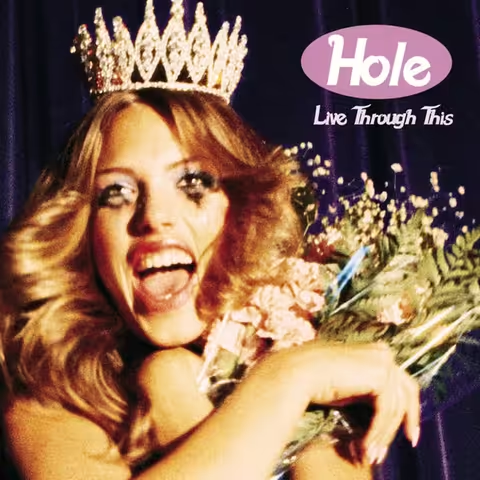
Live Through This is the album Courtney Love built to prove she belonged to no one. Hole's second record was a deliberate hard turn away from the scorched noise of their debut, a set of songs melodic enough to stand beside Nirvana and the Smashing Pumpkins yet vicious enough to draw blood, and Love made it knowing the whole industry was waiting to see whether Kurt Cobain's wife could really front a band. Then, four days before it reached shops on 12 April 1994, Cobain was found dead in Seattle, and the record Love had fought to make hers was instantly reframed: first as a grief artefact, and then, in the ugliest rumour of the decade, as something her husband must have secretly written.
The truth is both simpler and stranger. Live Through This was all but finished before tragedy swallowed it, cut in twenty-three days in a suburban Georgia studio by a band that had only just clicked into place, made with two producers Hole hired partly because Cobain admired their work with Radiohead. It went platinum, topped critics' polls, and survived every attempt to explain it away. This is the full story of how it was made, who really played on it, why its closing track carries the wrong title, and how an album bracketed by death became one of the most influential rock records ever fronted by a woman.
Album Facts
Before the deep dive, here is the record at a glance. Hole's major-label debut was a tightly run operation despite the chaos that surrounded the band, finished fast and mixed by some of the most respected names in American alternative rock.
| Field | Detail |
|---|---|
| Artist | Hole |
| Album | Live Through This |
| Release date | 12 April 1994 |
| Label | DGC Records (a Geffen subsidiary) |
| Producers | Paul Q. Kolderie and Sean Slade |
| Studios | Triclops Sound, Marietta, Georgia (recording); Record One, Los Angeles and Bad Animals, Seattle, plus Sear Sound, New York (mixing) |
| Genre | Alternative rock, grunge, punk rock |
| Track count | 12 |
| Total runtime | 38:16 |
| Billboard 200 peak | No. 52 (68 weeks on chart) |
| UK Albums Chart peak | No. 13 |
| Other notable peaks | Australia No. 13, Belgium (Wallonia) No. 8, Canada No. 29, Germany No. 39, Sweden No. 22 |
| Certifications | Platinum (US), Platinum (Canada and Australia), Gold (UK) |
| Estimated sales | Over 1.6 million in the US, more than 2 million worldwide |
| Key singles | Miss World, Doll Parts, Violet, Softer, Softest |
Grunge Goes Overground: The World of 1994
By the time Live Through This landed, the underground had become the mainstream. Nirvana's Nevermind had detonated in 1991 and dragged a whole scene blinking into the light, and the major labels had spent two years signing anything that sounded like flannel and feedback. 1994 was the year the gold rush peaked and the cracks began to show. It was a season of enormous, era-defining records, and Hole's second album had to fight for oxygen in a remarkably crowded room.
Consider what alternative rock fans were buying that year alongside it:
- Soundgarden, Superunknown, a number one album that pushed grunge toward psychedelia.
- Nine Inch Nails, The Downward Spiral, industrial rock as commercial juggernaut.
- Pearl Jam, Vitalogy, the biggest band in America wrestling with its own fame.
- Green Day, Dookie, pop-punk's mass-market breakthrough.
- Alice in Chains, Jar of Flies, the first EP ever to debut at number one.
- Nirvana's MTV Unplugged in New York, recorded in late 1993 and released that November as a posthumous farewell.
Into that landscape Hole arrived with something pointedly different. Where the men of grunge mostly sang about alienation and numbness, Love wrote about beauty, motherhood, body image, exploitation, and rage, from a female point of view that the genre had barely acknowledged existed. The early 1990s had also produced riot grrrl, the confrontational feminist punk movement led by bands like Bikini Kill and Bratmobile, and a wave of fierce women in rock that included L7, Babes in Toyland, PJ Harvey, and Liz Phair. Love's relationship with riot grrrl was famously thorny. She borrowed its politics while rejecting its purism, and Live Through This would openly mock the scene's conformity even as it became one of the most powerful feminist statements the decade produced. Critics reached for the dismissive label "foxcore" to describe women playing this kind of heavy music. Hole's second album would make that word look ridiculous.
Hole Before Live Through This
Hole began with a small ad. In the summer of 1989, Courtney Love placed a notice in the Los Angeles paper The Recycler that read, "I want to start a band. My influences are Big Black, Sonic Youth, and Fleetwood Mac." Eric Erlandson, a Loyola Marymount graduate then working as an accountant, answered it. Their first meeting was not love at first sight. "I saw her and I thought, oh, God, oh, no, what am I getting myself into," Erlandson remembered. "She grabbed me and started talking, and she's like, I know you're the right one, and I hadn't even opened my mouth yet." The band's name came from a line in Euripides' Medea and a remark from Love's mother, with the obvious anatomical pun left deliberately intact.
In those early days Love worked as a stripper to buy amplifiers, and the band cycled through bassists and drummers at a dizzying rate. Their debut album, Pretty on the Inside (1991), was produced by Kim Gordon of Sonic Youth with help from Gumball's Don Fleming. Abrasive, shrieking and deliberately unlovely, it won fevered praise from the British and American underground press, landed on Spin's albums of the year list, and reached number 59 in the UK. Love later called it "unlistenable", and meant it as a kind of compliment. The major labels circled. Madonna's Maverick imprint courted the band, but Love balked, describing the interest in a 1992 Vanity Fair piece as "kind of like Dracula's interest in his latest victim". In early 1992, Hole signed instead to Geffen's DGC subsidiary, the home of Nirvana, reportedly with a million-dollar advance and a royalty rate higher than Cobain's own band enjoyed.
What the band lacked was a stable rhythm section. Drummer Patty Schemel, recruited at a Los Angeles audition in April 1992, was the first piece. The second arrived a year later in the form of Kristen Pfaff.
Writing the Album: Jabberjaw to Rio
The songs that became Live Through This were written across two years and several cities. Love wrote "Violet" at the Los Angeles punk club Jabberjaw, then moved north to the Carnation, Washington home she shared with Cobain, where she, Erlandson and Schemel set up a makeshift studio and worked through the back catalogue and a flood of new material. "The songwriting process was really easy," Love recalled. "Jabberjaw was the salad days of it all." Many of the album's signatures, the gunshot choruses, the lullaby verses, the sudden swings between tenderness and fury, were forged in those rehearsals long before any producer heard them.
One of the strangest and most productive demo sessions happened in January 1993, thousands of miles from home. Nirvana had booked studio time in Rio de Janeiro to work up ideas for In Utero, and during the downtime Love and Schemel slipped in and cut rough versions of "Miss World", "She Walks on Me", "I Think That I Would Die" and "Softer, Softest". An earlier session in Seattle with producer Jack Endino had already yielded the single "Beautiful Son". The band was assembling its album in fragments, and the pieces were getting sharper.
The transformation came when Kristen Pfaff, a classically trained cellist who had been playing bass in the Minneapolis band Janitor Joe, joined in the spring of 1993. She brought a musicianship the band had never had, and everyone felt it at once.
"I found Kristen in L.A. and said, come with me to meet Courtney and Patty when you get to Seattle. She joined the band, she moved to Seattle, and that's when all the songs came to life, literally. She was the star of her band and so she was bringing that to Hole, and that created sparks in everybody."
Eric Erlandson, SPIN, 2014
A short UK tour in the summer of 1993, including the Phoenix Festival in July, gave the new lineup a test run, with crowds already moving to songs that had not yet been released. By the time Hole sent a clutch of demos to DGC, the band knew it had something. So did the label's A and R man Mark Kates, who travelled to Seattle to watch them rehearse and came away certain. There were only four or five finished songs on that demo tape. It was enough.
Making Live Through This in Georgia
Recording began on 8 October 1993 at Triclops Sound Studios in Marietta, Georgia, a suburban facility a long way from the Seattle fishbowl. Love chose it because the Smashing Pumpkins had made Siamese Dream there, and because she was convinced the room needed a vintage Neve mixing desk and Studer tape machines, the top-end analogue gear of the day. The studio sat in an office park; the only nearby food, producer Paul Q. Kolderie remembered, came from a Fuddruckers or a TGI Fridays. There was, by design, nothing to do but make the record.
The choice of producers was almost accidental. Love had chased Butch Vig, who made Nevermind and Siamese Dream, and Pearl Jam's Brendan O'Brien, and neither was available. Vig's manager quietly tipped off Kolderie and his partner Sean Slade, the Boston team behind Radiohead's "Creep" and records by the Lemonheads and Dinosaur Jr. Cobain, watching MTV, had a simpler instruction. "He's like, get the guy that did the Green Day album," Erlandson laughed. "I remember him saying, get the Green Day producer or get the Radiohead guy." Hole got the Radiohead guys. Love liked that she was, as she put it, getting two producers for the price of one.
They worked at speed. The basic tracks, drums, bass and scratch guitars, were finished in about five days. The revelation of those sessions was Pfaff, whose bass parts were so complete that they were kept exactly as played, with no overdubs at all.
"This has never happened on an album that we've done in all these years. Every single bass track on Live Through This was from the basic tracks. There was no bass overdubs because there was no need to, because they were perfect. That's like a singer doing an album's worth of vocals in just one take. It just doesn't happen."
Sean Slade, SPIN, 2014
Love's vocals were the opposite, built take by patient take. She would arrive at the studio reliably two hours late, sing two or three songs across many passes each evening, and leave; Kolderie and Slade then spent the following mornings editing the performances together. Crucially, they refused to double-track her voice, feeling it "took the fierceness away", and they left imperfections in place. When Geffen executives asked them to remove the audible crack in Love's voice during "Doll Parts", the producers ignored the note. That crack is now one of the most famous seconds on the record.
Not everything was so disciplined. A Triclops employee introduced the band to crystal meth, and heroin was in the picture too; Schemel later admitted that "Miss World" was recorded "a bit altered". The interpersonal weather was stormy. Pfaff and Erlandson had recently ended an on-and-off relationship and were forced to share a room, and Love's working method could be combustible. Kolderie described the atmosphere with a cartoonist's image.
"You know those cartoon things where when people are fighting and there is a dust cloud with sparks and stars flying out? That's how I think of it. There was always a fight about something. There were ashtrays flying. But they were never fighting with us. We would shut the control room door and just work."
Paul Q. Kolderie, SPIN, 2014
One anecdote captures the pressure perfectly. While the team was setting up drum sounds, Love phoned Vig to relay technical questions, and reported that Steve Albini, who had just recorded In Utero, considered the standard Shure SM57 snare microphone a tool for hacks. Slade, using exactly that microphone, did not miss a beat: he told Love it was actually a "Turbo 57", a model he invented on the spot. The crisis passed. Even the band's ambitions were stated plainly and emotionally; Slade remembered Love walking into the control room close to tears with a single demand. "This album has to go gold," she said. It would do far better than that.
Cobain visited mid-session, during a break from touring In Utero. Asked to add harmonies, he balked, reasonably, that he did not know the songs. "How can I sing on it if I haven't heard it?" he said, before Love talked him into improvising. He ended up ghosting the edges of "Asking for It" and "Softer, Softest", and little more; a later phone call in which he tried to dictate the mix, telling Slade to make the snare huge and double Love's vocals like Nevermind, was politely refused. "Sorry, Kurt, but we're not gonna do that," Slade told him. "That's not the album we are making here." The band finished recording on 31 October. Mixing, handled mostly by R.E.M. collaborator Scott Litt with one track ("Gutless") given to Dinosaur Jr.'s J Mascis, took another nineteen days. Bob Ludwig mastered it. The whole pressure cooker had run a little over six weeks.
Who Played on Live Through This
On paper Live Through This is a four-piece album, and the core of it is the chemistry between Love's voice and Erlandson's guitar, with Pfaff and Schemel locking the floor beneath them. But a handful of guests left fingerprints on the record, most importantly the singer Dana Kletter, whose close harmonies haunt seven of the twelve tracks and arguably helped turn "Doll Parts" into a hit.
| Role | Player | Notes |
|---|---|---|
| Core band | ||
| Lead vocals, rhythm guitar | Courtney Love | Wrote or co-wrote every original on the album |
| Lead guitar | Eric Erlandson | Co-writer; played 12-string acoustic on "Doll Parts" |
| Bass, backing vocals, piano | Kristen Pfaff | Her only Hole album; basslines kept from the basic tracks |
| Drums | Patty Schemel | Nailed "Jennifer's Body" on the second take |
| Guest musicians | ||
| Additional vocals | Dana Kletter | Harmonies on tracks 1, 2, 4, 6, 8 and 9 |
| Backing vocals | Kurt Cobain | Uncredited, on "Asking for It" and "Softer, Softest" |
| Production and engineering | ||
| Producers, engineers | Paul Q. Kolderie, Sean Slade | Slade also mixed six tracks |
| Mixing | Scott Litt | Tracks 1, 2, 4, 5 and 8, in Los Angeles and Seattle |
| Mixing | J Mascis | "Gutless", at Sear Sound, New York |
| Mastering | Bob Ludwig | |
| Artwork | ||
| Creative direction | Robin Sloane | |
| Art direction | Janet Wolsborn | |
| Front photography | Ellen von Unwerth | Shot cover model Leilani Bishop |
| Back photography | Frank Rodriguez | Childhood photo of Love in Springfield, Oregon |
| Inlay artwork | Juergen Teller, Margaret Morton | |
Slade credited Kletter's "Appalachian close harmony" on the "you will ache like I ache" line of "Doll Parts" as part of the song's success. Kolderie went further about the bassist who would never make another record, calling Pfaff "the secret ingredient" who "made the whole thing gel and happen". Their praise gives the album an aching subtext: this was a band that had just discovered exactly how good it could be.
The Songs
For all its surrounding turmoil, Live Through This is a remarkably concise album: twelve songs, none longer than three minutes and forty-two seconds, every one built around a hook. The writing credits on the sleeve list Hole collectively, though the BMI repertoire attributes the bulk of the songs to Love and Erlandson, with "Doll Parts" credited to Love alone.
| # | Title | Writer(s) | Length | Single? | Notes |
|---|---|---|---|---|---|
| 1 | Violet | Love, Erlandson | 3:24 | Yes (1995) | Inspired by Love's relationship with Billy Corgan |
| 2 | Miss World | Love, Erlandson | 3:00 | Yes (1994) | Lead single; demoed in Rio |
| 3 | Plump | Love, Erlandson | 2:34 | No | From a Pfaff musical idea; post-partum themes |
| 4 | Asking for It | Love, Erlandson | 3:29 | No | Cobain backing vocals; written in the studio |
| 5 | Jennifer's Body | Love, Erlandson | 3:42 | No | Schemel got her drum take on the second pass |
| 6 | Doll Parts | Love | 3:31 | Yes (1994) | Written in Boston, 1991; the album's biggest hit |
| 7 | Credit in the Straight World | Stuart Moxham | 3:11 | No | Young Marble Giants cover |
| 8 | Softer, Softest | Love, Erlandson | 3:28 | Yes (1996, Australia) | Cobain backing vocals; "kill-me pills" line |
| 9 | She Walks on Me | Love, Erlandson | 3:24 | No | Middle section devised on the Rio trip |
| 10 | I Think That I Would Die | Love, Erlandson, Kat Bjelland | 3:36 | No | References the Frances Bean custody battle |
| 11 | Gutless | Love, Erlandson | 2:15 | No | Mixed by J Mascis |
| 12 | Rock Star (Olympia) | Love, Erlandson | 2:42 | No | Mislabelled; mocks the Olympia scene |
"Violet" opens the record with what Rolling Stone called a "startling gunshot-guitar chorus", a song about Love's relationship with Smashing Pumpkins frontman Billy Corgan that snarls "go on, take everything, take everything, I want you to". "Miss World", the lead single, marries a bubblegum hook to a lyric of self-loathing and motherhood. "Doll Parts", written years earlier in the bathroom of a friend's Boston apartment, is the emotional centre, a fragile confession that erupts into the threat "someday you will ache like I ache". Kolderie knew the moment he heard it. "When I heard the lyrics to Doll Parts, I just thought, this is going to be big," he said.
The lyrics drew on Love's life and her reading in equal measure. "Asking for It" was inspired by a 1991 concert on tour with Mudhoney, when Love was assaulted while crowdsurfing and stripped of her clothes; it was written entirely in the studio. "I Think That I Would Die" references the 1992 custody battle over her daughter, Frances Bean, and lifts the line "she says, I am not a feminist" from a magazine interview with Julia Roberts. The phrase "kill-me pills" in "Softer, Softest" nods to the poet Anne Sexton, and the title Live Through This itself comes from a line in Gone with the Wind. The album's lone cover, the Young Marble Giants' "Credit in the Straight World", got a typically fierce overhaul; the song's author, Stuart Moxham, reportedly hated it, complaining that Hole had turned his spare post-punk tune into a "pornographic Led Zeppelin track".
B-sides, Outtakes and Lost Songs
The album's closing track is itself a kind of lost song. A number called "Rock Star" was originally meant to end the record, but at the last minute the band swapped in an outtake called "Olympia". The sleeves had already been printed, so "Rock Star" remained as the title, and decades of pressings have carried the error ever since. Alternate mixes of the song surfaced as B-sides with even sharper satirical lyrics, including the memorable line "we took punk rock, and we got a grade", aimed squarely at the riot-grrrl scene clustered around Olympia and Evergreen State College.
Around the album sit a scattering of related recordings worth knowing about:
- "Beautiful Son", "20 Years in the Dakota" and "Old Age", cut in Seattle with Jack Endino in November 1992 and released as a single in 1993.
- "Old Age" in particular was written by Cobain and given to Hole uncredited, the one genuine piece of his songwriting in the band's orbit.
- The 1995 EP Ask for It, which collected 1991 John Peel BBC session recordings of songs like "Doll Parts" and "Violet", proof that those songs existed long before the Georgia sessions.
That last point matters enormously, because those early Peel recordings are some of the hardest evidence against the rumour that would dog the album for years.
The Cover: Pageant Glory and Mascara Tears
The sleeve is one of the most celebrated in rock, and it has nothing to do with the band's faces. Photographer Ellen von Unwerth shot model Leilani Bishop as a beauty-pageant winner at the instant of victory, clutching a bouquet, wearing a tiara, mascara streaming down her cheeks in tears of triumph. Love explained exactly what she wanted to capture.
"I wanted to capture the look on a woman's face as she's being crowned, this sort of ecstatic, blue eyeliner running, kind of, I am, I am, I won! I have hemorrhoid cream under my eyes and adhesive tape on my butt, and I had to scratch and claw and fuck my way up, but I won Miss Congeniality."
Courtney Love, on the album cover
The band's logo on the front deliberately echoed the Mattel Barbie typeface, a sly comment on manufactured femininity. The back cover answered the glossy front with something raw: a family snapshot of Love as a child in Springfield, Oregon, with the tracklist printed beside it on embossing tape. Music scholars have read the contrast as the album's whole thesis in two images, the manufactured winner versus the real girl underneath. The record was dedicated to Joe Cole, a roadie for Black Flag and the Rollins Band who was shot dead in a December 1991 robbery after attending a Hole concert at the Whisky a Go Go. In 2024, Rolling Stone ranked the cover number 13 on its list of the 100 best album covers of all time.
Release and Reception
Live Through This arrived into unimaginable circumstances. Cobain was found dead on around 8 April 1994, and the album came out four days later. Whatever rollout DGC had planned was swept aside by a global news story, and the band's frontwoman became a figure of public grief before she was a figure of public triumph. And yet the record was so strong that it broke through anyway. Critics were nearly unanimous, and the album went on to top the major year-end polls.
"Love delivers punk not only as insinuating as Nirvana's but as corrosive as the Sex Pistols'. More significantly, Live Through This may be the most potent blast of female insurgency ever committed to tape."
Rolling Stone, 1994
Entertainment Weekly handed it a B-plus and declared that "Love is a greater star. She has charisma and attitude to burn, and she knows it." NME called it "a personal but secretive thrash-pop opera of urban nihilism", Melody Maker dubbed it "the high watermark of the genre that survived the crass label of foxcore", and Robert Christgau gave it a straight A. The album was named the number one record of 1994 by the critics at Rolling Stone, Spin and the Los Angeles Times, and topped the Village Voice's influential Pazz and Jop poll. Years later, Pitchfork would award it a perfect 10 in a 2018 reappraisal. Commercially it was a slow, steady success rather than an explosion, and the numbers tell the story.
| Territory | Chart peak | Certification |
|---|---|---|
| United States (Billboard 200) | No. 52, 68 weeks | Platinum (over 1.6 million sold) |
| United Kingdom | No. 13, 17 weeks | Gold (2013) |
| Australia | No. 13, 16 weeks | Platinum (70,000) |
| Canada | No. 29 | Platinum (100,000) |
| Belgium (Wallonia) | No. 8 | |
| Sweden | No. 22 | |
| Germany | No. 39 |
It went gold in the US in December 1994 and platinum in April 1995, and its 68-week run remains the longest of any Hole album on the Billboard 200. The record settled in for the long haul precisely because the songs kept finding new listeners on the radio.
Singles and Music Videos
Four singles were drawn from the album, and the videos tell their own sad story of a band in flux. Watch them in order and you see three different women playing bass, because the lineup that made the record was coming apart even as the songs climbed the charts.
| Single | Release date | Video bassist | Notes |
|---|---|---|---|
| Miss World | 21 March 1994 | Kristen Pfaff | The only single video filmed with the album's lineup intact |
| Doll Parts | 10 October 1994 | Jennifer Finch (L7) | Biggest hit; nominated for Best Alternative Video at the 1995 MTV VMAs |
| Violet | 17 July 1995 | Melissa Auf der Maur | New permanent bassist by this point |
| Softer, Softest | 22 January 1996 (Australia) | The band's MTV Unplugged performance served as the promo video |
"Miss World" came first, all sugar and bile, and its video is the last moving image of the album's classic four-piece together. Here is that lead single.
"Doll Parts" became the album's breakout, a song so tender that its eruption into rage feels almost unbearable, and its video, with L7's Jennifer Finch filling in on bass, earned an MTV Video Music Award nomination. By the time "Violet" was issued as a single in 1995, Melissa Auf der Maur had become Hole's permanent bassist, and her face is the one in the clip. The Australian single "Softer, Softest" used the band's stark MTV Unplugged performance as its video. Three singles, three bassists, one of them already gone.
Touring and the Loss of Kristen Pfaff
The tour that should have been a victory lap began in tragedy. In June 1994, just two months after Cobain and barely weeks after the album's release, Kristen Pfaff was found dead of a heroin overdose in her Seattle apartment. She had been planning to leave the band to get clean. The world tour was postponed, and the Canadian bassist Melissa Auf der Maur, recruited over the summer, stepped into an impossible situation.
The band opened its world tour on 26 August 1994 at the Reading Festival in England, and the BBC broadcaster John Peel, a long-time champion, described what he saw as a performance "teetering on the edge of chaos", with Love in a torn dress, lipstick smeared across her face, flinging flowers into the crowd. It set the tone for a campaign that was equal parts triumph and trainwreck. Over the following year Hole played Saturday Night Live, Australia's Big Day Out, an emotionally raw MTV Unplugged session, the KROQ Almost Acoustic Christmas, and Lollapalooza 1995, where Love notoriously punched riot-grrrl figurehead Kathleen Hanna backstage. Love's stage diving, her "kinderwhore" wardrobe of torn babydoll dresses and smeared makeup, and her habit of pulling fans onstage made the band a fixture of music television. The last show of that long, gruelling run took place on 3 September 1995 at the Molson Polar Beach Party in Tuktoyaktuk, in the Canadian Arctic, on a bill with Metallica.
Live Through This on Screen
The album's songs have had a long second life as music supervisors' shorthand for female fury and 1990s atmosphere. "Violet" in particular has become a go-to needle drop, while "Miss World" anchored one of the most talked-about pilot episodes of recent prestige television. A sampling of where the record has turned up:
- "Miss World" soundtracking the 2021 pilot of the acclaimed series Yellowjackets.
- "Violet" appearing in films including the 2009 horror Jennifer's Body, whose title nods to the album's fifth track, and the 2011 comedy Bridesmaids.
- "Doll Parts" recurring across crime dramas and talk-show performances over the decades.
- The mislabelled "Rock Star" (actually "Olympia") featuring in Bernardo Bertolucci's 1996 film Stealing Beauty.
The persistence of these placements is its own kind of legacy. Three decades on, a supervisor who wants to signal danger, defiance, or a particular flavour of 1990s feminine rage still reaches for Live Through This.
The Cobain Ghostwriting Myth
No account of this album is complete without confronting the rumour that has shadowed it since release: that Kurt Cobain, not Courtney Love, secretly wrote the songs. It is a claim with no evidence, repeatedly and emphatically denied by everyone involved, and it has endured anyway, fuelled by the grim coincidence of Cobain's death, the dramatic stylistic leap from Pretty on the Inside, and a strain of misogyny that found it easier to credit a dead man than a living woman.
The people who were in the room are unequivocal. The producers watched the songs being built from nothing. "We witnessed Asking for It from when it didn't exist to when it got finished," Slade said, and Kolderie put it bluntly: "I always bring that up whenever people say Kurt wrote the songs. I can say he didn't because I watched it happen." Schemel, who had been Cobain's friend since the late 1980s, was just as firm.
"There is that myth that Kurt wrote a lot of our songs. It's not true. Eric and Courtney wrote Live Through This."
Patty Schemel, VH1 Behind the Music, 2010
The journalist Everett True, who chronicled the era closely, reduced Cobain's actual contribution to its true size: "Kurt sang backing vocals on two songs. He wrote one B-side for Hole, Old Age, uncredited. And that was it." Cobain's own biographer, Charles R. Cross, interviewed everyone connected to the record and found unanimous agreement that Love and Erlandson wrote the songs. The hardest evidence is chronological: "Violet" and "Doll Parts" were both written in 1991 and performed on a John Peel BBC session that year, long before the sessions the rumour imagines. For Love, the accusation was not just false but insulting, because the whole point of the album had been to beat Cobain at his own game.
"I wanted to be better than Kurt. I was really competing with Kurt. And that's why it always offends me when people would say, oh, he wrote Live Through This. I'd be proud as hell to say that he wrote something on it, but I wouldn't let him. It was too Yoko for me. It's like, no fucking way, man, I've got a good band, I don't fucking need your help."
Courtney Love, SPIN, 2014
A 2006 Time magazine assessment cut to the heart of the matter, calling the album "clearly a woman's work" and "far more swaggering than any album any grunge man ever came up with". The rumour says more about its believers than about the record.
Covers, Samples and Tributes
Live Through This is itself partly a tribute, built around Hole's ferocious reading of the Young Marble Giants' "Credit in the Straight World". In the years since, its own songs have become covers fodder for a generation of artists drawn to Love's mix of vulnerability and venom, with "Doll Parts" and "Miss World" turning up in live sets and tribute performances by younger acts who grew up on the record. Documented sampling of the album is comparatively thin, which suits its analogue, performance-first character, but its influence as a songwriting and attitudinal template has been enormous, and several musicians have spoken about consciously writing toward the standard Love set with these songs. The record functions less as a source of samples than as a permission slip, the proof that a woman could be this angry, this melodic and this commercially successful all at once.
Reissues and Anniversaries
For an album so revered, Live Through This has been strikingly under-served by the reissue industry. There has been no lavish super-deluxe box set of the kind routinely lavished on its grunge peers, no official release of the demos and alternate mixes that collectors trade, and the famous "Rock Star" mislabel has never been quietly corrected. The original overseas pressing on City Slang, including a limited white vinyl edition, remains a sought-after object. What the album has accumulated instead is a steady stream of critical re-evaluation and scholarship: Anwen Crawford's entry in the respected 33 and a third book series appeared in 2014, the same year as Spin's definitive oral history, and Patty Schemel's 2011 documentary Hit So Hard told the band's story from behind the drum kit. Each anniversary, the twentieth in 2014 and the thirtieth in 2024, has brought fresh waves of coverage and renewed calls for the kind of expanded edition the record has long deserved. As of this writing, those calls remain unanswered.
Legacy and Influence
The cruellest part of the Live Through This story is how much promise it cut short. Pfaff's death ended a partnership the producers believed was only beginning, and the band would never sound quite the same. Hole regrouped for Celebrity Skin in 1998, a glossier, Fleetwood Mac-inspired record that reached number nine and produced their only number one single, before disbanding in 2002 and reuniting in various forms over the following decades. But Live Through This remains the band's defining statement and one of the most important records of its era.
Hole became one of the most commercially successful rock bands ever fronted by a woman, selling more than three million records in the United States, and scholars credit the band with "articulating a third-wave feminist consciousness" at a moment when few mainstream rock acts addressed gender at all. The album's DNA runs through a long line of artists who have cited Hole as an influence, among them Brody Dalle of the Distillers, Sky Ferreira, Lana Del Rey, Tove Lo, Tegan and Sara, Scout Niblett and Beach House's Victoria Legrand. Rolling Stone's 2020 revision of its 500 Greatest Albums list pushed the record all the way up to number 106. Love herself, characteristically, has remained a little mystified by its hold.
"I'm not quite sure why Live Through This is so iconic. I think it's because girls don't make angry records as much."
Courtney Love, SPIN, 2014
Things You Might Not Know
| Fact | Detail |
|---|---|
| The wrong title | The closing track is labelled "Rock Star" but the audio is actually an outtake called "Olympia"; a last-minute swap came too late to change the already-printed sleeve. |
| The album title | Live Through This is taken from a line in the 1939 film Gone with the Wind, by way of a lyric in "Asking for It". |
| The Turbo 57 | To deflect Steve Albini's criticism of a standard snare microphone, producer Sean Slade invented a fictional "Turbo 57" model on the spot, and Butch Vig backed him up over the phone. |
| One-take bass | Every bass part on the album was kept from the live basic tracks with no overdubs, something the producers said had never happened on any record they had made. |
| The Barbie logo | The band's logo on the front cover deliberately mimics the Mattel Barbie typeface, a comment on manufactured femininity. |
| The dedication | The album is dedicated to Joe Cole, a Black Flag and Rollins Band roadie murdered in a 1991 robbery after a Hole gig at the Whisky a Go Go. |
| Recorded in a strip mall | Triclops Sound sat in a suburban Atlanta office park where the only nearby food came from a Fuddruckers or a TGI Fridays. |
| The kept crack | Geffen asked the producers to remove the audible break in Love's voice on "Doll Parts"; they refused, and it became one of the album's signature moments. |
| Rio demos | Four songs were first demoed in Rio de Janeiro during downtime from a Nirvana session originally booked for In Utero ideas. |
| Cobain's real role | Cobain sang uncredited backing vocals on just two tracks and, separately, wrote one uncredited B-side, "Old Age"; he wrote none of the album. |
| A poet's borrow | The phrase "kill-me pills" and a line in "Plump" both echo the work of confessional poet Anne Sexton. |
| Three video bassists | The singles videos feature three different bassists, Kristen Pfaff, L7's Jennifer Finch and Melissa Auf der Maur, charting the band's upheaval in real time. |
The Riffology Podcast
Live Through This is one of those rare records where the story behind it is almost as gripping as the music, a band finding its feet in a Georgia studio, a singer determined to beat the biggest names in rock on her own terms, and a catalogue of songs that outlasted every tragedy and rumour thrown at them. The Riffology podcast digs into all of it, the sessions, the singles, the myths and the legacy, with the same love of detail you have just read. You can find Riffology on Spotify, Apple Podcasts and every other major platform, so settle in, turn it up, and live through this one with us.
Comments