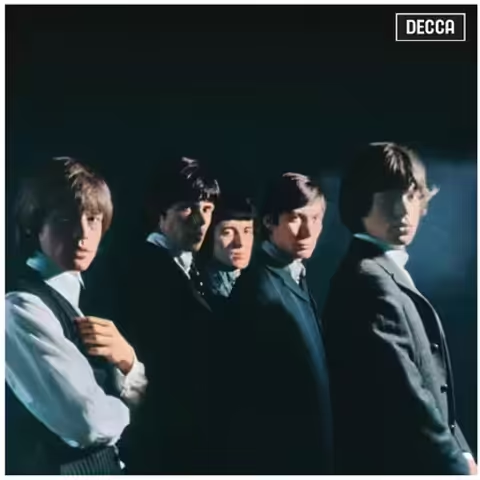
Andrew Loog Oldham had the Rolling Stones' master tapes and he was not giving them back. Decca Records wanted what every British label wanted on a debut LP in the spring of 1964: a title across the top and the band's name underneath, so a buyer in Leeds or Glasgow would know exactly what they were holding. Oldham, the group's nineteen-year-old manager and self-appointed producer, wanted a single Nicholas Wright photograph of five unsmiling young men half-swallowed by shadow, and nothing else. No title. No band name. Not even a caption. He sat on the masters until Decca blinked.
What those tapes contained was almost as confrontational as the sleeve. Twelve songs, eleven of them other people's, cut in roughly five days inside a cramped demo studio on Denmark Street, played by a band who had spent the previous year sharpening the same material in sweaty London rhythm and blues clubs. There was a single Jagger and Richards original on the whole record. The rest was Chuck Berry, Bo Diddley, Willie Dixon, Slim Harpo and Motown, delivered with a flat, unapologetic toughness that no British group had yet dared press onto an album. It went to number one in the United Kingdom and stayed there for twelve weeks. This is the complete story of how The Rolling Stones made The Rolling Stones.
Album Facts
| Field | Detail |
|---|---|
| Artist | The Rolling Stones |
| Album | The Rolling Stones (US edition retitled England's Newest Hit Makers) |
| Release Date | 17 April 1964 (UK); 29 May 1964 (US) |
| Label | Decca (UK); London Records (US) |
| Producer(s) | Andrew Loog Oldham, Eric Easton |
| Studio(s) | Regent Sound Studios, Denmark Street, London |
| Engineer | Bill Farley |
| Genre / Subgenre | Rhythm and blues, British blues, rock and roll |
| Track Count | 12 |
| Total Runtime | 33:24 |
| Billboard 200 Peak | 11 (US edition, England's Newest Hit Makers) |
| UK Albums Chart Peak | 1 (twelve weeks at the top) |
| Other Notable Chart Peaks | Australia 1, Germany 2, Finland 2 |
| Certifications | US Gold (RIAA); Canada Platinum (Music Canada) |
| Estimated Sales | Never officially totalled; one of the UK's biggest sellers of 1964 and gold-certified in the US |
| Key Singles | No singles drawn from the UK LP; the US edition spun off "Tell Me" and carried "Not Fade Away" |
Cultural Context: 1964
Britain in early 1964 belonged, on paper, to the Beatles. The Liverpool group had spent the back half of 1963 turning the country upside down, and in February 1964 they conquered America on The Ed Sullivan Show. Pop in Britain was, by and large, expected to be cheerful, tidy and grateful. Album sleeves carried titles and smiling faces. Singles and LPs were kept strictly separate, so a hit 45 almost never appeared on the album that followed it. The whole apparatus of the British record industry was built to reassure parents, not alarm them.
The Rolling Stones were assembled to do the opposite. Where the Beatles wore matching suits, the Stones slouched. Where the Beatles wrote bright original songs, the Stones dug into the back catalogue of Chicago blues and Southern R&B that most British teenagers had never heard. Andrew Loog Oldham, who had briefly done publicity for the Beatles, understood the gap in the market exactly: if one group was going to be the band you took home to your mother, the other could be the band you were warned about. The debut album is the first full-length statement of that strategy.
- The Beatles topped both the UK and US charts through much of early 1964; the Stones positioned themselves as the rougher, bluesier alternative.
- UK chart convention kept singles off albums, which is why the band's hit "Not Fade Away" is absent from the UK edition of the LP.
- British R&B was a club movement first: the Stones, the Yardbirds, the Animals and Manfred Mann all came up playing American blues to small, fervent crowds.
- Long-players were still cut fast and cheap; the idea of spending months in a studio was years away.
The Band's Story Up to This Point
By the time the Rolling Stones walked into Regent Sound, they had existed as a working unit for less than two years, and they had already changed shape several times. The group coalesced in London across 1962 around the multi-instrumentalist Brian Jones, who placed the advertisements and, for a while, named the band and ran it. Jones recruited the pianist Ian Stewart, then singer Mick Jagger, who brought along his childhood acquaintance Keith Richards. The rhythm section settled over the following months with bassist Bill Wyman and drummer Charlie Watts, both slightly older and both poached from rival London outfits.
The band built its reputation as the house act at the Crawdaddy Club in Richmond, where their long, hypnotic readings of Bo Diddley and Chuck Berry numbers drew a fervent following. That residency brought them to the attention of Andrew Loog Oldham, who, with the established agent Eric Easton, signed on to manage them in 1963. Oldham's first significant act was brutal and decisive: he trimmed the public-facing lineup to five photogenic faces and pushed the founder Brian Jones's friend Ian Stewart out of the official band, judging him too square-jawed and ordinary to fit the image. Stewart stayed on as pianist and road manager for decades, and plays on this album, but he was never again pictured as a Rolling Stone.
Their first single, a cover of Chuck Berry's "Come On", appeared in June 1963 and scraped the lower reaches of the UK chart. A four-song EP and a second single, a cover of the Beatles-donated "I Wanna Be Your Man", followed. By the time the album sessions began, the band's third single, a charged reworking of Buddy Holly's "Not Fade Away", was climbing toward the UK Top 3. The live recording below, captured for BBC radio's Saturday Club in October 1963, catches the band at exactly this moment: a covers act with a residency, a manager with a plan, and a debut LP still a few months away.
Pre-production and Demos
There was, in the modern sense, almost no pre-production. The songs on The Rolling Stones were the band's stage set, road-tested night after night at the Crawdaddy and on the package tours the group had begun playing in late 1963. The band did not need to write the material, learn it or arrange it in the studio, because they had been performing most of it for months. That is the single most important fact about how this record sounds: it is a live club set, captured almost as-is, rather than a studio construction.
What demos existed were the band's own earlier singles and EP, all of them also covers, all of them cut quickly. The group's instinct, encouraged by Oldham, was to treat the album the same way: get the songs down fast, keep the rough edges, and resist the urge to smooth anything over. Jagger and Richards were only just beginning to write. Oldham, who would soon famously lock the pair in a kitchen until they produced an original song, had not yet turned them into the songwriting partnership that would carry the band through the rest of the decade. On this record they contribute exactly one composition of their own.
Creating the Album
Regent Sound Studios was not a glamorous room. It sat on Denmark Street, the short central-London lane known as Tin Pan Alley because it housed the city's music publishers, and it functioned mainly as a place for songwriters to cut quick demos. The space was small, the equipment basic, and the soundproofing reportedly improvised from egg boxes and acoustic tiles. The band recorded onto a two-track machine in mono. No true stereo mix of the album was ever made, a fact that still holds true: when the record was finally reissued in the 2016 box set The Rolling Stones in Mono, it was because mono was the only version that had ever existed.
The sessions ran across January and February 1964, in single-day bursts squeezed between live dates, and the band laid down the dozen songs in roughly five days of work. That pace was normal for the era. As the writer Michael Gallucci put it in a retrospective for Ultimate Classic Rock, bands of the early 1960s simply did not linger in the studio.
"You set up your instruments, you made sure sound levels were okay for the sound guy and then you bashed out a couple of songs before you were even allowed to take a pee break."
Michael Gallucci, Ultimate Classic Rock, 2015
Andrew Loog Oldham took the producer's credit alongside Eric Easton, despite having no engineering background whatsoever. The actual knob-twiddling fell to the Regent Sound staff engineer Bill Farley, while Oldham's contribution was closer to that of a director or a hype man, keeping the energy up and protecting the band's raw sound from anyone who might want to tidy it. The cramped, dry, slightly muddy quality of the record was partly a limitation of the room and partly a deliberate aesthetic. It made the Stones sound like a gang in a basement, which was precisely the point.
The sessions had two notable visitors. Phil Spector, the American producer then at the height of his Wall of Sound fame, and the singer Gene Pitney both dropped in and ended up contributing to the group instrumental "Little by Little". Pitney played piano and Spector shook maracas and added percussion; the pair are immortalised in the subtitle of the album's other group instrumental, "Now I've Got a Witness (Like Uncle Phil and Uncle Gene)". Backing vocals on "Little by Little" came from two more famous visitors, Allan Clarke and Graham Nash of the Hollies. For a record made fast and cheap, the guest list was unusually starry.
Personnel and Credits
| Role | Player | Notes |
|---|---|---|
| The Rolling Stones | ||
| Lead vocals, harmonica, percussion | Mick Jagger | Vocals, handclaps and tambourine throughout; harmonica on "Honest I Do" and "I'm a King Bee"; maracas on "Mona" |
| Guitars, backing vocals | Keith Richards | Lead and rhythm, six- and twelve-string; backing vocals. Still credited as "Keith Richard" until 1978 |
| Guitar, harmonica, slide, backing vocals | Brian Jones | Rhythm guitar; lead guitar and slide on "I'm a King Bee"; slide on "Walking the Dog"; harmonica on several tracks; whistling on "Walking the Dog" |
| Bass, backing vocals | Bill Wyman | Bass and handclaps; backing vocals |
| Drums | Charlie Watts | Drums and handclaps |
| Additional musicians | ||
| Piano, organ | Ian Stewart | The founder member dropped from the public lineup by Oldham; organ on "Now I've Got a Witness" and "You Can Make It If You Try", piano on "Tell Me" and "Can I Get a Witness" |
| Piano | Gene Pitney | Visiting American singer; piano on "Little by Little" |
| Percussion, maracas | Phil Spector | Visiting producer; percussion on "Little by Little". One of the "Uncle Phil and Uncle Gene" of the album's subtitle |
| Backing vocals | Allan Clarke, Graham Nash | The Hollies singers; backing vocals on "Little by Little" |
| Production and artwork | ||
| Producers | Andrew Loog Oldham, Eric Easton | The band's co-managers; Oldham was nineteen and had no studio background |
| Engineer | Bill Farley | Regent Sound staff engineer who handled the actual recording |
| Photography | Nicholas Wright | Shot the title-less, name-less cover portrait |
The personnel list tells two quiet stories. The first is the presence of Ian Stewart, the so-called sixth Stone, who plays piano and organ across the record despite having been quietly written out of the band's public identity only months earlier. The second is how little of the album is the work of the five credited musicians alone: pianists, percussionists and backing singers from outside the band shape several of the key tracks. For a record built on a myth of five-against-the-world authenticity, The Rolling Stones is, in places, surprisingly crowded.
The Songs
| # | Title | Writer(s) | Length | Single? | Notes |
|---|---|---|---|---|---|
| 1 | Route 66 | Bobby Troup | 2:20 | No | A 1946 hit for the Nat King Cole Trio, reborn as a flat-out opener |
| 2 | I Just Want to Make Love to You | Willie Dixon | 2:17 | No | Muddy Waters via Chicago blues; one of the album's hardest tracks |
| 3 | Honest I Do | Jimmy Reed | 2:09 | No | A gentle Jimmy Reed shuffle with Jagger on harmonica |
| 4 | Mona (I Need You Baby) | Ellas McDaniel | 3:33 | No | Bo Diddley; replaced by "Not Fade Away" on the US edition |
| 5 | Now I've Got a Witness | Nanker Phelge | 2:29 | No | Group instrumental; subtitle name-checks Spector and Pitney |
| 6 | Little by Little | Nanker Phelge, Phil Spector | 2:39 | No | Cut with Spector, Pitney and two Hollies in the room |
| 7 | I'm a King Bee | James Moore | 2:35 | No | Slim Harpo swamp blues; Brian Jones on slide and lead |
| 8 | Carol | Chuck Berry | 2:33 | No | One of three Chuck Berry pillars in the band's early set |
| 9 | Tell Me (You're Coming Back) | Jagger, Richards | 4:05 | US single | The only Jagger and Richards original on the record |
| 10 | Can I Get a Witness | Holland, Dozier, Holland | 2:55 | No | The Motown song Marvin Gaye had taken into the US Top 25 |
| 11 | You Can Make It If You Try | Ted Jarrett | 2:01 | No | Gospel-soul cover with Ian Stewart on organ |
| 12 | Walking the Dog | Rufus Thomas | 3:10 | No | Rufus Thomas hit from the year before; Jones whistles the hook |
The album opens with a statement of method. "Route 66" is a list of American place names, sung by a band who had never been to any of them, ripping through Bobby Troup's old standard at twice the swagger Nat King Cole ever gave it. It tells you immediately that this is a covers record made by obsessives, a group reaching across the Atlantic for a culture they could only reach through imported records. "I Just Want to Make Love to You", the Willie Dixon song they knew through Muddy Waters, follows it with a thick, insistent groove that makes the band's blues credentials unmissable.
The deeper cuts are where the band's record collections show. "I'm a King Bee", the Slim Harpo swamp-blues number, is built on Brian Jones's slide guitar and a leering Jagger vocal, and it is one of the moments where the Stones sound genuinely dangerous rather than merely enthusiastic. "Honest I Do", the Jimmy Reed shuffle, shows the gentler, more lovesick side of the same record collection. "Carol", the Chuck Berry cover, is the band doing what they had done every night at the Crawdaddy, and it swings accordingly.
The two group instrumentals, "Now I've Got a Witness" and "Little by Little", are the closest the album comes to original material that is not a Jagger and Richards song. Credited to the band pseudonym Nanker Phelge, they are essentially studio jams, the second of them stitched together with Phil Spector and Gene Pitney in the room. And then there is "Tell Me (You're Coming Back)", the one true original: a slightly awkward, jangling, almost Merseybeat-flavoured song that sounds far less sure of itself than the covers around it, but which pointed directly at the songwriting partnership that would soon take over the band entirely. It was chosen as a single in the United States, where it reached the lower end of the Hot 100, the first hint that the future of the Rolling Stones lay in their own compositions rather than other people's.
B-sides, Outtakes and Lost Songs
The single most confusing thing about the Rolling Stones' early catalogue is the gap between the UK and US release systems, and the debut album sits right at the centre of it. In Britain, custom dictated that hit singles did not appear on albums. So the band's biggest early single, "Not Fade Away", which was riding high in the UK chart at the very moment the album came out, is nowhere to be found on the UK LP. British fans who wanted it had to buy the 45 separately.
In the United States, London Records played by different rules. When it assembled the US edition, retitled England's Newest Hit Makers, it dropped Bo Diddley's "Mona (I Need You Baby)" and slotted "Not Fade Away" in its place, on the entirely sensible logic that American buyers would want the hit on the album. "Mona" was not lost, exactly; it resurfaced on the US-only compilation The Rolling Stones, Now! in early 1965. The result, though, is that the band's debut album exists in two materially different versions, with a different opening track, a different running order and a different centre of gravity depending on which side of the Atlantic you bought it.
- UK edition (Decca): opens with "Route 66", includes "Mona (I Need You Baby)", omits "Not Fade Away".
- US edition (London, England's Newest Hit Makers): opens with "Not Fade Away", drops "Mona", shortens two subtitles.
- "Not Fade Away": a UK single in early 1964 but, by British convention, kept off the UK album.
- "Mona (I Need You Baby)": exiled from the US debut, later rescued onto The Rolling Stones, Now! in 1965.
Album Artwork and Packaging
The cover is the boldest thing about the whole release, and it was Andrew Loog Oldham's idea. He commissioned the photographer Nicholas Wright to shoot the five band members in moody half-light, then insisted the sleeve carry that image and nothing else. No album title. No band name. Just five faces and, tucked discreetly in a corner, the Decca logo. In an era when every record told you in large letters exactly what it was, this was, in Oldham's own description, an unheard-of provocation.
"The Rolling Stones' LP would have no title and no name, just their moody mugs staring back out atcha."
Andrew Loog Oldham, Rolling Stoned
Decca resisted. The label's instinct was that a nameless, title-less record would baffle shop assistants and buyers alike. By the accounts that have circulated since, Oldham simply refused to hand over the finished master tapes until the label agreed to release the sleeve his way, betting correctly that the gamble would make the band look more mysterious and more dangerous than any caption could. The bet paid off. The cover became instantly iconic precisely because it withheld information, treating the band as something you were already supposed to recognise.
The US label undid the trick. London Records used the same Nicholas Wright photograph but slapped the subtitle England's Newest Hit Makers across it, the exact kind of explanatory labelling Oldham had fought to avoid. First pressings of the UK album are also a collector's minefield of misprints: early copies carried a shorter, wrong-master version of "Tell Me", listed Bo Diddley's track simply as "Mona", spelled the songwriter Lamont Dozier as "Bozier", and dropped the word "If" from the title of "You Can Make It If You Try". Those errors, corrected on later pressings, now help collectors date and value original copies.
Release and Reception
Decca released The Rolling Stones on 17 April 1964. It went straight to number one on the UK Albums Chart and stayed there for twelve weeks, becoming one of the biggest-selling British albums of the year and establishing the band as genuine commercial rivals to the Beatles rather than mere club curiosities. The US edition followed on 29 May and reached number 11 on the Billboard 200, eventually going gold. To this day it remains the only Rolling Stones studio album of the 1960s and 1970s to miss the US Top 5, which says less about its quality than about how steeply the band's American fortunes would rise immediately afterwards.
Critical opinion, both at the time and in retrospect, has been warm. AllMusic's Richie Unterberger awarded it four and a half stars, and the record has since been folded into the standard reference canon, appearing in Robert Dimery's 1001 Albums You Must Hear Before You Die and placing at number 418 in Colin Larkin's All Time Top 1000 Albums. Writing for BBC Music in 2012, the Stones biographer Sean Egan summed up the consensus.
"It's a testament to the group's brilliance that the result was still the best album to emerge from the early 1960s British blues boom ... the ensemble lovingly deliver some of their favourite shots of rhythm 'n' blues."
Sean Egan, BBC Music, 2012
The reservations that critics do raise tend to be the same ones: that it is a covers album by a band still finding its own voice, that it leans heavily on other people's records, and that the Stones would do far greater work within a year or two. All of which is true, and none of which dents the album's importance. It is the sound of a band arriving fully formed as performers, if not yet as writers.
Singles and Music Videos
| Single | Territory | Release | Notes |
|---|---|---|---|
| "Not Fade Away" | US (on England's Newest Hit Makers) | 6 March 1964 | A UK single first; carried onto the US album in place of "Mona" |
| "Tell Me (You're Coming Back)" | US | 12 June 1964 | The album's lone original, issued as a US single and a Hot 100 entry |
| (None) | UK | Not applicable | British convention kept hit singles off the album entirely |
There were no music videos in the modern sense in 1964; promotion happened on television and radio. The band plugged the record through appearances on the British pop shows of the day and through the relentless live touring that defined their schedule. In the United States, where the album was retitled and reshuffled, "Tell Me" and "Not Fade Away" did the work of singles, introducing American audiences to a group that would return within months with far bigger hits. The absence of a UK single drawn from the album was not an oversight but the standard practice of the era, and it is the main reason the UK and US track lists diverge.
Touring and Live
The album was born from touring and immediately fed back into more of it. Across 1963 and into 1964 the Rolling Stones had graduated from club residencies to the British package-tour circuit, sharing bills and playing short, sharp sets to increasingly hysterical audiences. The debut album landed in the middle of that grind rather than pausing it. The band did not retreat to a studio to make a follow-up; they kept playing, kept the songs from the album in the set, and kept recording singles between dates.
- The band's live reputation, built at the Crawdaddy Club in Richmond, was the engine that got them signed and the reason the album sounds like a stage set.
- Their first US tour came in June 1964, weeks after the American edition appeared, exposing them to the audiences whose music they had been covering.
- The relentless recording-and-touring pace of the period meant the band were already several singles ahead of the album by the time it topped the chart.
Exact setlists and attendances from this earliest era are patchily documented, and reports vary on the details of individual shows. What is not in doubt is the velocity of it all: the Stones of 1964 were a band in permanent motion, and the debut album was a single snapshot taken without stopping the film.
In TV, Film and Media
The songs on The Rolling Stones have had a long afterlife on screen and in the wider culture, mostly because they were already standards before the Stones touched them. "Route 66", "Walking the Dog" and "I Just Want to Make Love to You" have all been used and re-used across film, television and advertising in the decades since, often in versions that owe their attitude to the Stones' readings rather than the originals. The album's importance to later musicians is its own kind of media legacy: it became the template that a generation of British and American garage and blues-rock bands reached for.
The most striking single tribute came from David Bowie, who set out to recapture the feel of this exact record on his 1972 glam-era single "The Jean Genie".
"I didn't get that near to it, but it had a feel that I wanted, that '60s thing."
David Bowie, on chasing the sound of The Rolling Stones for "The Jean Genie"
Controversy and the Cover
The album's controversies were matters of image rather than content. The music itself, a set of American blues and R&B covers, was not the kind of thing that drew censorship or moral panic. What unsettled the British establishment was the band's presentation: the surliness, the long hair, the refusal to smile, and above all that title-less, name-less sleeve, which read as arrogance to anyone raised on the cheerful conventions of British pop. Oldham understood and amplified all of it. The Rolling Stones were being deliberately marketed as the anti-Beatles, the group respectable parents were supposed to distrust, and the cover was the opening move in that campaign.
As Ultimate Classic Rock noted, the band's full bad-boy reputation arrived a little later, but the debut album planted the seeds. The decision to present five unsmiling faces with no explanatory text was, in 1964, a small act of insolence, and it worked exactly as intended.
Covers, Samples and Tributes
There is a neat irony in discussing covers of an album that is itself almost entirely covers. The Rolling Stones did not so much write this record as curate it, pulling together the Chicago blues of Muddy Waters and Willie Dixon, the swamp blues of Slim Harpo, the rock and roll of Chuck Berry and Bo Diddley, and the Detroit soul of Holland-Dozier-Holland into a single statement of taste. In doing so, they sent a generation of young British and American listeners back to the original artists, many of whom were Black American musicians who had never received their due in the mainstream pop market.
That curatorial act is arguably the album's most lasting influence. As the writer Paul Cashmere observed on the record's sixtieth anniversary, the debut is essentially a guided tour of the band's American influences.
"Mainly Blues, Rock and Roll and Rhythm & Blues covers with the Stones displaying their influences from American music of the 50s and early 60s."
Paul Cashmere, Noise11, 2024
The album's lone original, "Tell Me", has itself been covered and re-recorded over the years, and the Stones' arrangements of the covers, especially "Route 66" and "I'm a King Bee", became the templates that countless garage and blues-rock bands learned from. The record's deepest legacy is not a list of cover versions but a redirection of attention: it pointed a mass audience back toward the source.
Reissues, Remasters and Anniversaries
The Rolling Stones has had a slightly awkward reissue history, complicated by the UK and US split and by the band's tangled ownership of their early catalogue. The original British LP first appeared on compact disc in 1984, then drifted out of print on CD for years. In August 2002, the album, by then officially carrying the England's Newest Hit Makers title in the US, was remastered and reissued by ABKCO as a hybrid CD and Super Audio CD digipak, part of a wider campaign to bring the band's pre-1971 catalogue up to modern standards.
In November 2010 the original UK version was made available both digitally and as part of a limited-edition vinyl box set, The Rolling Stones 1964 to 1969. The most significant later reissue came on 30 September 2016, when the album was restored to its original title and gathered into The Rolling Stones in Mono, the box set that collected the band's 1960s output in its native mono. That set underlined a fact that surprises many casual listeners: there is no true stereo mix of this album, and there never has been. It was made in mono, in five days, in a demo studio, and that is the only way it has ever truly existed.
Legacy and Influence
Measured against Beggars Banquet, Let It Bleed, Sticky Fingers or Exile on Main St., the band's debut can look like a modest curtain-raiser, a covers album by a group who had not yet become themselves. That is to misread it. The Rolling Stones is the moment the band's identity snapped into focus: the bluesy obsession, the deliberate roughness, the anti-establishment presentation, the refusal to be the Beatles. Everything the Stones would become over the next decade is implied here, even if very little of it is yet written.
The album was also a structural turning point in the British music industry. A band could now top the chart with a record of American blues covers, presented with open contempt for the prevailing conventions of pop packaging, and the public would buy it in vast numbers. That opened the door for the entire British blues boom and for the harder, more confrontational rock that followed. When David Bowie reached back nearly a decade later to recapture the feel of this record, he was acknowledging something most listeners take for granted: that the sound of the Rolling Stones, the gang-in-a-basement toughness, was largely invented here, on a two-track machine in a tiny room off Charing Cross Road.
The band, of course, went on to become the longest-running and among the most successful rock groups in history. They would write their own classics within a year, lose Brian Jones in 1969, survive the deaths and departures of key members, and outlast almost every contemporary. But all of it starts with a nameless sleeve, a hostage tape negotiation, and twelve songs cut in five days by five young men who knew exactly what they wanted to sound like.
Things You Might Not Know
| Fact | Detail |
|---|---|
| The hostage tapes | Andrew Loog Oldham reportedly refused to hand Decca the finished master tapes until the label agreed to release the album with no title and no band name on the cover. |
| Five days flat | The band recorded all twelve songs in roughly five days of single-day sessions at Regent Sound, squeezed between live dates in January and February 1964. |
| A demo studio | Regent Sound on Denmark Street was a cheap demo facility, with soundproofing reportedly improvised from egg boxes, not a purpose-built album studio. |
| Mono only | No true stereo mix of the album was ever made; the 2016 box set The Rolling Stones in Mono exists partly because mono is the only version that ever did. |
| One original | Jagger and Richards contributed exactly one song of their own, "Tell Me (You're Coming Back)"; the rest are covers or group instrumentals. |
| Nanker Phelge | Two tracks are credited to "Nanker Phelge", the pseudonym the band used for group compositions, combining a grotesque face Brian Jones liked to pull with the surname of a former flatmate. |
| Uncle Phil and Uncle Gene | Phil Spector played maracas and Gene Pitney played piano on "Little by Little"; the pair are name-checked in the subtitle of "Now I've Got a Witness". |
| Two Hollies on board | Allan Clarke and Graham Nash of the Hollies added backing vocals to "Little by Little", making the guest list unusually starry for a fast, cheap session. |
| The sixth Stone | Ian Stewart, dropped from the public lineup by Oldham for being too ordinary-looking, plays piano and organ across the album he was no longer officially a member of. |
| The US swap | The American edition dropped Bo Diddley's "Mona" for "Not Fade Away"; "Mona" later resurfaced on the 1965 US compilation The Rolling Stones, Now!. |
| Misprint heaven | First UK pressings carried a wrong-master version of "Tell Me", spelled songwriter Lamont Dozier as "Bozier", and dropped the word "If" from "You Can Make It If You Try". |
| England's Newest Hit Makers | The US subtitle the band never chose was added by London Records over Oldham's title-less concept, undoing the whole point of the original sleeve. |
| Bowie's homage | David Bowie said his 1972 single "The Jean Genie" was a deliberate attempt to recapture the feel of this exact record. |
Riffology Podcast
If you enjoyed this complete story of the Rolling Stones' debut, the Riffology podcast digs into the records that built rock and roll, from the British blues boom to the albums it made possible. Riffology is available on Apple Podcasts, Spotify, Amazon Music, Pocket Casts and every other major podcast platform; subscribe wherever you usually listen, and we will see you in the next episode.
Comments