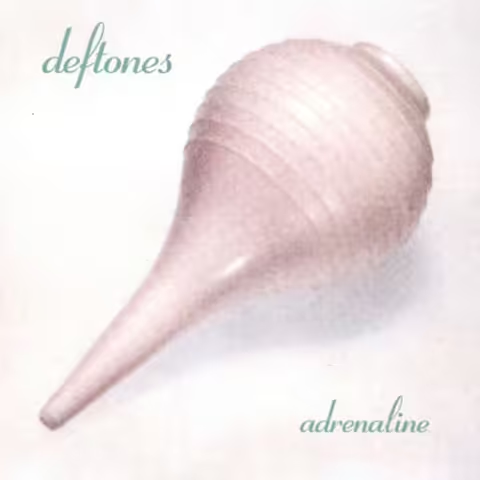
The pink bulb syringe on the cover of Deftones' first album was a Maverick Records compromise. The band wanted a photograph of a real adrenaline shot, the kind paramedics drive into a stalled heart; the label's lawyers worried about minors mail-ordering syringes and settled the argument with a child's nasal aspirator photographed against a flat white background. That is how Stephen Carpenter, Chino Moreno, Chi Cheng and Abe Cunningham introduced themselves to the world in October 1995, six years of garage rehearsals and 220,000 word-of-mouth copies away from the Grammy and the platinum disc that would eventually catch up with them.
Adrenaline is the album where one of the most important American heavy bands of the last thirty years arrived almost fully formed, then waited patiently for the rest of the culture to notice. It is also, in the words of Stereogum's Chris DeVille looking back twenty years later, "totally nu metal", a fact the band would spend the better part of the next decade trying to outrun. This is how it got made, why almost no one cared at first, and what made it stick.
Album Facts
| Field | Detail |
|---|---|
| Artist | Deftones |
| Album | Adrenaline |
| Release Date | 3 October 1995 |
| Label | Maverick Records |
| Producer(s) | Terry Date and Deftones (tracks 1, 10); Ross Robinson (hidden track "Fist") |
| Studio(s) | Bad Animals Studio, Seattle, Washington; Sound City Studios, Van Nuys, California ("Fist") |
| Genre / Subgenre | Alternative metal, nu metal, post-hardcore, rap rock |
| Track Count | 11 (one hidden) |
| Total Runtime | 47:06 |
| Billboard 200 Peak | Did not chart on the main Billboard 200; peaked at No. 23 on the Heatseekers Albums chart, where it spent 21 weeks |
| UK Albums Chart Peak | Did not chart on the main Albums Chart; later peaked at No. 34 on the UK Rock & Metal Albums Chart in 2026 |
| Other Notable Chart Peaks | US Top Catalog Albums No. 46; Greek IFPI No. 21 (2025) |
| Certifications | US Platinum (RIAA, 23 September 2008); UK Gold (BPI); Australia Gold (ARIA, 2025) |
| Estimated Sales | Over 220,000 in its first cycle; over 1,000,000 in the US by 2008 |
| Key Singles | "7 Words" (September 1995); "Bored" (May 1996) |
Cultural Context
October 1995 was a hinge month for American heavy music. Smashing Pumpkins' Mellon Collie and the Infinite Sadness would arrive three weeks later and immediately become the biggest rock album of the year. Alice in Chains' self-titled "Tripod" record had just landed at No. 1 on the Billboard 200. Bush, Foo Fighters and Garbage were carving up modern rock radio between them. The grunge story everybody could tell was already, in commercial terms, half over: Kurt Cobain had been dead for eighteen months and the bands that came up in Nirvana's wake were arguing about what to do next.
The records Deftones were competing with for shelf space and column inches in the autumn of 1995 included:
- Alice in Chains, Alice in Chains (the "Tripod" album, No. 1 on the Billboard 200 the week before)
- Smashing Pumpkins, Mellon Collie and the Infinite Sadness (three weeks away, would sell ten million)
- Bush, Sixteen Stone (still hanging on a year after release; "Glycerine" was top-30 single)
- Foo Fighters, Foo Fighters (Dave Grohl's debut, four months in)
- White Zombie, Astro-Creep: 2000 (Terry Date's most recent heavy production, still on tour)
- Korn, Korn (a year old, still building, still ungold)
The arguments were not all happening in Seattle. A year earlier in October 1994 a self-titled debut by a five-piece from Bakersfield called Korn had crept onto Immortal/Epic and started a slow chain reaction. The album would not be certified gold until February 1996 and platinum until February 1999, but its DNA - seven-string detuned guitars, hip-hop-influenced rhythm sections, a frontman willing to weep and scream on the same record - had already begun seeping into a generation of bands that had grown up on Faith No More, Rage Against the Machine, Helmet and the Red Hot Chili Peppers. Critics had not yet invented a name for it. Within four years they would call it nu metal and treat it as both the dominant commercial force in rock and the source of all that was wrong with rock. Deftones were already inside the bubble before the bubble had a name.
The Band's Story Up to This Point
Stephen Carpenter, Chino Moreno and Abe Cunningham were friends from C. K. McClatchy High School in Sacramento, drawn together as much by the city's skateboarding scene as by any specific shared taste in music. Carpenter taught himself guitar largely in a wheelchair after a car hit him while he was skating as a teenager. A long-running myth said the driver's settlement bought him his first proper rig; Cunningham eventually went on the record to call that one a fiction. What is true is that Carpenter spent months in convalescence playing along to Anthrax, S.O.D. and Metallica records, building a vocabulary of riffs that would still be audible on Deftones albums two decades later.
The personnel arithmetic was complicated. The first lineup, sketched out in Carpenter's garage around 1988, had Cunningham on drums and a friend called Dominic Garcia on bass. When Cunningham briefly left to join the Sacramento band Phallucy, Garcia shifted to drums and Chi Cheng, a softly spoken weightlifter and English literature student, came in on bass. A drummer called John Taylor held the chair from 1991 until Cunningham returned in 1993. By the time the lineup that recorded Adrenaline settled, the band had been gigging together in some form for the better part of six years.
The break came through sheer persistence. The band drove down to Los Angeles and San Francisco constantly, opening for whoever would let them on the bill, including a young Korn at small Hollywood venues. While closing for another band in LA, after most of the audience had drifted out, they impressed a representative from Madonna's young Maverick Records label. A private showcase for Maverick founders Freddy DeMann (Madonna's former manager) and Guy Oseary followed: three songs in a rehearsal room, a contract on the table. The label put Deftones on its 1994 roster alongside Candlebox, Alanis Morissette and a then-unknown Jagged Little Pill.
"One word: perseverance. We've been together for almost eight years, on the road for two, and we do it with honesty and integrity, and the kids can tell."
Chi Cheng, Guitar School, 1997
Pre-production and Demos
By the time Maverick handed the band a studio budget, the bones of Adrenaline already existed on tape. Most of the songs had been in the live set for two or three years. A four-track demo recorded around the time Cheng joined was already circulating in Sacramento and on cassette stalls at Bay Area shows. There is no Mike Patton-style mountain of unused demos for this record; what got worked up in pre-production was mostly arrangement, dynamics and what to leave out.
Carpenter's writing approach by this point was a known quantity: huge palm-muted riffs in dropped tunings, often stacked in chunks rather than developed across a chorus, with the actual song shape worked out in the room with Cunningham. Moreno wrote lyrics late, often in the booth. Cheng's basslines were a feature rather than a foundation, regularly playing counter-melodies against Carpenter's guitar rather than doubling the root. The early-track sequencing of Adrenaline ("Bored", "Minus Blindfold", "One Weak", "Nosebleed") is, by the band's own admission, more or less a snapshot of how their set opened in 1994 and 1995.
One song was very deliberately held back. A track called "Teething" had been a live staple since the four-piece's earliest gigs but did not make the cut for the album. It would resurface a year later on the soundtrack to The Crow: City of Angels, with the band appearing as themselves performing it during the film's Day of the Dead festival sequence.
Creating the Album
Maverick's chosen producer was Terry Date, fresh off Soundgarden's Superunknown, Pantera's Vulgar Display of Power and Far Beyond Driven, and White Zombie's Astro-Creep: 2000. He was, in 1995, arguably the most in-demand heavy producer in America. Sessions were booked at Bad Animals Studio in Seattle, the SSL- and Neve-equipped facility owned by Ann and Nancy Wilson of Heart, where Date had cut much of his recent work. The band arrived in Washington in the spring of 1995 with most of the songs already road-tested and not a lot of budget for second-guessing them.
Date's approach to the record was to capture, not to construct. The drums went down to 2-inch analogue tape, Carpenter tracked through his stage rig with minimal layering, Cheng played live with the band in the room. The single most unusual production decision concerned vocals. Rather than have Moreno cut overdubs in a vocal booth to a stereo monitor mix, Date set him up on the live floor with a Shure SM58, the same workhorse dynamic microphone used by almost every singer in every small venue in the world. Moreno performed his vocals live with the rhythm section, often in a single take.
"At the time we did the first record, which I really like and think is good, you can tell the band was really young. We'd been playing most of those songs for quite a while, and we were just so happy to be making a record that we didn't really think a whole lot about making the songs better."
Abe Cunningham, Modern Drummer, 1997
The SM58 detail is worth pausing on. The 58 is a stage microphone built to survive being dropped, kicked and rained on; it has a tight cardioid pattern designed to reject monitor wedges and a high-frequency presence peak tuned for live PA cut-through. Almost no engineer would willingly choose it for a lead vocal in a million-dollar studio over an SM7 or a U87 or a Sony C-800G. Date and Moreno chose it because Moreno was used to it, because it bled bandmate noise in a useful way, and because it captured something on the page that a better microphone routinely smooths out. Listen to the way Moreno's voice rasps and clips on "7 Words" and "Bored": that is the 58 hitting its limit, on purpose.
The other unusual figure on the floor was Frank Delgado. Not yet an official member, Delgado had been touring with the band as a sample technician and showed up at Bad Animals to add atmospheric textures to two tracks, "Minus Blindfold" and "Fireal". His contributions were significant enough that they are the reason both songs have the warped, half-broken-tape feel they do, but they did not make the printed credits. Delgado would be acknowledged as a guest on Around the Fur two years later and joined the band as a full member by 1999.
One track was tracked entirely outside the Date sessions. The hidden closer "Fist" was cut at Sound City Studios in Van Nuys with producer Ross Robinson, the man who had just produced Korn's self-titled debut and would soon midwife Slipknot, Limp Bizkit and At the Drive-In into existence. Robinson was a Maverick A&R favourite at this point; the connection was an obvious one. "Fist" is the most overtly aggressive thing on the record, and it sits at the end of the album as both a joke (it follows a long pause after "Fireal") and a declaration of intent. Ulrich Wild assisted Date through the main sessions; Ted Jensen mastered the album at Sterling Sound in New York.
The budget was not large. Maverick was happy to take a flyer on the band as part of a quietly diversifying roster but had no intention of writing the cheques it would write a year later for Alanis Morissette. The whole project was wrapped quickly. Moreno later described the recording as "really fast", which is consistent with everyone else's accounts: the band knew the songs, played the songs, went home.
Personnel and Credits
| Role | Player | Notes |
|---|---|---|
| Core band | ||
| Lead vocals | Chino Moreno | Recorded live with the band on a hand-held Shure SM58 |
| Guitar | Stephen Carpenter | Dropped-tuning rhythm and lead |
| Bass, backing vocals | Chi Cheng | Often plays counter-melody rather than root |
| Drums | Abe Cunningham | Returned to the band in 1993 after a brief spell with Phallucy |
| Additional musicians | ||
| Audio effects, samples | Frank Delgado | Uncredited on the original sleeve; appears on "Minus Blindfold" and "Fireal" |
| Production and engineering | ||
| Producer | Terry Date and Deftones | All tracks except "Fist" |
| Producer | Ross Robinson | Hidden track "Fist" only; cut at Sound City, Van Nuys |
| Engineer, mixing | Terry Date | Tracked at Bad Animals Studio, Seattle |
| Assistant engineer | Ulrich Wild | Later a well-known metal producer in his own right (Static-X, Powerman 5000) |
| 2nd assistant | Tom Smurdy | |
| Mastering | Ted Jensen | Sterling Sound, New York |
| Artwork | ||
| Cover photo | Victor Bracke | Pink bulb syringe |
| Art direction, design | Kim Biggs | |
| Photography | Michelle Shuman | Band photography |
| Photo of Chi | Rick Kosick | Better known as the photographer and producer behind the Jackass franchise |
| Photo of Chino | Julia Carroll | |
The Songs
| # | Title | Writer(s) | Length | Single? | Notes |
|---|---|---|---|---|---|
| 1 | "Bored" | Moreno (lyrics), Deftones (music) | 4:06 | Single (May 1996) | Album opener; second promotional single |
| 2 | "Minus Blindfold" | Moreno, Deftones | 4:04 | Uncredited audio effects by Frank Delgado | |
| 3 | "One Weak" | Moreno, Deftones | 4:29 | ||
| 4 | "Nosebleed" | Moreno, Deftones | 4:26 | ||
| 5 | "Lifter" | Moreno, Deftones | 4:43 | Singled out by Kerrang!'s 1995 review for Date's guitar production | |
| 6 | "Root" | Moreno, Deftones | 3:41 | ||
| 7 | "7 Words" | Moreno, Deftones | 3:44 | Single (September 1995) | First promotional single; "Suck! Suck! Suck! Suck!" |
| 8 | "Birthmark" | Moreno, Deftones | 4:18 | ||
| 9 | "Engine No. 9" | Moreno, Deftones | 3:25 | Hip-hop-influenced rhythm; live setlist staple for decades | |
| 10 | "Fireal" | Moreno, Deftones | 6:35 | Slow burn closer with Delgado samples; segues into hidden track | |
| 11 | "Fist" (hidden) | Moreno, Deftones | 3:35 | Produced by Ross Robinson at Sound City; misspelled "First" on some digital editions and Japanese pressings |
"Bored" opens the record with the band's mission statement in miniature: a stop-start riff built on a six-note descending figure, Cunningham's snare dropped late in the bar, Moreno singing the title in a half-whisper before exploding into the chorus. It is the single least subtle song on the album and was deliberately placed first to function exactly as a calling card. The vinyl pressings, of which there were not many in 1995, opened with the audible click of Cunningham's count.
"Minus Blindfold" is where Delgado's uncredited contribution first becomes audible: thin atmospheric washes underneath the verse that the band have never quite been able to replicate live without him. "One Weak" and "Nosebleed" are the closest the record comes to a one-two punch in the conventional rock sense, both anchored by Cheng playing octaves above Carpenter's guitar in a way that nobody else in the genre was doing in 1995.
"Lifter" is the song the Kerrang! review picked out, and it is easy to hear why. Carpenter's main riff is unusually clean by the standards of this record, a kind of cleaner Helmet-derived figure that bends just before the chorus into the kind of detuned crunch that became the band's calling card. "Root" is the most overtly hip-hop-influenced track on the first half, with Moreno sing-rapping the verse over a beat that sits halfway between a Beastie Boys throwback and a Korn template.
"7 Words" was the song Maverick chose as the first promotional single and it remains, for most people, the song they think of when they think of Adrenaline. The chorus, a repeated bellow of "Suck! Suck! Suck! Suck!", is the most adolescent moment on the record and was almost certainly the reason it never made it onto mainstream rock radio. It was also the song that built the band's live reputation: those four syllables, screamed back from the floor, were the thing every Deftones audience instinctively wanted to do for the next ten years.
"Birthmark" sits in the centre of the record's second half as its most overlooked track. The verse is the most patient piece of writing on the album, with Cheng holding a single sustained note while Cunningham builds the room around him; the chorus is unusually melodic for the band at this stage. "Engine No. 9" is the closest the band came on this record to writing a hip-hop song outright, a beat-driven thing with a verse structure lifted, the band have cheerfully admitted, from the Beastie Boys playbook.
"Fireal" is the closer, and it is the most clearly forward-looking thing on the record. Six and a half minutes long, anchored by Delgado's uncredited textures, it ends with a long fade that nobody in 1995 read as a hint of what was coming on Around the Fur and White Pony but which sounds in retrospect like a road map. After the silence, "Fist" smashes the door open: Ross Robinson's production is rawer, dryer, and altogether more menacing than anything Date tracked, and the contrast between the two production styles is itself one of the most interesting things on the album.
B-sides, Outtakes and Lost Songs
Because Adrenaline was a promotional-singles-only release with no commercial 7-inch programme, the conventional B-side culture that surrounded a British release of the same year is largely absent. There are no Maverick-pressed 12-inch B-sides for "7 Words" or "Bored". The closest equivalent is "Teething", the song held back from the album and donated to The Crow: City of Angels a year later, where it appears alongside Filter, Bush and Hole on a soundtrack that was at the time one of the highest-grossing soundtrack albums in the world. The film cameo, in which the band appear as themselves during the Day of the Dead festival sequence, is the closest the original Adrenaline lineup ever came to a feature-film performance.
A small clutch of demos and live recordings from the 1994 to 1995 period circulate in tape-trading and Discogs grey-market circles, including a four-track demo recorded shortly after Cheng joined. None of these have ever been officially released, and although the band gestured for years at a comprehensive early-years vault release, the eventual 2005 B-Sides & Rarities compilation drew almost entirely from the Around the Fur period onwards.
Album Artwork and Packaging
The cover image was shot by Victor Bracke and art-directed by Kim Biggs: a single pink rubber bulb syringe, photographed from a low angle against a flat white background, with the band's name and album title set in a hand-drawn blue script across the top. The choice was deliberately childish. The band's first instinct had been to use a real adrenaline shot, the kind of long-needled cardiac syringe that Pulp Fiction had made cinematically famous a year earlier; Maverick balked at the imagery and the bulb aspirator was the compromise. It is the kind of object every American household had in a bathroom drawer; the kind of object nobody had ever put on the front of a metal record.
The CD booklet is sparse, dominated by black-and-white photographs of the band shot by Michelle Shuman, Rick Kosick and Julia Carroll. (Kosick would, within five years, become better known as one of the photographers and producers behind the original Jackass television show and films, an association the band have always found amusing.) The lyric sheet is partial; several songs are reduced to single phrases or no text at all, a habit Moreno kept for the rest of the band's career.
The Japanese pressing, released on Maverick's local partner shortly after the US edition, added two short bonus tracks and a slightly different running order; it is the most collectible of the original pressings on the second-hand market. European pressings, distributed initially by Warner Music, used the same artwork as the US release.
Release and Reception
The album landed quietly on 3 October 1995. It did not chart on the main Billboard 200 in its release window; it crept onto the Heatseekers Albums chart, the Billboard sub-chart for artists yet to break onto the main list, and eventually peaked at No. 23 over a 21-week run. Sales in the first six months were measured in tens rather than hundreds of thousands. Maverick did not panic. The label's recent experience with Candlebox had taught it that the first record from a new heavy band was rarely the one that paid for itself.
Contemporary reviews were largely positive but cautious. Kerrang!'s Paul Brannigan, writing in November 1995, gave it four stars out of five and called it "impressive", singling out Terry Date's production for praise and comparing the band to Quicksand and Tool. The Los Angeles Times' Sandy Masuo, reviewing the album in January 1996, awarded it three out of four and praised "a bracing blend of extremes". Pulse! magazine's Jon Wiederhorn called it "more blatantly metallic than Nirvana"; Car Audio magazine's Katherine Turman wrote "if this is what heavy metal is evolving into, it's a damn good thing".
"Excellent production from Terry Date allows the crisp guitar on 'Lifter' and '7 Words' to shine. 'Bored' and 'Nosebleed' are just as blunt and angry, slabs of guitar crashing down on swirling, hypnotic rhythms."
Paul Brannigan, Kerrang!, November 1995
The Rolling Stone Album Guide retrospectively gave the album just two stars out of five, the lowest score any reputable book or publication has ever given it. AllMusic's Daniel Gioffre eventually awarded three out of five, praising Cunningham's "surprisingly sophisticated drumming" and the band's "control even in the midst of chaos", while flagging "a bit of sameness in Chino Moreno's whispered vocal melodies". Drowned in Sound, retrospectively reviewing the album in 2001, gave it an 8 out of 10.
None of this added up to a breakthrough. The breakthrough was the live shows. Throughout 1995 and 1996 Deftones toured constantly, opening for Handsome, Korn, White Zombie and Super 8 (whose vocalist, Bronx Style Bob, had been one of the figures who helped the band catch Maverick's attention in the first place). In 1996 they were added to Kiss's Alive/Worldwide reunion tour as one of the opening acts, putting them in front of arena crowds for the first time. Audiences who came in cold for "7 Words" went home with a copy of Adrenaline under their arm. By the time Around the Fur came out two years later, the debut had sold more than 220,000 copies almost entirely off that foundation. The RIAA Gold certification arrived on 7 July 1999.
Singles and Music Videos
| Single | Release | Format | B-sides | Director / Notes |
|---|---|---|---|---|
| "7 Words" | September 1995 | Promotional single, CD and 12-inch | None commercially | Music video; received intermittent late-night airplay on MTV's Headbangers Ball and 120 Minutes |
| "Bored" | May 1996 | Promotional single | None commercially | Music video; promoted heavily on the Kiss Alive/Worldwide support slot |
Neither single charted on the Billboard Hot 100. Mainstream alternative radio largely ignored them; the "7 Words" video, in particular, was deemed too aggressive for daytime rotation. Headbangers Ball, then in its first incarnation's twilight, gave both videos sporadic airplay. The promotion was a slow drip, the kind that depends on touring underneath the record and trusting the singles to do their work over years rather than weeks. By the time Around the Fur arrived in October 1997 with the immediately more radio-friendly "My Own Summer (Shove It)" and "Be Quiet and Drive (Far Away)", both Adrenaline singles were back on regional rock radio as catalogue staples.
Touring and Live
The early touring cycle for Adrenaline was the unromantic kind: vans, opening slots, club PAs.
- Late 1995: club support runs with Handsome and a still-rising Korn, often in front of audiences of 200 to 500
- Early to mid 1996: White Zombie tour as openers on the Astro-Creep: 2000 US legs
- Summer 1996: a brief Warped Tour run, where the band famously performed in skate-influenced street clothes rather than the leather and combat boots most of their peers wore
- Late 1996 into 1997: opening slots on Kiss's Alive/Worldwide reunion tour, the band's first arena exposure
- 1997: a sustained European tour including the band's first appearance at Glastonbury in 1998 the following summer
Bert McCracken of the Used would later tell oral historian Chris Payne that he saw the band on the 1995 Warped Tour and watched Chino Moreno jump off a tower of speaker stacks; it became, in McCracken's telling, the founding image of his own subsequent career. The same era of touring inspired Brian "Head" Welch and James "Munky" Shaffer of Korn to talk publicly about Deftones as the band they would have been most upset to lose a battle of the bands to.
In TV, Film and Media
The most prominent immediate-era placement of an Adrenaline song was not a song from the record itself but the held-back "Teething", which appeared on The Crow: City of Angels in August 1996 and gave the band their first soundtrack pay cheque. The album itself was not heavily exploited for sync placements in its first cycle: the songs were too aggressive and the lyrics too profane for most television. In subsequent decades, however, "7 Words" and "Engine No. 9" have appeared in skate videos (most famously Toy Machine's late-1990s output), in episodes of The Sopranos and in the soundtracks to Tony Hawk's Pro Skater-adjacent video games. Several of the tracks have become DJ staples in the alt-metal and shoegaze-revival club nights that emerged in the late 2010s.
Covers, Samples and Tributes
Compared to the band's later work, Adrenaline has been only modestly covered. The most notable straight cover is by Slipknot percussionist Shawn Crahan's side-project Dirty Little Rabbits, who cut a stripped-down "Bored" for a Deftones tribute compilation in the late 2000s. The 2009 charity single "A Song for Chi", recorded to benefit Chi Cheng's medical care after his 2008 accident and his eventual death in 2013, drew vocalists and players from Korn, Sevendust, Slipknot and others; while not strictly an Adrenaline cover, it leaned heavily on the era's musical vocabulary.
The album itself samples very little. The most notable interpolation is the Beastie Boys-flavoured verse structure of "Root" and "Engine No. 9", which the band have always cited as deliberate homage rather than lift. The album does not appear to have been sampled significantly in subsequent hip-hop or electronic work; the most documented secondary use of a Deftones sample is Mike Shinoda's later remix of "Passenger" from White Pony.
Reissues, Remasters and Anniversaries
Unlike most of its peers, Adrenaline has never had a deluxe anniversary edition. There has been no 10th, 20th, 25th or 30th-anniversary box. The band have spoken in interviews about wanting to do one, and have repeatedly cited the lack of unreleased material from the era as the reason none has materialised; the early demos that exist are, in Moreno's words, "not really for public consumption". The album was included in 2011's limited-edition The Vinyl Collection 1995-2011, a one-thousand-copy box of every Deftones album to date pressed on coloured vinyl, which now changes hands for four-figure sums on Discogs.
The standalone vinyl reissue programme has been more active. Maverick repressed the album on black 180-gram vinyl in 2008 to coincide with its US Platinum certification. A subsequent reissue under Warner's Rhino imprint followed in 2013. The 2020 reissues to mark the 25th anniversary of the album, briefly mooted in the trade press, were postponed alongside the White Pony 20th-anniversary expansion and quietly never materialised, in part because the band's energy through 2020 to 2025 was absorbed by Ohms, the long-promised Eros, and the Sablan-era touring lineup.
Legacy and Influence
For most of the late 1990s and early 2000s, Adrenaline was read as a footnote to Around the Fur and a footnote-to-the-footnote of White Pony. It was the record the band had made before they were good; the one Chino Moreno later said he could no longer listen to without wincing at the lyrics. Retrospective reassessment was slow but firm. Stereogum's Chris DeVille marked the record's 20th anniversary in 2015 with a long piece arguing that Adrenaline was nu metal's strongest non-Korn calling card, an argument that has more or less held since.
"Adrenaline marks the start of one of rock's most underrated careers, and true to its title, it started Deftones off with a bang."
Chris DeVille, Stereogum, 2 October 2015
The 2020s shoegaze and "deftonescore" revival, which produced a wave of bands including Wisp, Loathe, Narrow Head, Bleed, Trauma Ray and Glare, has largely cited Around the Fur, White Pony and Saturday Night Wrist as foundational rather than Adrenaline. The exception is Sacramento-area heavy bands and the post-hardcore lineage that runs through Boston Manor, Holding Absence and Higher Power, all of whom have at various times cited the bone-headed directness of "7 Words" and "Bored" as a permission slip to be both heavy and ugly. The album's Platinum certification in 2008, thirteen years after release, was the recognition the band's commercial trajectory always implied: a record that did not sell, that then would not stop selling.
The deeper legacy is structural. Deftones are the only band of their original cohort to have produced ten albums across four decades without a major lineup change other than Chi Cheng's tragic loss. They have outlasted Korn's commercial peak, Limp Bizkit's collapse and rehabilitation, Linkin Park's reinvention, and several entire genres named in their wake. The Grammy nominations for Ohms in 2022 and Private Music in 2026, and the band's June 2025 headline at London's Crystal Palace Park, are end-points of a line that runs in an unbroken curve back to the SM58 plugged into Bad Animals Studio in the spring of 1995.
Things You Might Not Know
| Fact | Detail |
|---|---|
| The name | Stephen Carpenter coined "Deftones" by combining the hip-hop slang "def" with the suffix "-tones", a backwards play on the phrase "tone deaf". |
| The bulb syringe | The cover photograph was a Maverick compromise; the band had wanted a real long-needled cardiac adrenaline shot. |
| Chino's microphone | Lead vocals across the entire album were tracked on a hand-held Shure SM58, a stage microphone that almost no producer would willingly choose for a million-dollar studio session. |
| The hidden track's producer | "Fist" was produced by Ross Robinson, fresh off Korn's debut, at Sound City in Van Nuys. The rest of the album was produced by Terry Date at Bad Animals in Seattle. |
| Frank Delgado wasn't credited | The band's eventual fifth member contributed atmospheric textures to "Minus Blindfold" and "Fireal" but does not appear in the sleeve credits. |
| One song held back | "Teething" had been in the live set since 1992 but was kept off the album; it surfaced on the 1996 soundtrack to The Crow: City of Angels, with the band appearing as themselves in the film. |
| Stephen Carpenter and the car | Carpenter taught himself guitar largely in a wheelchair after being hit by a car while skating as a teenager. Cunningham has publicly debunked the long-running myth that the driver's insurance settlement bought the band its first gear. |
| Cunningham's brief Phallucy detour | Abe Cunningham left Deftones around 1990 to join the Sacramento band Phallucy, returning in 1993; Dominic Garcia covered drums in his absence after switching from bass. |
| The "Fist" typo | Several digital streaming editions and the Japanese CD pressing misspell the hidden track as "First" rather than "Fist". |
| The mastering engineer | Ted Jensen, who would later master Norah Jones's Come Away with Me and most of Eagles' later catalogue, mastered Adrenaline at Sterling Sound in New York. |
| The assistant engineer | Ulrich Wild, the assistant on the Bad Animals sessions, went on to produce Static-X's Wisconsin Death Trip, Powerman 5000 and Pitchshifter. |
| The cover photographer's day job | Rick Kosick, credited with the photo of Chi Cheng in the booklet, was about to become one of the photographers behind the original Jackass television series and films. |
| The Kiss opening slot | Deftones spent much of 1996 opening for Kiss on the Alive/Worldwide reunion tour, their first sustained arena exposure. |
| The slow burn to Platinum | Adrenaline was certified RIAA Gold on 7 July 1999, but did not reach Platinum status until 23 September 2008, almost thirteen years after release. |
| The signing showcase | The band were signed to Maverick after a private three-song performance for Madonna's former manager Freddy DeMann and a then very young Guy Oseary, in a Los Angeles rehearsal room. |
Riffology Podcast
If this is the kind of deep dive that scratches an itch, the Riffology podcast covers an album of this stripe most weeks, with the same level of session detail, contemporary review excavation and "wait, who played on what" trivia you've just read here. The show is available on Apple Podcasts, Spotify, Amazon Music, Pocket Casts and every other major podcast platform. New episodes drop weekly.
Comments